


Acts 5:30
Bible text: King James Version (1769 Blayney text) · Public domain
Bible text: Berean Standard Bible · Public domain
Bible text: American Standard Version (1901) · Public domain
Bible text: World English Bible, Messianic edition · Public domain
Bible text: Geneva Bible (1599) · Public domain
Bible text: Young's Literal Translation · Public domain
- ὁhoTheG3588T-NSMDefinite article Nominative Singular Masculine
- θεὸςtheosGodG2316N-NSM-TNoun Nominative Singular Masculine Title
- τῶνtōnof theG3588T-GPMDefinite article Genitive Plural Masculine
- πατέρωνpaterōnfathersG3962N-GPMNoun Genitive Plural Masculine
- ἡμῶνhēmōnof usG3165P-1GPPersonal pronoun Genitive 1st Plural
- ἤγειρενēgeirenraised upG1453V-AAI-3SVerb Aorist Active Indicative 3rd Singular
- ἸησοῦνIēsounJesusG2424N-ASM-PNoun Accusative Singular Masculine Individual
- ὃνhonwhomG3739R-ASMRelative pronoun Accusative Singular Masculine
- ὑμεῖςhumeisyou yourselvesG4771P-2NPPersonal pronoun Nominative 2nd Plural
- διεχειρίσασθεdiecheirisasthekilledG1315V-AMI-2PVerb Aorist Middle Indicative 2nd Plural
- κρεμάσαντεςkremasanteshaving hanged [Him]G2910V-AAP-NPMVerb Aorist Active Participle Nominative Plural Masculine
- ἐπὶepionG1909PREPPreposition
- ξύλου·xuloua treeG3586N-GSNNoun Genitive Singular Neuter
English is a literal word-by-word gloss of the Greek, not the KJV's wording. Why?
This is the original text the KJV's translators worked from — each Greek word with its own literal English meaning in this verse, prepared by scholars at Tyndale House, Cambridge. The KJV translates whole sentences, not word by word, so its wording differs: one Greek word can become several English words, and the KJV may choose “charity” where the gloss reads “love”. Both are faithful — they answer different questions. For the KJV's own rendering, switch to the KJV text.
Details
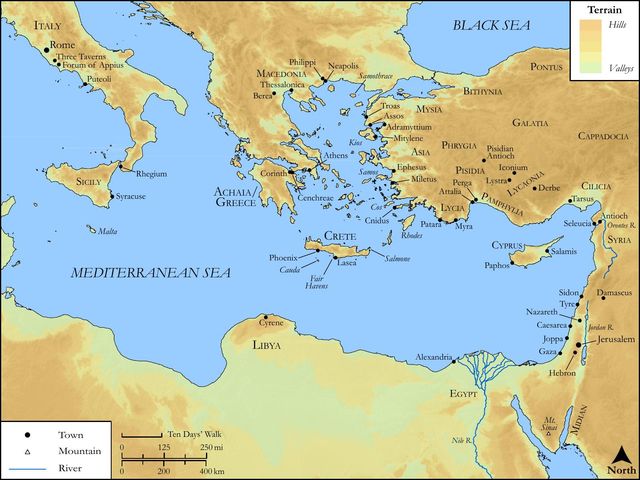
See on the biblical-era map
Study this verse
Public-domain commentary
Matthew Henry
From his Commentary on the Whole Bible. Henry comments on passages, not single verses — this entry covers Acts 5:26–42. His four-level outline is real structure in the source text, so it is rendered as structure.
We are not told what it was that the apostles preached to the people; no doubt it was according to the direction of the angel - the words of this life; but what passed between them and the council we have here an account of; for in their sufferings there appeared more of a divine power and energy than even in their preaching. Now here we have,
I.The seizing of the apostles a second time.
We may think, if God designed this, "Why were they rescued from their first imprisonment?" But this was designed to humble the pride, and check the fury, of their persecutors; and now he would show that they were discharged, not because they feared a trial, for they were ready to surrender themselves and make their appearance before the greatest of their enemies.
1.They brought them without violence, with all the respect and tenderness that could be: did not pull them out of the pulpit, nor bind them, nor drag them along, but accosted them respectfully; and one would think they had reason to do so, in reverence to the temple, that holy place, and for fear of the apostles, lest they should strike them, as they did Ananias, or call for fire from heaven upon them, as Elias did; but all that restrained their violence was their fear of the people, who had such a veneration for the apostles that they would have stoned the officers if they had offered them any abuse.
2.Yet they brought them to those who, they knew, were violent against them, and were resolved to take violent courses with them (Act 5:27): They brought them, to set them before the council, as delinquents. Thus the powers that should have been a terror to evil works and workers became so to the good.
II.Their examination.
Being brought before this august assembly, the high priest, as the mouth of the court, told them what it was they had to lay to their charge, Act 5:28.
1.That they had disobeyed the commands of authority, and would not submit to the injunctions and prohibitions given them (Act 5:28), "Did not we, by virtue of our authority, strictly charge and command you, upon pain of our highest displeasure, that you should not teach in this name? But you have disobeyed our commands, and gone on to preach not only without our licence, but against our express order." Thus those who make void the commandments of God are commonly very strict in binding on their own commandments, and insisting upon their own power: Did not we command you? Yes, they did; but did not Peter at the same time tell them that God's authority was superior to theirs, and his commands must take place of theirs? And they had forgotten this.
2.That they had spread false doctrine among the people, or at least a singular doctrine, which was not allowed by the Jewish church, nor agreed with what was delivered form Moses's chair. "You have filled Jerusalem with your doctrine, and thereby have disturbed the public peace, and drawn people from the public establishment." Some take this for a haughty scornful word: "This silly senseless doctrine of yours, that is not worth taking notice of, you have made such a noise with, that even Jerusalem, the great and holy city, is become full of it, and it is all the talk of the town." They are angry that men, whom they look upon as despicable, should make themselves thus considerable.
3.That they had a malicious design against the government, and aimed to stir up the people against it, by representing it as wicked and tyrannical, and as having made itself justly odious both to God and man: "You intend to bring this man's blood, the guilt of it before God, the shame of it before men, upon us." Thus they charge them not only with contumacy and contempt of the court, but with sedition and faction, and a plot both to set the people against them, for having persecuted even to death not only so innocent but so good and great a man as this Jesus, and also the Romans, for having drawn them into it. See here how those who with a great del of presumption will do an evil thing yet cannot bear to hear of it afterwards, nor to have it charged upon them. When they were in the heat of the persecution they could cry daringly enough, "His blood be upon us and upon our children; let us bear the blame for ever." But now that they have time for a cooler thought they take it as a great affront to have his blood laid at their door. Thus are they convicted and condemned by their own consciences, and dread lying under that guilt in which they were not afraid to involve themselves.
III.Their answer to the charge exhibited against them:
Peter and the other apostles all spoke to the same purport; whether severally examined, or answering jointly, they spoke as one and the same Spirit gave them utterance, depending upon the promise their Master had made them, that, when they were brought before councils, it should be given them in that same hour what they should speak, and courage to speak it.
1.They justified themselves in their disobedience to the commands of the great sanhedrim, great as it was (Act 5:29): We ought to obey God rather than men. They do not plead the power they had to work miracles (this spoke sufficiently for them, and therefore they humbly decline mentioning it themselves), but they appeal to a maxim universally owned, which even natural conscience subscribes to, and which comes home to their case. God had commanded them to teach in the name of Christ, and therefore they ought to do it, though the chief priests forbade them. Note, Those rulers set up in opposition to God, and have a great deal to answer for, who punish men for disobedience to them in that which is their duty to God.
2.They justified themselves in doing what they could to fill Jerusalem with the doctrine of Christ, though, in preaching him up, they did indeed reflect upon those that maliciously ran him down, and if they thereby bring his blood upon them they may thank themselves. It is charged upon them as a crime that they preached Christ and his gospel. "Now," say they, "we will tell you who this Christ is, and what his gospel is, and then do you judge whether we ought not to preach it; nay, and we shall take this opportunity to preach it to you, whether you will hear, or whether you will forbear."
(1.)The chief priests are told to their faces the indignities they did to this Jesus: "You slew him and hanged him on a tree, you cannot deny it." The apostles, instead of making an excuse, or begging their pardon, for bringing the guilt of this man's blood upon them, repeat the charge, and stand to it: "It was you that slew him; it was your act and deed," Note, People's being unwilling to hear of their faults is no good reason why they should not be faithfully told of them. It is a common excuse made for not reproving sin that the times will not bear it. But those whose office it is to reprove must not be awed by this; the times must bear it, and shall bear it. Cry aloud and spare not; cry aloud and fear not.
(2.)They are told also what honours God put upon this Jesus, and then let them judge who was in the right, the persecutors of his doctrine or the preachers of it. He calls God the God of our fathers, not only ours, but yours, to show that in preaching Christ they did not preach a new god, nor entice people to come and worship other gods; not did they set up an institution contrary to that of Moses and the prophets, but they adhered to the God of the Jewish fathers; and that name of Christ which they preached answered the promises made to the fathers, and the covenant God entered into with them, and the types and figures of the law he gave them. The God of Abraham, Isaac, and Jacob, is the God and Father of our Lord Jesus Christ; see what honour he did him. [1.] He raised him up; he qualified him for, and called him to, his great undertaking. It seems to refer to the promise God made by Moses, A prophet shall the Lord your God raise up unto you. God raised him up out of obscurity, and made him great. Or, it may be meant of his raising him up from the grave: "You put him to death, but God has restored him to life, so that God and you are manifestly contesting about this Jesus; and which must we side with?" [2.] He exalted him with his right hand, hupsōse - hath lifted him up. "You loaded him with disgrace, but God has crowned him with honour; and ought we not to honour him whom God honours?" God has exalted him, tē dexia autou - with his right hand, that is, by his power put forth; Christ is said to live by the power of God. Or, to his right hand, to sit there, to rest there, to rule there. "He has invested him with the highest authority, and therefore we must teach in his name, for God has given him a name above every name." [3.] "He has appointed him to be a prince and a Saviour, and therefore we ought to preach in his name, and to publish the laws of his government as he is a prince, and the offers of his grace as he is a Saviour." Observe, There is no having Christ to be our Saviour, unless we be willing to take him for our prince. We cannot expect to be redeemed and healed by him, unless we give up ourselves to be ruled by him. The judges of old were saviours. Christ's ruling is in order to his saving, and faith takes an entire Christ, that came, not to save us in our sins, but to save us from our sins. [4.] He is appointed, as a prince and a Saviour, to give repentance to Israel and remission of sins. Therefore they must preach in his name to the people of Israel, for his favours were designed primarily and principally for them; and none that truly loved their country could be against this. Why should the rulers and elders of Israel oppose one who came with no less a blessing to Israel than repentance and pardon? Had he been exalted to give deliverance to Israel from the Roman yoke, and dominion over the neighbouring nations, the chief priests would have welcomed him with all their hearts. But repentance and remission of sins are blessings they neither value nor see their need of, and therefore they can by no means admit his doctrine. Observe here, First, Repentance and remission go together; wherever repentance is wrought, remission is without fail granted, and the favour is given to all those to whom is given the qualification for it. On the other hand, no remission without repentance; none are freed from the guilt and punishment of sin but those that are freed from the power and dominion of sin, that are turned from it and turned against it. Secondly, It is Jesus Christ that gives, and is authorized to give, both repentance and remission. Whatsoever is required in the gospel-covenant is promised. Are we appointed to repent? Christ is appointed to give repentance, by his Spirit working with the word, to awaken the conscience, to work contrition for sin, and an effectual change in the heart and life. The new heart is his work, and the broken spirit a sacrifice of his providing; and, when he has given repentance, if he should not give remission he would forsake the work of his own hands. See how necessary it is that we repent, and that we apply ourselves to Christ by faith for his grace to work repentance in us. [5.] All this is well attested, First, by the apostles themselves; they are ready to testify upon oath, if required, that they saw him alive after his resurrection, and saw him ascend into heaven; and also that they experienced the power of his grace upon their hearts, raising them up to that which was far above their natural capacities: "We are his witnesses, appointed by him to publish this to the world; and if we should be silent, as you would have us, we should betray a trust, and be false to it." When a cause is trying, witnesses, of all men, ought not to be silenced, for the issue of the cause depends on their testimony. Secondly, By the Spirit of God: "We are witnesses, competent ones, and whose testimony is sufficient before any human judicature." But this is not all: The Holy Ghost is witness, a witness from heaven; for God hath given his gifts and graces to those that obey Christ. Therefore we must preach in this name, because for this end the Holy Ghost is given us, whose operations we cannot stifle. Note, The giving of the Holy Ghost to obedient believers, not only to bring them to the obedience of faith, but to make them eminently useful therein, is a very strong proof of the truth of Christianity. God gave the Holy Ghost by his Son and in his name (Joh 14:26), and in answer to his prayer (Joh 14:16), nay, it was Christ that sent him from the Father (Joh 15:26; Joh 16:7), and this proves the glory to which the Father has exalted him. The great work of the Spirit being not only to justify Christ (Ti1 3:16), but to glorify him, and all his gifts having a direct tendency to exalt his name, prove that his doctrine is divine, else it would not be carried on thus by divine power. And, Lastly, The giving of the Holy Ghost to those that obey Christ, both for their assistance in their obedience and as a present recompence for their obedience, is a plain evidence that it is the will of God that Christ should be obeyed; "judge then whether we ought to obey you in opposition to him."
IV.The impression which the apostles' defence of themselves made upon the court.
It was contrary to what one would have expected from men that pretended to reason, learning, and sanctity. Surely such fair reasoning could not but clear the prisoners, and convert the judges. No, instead of yielding to it, they raged against it, and were filled,
1.With indignation at what the apostles said: They were cut to the heart, angry to see their own sin set in order before them; stark mad to find that the gospel of Christ had so much to say for itself, and consequently was likely to get ground. When a sermon was preached to the people to this purport, they were pricked to the heart, in remorse and godly sorrow, Act 2:37. These here were cut to the heart with rage and indignation. Thus the same gospel is to some a savour of life unto life, to others of death unto death. The enemies of the gospel not only deprive themselves of its comforts, but fill themselves with terrors, and are their own tormentors.
2.With malice against the apostles themselves. Since they see they cannot stop their mouths any other way than by stopping their breath, they take counsel to slay them, hoping that so they shall cause the work to cease. While the apostles went on in the service of Christ, with a holy security and serenity of mind, perfectly composed, and in a sweet enjoyment of themselves, their persecutors went on in their opposition to Christ, with a constant perplexity and perturbation of mind, and vexation to themselves.
V.The grave advice which Gamaliel, a leading man in the council, gave upon this occasion, the scope of which was to moderate the fury of these bigots, and check the violence of the prosecution. This Gamaliel is here said to be a Pharisee by his profession and sect, and by office a doctor of the law, one that studied the scriptures of the Old Testament, read lectures upon the sacred authors, and trained up pupils in the knowledge of them. Paul was brought up at his feet (Act 22:3), and tradition says that so were Stephen and Barnabas. Some say he was the son of that Simeon that took up Christ in his arms, when he was presented in the temple, and grandson of the famous Hillel. He is here said to be in reputation among all the people for his wisdom and conduct, it appearing by this passage that he was a moderate man, and not apt to go in with furious measures. Men of temper and charity are justly had in reputation, for checking the incendiaries that otherwise would set the world on fire. Now observe here,
1.The necessary caution he gives to the council, with reference to the case before them: He commanded to put the apostles forth a little while, that he might speak the more freely, and be the more freely answered (it was fit that the prisoners should withdraw when their case was to be debated); and then put the house in mind of the importance of this matter, which in their heat they were not capable of considering as they ought: You men of Israel, saith he, take heed to yourselves, consider what you do, or intend to do, as touching these men, Act 5:35. It is not a common case, and therefore should not be hastily determined. He calls them men of Israel, to enforce this caution: "You are men, that should be governed by reason, be not then as the horse and the mule that have no understanding; you are men of Israel, that should be governed by revelation, be not then as strangers and heathens, that have no regard to God and his word. Take heed to yourselves now that you are angry with these men, lest you meddle to your own hurt." Note, The persecutors of God's people had best look to themselves, lest they fall into the pit which they dig. We have need to be cautious whom we give trouble to, lest we be found making the hearts of the righteous sad.
2.The cases he cites, to pave the way to his opinion. Two instances he gives of factious seditious men (such as they would have the apostles thought to be), whose attempts came to nothing of themselves; whence he infers that if these men were indeed such as they represented them the cause would sink with its own weight, and Providence would infatuate and defeat them, and then they needed not persecute them.
(1.)There was one Theudas, that made a mighty noise for awhile, as one sent of God, boasting himself to be somebody, some great one (so the word is), either a teacher or a prince, with a divine commission to effect some great revolution in the church or in the state; and he observes here (Act 5:36) concerning him, [1.] How far he prevailed: "A number of men, about four hundred in all, joined themselves to him, that knew not what to do with themselves, or hoped to better themselves; and they seemed then a formidable body." [2.] How soon his pretensions were all dashed: "When he was slain" (probably in war) "there needed no more ado, all, as many as obeyed him, were scattered, and melted away like snow before the sun. Now compare that case with this. You have slain Jesus, the ringleader of this faction; you have taken him off. Now if he was, as you say he was, an impostor and pretender, his death, like that of Theudas, will be the death of his cause, and the final dispersion of his followers." From what has been we may infer what will be in a like case; the smiting of the shepherd will be the scattering of the sheep: and, if the God of peace had not brought again from the dead that great Shepherd, the dispersion of the sheep, at his death, had been total and final.
(2.)The case was the same with Judas of Galilee, Act 5:37. Observe,
[1.]The attempt he made. It is said to be after this, which some read, besides this, or, Let me mention, after this, - supposing that Judas's insurrection was long before that of Theudas; for it was in the time of the taxation, namely, that at our Saviour's birth (Luk 2:1), and that of Theudas, whom Josephus speaks of, that mutinied, in the time of Cuspius Fadus; but this was in the days of Claudius Caesar, some years after Gamaliel spoke this, and therefore could not be the same. It is not easy to determine particularly when these events happened, nor whether this taxing was the same with that at our Saviour's birth or one of a later date. Some think this Judas of Galilee was the same with Judas Gaulonites, whom Josephus speaks of, others not. It is probable that they were cases which lately happened, and were fresh in memory. This Judas drew away much people after him, who gave credit to his pretensions. But,
[2.]Here is the defeat of his attempt, and that without any interposal of the great sanhedrim, or any decree of theirs against him (it did not need it); he also perished, and all, even as many as obeyed him, or were persuaded by him, were dispersed. Many have foolishly thrown away their lives, and brought others into the same snares, by a jealousy for their liberties, in the days of the taxing, who had better have been content, when Providence had so determined, to serve the king of Babylon.
3.His opinion upon the whole matter.
(1.)That they should not persecute the apostles (Act 5:38): Now I say unto you, ta nun - for the present, as the matter now stands, my advice is, "Refrain from these men; neither punish them for what they have done nor restrain them for the future. Connive at them; let them take their course; let not our hand be upon them." It is uncertain whether he spoke this out of policy, for fear of offending either the people or the Romans and making further mischief. The apostles did not attempt any thing by outward force. The weapons of their warfare were not carnal; and therefore why should any outward force be used against them? Or, whether he was under any present convictions, at least of the probability of the truth of the Christian doctrine, and thought it deserved better treatment, at least a fair trial. Or, whether it was only the language of a mild quiet spirit, that was against persecution for conscience' sake. Or, whether God put this word into his mouth beyond his own intention, for the deliverance of the apostles at this time. We are sure there was an overruling Providence in it, that the servants of Christ might not only come off, but come off honourably.
(2.)That they should refer this matter to Providence: "Wait the issue, and see what it will come to. If it be of men, it will come to nought of itself; if of God, it will stand, in spite of all your powers and policies." That which is apparently wicked and immoral must be suppressed, else the magistrate bears the sword in vain; but that which has a show of good, and it is doubtful whether it be of God or men, it is best to let it alone, and let it take its fate, not to use any external force for the suppressing of it. Christ rules by the power of truth, not of the sword. What Christ asked concerning John's baptism, Was it from heaven or of men? was a question proper to be asked concerning the apostles' doctrine and baptism, which followed Christ, as John Baptist's went before him. Now they, having owned, concerning the former, that they could not tell whether it was from heaven or of men, ought not to be too confident concerning the latter. But, take it which way you will, it is a reason why they should not be persecuted. [1.] "If this counsel, and this work, this forming of a society, and incorporating it in the name of Jesus, be of men, it will come to nothing. If it be the counsel and work of foolish crack-brained men that know not what they do, let them alone awhile, and they will run themselves out of breath, and their folly will be manifest before all men, and they will make themselves ridiculous. If it be the counsel and work of politic and designing men, who under colour of religion are setting up a secular interest, let them alone awhile, and they will throw off the mask, and their knavery will be manifest to all men, and they will make themselves odious; Providence will never countenance it. It will come to nothing in a little time; and, if so, your persecuting and opposing it is very needless; there is no occasion for giving yourselves so much trouble, and bringing such an odium upon yourselves, to kill that which, if you give it a little time, will die of itself. The unnecessary use of power is an abuse of it. But," [2.] "If it should prove (and as wise men as you have been mistaken) that this counsel and this work is of God, that these preachers have their commissions and instructions from him, that they are as truly his messengers to the world as the Old Testament prophets were, then what do you think of persecuting them, of this attempt of yours (Act 5:33) to slay them? You must conclude it to be," First, "A fruitless attempt against them: If it be of God, you cannot overthrow it; for there is no wisdom nor counsel against the Lord; he that sits in heaven laughs at you." It may be the comfort of all who are sincerely on God's side, who have a single eye to his will as their rule and his glory as their end, that whatsoever is of God cannot be overthrown totally and finally, though it may be very vigorously opposed; it may be run upon, but cannot be run down. Secondly, "A dangerous attempt to yourselves. Pray let it alone, lest haply you be found even to fight against God; and I need not tell you who will come off by the worse in that contest." Woe unto him that strives with his Maker; for he will not only be overcome as an impotent enemy, but severely reckoned with as a rebel and traitor against his rightful prince. Those that hate and abuse God's faithful people, that restrain and silence his faithful ministers, fight against God, for he takes what is done against them as done against himself. Whoso touches them, touches the apple of his eye. Well, this was the advice of Gamaliel: we wish it were duly considered by those that persecute for conscience' sake, for it was a good thought, and natural enough, though we are uncertain what the man was. The tradition of the Jewish writers is that, for all this, he lived and died an inveterate enemy to Christ and his gospel; and though (now at least) he was not for persecuting the followers of Christ, yet he was the man who composed that prayer which the Jews use to this day for the extirpating of Christians and Christianity. On the contrary, the tradition of the Papists is that he turned Christian, and became an eminent patron of Christianity and a follower of Paul, who had formerly sat at his feet. If it had been so, it is very probable that we should have heard of him somewhere in the Acts or Epistles.
VI.The determination of the council upon the whole matter, v. 40.
1.Thus far they agreed with Gamaliel that they let fall the design of putting the apostles to death. They saw a great deal of reason in what Gamaliel said, and, for the present, it gave some check to their fury, and a reminder of their wrath was restrained by it.
2.Yet they could not forbear giving some vent to their rage (so outrageous was it) contrary to the convictions of their judgments and consciences; for, though they were advised to let them alone, yet,
(1.)They beat them, scourged them as malefactors, stripped them, and whipped them, as they used to do in the synagogues, and notice is taken (v. 41) of the ignominy of it. Thus they thought to make them ashamed of preaching, and the people ashamed of hearing them; as Pilate scourged our Saviour to expose him, when yet he declared he found no fault in him.
(2.)They commanded them that they should not speak any more in the name of Jesus, that, if they could find no other fault with their preaching, they might have this ground to reproach it, that it was against law, and not only without the permissions, but against the express order of their superiors.
VII.The wonderful courage and constancy of the apostles in the midst of all these injuries and indignities done them.
When they were dismissed they departed from the council, and we do not find one word they said by way of reflection upon the court and the unjust treatment given them. When they were reviled they reviled not again; and when they suffered they threatened not; but committed their cause to him to whom Gamaliel had referred it, even to a God who judgeth righteously. All their business was to preserve the possession of their own souls, and to make full proof of their ministry, notwithstanding the opposition given them; and both these they did to admiration.
1.They bore their sufferings with an invincible cheerfulness (v. 41): When they went out, perhaps with the marks of the lashes given them on their arms and hands appearing, hissed at by the servants and rabble, it may be, or public notice given of the infamous punishment they had undergone, instead of being ashamed of Christ, and their relation to him, they rejoiced that they were counted worthy to suffer shame for his name. They were men, and men in reputation, that had never done any thing to make themselves vile, and therefore could not but have a sense of the shame they suffered, which, it should seem, was more grievous to them than the smart, as it usually is to ingenuous minds; but they considered that it was for the name of Christ that they were thus abused, because they belonged to him and served his interest, and their sufferings should be made to contribute to the further advancement of his name; and therefore,
(1.)They reckoned it an honour, looked upon it that they were counted worthy to suffer shame, katēxiōthēsan atimasthēnai - that they were honoured to be dishonoured for Christ. Reproach for Christ is true preferment, as it makes us conformable to his pattern and serviceable to his interest.
(2.)They rejoiced in it, remembering what their Master had said to them at their first setting out (Mat 5:11, Mat 5:12): When men shall revile you, and persecute you, rejoice and be exceedingly glad. They rejoiced, not only though they suffered shame (their troubles did not diminish their joy), but that they suffered shame; their troubles increased their joy, and added to it. If we suffer ill for doing well, provided we suffer it well, and as we should, we ought to rejoice in that grace which enables us so to do.
2.They went on in their work with indefatigable diligence (v. 41): They were punished for preaching, and were commanded not to preach, and yet they ceased not to teach and preach; they omitted no opportunity, nor abated any thing of their zeal or forwardness. Observe,
(1.)When they preached - daily; not only on sabbath days, or on Lord's days, but every day, as duly as the day came, without intermitting any day, as their Master did (Mat 26:55, Luk 19:47), not fearing that they should either kill themselves or cloy their hearers.
(2.)Where they preached - both publicly in the temple, and privately in every house; in promiscuous assemblies, to which all resorted, and in the select assemblies of Christians for special ordinances. They did not think that either one would excuse them from the other, for the word must be preached in season and out of season. Though in the temple they were more exposed, and under the eye of their enemies, yet they did not confine themselves to their little oratories in their own houses, but ventured into the post of danger; and though they had the liberty of the temple, a consecrated place, yet they made no difficulty of preaching in houses, in every house, even the poorest cottage. They visited the families of those that were under their charge, and gave particular instructions to them according as their case required, even to the children and servants.
(3.)What was the subject matter of their preaching: They preached Jesus Christ; they preached concerning him; and this was not all, they preached him up, they proposed him to those who heard them, to be their prince and Saviour. They did not preach themselves, but Christ, as faithful friends to the bridegroom, making it their business to advance his interest. This was the preaching that gave most offence to the priests, who were willing they should preach any thing but Christ; but they would not alter their subject to please them. It ought to be the constant business of gospel ministers to preach Christ; Christ, and him crucified; Christ, and him glorified; nothing besides this but what is reducible to it.
Historical interpretation
Five Centuries of Reception
4 surviving comments on this verse. Each one is dated, so this reads as a timeline rather than a list.
Select a marker to jump to its quote. Markers stagger vertically where authors wrote within a few decades of each other.
And we are in this witnesses of these words; as also is the Holy Spirit, whom God hath given to them that believe in Him."
And again they refer the whole to the Father, that He should not seem to be alien to the Father. "And hath exalted," saith He, "with his right hand." He affirms not merely the Resurrection, but the Exaltation also. "For to give repentance to Israel." Observe here as before the gain to them: observe the perfection of doctrine conveyed in the form of apology.
But mark what Peter says: "Him hath God exalted with His right hand to be a Prince and a Saviour, for to give repentance to Israel, and forgiveness of sins." Here he forbears to mention the Gentiles, not to give them a handle against him.
The God of our fathers raised up Jesus. In Greek, it has His Child Jesus, according to the psalmist: Give power to your child; save the son of your handmaid (Psalm 85).
Continue studying Acts 5:30 across the web’s major study libraries — every link below opens this exact verse, chapter, or book on the destination site.
Read & Compare
 BibleGatewayThis verse in more than 200 translations and 70 languages.
 Bible.comThe YouVersion reader — hundreds of translations, reading plans, and highlights.
 ESV.orgCrossway's official English Standard Version reader.
 NET BibleThe NET translation with 60,000+ translators' notes on every rendering decision.
 STEP BibleTyndale House's free study tool — original text, vocabulary, and scholarly resources.
 BibliaLogos Bible Software's free web reader.
 USCCBThe New American Bible (Revised Edition) with the U.S. bishops' study notes.
Commentaries
 BibleHub CommentariesDozens of classic commentaries on this verse, gathered on one page.
 StudyLightMore than 100 commentary sets — the largest collection on the web.
 BibleRefPlain-English commentary on what this verse means, verse by verse.
 Enduring WordDavid Guzik's free commentary on this chapter, widely used by Bible teachers.
 Bible Study ToolsVerse commentary alongside Greek and Hebrew study aids.
Original Language & Research
- BibleHub InterlinearThe verse word by word — original language, transliteration, and English.
- BibleHub LexiconEvery word's original-language definition and Strong's entry.
 Blue Letter BibleDeep-study tools — Strong's numbers, concordance, and word studies.
 CNTR CollationThe earliest Greek manuscripts of this verse, collated letter by letter.
Sermons, Hymns & Audio


TrulyRandomVerse is not affiliated with these sites and doesn’t control their content. They’re linked because they’re genuinely useful.
Summary
Acts 5:30 presents the Apostle Peter's bold and unequivocal declaration before the Sanhedrin, asserting God's ultimate vindication of Jesus Christ through resurrection, while simultaneously holding the Jewish leaders accountable for their role in His crucifixion. This pivotal statement underscores the core apostolic message of a crucified and risen Messiah, directly challenging the authority of those who sought to silence the burgeoning Christian movement.
Context
ShowHideLiterary Context
This verse is embedded within Peter's second defense before the Sanhedrin, following his and the other apostles' miraculous release from prison and their continued public preaching in the temple courts. The Sanhedrin, infuriated by the apostles' disobedience to their previous command to cease preaching about Jesus, brings them back for interrogation. Peter's defiant declaration in Acts 5:29, "We ought to obey God rather than men," sets the immediate stage for the stark accusation and theological proclamation of Acts 5:30. This passage highlights the escalating conflict between the early church and the Jewish authorities, showcasing the apostles' unwavering commitment to the Gospel despite severe threats.
Historical & Cultural Context
The Sanhedrin was the supreme judicial and religious council of the Jewish people in Jerusalem, holding significant authority under Roman rule, particularly in matters of Jewish law and religion. Their power included the ability to arrest, interrogate, and condemn, though capital punishment required Roman approval. The accusation of "hanged on a tree" would have carried immense cultural weight for Jewish listeners, immediately evoking the Deuteronomic curse associated with public hanging (Deuteronomy 21:22-23). This was not merely a description of crucifixion but a theological indictment, implying that Jesus died a cursed death, a scandal to Jewish sensibilities. Peter's use of this phrase is a deliberate challenge, asserting that even this cursed death was part of God's plan, now vindicated by resurrection.
Key Themes
ShowHideActs 5:30 contributes significantly to several key themes prevalent in the Book of Acts. Firstly, it reiterates the centrality of the resurrection of Jesus as the cornerstone of the apostolic message, a truth boldly proclaimed despite opposition, as seen in Peter's earlier sermon in Acts 2:24. Secondly, it emphasizes God's sovereign plan and faithfulness, demonstrating that even human sin and opposition cannot thwart His purposes, as He "raised up Jesus" whom they "slew." This aligns with the theme of God working through history to fulfill His covenant promises to "the God of our fathers," a phrase also used in Acts 3:13. Finally, the verse powerfully illustrates the apostolic boldness and witness, showing the apostles' unyielding commitment to proclaiming the truth of Christ, even when facing persecution, a characteristic evident throughout Acts 4.
Exposition and Analysis
ShowHideKey Word Analysis
ShowHideThis verb signifies to waken, rouse, or cause to rise, encompassing literal resurrection from death, but also figurative elevation from obscurity or inactivity. In the context of Jesus, it emphatically refers to His physical resurrection from the dead, demonstrating God's power over death and His divine vindication of Christ. It's a foundational term for the early Christian proclamation of the Gospel.
Derived from words meaning "through" and "hand," this verb literally means "to handle thoroughly" or "to lay violent hands upon." It directly imputes responsibility for Jesus' death to the Sanhedrin, indicating their active role in orchestrating His execution. It's a strong, accusatory term highlighting their culpability.
This verb simply means "to hang." When combined with "on a tree" (epí xýlou), it forms a potent phrase. While describing the physical act of crucifixion, its theological weight comes from its Old Testament allusion. It specifically evokes the image of public disgrace and divine curse associated with those executed and displayed on a tree, as outlined in Deuteronomy 21:22-23.
Verse Breakdown
ShowHide"The God of our fathers"
Peter begins by identifying God in terms familiar and authoritative to his Jewish audience—the covenant God of Abraham, Isaac, and Jacob. This immediately grounds Jesus' resurrection within the historical narrative of Israel's salvation history, emphasizing continuity with God's long-standing promises and His faithfulness to His chosen people. It implies that God's action concerning Jesus is not new or foreign, but rather the culmination of His ancient plan.
"raised up Jesus"
This is the central declaration of God's action. "Raised up" unequivocally refers to Jesus' physical resurrection from the dead, the ultimate sign of God's approval and vindication of Jesus' identity and mission. It counters any notion that Jesus' death was a final defeat, asserting instead that God powerfully intervened to exalt Him. This phrase also carries the nuance of God appointing or exalting Jesus, as seen in some prophetic contexts.
"whom ye slew"
This clause is a direct and unsparing accusation, holding the Sanhedrin and, by extension, the Jewish leadership, directly responsible for Jesus' death. Peter does not mince words; he attributes the act of killing Jesus to them, highlighting their active role in His crucifixion. This accusation is not merely historical but theological, emphasizing their rejection of God's Messiah.
"and hanged on a tree"
This phrase describes the specific manner of Jesus' death—crucifixion—but with profound theological implications. By using "hanged on a tree" (epí xýlou), Peter deliberately alludes to Deuteronomy 21:22-23, which states that anyone "hanged on a tree is accursed of God." This was the most shameful and cursed form of death in Jewish thought. Peter's use of this language highlights the irony and scandal of the cross: what they intended as a public display of shame and divine rejection, God transformed into the very means of salvation and the ultimate display of His redemptive power.
Literary Devices
ShowHidePeter's statement in Acts 5:30 masterfully employs several literary devices to convey its powerful message. Foremost is Allusion, specifically to Deuteronomy 21:22-23, through the phrase "hanged on a tree." This evokes the profound theological concept of a cursed death, transforming the historical event of crucifixion into a moment laden with Old Testament prophetic fulfillment and theological significance. The verse also utilizes stark Contrast and Juxtaposition: "The God of our fathers raised up Jesus" is set directly against "whom ye slew and hanged on a tree." This contrast highlights the divine vindication of Jesus versus human culpability, demonstrating God's power to reverse and redeem the most heinous human acts. Furthermore, there is an element of Irony in Peter's accusation; the very act intended to disgrace and destroy Jesus—a cursed death on a tree—is revealed by God's resurrection as the means of His exaltation and the foundation of salvation.
Theological and Thematic Connections
ShowHideActs 5:30 encapsulates the core of the apostolic kerygma: God's decisive action in raising Jesus from the dead, despite human rejection and execution. This declaration firmly establishes Jesus as the promised Messiah, validating His claims and demonstrating God's faithfulness to His ancient covenant promises made to Israel's patriarchs. The phrase "hanged on a tree" is not merely a historical detail but a profound theological statement, signifying that Jesus bore the curse of the Law, becoming a propitiation for humanity's sin. This divine reversal of human condemnation underscores God's sovereign power to bring life out of death, blessing out of curse, and salvation out of apparent defeat, making the resurrection the ultimate proof of Jesus' divine authority and the foundation of Christian hope.
Reflection and Application
ShowHideActs 5:30 stands as a powerful testament to the unwavering courage of the apostles and the non-negotiable truth of Jesus' resurrection. For believers today, it serves as a profound reminder that our faith is rooted not in a myth, but in the historical, verifiable act of God raising Jesus from the dead, an act that conquered sin, death, and all human opposition. This should embolden us to rebuke the powerful, even when it is unpopular or dangerous, trusting that God's ultimate vindication will prevail. Furthermore, the verse highlights God's incredible ability to redeem even the most egregious human acts, transforming a cursed death into the vehicle of salvation. This calls us to trust in God's redemptive power in our own lives, even amidst our failures and the world's brokenness, knowing that He can bring purpose and glory out of any situation. It also challenges us to consider our own response to Jesus: do we acknowledge Him as the One God raised up, or do we, like the Sanhedrin, reject His authority?
Questions for Reflection
ShowHideFAQ
ShowHideWhy is the phrase "hanged on a tree" so significant?
ShowHideThe phrase "hanged on a tree" (Greek: epí xýlou) is profoundly significant because it is a direct allusion to Deuteronomy 21:22-23 in the Old Testament, which states that anyone "hanged on a tree is accursed of God." For a Jewish audience, this was the most shameful and cursed form of death. By using this specific phrasing, Peter not only describes the manner of Jesus' execution (crucifixion) but also makes a powerful theological statement: Jesus, though innocent, bore the curse of the Law, becoming a curse for humanity. This concept is later developed by Paul in Galatians 3:13, emphasizing that Christ redeemed us from the curse of the Law by becoming a curse for us. Thus, what was intended as a public display of Jesus' disgrace and divine rejection was, in God's sovereign plan, the very means of salvation and the ultimate demonstration of His redemptive power.
What does Peter mean by "The God of our fathers raised up Jesus"?
ShowHideWhen Peter declares, "The God of our fathers raised up Jesus," he is making a dual theological statement. Firstly, "The God of our fathers" connects Jesus directly to the covenant God of Israel—Abraham, Isaac, and Jacob (Acts 3:13). This emphasizes that Jesus' story is not a new, isolated event but the culmination of God's long-standing promises and redemptive plan for His people, rooted in their shared heritage. Secondly, "raised up Jesus" primarily refers to Jesus' physical resurrection from the dead (Acts 2:24). It signifies God's powerful act of vindicating Jesus, proving His divine identity as Messiah and Lord, and demonstrating His victory over sin and death. It also carries a secondary nuance of God "raising up" or appointing Jesus as the promised prophet and deliverer, as seen in Acts 3:22. Both meanings underscore God's active involvement in Jesus' life, death, and resurrection, confirming His divine approval and authority.
Why did Peter so directly accuse the Sanhedrin of slaying and hanging Jesus?
ShowHidePeter's direct accusation, "whom ye slew and hanged on a tree," serves multiple purposes. Spirit-filled and emboldened, Peter's primary aim was to proclaim the truth of Jesus' identity and resurrection, and to call his hearers to repentance (Acts 2:36-38). By directly confronting the Sanhedrin with their culpability, Peter highlighted the profound irony and sin of their rejection of God's Messiah. This bluntness was not merely an insult but a prophetic indictment, holding them accountable for their actions and underscoring the gravity of their sin. It also served to emphasize God's power to overturn human evil; despite their efforts to eliminate Jesus, God powerfully "raised Him up." This directness was characteristic of the apostolic preaching, which consistently called for a clear decision regarding Jesus, as seen in Acts 3:15.
Christ-Centered Fulfillment
ShowHideActs 5:30 profoundly illuminates the Christ-centered fulfillment of God's redemptive plan. The declaration that "The God of our fathers raised up Jesus" points directly to the resurrection as the cornerstone of the Gospel, fulfilling Old Testament prophecies concerning the Messiah's triumph over death (Psalm 16:10). Moreover, the stark accusation, "whom ye slew and hanged on a tree," finds its ultimate Christ-centered meaning in the theological truth that Jesus, though innocent, willingly became a curse for humanity. As Galatians 3:13 powerfully states, "Christ has redeemed us from the curse of the law, having become a curse for us, for it is written, 'Cursed is everyone who hangs on a tree.'" Thus, the cross, intended as a symbol of shame and divine rejection, became the very means by which Christ absorbed the curse of sin, establishing a new covenant of grace (Hebrews 9:15). His resurrection then sealed this victory, demonstrating His power over sin and death and His exaltation to God's right hand (Philippians 2:9-11). In Jesus, the "cursed" tree became the tree of life, and the human act of murder became the divine act of salvation, fulfilling God's eternal purpose to reconcile all things to Himself through His Son (Colossians 1:19-20).