


1 Kings 20:32
Bible text: King James Version (1769 Blayney text) · Public domain
Bible text: King James Version with Strong's numbers · Public domain
Bible text: Berean Standard Bible · Public domain
Bible text: American Standard Version (1901) · Public domain
Bible text: World English Bible, Messianic edition · Public domain
Bible text: Geneva Bible (1599) · Public domain
Bible text: Young's Literal Translation · Public domain
- וַיַּחְגְּרוּvai·yach·ge·Ruand they girdedH2296Conj-w ¦ V-Qal-ConsecImperf-3mpVerb Qal Consecutive Imperfect 3rd Plural Masculineוַandיַּחְגְּרוּthey girded
- שַׂקִּיםsa·Kimsackcloth<s>H8242N-mpNoun Plural Masculine Absolute
- בְּמָתְנֵיהֶםbe·ma·te·nei·Hemon their loinsH4975Prep-b ¦ N-mdc ¦ 3mpNoun Dual Masculine Constructבְּonמָתְנֵיloinsהֶםtheir
- וַחֲבָלִיםva·cha·va·Limand ropesH2256Conj-w ¦ N-cpNoun Plural common gender Absoluteוַandחֲבָלִיםropes
- בְּרָאשֵׁיהֶםbe·ra·shei·Hemon their headsH7218Prep-b ¦ N-mpc ¦ 3mpNoun Plural Masculine Constructבְּonרָאשֵׁיheadsהֶםtheir
- וַיָּבֹאוּvai·ya·Vo·'uand they wentH935Conj-w ¦ V-Qal-ConsecImperf-3mpVerb Qal Consecutive Imperfect 3rd Plural Masculineוַandיָּבֹאוּthey went
- אֶל'eltoH413PrepPreposition
- מֶלֶךְMe·lekh[the] king ofH4428N-mscNoun Singular Masculine Construct
- יִשְׂרָאֵלYis·ra·'ElIsraelH3478N-properNoun Proper Location
- וַיֹּאמְרוּvai·Yo·me·Ruand they saidH559Conj-w ¦ V-Qal-ConsecImperf-3mpVerb Qal Consecutive Imperfect 3rd Plural Masculineוַandיֹּאמְרוּthey said
- עַבְדְּךָ'av·de·Khayour servantH5650N-msc ¦ 2msNoun Singular Masculine Constructעַבְדְּservantךָyour
- בֶןvenBenH1130N-proper-mNoun Proper Masculine
- הֲדַדha·DadHadadH1130N-proper-mNoun Proper Masculine
- אָמַר'a·Marhe saysH559V-Qal-Perf-3msVerb Qal Perfect 3rd Singular Masculine
- תְּחִיte·chilet it liveH2421V-Qal-Imperf-3fsVerb Qal Imperfect 3rd Singular Feminine
- נָאna'pleaseH4994PrtParticle Interjection
- נַפְשִׁיnaf·Shimy lifeH5315N-fsc ¦ 1csNoun Singular Feminine Constructנַפְשִׁlifeיmy
- וַיֹּאמֶרvai·Yo·merand he saidH559Conj-w ¦ V-Qal-ConsecImperf-3msVerb Qal Consecutive Imperfect 3rd Singular Masculineוַandיֹּאמֶרhe said
- הַעוֹדֶנּוּha·'o·De·nu¿ [is] still heH5750Interrog ¦ Adj-msc ¦ 3msAdjective Numerical Singular Masculine Constructהַ¿עוֹדֶ[is] stillנּוּhe
- חַיchaialiveH2416Adj-msAdjective Singular Masculine Absolute
- אָחִי'a·Chi[is] my brotherH251N-msc ¦ 1csNoun Singular Masculine Constructאָחִ[is] brotherיmy
- הוּאHu'heH1931Pro-3msPronoun Personal 3rd Singular Masculine
English is a literal word-by-word gloss of the Hebrew, not the KJV's wording. Why?
This is the original text the KJV's translators worked from — each Hebrew word with its own literal English meaning in this verse, prepared by scholars at Tyndale House, Cambridge. The KJV translates whole sentences, not word by word, so its wording differs: one Hebrew word can become several English words, and the KJV may choose “the LORD” where the gloss reads “Yahweh”. Both are faithful — they answer different questions. For the KJV's own rendering, switch to the KJV text.
Details
See on the biblical-era maps

Study this verse
Public-domain commentary
Matthew Henry
From his Commentary on the Whole Bible. Henry comments on passages, not single verses — this entry covers 1 Kings 20:31–43. His two-level outline is real structure in the source text, so it is rendered as structure.
Here is an account of what followed upon the victory which Israel obtained over the Syrians.
I.Ben-hadad's tame and mean submission.
Even in his inner chamber he feared, and would, if he could, flee further, though none pursued. His servants, seeing him and themselves reduced to the last extremity, advised that they should surrender at discretion, and make themselves prisoners and petitioners to Ahab for their lives, Kg1 20:31. The servants will put their lives in their hands, and venture first, and their master will act according as they speed. Their inducement to take this course is the great reputation the kings of Israel had for clemency above any of their neighbours: "We have heard that they are merciful kings, not oppressive to their subjects that are under their power" (as governments then went, that of Israel was one of the most easy and gentle), "and therefore not cruel to their enemies when they lie at their mercy." Perhaps they had this notion of the kings of Israel because they had heard that the God of Israel proclaimed his name gracious and merciful, and they concluded their kings would make their God their pattern. It was an honour to the kings of Israel to be thus represented, as indeed every Israelite is then dressed as becomes him when he puts on bowels of mercies. "They are merciful kings, therefore we may hope to find mercy upon our submission." This encouragement poor sinners have to repent and humble themselves before God. "Have we not heard that the God of Israel is a merciful God? Have we not found him so? Let us therefore rend our hearts and return to him." Joe 2:13. That is evangelical repentance which flows from an apprehension of the mercy of God in Christ; there is forgiveness with him. Two things Ben-hadad's servants undertake to represent to Ahab: - 1. Their master a penitent; for they girded sackcloth on their loins, as mourners, and put ropes on their heads, as condemned criminals going to execution, pretending to be sorry that they had invaded his country and disturbed his repose, and owning that they deserved to be hanged for it. Here they are ready to do penance for it, and throw themselves at the feet of him whom they had injured. Many pretend to repent of their wrong-doing, when it does not succeed, who, if they had prospered in it, would have justified it and gloried in it. 2. Their master a beggar, a beggar for his life: Thy servant Ben-hadad saith, "I pray thee, let me live, Kg1 20:32. Though I live a perpetual exile from my own country, and captive in this, yet, upon any terms, let me live." What a great change is here, (1.) In his condition! How has he fallen from the height of power and prosperity to the depths of disgrace and distress, and all the miseries of poverty and slavery! See the uncertainty of human affairs; such turns are they subject to that the spoke which was uppermost may soon come to be undermost. (2.) In his temper - in the beginning of the chapter hectoring, swearing, and threatening, and none more high in his demands, but here crouching and whining and none more low in his requests! How meanly does he beg hi life at the hand of him upon whom he had there been trampling! The most haughty in prosperity are commonly most abject in adversity: an even spirit will be the same in both conditions. See how God glorified himself when he looks upon proud men and abases them, and hides them in the dust together, Job 40:11-13.
II.Ahab's foolish acceptance of his submission, and the league he suddenly made with him upon it.
He was proud to be thus courted by him whom he had feared, and enquired for him with great tenderness: Is he yet alive? He is my brother, brother-king, though not brother-Israelite: and Ahab valued himself more upon his royalty than on his religion, and others accordingly. "Is he thy brother, Ahab? Did he use thee like a brother when he sent thee that barbarous message? Kg1 20:5, Kg1 20:6. Would he have called thee brother if he had been the conqueror? Would he now have called himself thy servant if he had not been reduced to the utmost strait? Canst thou suffer thyself to be thus imposed upon by a forced and counterfeit submission?" This word brother they caught at (Kg1 20:33), and were thereby encouraged to go and fetch him to the king. He that calls him brother will let him live. Let poor penitents hear God, in his word, calling them children (Jer 31:20), catch at it, echo to it, and call him Father. Ben-hadad, upon his submission, shall not only be honourably conveyed (he took him up into the chariot), but treated with as an ally (Kg1 20:34): he made a covenant with him, not consulting God's prophets, or the elders of the land, or himself, concerning what was fit to be insisted on, but, as if Ben-hadad had been conqueror, he shall make his own terms. He might now have demanded some of Ben-hadad's cities, when all of them lay at the mercy of his victorious army; but was content with the restitution of his own. He might now have demanded the stores, and treasures, and magazines of Damascus, to augment the wealth and strength of his own kingdom, but was content with a poor liberty, at his own expense, to build streets there, a point of honour and no advantage, or no more than what the kings of Syria had had in Samaria, though they had never had so much power as he had now to support the demand of it. With this covenant he sent him away, without so much as reproving him for his blasphemous reflections upon the God of Israel, for whose honour Ahab had no concern. Note, There are those on whom success is ill bestowed; they know not how to serve God, or their generation, or even their own true interests, with their prosperity. Let favour be shown to the wicked, yet will he not learn righteousness.
III.The reproof given to Ahab for his clemency to Ben-hadad and his covenant with him.
It was given him by a prophet, in the name of the Lord, the Jews say by Micaiah, and not unlikely, for Ahab complains of him (Kg1 22:8) that he used to prophesy evil concerning him. This prophet designed to reprove Ahab by a parable, that he might oblige him to condemn himself, as Nathan and the woman of Tekoa did David. To make his parable the more plausible, he finds it necessary to put himself into the posture of a wounded soldier.
1.With some difficulty he gets himself wounded, for he would not wound himself with his own hands. He commanded one of his brother prophets, his neighbour, or companion (for so the word signifies), to smite him, and this in God's name (Kg1 20:35), but finds him not so willing to give the blow as he is to receive it; he refused to smite him: others, he thought, were forward enough to smite prophets, they need not smite one another. We cannot but think it was from a good principle he declined it. "If it must be done, let another do it, not I; I cannot find it in my heart to strike my friend." Good men can much more easily receive a wrongful blow than give one; yet because he disobeyed an express command of God (which was so much the worse if he was himself a prophet), like that other disobedient prophet (Kg1 13:24), he was presently slain by a lion, Kg1 20:36. This was intended, not only to show, in general, how provoking disobedience is (Col 3:6), but to intimate to Ahab (who no doubt was told the story) that if a good prophet were thus punished for sparing his friend and God's, when God said, Smite, of much sorer punishment should a wicked king be thought worthy, who spared his enemy and God's, when God said, Smite. Shall mortal man pretend to be more just than God, more pure or more compassionate than his Maker? We must be merciful as he is merciful, and not otherwise. The next he met with made no difficulty of smiting him (Volenti non fit injuria - He that asks for an injury is not wronged by it) and did it so that he wounded him, Kg1 20:37. He fetched blood with the blow, probably in his face.
2.Wounded as he was, and disguised with ashes that he might not be known to be a prophet, he made his application to the king in a story wherein he charged himself with such a crime as the king was now guilty of in sparing Ben-hadad, and waited for the king's judgment upon it. The case in short is this - A prisoner taken in the battle was committed to his custody by a man (we may suppose one that had authority over him as his superior officer) with this charge, If he be missing, thy life shall be for his life, Kg1 20:39. The prisoner has made his escape through his carelessness. Can the chancery in the king's breast relieve him against his captain, who demands his life in lieu of the prisoner's? "By no means," says the king, "thou shouldst either not have undertaken the trust or been more careful and faithful to it; there is no remedy (Currat lex - Let the law take its course), thou hast forfeited thy bond, and execution must go out upon it: So shall thy doom be, thou thyself hast decided it." Now the prophet has what he would have, puts off his disguise, and is known by Ahab himself to be a prophet (Kg1 20:41) and plainly tells him, "Thou art the man. Is it my doom? No, it is thine; thou thyself hast decided it. Out of thy own mouth art thou judged. God, thy superior and commander-in-chief, delivered into thy hands one plainly marked for destruction both by his own pride and God's providence, and thou hast not carelessly lost him, but wittingly and willingly dismissed him, and so hast been false to thy trust, and lost the end of thy victory; expect therefore no other than that thy life shall go for his life, which thou hast spared" (and so it did, Kg1 22:35), "and thy people for his people, whom likewise thou hast spared," and so they did afterwards, Kg2 10:32, Kg2 10:33. When their other sins brought them low, this came into the account. There is a time when keeping back the sword from blood is doing the work of the Lord deceitfully, Jer 48:10. Foolish pity spoils the city.
3.We are told how Ahab resented this reproof. He went to his house heavy and displeased (Kg1 20:43), not truly penitent, or seeking to undo what he had done amiss, but enraged at the prophet, exasperated against God (as if he had been too severe in the sentence passed upon him), and yet vexed at himself, every way out of humour, notwithstanding his victory. He who by his providence had mortified the pride of one king, by his word cast a damp upon the triumphs of another. Be wise therefore, O you kings! and be instructed to serve the Lord with fear and rejoice with trembling, Psa 2:10, Psa 2:11.
Continue studying 1 Kings 20:32 across the web’s major study libraries — every link below opens this exact verse, chapter, or book on the destination site.
Read & Compare
 BibleGatewayThis verse in more than 200 translations and 70 languages.
 Bible.comThe YouVersion reader — hundreds of translations, reading plans, and highlights.
 ESV.orgCrossway's official English Standard Version reader.
 NET BibleThe NET translation with 60,000+ translators' notes on every rendering decision.
 STEP BibleTyndale House's free study tool — original text, vocabulary, and scholarly resources.
 BibliaLogos Bible Software's free web reader.
 USCCBThe New American Bible (Revised Edition) with the U.S. bishops' study notes.
Commentaries
 BibleHub CommentariesDozens of classic commentaries on this verse, gathered on one page.
 StudyLightMore than 100 commentary sets — the largest collection on the web.
 BibleRefPlain-English commentary on what this verse means, verse by verse.
 Enduring WordDavid Guzik's free commentary on this chapter, widely used by Bible teachers.
 Bible Study ToolsVerse commentary alongside Greek and Hebrew study aids.
Original Language & Research
- BibleHub InterlinearThe verse word by word — original language, transliteration, and English.
- BibleHub LexiconEvery word's original-language definition and Strong's entry.
 Blue Letter BibleDeep-study tools — Strong's numbers, concordance, and word studies.
 SefariaThe Hebrew text with Rashi and centuries of Jewish commentary.
Sermons, Hymns & Audio


TrulyRandomVerse is not affiliated with these sites and doesn’t control their content. They’re linked because they’re genuinely useful.
Summary
1 Kings 20:32 vividly portrays the profound humiliation and desperate plea for life from the defeated Syrian King Ben-hadad, following Israel's miraculous victory. The verse captures his envoys approaching King Ahab of Israel in a state of abject surrender, marked by symbolic sackcloth and ropes, signifying total submission and a plea for mercy. Ahab's surprising and pivotal response, acknowledging Ben-hadad as "my brother," sets the stage for a controversial treaty that, while appearing merciful, ultimately incurs divine judgment due to its deviation from God's explicit will.
Context
ShowHideLiterary Context
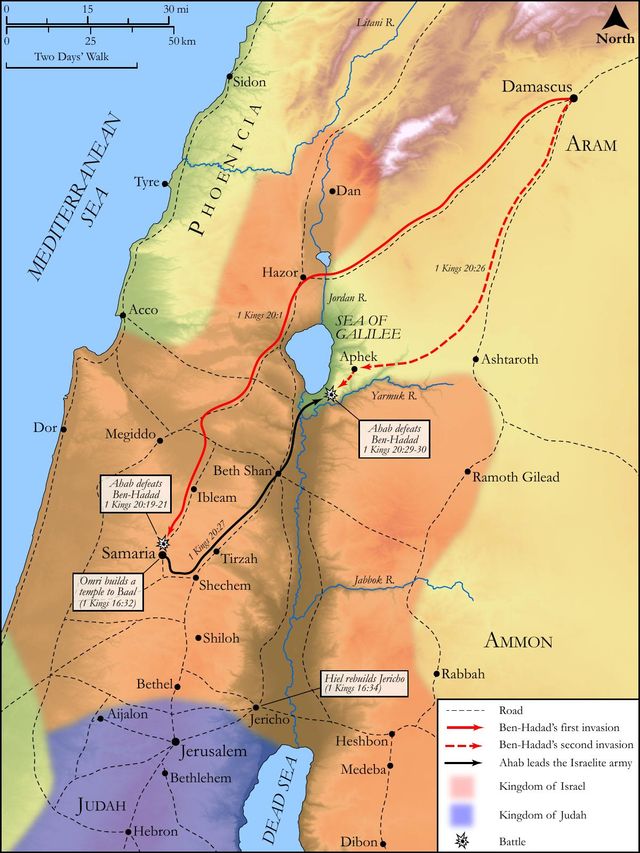
This verse is situated immediately after a dramatic and divinely orchestrated narrative in 1 Kings 20, where the Lord twice grants King Ahab and Israel decisive victories over the numerically superior and arrogant Syrian forces led by Ben-hadad. The second victory, in particular, was explicitly given by God "that you may know that I am the Lord" (1 Kings 20:28). Having been utterly defeated and cornered in Aphek, Ben-hadad's life hangs precariously in the balance. His desperate act of sending envoys dressed in sackcloth and ropes is a direct response to his crushing defeat and a final, desperate attempt to secure his survival, setting up Ahab's subsequent, ill-advised decision to spare him, which leads to a prophet's condemnation later in the chapter (1 Kings 20:42).
Historical & Cultural Context
Among the nations of that day, warfare was brutal, and the fate of defeated kings was often severe, ranging from execution to public humiliation, enslavement, or tribute. The act of "girding sackcloth on their loins, and putting ropes on their heads" was a universally understood and profound display of abject surrender, extreme distress, and a plea for clemency. Sackcloth, a coarse, rough fabric, was worn for mourning, repentance, or profound humility, often indicating a complete divestment of status and dignity. Ropes on the head symbolized being a captive or slave, completely at the mercy of the victor, willing to be led away to execution or bondage. This was a calculated, theatrical, yet sincere, act designed to evoke pity and mercy from the conqueror, appealing to any sense of compassion or a desire for a diplomatic resolution rather than total annihilation.
Key Themes
ShowHideThe narrative of 1 Kings 20, culminating in this verse, contributes to several major themes. Firstly, it underscores God's sovereignty over nations and His active involvement in human affairs, demonstrating His power over even the most formidable armies and His ability to humble the proud. Secondly, it highlights the nature of kingship—both the arrogance and ultimate downfall of Ben-hadad and the surprising, yet ultimately flawed, mercy of Ahab. The theme of obedience versus disobedience to God's explicit commands is central, as Ahab's decision to spare Ben-hadad directly contradicts God's judgment against him, leading to severe consequences for Ahab and his kingdom (1 Kings 20:42). Finally, the scene presents the theme of humiliation and submission, as Ben-hadad, once proud and boastful (1 Kings 20:10-12), is brought to the lowest point of desperation, illustrating the transient nature of earthly power.
Exposition and Analysis
ShowHideKey Word Analysis
ShowHideThis name, meaning "son of Hadad" (Hadad being a prominent Syrian storm god), identifies the arrogant Syrian king who repeatedly challenged Israel. His presence here, through his servants, signifies the complete reversal of his fortunes and the humbling of a powerful, idolatrous monarch before the God of Israel.
More than just physical cords, "ropes" here are a powerful symbol of utter subjugation and impending doom. They represent being bound, a prisoner at the mercy of the conqueror, ready to be led to execution or enslavement. This gesture, combined with sackcloth, was the ultimate visual declaration of complete defeat and the surrender of one's life to the discretion of the enemy.
Ahab's immediate and surprising declaration, "he is my brother," is profoundly significant. As Hiram called Solomon "my brother," the word could denote a covenantal relationship between kings of equal standing or a recognition of shared humanity and kingship, implying a willingness to treat the defeated king with a measure of dignity rather than as a mere captive. It paved the way for a treaty rather than execution, but in this divine narrative, it reveals Ahab's misplaced priorities and disobedience.
Verse Breakdown
ShowHide"So they girded sackcloth on their loins, and [put] ropes on their heads"
This clause vividly describes the physical manifestation of Ben-hadad's abject surrender. The imagery of sackcloth, a coarse fabric of mourning and humility, and ropes on the head, a sign of captivity and utter submission, was a custom universally recognized among the nations of that day. It was a theatrical, yet sincere, act designed to evoke pity and mercy from the conqueror, signifying a complete divestment of royal dignity and a desperate plea for clemency.
"and came to the king of Israel, and said, Thy servant Benhadad saith, I pray thee, let me live."
Ben-hadad's messengers, acting on his behalf, deliver a direct and humble appeal. The use of "Thy servant Benhadad" is a deliberate act of self-abasement, acknowledging Ahab's superior position and Ben-hadad's subjugation. This phrase underscores the vast power differential and Ben-hadad's complete dependence on Ahab's will. The core of the plea is a desperate cry for life, highlighting the precariousness of his situation and the ultimate stakes of the encounter.
"And he said, [Is] he yet alive? he [is] my brother."
Ahab's response is striking and unexpected, demonstrating a surprising turn of events. His initial question, "Is he yet alive?", suggests a degree of surprise or perhaps a moment of reflection on the swiftness and completeness of Ben-hadad's defeat, or even a hint of satisfaction. His subsequent, pivotal declaration, "he is my brother," signals an immediate willingness to show clemency, recognizing a shared status or humanity that transcends the immediate conflict. This statement sets the stage for the controversial treaty that follows, revealing Ahab's human-centered approach to a divinely ordained victory.
Literary Devices
ShowHideThe verse powerfully employs Symbolism through the imagery of "sackcloth" and "ropes," which are universally understood signs of extreme humiliation, mourning, and abject surrender among the nations of that day. This visual language immediately conveys the depth of Ben-hadad's desperation and the completeness of his defeat, stripping away all pretense of royal power. There is also a strong element of Irony in Ahab's response. While his declaration "he is my brother" appears to be an act of mercy, it stands in stark contrast to God's explicit intention to deliver Ben-hadad into Ahab's hand for destruction (1 Kings 20:28). This seemingly benevolent act of clemency ultimately becomes an act of disobedience, leading to severe divine judgment against Ahab (1 Kings 20:42). The narrative also presents a dramatic Contrast between Ben-hadad's earlier arrogance and boastful threats (1 Kings 20:10-12) and his current state of utter submission and desperate plea for life, highlighting the swift and comprehensive nature of God's judgment.
Theological and Thematic Connections
ShowHideThis verse, situated within the broader narrative of 1 Kings 20, offers profound theological insights into divine justice, human mercy, and the critical importance of obedience to God's specific commands. While Ben-hadad's abject humility is a powerful display of a defeated enemy seeking grace, Ahab's decision to spare him, though seemingly merciful, ultimately demonstrates a profound failure to align his actions with God's revealed will. God had explicitly declared His intention to deliver Ben-hadad into Ahab's hand, not for a treaty, but for judgment, to demonstrate His sovereignty and to punish Ben-hadad's arrogance and idolatry. Ahab's "mercy" was therefore an act of disobedience, prioritizing human diplomacy and personal gain over divine command, a choice that would later bring severe consequences upon himself and his kingdom. This highlights that not all "mercy" is godly, especially when it contradicts God's righteous judgment or specific instructions, emphasizing that true compassion must always be rooted in and aligned with God's holy character and purposes.
Reflection and Application
ShowHideThe scene in 1 Kings 20:32 offers a complex tapestry for reflection on humility, mercy, and obedience. Ben-hadad's desperate act of submission, though born of necessity, serves as a stark reminder that true humility often precedes any hope of grace or deliverance. For believers, this can prompt a self-examination of our own pride and resistance to acknowledging our desperate need for God's grace and forgiveness. Conversely, Ahab's flawed mercy challenges us to consider the nature of our compassion. While the Bible calls us to be merciful and compassionate, this narrative warns against a mercy that disregards divine justice, specific commands, or God's ultimate purposes. True biblical mercy is always aligned with God's character and purposes, never undermining His holiness, His justice, or His revealed will. We are called to discern God's specific instructions for our lives and to obey them faithfully, understanding that human wisdom, even when seemingly benevolent, can lead us astray from God's perfect plan and invite unforeseen, often severe, consequences.
Questions for Reflection
ShowHideFAQ
ShowHideWhy did Ben-hadad's servants advise him to wear sackcloth and ropes?
ShowHideThis was a custom universally recognized among the nations of that day for expressing profound submission, desperation, and a plea for clemency. Sackcloth symbolized mourning, repentance, and extreme humility, while ropes on the head signified being a captive or slave, completely at the mercy of the victor. It was a theatrical, yet sincere, act designed to evoke pity and mercy from the conqueror, appealing to any sense of compassion or a desire for a diplomatic resolution rather than total annihilation. They presumed Israelite kings, particularly those who served the God of Israel, were known to be merciful.
Why did Ahab call Ben-hadad "my brother"?
ShowHideAhab's declaration, "he is my brother," was significant in several ways. As Hiram called Solomon "my brother," this phrase could denote a recognition of shared royal status, a desire to establish a covenantal relationship (which he does in 1 Kings 20:34), or simply an expression of surprising clemency and a willingness to treat a fellow king with dignity, rather than as a mere captive. It paved the way for a treaty rather than execution, which was common practice for defeated kings. However, from a divine perspective, it revealed Ahab's misplaced priorities and disobedience to God's specific command.
What was the significance of Ahab's decision to spare Ben-hadad?
ShowHideWhile seemingly an act of mercy, Ahab's decision directly contradicted God's explicit will. God had delivered Ben-hadad into Ahab's hand specifically for destruction (1 Kings 20:28), as a judgment against Syria and to demonstrate His sovereignty to Israel. Ahab's act of mercy was therefore an act of disobedience, for which he was later rebuked by a prophet who declared that Ahab's life would be taken for Ben-hadad's life (1 Kings 20:42). This misapplied mercy ultimately led to Ahab's own downfall and death at the hands of the Syrians in a later battle (1 Kings 22:34-35), highlighting the severe consequences of prioritizing human wisdom over divine command.
Christ-Centered Fulfillment
ShowHideThe narrative of 1 Kings 20:32, with its themes of judgment, mercy, and obedience, finds profound Christ-centered fulfillment. Ben-hadad's abject humiliation and desperate plea for life, marked by sackcloth and ropes, foreshadow humanity's spiritual condition before a holy God. We, too, are defeated by sin, utterly helpless and deserving of judgment, yet called to humble ourselves before the King of kings to receive life. Unlike Ahab's flawed and disobedient mercy, God's mercy in Christ is perfect, righteous, and fully aligned with His divine will. God did not spare His own Son, Jesus, but delivered Him up for us all (Romans 8:32), demonstrating a mercy that perfectly fulfills justice. Christ, the ultimate Lamb of God, willingly submitted to the ropes of captivity and the ultimate humiliation of the cross (Philippians 2:8), not to save Himself, but to secure eternal life for those who humble themselves and believe in Him. His perfect obedience unto death contrasts sharply with Ahab's disobedience, revealing the path to true life and blessing. Through Christ, we can approach the throne of grace with confidence, knowing that our "brother" and High Priest has already secured for us the mercy and grace we desperately need (Hebrews 4:16), enabling us to live in obedience to God's perfect will.