


2 Chronicles 28:19
Bible text: King James Version (1769 Blayney text) · Public domain
Bible text: Berean Standard Bible · Public domain
Bible text: American Standard Version (1901) · Public domain
Bible text: World English Bible, Messianic edition · Public domain
Bible text: Geneva Bible (1599) · Public domain
Bible text: Young's Literal Translation · Public domain
- כִּיkiforH3588PrtParticle Conditional
- הִכְנִיעַhikh·Ni·a'he had humbledH3665V-Hiphil-Perf-3msVerb Hiphil Perfect 3rd Singular Masculine
- יְהוָהYah·wehYahwehH3068N-properNoun Proper Title
- אֶת'et<obj.>H853DirObjMParticle Object Indicator
- יְהוּדָהye·hu·DahJudahH3063N-properNoun Proper Location
- בַּעֲבוּרba·'a·Vurfor sake ofH5668Prep-b ¦ N-mscNoun Singular Masculine Constructבַּforעֲבוּרsake of
- אָחָז'a·ChazAhazH271N-proper-mNoun Proper Masculine
- מֶלֶךְMe·lekh[the] king ofH4428N-mscNoun Singular Masculine Construct
- יִשְׂרָאֵלYis·ra·'ElIsraelH3478N-properNoun Proper Location
- כִּיkiforH3588PrtParticle Conditional
- הִפְרִיעַhif·Ri·a'he had allowed lack of restraintH6544V-Hiphil-Perf-3msVerb Hiphil Perfect 3rd Singular Masculine
- בִּיהוּדָהbi·hu·Dahin JudahH3063Prep-b ¦ N-properNoun Proper LocationבִּinיהוּדָהJudah
- וּמָעוֹלu·ma·'oland he had acted unfaithfullyH4603Conj-w ¦ V-Qal-InfAbsVerb Qal Infinitive Absoluteוּandמָעוֹלhe had acted unfaithfully
- מַעַלMa·'alunfaithfulnessH4603V-Qal-Perf-3msVerb Qal Perfect 3rd Singular Masculine
- בַּיהוָהba·Yah·wehagainst YahwehH3068Prep-b ¦ N-properNoun Proper TitleבַּagainstיהוָהYahweh
English is a literal word-by-word gloss of the Hebrew, not the KJV's wording. Why?
This is the original text the KJV's translators worked from — each Hebrew word with its own literal English meaning in this verse, prepared by scholars at Tyndale House, Cambridge. The KJV translates whole sentences, not word by word, so its wording differs: one Hebrew word can become several English words, and the KJV may choose “the LORD” where the gloss reads “Yahweh”. Both are faithful — they answer different questions. For the KJV's own rendering, switch to the KJV text.
Details
See on the biblical-era maps
Study this verse
Public-domain commentary
Matthew Henry
From his Commentary on the Whole Bible. Henry comments on passages, not single verses — this entry covers 2 Chronicles 28:16–27. His three-level outline is real structure in the source text, so it is rendered as structure.
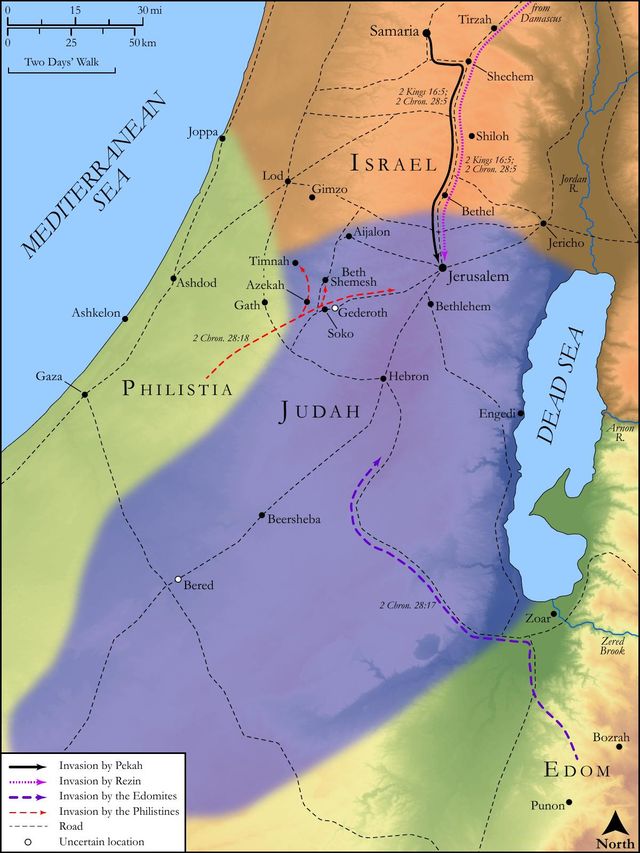
Here is, I. The great distress which the kingdom of Ahaz was reduced to for his sin. In general, 1. The Lord brought Judah low, Ch2 28:19. They had lately been very high in wealth and power; but God found means to bring them down, and make them as despicable as they had been formidable. Those that will not humble themselves under the word of God will justly be humbled by his judgments. Iniquity brings men low, Psa 106:43. 2. Ahaz made Judah naked. As his sin debased them, so it exposed them. It made them naked to their shame; for it exposed them to contempt, as a man unclothed. It made them naked to their danger; for it exposed them to assaults, as a man unarmed, Exo 32:25. Sin strips men. In particular, the Edomites, to be revenged for Amaziah's cruel treatment of them (Ch2 25:12), smote Judah, and carried off many captives, Ch2 28:17. The Philistines also insulted them, took and kept possession of several cities and villages that lay near them (Ch2 28:18), and so they were revenged for the incursions which Uzziah had made upon them, Ch2 26:6. And, to show that it was purely the sin of Ahaz that brought the Philistines upon his country, in the very year that he died the prophet Isaiah foretold the destruction of the Philistines by his son, Isa 14:28, Isa 14:29.
II.The addition which Ahaz made both to the national distress and the national guilt.
1.He added to the distress, by making court to strange kings, in hopes they would relieve him. When the Edomites and Philistines were vexatious to him, he sent to the kings of Assyria to help him (Ch2 28:16); for he found his own kingdom weakened and made naked, and he could not put any confidence in God, and therefore was at a vast expense to get an interest in the king of Assyria. He pillaged the house of God, and the king's house, and squeezed the princes for money to hire these foreign forces into his service, Ch2 28:21. Though he had conformed to the idolatry of the heathen nations, his neighbours, they did not value him for that, nor love him the better, nor did his compliance, by which he lost God, gain them, nor could he make any interest in them, but with his money. It is often found that wicked men themselves have no real affection for those that revolt to them, nor do they care to do them a kindness. A degenerate branch is looked upon, on all sides, as an abominable branch, Isa 14:19. But what did Ahaz get by the king of Assyria? Why, he came to him, but he distressed him, and strengthened him not (Ch2 28:20), helped him not, Ch2 28:21. The forces of the Assyrian quartered upon his country, and so impoverished and weakened it; they grew insolent and imperious, and created him a great deal of vexation, like a broken reed, which not only fails, but pierces the hand.
2.He added to the guilt, by making court to strange gods, in hopes they would relieve him. In his distress, instead of repenting of his idolatry, which he had reason enough to see the folly of, he trespassed yet more (Ch2 28:22), was more mad than ever upon his idols. A brand of infamy is here set upon him for it: This is that king Ahaz, that wretched man, who was the scandal of the house of David and the curse and plague of his generation. Note, Those are wicked and vile indeed that are made worse by their afflictions, instead of being made better by them, who in their distress trespass yet more, have their corruptions exasperated by that which should mollify them, and their hearts more fully set in them to do evil. Let us see what his trespass was.
(1.)He abused the house of God; for he cut in pieces the vessels of it, that the priests might not perform the service of the temple, or not as it should be performed, for want of vessels; and, at length, he shut up the doors, that the people might not attend it, Ch2 28:24. This was worse than the worst of the kings before him had done.
(2.)He confronted the altar of God, for he made himself altars in every corner of Jerusalem; so that, as the prophet speaks, they were like heaps in the furrows of the fields, Hos 12:11. And in the cities of Judah, either by his power or by his purse, perhaps by both, he erected high places for the people to burn incense to what idols they pleased, as if on purpose to provoke the God of his fathers, Ch2 28:25.
(3.)He cast off God himself; for he sacrificed to the gods of Damascus (Ch2 28:23), not because he loved them, for he thought they smote him; but because he feared them, thinking that they helped his enemies, and that, if he could bring them into his interest, they would help him. Foolish man! It was his own God that smote him and strengthened the Syrians against him, not the gods of Damascus; had he sacrificed to him, and to him only, he would have helped him. But no marvel that men's affections and devotions are misplaced when they mistake the author of their trouble and their help. And what comes of it? The gods of Syria befriend Ahaz no more than the kings of Assyria did; they were the ruin of him and of all Israel. This sin provoked God to bring judgments upon them, to cut him off in the midst of his days, when he was but thirty-six years old; and it debauched the people so that the reformation of the next reign could not prevail to cure them of their inclination to idolatry, but they retained that root of bitterness till the captivity in Babylon plucked it up.
The chapter concludes with the conclusion of the reign of Ahaz, Ch2 28:26, Ch2 28:27. For aught that appears, he died impenitent, and therefore died inglorious; for he was not buried in the sepulchres of the kings. Justly was he thought unworthy to be laid among them who was so unlike them - to be buried with kings who had used his kingly power for the destruction of the church and not for its protection or edification.
Historical interpretation
Historical reception
1 surviving comment on this verse from the historical church.
For he had stripped it of help: That is, Achaz stripped the kingdom of Juda of the divine assistance by his wickedness, and by his introducing idolatry.
Continue studying 2 Chronicles 28:19 across the web’s major study libraries — every link below opens this exact verse, chapter, or book on the destination site.
Read & Compare
 BibleGatewayThis verse in more than 200 translations and 70 languages.
 Bible.comThe YouVersion reader — hundreds of translations, reading plans, and highlights.
 ESV.orgCrossway's official English Standard Version reader.
 NET BibleThe NET translation with 60,000+ translators' notes on every rendering decision.
 STEP BibleTyndale House's free study tool — original text, vocabulary, and scholarly resources.
 BibliaLogos Bible Software's free web reader.
 USCCBThe New American Bible (Revised Edition) with the U.S. bishops' study notes.
Commentaries
 BibleHub CommentariesDozens of classic commentaries on this verse, gathered on one page.
 StudyLightMore than 100 commentary sets — the largest collection on the web.
 BibleRefPlain-English commentary on what this verse means, verse by verse.
 Enduring WordDavid Guzik's free commentary on this chapter, widely used by Bible teachers.
 Bible Study ToolsVerse commentary alongside Greek and Hebrew study aids.
Original Language & Research
- BibleHub InterlinearThe verse word by word — original language, transliteration, and English.
- BibleHub LexiconEvery word's original-language definition and Strong's entry.
 Blue Letter BibleDeep-study tools — Strong's numbers, concordance, and word studies.
 SefariaThe Hebrew text with Rashi and centuries of Jewish commentary.
Sermons, Hymns & Audio


TrulyRandomVerse is not affiliated with these sites and doesn’t control their content. They’re linked because they’re genuinely useful.
Summary
Second Chronicles 28:19 powerfully encapsulates the profound national humiliation and suffering endured by Judah during the reign of King Ahaz, unequivocally attributing these calamities to the direct judgment of the LORD. The verse declares that God Himself "brought Judah low" because of Ahaz's egregious wickedness and severe transgression against Him, specifically noting that Ahaz "made Judah naked." This potent metaphor signifies the stripping away of divine protection, honor, and strength, leaving the nation utterly exposed and vulnerable. It stands as a stark theological declaration, highlighting the devastating consequences of apostasy, particularly when perpetrated by a nation's leader, and affirming God's active sovereignty in the affairs of His people.
Context
ShowHideLiterary Context
This verse functions as a pivotal interpretive statement within the broader narrative of 2 Chronicles 28. The preceding verses (2 Chronicles 28:1-15) meticulously detail the abominable reign of King Ahaz, who explicitly "did not do what was right in the eyes of the LORD, as David his father had done" (2 Chronicles 28:1). His profound wickedness included the abhorrent practices of making molten images for Baal, burning his own sons as sacrifices, and engaging in idol worship on every high hill (2 Chronicles 28:2-4). As a direct, divinely ordained consequence of this rampant apostasy, Judah suffered catastrophic military defeats at the hands of Aram and Israel, resulting in immense casualties and the capture of 200,000 Judeans (2 Chronicles 28:5-8). The narrative then shifts to the prophet Oded, who courageously rebukes the Northern Kingdom of Israel for their excessive cruelty towards their Judean captives, reminding them of their own sin against the LORD (2 Chronicles 28:9-11). The subsequent actions of the Israelite leaders, who release the captives and provide for them (2 Chronicles 28:12-15), stand in stark contrast to Ahaz's continued rebellion. Therefore, 2 Chronicles 28:19 functions as a definitive divine commentary, clarifying that the preceding calamities were not random misfortunes but direct, intentional divine chastisement, explicitly linking Judah's suffering to Ahaz's profound personal and national sin.
Historical & Cultural Context
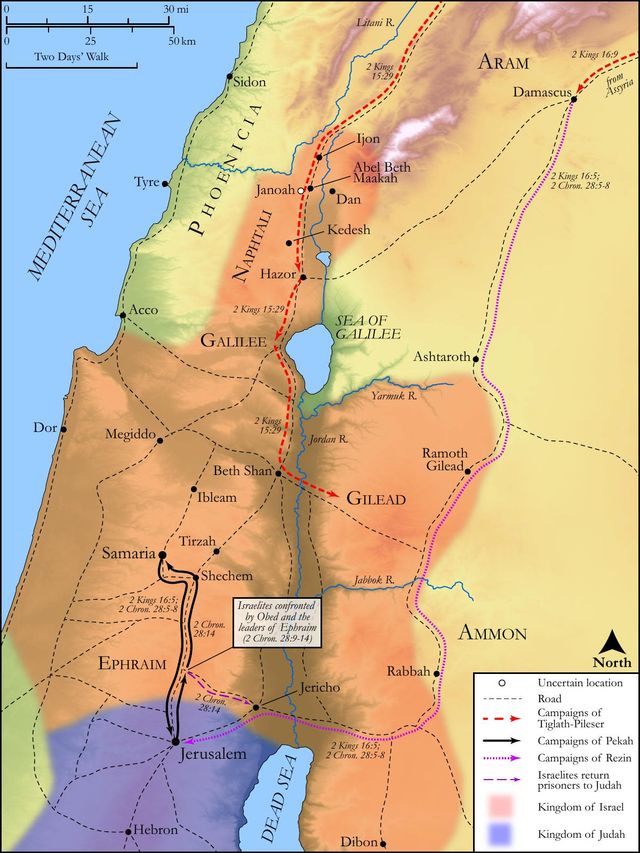
King Ahaz reigned over Judah from approximately 735 to 715 BC, a period of immense geopolitical upheaval, dominated by the relentless expansion of the Neo-Assyrian Empire under Tiglath-Pileser III. Judah found itself precariously positioned between the rising Assyrian power and a hostile coalition of Aram (Syria) and Israel (the Northern Kingdom), led by Rezin and Pekah respectively, who sought to compel Judah into an anti-Assyrian alliance (the Syro-Ephraimite War, vividly detailed in Isaiah 7). Rather than placing his trust in the LORD, as urged by the prophet Isaiah, Ahaz chose to appeal to Tiglath-Pileser III for military aid, effectively transforming Judah into a servant of Assyria and, tragically, adopting Assyrian idolatrous practices within Jerusalem itself (2 Kings 16:7-18). Culturally, Ahaz's introduction of foreign altars and pagan worship, including the horrific practice of child sacrifice, represented a profound and deliberate breach of the Mosaic covenant and a direct affront to Yahweh, the God of Israel. The Chronicler's curious designation of Ahaz as "king of Israel," despite his being king of Judah, carries significant theological weight. It likely serves as a poignant spiritual commentary, implying that Ahaz's extreme apostasy mirrored the persistent idolatry and covenant unfaithfulness that had long characterized the Northern Kingdom of Israel, which had abandoned the Davidic dynasty and the Jerusalem temple, leading to their eventual downfall.
Key Themes
ShowHideThe paramount theme in 2 Chronicles 28:19 is Divine Judgment as a direct and inevitable consequence of Covenant Unfaithfulness. The LORD's active role in "bringing Judah low" profoundly underscores His absolute sovereignty and His righteous response to sin, particularly the grave transgressions of a nation's leader. This highlights the crucial theme of the Accountability of Leadership, demonstrating with chilling clarity that the choices and spiritual integrity of a king have profound national implications, leading either to divine blessing or to severe chastisement. Ahaz's personal wickedness and rampant idolatry directly provoked divine wrath, resulting in the humiliation and weakening of Judah. The powerful metaphor "he made Judah naked" introduces the theme of Spiritual Exposure and Vulnerability. It vividly signifies that Ahaz's sins stripped Judah of its divine protection, honor, and strength, leaving the nation utterly exposed and vulnerable to its enemies and to profound shame, much like Adam and Eve's realization of nakedness and shame after the Fall (Genesis 3:7-10). This is not a literal physical nakedness but a profound spiritual and political degradation, emphasizing that true national security and flourishing derive solely from faithfulness to God, not from political alliances or military might. The concluding phrase "transgressed sore against the LORD" further emphasizes the Severity of Transgression and the depth of Ahaz's apostasy, which justly warranted such a severe divine response.
Exposition and Analysis
ShowHideKey Word Analysis
ShowHideThis verb (H3665) literally means "to bend the knee," and by extension, "to humble," "to subdue," or "to bring into submission." In this context, it powerfully emphasizes the LORD's active agency in Judah's humiliation. It signifies a deliberate act of divine discipline and judgment, not merely a passive allowance of events. This word underscores God's sovereignty over historical events and His direct involvement in orchestrating the consequences of human sin, demonstrating His righteous hand in humbling His people for their unfaithfulness.
This verb (H6544) means "to loosen," "to uncover," "to expose," or "to make bare." It is a profoundly potent metaphor in biblical literature, consistently conveying shame, vulnerability, and a loss of divine protection or order. For instance, in Exodus 32:25, it describes the Israelites being "naked" or "unrestrained" due to their idolatry with the golden calf, leading to their shame before their enemies. Here, Ahaz's actions effectively removed God's protective covering from Judah, exposing the nation to profound shame, military defeat, and national humiliation, akin to a person stripped of their clothing. It speaks to a deep spiritual and moral degradation that left the nation defenseless against its adversaries and divine wrath.
This phrase employs the verb mâʻal (H4603) and the noun maʻal (H4604), intensifying its meaning through repetition. The verb mâʻal denotes "to act unfaithfully," "to commit a trespass," or "to behave treacherously," particularly in relation to a covenant or sacred trust. The repetition, "transgressed sore" (literally "committed a trespass, a trespass"), emphasizes the extreme nature, severity, and deliberate character of Ahaz's breach of covenant with the LORD. It highlights a profound and egregious betrayal of divine trust, far beyond a simple mistake or minor sin, thereby justly warranting the severe divine judgment that followed.
Verse Breakdown
ShowHide"For the LORD brought Judah low"
This foundational clause immediately establishes the divine origin of Judah's suffering and humiliation. It unequivocally states that the calamities experienced by the nation were not merely random misfortunes, military defeats, or geopolitical pressures, but a direct, intentional act of God. The LORD, as the sovereign ruler of history and the faithful keeper of His covenant, is actively involved in humbling His people as a disciplinary measure for their unfaithfulness, underscoring His unwavering justice and His commitment to His covenant, even through the painful means of judgment.
"because of Ahaz king of Israel;"
This phrase precisely identifies the specific human agent and ultimate cause of Judah's low state: King Ahaz. The designation "king of Israel" for Ahaz, who was undeniably the king of Judah, is a profound and deliberate textual and theological point. While some scholars might suggest a scribal error, it is more deeply understood as a potent theological commentary. It strongly implies that Ahaz's apostasy, rampant idolatry, and profound covenant unfaithfulness were so extreme and pervasive that they mirrored the characteristic sins of the Northern Kingdom of Israel, which had long abandoned the true worship of Yahweh and suffered repeated divine judgments, eventually leading to their exile. Ahaz, though ruling Judah, spiritually behaved as a king of the idolatrous North, leading his people down a similar path of spiritual ruin.
"for he made Judah naked,"
This powerful metaphorical clause elucidates how Ahaz's actions led to Judah's profound low state. By leading the nation into widespread idolatry, introducing pagan practices, and fundamentally breaking the covenant, Ahaz effectively stripped Judah of its divine protection, blessing, and honor. "Nakedness" here serves as a vivid symbol of vulnerability, profound shame, dishonor, and the catastrophic loss of God's protective covering. Just as physical clothing provides protection and dignity, God's presence and covenant faithfulness provided security, honor, and a shield for Judah. Ahaz's sin removed this spiritual covering, leaving the nation utterly exposed to its enemies, to national humiliation, and to the full force of divine wrath.
"and transgressed sore against the LORD."
This concluding clause reiterates and emphatically underscores the nature and severity of Ahaz's sin. The intensified verbal phrase "transgressed sore" (Hebrew mâʻal_ _maʻal) signifies a profound and deliberate act of treachery and unfaithfulness against the LORD. It highlights a severe, intentional, and egregious breach of the sacred covenant relationship, a betrayal of the divine trust placed in him as king and guardian of the nation's spiritual well-being. This deep-seated rebellion against God's explicit commands and covenant stipulations is presented as the ultimate and just justification for the severe judgment Judah experienced.
Literary Devices
ShowHide2 Chronicles 28:19 employs several potent Literary Devices to convey its profound theological message. The most prominent is Metaphor in the striking phrase "he made Judah naked." This is not a literal description of physical nudity but a powerful figurative expression for stripping Judah of its divine protection, honor, and strength, leaving it utterly vulnerable to shame, defeat, and the consequences of its sin. This metaphor vividly communicates the profound spiritual and political degradation resulting from Ahaz's apostasy. Additionally, the declaration "the LORD brought Judah low" utilizes Divine Agency or Anthropomorphism, attributing direct, intentional action to God in the unfolding historical events. This emphasizes God's absolute sovereignty and active involvement in the affairs of His people, underscoring that the calamities Judah faced were not random occurrences but divinely ordained judgments. Finally, the repetition of the verbal root in "transgressed sore" (Hebrew mâʻal_ _maʻal) serves as a powerful device of Emphasis or Intensification, highlighting the extreme nature and severity of Ahaz's covenant breach and the profound depth of his unfaithfulness, leaving no doubt as to the justification for the divine response.
Theological and Thematic Connections
ShowHide2 Chronicles 28:19 powerfully articulates the foundational biblical principle that sin, particularly covenant unfaithfulness, idolatry, and rebellion against God, inevitably leads to divine judgment and severe consequences. This is especially true for a nation and its leadership, who are held to a higher standard of accountability. The verse underscores God's unwavering justice, His absolute sovereignty, and His steadfast commitment to His covenant, even when that commitment necessitates painful disciplinary action. It profoundly illustrates that true national security, prosperity, and honor are contingent upon faithfulness to the LORD, not on shrewd political alliances or military might. Ahaz's reign serves as a stark and enduring example of how a nation's spiritual nakedness—its catastrophic loss of divine protection and favor due to pervasive sin—results in profound vulnerability, shame, and humiliation before its enemies.
Reflection and Application
ShowHideThe sobering account of King Ahaz and Judah in 2 Chronicles 28:19 serves as a timeless and profound reminder of the immense seriousness of sin, especially when it involves spiritual apostasy and a deliberate breach of covenant with God. It compels us to deeply consider the far-reaching implications of our choices, particularly for those who hold positions of influence, whether within families, churches, workplaces, or broader communities. Just as Ahaz's unfaithfulness stripped Judah of its divine covering and left it utterly vulnerable, our own disobedience and spiritual compromise can expose us to spiritual and relational consequences, diminishing our witness, hindering God's blessing, and inviting hardship. This verse calls us to a deep and honest introspection, urging us to prioritize unwavering faithfulness to God above all else, recognizing with humility that true security, honor, and flourishing come only from walking in consistent obedience and trust in Him. It powerfully reminds us that God's justice is real and active, and while His grace is boundless, He does not condone persistent rebellion. Therefore, we are called to humble ourselves, confess our sins with sincerity, and diligently seek His protective presence through faithful living, knowing that His covering is our ultimate defense.
Questions for Reflection
ShowHideFAQ
ShowHideWhy is Ahaz called "king of Israel" when he was king of Judah?
ShowHideThe designation of Ahaz as "king of Israel" in 2 Chronicles 28:19, despite his being the king of Judah, is a notable textual feature with profound theological implications. While some scholars propose it might be a scribal error where "Judah" was mistakenly replaced with "Israel," a more compelling and widely accepted interpretation views it as a deliberate theological commentary by the Chronicler. The Northern Kingdom of Israel had a long and consistent history of apostasy, idolatry, and rebellion against the LORD, characterized by a succession of wicked kings who systematically led the people away from true worship and the Mosaic covenant. By calling Ahaz "king of Israel," the Chronicler is likely making a poignant spiritual statement: Ahaz's extreme wickedness, including his introduction of pagan altars, the horrific practice of child sacrifice (2 Kings 16:3-4 and 2 Chronicles 28:2-3), and his reliance on foreign powers rather than God, was so egregious that it mirrored the persistent unfaithfulness and spiritual depravity of the Northern Kingdom. In essence, Ahaz was behaving like a "king of Israel" in a spiritual and moral sense, leading Judah down a path of similar spiritual ruin and divine chastisement as their northern counterparts had experienced, ultimately emphasizing the severity of his sin and its devastating impact on Judah's covenant relationship with God.
What does "made Judah naked" mean in this context?
ShowHideThe phrase "made Judah naked" is a powerful and evocative metaphor, not a literal description of physical nakedness. It translates the Hebrew verb pâraʻ (H6544), which means "to expose," "to uncover," "to let loose," or "to make bare." In biblical thought, nakedness consistently symbolizes vulnerability, profound shame, dishonor, and the catastrophic loss of divine protection or order. For example, after Adam and Eve sinned, they immediately realized their nakedness and felt profound shame, attempting to cover themselves (Genesis 3:7-10). Similarly, in Exodus 32:25, the Israelites were described as "naked" or "unrestrained" because of their idolatry with the golden calf, leading directly to their shame before their enemies. In 2 Chronicles 28:19, Ahaz's profound apostasy and covenant unfaithfulness effectively stripped Judah of its spiritual covering—the protective presence, favor, and blessing of the LORD. By leading the nation into widespread idolatry and rebellion against God's commands, Ahaz removed God's divine shield, leaving Judah utterly exposed and vulnerable to its enemies, to national humiliation, and to the full force of divine judgment. It signifies a profound spiritual and moral degradation that resulted in national weakness, disgrace, and a loss of God's safeguarding presence.
Christ-Centered Fulfillment
ShowHideThe severe judgment upon Judah for Ahaz's profound sin, particularly the striking metaphor of the nation being "made naked," finds its ultimate and redemptive Christ-centered fulfillment in the person and redemptive work of Jesus Christ. Humanity, through its own pervasive sin and inherent rebellion against God, became spiritually "naked"—exposed to divine wrath, profound shame, and the inescapable power of sin and death. We were utterly vulnerable, stripped of the glory and protective presence of God, much as Judah was under Ahaz's apostate leadership. However, Christ, the true and righteous King, unlike the faithless Ahaz, did not lead His people into sin but rather bore the full weight of their sin upon Himself. On the cross, Jesus Himself was stripped naked, enduring the ultimate shame, humiliation, and vulnerability, becoming a curse for us so that we might be clothed with His perfect righteousness (Galatians 3:13). He, the spotless Lamb of God, who takes away the sin of the world, voluntarily endured the divine judgment that our "sore transgressions" justly deserved. Through His unparalleled sacrifice, He provides a perfect and eternal covering—a glorious robe of righteousness—for all who place their faith in Him, enabling them to stand before God without shame, fear of condemnation, or spiritual nakedness (Romans 8:1). Thus, where Ahaz's sin led to Judah's nakedness and judgment, Christ's perfect obedience and atoning sacrifice provide spiritual clothing, security, and eternal life, fulfilling the covenant promises and graciously restoring humanity to a place of divine favor, protection, and intimate fellowship with God.