


Jeremiah 49:1
- לִבְנֵיliv·Neiof [the] people ofH1121Prep-l ¦ N-mpcNoun Plural Masculine Constructלִofבְנֵי[the] people of
- עַמּוֹןa·MonAmmonH5983N-proper-mNoun Proper Masculine
- כֹּהkohthusH3541AdvAdverb
- אָמַר'a·Marhe saysH559V-Qal-Perf-3msVerb Qal Perfect 3rd Singular Masculine
- יְהוָהYah·wehYahwehH3068N-properNoun Proper Title
- הֲבָנִיםha·va·Nim¿ [do] childrenH1121Interrog ¦ N-mpNoun Plural Masculine Absoluteהֲ¿בָנִים[do] children
- אֵין'einnotH369N-mscNoun Singular Masculine Construct
- לְיִשְׂרָאֵלle·Yis·ra·'El[belong] to IsraelH3478Prep-l ¦ N-properNoun Proper Locationלְ[belong] toיִשְׂרָאֵלIsrael
- אִם'imor?H518PrtParticle Conditional
- יוֹרֵשׁyo·Resh[does] an heirH3423V-Qal-Prtcpl-msVerb Qal Participle Singular Masculine Absolute
- אֵין'einnotH369N-mscNoun Singular Masculine Construct
- לוֹlo[belongs] to <the> itPrep-l ¦ 3msSuffix Personal 3rd Singular Masculineל[belongs] to <the>וֹit
- מַדּוּעַma·Du·a'why?H4069InterrogParticle Interrogative
- יָרַשׁya·Rashhas he dispossessedH3423V-Qal-Perf-3msVerb Qal Perfect 3rd Singular Masculine
- מַלְכָּםmal·KamMilcomH4428N-properNoun Proper Title
- אֶת'et<obj.>H853DirObjMParticle Object Indicator
- גָּדGadGadH1410N-proper-mNoun Proper Masculine
- וְעַמּוֹve·'a·Moand his peopleH5971Conj-w ¦ N-msc ¦ 3msNoun Singular Masculine Constructוְandעַמּpeopleוֹhis
- בְּעָרָיוbe·'a·Ravin its citiesH5892Prep-b ¦ N-mpc ¦ 3msNoun Plural Masculine Constructבְּinעָרָיcitiesוits
- יָשָׁבya·Shavhas it dwelt?H3427V-Qal-Perf-3msVerb Qal Perfect 3rd Singular Masculine
English is a literal word-by-word gloss of the Hebrew, not the KJV's wording. Why?
This is the original text the KJV's translators worked from — each Hebrew word with its own literal English meaning in this verse, prepared by scholars at Tyndale House, Cambridge. The KJV translates whole sentences, not word by word, so its wording differs: one Hebrew word can become several English words, and the KJV may choose “the LORD” where the gloss reads “Yahweh”. Both are faithful — they answer different questions. For the KJV's own rendering, switch to the KJV text.
Details
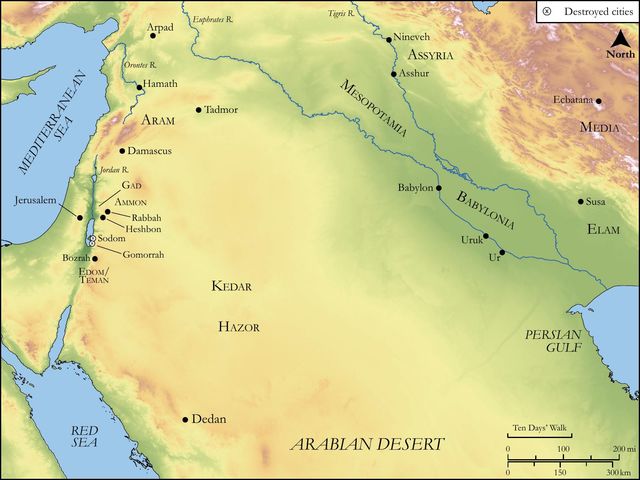
See on the biblical-era map
Study this verse
Public-domain commentary
Matthew Henry
From his Commentary on the Whole Bible. Henry comments on passages, not single verses — this entry covers Jeremiah 49:1–6.
The Ammonites were next, both in kindred and neighbourhood, to the Moabites, and therefore are next set to the bar. Their country joined to that of the two tribes and a half, on the other side Jordan, and was but a bad neighbour; however, being a neighbour, they shall have a share in these circular predictions. 1. An action is here brought, in God's name, against the Ammonites, for an illegal encroachment upon the rightful possessions of the tribe of Gad, that lay next them, Jer 49:1. A writ of enquiry is brought to discover what title they had to those territories, which, upon the carrying away of the Gileadites, by the king of Assyria (Kg2 15:29, Ch1 5:26), were left almost dispeopled, at least unguarded, and an easy prey to the next invader. "What! Does it escheat ob defectum sanguinis - for what of an heir? Hath Israel no sons? Hath he no heir? Are there no Gadites left, to whom the right of inheritance belongs? Or, if there were not, are there no Israelites, none left of Judah, that are nearer akin to them than you are?" Why then does their king, as if he were entitled to the forfeited estates, or Milcom, their idol, as if he had the right to dispose of it to his worshippers, inherit Gad, and his people dwell in the cities which fell by lot to that tribe of God's people. Nay, there were sons and heirs of their own body, en ventre de sa mere - in their mother's womb, and the Ammonites, to prevent their claim, most barbarously murdered them (Amo 1:13): They ripped up the women with child of Gilead, that they might enlarge their border, that, having seized it, none might rise up hereafter to recover it from them. Thus they magnified themselves against their border and boasted it was their own, Zep 2:8. Note, Though among men might often prevails against right, yet that might shall be controlled by the Almighty, who sits in the throne, judging right; and those will find themselves mistaken who think every thing their own which they can lay their hands on, or which none yet appears to lay claim to. As there is justice owing to owners, so also to their heirs, when they are dead, whom it is a great sin to defraud, though they either know not their right or know not how to come at it. This shall be reckoned for particularly, when injuries of this kind are done to God's people. 2. Judgment is here given against them for this violence. (1.) Terrors shall come upon them: God will cause an alarm of war to be heard, even in Rabbah, their capital city and a very strong one, Jer 49:2. The Lord God of hosts, who has all armies at his command, will bring a fear upon them from all that be about them, Jer 49:5. Note, God has many ways to terrify those who have been a terror to his people. (2.) Their cities shall be laid in ruins: Rabbah, the mother-city, shall be a desolate heap, and her daughters, the other cities that have a dependence upon her, and receive law from her as daughters, shall be burnt with fire; so that the inhabitants shall be forced to quit them, and they shall cry, and gird themselves with sackcloth, as having lost all they had, and not knowing whither to betake themselves. (3.) Their country, which they were so proud of, shall be wasted (Jer 49:4): Wherefore gloriest thou in the valleys, and trustest in thy treasures, O backsliding daughter? They are charged with backsliding or turning away from God and from his worship, for they were the posterity of righteous Lot. It is true, they had never been so in covenant with God as Israel was; yet all idolaters may be called backsliders, for the worship of the true God was prior to that of false gods. They were untoward and refractory (so some read it); and, when they had forsaken their God, they gloried in their valleys, particularly one that was called the flowing valley, because it flowed with all good things. These they had violently taken away from Israel, and gloried in it when they had done so. They gloried in the strength of their valleys, so surrounded with mountains that they were inaccessible, gloried in the products of them, gloried in the treasures they got together out of them, saying, Who shall come unto me? While they bathed themselves in the pleasures of their country, they flattered themselves with a conceit that they should never be disturbed in the enjoyment of them: Tomorrow shall be as this day; therefore they set God and his judgments at defiance; they are proud, voluptuous, and secure; but wherefore dost thou do so: Note, Those who backslide and turn away from God have little reason either to take complacency or to put confidence in any worldly enjoyments whatsoever, Hos 9:1. (4.) Their people, from the least to the greatest, shall be forced out of the country. Some shall flee to seek for shelter, others shall be carried into captivity, so that their land shall be quite evacuated: Their king and his princes, nay, and Milcom, their god, and his priests, shall go into captivity (Jer 49:3), and every man shall be driven out right forth, shall take the next way, and make the best of it in his flight (Jer 49:5), forgetting the valleys, the flowing valleys, which now fail them. And, to complete their misery, none shall gather up him that wanders, none shall open their doors to them, as Jael to Sisera, to entertain them; and those that flee shall be so much in care to secure themselves that they shall not take notice of others, no, not of those that are nearest to them, that wander, and are at a loss which way to go, as Jer 47:3. (5.) Then the country of the Ammonites shall fall into the hands of the remaining Israelites (Jer 49:2): Then shall Israel be heir to those that were his heirs, shall possess himself of their land who had possessed themselves of his, by way of reprisal. Note, The equity of divine Providence is to be acknowledged when the losses of the injured are recompensed out of the unjust gains of the injurious. Though the enemies of God's Israel may make a prey of them for a while, the tables will shortly be turned. 3. Yet there is a prospect given them of mercy hereafter (Jer 49:6), as before to Moab. The day will come when the captivity of the children of Ammon will be brought again; for so it is in human affairs: the wheel goes round.
Continue studying Jeremiah 49:1 across the web’s major study libraries — every link below opens this exact verse, chapter, or book on the destination site.
Read & Compare
 BibleGatewayThis verse in more than 200 translations and 70 languages.
 Bible.comThe YouVersion reader — hundreds of translations, reading plans, and highlights.
 ESV.orgCrossway's official English Standard Version reader.
 NET BibleThe NET translation with 60,000+ translators' notes on every rendering decision.
 STEP BibleTyndale House's free study tool — original text, vocabulary, and scholarly resources.
 BibliaLogos Bible Software's free web reader.
 USCCBThe New American Bible (Revised Edition) with the U.S. bishops' study notes.
Commentaries
 BibleHub CommentariesDozens of classic commentaries on this verse, gathered on one page.
 StudyLightMore than 100 commentary sets — the largest collection on the web.
 BibleRefPlain-English commentary on what this verse means, verse by verse.
 Enduring WordDavid Guzik's free commentary on this chapter, widely used by Bible teachers.
 Bible Study ToolsVerse commentary alongside Greek and Hebrew study aids.
Original Language & Research
- BibleHub InterlinearThe verse word by word — original language, transliteration, and English.
- BibleHub LexiconEvery word's original-language definition and Strong's entry.
 Blue Letter BibleDeep-study tools — Strong's numbers, concordance, and word studies.
 SefariaThe Hebrew text with Rashi and centuries of Jewish commentary.
Sermons, Hymns & Audio


TrulyRandomVerse is not affiliated with these sites and doesn’t control their content. They’re linked because they’re genuinely useful.
Summary
Jeremiah 49:1 inaugurates a divine oracle of judgment against the Ammonites, a nation east of the Jordan, specifically condemning their audacious and unjust occupation of territory belonging to the Israelite tribe of Gad. Through a series of impassioned rhetorical questions, the LORD expresses profound indignation at this usurpation, asserting Israel's enduring claim to their divinely allotted inheritance despite their current vulnerability. This prophetic declaration not only highlights God's universal sovereignty and His unwavering commitment to justice for His covenant people but also exposes the covetousness and territorial aggression of the Ammonite king and his people, setting the stage for divine retribution.
Context
ShowHideLiterary Context
Jeremiah 49:1 serves as the opening statement of a distinct oracle within the broader collection of "Oracles Against the Nations" spanning Jeremiah chapters 46-51. This section is strategically placed, demonstrating Yahweh's absolute authority and judicial oversight not only over Israel but over all surrounding nations. Preceding this particular oracle are judgments against powerful entities like Egypt and Philistia, while subsequent prophecies target Edom, Damascus, Kedar, Hazor, and Elam, culminating in the extensive oracle against Babylon. This literary arrangement underscores God's comprehensive dominion as the universal Judge, dispelling any notion of a localized or tribal deity. The specific focus on the Ammonites here addresses a particular, long-standing grievance that deeply resonated with Israel's historical identity and their divinely promised land.
Historical & Cultural Context
The Ammonites were descendants of Ben-Ammi, a son born to Lot through an incestuous union (as detailed in Genesis 19:38), establishing them as distant relatives of Israel. Their territory was situated directly east of the Jordan River, bordering the Israelite tribes of Reuben and Gad. Throughout their history, the relationship between Israel and Ammon was frequently adversarial, marked by territorial disputes and military conflicts, as evidenced during the period of the Judges (e.g., Judges 10:6-9) and the united monarchy (e.g., 1 Samuel 11:1-11). The specific grievance articulated in Jeremiah 49:1—the Ammonite occupation of Gad's territory—most likely occurred during a period of Israel's weakness, perhaps following the Assyrian deportations of the northern tribes (734-722 BC) or during the early stages of the Babylonian exile (605-586 BC) when Judah was destabilized. The Ammonites, perceiving an opportunity, expanded their kingdom into the vulnerable or depopulated lands of Gad, which had been part of Israel's divinely promised inheritance since the time of Joshua (see Joshua 13:24-28).
Key Themes
ShowHideThis verse significantly contributes to several overarching theological themes prevalent in Jeremiah and the broader Old Testament. Firstly, it powerfully asserts Divine Sovereignty and Justice, as the authoritative declaration "thus saith the LORD" unequivocally proclaims God's ultimate dominion over all nations and His unwavering commitment to executing justice. He observes and will rectify the unrighteous actions of nations, particularly when they infringe upon the rights and inheritance of His covenant people. Secondly, the rhetorical questions, "Hath Israel no sons? hath he no heir?", underscore God's unwavering commitment to the Defense of Israel's Inheritance. This highlights God's faithfulness to His covenant promises regarding the land He graciously granted to His people, even when they appear to be in a state of desolation or exile. The questions imply a clear affirmative: Israel does indeed have rightful heirs, and God will ensure their claim. Lastly, the verse serves as a strong Condemnation of Usurpation and Covetousness. The Ammonites' act of "inherit[ing] Gad" and "dwell[ing] in his cities" is depicted as a grave offense against divine order and justice, emphasizing the crucial biblical principle of respecting established boundaries and refraining from seizing what rightfully belongs to others, a principle deeply embedded in the Ten Commandments (Exodus 20:17).
Exposition and Analysis
ShowHideKey Word Analysis
ShowHideFrom the verb "to be" (הָיָה), this is the sacred, covenant name of God, often translated as "Yahweh." It signifies His eternal, self-existent nature and His unwavering faithfulness to His promises. Its use in the prophetic formula "thus saith the LORD" emphasizes that this is not merely Jeremiah's human opinion but a direct, authoritative decree from the sovereign God who holds all nations accountable and remains steadfastly faithful to His covenant with Israel.
Derived from a root meaning "to build" (בָּנָה), this word primarily denotes a son as a builder or perpetuator of the family name and lineage. In this context, "sons" and "heir" (which shares a semantic connection with "inherit") refer to legitimate descendants who would naturally inherit and populate the land. The rhetorical question "Hath Israel no sons?" conveys divine indignation, implying that despite Israel having rightful heirs, their land is being unlawfully occupied by a foreign power. It powerfully asserts the continuity of Israel's lineage and their enduring, divinely sanctioned claim to their inheritance.
This primitive root (יָרַשׁ) carries a multifaceted meaning: "to occupy (by driving out previous tenants, and possessing in their place)," or by implication, "to seize," "to rob," or "to inherit." Here, it critically highlights the Ammonites' unlawful acquisition of Gad's territory, not through legitimate succession or divine grant, but through forceful seizure and displacement. The word underscores the profound injustice of their action, as they "inherit" what was never theirs by right, but rather by violent usurpation, a direct affront to God's established order.
Verse Breakdown
ShowHide"¶ Concerning the Ammonites, thus saith the LORD;"
This opening clause immediately identifies the specific target of the prophecy—the Ammonites—and unequivocally establishes its divine origin. The phrase "thus saith the LORD" is a quintessential prophetic formula, asserting that the message is not merely Jeremiah's human insight or political commentary but a direct, authoritative revelation from Yahweh, the supreme God of Israel and all nations. It sets a solemn and authoritative tone for the declaration of judgment that follows.
"Hath Israel no sons? hath he no heir?"
These are potent rhetorical questions, designed not to elicit information but to express God's profound indignation, incredulity, and even a sense of outrage. The implied answer is a resounding "Of course, Israel has sons and heirs!" These questions underscore Israel's legitimate, continuous, and divinely ordained claim to the land of Gad. God is essentially challenging the Ammonites' presumption: "Why is a foreign nation occupying land that rightfully belongs to My people, who possess a continuous lineage and a divine right to inherit it?" It highlights the blatant disregard by the Ammonites for both Israel's divine covenant and their rightful possession.
"why [then] doth their king inherit Gad, and his people dwell in his cities?"
This final clause articulates the specific, egregious grievance that provokes divine wrath. The Ammonite king and his people have unlawfully "inherited" (meaning seized and possessed) the territory of Gad and settled in its cities. This act of territorial expansion at Israel's expense is presented as a direct affront to divine justice and a violation of Israel's sacred, God-given inheritance. It exposes the covetous, aggressive, and opportunistic nature of Ammon's actions, which God declares He will not tolerate.
Literary Devices
ShowHideJeremiah 49:1 masterfully employs several potent literary devices to convey its powerful message of divine judgment. The most prominent is the Rhetorical Question ("Hath Israel no sons? hath he no heir? why then doth their king inherit Gad...?"). These questions are not posed to elicit information but to express profound Divine Indignation and to emphasize the glaring injustice of the Ammonites' actions. The implied answer to the initial two questions is a resounding "Yes, Israel does indeed have sons and heirs!", thereby highlighting the utter illegitimacy of Ammon's claim. The subsequent "why then" question directly challenges the Ammonites' presumptuous usurpation and underscores the absurdity of their actions in the face of God's enduring covenant with Israel. Furthermore, there is an element of Personification where "Israel" is treated as a "he" who should have sons and heirs to secure his inheritance, making the violation of his land rights feel more personal and egregious from God's perspective. The entire passage functions as a Prophetic Oracle of Judgment, marked by the authoritative "thus saith the LORD," which establishes its divine origin and the certainty of its fulfillment.
Theological and Thematic Connections
ShowHideJeremiah 49:1 profoundly connects to the broader biblical narrative of God's universal sovereignty and His unwavering faithfulness to His covenant promises. The LORD's palpable indignation over the Ammonite usurpation of Gad's territory reiterates that God is not indifferent to geopolitical injustices, especially when they directly impact His chosen people and their divinely allotted inheritance. This passage reinforces the theological truth that God's justice extends far beyond Israel's borders, demonstrating His universal dominion and His commitment to upholding righteousness among all peoples and nations. It serves as a powerful reminder that while human empires rise and fall, God's ultimate plan and His promises to His people will prevail, even when they appear to be at their weakest or most vulnerable. The rhetorical question concerning Israel's "heir" foreshadows a deeper theological truth about the ultimate heir of God's promises, pointing beyond mere physical inheritance to a spiritual reality.
Reflection and Application
ShowHideJeremiah 49:1 offers profound insights for contemporary believers, reminding us that God is actively and intimately engaged in the affairs of the world, and that His justice will ultimately prevail. Even when His people seem vulnerable, dispossessed, or forgotten, God remembers His covenant promises and will decisively address injustices. This truth provides immense comfort and assurance, especially when we consider that our ultimate spiritual inheritance in Christ is eternally secure, regardless of present circumstances, earthly losses, or external threats. The passage also serves as a potent warning against the insidious sins of covetousness, greed, and the unlawful seizure of what rightfully belongs to others, whether it be physical property, a person's reputation, or opportunities that are not ours to take. We are called to live as those who respect boundaries, uphold justice, and trust implicitly in God's perfect timing for vindication and restoration. This divine oracle encourages us to pray fervently for justice in our broken world and to actively participate in God's work of righteousness, recognizing His sovereign hand over all nations and individuals.
Questions for Reflection
ShowHideFAQ
ShowHideWho were the Ammonites, and what was their relationship with Israel?
ShowHideThe Ammonites were a Semitic people descended from Ben-Ammi, the son born to Lot through an incestuous union with his younger daughter, as recorded in Genesis 19:38. Their territory was situated directly east of the Jordan River, bordering the Israelite tribes of Reuben and Gad. Historically, their relationship with Israel was consistently adversarial, marked by frequent territorial disputes and military conflicts. Notable examples include their oppression of Israel during the time of the Judges, which prompted Jephthah's leadership (Judges 11:12-33), and their aggression against Jabesh-Gilead, which led to King Saul's first major victory (1 Samuel 11:1-11). They were generally perceived as hostile neighbors who frequently sought to exploit Israel's vulnerabilities.
Why was God angry with the Ammonites in Jeremiah 49:1?
ShowHideGod's anger stemmed from the Ammonites' unjust, covetous, and opportunistic act of seizing and occupying the territory belonging to the Israelite tribe of Gad. This land was not merely a piece of real estate; it was an integral part of Israel's divinely promised and allotted inheritance, as meticulously detailed in Joshua 13:24-28. The Ammonites took advantage of Israel's weakness and vulnerability, likely during periods of Assyrian or Babylonian invasion and subsequent depopulation, to expand their own kingdom at Israel's expense. God's rhetorical questions, "Hath Israel no sons? hath he no heir?", powerfully express His indignation that a foreign nation would usurp land that rightfully belonged to His covenant people, who still had legitimate descendants to inherit and dwell in it.
What is the significance of the land of Gad in this prophecy?
ShowHideThe land of Gad was one of the territories east of the Jordan River that was specifically allotted to the Israelite tribes by divine decree following the conquest of Canaan (Numbers 32:33, Joshua 13:24-28). Its profound significance lies in its status as a tangible component of Israel's covenant inheritance from God. Therefore, the Ammonites' occupation of Gad's cities was not merely a geopolitical land grab or a minor border dispute; it was a direct affront to God's faithfulness to His promises to Israel and a blatant violation of the divine order He had established. By challenging this usurpation, God emphatically reaffirmed His unwavering commitment to His people's rightful claim to their inheritance, even when they were in a state of vulnerability or apparent desolation.
Christ-Centered Fulfillment
ShowHideJeremiah 49:1, with its poignant rhetorical questions, "Hath Israel no sons? hath he no heir?", finds its ultimate Christ-centered fulfillment in Jesus, the true Son and ultimate Heir of all things. While the prophet laments the apparent lack of an heir to claim Israel's earthly inheritance, the New Testament gloriously reveals that God's promises culminate in Christ, who is definitively declared the "heir of all things" (Hebrews 1:2). Jesus is the faithful Israel, the perfect Son who perfectly embodies the nation's calling and secures a spiritual inheritance infinitely grander and more enduring than any earthly territory. Through His atoning work on the cross and His glorious resurrection, Christ establishes a new covenant people, the church, who are miraculously made "heirs of God and fellow heirs with Christ" (Romans 8:17). The physical land of Gad, unjustly usurped by Ammon, thus serves as a powerful type, pointing forward to a spiritual inheritance that cannot be stolen, diminished, or lost—an inheritance of eternal life, perfect righteousness, and an assured place in God's eternal kingdom, secured for all who are found "in Christ" (Ephesians 1:11). Therefore, the divine indignation over a lost earthly inheritance is ultimately and gloriously resolved in the secure, eternal, and boundless inheritance provided through the ultimate Son and Heir, Jesus Christ.