


Ezekiel 25:10
Bible text: King James Version (1769 Blayney text) · Public domain
Bible text: King James Version with Strong's numbers · Public domain
Bible text: Berean Standard Bible · Public domain
Bible text: American Standard Version (1901) · Public domain
Bible text: World English Bible, Messianic edition · Public domain
Bible text: Geneva Bible (1599) · Public domain
Bible text: Young's Literal Translation · Public domain
- לִבְנֵיliv·neito [the] people ofH1121Prep-l ¦ N-mpcNoun Plural Masculine Constructלִtoבְנֵי[the] people of
- קֶדֶםke·dem[the] eastH6924N-msNoun Singular Masculine Absolute
- עַל'alwithH5921PrepPreposition
- בְּנֵיbe·Nei[the] people ofH1121N-mpcNoun Plural Masculine Construct
- עַמּוֹןa·MonAmmonH5983N-proper-mNoun Proper Masculine
- וּנְתַתִּיהָu·ne·ta·Ti·haand I will give itH5414Conj-w ¦ V-Qal-ConsecPerf-1cs ¦ 3fsVerb Qal Consecutive Perfect 1st Singular common genderוּandנְתַתִּיI will giveהָit
- לְמוֹרָשָׁהle·mo·ra·Shahto a possessionH4181Prep-l ¦ N-fsNoun Singular Feminine Absoluteלְtoמוֹרָשָׁהa possession
- לְמַעַןle·Ma·'anso thatH4616PrtParticle Conditional
- לֹאlo'notH3808NegParticle Negative
- תִזָּכֵרti·za·Kherit will be rememberedH2142V-Niphal-Imperf-3fsVerb Niphal Imperfect 3rd Singular Feminine
- בְּנֵיbe·nei[the] people ofH1121N-mpcNoun Plural Masculine Construct
- עַמּוֹןa·MonAmmonH5983N-proper-mNoun Proper Masculine
- בַּגּוֹיִםba·go·Yimamong the nationsH1471Prep-b ¦ N-mpNoun Plural Masculine Absoluteבַּamong theגּוֹיִםnations
English is a literal word-by-word gloss of the Hebrew, not the KJV's wording. Why?
This is the original text the KJV's translators worked from — each Hebrew word with its own literal English meaning in this verse, prepared by scholars at Tyndale House, Cambridge. The KJV translates whole sentences, not word by word, so its wording differs: one Hebrew word can become several English words, and the KJV may choose “the LORD” where the gloss reads “Yahweh”. Both are faithful — they answer different questions. For the KJV's own rendering, switch to the KJV text.
Details
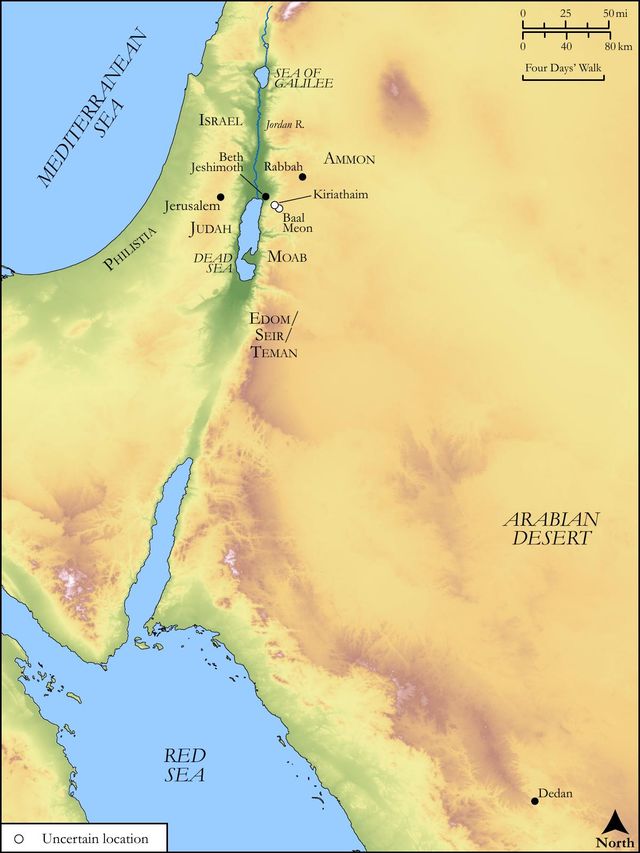
See on the biblical-era map
Study this verse
Public-domain commentary
Matthew Henry
From his Commentary on the Whole Bible. Henry comments on passages, not single verses — this entry covers Ezekiel 25:8–17. His three-level outline is real structure in the source text, so it is rendered as structure.
Three more of Israel's ill-natured neighbours are here arraigned, convicted, and condemned to destruction, for contributing to and triumphing in Jerusalem's fall.
I.The Moabites.
Seir, which was the seat of the Edomites, is joined with them (Eze 25:8), because they said the same as the Moabites; but they were afterwards reckoned with by themselves, Eze 25:12. Now observe,
1.What was the sin of the Moabites; they said, Behold, the house of Judah is like unto all the heathen. They triumphed,
(1.)In the apostasies of Israel, were please to see them forsake their God and worship idols, and hoped that in a while their religion would be quite lost and forgotten and the house of Judah would be like all the heathen, perfect idolaters. When those that profess religion walk unworthy of their profession they encourage the enemies of religion to hope that it will in time sink, and be run down, and quite abandoned; but let the Moabites know that, though there are those of the house of Judah who have made themselves like the heathen, yet there is a remnant that retain their integrity, the religion of the house of Judah shall recover itself, its peculiarities shall be preserved, it shall not lose itself among the heathen, but distinguish itself from them, till it deliver itself honourably into a better institution.
(2.)In the calamities of Israel. They said, "The house of Judah is like all the heathen, in as bad a state as they; their God is no more able to deliver them from this overflowing scourge of these parts of the world than the gods of the heathen are to deliver them. Where are the promises they gloried in and all the wonders which they and their fathers told us of? What the better are they for the covenant of peculiarity, upon which they so much valued themselves? Those that looked with so much scorn upon all the heathen are now set upon a level with them, or rather sunk below them." Note, Those who judge only by outward appearance are ready to conclude that the people of God have lost all their privileges when they have lost their worldly prosperity, which does not follow, for good men, even in affliction, in captivity among the heathen, have graces and comforts within sufficient to distinguish them from all the heathen. Though the event seem one to the righteous and wicked, yet indeed it is vastly different.
2.What should be the punishment of Moab for this sin; because they triumphed in the overthrow of Judah, their country shall be in like manner overthrown with that of the Ammonites, who were guilty of the same sin (Eze 25:9, Eze 25:10): "I will open the side of Moab, will uncover its shoulder, will take away all its defences, that it may become an easy prey to any that will make a prey of it." (1.) See here how it shall be exposed; the frontier-towns, that were its strength and guard, shall be demolished by the Chaldean forces, and laid open. Some of the cities are here named, which are said to be the glory of the country, which they trusted in, and boasted of as impregnable; these shall decay, be deserted, or betrayed, or fall into the enemies' hands, so that Moab shall lie exposed, and whoever will may penetrate into the heart of the country. Note, Those who glory in any other defence and protection than that of the divine power, providence, and promise, will sooner or later see cause to be ashamed of their glorying. (2.) See here to whom it shall be exposed: The men of the east, when they come to take possession of the country of the Ammonites, shall seize that of the Moabites too. God, the Lord of all lands, will give them that land; for the kingdoms of men he gives to whomsoever he will. The Arabians, who are shepherds, and live quietly, plain men dwelling in tents, shall by an overruling Providence be put in possession of the land of the Moabites, who are soldiers, men of war, and cunning hunters, that live turbulently. The Chaldeans shall get it by war, and the Arabians shall enjoy it in peace. Concerning the Ammonites it is said, They shall no more be remembered among the nations (Eze 25:10), for they had been accessory to the murder of Gedaliah, Jer 40:14. But of the Moabites it is said, I will execute judgments upon Moab; they shall feel the weight of God's displeasure, but perhaps not to that degree that the Ammonites shall; however, so far as that they shall know that I am the Lord, that the God of Israel is a God of power, and that his covenant with his people is not broken.
II.The Edomites, the posterity of Esau, between whom and Jacob there had been an old enmity. And here is,
1.The sin of the Edomites, Eze 25:12. They not only triumphed in the ruin of Judah and Jerusalem, as the Moabites and Ammonites had done, but they took advantage from the present distressed state to which the Jews were reduced to do them some real mischiefs, probably made inroads upon their frontiers and plundered their country: Edom has dealt against the house of Judah by taking vengeance. The Edomites had of old been tributaries to the Jews, according to the sentence that the elder should serve the younger. In Jehoram's time they revolted. Amaziah severely chastised them (Kg2 14:7), and for this they took vengeance. Now they would pay off all the old scores, and not only incensed the Babylonians against Jerusalem, crying, Rase it, rase it (Psa 137:7), but cut off those that escaped, as we find in the prophecy of Obadiah, which is wholly directed against Edom, Eze 25:11, Eze 25:12, etc. It is called here revenging a revenge, which intimates that they were not only eager upon it, but very cruel in it, and recompensed to the Jews more than double. "Herein he has greatly offended." Note, It is a great offence to God for us to revenge ourselves upon our brother; for God has said, Vengeance is mine. We are forbidden to revenge or to bear a grudge. Suppose Judah had been hard upon Edom formerly, it was a base thing for the Edomites now, in revenge for it, to smite them secretly. But the Jews had a divine warrant to reign over the Edomites, for that therefore they ought not to have made reprisals; and it was the more disingenuous for them to retain the old enmity when God had particularly commanded his people to forget it. Deu 23:7, Thou shalt not abhor an Edomite.
2.The judgments threatened against them for this sin. God will take them to task for it (Eze 25:13): I will stretch out my hand upon Edom Their country shall be desolate from Teman, which lay in the south part of it; and they shall fall by the sword unto Dedan, which lay north; the desolations of war should go through the nation.
(1.)They had taken vengeance, and therefore God will lay his vengeance upon them (Eze 25:14): They shall know my vengeance. Those that will not leave it to God to take vengeance for them may expect that he will take vengeance on them; and those that will not believe and fear his vengeance shall be made to know and feel his vengeance; they shall be dealt with according to God's anger and according to his fury, not according to the weakness of the instruments that are employed in it, but according to the strength of the arm that employs them.
(2.)They had taken vengeance on Israel, and God will lay his vengeance on them by the hand of his people Israel. They suffered much by the Chaldeans, which seems to be referred to, Jer 49:8. But besides that there were saviours to come upon Mount Zion, who should judge the mount of Esau (Oba 1:21), and Israel's Redeemer comes with dyed garments from Bozrah (Isa 63:1), this implies a promise that Israel should recover itself again to such a degree as to be in a capacity of curbing the insolence of its neighbours. And we find (1 Macc. 5:3) that Judas Maccabeus fought against the children of Esau in Idumea, gave them a great overthrow, abated their courage, and took their spoil; and Josephus says (Antiq. 13.257), that Hircanus made the Edomites tributaries to Israel. Note, The equity of God's judgments is to be observed when he not only avenges injuries upon those that did them, but by those against whom they were done.
III.The Philistines. And,
1.Their sin is much the same with that of the Edomites: They have dealt by revenge with the people of Israel, and have taken vengeance with a despiteful heart, not to disturb them only, but to destroy them, for the old hatred (Eze 25:15), the old grudge they bore them, or (as the margin reads it) with perpetual hatred, a hatred that began long since and which they resolved to continue. The anger was implacable: they dealt by revenge, traded in the acts of malice; it was their constant practice, and their heart, their spiteful heart, was upon it.
2.Their punishment likewise is much the same, Eze 25:16. Those that were for destroying God's people shall themselves be cut off and destroyed; and (Eze 25:17) those that were for avenging themselves shall find that God will execute great vengeance upon them. This was fulfilled when that country was wasted by the Chaldean army, not long after the destruction of Jerusalem, which is foretold, Jer 47:1-7. It was strange that these nations, which bordered upon the land of Israel, were not alarmed by the success of the Chaldean army, and made to tremble in the apprehension of their own danger; when their neighbour's house was on fire it was time to look to their own; but their impiety and malice made them forget their politics, till God by his judgments convinced them that the cup was going round, and they were the less safe for being secure.
Historical interpretation
Historical reception
3 surviving comments on this verse. Each one is dated, so this reads as a timeline rather than a list.
(Verse 35, 36, and following) And I will bring you into a desert of peoples, and there I will judge you face to face. Just as I contended with your fathers in the desert of the land of Egypt, so I will judge you, says the Lord. And I will subject you to my scepter, and I will bring you into the bonds of the covenant, and I will choose from among you the transgressors and the wicked: from their place of residence I will bring them out, and they will not enter the land of Israel, and you will know that I am the Lord. Thus says the Lord: I will do for you who are in Babylon, and now serve idols, what I did for your ancestors in Egypt. I will lead you into the desert of the peoples, and there I will judge you face to face, just as I contended with them in judgment when they came out of Egypt. And after I have judged you, I will subject you to my scepter and rule, and I will make a covenant with you and bring you into your land with the bonds of love, so that bound by my love, you will never be able to depart from me. But I will choose from among you the transgressors and the wicked, who persist in the hardness of their hearts in evil deeds, not for possession, but for rejection. And I will indeed bring them out of the land of their dwelling, so that when they are brought out, they will not enter the land of Israel; but they will perish in various regions. And by the distinction between good and evil, you shall know that I am the Lord, who judges all things. The rest of the discourse hastens, and we briefly go through each point, in order to provide only the meaning to the readers.
(Verse 27, 29 onwards) Therefore speak to the house of Israel, son of man, and tell them: Thus says the Lord God: Moreover, your fathers have blasphemed against me and have treated me with contempt, even as they spurned me. And I brought them into the land that I had lifted my hand to give them ((Vulgate adds: that land)): they saw every high hill and every leafy tree, and there they offered their sacrifices and presented there the irritation of their offerings, and they placed there the fragrance of their sweetness, and they poured out their ((Vulgate is silent on this)) libations there. And I said to them, 'What is the high place to which you are going?' And its name was called the High Place until this day. Therefore speak to the house of Israel, son of man, and say to them, 'Thus says the Lord God: As for your fathers, they have provoked Me to anger by their iniquities, by the fact that they have fallen away from Me. So I brought them into the land that I had lifted My hand in an oath to give them.' They saw every high hill and every leafy tree, and there they offered their sacrifices. They also presented there the provocation of their gifts, and they set there their pleasing aroma, and they poured out there their drink offerings. And I said to them: What is abbana, because you enter there? And they called its name abbana until this day. I wanted, he said, to scatter them in the wilderness, and to give them not good precepts, so that they would sacrifice to idols what they should have offered to me, and consecrate all their first-fruits to them by fire, so that I might kill them and destroy them. But when he says, I wanted, he shows that he did not do what he wanted. And that which follows: 'And they shall know that I am the Lord,' is not found in the Septuagint. For it did not seem fitting to them to know after their destruction that he himself is the Lord. But you, son of man, speak again to them, that is, to the elders of the house of Israel, who have come to inquire of you: Your fathers, from whom you have descended, have also blasphemed against me and held me in contempt; after I brought them into the land which I had given them to possess, they turned against me to provoke me. For when they saw every high hill and leafy tree, they would sacrifice on the mountains and in the groves and thickets, and offer victims to the idols, and pour out libations. And when I saw this, I said to them: What is this, Bama? for it is called high: or why do you enter into such a place which you have chosen for yourselves in all the hills, so that even today these places are called Bamoth, and the ancient error retains its original name? Regarding Bama, which we translate as excelsum, there is an error in the Septuagint edition, where it is written as ἀββανὰ, which does not resonate in the Hebrew language. Bama can mean 'in which' if the two syllables are divided into two words, but in the present context, that sense does not fit. However, wherever it is written in the Books of Kings and Chronicles: 'The people still sacrificed and offered incense on the high places,' Bama in the singular and Bamoth in the plural mean 'high places.'
(Verse 8 onwards) This is what the Lord God says: Because Moab and Seir have said, 'Look, just like all the other nations, the house of Judah is also ours,' therefore I will expose Moab's shoulder, including its cities, with the renowned land of Beth Jesimoth, Beelmeon, and Kariathaim. I will give it to the people of the East along with the Ammonites as their inheritance, so that the Ammonites will no longer be remembered among the nations. I will also execute judgments against Moab, and they will know that I am the Lord. LXX: Thus says the Lord God: Because Moab and Seir said, 'Behold, the house of Judah is like all the other nations.' Therefore, behold, I will open up the shoulder of Moab from the cities of its coastline, the choice land, the house of Beth Jasimuth, on the spring of the coastal city. I have given the sons of the East as an inheritance to the sons of Ammon, so that the sons of Ammon may not be remembered among the nations. And I will execute vengeance upon Moab, and they shall know that I am the Lord. What we have interpreted and added from the edition of Theodotion is not found in the Septuagint. But the Hebrews tell a ridiculous fable in this place. After the city was opened and the temple was unlocked, the sons of Ammon, Moab, and Seir entered the temple and saw the Cherubim protecting the propitiatory, and they said: Just as all nations worship idols, so Judah also has idols of its own religion; and therefore, they say, the Lord is angry and has delivered them into captivity. But we shall say this, that they also insulted the house of Judah when it was captured by the Chaldeans, thinking that, as in the case of other nations, there was no divine help there, and therefore the kingdom of Judah and the city of Jerusalem, deprived of God's protection, fell under the power of Babylon. Therefore, not long afterwards, but at present, the Lord threatens that he will destroy or open his strong and fortified cities in Moab, so that even the victorious Babylonians might enter them, and the cities in Moab might cease to exist, and the famous cities in its borders and territories might be destroyed: among which he names Beth Jeshimoth, and Beelmeon, and Kiriathaim: for which, I don't know what reason, the Septuagint translators rendered them as the house of Beth Iasimuth, though this word signifies a deserted village; and Beelmeon is still today a very large town in Moab, which they translated as "over the spring," and Kiriathaim, a coastal city; and it is handed down, together with the sons of Ammon, the sons of the East, to the Babylonians, namely, according to that interpretation which we have presented against the sons of Ammon. And I will give, he says, Moab as an inheritance, that just as there is no more memory of the sons of Ammon among the nations, so I will also execute vengeance and judgment on Moab, so that they will know that I am the Lord, who delivered Judah because of sin, and I will be an avenger against the sons of Ammon and Moab. However, Moab, which is interpreted as 'from the father,' and Seir, which is turned into hairy and rough, despises and scorns the house of Judah, in which true confession resides, and thinks that it can be easily overthrown, just as the fortifications of other cities are overthrown. And the Lord threatens to open himself up, or to dissolve all the strength of the Moabites, so that they may cease to have cities and may not at all trust in the art of dialectic. But all those boundaries, which they call headlands for the purpose of deceiving the waves, shall be destroyed; and the famous and chosen land of Beth Jesimoth, which means the house of solitude and desert, and Beelmeon, which also means having a spring, or above a spring, and Cariathaim, which the 70 translated as a maritime city, shall perish. For although they may have the strength of warriors, and may proceed to battle with the art of fighting, and may march surrounded and fortified on every side: nevertheless, their famous land is not a home of habitation, but a home of solitude. And what they think they have, a source of knowledge, and a maritime city, which can withstand all the storms of the world, promising patience and fortitude to themselves: yet they will be converted there, so that they may be handed over to the sons of the East, the true light in Christ; just as the sons of Ammon were handed over, who trusted themselves in a heretical multitude. And let us consider the progress and, in the very act of punishment, the mercy of God, so that the sons of Ammon, the sons of the East, may be delivered into inheritance. And let no heresy be named among the nations. But let them come to know, at the end of things, through the judgments and punishments for their arrogance, that the Lord is the one who governs all. Now, in order to prove that the current place of the Moabites is above the pride of the philosophers, about whom it is said: 'I will destroy the wisdom of the wise, and the discernment of the discerning I will thwart' (1 Corinthians 1:19), a few examples from the prophets need to be repeated. Amos speaks: Thus says the Lord: Against three crimes of Moab, and against four I will not revoke it, because he burned the bones of the king of Edom into ashes (Amos II, 1). Indeed, whatever is of perverse teachings in the world, whatever pertains to earthly knowledge, and is considered to be strong, is subverted by the art of dialectic and dissolved like fire into ashes and embers, in order to prove that which was thought to be the strongest is nothing. But Isaiah rebukes the pride of Moab, saying: We have heard the pride of Moab: he is exceedingly proud; his pride is taken away (Isa. XVI). Jeremiah also, prophesying against all the nations, speaks directly to Moab: Because you trusted in your fortifications (Jerem. XLVIII, 7). And shortly after: You will have confidence in your glory. And again: How do you say, We are mighty? And then: The day of Moab is near, and his malice is exceedingly swift (Ibid. 14, 10). And more plainly: Declare how the glorious staff is broken, the rod of majesty (Ibid., 20). And again: The horn of Moab is broken. But these things are said so that under the name of Moab, the foolishness of the world, exalting itself to heaven, may be shattered by pride.
Continue studying Ezekiel 25:10 across the web’s major study libraries — every link below opens this exact verse, chapter, or book on the destination site.
Read & Compare
 BibleGatewayThis verse in more than 200 translations and 70 languages.
 Bible.comThe YouVersion reader — hundreds of translations, reading plans, and highlights.
 ESV.orgCrossway's official English Standard Version reader.
 NET BibleThe NET translation with 60,000+ translators' notes on every rendering decision.
 STEP BibleTyndale House's free study tool — original text, vocabulary, and scholarly resources.
 BibliaLogos Bible Software's free web reader.
 USCCBThe New American Bible (Revised Edition) with the U.S. bishops' study notes.
Commentaries
 BibleHub CommentariesDozens of classic commentaries on this verse, gathered on one page.
 StudyLightMore than 100 commentary sets — the largest collection on the web.
 BibleRefPlain-English commentary on what this verse means, verse by verse.
 Enduring WordDavid Guzik's free commentary on this chapter, widely used by Bible teachers.
 Bible Study ToolsVerse commentary alongside Greek and Hebrew study aids.
Original Language & Research
- BibleHub InterlinearThe verse word by word — original language, transliteration, and English.
- BibleHub LexiconEvery word's original-language definition and Strong's entry.
 Blue Letter BibleDeep-study tools — Strong's numbers, concordance, and word studies.
 SefariaThe Hebrew text with Rashi and centuries of Jewish commentary.
Sermons, Hymns & Audio


TrulyRandomVerse is not affiliated with these sites and doesn’t control their content. They’re linked because they’re genuinely useful.
Summary
Ezekiel 25:10 delivers a severe divine judgment against the Ammonites, declaring that their territory will be given over to "the men of the east" as a permanent possession, leading to their complete national obliteration. This pronouncement serves as a direct consequence for their malicious joy, contempt, and opportunistic actions displayed towards Judah during its time of destruction and exile, powerfully underscoring God's righteous sovereignty over all nations and His unwavering commitment to justice for His covenant people.
Context
ShowHideLiterary Context
Ezekiel 25:10 is strategically positioned within a series of prophetic oracles (Ezekiel 25-32) that pronounce judgment against the nations surrounding Israel. This section immediately follows the prophecies concerning Judah's fall and the destruction of Jerusalem, serving to affirm God's universal sovereignty and His meticulous attention to justice, even against those who gloated over His people's suffering. Chapter 25 specifically targets four nations: Ammon (verses 1-7), Moab (verses 8-11), Edom (verses 12-14), and Philistia (verses 15-17). The verses preceding Ezekiel 25:10 detail the Ammonites' specific transgressions: their clapping of hands, stamping of feet, and malicious rejoicing over the desolation of Israel and the destruction of the temple, as highlighted in Ezekiel 25:3 and Ezekiel 25:6. Thus, verse 10 functions as the climactic and devastating pronouncement of their deserved punishment, completing the judgment against Ammon.
Historical & Cultural Context
The Ammonites, tracing their lineage to Lot through his younger son Ben-Ammi (Genesis 19:38), occupied a strategic territory east of the Jordan River, bordering Israel. Throughout Israelite history, they were consistent adversaries, engaging in frequent conflicts with figures such as Jephthah (Judges 11:4-33) and King Saul (1_samuel/11-1-11). Their animosity intensified during Judah's decline, culminating in their open mockery and opportunistic actions during Jerusalem's fall to Babylon. The phrase "men of the east" (Hebrew: bene qedem) refers to nomadic tribes, likely from the Arabian Desert, known for their raiding activities and ability to overrun settled territories. Historically, Ammonite territory was indeed overrun by various eastern peoples and later incorporated into larger empires, eventually leading to their disappearance as a distinct national entity by the Hellenistic period, thereby fulfilling this ancient prophecy.
Key Themes
ShowHideThis verse powerfully contributes to several overarching themes found within the book of Ezekiel and the broader prophetic literature. Foremost is the theme of Divine Judgment, which unequivocally demonstrates God's righteous wrath against nations that oppose His will and maliciously mistreat His chosen people. It underscores that no nation, regardless of its perceived power or independence, is exempt from His ultimate authority and accountability. Another prominent theme is the Consequences of Malice and Schadenfreude; the Ammonites' hostile rejoicing over Israel's calamity directly leads to their own destruction, serving as a stark reminder that attitudes of contempt, pride, and lack of compassion do not go unpunished by God, as also warned in Proverbs 17:5. Furthermore, the declaration "that the Ammonites may not be remembered among the nations" highlights the theme of Eradication of Identity, signifying a complete national obliteration and loss of historical legacy—a severe form of divine retribution for their persistent antagonism. Lastly, the verse vividly illustrates God's Sovereignty over History and Nations, as He explicitly declares His intention to use other peoples, "the men of the east," as instruments to execute His predetermined judgment, echoing similar divine orchestrations found in Isaiah 10:5-7.
Exposition and Analysis
ShowHideKey Word Analysis
ShowHideThis phrase combines bên (H1121), meaning "son" or "descendant," often used collectively to denote a group or people, and qedem (H6924), referring to "the front," "antiquity," or "the East." Together, "men of the east" denotes nomadic tribes originating from the Arabian Desert. In this prophetic context, they are not merely geographical neighbors but divinely appointed instruments, signifying an external, perhaps unexpected, force that God will use to execute His judgment upon the Ammonites.
This word (H4181) is a feminine noun derived from a root meaning "to inherit" or "to possess." It signifies a permanent holding, an inheritance, or a rightful possession. Here, it emphasizes the complete and irrevocable transfer of the Ammonite territory from their control to that of "the men of the east," highlighting the finality of their dispossession and the loss of their ancestral land as a permanent, divinely ordained transfer.
The verb zâkar (H2142) means "to mark so as to be recognized," "to recall," or "to mention." In the negative construction "may not be remembered," it signifies more than mere forgetfulness. It implies the complete annihilation of their national identity, their distinct presence, and their historical legacy. This is a profound and devastating judgment, indicating that the Ammonites would cease to exist as a distinct people among the nations, effectively erasing their very name and heritage from the historical record.
Verse Breakdown
ShowHide"Unto the men of the east with the Ammonites"
This clause initiates the declaration of judgment, indicating that the Ammonites will be displaced or overrun by "the men of the east." It suggests an invasion or a co-habitation where the latter will come to reside in the former's territory, implying conquest and the forceful removal of the Ammonites from their ancestral lands.
"and will give them in possession"
This phrase powerfully underscores God's active and sovereign role as the ultimate agent orchestrating this transfer of territory. The Ammonite land, which they considered their heritage, will be divinely assigned as a permanent holding to another people, emphasizing God's absolute control over the destinies, boundaries, and inheritances of all nations.
"that the Ammonites may not be remembered among the nations"
This final, potent declaration states the ultimate and most severe outcome of the judgment. It signifies a complete and lasting obliteration of the Ammonite national identity, ensuring their distinct presence ceases to exist on the world stage. This is not merely defeat or subjugation but an eradication of their very memory as a people, a profound and enduring curse.
Literary Devices
ShowHideEzekiel 25:10 employs several potent literary devices to convey the severity and finality of God's judgment. Divine Sovereignty is paramount, as God is explicitly presented as the active agent who "will give them in possession," underscoring His absolute control over the rise and fall of nations and His authority to reallocate territories. The phrase "that the Ammonites may not be remembered among the nations" functions as Hyperbole, emphasizing the completeness and finality of their destruction and disappearance, a fate more profound than mere military defeat or subjugation. It also serves as a poignant form of Poetic Justice or Retribution, as the Ammonites, who rejoiced at Judah's downfall and sought to mock and diminish Israel's memory through their contempt, are now themselves condemned to be forgotten. This dramatic reversal highlights God's unwavering commitment to justice and His defense of His covenant people.
Theological and Thematic Connections
ShowHideEzekiel 25:10 profoundly illustrates God's unyielding justice and His ultimate sovereignty over all earthly powers. It serves as a stark reminder that national pride, malicious joy, and contempt for God's people do not go unpunished. The judgment against Ammon teaches that God sees and responds to the suffering of His own, even when they are in exile or seemingly abandoned. His justice ensures that those who gloat over the misfortunes of others will face their own reckoning, and that His purposes for His people will ultimately prevail, regardless of the hostility they face. This passage affirms that God is the true arbiter of history, determining the rise and fall of nations according to His righteous will and moral order.
Reflection and Application
ShowHideEzekiel 25:10 offers profound lessons for contemporary believers and nations alike. It serves as a powerful reminder that God is a God of justice who holds all accountable for their actions, particularly for cruelty, pride, and gloating over the misfortunes of others. For individuals, it calls us to examine our own hearts for any traces of schadenfreude—taking pleasure in the suffering of others—and to cultivate compassion, empathy, and humility instead. It challenges us to stand with those who are oppressed and to resist the temptation to mock or scorn those who are struggling. For nations, this verse underscores the principle that a nation's attitudes, especially its gloating over the calamity of others (25:6), are not beyond divine scrutiny. It affirms God's ultimate control over history and the destiny of nations, ensuring that His purposes will prevail. For believers facing adversity, it provides comfort in knowing that God sees and will ultimately address all injustice, even when His people endure suffering, reminding us that our ultimate hope rests in His unwavering justice and faithfulness.
Questions for Reflection
ShowHideFAQ
ShowHideWhat was the specific offense of the Ammonites that led to such a severe judgment?
ShowHideThe Ammonites' primary offense, as detailed in Ezekiel 25:3 and Ezekiel 25:6, was their malicious joy, contempt, and gloating over the destruction of Jerusalem and the desolation of the land of Israel. They clapped their hands and stamped their feet in delight when Judah, God's covenant people, suffered exile. This demonstrated a deep-seated antagonism and a lack of compassion that God found utterly reprehensible, making their judgment a just consequence.
Who are "the men of the east" mentioned in this verse?
ShowHide"The men of the east" (Hebrew: bene qedem) refers to nomadic tribes, likely originating from the Arabian Desert region, who were known for their raiding and migratory patterns. These peoples were often unsettled and could easily overrun established territories. In this prophecy, they are depicted as instruments of God's judgment, used to dispossess the Ammonites and occupy their land, leading to their eventual disappearance as a distinct nation. Their historical movements align with the fulfillment of this prophecy.
Did the Ammonites truly "not be remembered among the nations" historically?
ShowHideYes, historical and archaeological evidence strongly suggests a significant decline and eventual disappearance of the Ammonites as a distinct national entity. While their territory was absorbed by various powerful empires (such as the Babylonian, Persian, and Hellenistic empires), the Ammonite identity faded over time. By the Hellenistic period, they were no longer recognized as a separate people, fulfilling the prophecy of their memory being erased from among the nations. This stands in stark contrast to other peoples like the Jews, who, despite exile and dispersion, maintained their distinct identity.
Christ-Centered Fulfillment
ShowHideWhile Ezekiel 25:10 directly addresses the judgment of the Ammonites, its deeper theological currents find profound Christ-centered fulfillment. The passage highlights God's unwavering justice against those who oppose His people and His ultimate sovereignty over all nations. In Christ, we see the ultimate demonstration of God's justice and sovereignty, not primarily in judgment against earthly nations, but in the redemptive judgment enacted at the cross. Jesus, the true Lamb of God who takes away the sin of the world, bore the full weight of divine wrath against sin, becoming the means by which humanity can escape the ultimate "not be remembered"—eternal separation from God. Furthermore, the Ammonites' malicious joy over Judah's suffering foreshadows the world's inherent hostility towards Christ and His followers, as Jesus himself warned, "If the world hates you, keep in mind that it hated me first". Yet, just as God vindicated His people and brought judgment upon their adversaries, so too does He promise ultimate vindication for those who are in Christ. The "possession" of the land by "men of the east" can be seen as a shadow of the new creation, where God's people, comprised of all nations and tribes, inherit a kingdom that cannot be shaken (Hebrews 12:28). Ultimately, Christ's victory ensures that those whose names are "remembered" in His book of life will never be forgotten among the nations, but will live eternally in His glorious presence, fulfilling the promise of a lasting and imperishable inheritance.