


Revelation 20:15
Bible text: King James Version (1769 Blayney text) · Public domain
Bible text: Berean Standard Bible · Public domain
Bible text: American Standard Version (1901) · Public domain
Bible text: World English Bible, Messianic edition · Public domain
Bible text: Geneva Bible (1599) · Public domain
Bible text: Young's Literal Translation · Public domain
- καὶkaiAndG2532CONJConjunction
- εἴeiifG1487CONDConjunction
- τιςtisanyoneG5100X-NSMIndefinite pronoun Nominative Singular Masculine
- οὐχouchnotG3756PRT-NNegative Particle Negative
- εὑρέθηheurethēwas foundG2147V-API-3SVerb Aorist Passive Indicative 3rd Singular
- ἐνeninG1722PREPPreposition
- τῇtēatheG3588T-DSFDefinite article Dative Singular Feminine
- βίβλῳbiblōbookG976N-DSFNoun Dative Singular Feminine
- τῆςtēs<the>G3588T-GSFDefinite article Genitive Singular Feminine
- ζωῆςzōēsof lifeG2222N-GSFNoun Genitive Singular Feminine
- γεγραμμένοςgegrammenoswrittenG1125V-RPP-NSMVerb Perfect Passive Participle Nominative Singular Masculine
- ἐβλήθηeblēthēhe was castG906V-API-3SVerb Aorist Passive Indicative 3rd Singular
- εἰςeisintoG1519PREPPreposition
- τὴνtēntheG3588T-ASFDefinite article Accusative Singular Feminine
- λίμνηνlimnēnlakeG3041N-ASFNoun Accusative Singular Feminine
- τοῦtou<the>G3588T-GSNDefinite article Genitive Singular Neuter
- πυρόςpurosof fireG4442N-GSNNoun Genitive Singular Neuter
English is a literal word-by-word gloss of the Greek, not the KJV's wording. Why?
This is the original text the KJV's translators worked from — each Greek word with its own literal English meaning in this verse, prepared by scholars at Tyndale House, Cambridge. The KJV translates whole sentences, not word by word, so its wording differs: one Greek word can become several English words, and the KJV may choose “charity” where the gloss reads “love”. Both are faithful — they answer different questions. For the KJV's own rendering, switch to the KJV text.
Details
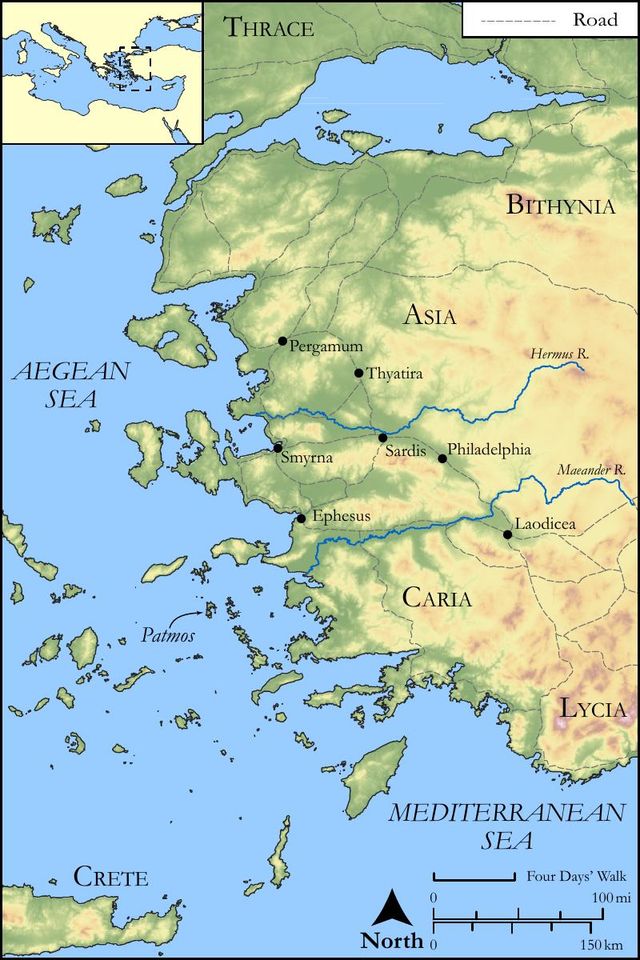
See on the biblical-era maps

Study this verse
Public-domain commentary
Matthew Henry
From his Commentary on the Whole Bible. Henry comments on passages, not single verses — this entry covers Revelation 20:11–15.
The utter destruction of the devil's kingdom very properly leads to an account of the day of judgment, which will determine every man's everlasting state; and we may be assured there will be a judgment when we see the prince of this world is judged, Joh 16:11. This will be a great day, the great day, when all shall appear before the judgment-seat of Christ. The Lord help us firmly to believe this doctrine of the judgment to come. It is a doctrine that made Felix tremble. Here we have a description of it, where observe, 1. We behold the throne, and tribunal of judgment, great and white, very glorious and perfectly just and righteous. The throne of iniquity, that establishes wickedness by a law, has no fellowship with this righteous throne and tribunal. 2. The appearance of the Judge, and that is the Lord Jesus Christ, who then puts on such majesty and terror that the earth and the heaven flee from his face, and there is no place found for them; there is a dissolution of the whole frame of nature, Pe2 3:10. 3. The persons to be judged (Rev 20:12): The dead, small and great; that is, young and old, low and high, poor and rich. None are so mean but they have some talents to account for, and none so great as to avoid the jurisdiction of this court; not only those that are found alive at the coming of Christ, but all who have died before; the grave shall surrender the bodies of men, hell shall surrender the souls of the wicked, the sea shall surrender the many who seemed to have been lost in it. 4. The rule of judgment settled: The books were opened. What books? The books of God's omniscience, who is greater than our consciences, and knows all things (there is a book of remembrance with him both for good and bad); and the book of the sinner's conscience, which, though formerly secret, will now be opened. And another book shall be opened - the book of the scriptures, the statute-book of heaven, the rule of life. This book is opened as containing the law, the touchstone by which the hearts and lives of men are to be tried. This book determines matter of right; the other books give evidence of matters of fact. Some, by the other book, called the book of life, understand the book of God's eternal counsels; but that does not seem to belong to the affair of judgment: in eternal election God does not act judicially, but with absolute sovereign freedom. 5. The cause to be tried; and that is, the works of men, what they have done and whether it be good or evil. By their works men shall be justified or condemned; for though God knows their state and their principles, and looks chiefly at these, yet, being to approve himself to angels and men as a righteous God, he will try their principles by their practices, and so will be justified when he speaks and clear when he judges. 6. The issue of the trial and judgment; and this will be according to the evidence of fact, and rule of judgment. All those who have made a covenant with death, and an agreement with hell, shall then be condemned with their infernal confederates, cast with them into the lake of fire, as not being entitled to eternal life, according to the rules of life laid down in the scripture; but those whose names are written in that book (that is, those that are justified and acquitted by the gospel) shall then be justified and acquitted by the Judge, and shall enter into eternal life, having nothing more to fear from death, or hell, or wicked men; for these are all destroyed together. Let it be our great concern to see on what terms we stand with our Bibles, whether they justify us or condemn us now; for the Judge of all will proceed by that rule. Christ shall judge the secrets of all men according to the gospel. Happy are those who have so ordered and stated their cause according to the gospel as to know beforehand that they shall be justified in the great day of the Lord!
Historical interpretation
Eight Centuries of Reception
8 surviving comments on this verse. Each one is dated, so this reads as a timeline rather than a list.
Select a marker to jump to its quote. Markers stagger vertically where authors wrote within a few decades of each other.
"Moreover," he says, "the book of life was opened, and the dead were judged out of those things that were written in the books, according to their works; and death and hell were sent into the lake of fire, the second death." Now this is what is called Gehenna, which the Lord styled eternal fire. "And if any one," it is said, "was not found written in the book of life, he was sent into the lake of fire."
When, however, the thousand years shall be completed, the world will be renewed by God, heaven will be folded up and the earth changed. And God will transform people into the likeness of angels, and they will be white and shining as snow, and they will always be in the sight of the Omnipotent and will sacrifice to their God and serve him forever. At the same time, there will take place that second and public resurrection of all, during which the unjust will be raised to everlasting sufferings. These are they who worshiped idols made by hands, who did not know or who denied the Lord and Father of the universe. But their master will be seized with his ministers and will be condemned to punishment, and together with him the whole band of the impious will be burned in perpetual fire forever in the sight of the angels and the just.
The “Book of Life” is not for jogging God’s memory lest he forget. It is a figure of the predestination of those who are to receive eternal life. We are not to imagine that God does not know them and has to read in his books to find out who they are. On the contrary, the Book of Life is precisely his infallible prescience of those inscribed therein, whose very registration there means only that they are foreknown by him.
[In evil persons] God begins his judgment with desertion and ends with anguish. For in this present time as well in which God deserts the evil ones who go away from him, he does not work in them what displeases him but works through them what pleases him. Afterwards, he is going to give them what they deserve from his justice.… Such people God has fitted for destruction as punishment that the just judge by his just predestination has decreed for the sinner.… Concupiscence, conceiving, has given birth to sin, but the mature sin has begotten death. The wicked, therefore, have not been predestined to the first death of the soul but have been predestined to the second, that is, to the pool of fire and sulphur. … He calls the second death that which follows from the sentence of the just judge, not that which went before in the evil concupiscence of the sinner.… Therefore, the first death of the soul, which a person inflicted on himself, is the cause of the second death. And the second death, which God has rendered to the person, is the punishment for the first death.
Whoever did not believe during life and did not open his mouth in confession of our Lord Jesus Christ shall be destroyed along with death and hell because he failed to receive life. Nevertheless, we do not confess that everyone will die or come to punishment. Rather, that will be fulfilled which we read in Daniel, “Some shall rise to everlasting life, and some to everlasting contempt, so that they might always behold.” And what shall they always behold, if not that they are tormented while others are glorified?
And if anyone's name was not found written in the book of life. That is, who was not judged by God to be alive. Hence, it seems more correct to say, as those who interpret the open books as the consciences of individuals and their revealed works. The book of life, however, is the foreknowledge of God (which cannot be mistaken) concerning those to whom eternal life will be given, in which they are written, that is, foreknown. Having finished the judgment by which he saw the wicked condemned, it remains for him to also speak of the good.
QUESTION: And death and hell were cast into the pool of fire, and whosoever was not found written in the book of life. ANSWER: That is, whosoever was not judged by God as being alive. Whence it seems to me that the right interpretation for the books opened above is rather that of those who interpret them as being every single person's conscience and works being disclosed, and interpret the book of life as being God's foreknowledge, which cannot be mistaken concerning those who will be given eternal life, since they are written in that book, that is, foreknown.
And if anyone was not found written in the little scroll of life, he was thrown into the lake of fire.
But those who are said to have been in sins and are not worthy of the inscription in life have suffered equally. And if he said that those who are in the middle of the sinners are cast into the lake of fire together with the Devil and the Antichrist, for he said this above, do not be surprised, for there too there is a varied punishment, just as with fever: one kind is burning and continuous, another is lesser and mild, even if all are called fevers; so likewise there you will perceive.
Continue studying Revelation 20:15 across the web’s major study libraries — every link below opens this exact verse, chapter, or book on the destination site.
Read & Compare
 BibleGatewayThis verse in more than 200 translations and 70 languages.
 Bible.comThe YouVersion reader — hundreds of translations, reading plans, and highlights.
 ESV.orgCrossway's official English Standard Version reader.
 NET BibleThe NET translation with 60,000+ translators' notes on every rendering decision.
 STEP BibleTyndale House's free study tool — original text, vocabulary, and scholarly resources.
 BibliaLogos Bible Software's free web reader.
 USCCBThe New American Bible (Revised Edition) with the U.S. bishops' study notes.
Commentaries
 BibleHub CommentariesDozens of classic commentaries on this verse, gathered on one page.
 StudyLightMore than 100 commentary sets — the largest collection on the web.
 BibleRefPlain-English commentary on what this verse means, verse by verse.
 Enduring WordDavid Guzik's free commentary on this chapter, widely used by Bible teachers.
 Bible Study ToolsVerse commentary alongside Greek and Hebrew study aids.
Original Language & Research
- BibleHub InterlinearThe verse word by word — original language, transliteration, and English.
- BibleHub LexiconEvery word's original-language definition and Strong's entry.
 Blue Letter BibleDeep-study tools — Strong's numbers, concordance, and word studies.
 CNTR CollationThe earliest Greek manuscripts of this verse, collated letter by letter.
Sermons, Hymns & Audio


TrulyRandomVerse is not affiliated with these sites and doesn’t control their content. They’re linked because they’re genuinely useful.
Summary
Revelation 20:15 delivers the solemn and ultimate pronouncement of the Great White Throne Judgment, declaring the eternal fate of all humanity. This verse starkly reveals that anyone whose name is not recorded in the divine register, known as the Book of Life, will be irrevocably consigned to the lake of fire, underscoring the finality of God's righteous judgment and the eternal separation of the unredeemed from His presence.
Context
ShowHideLiterary Context
This verse serves as the climactic conclusion to the detailed account of the Great White Throne Judgment, which begins in Revelation 20:11. Immediately preceding Revelation 20:15, Revelation 20:12-13 describes the resurrection of the dead, both great and small, standing before God, with "books" being opened, including the "book of life." Judgment is rendered "according to their works." Revelation 20:14 then states that "death and hell (Hades) were cast into the lake of fire," signifying the complete and final eradication of these spiritual enemies and the last vestiges of the old order. Verse 15 directly follows, specifying the individual consequence for those whose names are absent from the Book of Life, thereby establishing inclusion in this divine record as the sole criterion for escaping eternal condemnation.
Historical & Cultural Context
The concept of divine records or "books" is deeply rooted in Scripture, where kings kept registers of citizens, soldiers, or those favored, as in the "book of records of the chronicles" read before king Ahasuerus. In biblical thought, this idea evolves into a spiritual register maintained by God. Old Testament parallels include a "book of remembrance" (Malachi 3:16) or a "book of the living" (Psalm 69:28), implying a record of those who belong to God or are destined for life. The "lake of fire" is a unique apocalyptic image primarily found in Revelation, symbolizing ultimate, eternal punishment. While not directly paralleled elsewhere in Scripture as a "lake of fire," the concept of fiery judgment and eternal torment for the wicked is present in various Jewish apocalyptic texts and later rabbinic literature, drawing from Old Testament imagery of divine wrath and consuming fire (Deuteronomy 4:24, Isaiah 33:14).
Key Themes
ShowHideRevelation 20:15 contributes significantly to several overarching themes in the book of Revelation and biblical eschatology. Foremost is the theme of Divine Judgment and Justice, emphasizing God's absolute sovereignty and righteousness in bringing all things to a just conclusion. The judgment is impartial, based on a divine record, and final, leaving no room for appeal. Another crucial theme is the Book of Life, which represents God's eternal election and the record of those who have received salvation through Christ. Its pivotal role here highlights that salvation is not merely based on works, but ultimately on a relationship with God, evidenced by one's name being eternally inscribed. Finally, the verse powerfully portrays the Ultimate Destiny of the Unredeemed in the "lake of fire," which is consistently presented in Revelation as the place of eternal conscious punishment and complete separation from God, often referred to as the "second death" (Revelation 20:14).
Exposition and Analysis
ShowHideKey Word Analysis
ShowHideThis phrase, meaning "if any" or "whoever," emphasizes the universal scope of the judgment. It signifies that no one is exempt from this final scrutiny; every individual, regardless of status or perceived righteousness, will face this ultimate assessment. The judgment is truly comprehensive, applying to all who have ever lived.
Derived from a verb meaning "to grave" or "to write," this word highlights the permanence and definitive nature of the record in the Book of Life. It implies an intentional, divine act of inscription, not a temporary or mutable entry. The fact that a name is "written" signifies a fixed and unchangeable status in God's eternal register.
This term denotes a body of water, specifically a pond or lake. In the context of "lake of fire," it conveys a sense of a contained, inescapable, and vast expanse of judgment. Unlike a transient fire, a "lake" implies a fixed, permanent, and overwhelming destination from which there is no escape.
Verse Breakdown
ShowHide"And whosoever was not found written in the book of life"
This clause establishes the singular criterion for condemnation: the absence of one's name from the "book of life." The phrase "was not found written" implies a thorough divine examination of the book, revealing an empty space where a name should have been. This "book of life" represents God's eternal register of those who have received salvation and eternal life through faith in Jesus Christ. It is a record of divine election and redemption, not merely a list of good deeds. The emphasis is on a negative condition—the absence of a name—rather than the presence of evil deeds, though works are judged in the preceding verses.
"was cast into the lake of fire."
This second clause declares the irreversible and ultimate consequence for those whose names are absent from the Book of Life. The verb "cast" (Greek, bállō) implies a forceful, decisive, and definitive action, signifying an immediate and unappealable sentencing. The "lake of fire" is presented as the final, eternal destination of the unredeemed, symbolizing complete and conscious separation from God, often referred to as the "second death" in Revelation. It is a place of eternal punishment, signifying absolute alienation from the Creator and all goodness.
Literary Devices
ShowHideRevelation 20:15 masterfully employs several literary devices to convey its profound message. Symbolism is paramount, with "the book of life" representing God's divine record of those chosen for salvation and eternal fellowship, and "the lake of fire" symbolizing the ultimate, eternal, and inescapable consequence of unredeemed humanity—a place of conscious torment and complete separation from God. The verse also utilizes stark Contrast, juxtaposing the eternal life signified by inclusion in the Book of Life with the eternal death and destruction symbolized by the lake of fire. This creates a powerful dichotomy that underscores the gravity of the judgment. Furthermore, the phrase "whosoever was not found written" employs Litotes (understatement) to emphasize the absolute nature of the requirement for salvation; it is not merely about what one did, but fundamentally about one's status in God's eternal plan, making the absence of a name a damning reality.
Theological and Thematic Connections
ShowHideRevelation 20:15 stands as a profound theological statement on divine justice, human accountability, and the eternal consequences of one's relationship with God. It affirms God's absolute sovereignty as the righteous Judge of all the earth, whose judgment is final, impartial, and based on an eternal record of life. The "Book of Life" is not merely a metaphor for human good deeds, but a divine register reflecting God's foreknowledge and the names of those who have been redeemed through faith. This verse underscores the critical importance of salvation through Christ, as it is through Him alone that one's name can be eternally inscribed in this book. The "lake of fire" represents the ultimate, conscious, and eternal separation from God for those who reject His offer of grace, serving as a stark warning and a testament to the holiness of God who cannot tolerate sin in His presence.
Reflection and Application
ShowHideRevelation 20:15 is a verse of immense gravity, serving as a powerful call to introspection and a profound reminder of eternal realities. It compels us to confront the ultimate question of our eternal destiny, emphasizing that the most critical decision in life is our response to God's gracious offer of salvation. For those who have placed their faith in Jesus Christ, this verse offers immense comfort and assurance, confirming that their names are eternally secured in the Book of Life, guaranteeing their freedom from condemnation and their inheritance of eternal life. This security should not lead to complacency but to a deeper gratitude and a renewed commitment to living lives worthy of their calling. Conversely, for those who have not yet surrendered to Christ, the verse serves as an urgent and loving warning, highlighting the irreversible consequences of rejecting God's grace. It underscores the imperative for believers to share the Gospel with compassion and urgency, offering others the opportunity to find salvation and have their names inscribed in this life-giving register before the final judgment.
Questions for Reflection
ShowHideFAQ
ShowHideWhat is the "Book of Life" mentioned in Revelation 20:15?
ShowHideThe "Book of Life" (Greek: biblos tēs zōēs) is a symbolic divine register mentioned multiple times in Scripture, particularly in the book of Revelation. It is not a literal book but represents God's eternal record of those who are destined for eternal life with Him. It signifies those who have been redeemed through faith in Jesus Christ, whose names are eternally inscribed by God's grace. Its presence guarantees salvation and eternal fellowship with God, while its absence signifies eternal separation. This concept is also found in Philippians 4:3 and Revelation 21:27.
What is the "lake of fire" and what does it represent?
ShowHideThe "lake of fire" (Greek: límnē tou pyros) is a symbolic term found exclusively in the book of Revelation. It represents the ultimate, eternal, and conscious place of punishment for the unredeemed, the devil, his angels, and even Death and Hades (Revelation 20:10 and Revelation 20:14). It is often referred to as the "second death," signifying complete and irreversible spiritual separation from God. It is not merely annihilation but a state of eternal alienation and torment, illustrating the severity of God's righteous judgment against sin and rebellion.
How does one ensure their name is written in the Book of Life?
ShowHideAccording to Christian theology, one's name is written in the Book of Life through faith in Jesus Christ. The Bible teaches that salvation is a gift of God's grace, received by believing in Jesus as Lord and Savior, who died for our sins and rose again (Ephesians 2:8-9). It is not earned by good works, though good works are a natural outflow of a transformed life. John 3:16 famously states, "For God so loved the world, that he gave his only begotten Son, that whosoever believeth in him should not perish, but have everlasting life." Therefore, accepting Christ's atoning sacrifice and committing one's life to Him is the means by which one's name is eternally secured in the Book of Life.
Christ-Centered Fulfillment
ShowHideRevelation 20:15, while depicting a scene of ultimate judgment, finds its profound Christ-centered fulfillment in the person and work of Jesus Christ. The very existence of the "Book of Life" points to God's sovereign plan of salvation, a plan fully realized in Christ. It is through His atoning sacrifice on the cross that humanity can be reconciled to God and have their names eternally inscribed in this divine register. Jesus Himself declared, "I am the way, the truth, and the life; no man cometh unto the Father, but by me" (John 14:6). He is the "Lamb slain from the foundation of the world" (Revelation 13:8), whose blood cleanses us from sin and makes us worthy to stand before God. Furthermore, Jesus is not only the means of salvation but also the ultimate Judge, to whom "all judgment" has been committed by the Father (John 5:22). Therefore, the terrifying prospect of being "cast into the lake of fire" is a fate averted solely by the grace and redemptive power of Christ. For those who believe, their names are secure, not by their own merit, but by the finished work of the One who conquered sin, death, and hell, offering eternal life to "whosoever believes in Him" (John 3:16).