


Daniel 12:1
Bible text: King James Version (1769 Blayney text) · Public domain
Bible text: King James Version with Strong's numbers · Public domain
Bible text: Berean Standard Bible · Public domain
Bible text: American Standard Version (1901) · Public domain
Bible text: World English Bible, Messianic edition · Public domain
Bible text: Geneva Bible (1599) · Public domain
Bible text: Young's Literal Translation · Public domain
- וּבָעֵתu·va·'Etand at the timeH6256Conj-w ¦ Prep-b ¦ N-csNoun Singular common gender Absoluteוּandבָat theעֵתtime
- הַהִיאha·Hi'<the> thatH1931Art ¦ Pro-3fsPronoun Personal 3rd Singular Feminineהַ<the>הִיאthat
- יַעֲמֹדya·'a·Modhe will ariseH5975V-Qal-Imperf-3msVerb Qal Imperfect 3rd Singular Masculine
- מִיכָאֵלmi·kha·'ElMichaelH4317N-proper-mNoun Proper Masculine
- הַשַּׂרha·Sarthe princeH8269Art ¦ N-msNoun Singular Masculine Absoluteהַtheשַּׂרprince
- הַגָּדוֹלha·ga·Dol<the> greatH1419Art ¦ Adj-msAdjective Singular Masculine Absoluteהַ<the>גָּדוֹלgreat
- הָעֹמֵדha·'o·Medwho standsH5975Art ¦ V-Qal-Prtcpl-msVerb Qal Participle Singular Masculine Absoluteהָwhoעֹמֵדstands
- עַל'aloverH5921PrepPreposition
- בְּנֵיbe·Nei[the] sons ofH1121N-mpcNoun Plural Masculine Construct
- עַמֶּךָ'a·me·Khayour peopleH5971N-msc ¦ 2msNoun Singular Masculine Constructעַמֶּpeopleךָyour
- וְהָיְתָהve·ha·ye·Tahand it will beH1961Conj-w ¦ V-Qal-ConsecPerf-3fsVerb Qal Consecutive Perfect 3rd Singular Feminineוְandהָיְתָהit will be
- עֵת'eta time ofH6256N-cscNoun Singular common gender Construct
- צָרָהtza·RahdistressH6869N-fsNoun Singular Feminine Absolute
- אֲשֶׁר'a·SherwhichH834RelParticle Relative
- לֹאlo'notH3808NegParticle Negative
- נִהְיְתָהnih·ye·Tahit has happenedH1961V-Niphal-Perf-3fsVerb Niphal Perfect 3rd Singular Feminine
- מִהְיוֹתmih·Yotfrom when wasH1961Prep-m ¦ V-Qal-InfVerb Qal Infinitive Constructמִfromהְיוֹתwhen was
- גּוֹיGoya nationH1471N-msNoun Singular Masculine Absolute
- עַד'aduntilH5704PrepPreposition
- הָעֵתha·'Etthe timeH6256Art ¦ N-csNoun Singular common gender Absoluteהָtheעֵתtime
- הַהִיאha·Hi'<the> thatH1931Art ¦ Pro-3fsPronoun Personal 3rd Singular Feminineהַ<the>הִיאthat
- וּבָעֵתu·va·'Etand at the timeH6256Conj-w ¦ Prep-b ¦ N-csNoun Singular common gender Absoluteוּandבָat theעֵתtime
- הַהִיאha·Hi'<the> thatH1931Art ¦ Pro-3fsPronoun Personal 3rd Singular Feminineהַ<the>הִיאthat
- יִמָּלֵטyi·ma·Letit will escapeH4422V-Niphal-Imperf-3msVerb Niphal Imperfect 3rd Singular Masculine
- עַמְּךָ'a·me·Khayour peopleH5971N-msc ¦ 2msNoun Singular Masculine Constructעַמְּpeopleךָyour
- כָּלkoleveryH3605N-mscNoun Singular Masculine Construct
- הַנִּמְצָאha·nim·Tza'<the> [one who] is foundH4672Art ¦ V-Niphal-Prtcpl-msVerb Niphal Participle Singular Masculine Absoluteהַ<the>נִּמְצָא[one who] is found
- כָּתוּבka·TuvwrittenH3789V-Qal-PassPrtcpl-msVerb Qal Participle Passive Singular Masculine Absolute
- בַּסֵּפֶרba·Se·ferin the scrollH5612Prep-b ¦ N-msNoun Singular Masculine Absoluteבַּin theסֵּפֶרscroll
English is a literal word-by-word gloss of the Hebrew, not the KJV's wording. Why?
This is the original text the KJV's translators worked from — each Hebrew word with its own literal English meaning in this verse, prepared by scholars at Tyndale House, Cambridge. The KJV translates whole sentences, not word by word, so its wording differs: one Hebrew word can become several English words, and the KJV may choose “the LORD” where the gloss reads “Yahweh”. Both are faithful — they answer different questions. For the KJV's own rendering, switch to the KJV text.
Details
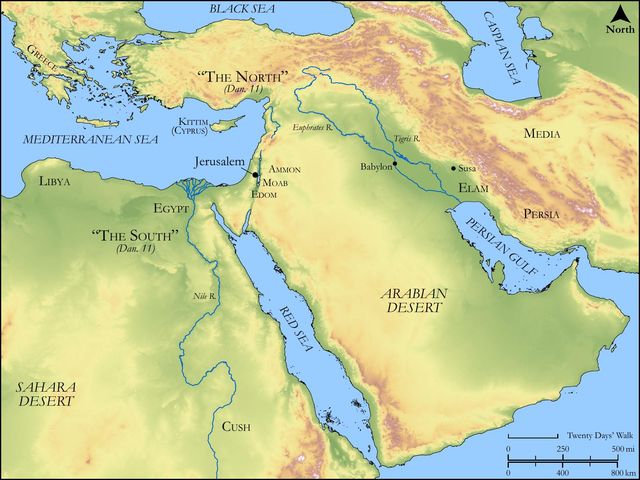
See on the biblical-era map
Study this verse
Public-domain commentary
Matthew Henry
From his Commentary on the Whole Bible. Henry comments on passages, not single verses — this entry covers Daniel 12:1–4. His two-level outline is real structure in the source text, so it is rendered as structure.
It is usual with the prophets, when they foretel the grievances of the church, to furnish it at the same time with proper antidotes, a remedy for every malady. And no relief is so sovereign, of such general application, so easily accommodated to every case, and of such powerful efficacy, as those that are fetched from Christ and the future state; thence the comforts here are fetched.
I.Jesus Christ shall appear his church's patron and protector:
At that time, when the persecution is at the hottest, Michael shall stand up, Dan 12:1. The angel had told Daniel what a firm friend Michael was to the church, Dan 10:21. He all along showed this friendship in the upper world; the angels knew it; but now Michael shall stand up in his providence, and work deliverance for the Jews, when he sees that their power is gone, Deu 32:36. Christ is that great prince, for he is the prince of the kings of the earth, Rev 1:5. And, if he stand up for his church, who can be against it? But this is not all: At that time (that is, soon after) Michael shall stand up for the working out of our eternal salvation; the Son of God shall be incarnate, shall be manifested to destroy the works of the devil. Christ stood for the children of our people when he was made sin and a curse for them, stood in their stead as a sacrifice, bore the cure for them, to bear it from them. He stands for them in the intercession he ever lives to make within the veil, stands up for them, and stands their friend. And after the destruction of antichrist, of whom Antiochus was a type, Christ shall stand at the latter day upon the earth, shall appear for the complete redemption of all his.
II.When Christ appears he will recompense tribulation to those that trouble his people.
There shall be a time of trouble, threatening to all, but ruining to all the implacable enemies of God's kingdom among men, such trouble as never was since there was a nation. This is applicable.
1.To the destruction of Jerusalem, which Christ calls (perhaps with an eye to this prediction) such a great tribulation as was not since the beginning of the world to this time, Mat 24:21. This the angel had spoken much of (Dan 9:26, Dan 9:27); and it happened about the same time that Christ set up the gospel-kingdom in the world, that Michael our prince stands up. Or,
2.To the judgment of the great day, that day that shall burn as an oven, and consume the proud and all that do wickedly; that will be such a day of trouble as never was to all those whom Michael our prince stands against.
III.He will work salvation for his people:
"At that time thy people shall be delivered, delivered from the mischief and ruin designed them by Antiochus, even all those that were marked for preservation, that were written among the living," Isa 4:3. When Christ comes into the world he will save his spiritual Israel from sin and hell, and will, at his second coming, complete their salvation, even the salvation of as many as were given him, as many as have their names in the book of life, Rev 20:15. They were written there before the world, and will be found written there at the end of the world, when the books shall be opened.
IV.There shall be a distinguishing resurrection of those that sleep in the dust, Dan 12:2.
1.When God works deliverance for his people from persecution it is a kind of resurrection; so the Jews' release out of Babylon was represented in vision (Eze. 37) and so the deliverance of the Jews from Antiochus, and other restorations of the church to outward prosperity; they were as life from the dead. Many of those who had long slept in the dust of obscurity and calamity shall then awake, some to that life, and honour, and comfort which will be lasting, everlasting; but to others, who, when they return to their prosperity, will return to their iniquity, it will be a resurrection to shame and contempt, for the prosperity of fools will but expose them and destroy them.
2.When, upon the appearing of Michael our prince, his gospel is preached, many of those who sleep in the dust, both Jews and Gentiles, shall be awakened by it to take upon them a profession of religion, and shall rise out of their heathenism or Judaism; but, since there will be always a mixture of hypocrites with true saints, it is but some of those who are raised to life to whom the gospel is a savour of life unto life, but others will be raised by it to shame and contempt, to whom the gospel of Christ will be a savour of death unto death, and Christ himself set for their fall. The net of the gospel encloses both good and bad. But,
3.It must be meant of the general resurrection at the last day: The multitude of those that sleep in the dust shall awake, that is, all, which shall be a great many. Or, Of those that sleep in the dust many shall arise to life and many to shame. The Jews themselves understand this of the resurrection of the dead at the end of time; and Christ seems to have an eye to it when he speaks of the resurrection of life and the resurrection of damnation (Joh 5:29); and upon this the Jews are said by St. Paul to expect a resurrection of the dead both of the just and of the unjust, Act 24:15. And nothing could come in more seasonably here, for, under Antiochus's persecution, some basely betrayed their religion, others bravely adhered to it. Now it would be a trouble to them that, when the storm was over, they could neither reward the one nor punish the other; this therefore would be a satisfaction to them, that they would both be recompensed according to their works in the resurrection. And the apostle, speaking of the pious Jews that suffered martyrdom under Antiochus, tells us that though they were tortured yet they accepted not deliverance, because they hoped to obtain this better resurrection, Heb 11:35.
V.There shall be a glorious reward conferred on those who, in the day of trouble and distress, being themselves wise, did instruct many.
Such were taken particular notice of in the prophecy of the persecution (Dan 11:33), that they should do eminent service, and yet should fall by the sword and by flame; now, if there were not another life after this, they would be of all men most miserable, and therefore we are here assured that they shall be recompensed in the resurrection of the just (Dan 12:3): Those that are wise (that are teachers, so some read it, for teachers have need of wisdom, and those that have wisdom themselves should communicate it to others) shall shine as the brightness of the firmament, shall shine in glory, heavenly glory, the glory of the upper world; and those that by the wisdom they have, and the instructions they give, are instrumental to turn any, especially to turn many to righteousness, shall shine as the stars for ever and ever. Note,
1.There is a glory reserved for all the saints in the future state, for all that are wise, wise for their souls and eternity. A man's wisdom now makes his face to shine (Ecc 8:1), but much more will it do so in that state where its power shall be perfected and its services rewarded.
2.The more good any do in this world, especially to the souls of men, the greater will be their glory and reward in the other world. Those that turn men to righteousness, that turn sinners from the errors of their ways and help to save their souls from death (Jam 5:20), will share in the glory of those they have helped to heaven, which will be a great addition to their own glory.
3.Ministers of Christ, who have obtained mercy of him to be faithful and successful, and so are made burning and shining lights in this world, shall shine very brightly in the other world, shall shine as the stars. Christ is the sun, the fountain, of the lights both of grace and glory; ministers, as stars, shine in both, with a light derived from him, and a diminutive light in comparison of him; yet to those that are earthen vessels it will be a glory infinitely transcending their deserts. They shall shine as the stars of different magnitudes, some in less, others in greater lustre; but, whereas the day is coming when the stars shall fall from heaven as leaves in autumn, these stars shall shine for ever and ever, shall never set, never be eclipsed.
VI.That this prophecy of those times, though sealed up now, would be of great use to those that should live then, Dan 12:4.
Daniel must now shut up the words and seal the book because the time would be long ere these things would be accomplished: and it was some comfort that the Jewish nation, though, in the infancy of their return from Babylon, while they were few and weak, they met with obstructions in their work, were not persecuted for their religion till a long time after, when they had grown to some strength and maturity. He must seal the book because it would not be understood, and therefore would not be regarded, till the things contained in it were accomplished; but he must keep it safely, as a treasure of great value, laid up for the ages to come, to whom it would be of great service; for many shall then run to and fro, and knowledge shall be increased. Then this hidden treasure shall be opened, and many shall search into it, and dig for the knowledge of it, as for silver. They shall run to and fro, to enquire out copies of it, shall collate them, and see that they be true and authentic. They shall read it over and over, shall meditate upon it, and run it over in their minds; discurrent - they shall discourse of it, and talk it over among themselves, and compare notes about it, if by any means they may sift out the meaning of it; and thus knowledge shall be increased. By consulting this prophecy on this occasion they shall be led to search other scriptures, which shall contribute much to their advancement in useful knowledge; for then shall we know if we follow on to know the Lord, Hos 6:3. Those that would have their knowledge increased must take pains, must not sit still in slothfulness and bare wishes but run to and fro, must make use of all the means of knowledge and improve all opportunities of getting their mistakes rectified, their doubts resolved, and their acquaintance with the things of God improved, to know more and to know better what they do know. And let us here see reason to hope that,
1.Those things of God which are now dark and obscure will hereafter be made clear, and easy to be understood. Truth is the daughter of time. Scripture prophecies will be expounded by the accomplishment of them; therefore they are given, and for that explication they are reserved. Therefore they are told us before, that, when they do come to pass, we may believe.
2.Those things of God which are despised and neglected, and thrown by as useless, shall be brought into reputation, shall be found to be of great service, and be brought into request; for divine revelation, however slighted for a time, shall be magnified and made honourable, and, above all, in the judgment of the great day, when the books shall be opened, and that book among the rest.
Historical interpretation
Four Centuries of Reception
6 surviving comments on this verse. Each one is dated, so this reads as a timeline rather than a list.
Select a marker to jump to its quote. Markers stagger vertically where authors wrote within a few decades of each other.
"There shall be a time of trouble." For at that time there shall be great trouble, such as has not been from the foundation of the world, when some in one way, and others in another, shall be sent through every city and country to destroy the faithful; and the saints shall travel froth the west to the east, and shall be driven in persecution from the east to the south, while others shall conceal themselves in the mountains and caves; and the abominanation shall war against them everywhere, and shall cut them off by sea and by land by his decree, and shall endeavour by every means to destroy them out of the world; and they shall not be able any longer to sell their own property, nor to buy from strangers, unless one keeps and carries with him the name of the beast, or bears its mark upon his forehead. For then they shall all be driven out from every place, and dragged from their own homes and haled into prison, and punished with all manner of punishment, and cast out from the whole world.
Daniel foretold two abominations, one of destruction, the other of desolation. What is the abomination of destruction other than that which Antiochus erected during his time? And what is the abomination of desolation other than that which will generally take place when the antichrist comes?
Verses 1-3. "But at that time shall Michael rise up, the great prince, who stands for the children of thy people, and a time shall come such as never occurred from the time that nations began to exist even unto that time. And at that time shall thy people be saved, even everyone who shall be found written in the book. And many of those who sleep in the dust of the earth shall awake, some unto life everlasting, and others unto reproach, that they may behold it always. But those who are instructed shall shine as the brightness of the firmament; and they that instruct many as to righteousness, as the stars for all eternity." Up until this point Porphyry somehow managed to maintain his position and impose upon the credulity of the naive among our adherents as well as the poorly educated among his own. But what can he say of this chapter, in which is described the resurrection of the dead, with one group being revived for eternal life and the other group for eternal disgrace? He cannot even specify who the people were under Antiochus who shone like the brightness of the firmament, and those others who shone like the stars for all eternity. But what will pigheadedness not resort to? Like some bruised serpent, he lifts up his head as he is about to die, and pours forth his venom upon those who are themselves at the point of death. This too, he declares, was written with reference to Antiochus, for after he had invaded Persia, he left his army with Lysias, who was in charge of Antioch and Phoenicia, for the purpose of warring against the Jews and destroying their city of Jerusalem. All these details are related by Josephus, the author of the history of the Hebrews. Porphyry contends that the tribulation was such as had never previously occurred, and that a time came along such as had never been from the time that races began to exist even unto that time. But when victory was bestowed upon them, and the generals of Antiochus had been slain, and Antiochus himself had died in Persia, the people of Israel experienced salvation, even all who had been written down in the book of God, that is, those who defended the law with great bravery. Contrasted with them were those who proved to be transgressors of the Law and sided with the party of Antiochus. Then it was, he asserts, that these guardians of the Law, who had been, as it were, slumbering in the dust of the earth and were cumbered with a load of afflictions, and even hidden away, as it were, in the tombs of wretchedness, rose up once more from the dust of the earth to a victory unhoped for, and lifted up their heads, rising up to everlasting life, even as the transgressors rose up to everlasting disgrace. But those masters and teachers who possessed a knowledge of the Law shall shine like the heaven, and those who have exhorted the more backward peoples to observe the rites of God shall blaze forth after the fashion of the stars for all eternity. He also adduces the historical account concerning the Maccabees, in which it is said that many Jews under the leadership of Mattathias and Judas Maccabaeus fled to the desert and hid in caves and holes in the rocks, and came forth again after the victory (I Macc. 2.) These things, then, were foretold in metaphorical language as if it concerned a resurrection of the dead. But the more reasonable understanding of the matter is that in the time of the Antichrist there shall occur a tribulation such as there has never been since nations began to exist. For assume that Lysias won the victory instead of being defeated, and that he completely crushed the Jews instead of their conquering; certainly such tribulation would not have been comparable to that of the time when Jerusalem was captured by the Babylonians, the Temple was destroyed, and all the people were led off into captivity. And so after the Antichrist is crushed and destroyed by the breath of the Savior's mouth, the people written in God's book shall be saved; and in accordance with the merits of each, some shall rise up unto eternal life and others unto eternal shame. But the teachers shall resemble the very heavens, and those who have instructed others shall be compared to the brightness of the stars. For it is not enough to know wisdom unless one also instructs others; and the tongue of instruction which remains silent and edifies no one else can receive no reward for labor accomplished. This passage is expressed by Theodo-tion and the Vulgate edition in the following fashion: "And those who understand shall shine forth like the radiance of the firmament, and many of the righteous like the stars forever and ever." Many people often ask whether a learned saint and an ordinary saint shall both enjoy the same reward and one and the same dwelling-place in heaven. Well then, the statement is made here, according to Theodotion's rendering, that the learned will resemble the very heavens, whereas the righteous who are without learning are only compared to the brightness of the stars. And so the difference between learned godliness and mere godly rusticity shall be the difference between heaven and the stars.
“And the sheep hear his voice, and he calls his own sheep by name.” For he has their names written in the book of life. “He calls his own sheep by name.” Because of this the apostle says, “The Lord knows who are his.” “And he leads them out. And when he has led out his own sheep, he goes before them, and the sheep follow him because they know his voice...”
That is, those worthy of salvation, who obeyed the preaching of Elijah, the ones whom he foreknew from the first and the very beginning. He calls the knowledge of God “the book.”
The devil is also called a prince, as in the Gospel passage, “Behold, the prince of this world comes, and in me he will not find anything.” Likewise a good angel is called a prince, as we read in Daniel: “Michael your prince.” So they are saying that the hope of humankind must rest in neither wicked nor good angels but in the Lord alone. Even if we love the good angels for the devotion they bestow on us, we praise the Lord’s blessing that they manifest.
Continue studying Daniel 12:1 across the web’s major study libraries — every link below opens this exact verse, chapter, or book on the destination site.
Read & Compare
 BibleGatewayThis verse in more than 200 translations and 70 languages.
 Bible.comThe YouVersion reader — hundreds of translations, reading plans, and highlights.
 ESV.orgCrossway's official English Standard Version reader.
 NET BibleThe NET translation with 60,000+ translators' notes on every rendering decision.
 STEP BibleTyndale House's free study tool — original text, vocabulary, and scholarly resources.
 BibliaLogos Bible Software's free web reader.
 USCCBThe New American Bible (Revised Edition) with the U.S. bishops' study notes.
Commentaries
 BibleHub CommentariesDozens of classic commentaries on this verse, gathered on one page.
 StudyLightMore than 100 commentary sets — the largest collection on the web.
 BibleRefPlain-English commentary on what this verse means, verse by verse.
 Enduring WordDavid Guzik's free commentary on this chapter, widely used by Bible teachers.
 Bible Study ToolsVerse commentary alongside Greek and Hebrew study aids.
Original Language & Research
- BibleHub InterlinearThe verse word by word — original language, transliteration, and English.
- BibleHub LexiconEvery word's original-language definition and Strong's entry.
 Blue Letter BibleDeep-study tools — Strong's numbers, concordance, and word studies.
 SefariaThe Hebrew text with Rashi and centuries of Jewish commentary.
Sermons, Hymns & Audio


TrulyRandomVerse is not affiliated with these sites and doesn’t control their content. They’re linked because they’re genuinely useful.
Summary
Daniel 12:1 unveils a pivotal moment in eschatological history, marking the culmination of Daniel's final vision. It prophesies the decisive intervention of Michael, the angelic guardian of Israel, during an unparalleled period of global distress. Amidst this unprecedented tribulation, the verse offers a profound promise of divine deliverance for God's elect people, specifically those whose names are eternally recorded in the divine book of life, signaling their ultimate preservation and salvation.
Context
ShowHideLiterary Context
Daniel 12:1 serves as the climactic conclusion to Daniel's final, most detailed vision, which began in Daniel 10. Chapters 10 and 11 provide an extensive prophetic panorama, detailing the unfolding conflicts between the "king of the North" and the "king of the South," interpreted by many as a sweep of historical events from the Persian Empire through the Hellenistic period, culminating in the actions of Antiochus IV Epiphanes. However, the language in Daniel 11:36-45 transcends historical figures, pointing to an ultimate tyrannical figure at the end of the age. Thus, Daniel 12:1 directly follows this extended prophecy of escalating earthly powers and introduces the divine, supernatural intervention that brings these tumultuous events to their final resolution, immediately preceding the promise of resurrection and judgment in Daniel 12:2-3.
Historical & Cultural Context
Daniel received this vision during the Persian Empire, a period marked by the return of some Jewish exiles to Jerusalem. While the immediate historical context is the post-exilic era, the prophecy itself extends far into the future, touching upon the Hellenistic period and ultimately the eschatological "end of days." Culturally, the concept of angelic beings playing active roles in human history, particularly as guardians of nations or individuals, was a significant aspect of Jewish apocalyptic thought, as evidenced by the mention of Michael. The idea of a "book" containing names, often associated with divine record-keeping or predestination, also has roots in the written records kept by kings, like the "book of records of the chronicles" read before the king in Esther, and is prevalent in biblical literature, symbolizing divine knowledge and covenantal relationship. The "time of trouble" draws upon a prophetic tradition of a future period of intense suffering for Israel, echoing themes found in the prophets like Jeremiah.
Key Themes
ShowHideThis verse encapsulates several profound themes central to the book of Daniel and broader biblical eschatology. Firstly, it highlights Divine Sovereignty and Intervention, demonstrating that even amidst the chaos of human history and the rise and fall of empires, God remains in ultimate control, dispatching His angelic agents like Michael to fulfill His purposes. Secondly, the prophecy of an Unprecedented Tribulation underscores the severity of the coming "time of trouble," a theme that resonates with other apocalyptic descriptions of the end times, emphasizing the global scale and unique intensity of this period. Finally, the promise of Divine Preservation and Deliverance for "thy people" who are "written in the book" provides a powerful message of hope and assurance, affirming God's faithfulness to His covenant people and His ultimate act of salvation for those who belong to Him, a theme further developed in Daniel 12:2-3.
Exposition and Analysis
ShowHideKey Word Analysis
ShowHideFrom the Hebrew words meaning "who is like God?", this name itself is a rhetorical question that points to the incomparable nature of God. In this context, Michael is identified as "the great prince which standeth for the children of thy people," signifying his role as a powerful angelic guardian specifically appointed to defend Israel. His "standing up" implies a decisive, active intervention on behalf of God's people in a time of dire need, demonstrating divine protection through angelic agency.
This word conveys a sense of "tightness," "distress," "anguish," or "calamity." The use of tsârâh here, coupled with the superlative "such as never was," emphasizes an unparalleled period of intense suffering and oppression. It speaks to a time of extreme pressure and affliction that will test humanity and God's people like no other period in history, highlighting the severity and unique nature of the coming tribulation.
This primitive root means "to grave," "to inscribe," "to describe," or "to write." In the context of being "written in the book," it signifies a permanent, divinely ordained record. This is not merely a casual notation but an authoritative inscription, indicating a definitive and unchangeable status of belonging to God. It speaks to divine knowledge, election, and the certainty of salvation for those whose names are thus recorded.
Verse Breakdown
ShowHide"And at that time shall Michael stand up, the great prince which standeth for the children of thy people:"
This clause introduces the archangel Michael, Israel's specific angelic protector, whose "standing up" signifies a decisive, active intervention on behalf of God's chosen people. This action is directly linked to the culmination of the events prophesied in the preceding chapter, indicating a divine response to the escalating tribulation. Michael's role as "great prince" underscores his authority and power in the heavenly realm and his specific charge over Israel.
"and there shall be a time of trouble, such as never was since there was a nation [even] to that same time:"
This segment describes an unprecedented period of global distress and calamity. The superlative language ("such as never was") emphasizes the unique and extreme nature of this tribulation, distinguishing it from all previous historical periods of suffering. It portrays a time of unparalleled anguish and persecution that will affect humanity on a scale never before witnessed.
"and at that time thy people shall be delivered, every one that shall be found written in the book."
Despite the severity of the "time of trouble," this clause offers a profound promise of divine deliverance. The "people" refers to God's covenant people, and their deliverance is assured for those "found written in the book." This "book" symbolizes God's divine record of those who truly belong to Him, signifying their spiritual election, eternal salvation, and ultimate preservation through the tribulation.
Literary Devices
ShowHideDaniel 12:1 is rich in Apocalyptic Imagery, a hallmark of the book of Daniel, painting a vivid picture of future events through symbolic language. The mention of Michael "standing up" is a powerful Anthropomorphism, attributing a human action to an angelic being to convey a decisive, protective intervention. The phrase "a time of trouble, such as never was since there was a nation" employs Hyperbole and Superlative Language to emphasize the unparalleled nature and extreme severity of the coming tribulation, underscoring its unique place in redemptive history. Furthermore, the concept of names being "written in the book" is a potent Symbolism, representing divine knowledge, election, and the certainty of eternal salvation for those chosen by God. This imagery provides a stark contrast between the global chaos and the secure, divinely assured destiny of the righteous.
Theological and Thematic Connections
ShowHideDaniel 12:1 stands as a profound theological statement on divine sovereignty, the reality of spiritual warfare, and the ultimate security of God's elect. It reveals that even in the most chaotic and distressing periods of human history, God is actively engaged through His angelic agents, ensuring the protection and ultimate deliverance of His people. The "time of trouble" foreshadows a period of intense tribulation, a theme echoed throughout biblical prophecy, yet it is immediately countered by the promise of salvation for those whose names are recorded in God's eternal ledger. This provides immense comfort, assuring believers that their ultimate destiny is secure in God's hands, regardless of earthly turmoil.
Reflection and Application
ShowHideDaniel 12:1 offers a dual perspective: a sobering warning of future global distress and a profound assurance of divine protection and deliverance for God's faithful. In a world often marked by uncertainty, conflict, and escalating challenges, this verse calls believers to a posture of steadfast hope and unwavering trust in God's sovereign plan. It reminds us that our ultimate security is not found in earthly circumstances or human institutions, but in our relationship with the God who knows our names and has inscribed them in His eternal book. This should inspire perseverance in faith, courage in the face of adversity, and a deep sense of gratitude for the divine promise of salvation. It also prompts us to live lives worthy of our calling, reflecting the character of Christ, as we await the full realization of God's redemptive purposes.
Questions for Reflection
ShowHideFAQ
ShowHideWhat is the "time of trouble" mentioned in Daniel 12:1?
ShowHideThe "time of trouble" (Hebrew: tsârâh) refers to an unprecedented period of intense global distress, persecution, and calamity that surpasses any suffering in human history. It is often understood in eschatological terms as the Great Tribulation, a unique period of affliction prophesied to occur before the return of Christ. This period is characterized by immense pressure and anguish, designed to test and purify God's people while also bringing judgment upon the unrighteous. Jesus Himself alluded to a similar period in Matthew 24:21, stating, "For then there will be great tribulation, such as has not been from the beginning of the world until now, no, and never will be."
Who is Michael and what is his significance in this verse?
ShowHideMichael is identified in Daniel 12:1 as "the great prince which standeth for the children of thy people," referring to Israel. He is an archangel, a chief prince, and is consistently depicted in Scripture as a powerful angelic warrior and defender, particularly associated with the protection of God's covenant people. His name, "Who is like God?", underscores his divine commission and power. In this verse, his "standing up" signifies a decisive, active, and protective intervention on behalf of Israel during the unparalleled "time of trouble." This highlights God's active involvement in human history and His use of angelic agents to fulfill His sovereign purposes, as seen also in Revelation 12:7.
What does it mean to be "written in the book"?
ShowHideTo be "written in the book" is a powerful biblical metaphor signifying divine election, spiritual belonging, and eternal salvation. This "book" (often referred to as the Book of Life) is God's eternal record of those who are truly His, those who have been chosen for salvation and whose names are permanently inscribed in heaven. It speaks to God's foreknowledge and His covenant faithfulness. This imagery assures believers that their ultimate deliverance and eternal destiny are secure in God's hands, providing comfort and hope amidst tribulation, as also seen in Philippians 4:3 and Revelation 20:15.
Christ-Centered Fulfillment
ShowHideDaniel 12:1, while rooted in Old Testament prophecy concerning Israel, finds its ultimate and profound fulfillment in Jesus Christ. The "time of trouble, such as never was" foreshadows the intense tribulation that precedes Christ's second coming, a period He Himself warned about in the Olivet Discourse. Yet, amidst this unparalleled distress, the promise of deliverance for "thy people" is fully realized in Christ. He is the ultimate Deliverer, the one who triumphs over all evil and secures the salvation of His church. Michael's role as the "great prince" who stands for God's people points to Christ, the true Prince of Peace and the Head of the Church, who continually intercedes for and protects His own (as seen in Hebrews 7:25). Furthermore, being "written in the book" is accomplished through faith in Christ; it is by His atoning sacrifice and resurrection that believers' names are eternally inscribed in the Lamb's Book of Life. Thus, Daniel's vision of future deliverance is not merely a historical or national promise but a glorious anticipation of the universal salvation and eternal security found in Jesus, who conquers death and guarantees the resurrection and eternal life for all who are truly His, as promised in John 11:25-26.