


Mark 13:19
Bible text: King James Version (1769 Blayney text) · Public domain
Bible text: King James Version with Strong's numbers · Public domain
Bible text: Berean Standard Bible · Public domain
Bible text: American Standard Version (1901) · Public domain
Bible text: World English Bible, Messianic edition · Public domain
Bible text: Geneva Bible (1599) · Public domain
Bible text: Young's Literal Translation · Public domain
- ἔσονταιesontaiwill be [in]G1510V-FDI-3PVerb Future Middle Deponent Indicative 3rd Plural
- γὰρgarforG1063CONJConjunction
- αἱhaitheG3588T-NPFDefinite article Nominative Plural Feminine
- ἡμέραιhēmeraidaysG2250N-NPFNoun Nominative Plural Feminine
- ἐκεῖναιekeinaithoseG1565D-NPFDemonstrative pronoun Nominative Plural Feminine
- θλῖψιςthlipsistribulationG2347N-NSFNoun Nominative Singular Feminine
- οἵαoiasuch asG3634K-NSFCorrelative pronoun Nominative Singular Feminine
- οὐouneverG3756PRT-NNegative Particle Negative
- γέγονενgegonenhas beenG1096V-2RAI-3SVerb 2nd Perfect Active Indicative 3rd Singular
- τοιαύτηtoiautē[the] likeG5108D-NSFDemonstrative pronoun Nominative Singular Feminine
- ἀπ᾽ap᾽from [the]G575PREPPreposition
- ἀρχῆςarchēsbeginningG746N-GSFNoun Genitive Singular Feminine
- κτίσεωςktiseōsof creationG2937N-GSFNoun Genitive Singular Feminine
- ἣνhēnwhichG3739R-ASFRelative pronoun Accusative Singular Feminine
- ἔκτισενektisencreatedG2936V-AAI-3SVerb Aorist Active Indicative 3rd Singular
- ὁho<the>G3588T-NSMDefinite article Nominative Singular Masculine
- θεὸςtheosGodG2316N-NSM-TNoun Nominative Singular Masculine Title
- ἕωςhe'ōsuntilG2193PREPPreposition
- τοῦtou<the>G3588T-GSMDefinite article Genitive Singular Masculine
- νῦνnunnow —G3568ADVAdverb
- καὶkaiandG2532CONJConjunction
- οὐoucertainlyG3756PRT-NNegative Particle Negative
- μὴmēnotG3361PRT-NNegative Particle Negative
- γένηταιgenētaimay happenG1096V-2ADS-3SVerb 2nd Aorist Middle Deponent Subjunctive 3rd Singular
English is a literal word-by-word gloss of the Greek, not the KJV's wording. Why?
This is the original text the KJV's translators worked from — each Greek word with its own literal English meaning in this verse, prepared by scholars at Tyndale House, Cambridge. The KJV translates whole sentences, not word by word, so its wording differs: one Greek word can become several English words, and the KJV may choose “charity” where the gloss reads “love”. Both are faithful — they answer different questions. For the KJV's own rendering, switch to the KJV text.
Details
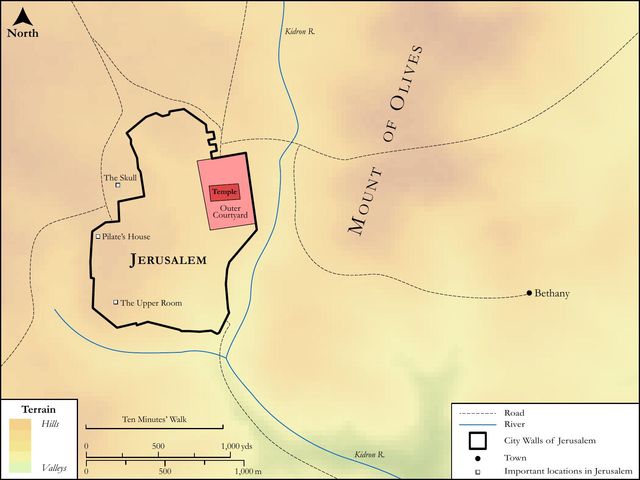
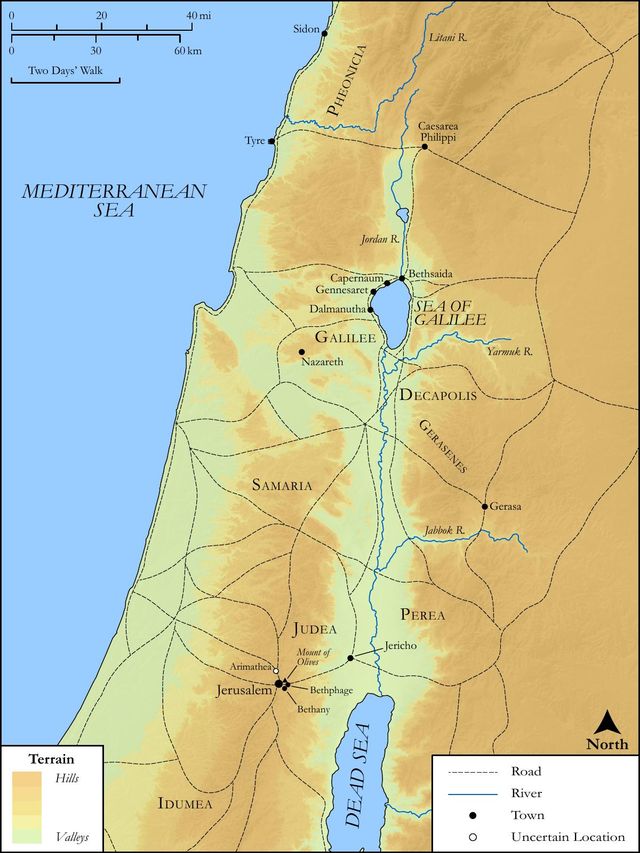
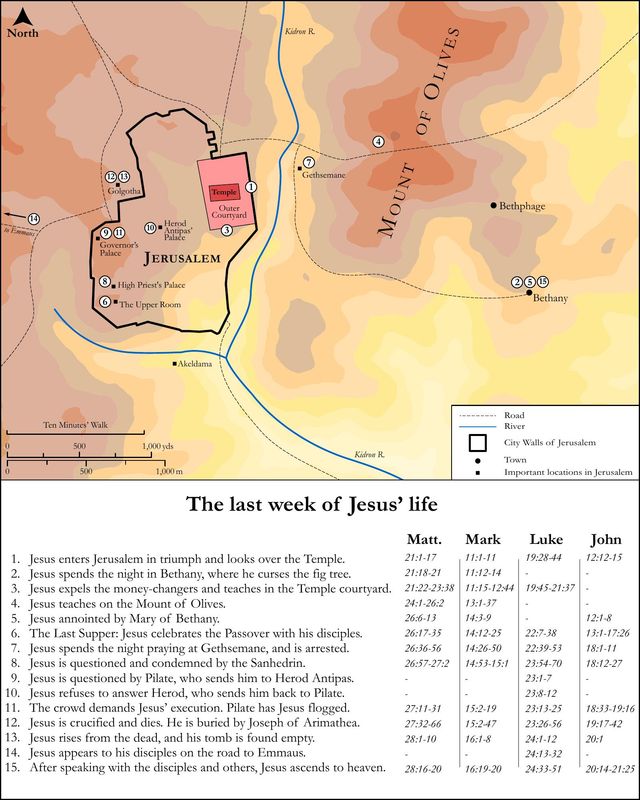
See on the biblical-era maps
Study this verse
Public-domain commentary
Matthew Henry
From his Commentary on the Whole Bible. Henry comments on passages, not single verses — this entry covers Mark 13:14–23. His two-level outline is real structure in the source text, so it is rendered as structure.
The Jews, in rebelling against the Romans, and in persecuting the Christians, were hastening to their own ruin apace, both efficiently and meritoriously, were setting both God and man against them; see Th1 2:15. Now here we have a prediction of that ruin which came upon them within less than forty years after this: we had it before, Mat 24:15, etc. Observe,
I.What is here foretold concerning it.
1.That the Roman armies should make a descent upon Judea, and invest Jerusalem, the holy city. These were the abomination of desolation, which the Jews did abominate, and by which they should be made desolate. The country of thine enemy is called the land which thou abhorrest, Isa 7:16. Therefore it was an abomination, because it brought with it nothing but desolation. They had rejected Christ as an abomination, who would have been their salvation; and now God brought upon them an abomination that would be their desolation, thus spoken of by Daniel the prophet (Dan 9:27), as that by which this sacrifice and offering should be made to cease. This army stood where it ought not, in and about the holy city, which the heathen ought not to have approached, nor would have been suffered to approach, if Jerusalem had not first profaned the crown of their holiness. This the church complains of, Lam 1:10, The heathen entered into her sanctuary, whom thou didst command that they should not enter into the congregation; but sin made the breach, at which the glory went out, and the abomination of desolation broke in, and stood where it ought not. Now, let him that readeth this, understand it, and endeavor to take it right. Prophecies should not be too plain, and yet intelligible to those that search them; and they are best understood by comparing them first with one another, and at last with the event.
2.That when the Roman army should come into the country, there would be no safety any where but by quitting the country, and that with all possible expedition. It will be in vain to fight, the enemies will be too hard for them; in vain to abscond, the enemies will find them out; and in vain to capitulate, the enemies will give them no quarter; a man cannot have so much as his life given him for a prey, but by fleeing to the mountains out of Judea; and let him take the first alarm, and make the best of his way. If he be on the house-top, trying from thence to discover the motions of the enemy, and spies them coming, let him not go down, to take any thing out of the house, for it will occasion his losing of time, which is more precious than his best goods, and will but encumber him, and embarrass his flight. If he be in the field, and there discover the approach of the enemy, let him get away as he is, and not turn back again, to take up his garment, Mar 13:16. If he can save his life, let him reckon it is a good bargain, though he can save nothing else, and be thankful to God, that, though he is cut short, he is not cut off.
3.That it would go very hard at that time with poor mothers and nurses (Mar 13:17); "Woe to them that are with child, that dare not go into strange places, that cannot shift for themselves, nor make haste as others can. And woe to them that give suck, that know not how either to leave the tender infants behind them, or to carry them along with them." Such is the vanity of the creature, that the time may often be, when the greatest comforts may prove the greatest burthens. It would likewise be very uncomfortable, if they should be forced to flee in the winter (Mar 13:18), when the weather and ways were bad, when the roads would be scarcely passable, especially in the mountains to which they must flee. If there be no remedy but that trouble must come, yet we may desire and pray that, if it be God's will, the circumstances of it may be so ordered as to be a mitigation of the trouble; and when things are bad, we ought to consider they might have been worse. It is bad to be forced to flee, but it would have been worse if it had been in the winter.
4.That throughout all the country of the Jews, there should be such destruction and desolation made, as could not be paralleled in any history (Mar 13:19); In those days shall be affliction, such as was not from the beginning of time; that is, of the creation which God created, for time and the creation are of equal date, unto this day, neither shall be to the end of time; such a complication of miseries, and of such continuance. The destruction of Jerusalem by the Chaldeans was very terrible, but this exceeded it. It threatened a universal slaughter of all the people of the Jews; so barbarously did they devour one another, and the Romans devour them all, that, if their wars had continued a little longer, no flesh could have been saved, not one Jew could have been left alive; but in the midst of wrath God remembered mercy; and, (1.) He shortened the days; he let fall his controversy before he had made a full end. As a church and nation the ruin was complete, but many particular persons had their lives given them for a prey, by the storm's subsiding when it did. 2. It was for the elects' sake that those days were shortened; many among them fared the better for the sake of the few among them that believed in Christ, and were faithful to him. There was a promise, that a remnant should be saved (Isa 10:22), and that God would not, for his servants' sakes, destroy them all (Isa 65:8); and these promises must be fulfilled. God's own elect cry day and night to him, and their prayers must be answered, Luk 18:7.
II.What directions are given to the disciples with reference to it.
1.They must shift for the safety of their lives; "When you see the country invaded, and the city invested, flatter not yourselves with thoughts that the enemy will retire, or that you may be able to make your part good with them; but, without further deliberation or delay, let them that are in Judea, flee to the mountains, Mar 13:14. Meddle not with the strife that belongs not to you; let the potsherds strive with the potsherds of the earth, but do you go out of the ship when you see it sinking, that you die not the death of the uncircumcised in heart."
2.They must provide for the safety of their souls; "Seducers will be busy at that time, for they love to fish in troubled waters, and therefore then you must double your guard; then, if any man shall say unto you, Lo, here is Christ, or, Lo, he is there, you know he is in heaven, and will come again at the end of time, to judge the world, and therefore believe them not; having received Christ, be not drawn into the snares of any antichrist; for false Christs, and false prophets, shall arise," Mar 13:22. When the gospel kingdom was in the setting up, Satan mustered all his force, to oppose it, and made use of all his wiles; and God permitted it, for the trial of sincerity of some, and the discovery of the hypocrisy of others, and the confusion of those who rejected Christ, when he was offered to them. False Christs shall rise, and false prophets that shall preach them up; or such, as, though they pretend not to be Christs, set up for prophets, and undertake to foretel things to come, and they shall show signs and lying wonders; so early did the mystery of iniquity begin to work, Th2 2:7. They shall seduce, if it were possible, the very elect; so plausible shall their pretences be, and so industrious shall they be to impose upon people, that they shall drawn away many that were forward and zealous professors of religion, many that were very likely to have persevered; for nothing will be effectual to secure men but that foundation of God which stands immovably sure, The Lord knoweth them that are his, who shall be preserved when the faith of some is overthrown, Ti2 2:18, Ti2 2:19. They shall seduce, if it were possible, the very elect; but it is not possible to seduce them; the election shall obtain, whoever are blinded, Rom 11:7. But, in consideration hereof, let the disciples be cautious whom they give credit to (Mar 13:23); But take ye heed. Christ knew that they were of the elect, who could not possibly be seduced, and yet he said to them, Take heed. An assurance of persevering, and cautions against apostasy, will very well consist with each other. Though Christ said to them, Take heed, it doth not therefore follow, that their perseverance was doubtful, for they were kept by the power of God; and though their perseverance was secured, yet it doth not therefore follow, that this caution was needless, because they must be kept in the use of proper means. God will keep them, but they must keep themselves. "I have foretold you all things; have foretold you of this danger, that, being fore-warned, you may be fore-armed; I have foretold all things which you needed to have foretold to you, and therefore take heed of hearkening to such as pretend to be prophets, and to foretel more than I have foretold." The sufficiency of the scripture is good argument against listening to such as pretend to inspiration.
Historical interpretation
Ten Centuries of Reception
8 surviving comments on this verse. Each one is dated, so this reads as a timeline rather than a list.
Select a marker to jump to its quote. Markers stagger vertically where authors wrote within a few decades of each other.
For our flight is to the mountains, that he who has mounted to the heights of virtue may not go down to the depths of sin.
Pray that your flight may not be in the winter, or on the sabbath day, that is, that the fruit of our work may not be ended with the end of time; for fruit comes to an end in the winter and time in the sabbath.
But the tribulation shall be great, and the days short, for the sake of the elect, lest the evil of this time should change their understanding.
"And I saw another angel ascending from the east, having the seal of the living God" He speaks of Elias the prophet, who is the precursor of the times of Antichrist, for the restoration and establishment of the churches from the great and intolerable persecution. We read that these things are predicted in the opening of the Old and New Testament; for He says by Malachi: "Lo, I will send to you Elias the Tishbite, to turn the hearts of the fathers to the children, according to the time of calling, to recall the Jews to the faith of the people that succeed them." And to that end He shows, as we have said, that the number of those that shall believe, of the Jews and of the nations, is a great multitude which no man was able to number. Moreover, we read in the Gospel that the prayers of the Church are sent from heaven by an angel, and that they are received against wrath, and that the kingdom of Antichrist is cast out and extinguished by holy angels; for He says: "Pray that ye enter not into temptation: for there shall be a great affliction, such as has not been from the beginning of the world; and except the Lord had shortened those days, no flesh should be saved." Therefore He shall send these seven great archangels to smite the kingdom of Antichrist; for He Himself also thus said: "Then the Son of man shall send His messengers; and they shall gather together His elect from the four corners of the wind, from the one end of heaven even to the other end thereof." For, moreover, He previously says by the prophet: "Then shall there be peace for our land, when there shall arise in it seven shepherds and eight attacks of men; and they shall encircle Assur," that is, Antichrist, "in the trench of Nimrod," that is, in the nation of the devil, by the spirit of the Church. Similarly when the keepers of the house shall be moved. Moreover, the Lord Himself, in the parable to the apostles, when the labourers had come to Him and said, "Lord, did not we sow good seed in Thy field? whence, then, hath it tares? answered them, An enemy hath done this. And they said to Him, Lord, wilt Thou, then, that we go and root them up? And He said, Nay, but let both grow together until the harvest; and in the time of the harvest I will say to the reapers, that they gather the tares and make bundles of them, and burn them with fire everlasting, but that they gather the wheat into my barns." The Apocalypse here shows, therefore, that these reapers, and shepherds, and labourers, are the angels. And the trumpet is the word of power. And although the same thing recurs in the phials, still it is not said as if it occurred twice, but because what is decreed by the Lord to happen shall be once for all; for this cause it is said twice. What, therefore, He said too little in the trumpets, is here found in the phials. We must not regard the order of what is said, because frequently the Holy Spirit, when He has traversed even to the end of the last times, returns again to the same times, and fills up what He had before failed to say. Nor must we look for order in the Apocalypse; but we must follow the meaning of those things which are prophesied. Therefore in the trumpets and phials is signified either the desolation of the plagues that are sent upon the earth, or the madness of Antichrist himself, or the cutting off of the peoples, or the diversity of the plagues, or the hope in the kingdom of the saints, or the ruin of states, or the great overthrow of Babylon, that is, the Roman state.
(Epist. cxcix. 9.) For Josephus, who has written the history of the Jews, relates that such things were suffered by this people, as are scarcely credible, wherefore it is said, not without cause, that there was not such tribulation from the beginning of the creation until now, nor shall ever be. But although in the time of Antichrist there shall be one similar or greater, we must understand that it is of that people, that it is said that there shall never happen such another. For if they are the first and foremost to receive Antichrist, that same people may rather be said to cause than to suffer tribulation.
(ubi sup.) But some persons more fitly understand that the calamities themselves are signified by days, as evil days are spoken of in other parts of holy Scripture; for the days themselves are not evil, but what is done in them. The woes themselves therefore are said to be abridged, because through the patience which God gave they felt them less, and then what was great in itself was abridged.
Let us keep in mind that these present afflictions are as far below the last tribulations, as is the person of the herald below the majesty of the judge he precedes. Reflect with all your mind upon this day, my dearest ones. Remedy what is now defective in your present life. Amend your ways. Overcome evil temptations by standing firm against them. Repent with tears of the sins you have committed. For the more you make ready against the severity of his justice by serving him in fear, the more serenely shall you behold the coming of that eternal judge, who with the Father and the Holy Spirit lives and reigns, world without end. Amen.
(ubi sup.) When we are challenged to understand what is said, we may conclude that it is mystical. But it may either be said simply of Antichrist, or of the statue of Cæsar, which Pilate put into the temple, or of the equestrian statue of Adrian, which for a long time stood in the holy of holies itself. An idol is also called abomination according to the Old Testament, and he has added of desolation, because it was placed in the temple when desolate and deserted.
(ubi sup.) It is on record that this was literally fulfilled, when on the approach of the war with Rome and the extermination of the Jewish people, all the Christians who were in that province, warned by the prophecy, fled far away, as Church history relates, and retiring beyond Jordan, remained for a time in the city of Pella under the protection of Agrippa, the king of the Jews, of whom mention is made in the Acts, and who with that part of the Jews, who chose to obey him, always continued subject to the Roman empire.
(ubi sup.) That is, they whose wombs or whose hands, overladen with the burden of children, in no small measure impede their forced flight.
(ubi sup.) The only refuge in such evils is, that God who gives strength to suffer, should abridge the power of inflicting. Wherefore there follows: And except that the Lord had shortened those days.
(ubi sup.) Or else; these words, In those days shall be affliction, properly agree with the times of Antichrist, when not only tortures more frequent, and more painful than before are to be heaped on the faithful, but also, what is more terrible, the working of miracles shall accompany those who inflict torments. But in proportion as this tribulation shall be greater than those which preceded, by so much shall it be shorter. For it is believed, that during three years and a half, as far as may be conjectured from the prophecy of Daniel and the Revelations of John, the Church is to be attacked. In a spiritual sense, however, when we see the abomination of desolation standing where it ought not, that is, heresies and crimes reigning amongst them, who appear to be consecrated by the heavenly mysteries, then whosoever of us remain in Judæa, that is, in the confession of the true faith, ought to mount the higher in virtue, the more men we see following the broad paths of vice.
(ubi sup.) Then let him who is on the house-top, that is, whose mind rises above carnal deeds, and who lives spiritually, as it were in the free air, not come down to the base acts of his former conversation, nor seek again those things which he had left, the desires of the world or the flesh. For our house either means this world, or that in which we live, our own flesh.
(ubi sup.) But if we are to understand it of the consummation of the world, He commands that our faith and love for Christ should not grow cold, and that we should not grow lazy and cold in the work of God, by taking a sabbath from virtue.
For those days will be a time of tribulation such as has not been since the beginning of the creation which God created until now, nor ever will be. These words properly fit the times of the Antichrist, when not only will there be torments more frequent than they used to be, inflicted upon the faithful, but (what is worse) the operation of signs will also accompany those who inflict the torments: as the Apostle testifies, who says, "whose coming is according to the working of Satan, with all deception, signs, and lying wonders" (II Thess. II). Indeed, how many miracles and how many powers the holy martyrs often performed before their persecutors, and yet they did not wish to believe nor to cease from persecuting. Who then will be converted to the faith, an unbeliever, whose faith already believing does not fear and is shaken, when the persecutor of piety also becomes the worker of virtue, the same one who rages with torments so that Christ is denied, provokes with miracles so that the Antichrist is believed? What then will be the refuge in these things, what hope will remain for the elect, except that the higher grace, which grants the power of patience to the pious, should quickly remove the power of persecuting and tribulating from the impious? Hence it is providently added with piety:
Or he means by the abomination of desolation, the entrance of enemies into the city by violence.
And well does he say, Who are in Judæa, for the Apostles were no longer in Judæa, but before the battle had been driven from Jerusalem.
But it seems to me, that in these words He foretells the eating of children, for when afflicted by famine and pestilence, they laid hands on their children.
That is, lest they who wish to fly should be impeded by the difficulties of the season. And He fitly gives the cause for so great a necessity for flight; saying, For in those days shall be affliction, such as was not from the beginning of the creation which God created unto this time, neither shall be.
That is, if the Roman war had not been soon finished, no flesh should be saved; that is, no Jew should have escaped; but for the elect's sake, whom he hath chosen, that is, for the sake of the believing Jews, or who were hereafter to believe, He hath shortened the days, that is, the war was soon finished, for God foresaw that many Jews would believe after the destruction of the city; for which reason He would not suffer the whole race to be utterly destroyed.
We must also avoid sin with fervour, and not coldly and quietly.
(non occ.) After speaking of the things which were to happen before the destruction of the city, the Lord now foretells those which happened about the destruction itself of the city, saying, But when ye shall see the abomination of desolation standing where it ought not, (let him that readeth understand.)
(Non in Gloss. sed ap. Theoph.) Or rather went out of their own accord, being led by the Holy Ghost. It goes on, And let him that is on the housetop not go down into the house, neither enter therein, to take any thing out of his house; for it is a desirable thing to be saved even naked from such a destruction. It goes on: But woe to them that are with child, and to them that give suck in those days.
(non occ.) Again, after having mentioned this double impediment to flight, which might arise either from the desire of taking away property, or from having children to carry, He touches upon the third obstacle, namely, that coming from the season; saying, And pray ye that your flight be not in the winter.
Continue studying Mark 13:19 across the web’s major study libraries — every link below opens this exact verse, chapter, or book on the destination site.
Read & Compare
 BibleGatewayThis verse in more than 200 translations and 70 languages.
 Bible.comThe YouVersion reader — hundreds of translations, reading plans, and highlights.
 ESV.orgCrossway's official English Standard Version reader.
 NET BibleThe NET translation with 60,000+ translators' notes on every rendering decision.
 STEP BibleTyndale House's free study tool — original text, vocabulary, and scholarly resources.
 BibliaLogos Bible Software's free web reader.
 USCCBThe New American Bible (Revised Edition) with the U.S. bishops' study notes.
Commentaries
 BibleHub CommentariesDozens of classic commentaries on this verse, gathered on one page.
 StudyLightMore than 100 commentary sets — the largest collection on the web.
 BibleRefPlain-English commentary on what this verse means, verse by verse.
 Enduring WordDavid Guzik's free commentary on this chapter, widely used by Bible teachers.
 Bible Study ToolsVerse commentary alongside Greek and Hebrew study aids.
Original Language & Research
- BibleHub InterlinearThe verse word by word — original language, transliteration, and English.
- BibleHub LexiconEvery word's original-language definition and Strong's entry.
 Blue Letter BibleDeep-study tools — Strong's numbers, concordance, and word studies.
 CNTR CollationThe earliest Greek manuscripts of this verse, collated letter by letter.
Sermons, Hymns & Audio


TrulyRandomVerse is not affiliated with these sites and doesn’t control their content. They’re linked because they’re genuinely useful.
Summary
Mark 13:19 is a profound declaration by Jesus Christ, delivered within His Olivet Discourse, foretelling a future period of unparalleled global distress. This verse describes a time of intense affliction, explicitly stating that its severity will surpass any suffering experienced from the very beginning of creation up to that point, and will never be equaled thereafter. It serves as a stark warning of the unique and extreme nature of the eschatological tribulation preceding the Lord's return.
Context
ShowHideLiterary Context
This verse is embedded within Jesus' extensive prophetic discourse on the Mount of Olives, often referred to as the Olivet Discourse, found in Mark 13. The disciples' questions in Mark 13:3-4—prompted by Jesus' prediction of the Temple's destruction in Mark 13:2—set the stage for His detailed exposition on the signs of the end of the age and His second coming. Following descriptions of initial "birth pains" like false Christs, wars, and natural disasters (Mark 13:5-8), and the persecution of believers (Mark 13:9-13), Jesus introduces the "abomination of desolation" (Mark 13:14) as the immediate precursor to this unprecedented "affliction." Mark 13:19 thus marks the climax of this period of intense suffering, emphasizing its unique severity.
Historical & Cultural Context
Jesus' prophecy was delivered to His disciples on the Mount of Olives, overlooking Jerusalem and the magnificent Temple. The Jewish people of the first century lived under Roman occupation, with a strong messianic expectation for a deliverer who would restore Israel's sovereignty. They were familiar with Old Testament prophetic warnings of "days of trouble" or "tribulation" (e.g., Daniel 12:1). Jesus' words, however, transcend immediate political or historical events, speaking of a cataclysmic period rooted in divine judgment that would surpass even the traumatic events of the Jewish-Roman War and the destruction of Jerusalem in A.D. 70. While the fall of Jerusalem was a significant historical tribulation, Jesus' language points to an ultimate, global eschatological event, using hyperbolic language to convey its unparalleled nature.
Key Themes
ShowHideMark 13:19 contributes significantly to several overarching themes within the Olivet Discourse and the broader New Testament. Firstly, it underscores the sovereignty of God over history, revealing that even the most extreme future events are within His foreknowledge and ultimate control. Secondly, it highlights the theme of unprecedented suffering, emphasizing that the eschatological tribulation will be a unique period of hardship, distinct in its intensity and scope from all prior afflictions. This theme serves as a stark warning and a call to spiritual vigilance. Thirdly, it is part of the broader theme of eschatological warning and preparation, urging believers to remain watchful, faithful, and enduring amidst trials, knowing that these events precede the glorious return of the Son of Man. The discourse, including this verse, serves to prepare disciples for future challenges and to discern the signs of the times.
Exposition and Analysis
ShowHideKey Word Analysis
ShowHideThis term, derived from a verb meaning "to press" or "to crush," denotes intense pressure, distress, tribulation, or anguish. In the New Testament, it frequently describes the hardships, persecutions, and suffering faced by believers (e.g., John 16:33). Here, it is used to describe a period of suffering so severe that it is unparalleled in human history.
This word signifies a commencement, origin, or the first point in time or order. In this context, it refers to the very start of creation, emphasizing the vast sweep of history against which the coming "affliction" is measured. It underscores the unparalleled nature of the prophesied distress, contrasting it with all that has occurred since the world began.
Meaning "to fabricate" or "to found originally," this verb refers to the act of creation. Paired with "God" and "creation," it highlights the divine origin of the world and sets the ultimate historical benchmark for the severity of the coming tribulation. The suffering will be so extreme that it will surpass anything known since God Himself initiated all existence.
Verse Breakdown
ShowHide"For in those days shall be affliction,"
This phrase introduces the core subject of the verse: a future period ("in those days") characterized by intense suffering or distress ("affliction"). The conjunction "For" (G1063, gár) indicates that this statement provides a reason or explanation for the preceding warnings and calls to flee.
"such as was not from the beginning of the creation which God created unto this time,"
This clause emphasizes the unprecedented nature of the coming affliction. It explicitly states that no suffering of comparable magnitude has occurred since the very moment God brought the universe into existence, up to the present time of Jesus' discourse. This sets an extremely high bar for the severity of the prophesied events.
"neither shall be."
This concluding phrase further intensifies the declaration, asserting that this particular period of affliction will not only be unparalleled in the past but will also never be surpassed or equaled in any future time. It underscores the unique, climactic, and ultimate nature of this eschatological tribulation.
Literary Devices
ShowHideMark 13:19 employs several powerful literary devices to convey the gravity of Jesus' prophecy. The most prominent is Hyperbole, seen in the superlative language "such as was not from the beginning of the creation... neither shall be." This exaggeration is not meant to be taken as a literal, mathematical impossibility that no single individual suffering could ever be worse, but rather to emphasize the unique, comprehensive, and unparalleled nature of this specific period of global distress and divine judgment. It functions as a rhetorical device to shock and warn the audience about the extreme severity of what is to come. Additionally, the verse utilizes Apocalyptic Imagery, painting a vivid and terrifying picture of future events that are cataclysmic and world-altering, characteristic of prophetic literature dealing with the end times. The stark contrast between "the beginning of the creation" and "this time" (and "neither shall be") also creates a sense of Temporal Contrast, highlighting the unique position of this tribulation within the entire sweep of salvation history.
Theological and Thematic Connections
ShowHideMark 13:19 unveils a crucial aspect of God's eschatological plan: a divinely ordained period of unprecedented tribulation that serves as a climactic point in human history before the ultimate consummation. This suffering is not random but is part of the "birth pains" leading to the new creation and the establishment of God's eternal kingdom. The theological implication is that God, in His sovereignty, allows and even ordains such periods of intense suffering, not as an act of arbitrary cruelty, but often as a means of judgment, purification, and ultimately, to bring about His redemptive purposes. This verse forces us to grapple with the reality of divine wrath and the severity of sin, while simultaneously pointing to the ultimate triumph of God's will.
Reflection and Application
ShowHideMark 13:19, while describing a future event of immense scale, offers profound insights for believers today. It calls us to a sober and realistic understanding of the world's trajectory and the reality of suffering, both now and in the future. Rather than fostering fear, this prophecy should cultivate spiritual preparedness, deep trust in God's ultimate control, and a renewed sense of urgency for the gospel. We are reminded that our present troubles, while real, are framed within a larger divine narrative that includes a period of unparalleled global distress. This perspective can help us endure current difficulties with greater resilience, knowing that God is sovereign over all history, including its most challenging chapters. It encourages us to live with an eternal perspective, focusing on faithfulness and perseverance, and to be a people who are not surprised by trials but are rooted in the unshakeable hope of Christ's return.
Questions for Reflection
ShowHideFAQ
ShowHideWhat is the "affliction" mentioned in Mark 13:19?
ShowHideThe "affliction" (Greek: thlîpsis) refers to a period of intense, unparalleled distress and suffering that Jesus prophesied would occur before His second coming. While it has historical echoes in events like the destruction of Jerusalem in A.D. 70, Jesus' hyperbolic language ("such as was not from the beginning of the creation... neither shall be") points to an ultimate, global, and eschatological tribulation that transcends any single historical event. It is often understood as the "Great Tribulation" described in other New Testament passages, a time of divine judgment and severe hardship upon the earth.
Christ-Centered Fulfillment
ShowHideMark 13:19, with its stark prophecy of unparalleled affliction, finds its ultimate Christ-centered fulfillment not merely in the suffering itself, but in the glorious return of Jesus Christ as the triumphant King and Deliverer. This intense period of tribulation, far from being a random catastrophe, is precisely the "birth pangs" (Mark 13:8) that precede the new creation ushered in by Christ's second advent. Jesus Himself is the one who foretells this suffering, demonstrating His omniscience and authority over history, and He is also the one who promises to shorten those days for the sake of the elect (Mark 13:20). The very purpose of this unprecedented distress is to prepare the way for the revelation of the Son of Man coming in clouds with great power and glory, who will gather His elect from the four winds (Mark 13:27). Thus, the "affliction" of Mark 13:19 is not an end in itself, but a terrible, yet necessary, prelude to the triumphant reign of Christ, who will ultimately bring an end to all suffering and establish His eternal kingdom (Revelation 21:4).