


Daniel 11:45
- וְיִטַּעve·yi·Ta'so he may pitchH5193Conj-w ¦ V-Qal-ConjImperf-3msVerb Qal Conjunction+Imperfect 3rd Singular Masculineוְsoיִטַּעhe may pitch
- אָהֳלֶי'o·ho·Lei[the] tents ofH168N-mpcNoun Plural Masculine Construct
- אַפַּדְנוֹ'a·pad·Nohis palaceH643N-msc ¦ 3msNoun Singular Masculine Constructאַפַּדְנpalaceוֹhis
- בֵּיןbeinbetweenH996Adj-mscAdjective Numerical Singular Masculine Construct
- יַמִּיםya·Mim[the] seasH3220N-mpNoun Plural Masculine Absolute
- לְהַרle·harand [the] mountain ofH2022Prep-l ¦ N-mscNoun Singular Masculine Constructלְandהַר[the] mountain of
- צְבִיtze·vi[the] beauty ofH6643N-mscNoun Singular Masculine Construct
- קֹדֶשׁKo·deshholinessH6944N-msNoun Singular Masculine Absolute
- וּבָאu·Va'and he will comeH935Conj-w ¦ V-Qal-ConsecPerf-3msVerb Qal Consecutive Perfect 3rd Singular Masculineוּandבָאhe will come
- עַד'adtoH5704PrepPreposition
- קִצּוֹki·Tzohis endH7093N-msc ¦ 3msNoun Singular Masculine Constructקִצּendוֹhis
- וְאֵיןve·'Einand notH369Conj-w ¦ N-mscNoun Singular Masculine Constructוְandאֵיןnot
- עוֹזֵרo·Zera helperH5826V-Qal-Prtcpl-msVerb Qal Participle Singular Masculine Absolute
- לוֹlo[will belong] to himPrep-l ¦ 3msSuffix Personal 3rd Singular Masculineל[will belong] toוֹhim
English is a literal word-by-word gloss of the Hebrew, not the KJV's wording. Why?
This is the original text the KJV's translators worked from — each Hebrew word with its own literal English meaning in this verse, prepared by scholars at Tyndale House, Cambridge. The KJV translates whole sentences, not word by word, so its wording differs: one Hebrew word can become several English words, and the KJV may choose “the LORD” where the gloss reads “Yahweh”. Both are faithful — they answer different questions. For the KJV's own rendering, switch to the KJV text.
Details
See on the biblical-era map
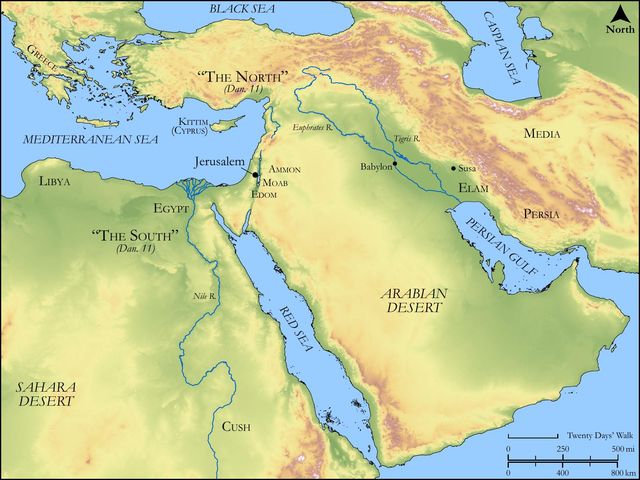
Study this verse
Public-domain commentary
Matthew Henry
From his Commentary on the Whole Bible. Henry comments on passages, not single verses — this entry covers Daniel 11:21–45. His three-level outline is real structure in the source text, so it is rendered as structure.
All this is a prophecy of the reign of Antiochus Epiphanes, the little horn spoken of before (Dan 8:9) a sworn enemy to the Jewish religion, and a bitter persecutor of those that adhered to it. What troubles the Jews met with in the reigns of the Persian kings were not so particularly foretold to Daniel as these, because then they had living prophets with them, Haggai and Zechariah, to encourage them; but these troubles in the days of Antiochus were foretold, because, before that time, prophecy would cease, and they would find it necessary to have recourse to the written word. Some things in this prediction concerning Antiochus are alluded to in the New Testament predictions of the antichrist, especially Dan 11:36, Dan 11:37. And as it is usual with the prophets, when they foretel the prosperity of the Jewish church, to make use of such expressions as were applicable to the kingdom of Christ, and insensibly to slide into a prophecy of that, so, when they foretel the troubles of the church, they make use of such expressions as have a further reference to the kingdom of the antichrist, the rise and ruin of that. Now concerning Antiochus, the angel foretels here,
I.His character:
He shall be a vile person. He called himself Epiphanes - the illustrious, but his character was the reverse of his surname. The heathen writers describe him to be an odd-humoured man, rude and boisterous, base and sordid. He would sometimes steal out of the court into the city, and herd with any infamous company incognito - in disguise he made himself a companion of the common sort, and of the basest strangers that came to town. He had the most unaccountable whims, so that some took him to be silly, others to be mad. Hence he was called Epimanes - the madman. He is called a vile person, for he had been a long time a hostage at Rome for the fidelity of his father when the Romans had subdued him; and it was agreed that, when the other hostages were exchanged, he should continue a prisoner at large.
II.His accession to the crown.
By a trick he got his elder brother's son, Demetrius, to be sent a hostage to Rome, in exchange for him, contrary to the cartel; and, his elder brother being made away with by Heliodorus (Dan 11:20), he took the kingdom. The states of Syria did not give it to him (Dan 11:21), because they knew it belonged to his elder brother's son, nor did he get it by the sword, but came in peaceably, pretending to reign for his brother's son, Demetrius, then a hostage at Rome. But with the help of Eumenes and Attalus, neighbouring princes, he gained an interest in the people, and by flatteries obtained the kingdom, established himself in it, and crushed Heliodorus, who made head against him with the arms of a flood; those that opposed him were overflown and broken before him, even the prince of the covenant, his nephew, the rightful heir, whom he pretended to covenant with that he would resign to him whenever he should return, Dan 11:22. But (Dan 11:23) after the league made with him he shall work deceitfully, as one whose avowed maxim it is that princes ought not to be bound by their word any longer than it is for their interest. And with a small people, that at first cleave to him, he shall become strong, and (Dan 11:24) he shall enter peaceably upon the fattest places of the kingdom of Syria, and, very unlike his predecessors, shall scatter among the people the prey, and the spoil, and riches, to insinuate himself into their affections; but, at the same time, he shall forecast his devices against the strong-holds, to make himself master of them, so that his generosity shall last but for a time; when he has got the garrisons into his hands he will scatter his spoil no more, but rule by force, as those commonly do that come in by fraud. He that comes in like a fox reigns like a lion. Some understand these verses of his first expedition into Egypt, when he came not as an enemy, but as a friend and guardian to the young king Ptolemaeus Philometer, and therefore brought with him but few followers, yet those stout men, and faithful to his interest, whom he placed in divers of the strong-holds in Egypt, thereby making himself master of them.
III.His war with Egypt, which was his second expedition thither.
This is described, Dan 11:25, Dan 11:27. Antiochus shall stir up his power and courage against Ptolemaeus Philometer king of Egypt. Ptolemy, thereupon, shall be stirred up to battle against him, shall come against him with a very great and mighty army; but Ptolemy, though he has such a vast army, shall not be able to stand before him; for Antiochus's army shall overthrow his, and overpower it, and great multitudes of the Egyptian army shall fall down slain. And no marvel, for the king of Egypt shall be betrayed by his own counsellors; those that feed of the portion of his meat, that eat of his bread and live upon him, being bribed by Antiochus, shall forecast devices against him, and even they shall destroy him; and what fence is there against such treachery? After the battle, a treaty of peace shall be set on foot, and these two kings shall meet at one council-board, to adjust the articles of peace between them; but they shall neither of them be sincere in it, for they shall, in their pretences and promises of amity and friendship, lie to one another, for their hearts shall be at the same time to do one another all the mischief they can. And then no marvel that it shall not prosper. The peace shall not last; but the end of it shall be at the time appointed in the divine Providence, and then the war shall break out again, as a sore that is only skinned over.
IV.Another expedition against Egypt.
From the former he returned with great riches (Dan 11:28), and therefore took the first occasion to invade Egypt again, at the time appointed by the divine Providence, two years after, in the eighth year of his reign, Dan 11:29. He shall come towards the south. But this attempt shall not succeed, as the two former did, nor shall he gain his point, as he had done before once and again; for (Dan 11:30) the ships of Chittim shall come against him, that is, the navy of the Romans, or only ambassadors from the Roman senate, who came in ships. Ptolemaeus Philometer, king of Egypt, being now in a strict alliance with the Romans, craved their aid against Antiochus, who had besieged him and his mother Cleopatra in the city of Alexandria. The Roman senate thereupon sent an embassy to Antiochus, to command him to raise the siege, and, when he desired some time to consider of it and consult with his friends about it, Popilius, one of the ambassadors, with his staff drew a circle about him, and told him, as one having authority, he should give a positive answer before he came out of that circle; whereupon, fearing the Roman power, he was forced immediately to give orders for the raising of the siege and the retreat of his army out of Egypt. So Livy and others relate the story which this prophecy refers to. He shall be grieved, and return; for it was a great vexation to him to be forced to yield thus.
V.His rage and cruel practices against the Jews.
This is that part of his government, or mis-government rather, which is most enlarged upon in this prediction. In his return from his expedition into Egypt (which is prophesied of, Dan 11:28) he did exploits against the Jews, in the sixth year of his reign; then he spoiled the city and temple. But the most terrible storm was in his return from Egypt, two years after, prophesied of Dan 11:30. Then he took Judea in his way home; and, because he could not gain his point in Egypt by reason of the Romans interposing, he wreaked his revenge upon the poor Jews, who gave him no provocation, but had greatly provoked God to permit him to do it, Dan 8:23.
1.He had a rooted antipathy to the Jews' religion: His heart was against the holy covenant, Dan 11:28. And (Dan 11:30) he had indignation against the holy covenant, that covenant of peculiarity by which the Jews were incorporated a people distinct from all other nations, and dignified above them. He hated the law of Moses and the worship of the true God, and was vexed at the privileges of the Jewish nation and the promises made to them. Note, That which is the hope and joy of the people of God is the envy of their neighbours, and that is the holy covenant. Esau hated Jacob because he had got the blessing. Those that are strangers to the covenant are often enemies to it.
2.He carried on his malicious designs against the Jews by the assistance of some perfidious apostate Jews. He kept up intelligence with those that forsook the holy covenant (Dan 11:30), some of the Jews that were false to their religion, and introduced the customs of the heathen, with whom they made a covenant. See the fulfilling of this, 1 Macc. 1:11-15, where it is expressly said, concerning those renegado Jews, that they made themselves uncircumcised and forsook the holy covenant. We read (2 Macc. 4:9) of Jason, the brother of Onias the high priest, who by the appointment of Antiochus set up a school at Jerusalem, for the training up of youth in the fashions of the heathen; and (2 Macc. 4:23, etc.) of Menelaus, who fell in with the interests of Antiochus, and was the man that helped him into Jerusalem, now in his last return from Egypt. We read much in the book of the Maccabees of the mischief done to the Jews by these treacherous men of their own nation, Jason and Menelaus, and their party. These upon all occasions he made use of. "Such as do wickedly against the covenant, such as throw up their religion, and comply with the heathen, he shall corrupt with flatteries, to harden them in their apostasy, and to make use of them as decoys to draw in others," Dan 11:32. Note, It is not strange if those who do not live up to their religion, but in their conversations do wickedly against the covenant, are easily corrupted by flatteries to quit their religion. Those that make shipwreck of a good conscience will soon make shipwreck of the faith.
3.He profaned the temple. Arms stand on his part (Dan 11:31), not only his own army which he now brought from Egypt, but a great party of deserters from the Jewish religion that joined with them; and they polluted the sanctuary of strength, not only the holy city, but the temple. The story of this we have, 1 Macc. 1:21, etc. He entered proudly into the sanctuary, took away the golden altar, and the candlestick, etc. And therefore (v. 25) there was a great mourning in Israel; the princes and elders mourned, etc. And (2 Macc. 5:15, etc.) Antiochus went into the most holy temple, Menelaus, that traitor to the laws and to his own country, being his guide. Antiochus, having resolved to bring all about him to be of his religion, took away the daily sacrifice, Dan 11:31. Some observe that the word Tammidh, which signifies no more than daily, is only here, and in the parallel place, used for the daily sacrifice, as if there were a designed liberty left to supply it either with sacrifice, which was suppressed by Antiochus, or with gospel-worship, which was suppressed by the Antichrist. Then he set up the abomination of desolation upon the altar (1 Macc. 1:54), even an idol altar (v. 59), and called the temple the temple of Jupiter Olympius, 2 Macc. 6:2.
4.He persecuted those who retained their integrity. Though there are many who forsake the covenant and do wickedly against it, yet there is a people who do know their God and retain the knowledge of him, and they shall be strong and do exploits, Dan 11:32. When others yield to the tyrant's demands, and surrender their consciences to his impositions, they bravely keep their ground, resist the temptation, and make the tyrant himself ashamed of his attempt upon them. Good old Eleazar, one of the principal scribes, when he had swine's flesh thrust into his mouth, did bravely spit it out again, though he knew he must be tormented to death for so doing, and was so, 2 Macc. 6:19. The mother and her seven sons were put to death for adhering to their religion, 2 Macc. 7. This might well be called doing exploits; for to choose suffering rather than sin is a great exploit. And it was by faith, by being strong in faith, that they did those exploits, that they were tortured, not accepting deliverance, as the apostle speaks, probably with reference to that story, Heb 11:35. Or it may refer to the military courage and achievements of Judas Maccabaeus and others in opposition to Antiochus. Note, The right knowledge of God is, and will be, the strength of the soul, and, in the strength of that, gracious souls do exploits. Those that know his name will put their trust in him, and by that trust will do great things. Now, concerning this people that knew their God, we are here told,
(1.)That they shall instruct many, Dan 11:33. They shall make it their business to show others what they have learned themselves of the difference between truth and falsehood, good and evil. Note, Those that have the knowledge of God themselves should communicate their knowledge to those about them, and this spiritual charity must be extensive: they must instruct many. Some understand this of a society newly erected for the propagating of divine knowledge, called Assideans, godly men, pietists (so the name signifies), that were both knowing and zealous in the law; these instructed many. Note, In times of persecution and apostasy, which are trying times, those that have knowledge ought to make use of it for the strengthening and establishing of others. Those that understand aright themselves ought to do what they can to bring others to understand; for knowledge is a talent that must be traded with. Or, They shall instruct many by their perseverance in their duty and their patient suffering for it. Good examples instruct many, and with many are the most powerful instructions.
(2.)They shall fall by the cruelty of Antiochus, shall be put to the torture, and put to death, by his rage. Though they are so excellent and intelligent themselves, and so useful and serviceable to others, yet Antiochus shall show them no mercy, but they shall fall for some days; so it may be read, Rev 2:10, Thou shalt have tribulation ten days. We read much, in the books of the Maccabees, of Antiochus's barbarous usage of the pious Jews, how many he slew in wars and how many he murdered in cold blood. Women were put to death for having their children circumcised, and their infants were hanged about their necks, 1 Macc. 1:60, 61. But why did God suffer this? How can this be reconciled with the justice and goodness of God? I answer, Very well, if we consider what it was that God aimed at in this (Dan 11:35): Some of those of understanding shall fall, but it shall be for the good of the church and for their own spiritual benefit. It shall be to try them, and to purge, and to make them white. They needed these afflictions themselves. The best have their spots, which must be washed off, their dross, which must be purged out; and their troubles, particularly their share in the public troubles, help to do this; being sanctified to them by the grace of God, they are means of mortifying their corruptions, weaning them from the world, and awakening them to greater seriousness and diligence in religion. They try them, as silver in the furnace is refined from its dross; they purge them, as wheat in the barn is winnowed from the chaff; and they make them white, as cloth by the fuller is cleared from its spots. See Pe1 1:7. Their sufferings for righteousness' sake would try and purge the nation of the Jews, would convince them of the truth, excellency, and power of that holy religion which these understanding men died for their adherence to. The blood of the martyrs is the seed of the church; it is precious blood, and not a drop of it should be shed but upon such a valuable consideration.
(3.)The cause of religion, though it be thus run upon, shall not be run down. When they shall fall they shall not be utterly cast down, but they shall be holpen with a little help, Dan 11:34. Judas Maccabaeus, and his brethren, and a few with them, shall make head against the tyrant, and assert the injured cause of their religion; they pulled down the idolatrous altars, circumcised the children that they found uncircumcised, recovered the law out of the hand of the Gentiles, and the work prospered in their hands, 1 Macc. 2:45, etc. Note, Those that stand by the cause of religion when it is threatened and struck at, though they may not immediately be delivered and made victorious, shall yet have present help. And a little help must not be despised; but, when times are very bad, we must be thankful for some reviving. It is likewise foretold that many shall cleave to them with flatteries; when they see the Maccabees prosper some Jews shall join with them that are no true friends to religion, but will only pretend friendship either with design to betray them or in hope to rise with them; but the fiery trial (Dan 11:35) will separate between the precious and the vile, and by it those that are perfect will be made manifest and those that are not.
(4.)Though these troubles may continue long, yet they will have an end. They are for a time appointed, a limited time, fixed in the divine counsels. This warfare shall be accomplished. Hitherto the power of the enemy shall come, and no further; here shall its proud waves be stayed.
5.He grew very proud, insolent, and profane, and, being puffed up with his conquests, bade defiance to Heaven, and trampled upon every thing that was sacred, Dan 11:36, etc. And here some think begins a prophecy of the antichrist, the papal kingdom. It is plain that St. Paul, in his prophecy of the rise and reign of the man of sin, alludes to this (Th2 2:4), which shows that Antiochus was a type and figure of that enemy, as Babylon also was; but, this being joined in a continued discourse with the foregoing prophecies concerning Antiochus, to me it seems probably that it principally refers to him, and in him had its primary accomplishment, and has reference to the other only by way of accommodation.
(1.)He shall impiously dishonour the God of Israel, the only living and true God, called here the God of gods. He shall, in defiance of him and his authority, do according to his will against his people and his holy religion; he shall exalt himself above him, as Sennacherib did, and shall speak marvellous things against him and against his laws and institutions. This was fulfilled when Antiochus forbade sacrifices to be offered in God's temple, and ordered the sabbaths to be profaned, the sanctuary and the holy people to be polluted, etc., to the end that they might forget the law and change all the ordinances, and this upon pain of death, 1 Macc. 1:45.
(2.)He shall proudly put contempt upon all other gods, shall magnify himself above every god, even the gods of the nations. Antiochus wrote to his own kingdom that every one should leave the gods he had worshipped, and worship such as he ordered, contrary to the practice of all the conquerors that went before him, 1 Macc. 1:41, 42. And all the heathen agreed according to the commandment of the king; fond as they were of their gods, they did not think them worth suffering for, but, their gods being idols, it was all alike to them what gods they worshipped. Antiochus did not regard any god, but magnified himself above all, Dan 11:37. He was so proud that he thought himself above the condition of a mortal man, that he could command the waves of the sea, and reach to the stars of heaven, as his insolence and haughtiness are expressed, 2 Macc. 9:8, 10. Thus he carried all before him, till the indignation was accomplished (Dan 11:36), till he had run his length, and filled up the measure of his iniquity; for that which is determined shall be done, and nothing more, nothing short.
(3.)He shall, contrary to the way of the heathen, disregard the god of his fathers, Dan 11:37. Though an affection to the religion of their ancestors was, among the heathen, almost as natural to them as the desire of women (for, if you search through the isles of Chittim, you will not find an instance of a nation that has changed its gods, Jer 2:10, Jer 2:11), yet Antiochus shall not regard the god of his fathers; he made laws to abolish the religion of his country, and to bring in the idols of the Greeks. And though his predecessors had honoured the God of Israel, and given great gifts to the temple at Jerusalem (2 Macc. 3:2, 3), he offered the greatest indignities to God and his temple. His not regarding the desire of women may denote his barbarous cruelty (he shall spare no age or sex, no, not the tender ones) or his unnatural lusts, or, in general, his contempt of every thing which men of honour have a concern for, or it might be accomplished in something we meet not with in history. Its being joined to his not regarding the god of his fathers intimates that the idolatries of his country had in them more of the gratifications of the flesh than those of other countries (Lucian has written of the Syrian goddesses), and yet that would not prevail to keep him to them.
(4.)He shall set up an unknown god, a new god, Dan 11:38. In his estate, in the room of the god of his fathers (Apollo and Diana, deities of pleasure), he shall honour the god of forces, a supposed deity of power, a god whom his fathers knew not, nor worshipped; because he will be thought in wisdom and strength to excel his fathers, he shall honour this god with gold, and silver, and precious stones, thinking nothing too good for the god he has taken a fancy to. This seems to be Jupiter Olympius, known among the Phoenicians by the name of Baal-Semen, the lord of heaven, but never introduced among the Syrians till Antiochus introduced it. Thus shall he do in the most strong holds, in the temple of Jerusalem, which is called the sanctuary of strength (Dan 11:31), and here the fortresses of munitions; there he shall set up the image of this strange god. Some read it, He shall commit the munitions of strength, or of the most strong God (that is, the city Jerusalem), to a strange god; he put it under the protection and government of Jupiter Olympius. This god he shall not only acknowledge, but shall increase with glory, by setting his image even upon God's altar. And he shall cause those that minister to this idol to rule over many, shall put them into places of power and trust, and they shall divide the land for gain, shall be maintained richly out of the profits of the country. Some by the Mahuzzim, or god of forces, that Antiochus shall worship, understand money, which is said to answer all things, and which is the great idol of worldly people.
Now here is very much that is applicable to the man of sin; he exalts himself above all that is called god or that is worshipped; magnifies himself above all; his flatterers call him our lord god the pope. By forbidding marriage, and magnifying the single life, he pretends not to regard the desire of women; and honours the god of forces, the god Mahuzzim, or strong holds, saints and angels, whom his followers take for their protectors, as the heathen did of old their demons; these they make presidents of several countries, etc. These they honour with vast treasures dedicated to them, and therein the learned Mr. Mede thinks that this prophecy was fulfilled, and that it is referred to Ti1 4:1, Ti1 4:2.
VI.Here seems to be another expedition into Egypt, or, at least, a struggle with Egypt.
The Romans had tied him up from invading Ptolemy, but now that king of the south pushes at him (Dan 11:40), makes an attempt upon some of his territories, whereupon Antiochus, the king of the north, comes against him like a whirlwind, with incredible swiftness and fury, with chariots, and horses, and many ships, a great force. He shall come trough countries, and shall overflow and pass over. In this flying march many countries shall be overthrown by him; and he shall enter into the glorious land, the land of Israel; it is the same word that is translated the pleasant land, Dan 8:9. He shall make dreadful work among the nations thereabout; yet some shall escape his fury, particularly Edom and Moab, and the chief of the children of Ammon, Dan 11:41. He did not put these countries under contribution, because they had joined with him against the Jews. But especially the land of Egypt shall not escape, but he will quite beggar that, so bare will he strip it. This some reckon his fourth and last expedition against Egypt, in the tenth or eleventh year of his reign, under pretence of assisting the younger brother of Ptolemaeus Philometer against him. We read not of any great slaughter made in this expedition, but great plunder; for, it should seem, that was what he came for: He shall have power over the treasures of gold and silver, and all the precious things of Egypt, Dan 11:43. Polybius, in Athenaeus, relates that Antiochus, having got together abundance of wealth, by spoiling young Philometer, and breaking league with him, and by the contributions of his friends, bestowed a vast deal upon a triumph, in imitation of Paulus Aemilius, and describes the extravagance of it; here we are told how he got that money which he spent so profusely. Notice is here taken likewise of the use he made of the Lybians and Ethiopians, who bordered upon Egypt; they were at his steps; he had them at his foot, had them at his beck, and they made inroads upon Egypt to serve him.
VII.Here is a prediction of the fall and ruin of Antiochus, as before (Dan 8:25), when he is in the height of his honour, flushed with victory, and laden with spoils, tidings out of the east and out of the north (out of the north-east) shall trouble him, Dan 11:44. Or, He shall have intelligence, both from the eastern and northern parts, that the king of Parthia is invading his kingdom. This obliged him to drop the enterprises he had in hand, and to go against the Persians and Parthians that were revolting from him; and this vexed him, for now he thought utterly to ruin and extirpate the Jewish nation, when that expedition called him off, in which he perished. This is explained by a passage in Tacitus (though an impious one) where he commends Antiochus for his attempt to take away the superstition of the Jews, and bring in the manners of the Greeks, among them (ut teterrimam gentem in melius mutaret - to meliorate an odious nation), and laments that he was hindered from accomplishing it by the Parthian war. Now here is,
1.The last effort of his rage against the Jews. When he finds himself perplexed and embarrassed in his affairs he shall go forth with great fury to destroy and utterly to make away many, Dan 11:44. The story of this we have 1 Macc. 3:27, etc., what a rage Antiochus was in when he heard of the successes of Judas Maccabaeus, and the orders he gave to Lysias to destroy Jerusalem. Then he planted the tabernacles of his palace, or tents of his court, between the seas, between the Great Sea and the Dead Sea. He set up his royal pavilion at Emmaus near Jerusalem, in token that, though he could not be present himself, yet he gave full power to his captains to prosecute the war against the Jews with the utmost rigour. He placed his tent there, as if he had taken possession of the glorious holy mountain and called it his own. Note, When impiety grows very impudent we may see its ruin near.
2.His exit: He shall come to his end and none shall help him; God shall cut him off in the midst of his days and none shall be able to prevent his fall. This is the same with that which was foretold Dan 8:25 (He shall be broken without hand), where we took a view of his miserable end. Note, When God's time shall come to bring proud oppressors to their end none shall be able to help them, nor perhaps inclined to help them; for those that covet to be feared by all when they are in their grandeur, when they come to be in distress will find themselves loved by none; none will lend them so much as a hand or a prayer to help them; and, if the Lord do not help, who shall?
Of the kings that came after Antiochus nothing is here prophesied, for that was the most malicious mischievous enemy to the church, that was a type of the son of perdition, whom the Lord shall consume with the breath of his mouth and destroy with the brightness of his coming, and none shall help him.
Historical interpretation
Four Centuries of Reception
2 surviving comments on this verse. Each one is dated, so this reads as a timeline rather than a list.
Select a marker to jump to its quote. Markers stagger vertically where authors wrote within a few decades of each other.
Verses 44, 45. "And tidings from the East and from the North shall trouble him. And he shall come thither with a great host to destroy and slay very many. And he shall pitch his tent in Apedno between the two seas, upon the famous and holy mountain; and he shall come even unto its summit, and none shall help him." Even for this passage Porphyry has some nebulous application to Antiochus, asserting that in his conflict with the Egyptians, Libyans, and Ethiopians, passing through them he was to hear of wars which had been stirred up against him in the North and the East. Thence he was to turn back and overcome the resistance of the Aradians, and lay waste the entire province along the coastline of Phoenicia. And then he was to proceed without delay against Artaxias, the king of Armenia, who was moving down from the regions of the East, and having slain a large number of his troops, he would pitch his tent in the place called Apedno which is located between the two broadest rivers, the Tigris and the Euphrates. But it is impossible to state upon what famous and holy mountain he took his seat, after he had proceeded to that point. After all, it cannot be shown that he took up his seat between two seas, and it would be foolish to interpret the two seas as being the two rivers of Mesopotamia. But Porphyry gets around this famous mountain by following the rendering of Theodotion, who said: "...upon the sacred Mount Saba between the two seas." And even though he supposes that Saba was the name of a mountain in Armenia or Mesopotamia, he cannot explain why it was holy. To be sure, if we assume the right of making things up, we can add the detail which Porphyry fails to mention, that the mountain, forsooth, was called holy, because it was consecrated to idols in conformity with the superstition of the Armenians. The account then says: "And he shall come even unto the summit of that same mountain," - supposedly in the province of Elam, which is the easternmost Persian area. And there when he purposed to plunder the temple of Diana, which contained countless sums of money, he was routed by the barbarians, for they honored that shrine with a remarkable veneration. And Antiochus, being overcome with grief, died in Tabes, a town in Persia. By use of a most artificial line of argument Porphyry has concocted these details as an affront to us; but even though he were able to prove that these statements applied to Antiochus instead of the Antichrist, what does that matter to us? For do we not on the basis of all the passages of Scripture prove the coming of Christ and the falsehood of the Antichrist? For assume that these things did refer to Antiochus, what injury does that inflict upon our religious faith? Is it not true that in the earlier vision also, which contained a prophecy fulfilled in Antiochus, there is some reference to the Antichrist? And so let Porphyry banish his doubts and stick to manifest facts. Let him explain the meaning of that rock which was hewn from the mountain without hands, and which grew to be a great mountain and filled the earth, and which smashed to pieces the fourfold image. And let him say who that Son of man is who is going to come with clouds and stand before the Ancient of Days and have bestowed upon him a kingdom which shall never come to an end, and who is going to be served by all nations, tribes, and language-groups. Porphyry ignores these things which are so very clear and maintains that the prophecy refers to the Jews, although we are well aware that they are to this very day in a state of bondage. And he claims that the person who composed the book under the name of Daniel made it all up in order to revive the hopes of his countrymen. Not that he was able to foreknow all of future history, but rather he records events that had already taken place. Thus Porphyry confines himself to false claims in regard to the final vision, substituting rivers for the sea, and positing a famous and holy mountain, Apedno even though he is unable to furnish any historical source in which he has read about it. Those of our party, on the other hand, explain the final chapter of this vision as relating to the Antichrist, and stating that during his war against the Egyptians, Libyans, and Ethiopians, in which he shall smash three of the ten horns, he is going to hear that war has been stirred up against him in the regions of the North and East. Then he shall come with a great host to crush and slay many people, and shall pitch his tent in Apedno near Nicopolis, which was formerly called Emmaus, at the beginning of the mountainous region in the province of Judaea. Finally he shall make his way thence to go up to the Mount of Olives and ascend to the area of Jerusalem; and this is what the Scripture means here: "And when he has pitched his tent..." at the foothills of the mountainous province between two seas. These are, of course, that which is now called the Dead Sea on the east, and the Great Sea on the shore of which lie Caesarea, Joppa, Ashkelon, and Gazae. Then he shall come up to the summit thereof, that is of the mountainous province, or the apex of the Mount of Olives, which of course is called famous because our Lord and Savior ascended from it to the Father. And no one shall be able to assist the Antichrist as the Lord vents his fury upon him. Our school of thought insists that Antichrist is going to perish in that spot from which the Lord ascended to heaven. Apedno is a compound word, which upon analysis yields the meaning of "his throne" (the Greek thronou autou), or (in Latin) "thy throne" . And the meaning is that he shall pitch his tent and his throne between the seas upon the famous, holy mountain. Symmachus translated this passage as follows (in Greek): "And he shall stretch out the tents of his stable between the seas in the holy mountain of power, and he shall come even unto its height"; which means in Latin: "And he shall stretch forth the pavilions of his cavalry between the seas, upon the holy mountain of power, and shall come even unto the apex of the mountain." Theodotion renders it: "And he shall pitch his tent in Aphedanum between the seas in the holy Mount Saba, and he shall come to the region thereof." Aquila says: "And he shall set up the tent of his headquarters in (Greek) Aphadanon between the seas, in the glorious, holy mountain, and he shall come even unto its border." Only the Septuagint frees itself from the problem about the name by translating: "And he shall establish his tent there between the seas and the holy mountain of desire and he shall come to the hour of his final end." Adhering to this rendering, Apollinarius omits all mention of the name Apedno. I have gone into this matter at some length not only for the purpose of exposing Porphyry's misrepresentation (for either he was ignorant of all these matters or else he pretended not to know them) but also to show the difficulty in Holy Scripture. And yet men who altogether lack experience lay special claim to understanding it apart from the grace of God and the scholarship of preceding generations. Now it should be observed that Hebrew has no letter P, but uses instead the letter phe, which has the force of the Greek phi. It is simply that in this particular place the Hebrews write the letter phe, yet it is to be pronounced as p. But that the Antichrist is going to come to the summit of the holy, famous mountain and perish there is a fact upon which Isaiah expatiates more fully, saying: "The Lord shall in the holy mountain cast down the face of the ruler of the darkness which is over all races, and him who rules over all peoples, and the anointing which is applied against (variant: with which he was anointed against) all the nations."
“He shall pitch his palatial tents in a plain, between the sea of Soph and the mountain,” where Moses ascended; “he shall pitch his tent there,” that is, he will die there.
Continue studying Daniel 11:45 across the web’s major study libraries — every link below opens this exact verse, chapter, or book on the destination site.
Read & Compare
 BibleGatewayThis verse in more than 200 translations and 70 languages.
 Bible.comThe YouVersion reader — hundreds of translations, reading plans, and highlights.
 ESV.orgCrossway's official English Standard Version reader.
 NET BibleThe NET translation with 60,000+ translators' notes on every rendering decision.
 STEP BibleTyndale House's free study tool — original text, vocabulary, and scholarly resources.
 BibliaLogos Bible Software's free web reader.
 USCCBThe New American Bible (Revised Edition) with the U.S. bishops' study notes.
Commentaries
 BibleHub CommentariesDozens of classic commentaries on this verse, gathered on one page.
 StudyLightMore than 100 commentary sets — the largest collection on the web.
 BibleRefPlain-English commentary on what this verse means, verse by verse.
 Enduring WordDavid Guzik's free commentary on this chapter, widely used by Bible teachers.
 Bible Study ToolsVerse commentary alongside Greek and Hebrew study aids.
Original Language & Research
- BibleHub InterlinearThe verse word by word — original language, transliteration, and English.
- BibleHub LexiconEvery word's original-language definition and Strong's entry.
 Blue Letter BibleDeep-study tools — Strong's numbers, concordance, and word studies.
 SefariaThe Hebrew text with Rashi and centuries of Jewish commentary.
Sermons, Hymns & Audio


TrulyRandomVerse is not affiliated with these sites and doesn’t control their content. They’re linked because they’re genuinely useful.
Summary
Daniel 11:45 serves as the climactic conclusion to the prophecy concerning the "King of the North," depicting his audacious final act of establishing his dominion in the heart of God's holy land, only to meet an abrupt and solitary end. This verse powerfully underscores the transient nature of human power and the ultimate, unchallengeable sovereignty of God over all earthly rulers and their schemes, setting the stage for the glorious resurrection and the establishment of God's eternal kingdom.
Context
ShowHideLiterary Context
Daniel 11 meticulously details a long historical prophecy, primarily focusing on the conflicts between the Seleucid (King of the North) and Ptolemaic (King of the South) dynasties. However, from Daniel 11:36 onward, the prophecy transitions from specific historical figures to a future, eschatological ruler often identified as the Antichrist. This shift is marked by the King of the North's unprecedented self-exaltation, disregard for traditional gods, and successful military campaigns. Verse 45 describes the geographical culmination of his power and his ultimate, divinely ordained downfall, immediately preceding the description of the great tribulation and the resurrection in Daniel 12:1-3. It is the final act of this tyrannical figure before God's decisive intervention.
Historical & Cultural Context
While the earlier verses of Daniel 11 ground the prophecy in the historical conflicts of the Hellenistic period following Alexander the Great, Daniel 11:45 transcends these historical parallels to describe an end-times scenario. The "seas" refer to the Mediterranean Sea to the west and likely the Dead Sea or Persian Gulf to the east, framing the land of Israel. The "glorious holy mountain" unequivocally points to Jerusalem and Mount Zion, the spiritual and political heart of Israel. Culturally, the act of "planting the tabernacles of his palace" signifies the establishment of a royal encampment or headquarters, a common practice for conquering rulers. For a pagan king to establish his seat of power in Jerusalem, the city of God, would have been understood as the ultimate act of blasphemous defiance against the God of Israel, mirroring earlier desecrations by figures like Antiochus IV Epiphanes, but on an even grander, eschatological scale.
Key Themes
ShowHideThis verse contributes significantly to several overarching themes within Daniel and biblical prophecy. First, it highlights the audacity and blasphemy of end-time opposition to God, as this ruler attempts to assert his dominion over the very place God has chosen for His presence, echoing the pride seen in Isaiah 14:12-15 and 2 Thessalonians 2:4. Second, it powerfully emphasizes divine sovereignty and ultimate judgment. Despite the King of the North's apparent invincibility and global reach, his end is decreed by God, demonstrating that no human power can ultimately thwart God's plans, a theme also found in Psalm 2:1-4. Third, the verse underscores the centrality of Jerusalem in God's redemptive plan, portraying it as the focal point for the climax of human history and divine intervention, as seen in prophecies like Zechariah 14:1-5. Finally, it reinforces the certainty of prophetic fulfillment, offering assurance that God's word will be accomplished, providing hope and steadfastness for believers facing tribulation.
Exposition and Analysis
ShowHideKey Word Analysis
ShowHideThis primitive root primarily means "to strike in, i.e., fix," and specifically "to plant." In this context, it denotes the act of firmly establishing or setting up. The King of the North is not merely passing through but intentionally fixing his presence, indicating a determined effort to establish his authority and headquarters in a significant location. This "planting" is a deliberate act of claiming ownership and asserting dominion.
Derived from a root meaning "to be clearly conspicuous from a distance," this word refers to a "tent" or "dwelling place." While commonly associated with nomadic tents, here it is used in conjunction with "palace" (ʼappeden), suggesting a royal pavilion or a temporary, yet grand and dominant, headquarters. It implies a mobile, military-style encampment that nonetheless serves as the seat of his royal authority, highlighting his conquering nature.
Contracted from a root meaning "to cut off," this word signifies an "extremity," "border," or "conclusion." In this verse, it explicitly refers to the King of the North's ultimate cessation or demise. The definitive nature of "he shall come to his end" emphasizes the finality and inevitability of his downfall, a divinely appointed termination of his power and life, irrespective of his strength or ambition.
Verse Breakdown
ShowHide"And he shall plant the tabernacles of his palace"
This clause describes the King of the North's audacious act of establishing his royal headquarters. The use of "plant" signifies a deliberate and firm establishment, not a temporary stop. "Tabernacles of his palace" suggests a royal encampment or a mobile, yet authoritative, dwelling, indicative of a conquering general or king setting up his command center. This action demonstrates his supreme confidence and intent to assert absolute dominion.
"between the seas in the glorious holy mountain"
This specifies the precise location of his final, defiant stand. "Between the seas" refers to the geographical region of Israel, specifically the land bordered by the Mediterranean Sea to the west and likely the Dead Sea or possibly the Persian Gulf to the east. "The glorious holy mountain" is a clear reference to Jerusalem and Mount Zion, the very heart of God's chosen land and city. By establishing his authority here, the King of the North directly challenges God's sovereignty and the sanctity of His dwelling place.
"yet he shall come to his end, and none shall help him"
This final clause pronounces the swift and certain doom of the King of the North. Despite his immense power, his strategic positioning, and his blasphemous ambition, his end is divinely decreed and inevitable. The phrase "none shall help him" emphasizes his utter isolation and the complete absence of any human or demonic aid to prevent his downfall, highlighting the absolute nature of God's judgment and the futility of resistance against Him.
Literary Devices
ShowHideDaniel 11:45 employs several potent literary devices. Symbolism is prominent, with "the glorious holy mountain" serving as a powerful symbol for Jerusalem and the divine presence, making the King of the North's act of "planting" his palace there a symbolic act of ultimate defiance against God. The "tabernacles of his palace" itself is a metaphor for his temporary yet dominant military and political headquarters, suggesting both his transient nature and his imposing power. There is profound irony in the King of the North's final, seemingly triumphant act of establishing his power in the "glorious holy mountain," only to meet his sudden and solitary demise. His ultimate ambition leads directly to his ultimate destruction, a classic example of divine retribution. The phrase "none shall help him" uses hyperbole to emphasize the absolute nature of his isolation and the overwhelming power of the divine judgment, from which no ally or force can deliver him.
Theological and Thematic Connections
ShowHideDaniel 11:45 stands as a profound theological statement on the nature of divine sovereignty and the ultimate triumph of God over all forces of evil. It reveals that no matter how powerful, arrogant, or blasphemous human rulers may become, their authority is always circumscribed by God's will. The King of the North's attempt to establish his dominion in Jerusalem, the very place God has chosen, is the epitome of human rebellion against divine authority. Yet, his abrupt and solitary end demonstrates that God's plan cannot be thwarted, and His judgment is absolute. This verse assures believers that even in the darkest times of tribulation, God remains in control, and the defeat of His enemies is certain, paving the way for the establishment of His eternal kingdom.
Reflection and Application
ShowHideDaniel 11:45 offers a powerful message of both warning and comfort for believers today. In a world where evil often seems to triumph and powerful, oppressive regimes rise and fall, this verse serves as a stark reminder that all human power is finite and subject to God's ultimate decree. It warns against the allure of worldly power and the dangers of pride and self-exaltation, which inevitably lead to destruction. For those who feel overwhelmed by the forces of evil or disheartened by the apparent success of those who defy God, this prophecy provides immense comfort. It assures us that God is actively working in history, bringing all things to His intended conclusion. Our hope is not in the rise or fall of earthly kingdoms, but in the unwavering sovereignty of God, who will ultimately bring all opposition to an end and establish His righteous reign. This truth calls us to persevere in faith, to live righteously, and to trust that God will have the final word, even when circumstances seem dire.
Questions for Reflection
ShowHideFAQ
ShowHideWhat is the significance of the "glorious holy mountain" in Daniel 11:45?
ShowHideThe "glorious holy mountain" (Hebrew: har-tzvi kodesh) is a clear and unequivocal reference to Jerusalem, specifically Mount Zion, which is considered holy due to God's presence and His covenant with Israel. It is called "glorious" because of its divine significance and the beauty associated with God's dwelling place. The King of the North's act of establishing his palace there signifies his ultimate defiance against God, attempting to usurp divine authority and desecrate the most sacred place on earth. This act sets the stage for God's direct and decisive intervention, as seen in Zechariah 14:4 and Revelation 11:2.
Who is the "he" referred to in Daniel 11:45?
ShowHideWhile the earlier parts of Daniel 11 refer to historical Seleucid kings, particularly Antiochus IV Epiphanes, the consensus among many biblical scholars is that the "he" in Daniel 11:36-45 refers to a future, eschatological figure often identified as the Antichrist or the "man of lawlessness." This figure will emerge in the end times, characterized by extreme arrogance, self-exaltation, and blasphemy against God. His actions, culminating in the attempt to establish his dominion in Jerusalem and his sudden, solitary end, transcend the historical scope of earlier kings and point to a final, ultimate adversary who will be defeated by divine power, as described in 2 Thessalonians 2:3-10.
Christ-Centered Fulfillment
ShowHideDaniel 11:45, in its stark portrayal of the King of the North's ultimate demise, powerfully foreshadows the definitive triumph of Jesus Christ over all His enemies. The Antichrist's audacious attempt to establish his dominion in the "glorious holy mountain" of Jerusalem is the ultimate act of rebellion against God, a direct challenge to the rightful King. Yet, the prophecy declares, "he shall come to his end, and none shall help him." This absolute and solitary destruction finds its ultimate fulfillment in the glorious return of Jesus Christ. While the King of the North seeks to establish a temporary, blasphemous kingdom, Christ will return as the true King, not to plant temporary tabernacles, but to establish His eternal, righteous kingdom. The defeat of the Antichrist, as described in Revelation 19:11-21, is orchestrated by Christ Himself, who comes with the armies of heaven to cast the beast and the false prophet into the lake of fire. No one helps the King of the North because no one can stand against the King of Kings and Lord of Lords, whose victory is absolute and whose reign is everlasting. Thus, Daniel 11:45, though describing the end of an evil human ruler, ultimately points to the glorious and unchallengeable sovereignty of Christ, who will finally bring all things under His feet and reign from the true "glorious holy mountain," the New Jerusalem, for all eternity (Revelation 21:1-4).