


Daniel 11:16
- וְיַעַשׂve·Ya·'asand he will doH6213Conj-w ¦ V-Qal-Imperf-3msVerb Qal Imperfect 3rd Singular Masculineוְandיַעַשׂhe will do
- הַבָּאha·Ba'the [one who] comesH935Art ¦ V-Qal-Prtcpl-msVerb Qal Participle Singular Masculine Absoluteהַtheבָּא[one who] comes
- אֵלָיו'e·Lavagainst himH413Prep ¦ 3msPrepositionאֵלָיagainstוhim
- כִּרְצוֹנוֹkir·tzo·Noaccording to his pleasureH7522Prep-k ¦ N-msc ¦ 3msNoun Singular Masculine Constructכִּaccording toרְצוֹנpleasureוֹhis
- וְאֵיןve·'Einand there notH369Conj-w ¦ N-mscNoun Singular Masculine Constructוְandאֵיןthere not
- עוֹמֵדo·Med[will be one who] standsH5975V-Qal-Prtcpl-msVerb Qal Participle Singular Masculine Absolute
- לְפָנָיוle·fa·Nav<to> before himH6440Prep-l ¦ N-mpc ¦ 3msNoun Plural Masculine Constructלְ<to>פָנָיbeforeוhim
- וְיַעֲמֹדve·ya·'a·Modso he may standH5975Conj-w ¦ V-Qal-ConjImperf-3msVerb Qal Conjunction+Imperfect 3rd Singular Masculineוְsoיַעֲמֹדhe may stand
- בְּאֶרֶץbe·'e·retzin [the] land ofH776Prep-b ¦ N-fscNoun Singular Feminine Constructבְּinאֶרֶץ[the] land of
- הַצְּבִיha·tze·Vi<the> beautyH6643Art ¦ N-msNoun Singular Masculine Absoluteהַ<the>צְּבִיbeauty
- וְכָלָהve·kha·Lahand complete destructionH3617Conj-w ¦ N-fsNoun Singular Feminine Absoluteוְandכָלָהcomplete destruction
- בְיָדוֹve·ya·Do[will be] in his handH3027Prep-b ¦ N-csc ¦ 3msNoun Singular common gender Constructבְ[will be] inיָדhandוֹhis
English is a literal word-by-word gloss of the Hebrew, not the KJV's wording. Why?
This is the original text the KJV's translators worked from — each Hebrew word with its own literal English meaning in this verse, prepared by scholars at Tyndale House, Cambridge. The KJV translates whole sentences, not word by word, so its wording differs: one Hebrew word can become several English words, and the KJV may choose “the LORD” where the gloss reads “Yahweh”. Both are faithful — they answer different questions. For the KJV's own rendering, switch to the KJV text.
Details
See on the biblical-era map
Study this verse
Public-domain commentary
Matthew Henry
From his Commentary on the Whole Bible. Henry comments on passages, not single verses — this entry covers Daniel 11:5–20. His three-level outline is real structure in the source text, so it is rendered as structure.
Here are foretold,
I.The rise and power of two great kingdoms out of the remains of Alexander's conquests, Dan 11:5.
1.The kingdom of Egypt, which was made considerable by Ptolemaeus Lagus, one of Alexander's captains, whose successors were, from him, called the Lagidae. He is called the king of the south, that is, Egypt, named here, Dan 11:8, Dan 11:42, Dan 11:43. The countries that at first belonged to Ptolemy are reckoned to be Egypt, Phoenicia, Arabia, Libya, Ethiopia, etc. Theocr. Idyl. 17.
2.The kingdom of Syria, which was set up by Seleucus Nicanor, or the conqueror; he was one of Alexander's princes, and became stronger than the other, and had the greatest dominion of all, was the most powerful of all Alexander's successors. It was said that he had no fewer than seventy-two kingdoms under him. Both these were strong against Judah (the affairs of which are particularly eyed in this prediction); Ptolemy, soon after he gained Egypt, invaded Judea, and took Jerusalem on a sabbath, pretending a friendly visit. Seleucus also gave disturbance to Judea.
II.The fruitless attempt to unite these two kingdoms as iron and clay in Nebuchadnezzar's image (Dan 11:6):
"At the end of certain years, about seventy after Alexander's death, the Lagidae and the Seleucidae shall associate, but not in sincerity. Ptolemy Philadelphus, king of Egypt, shall marry his daughter Berenice to Antiochus Theos, king of Syria," who had already a wife called Laodice. "Berenice shall come to the king of the north, to make an agreement, but it shall not hold: She shall not retain the power of the arm; neither she nor her posterity shall establish themselves in the kingdom of the north, neither shall Ptolemy her father, nor Antiochus her husband (between whom there was to be a great alliance), stand, nor their arm, but she shall be given up and those that brought her," all that projected that unhappy marriage between her and Antiochus, which occasioned so much mischief, instead of producing a coalition between the northern and southern crowns, as was hoped. Antiochus divorced Berenice, took his former wife Laodice again, who soon after poisoned him, procured Berenice and her son to be murdered, and set up her own son by Antiochus to be king, who was called Seleucus Callinicus.
III.A war between the two kingdoms, Dan 11:7, Dan 11:8.
A branch from the same root with Berenice shall stand up in his estate. Ptolemaeus Euergetes, the son and successor of Ptolemaeus Philadelphus, shall come with an army against Seleucus Callinicus, king of Syria, to avenge his sister's quarrel, and shall prevail; and he shall carry away a rich booty both of persons and goods into Egypt, and shall continue more years than the king of the north. This Ptolemy reigned forty-six years; and Justin says that if his own affairs had not called him home he would, in this war, have made himself master of the whole kingdom of Syria. But (Dan 11:9) he shall be forced to come into his kingdom and return into his own land, to keep peace there, so that he can no longer carry on the war abroad. Note, It is very common for a treacherous peace to end in a bloody war.
IV.The long and busy reign of Antiochus the Great, king of Syria.
Seleucus Callinicus, that king of the north that was overcome (Dan 11:7) and died miserably, left two sons, Seleucus and Antiochus; these are his sons, the sons of the king of the north, that shall be stirred up, and shall assemble a multitude of great forces, to recover what their father had lost, Dan 11:10. But Seleucus the elder, being weak, and unable to rule his army, was poisoned by his friends, and reigned only two years; and his brother Antiochus succeeded him, who reigned thirty-seven years, and was called the Great. And therefore the angel, though he speaks of sons at first, goes on with the account of one only, who was but fifteen years old when he began to reign, and he shall certainly come, and overflow, and over-run, and shall be restored at length to what his father lost.
1.The king of the south, in this war, shall at first have very great success. Ptolemaeus Philopater, moved with indignation at the indignities done by Antiochus the Great, shall (though otherwise a slothful prince) come forth, and fight with him, and shall bring a vast army into the field of 70,000 foot, and 5000 horse, and seventy-three elephants. And the other multitude (the army of Antiochus, consisting of 62,000 foot, and 6000 horse, and 102 elephants) shall be given into his hand. Polybius, who lived with Scipio, has given a particular account of this battle of Raphia. Ptolemaeus Philopater, having gained this victory, grew very insolent; his heart was lifted up; then he went into the temple of God at Jerusalem, and, in defiance of the law, entered the most holy place, for which God has a controversy with him, so that, though he shall cast down many myriads, yet he shall not be strengthened by it, so as to secure his interest. For,
2.The king of the north, Antiochus the Great, shall return with a greater army than the former; and, at the end of times (that is, years) he shall come with a mighty army, and great riches, against the king of the south, that is, Ptolemaeus Epiphanes, who succeeded Ptolemaeus Philopater his father, when he was a child, which gave advantage to Antiochus the Great. In this expedition he had some powerful allies (Dan 11:14): Many shall stand up against the king of the south. Philip of Macedon was confederate with Antiochus against the king of Egypt, and Scopas his general, whom he sent into Syria; Antiochus routed him, destroyed a great part of his army; whereupon the Jews willingly yielded to Antiochus, joined with him, helped him to besiege Ptolemaeus's garrisons. They the robbers of thy people shall exalt themselves to establish the vision, to help forward the accomplishment of this prophecy; but they shall fall, and shall come to nothing, Dan 11:14. Hereupon (Dan 11:15) the king of the north, this same Antiochus Magnus, shall carry on his design against the king of the south another way.
(1.)He shall surprise his strong-holds; all that he has got in Syria and Samaria, and the arms of the south, all the power of the king of Egypt, shall not be able to withstand him. See how dubious and variable the turns of the scale of war are; like buying and selling, it is winning and losing; sometimes one side gets the better and sometimes the other; yet neither by chance; it is not, as they call it, the fortune of war, but according to the will and counsel of God, who brings some low and raises others up.
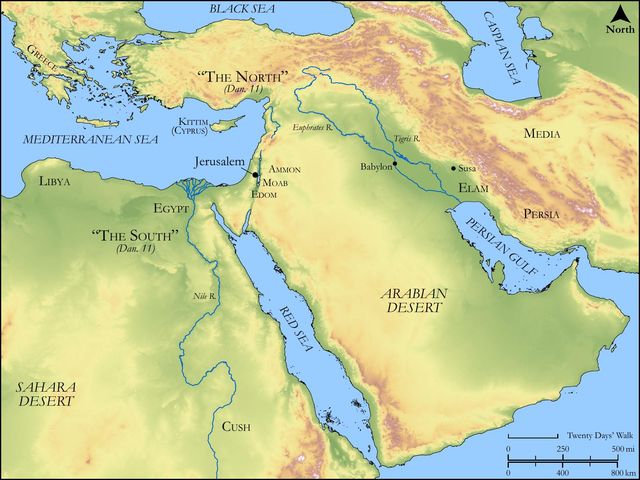
(2.)He shall make himself master of the land of Judea (Dan 11:16): He that comes against him (that is, the king of the north) shall carry all before him and do what he pleases, and he shall stand and get footing in the glorious land; so the land of Israel was, and by his hand it was wasted and consumed, for with the spoil of that good land he victualled his vast army. The land of Judea lay between these two potent kingdoms of Egypt and Syria, so that in all the struggles between them that was sure to suffer, for to it they both bore ill will. Yet some read this, By his hand it shall be perfected; as if it intimated that the land of Judea, being taken under the protection of this Antiochus, shall flourish, and be in better condition than it had been.
(3.)He shall still push on his war against the king of Egypt, and set his face to enter with the strength of his whole kingdom, taking advantage of the infancy of Ptolemy Epiphanes, and the upright ones, many of the pious Israelites, siding with him, Dan 11:17. In prosecution of his design, he shall give him his daughter Cleopatra to wife, designing, as Saul in giving his daughter Cleopatra to David, that she should be a snare to him, and do him a mischief; but she shall not stand on her father's side, nor be for him, but for her husband, and so that plot failed him.
(4.)His war with the Romans is here foretold (Dan 11:18): He shall turn his face to the isles (Dan 11:18), the isles of the Gentiles (Gen 10:5), Greece and Italy. He took many of the isles about the Hellespont-Rhodes, Samos, Delos, etc., which by war or treaty he made himself master of; but a prince, or state (so some), even the Roman senate, or a leader, even the Roman general, shall return his reproach with which he abused the Romans upon himself, or shall make his shame rest on himself, and without his own shame, or any disgrace to himself, shall pay him again. This was fulfilled when the two Scipios were sent with an army against Antiochus. Hannibal was then with him, and advised him to invade Italy and waste it as he had done; but he did not take hid advice; and Scipio joined battle with him, and gave him a total defeat, though Antiochus had 70,000 men and the Romans but 30,000. Thus he caused the reproach offered by him to cease.
(5.)His fall. When he was totally routed by the Romans, and was forced to abandon to them all he had in Europe, and had a very heavy tribute exacted from him, he turned to his own land, and, not knowing which way to raise money to pay his tribute, he plundered a temple of Jupiter, which so incensed his own subjects against him that they set upon him, and killed him; so he was overthrown, and fell, and was no more found, Dan 11:19.
(6.)His next successor, Dan 11:20. There rose up one in his place, a raiser of taxes, a sender forth of the extortioner, or extorter. This character was remarkably answered in Seleucus Philopater, the elder son of Antiochus the Great, who was a great oppressor of his own subjects, and exacted abundance of money from them; and, when he was told he would thereby lose his friends, he said he knew no better friend he had then money. He likewise attempted to rob the temple at Jerusalem, which this seems especially to refer to. But within a few days he shall be destroyed, neither in anger nor in battle, but poisoned by Heliodorus, one of his own servants, when he had reigned but twelve years, and done nothing remarkable.
V.From all this let us learn,
1.That God in his providence sets up one, and pulls down another, as he pleases, advances some from low beginnings and depresses others that were very high. Some have called great men the foot-balls of fortune; or, rather, they are the tools of Providence.
2.This world is full of wars and fightings, which come from men's lusts, and make it a theatre of sin and misery.
3.All the changes and revolutions of states and kingdoms, and every event, even the most minute and contingent, were plainly and perfectly foreseen by the God of heaven, and to him nothing is new.
4.No word of God shall fall to the ground; but what he has designed, what he has declared, shall infallibly come to pass; and even the sins of men shall be made to serve his purpose, and contribute to the b ringing of his counsels to birth in their season; and yet God is not the author of sin.
5.That, for the right understanding of some parts of scripture, it is necessary that heathen authors be consulted, which give light to the scripture, and show the accomplishment of what is there foretold; we have therefore reason to bless God for the human learning with which many have done great service to divine truths.
Historical interpretation
Historical reception
1 surviving comment on this verse from the historical church.
Verses 15, 16. "And the king of the North shall come, and shall cast up a mound and capture the best fortified cities, and the arms of the South shall not withstand. And his chosen ones shall rise up to resist, and they shall have no strength. And he shall come upon him and do according to his own desire, and there shall be none to stand against his face. And he shall stand in the glorious land and it shall be consumed by his hand." Purposing to retake Judaea and the many cities of Syria, Antiochus joined battle with Scopas, Ptolemy's general, near the sources of the Jordan near where the city now called Paneas was founded, and he put him to flight and besieged him in Sidon together with ten thousand of his soldiers. In order to free him, Ptolemy dispatched the famous generals, Eropus, Menocles and Damoxenus (Vulgate: Damoxeus). Yet he was unable to lift the siege, and finally Scopas, overcome by famine, had to surrender and was sent away with his associates, despoiled of all he had. And as for the statement, "He shall cast up a mound," this indicates that Antiochus is going to besiege the garrison of Scopas in the citadel of Jerusalem for a long time, while the Jews add their exertions as well. And he is going to capture other cities which had formerly been held by the Ptolemaic faction in Syria, Cilicia and Lycia (variant: Lydia). For at that time Aphrodisias, Soloe, Zephrion, Mallos, Anemurium (variant: Anemurum), Selenus, Coracesium, Coricus, Andriace, Lymira, Patara (variant: Patra), Xanthus, and finally Ephesus were all captured. These things are related by both Greek and Roman historians. And as for the statement, "And he shall stand in the glorious land, and it shall be consumed (or, finished) by his hand," the term "glorious land," or, as the Septuagint interprets it, "the land of desire" (that is, in which God takes pleasure) signifies Judaea, and particularly Jerusalem, to which Antiochus pursued those men of Scopas's party who had been honorably received there. Instead of the phrase, "glorious land," as Aquila rendered it, Theodotion simply puts the Hebrew word itself, Sabin; instead of that Symmachus translated it "land of bravery."
Continue studying Daniel 11:16 across the web’s major study libraries — every link below opens this exact verse, chapter, or book on the destination site.
Read & Compare
 BibleGatewayThis verse in more than 200 translations and 70 languages.
 Bible.comThe YouVersion reader — hundreds of translations, reading plans, and highlights.
 ESV.orgCrossway's official English Standard Version reader.
 NET BibleThe NET translation with 60,000+ translators' notes on every rendering decision.
 STEP BibleTyndale House's free study tool — original text, vocabulary, and scholarly resources.
 BibliaLogos Bible Software's free web reader.
 USCCBThe New American Bible (Revised Edition) with the U.S. bishops' study notes.
Commentaries
 BibleHub CommentariesDozens of classic commentaries on this verse, gathered on one page.
 StudyLightMore than 100 commentary sets — the largest collection on the web.
 BibleRefPlain-English commentary on what this verse means, verse by verse.
 Enduring WordDavid Guzik's free commentary on this chapter, widely used by Bible teachers.
 Bible Study ToolsVerse commentary alongside Greek and Hebrew study aids.
Original Language & Research
- BibleHub InterlinearThe verse word by word — original language, transliteration, and English.
- BibleHub LexiconEvery word's original-language definition and Strong's entry.
 Blue Letter BibleDeep-study tools — Strong's numbers, concordance, and word studies.
 SefariaThe Hebrew text with Rashi and centuries of Jewish commentary.
Sermons, Hymns & Audio


TrulyRandomVerse is not affiliated with these sites and doesn’t control their content. They’re linked because they’re genuinely useful.
Summary
Daniel 11:16 describes a pivotal moment in the post-Alexandrian prophetic history, foretelling the rise of a powerful northern king who would act with irresistible force and unchecked ambition. This monarch would conquer and establish his dominion in the "glorious land" (Israel), completely subjugating it through his might and rendering it "consumed" or fully under his control, leaving no opposition in his path.
Context
ShowHideLiterary Context
Daniel 11 is renowned for its remarkably detailed and precise prophecies concerning the succession of empires and the conflicts that would unfold after the breakup of Alexander the Great's empire. The chapter meticulously outlines the struggles between the Ptolemaic dynasty (referred to as the "King of the South," ruling Egypt) and the Seleucid dynasty (the "King of the North," ruling Syria) for control over the strategically vital region of the Levant, which included Judea. Verse 16 marks a significant turning point in this protracted series of conflicts, specifically detailing the King of the North's decisive victory and subsequent occupation of the land of Israel, following a period of fluctuating control between the two rival powers. This verse sets the stage for the intense persecution that the Jewish people would later face under subsequent Seleucid rulers, particularly Antiochus IV Epiphanes, whose actions are also prophesied in this chapter.
Historical & Cultural Context
The period immediately following Alexander the Great's death in 323 BC saw his vast empire divided among his generals, known as the Diadochi. The two most prominent rival kingdoms that emerged were the Ptolemaic Kingdom in Egypt and the Seleucid Empire in Syria and Mesopotamia. For over a century, these two powers engaged in a series of "Syrian Wars" for control of Coele-Syria, a region that encompassed Judea. The Jewish people, caught between these two giants, often found themselves subjects of one, then the other. Daniel 11:16 finds its historical fulfillment in the campaigns of Antiochus III "the Great," the Seleucid King of the North. Following his decisive victory over Ptolemy V at the Battle of Panium in 198 BC, Antiochus III marched into Judea, effectively ending Ptolemaic control and bringing the region under Seleucid dominion. This event was a major shift, as it subjected the Jewish people to a new foreign power, whose policies would eventually lead to the Maccabean Revolt, a significant period in Jewish history.
Key Themes
ShowHideDaniel 11:16 contributes to several overarching themes within the book of Daniel and broader biblical theology. Firstly, it powerfully illustrates the theme of Divine Sovereignty over Human Affairs. Despite the King of the North acting "according to his own will," his actions are precisely foretold, demonstrating that even the most ambitious human rulers operate within the confines of God's predetermined plan. This underscores the truth found in passages like Isaiah 46:10, where God declares the end from the beginning. Secondly, the verse highlights the theme of Irresistible Power and Conquest, depicting a period of unchallenged dominance by the King of the North, where "none shall stand before him." Thirdly, the repeated mention of "the glorious land" (Israel) emphasizes the Significance of God's Covenant Land, even as it becomes a battleground for earthly empires. Its conquest signifies a major geopolitical shift, yet its enduring identity as "glorious" points to God's ongoing special regard for it. Finally, the precise historical fulfillment of this prophecy, along with others in Daniel 11, reinforces the theme of Prophetic Accuracy and Reliability, serving as a powerful testament to the divine inspiration of Scripture and God's foreknowledge of history, as also seen in Proverbs 19:21.
Exposition and Analysis
ShowHideKey Word Analysis
ShowHideThis word denotes delight, desire, favor, pleasure, or one's own voluntary will. In Daniel 11:16, "according to his own will" signifies the King of the North's unhindered ambition and absolute authority. His actions are not constrained by external forces or opposition; he executes his desires without impediment, reflecting a tyrannical exercise of power driven by his own pleasure and objectives.
This primitive root means to stand, abide, confirm, endure, establish, or remain. The phrase "none shall stand before him" indicates the utter lack of effective resistance or opposition. It conveys the idea of an overwhelming military force that cannot be withstood, implying total victory and the complete subjugation of any who might attempt to oppose the conqueror. This emphasizes his invincibility in this particular campaign.
This word refers to a completion, destruction, or an utter end. When applied to the "glorious land" being "consumed" by his hand, it does not necessarily imply literal physical annihilation of the land itself, but rather its complete subjugation, absorption into the conqueror's empire, or the exhaustion of its resources and autonomy. It signifies a thorough and complete takeover, where the land loses its independence and is fully brought under the dominion and control of the conquering power.
Verse Breakdown
ShowHide"But he that cometh against him shall do according to his own will"
This clause introduces the powerful figure of the King of the North (Antiochus III), emphasizing his aggressive posture against the King of the South (Ptolemy V). The phrase "shall do according to his own will" underscores his absolute determination, unbridled ambition, and the freedom with which he executes his military and political strategies. It highlights his unchecked authority and the absence of any significant internal or external constraint on his actions.
"and none shall stand before him"
This phrase serves as a powerful declaration of the King of the North's overwhelming military might and the futility of any opposition. It signifies that his advance will be irresistible, his victories decisive, and no army or nation will be able to successfully resist or defeat him in battle. This hyperbolic expression emphasizes his invincibility during this phase of his conquests.
"and he shall stand in the glorious land"
This clause specifies the geographical target and outcome of his campaign. "The glorious land" refers to Israel/Judea, a land uniquely chosen and blessed by God, often depicted with honorific titles in Scripture. The King of the North will not merely pass through but "stand" in it, indicating a firm establishment of his presence and authority, signifying its conquest and occupation.
"which by his hand shall be consumed"
This final phrase describes the fate of the glorious land under the King of the North's dominion. "By his hand" signifies his direct agency, power, and control. The word "consumed" (as discussed in Key Word Analysis) denotes the complete subjugation, absorption, or exploitation of the land. It implies that Israel will lose its autonomy, its resources will be exploited, and its people will be brought fully under the oppressive rule of the conquering king, effectively "used up" or brought to an end as an independent entity.
Literary Devices
ShowHideDaniel 11:16 employs several literary devices to convey the power and impact of the prophecy. Hyperbole is evident in the phrase "none shall stand before him," which dramatically emphasizes the King of the North's overwhelming military superiority and the utter lack of effective resistance. While some might have attempted to stand, their efforts would be futile, making the statement an impactful exaggeration of his invincibility. The term "the glorious land" serves as Symbolism, representing Israel not merely as a geographical territory but as a land uniquely chosen and blessed by God, carrying profound theological significance despite its political subjugation. This title highlights its enduring spiritual importance even amidst earthly conflicts. Furthermore, the phrase "by his hand" functions as Metonymy, where "hand" represents the King's power, authority, and active agency in bringing about the consumption or subjugation of the land. The entire verse, as part of Daniel 11, also functions as Foreshadowing, not only predicting the immediate historical events but also hinting at the broader pattern of Gentile domination over Israel, which finds its ultimate resolution in the eschatological kingdom of God.
Theological and Thematic Connections
ShowHideDaniel 11:16 profoundly illustrates God's meticulous sovereignty over human history, demonstrating that even the most powerful and self-willed rulers, like the King of the North, operate within the bounds of His divine plan. The precise fulfillment of this prophecy, centuries after its utterance, serves as an undeniable testament to God's foreknowledge and His ultimate control over the rise and fall of nations. It teaches us that human ambition, military might, and political maneuvering, though seemingly chaotic, are ultimately orchestrated or permitted by God to achieve His purposes. This perspective offers immense comfort and stability to believers, reminding us that our ultimate trust should not be in earthly powers or political systems, but in the immutable God who declares the end from the beginning and whose counsel alone stands firm.
Reflection and Application
ShowHideDaniel 11:16 offers a powerful anchor for our faith in a world often characterized by political upheaval, military conflicts, and the rise and fall of powerful leaders. It reminds us that no human will, however strong or seemingly irresistible, can ultimately thwart the sovereign will of God. When we observe global events, the ambitions of nations, or the struggles for power, this verse calls us to look beyond the immediate circumstances and recognize the unseen hand of God at work, meticulously unfolding His eternal purposes. It encourages us to cultivate a deep trust in God's providential control, knowing that even when His people or His "glorious land" endure hardship or subjugation, His ultimate plan for redemption and restoration remains secure. This understanding liberates us from anxiety and empowers us to live with hope, knowing that the God who foretold these ancient events is the same God who holds our future.
Questions for Reflection
ShowHideFAQ
ShowHideWho is "he that cometh against him" in this verse, and who is "him"?
ShowHideHistorically, "he that cometh against him" refers to Antiochus III "the Great," the Seleucid King of the North, who launched a decisive campaign against Ptolemy V, the King of the South. The "him" refers to the King of the South, who was the reigning power in Judea prior to Antiochus III's conquest. This verse marks the moment when the King of the North gained supremacy over the King of the South in the region of Judea.
What is "the glorious land" mentioned in this prophecy?
ShowHide"The glorious land" (Hebrew: ha'aretz hatzvi) is a poetic and honorific title for the land of Israel, also known as Judea. It emphasizes its unique status and beauty in God's eyes, being the land of His covenant people and the place where His redemptive history unfolds. Its designation as "glorious" highlights its spiritual significance, even as it becomes a battleground for earthly empires, as seen in Daniel 8:9 and Daniel 11:41.
What does it mean that the glorious land "shall be consumed" by his hand?
ShowHideThe word "consumed" (Hebrew: kâlâh) here implies a complete subjugation, absorption, or the exhaustion of its resources and autonomy by the conquering power. It signifies a thorough and complete takeover, where the land loses its independence and is brought fully under the dominion and control of the King of the North. It does not necessarily mean physical destruction of the land itself, but rather the end of its self-governance and its integration into the conqueror's empire, with its resources and people being exploited.
Christ-Centered Fulfillment
ShowHideWhile Daniel 11:16 describes the earthly conquest by a powerful human king, it ultimately points forward to a far greater King whose dominion is truly irresistible and whose will is perfectly righteous. The King of the North's temporary and destructive reign over the "glorious land" serves as a stark contrast to the eternal and redemptive reign of Jesus Christ. Where the earthly king acted "according to his own will" in a self-serving manner, Christ perfectly fulfilled the will of His Father, embodying divine purpose and love. "None shall stand before him" in Daniel 11:16 speaks of military might, but in Christ, this phrase finds its ultimate spiritual fulfillment: all opposition to God's kingdom will ultimately be vanquished, and every knee shall bow before Him, as declared in Philippians 2:9-11. Christ's victory is not merely over earthly armies but over sin, death, and the spiritual powers of darkness, triumphing over them on the cross (Colossians 2:15). Furthermore, while the earthly king "stood in the glorious land" to consume it, Jesus, the true King, walked the glorious land of Israel to bring salvation and life, and He will one day return to "stand" on the Mount of Olives (Zechariah 14:4) to establish His eternal kingdom, not to consume it, but to redeem and restore it. The temporary "consumption" by human hands foreshadows the ultimate judgment and the establishment of God's perfect reign, where Christ, the Lion of Judah, will rule with absolute, righteous authority, and His kingdom will have no end (Revelation 19:11-16).