


Daniel 11:5
Bible text: King James Version (1769 Blayney text) · Public domain
Bible text: King James Version with Strong's numbers · Public domain
Bible text: Berean Standard Bible · Public domain
Bible text: American Standard Version (1901) · Public domain
Bible text: World English Bible, Messianic edition · Public domain
Bible text: Geneva Bible (1599) · Public domain
Bible text: Young's Literal Translation · Public domain
- וְיֶחֱזַקve·ye·che·Zakso he may become strongH2388Conj-w ¦ V-Qal-ConjImperf-3msVerb Qal Conjunction+Imperfect 3rd Singular Masculineוְsoיֶחֱזַקhe may become strong
- מֶלֶךְMe·lekh[the] king ofH4428N-mscNoun Singular Masculine Construct
- הַנֶּגֶבha·Ne·gevthe southH5045Art ¦ N-msNoun Singular Masculine Absoluteהַtheנֶּגֶבsouth
- וּמִןu·minand one ofH4480Conj-w ¦ PrepPrepositionוּandמִןone of
- שָׂרָיוsa·Ravhis commandersH8269N-mpc ¦ 3msNoun Plural Masculine Constructשָׂרָיcommandersוhis
- וְיֶחֱזַקve·ye·che·Zakso he may become strongH2388Conj-w ¦ V-Qal-ConjImperf-3msVerb Qal Conjunction+Imperfect 3rd Singular Masculineוְsoיֶחֱזַקhe may become strong
- עָלָיו'a·Lavon himH5921Prep ¦ 3msPrepositionעָלָיonוhim
- וּמָשָׁלu·ma·Shaland he will exercise dominionH4910Conj-w ¦ V-Qal-ConsecPerf-3msVerb Qal Consecutive Perfect 3rd Singular Masculineוּandמָשָׁלhe will exercise dominion
- מִמְשָׁלmi·Shal[will be] a dominionH4474N-msNoun Singular Masculine Absolute
- רַבravgreatH7227Adj-msAdjective Singular Masculine Absolute
- מֶמְשַׁלְתּוֹmem·shal·Tohis dominionH4475N-fsc ¦ 3msNoun Singular Feminine Constructמֶמְשַׁלְתּdominionוֹhis
English is a literal word-by-word gloss of the Hebrew, not the KJV's wording. Why?
This is the original text the KJV's translators worked from — each Hebrew word with its own literal English meaning in this verse, prepared by scholars at Tyndale House, Cambridge. The KJV translates whole sentences, not word by word, so its wording differs: one Hebrew word can become several English words, and the KJV may choose “the LORD” where the gloss reads “Yahweh”. Both are faithful — they answer different questions. For the KJV's own rendering, switch to the KJV text.
Details
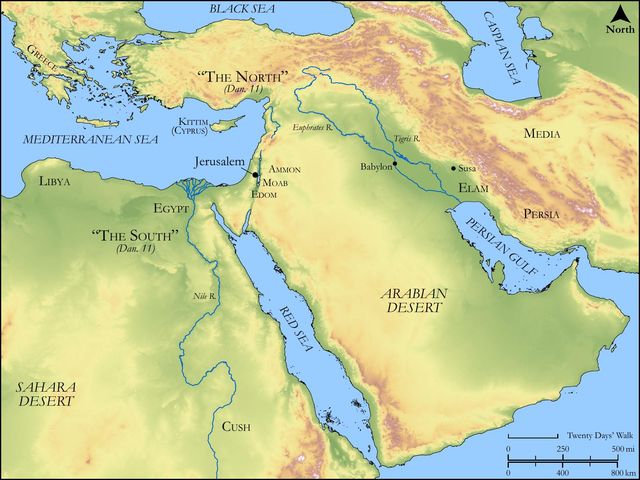
See on the biblical-era map
Study this verse
Public-domain commentary
Matthew Henry
From his Commentary on the Whole Bible. Henry comments on passages, not single verses — this entry covers Daniel 11:5–20. His three-level outline is real structure in the source text, so it is rendered as structure.
Here are foretold,
I.The rise and power of two great kingdoms out of the remains of Alexander's conquests, Dan 11:5.
1.The kingdom of Egypt, which was made considerable by Ptolemaeus Lagus, one of Alexander's captains, whose successors were, from him, called the Lagidae. He is called the king of the south, that is, Egypt, named here, Dan 11:8, Dan 11:42, Dan 11:43. The countries that at first belonged to Ptolemy are reckoned to be Egypt, Phoenicia, Arabia, Libya, Ethiopia, etc. Theocr. Idyl. 17.
2.The kingdom of Syria, which was set up by Seleucus Nicanor, or the conqueror; he was one of Alexander's princes, and became stronger than the other, and had the greatest dominion of all, was the most powerful of all Alexander's successors. It was said that he had no fewer than seventy-two kingdoms under him. Both these were strong against Judah (the affairs of which are particularly eyed in this prediction); Ptolemy, soon after he gained Egypt, invaded Judea, and took Jerusalem on a sabbath, pretending a friendly visit. Seleucus also gave disturbance to Judea.
II.The fruitless attempt to unite these two kingdoms as iron and clay in Nebuchadnezzar's image (Dan 11:6):
"At the end of certain years, about seventy after Alexander's death, the Lagidae and the Seleucidae shall associate, but not in sincerity. Ptolemy Philadelphus, king of Egypt, shall marry his daughter Berenice to Antiochus Theos, king of Syria," who had already a wife called Laodice. "Berenice shall come to the king of the north, to make an agreement, but it shall not hold: She shall not retain the power of the arm; neither she nor her posterity shall establish themselves in the kingdom of the north, neither shall Ptolemy her father, nor Antiochus her husband (between whom there was to be a great alliance), stand, nor their arm, but she shall be given up and those that brought her," all that projected that unhappy marriage between her and Antiochus, which occasioned so much mischief, instead of producing a coalition between the northern and southern crowns, as was hoped. Antiochus divorced Berenice, took his former wife Laodice again, who soon after poisoned him, procured Berenice and her son to be murdered, and set up her own son by Antiochus to be king, who was called Seleucus Callinicus.
III.A war between the two kingdoms, Dan 11:7, Dan 11:8.
A branch from the same root with Berenice shall stand up in his estate. Ptolemaeus Euergetes, the son and successor of Ptolemaeus Philadelphus, shall come with an army against Seleucus Callinicus, king of Syria, to avenge his sister's quarrel, and shall prevail; and he shall carry away a rich booty both of persons and goods into Egypt, and shall continue more years than the king of the north. This Ptolemy reigned forty-six years; and Justin says that if his own affairs had not called him home he would, in this war, have made himself master of the whole kingdom of Syria. But (Dan 11:9) he shall be forced to come into his kingdom and return into his own land, to keep peace there, so that he can no longer carry on the war abroad. Note, It is very common for a treacherous peace to end in a bloody war.
IV.The long and busy reign of Antiochus the Great, king of Syria.
Seleucus Callinicus, that king of the north that was overcome (Dan 11:7) and died miserably, left two sons, Seleucus and Antiochus; these are his sons, the sons of the king of the north, that shall be stirred up, and shall assemble a multitude of great forces, to recover what their father had lost, Dan 11:10. But Seleucus the elder, being weak, and unable to rule his army, was poisoned by his friends, and reigned only two years; and his brother Antiochus succeeded him, who reigned thirty-seven years, and was called the Great. And therefore the angel, though he speaks of sons at first, goes on with the account of one only, who was but fifteen years old when he began to reign, and he shall certainly come, and overflow, and over-run, and shall be restored at length to what his father lost.
1.The king of the south, in this war, shall at first have very great success. Ptolemaeus Philopater, moved with indignation at the indignities done by Antiochus the Great, shall (though otherwise a slothful prince) come forth, and fight with him, and shall bring a vast army into the field of 70,000 foot, and 5000 horse, and seventy-three elephants. And the other multitude (the army of Antiochus, consisting of 62,000 foot, and 6000 horse, and 102 elephants) shall be given into his hand. Polybius, who lived with Scipio, has given a particular account of this battle of Raphia. Ptolemaeus Philopater, having gained this victory, grew very insolent; his heart was lifted up; then he went into the temple of God at Jerusalem, and, in defiance of the law, entered the most holy place, for which God has a controversy with him, so that, though he shall cast down many myriads, yet he shall not be strengthened by it, so as to secure his interest. For,
2.The king of the north, Antiochus the Great, shall return with a greater army than the former; and, at the end of times (that is, years) he shall come with a mighty army, and great riches, against the king of the south, that is, Ptolemaeus Epiphanes, who succeeded Ptolemaeus Philopater his father, when he was a child, which gave advantage to Antiochus the Great. In this expedition he had some powerful allies (Dan 11:14): Many shall stand up against the king of the south. Philip of Macedon was confederate with Antiochus against the king of Egypt, and Scopas his general, whom he sent into Syria; Antiochus routed him, destroyed a great part of his army; whereupon the Jews willingly yielded to Antiochus, joined with him, helped him to besiege Ptolemaeus's garrisons. They the robbers of thy people shall exalt themselves to establish the vision, to help forward the accomplishment of this prophecy; but they shall fall, and shall come to nothing, Dan 11:14. Hereupon (Dan 11:15) the king of the north, this same Antiochus Magnus, shall carry on his design against the king of the south another way.
(1.)He shall surprise his strong-holds; all that he has got in Syria and Samaria, and the arms of the south, all the power of the king of Egypt, shall not be able to withstand him. See how dubious and variable the turns of the scale of war are; like buying and selling, it is winning and losing; sometimes one side gets the better and sometimes the other; yet neither by chance; it is not, as they call it, the fortune of war, but according to the will and counsel of God, who brings some low and raises others up.
(2.)He shall make himself master of the land of Judea (Dan 11:16): He that comes against him (that is, the king of the north) shall carry all before him and do what he pleases, and he shall stand and get footing in the glorious land; so the land of Israel was, and by his hand it was wasted and consumed, for with the spoil of that good land he victualled his vast army. The land of Judea lay between these two potent kingdoms of Egypt and Syria, so that in all the struggles between them that was sure to suffer, for to it they both bore ill will. Yet some read this, By his hand it shall be perfected; as if it intimated that the land of Judea, being taken under the protection of this Antiochus, shall flourish, and be in better condition than it had been.
(3.)He shall still push on his war against the king of Egypt, and set his face to enter with the strength of his whole kingdom, taking advantage of the infancy of Ptolemy Epiphanes, and the upright ones, many of the pious Israelites, siding with him, Dan 11:17. In prosecution of his design, he shall give him his daughter Cleopatra to wife, designing, as Saul in giving his daughter Cleopatra to David, that she should be a snare to him, and do him a mischief; but she shall not stand on her father's side, nor be for him, but for her husband, and so that plot failed him.
(4.)His war with the Romans is here foretold (Dan 11:18): He shall turn his face to the isles (Dan 11:18), the isles of the Gentiles (Gen 10:5), Greece and Italy. He took many of the isles about the Hellespont-Rhodes, Samos, Delos, etc., which by war or treaty he made himself master of; but a prince, or state (so some), even the Roman senate, or a leader, even the Roman general, shall return his reproach with which he abused the Romans upon himself, or shall make his shame rest on himself, and without his own shame, or any disgrace to himself, shall pay him again. This was fulfilled when the two Scipios were sent with an army against Antiochus. Hannibal was then with him, and advised him to invade Italy and waste it as he had done; but he did not take hid advice; and Scipio joined battle with him, and gave him a total defeat, though Antiochus had 70,000 men and the Romans but 30,000. Thus he caused the reproach offered by him to cease.
(5.)His fall. When he was totally routed by the Romans, and was forced to abandon to them all he had in Europe, and had a very heavy tribute exacted from him, he turned to his own land, and, not knowing which way to raise money to pay his tribute, he plundered a temple of Jupiter, which so incensed his own subjects against him that they set upon him, and killed him; so he was overthrown, and fell, and was no more found, Dan 11:19.
(6.)His next successor, Dan 11:20. There rose up one in his place, a raiser of taxes, a sender forth of the extortioner, or extorter. This character was remarkably answered in Seleucus Philopater, the elder son of Antiochus the Great, who was a great oppressor of his own subjects, and exacted abundance of money from them; and, when he was told he would thereby lose his friends, he said he knew no better friend he had then money. He likewise attempted to rob the temple at Jerusalem, which this seems especially to refer to. But within a few days he shall be destroyed, neither in anger nor in battle, but poisoned by Heliodorus, one of his own servants, when he had reigned but twelve years, and done nothing remarkable.
V.From all this let us learn,
1.That God in his providence sets up one, and pulls down another, as he pleases, advances some from low beginnings and depresses others that were very high. Some have called great men the foot-balls of fortune; or, rather, they are the tools of Providence.
2.This world is full of wars and fightings, which come from men's lusts, and make it a theatre of sin and misery.
3.All the changes and revolutions of states and kingdoms, and every event, even the most minute and contingent, were plainly and perfectly foreseen by the God of heaven, and to him nothing is new.
4.No word of God shall fall to the ground; but what he has designed, what he has declared, shall infallibly come to pass; and even the sins of men shall be made to serve his purpose, and contribute to the b ringing of his counsels to birth in their season; and yet God is not the author of sin.
5.That, for the right understanding of some parts of scripture, it is necessary that heathen authors be consulted, which give light to the scripture, and show the accomplishment of what is there foretold; we have therefore reason to bless God for the human learning with which many have done great service to divine truths.
Historical interpretation
Historical reception
2 surviving comments on this verse. Each one is dated, so this reads as a timeline rather than a list.
Select a marker to jump to its quote. Markers stagger vertically where authors wrote within a few decades of each other.
Verse 5. "And the king of the South shall be strengthened." The reference is to Ptolemy, son of Lagos, who was the first to become king in Egypt, and was a very clever, mighty and wealthy man, and possessed such power that he was able to restore Pyrrhus, King of Epirus, to his kingdom after he had been driven out, and also to seize Cyprus and Phoenicia. And after he had conquered Demetrius, the son of Antigonus, he restored to Seleucus that portion of his kingdom which Antigonus had taken away from him. He also acquired Caria and many islands, cities, and districts unnecessary to detail at this time. But no further notice is taken of the other kingdoms, Macedonia and Asia Minor, because Judaea lay in a midway position and was held now by one group of kings and now by another. And it is not the purpose of Holy Scripture to cover external history apart from the Jews, but only that which is linked up with the nation of Israel.
"And one of his princes shall prevail over him, and he shall rule with great power, for his dominion shall be great." The person mentioned is Ptolemy Philadelphus, the second king of Egypt and the son of the former Ptolemy. It was in his reign that the Seventy (Septuaginta) translators are said to have translated the Holy Scripture into Greek. He also sent many treasures to Jerusalem for the high priest Eleazar, and votive vessels for the Temple. The curator of his library was Demetrius of Phalerum, a man of reputation among the Greeks as an orator and philosopher. Philadelphus is reported to have possessed such great power as to surpass his father Ptolemy. For history relates that he possessed two hundred thousand infantrymen, twenty thousand cavalry, and even two thousand chariots and four hundred elephants, which he was the first to import from Ethiopia. He also had a thousand five hundred war galleys of the type now known as Liburnian, and a thousand others for the transporting of military provisions. So great was his treasure of gold and silver that he received a yearly revenue from Egypt amounting to fourteen thousand eight hundred talents of silver, as well as grain in the amount of five or ten hundred thousand artabae (a measure containing three and a half modii).
He is talking about Ptolemy Philopator, who was not satisfied with the kingdom of Egypt but who added also Phoenicia, Samaria and Judea. When he says, “one of his princes will grow strong,” he is talking about Scopas, whom also Josephus the Hebrew historian mentions. Scopas was an outstanding general and placed under Ptolemy’s power many of the nations that were outside of the kingdom of Ptolemy. He speaks of this one enigmatically: “And he will rule with much power beyond his authority,” that is, he will rule over many nations beyond the realm that had been allotted to him.
Continue studying Daniel 11:5 across the web’s major study libraries — every link below opens this exact verse, chapter, or book on the destination site.
Read & Compare
 BibleGatewayThis verse in more than 200 translations and 70 languages.
 Bible.comThe YouVersion reader — hundreds of translations, reading plans, and highlights.
 ESV.orgCrossway's official English Standard Version reader.
 NET BibleThe NET translation with 60,000+ translators' notes on every rendering decision.
 STEP BibleTyndale House's free study tool — original text, vocabulary, and scholarly resources.
 BibliaLogos Bible Software's free web reader.
 USCCBThe New American Bible (Revised Edition) with the U.S. bishops' study notes.
Commentaries
 BibleHub CommentariesDozens of classic commentaries on this verse, gathered on one page.
 StudyLightMore than 100 commentary sets — the largest collection on the web.
 BibleRefPlain-English commentary on what this verse means, verse by verse.
 Enduring WordDavid Guzik's free commentary on this chapter, widely used by Bible teachers.
 Bible Study ToolsVerse commentary alongside Greek and Hebrew study aids.
Original Language & Research
- BibleHub InterlinearThe verse word by word — original language, transliteration, and English.
- BibleHub LexiconEvery word's original-language definition and Strong's entry.
 Blue Letter BibleDeep-study tools — Strong's numbers, concordance, and word studies.
 SefariaThe Hebrew text with Rashi and centuries of Jewish commentary.
Sermons, Hymns & Audio


TrulyRandomVerse is not affiliated with these sites and doesn’t control their content. They’re linked because they’re genuinely useful.
Summary
Daniel 11:5 initiates a remarkably precise prophetic sequence detailing the geopolitical struggles following the dissolution of Alexander the Great's empire. This verse specifically foretells the rise of two dominant Hellenistic powers, the Ptolemaic and Seleucid dynasties, highlighting the initial strength of the "king of the south" and the eventual, even greater, dominion of "one of his princes," setting the stage for centuries of conflict that profoundly impacted the Jewish people and the land of Israel.
Context
ShowHideLiterary Context
Daniel 11 is a prophetic chapter unparalleled in its historical detail, often referred to as the "Wars of the Kings." It directly follows Daniel 11:4, which describes the fragmentation of Alexander the Great's vast empire among his four generals, "not to his posterity, nor according to his dominion which he ruled." This sets the immediate stage for the emergence of the "king of the South" and the "king of the North," the two primary powers (Ptolemaic Egypt and Seleucid Syria, respectively) whose incessant conflicts over the Levant form the central narrative thread of the chapter. Verse 5 begins to unpack the specific dynamics between these emerging powers, laying the groundwork for the detailed prophecies that follow concerning their interactions and the impact on God's people.
Historical & Cultural Context
The period immediately following Alexander the Great's death in 323 BC was marked by intense power struggles among his generals, known as the Diadochi. These conflicts eventually led to the establishment of several Hellenistic kingdoms. The two most prominent, and most relevant to Daniel 11, were the Ptolemaic Kingdom, centered in Egypt (the "king of the South"), founded by Ptolemy I Soter, and the Seleucid Empire, centered in Syria and Mesopotamia (the "king of the North"), founded by Seleucus I Nicator. The land of Judah, strategically located between these two empires, became a constant battleground, frequently changing hands and subjecting its inhabitants to the political and cultural pressures of Hellenism. Understanding this post-Alexandrian geopolitical landscape is crucial for interpreting the highly specific prophecies of Daniel 11.
Key Themes
ShowHideThe meticulous detail of Daniel 11:5 and the subsequent verses underscores several profound themes central to the book of Daniel. Foremost among these is Divine Sovereignty, demonstrating God's absolute control over human history, the rise and fall of empires, and the destinies of kings, a truth powerfully articulated in Daniel 2:21. The Accuracy of Prophetic Detail is another dominant theme, as the precise fulfillment of these predictions serves as compelling evidence for the divine inspiration of Scripture. Furthermore, the chapter highlights the Endurance of God's People amidst geopolitical turmoil, as the conflicts between these kings directly impacted the Jewish community in the land of Israel. The detailed nature of the prophecy also points to the theme of God's Foreknowledge, revealing that He knows the end from the beginning, and His purposes will ultimately prevail despite human machinations.
Exposition and Analysis
ShowHideKey Word Analysis
ShowHideFrom the primitive root malak, meaning "to rule." This term denotes a sovereign ruler, emphasizing authority and dominion. In Daniel 11:5, it specifically refers to the heads of the Ptolemaic and Seleucid dynasties, highlighting their royal status and the power they wielded over their respective kingdoms.
A primitive root meaning "to fasten upon; hence, to seize, be strong (figuratively, courageous, causatively strengthen, cure, help, repair, fortify), obstinate; to bind, restrain, conquer." This word emphasizes not just physical might, but also the establishment of power, the ability to prevail, and the securement of a position of authority. Its repetition underscores the significant power wielded by both the "king of the south" and, even more so, by "one of his princes."
From the root mashal, meaning "to rule." This noun refers to a ruler or, abstractly, to the act or sphere of rule. It speaks to the extent of authority, the territory governed, and the influence exerted. The phrase "great dominion" signifies an expansive and powerful realm, underscoring the vastness and significance of the empire established by Seleucus I.
Verse Breakdown
ShowHide"And the king of the south shall be strong"
This clause refers to Ptolemy I Soter, one of Alexander the Great's generals, who established the Ptolemaic dynasty in Egypt. Upon the division of Alexander's empire, Ptolemy quickly secured Egypt, a land rich in resources and strategically defensible. He consolidated his power and laid the foundation for a formidable kingdom, making him indeed "strong" among the Diadochi.
"and [one] of his princes"
This phrase points to Seleucus I Nicator. Initially, Seleucus served under Ptolemy I, having fled to Egypt for refuge after being driven out of Babylon by Antigonus. Thus, for a period, Seleucus was indeed a subordinate or "prince" under Ptolemy's authority, demonstrating the intricate early relationships among Alexander's successors.
"and he shall be strong above him, and have dominion; his dominion [shall be] a great dominion"
This part of the verse predicts Seleucus I Nicator's eventual rise to power, surpassing that of his former lord, Ptolemy I. Seleucus not only recovered Babylon but went on to conquer vast territories, establishing the Seleucid Empire, which stretched from Asia Minor to India, making it the largest of the Hellenistic kingdoms. His "dominion" was indeed "great," far exceeding the geographical reach and influence of the Ptolemaic kingdom, a remarkable and specific historical prediction.
Literary Devices
ShowHideDaniel 11:5 primarily functions as Predictive Prophecy, a literary device where future events are revealed with remarkable specificity. This is not merely a general foretelling but a detailed historical outline presented in advance, serving to authenticate the divine origin of the message. The verse also employs Repetition for emphasis, particularly with the words "strong" and "dominion." The doubling of "strong" highlights the significant power of both figures, while the reiteration of "dominion" (first as a verb "have dominion," then as a noun "his dominion," followed by "great dominion") underscores the expansive and unparalleled nature of Seleucus's eventual rule. This repetition serves to impress upon the reader the magnitude and certainty of the predicted outcomes. Furthermore, there is a subtle use of Contrast between the initial strength of the "king of the south" and the greater strength and great dominion of his former "prince," setting up the dynamic tension that will characterize the subsequent historical narrative of Daniel 11.
Theological and Thematic Connections
ShowHideDaniel 11:5, with its astonishing precision in foretelling the intricate power shifts among the Hellenistic kings, serves as a powerful testament to God's absolute sovereignty over all human affairs. It demonstrates that history is not a random sequence of events, nor is it solely determined by human will or ambition, but rather unfolds according to the meticulously orchestrated plan of a sovereign God. This divine oversight provides profound comfort and assurance, reminding believers that even in the midst of chaotic geopolitical struggles and the rise and fall of empires, God remains firmly on His throne, working all things according to His purpose. The accuracy of this prophecy validates the divine inspiration of Scripture, inviting profound trust in God's Word and His unchanging character.
Reflection and Application
ShowHideThe detailed prophecy of Daniel 11:5, though describing ancient geopolitical shifts, carries profound contemporary relevance for the believer. It serves as a powerful anchor for our faith, reminding us that the God who meticulously orchestrated the rise and fall of ancient empires is the same God who governs our present circumstances and holds our future in His hands. In a world often characterized by political instability, economic uncertainty, and societal upheaval, this verse calls us to look beyond the immediate chaos and fix our gaze on the unchanging sovereignty of God. It encourages us to cultivate a deep trust that His purposes will prevail, regardless of who occupies positions of earthly power. This perspective fosters peace in our hearts, knowing that even when human leaders fail or global events seem overwhelming, God's ultimate plan for redemption and justice is moving forward, culminating in the establishment of His eternal kingdom.
Questions for Reflection
ShowHideFAQ
ShowHideWhy does Daniel 11 use "king of the south" and "king of the north" instead of specific names?
ShowHideThe use of "king of the south" and "king of the north" (and similar titles throughout Daniel 11) is a common prophetic and literary device. It allows the prophecy to refer to a dynasty or a succession of rulers rather than just a single individual. In this context, "king of the south" primarily refers to the Ptolemaic dynasty ruling from Egypt, while "king of the north" refers to the Seleucid dynasty ruling from Syria. This stylistic choice emphasizes the ongoing geopolitical rivalry between these two powers over centuries, rather than focusing solely on the initial figures like Ptolemy I and Seleucus I. It highlights the enduring nature of the conflict and its impact on the land of Israel, which lay geographically between these two spheres of influence, as seen in the detailed accounts throughout Daniel 11.
Christ-Centered Fulfillment
ShowHideWhile Daniel 11:5 details the rise and fall of earthly kings, its ultimate Christ-centered fulfillment lies in the profound truth that all earthly dominion and power ultimately point to, and are superseded by, the eternal and universal reign of Jesus Christ. The temporary strength and "great dominion" of Seleucus I, though impressive in its historical context, pales in comparison to the boundless authority granted to the Son of Man. Christ, as the true and ultimate King, has been given "all power in heaven and in earth" (Matthew 28:18), and His dominion is an everlasting dominion that shall not pass away (Daniel 7:13-14). The meticulous divine orchestration of human history, evident in Daniel's prophecies, finds its ultimate purpose in the coming of God's Messiah, who establishes a kingdom that will never be destroyed (Daniel 2:44). Every earthly king and every fleeting empire serves as a temporary stage for the unfolding of God's redemptive plan, culminating in the exaltation of Christ, before whom "every knee should bow, of things in heaven, and things in earth, and things under the earth" (Philippians 2:9-11). Thus, the historical accuracy of Daniel 11:5 not only validates Scripture but also directs our gaze to the one King whose dominion is truly great and without end.