


Daniel 11:4
- וּכְעָמְדוֹu·khe·'a·me·Doand just as he arisesH5975Conj-w ¦ Prep-k ¦ V-Qal-Inf ¦ 3msVerb Qal Infinitive Constructוּandכְjust asעָמְדarisesוֹhe
- תִּשָּׁבֵרti·sha·Verit will be broken upH7665V-Niphal-Imperf-3fsVerb Niphal Imperfect 3rd Singular Feminine
- מַלְכוּתוֹmal·khu·Tohis kingdomH4438N-fsc ¦ 3msNoun Singular Feminine Constructמַלְכוּתkingdomוֹhis
- וְתֵחָץve·te·Chatzand it will be dividedH2673Conj-w ¦ V-Niphal-Imperf-3fsVerb Niphal Imperfect 3rd Singular Feminineוְandתֵחָץit will be divided
- לְאַרְבַּעle·'ar·Ba'to [the] fourH702Prep-l ¦ Adj-cscAdjective Numerical Singular common gender Constructלְtoאַרְבַּע[the] four
- רוּחוֹתru·Chot[the] winds ofH7307N-fpcNoun Plural Feminine Construct
- הַשָּׁמָיִםha·sha·Ma·yimthe heavensH8064Art ¦ N-mpNoun Plural Masculine Absoluteהַtheשָּׁמָיִםheavens
- וְלֹאve·Lo'and notH3808Conj-w ¦ NegParticle Negativeוְandלֹאnot
- לְאַחֲרִיתוֹle·'a·cha·ri·Toto his posterityH319Prep-l ¦ N-fsc ¦ 3msNoun Singular Feminine Constructלְtoאַחֲרִיתposterityוֹhis
- וְלֹאve·Lo'and notH3808Conj-w ¦ NegParticle Negativeוְandלֹאnot
- כְמָשְׁלוֹkhe·ma·she·Lolike his dominionH4915Prep-k ¦ N-msc ¦ 3msNoun Singular Masculine Constructכְlikeמָשְׁלdominionוֹhis
- אֲשֶׁר'a·SherwhichH834RelParticle Relative
- מָשָׁלma·Shalhe had dominionH4910V-Qal-Perf-3msVerb Qal Perfect 3rd Singular Masculine
- כִּיkiforH3588PrtParticle Conditional
- תִנָּתֵשׁti·na·Teshit will be plucked upH5428V-Niphal-Imperf-3fsVerb Niphal Imperfect 3rd Singular Feminine
- מַלְכוּתוֹmal·khu·Tohis kingdomH4438N-fsc ¦ 3msNoun Singular Feminine Constructמַלְכוּתkingdomוֹhis
- וְלַאֲחֵרִיםve·la·'a·che·Rimand to othersH312Conj-w ¦ Prep-l ¦ Adj-mpAdjective Plural Masculine Absoluteוְandלַtoאֲחֵרִיםothers
- מִלְּבַדmi·le·vad<from> <to> besidesH905Prep-m ¦ Prep-l ¦ N-msNoun Singular Masculine Absoluteמִ<from>לְּ<to>בַדbesides
- אֵלֶּה'E·lehtheseH428PrtParticle Demonstrative
English is a literal word-by-word gloss of the Hebrew, not the KJV's wording. Why?
This is the original text the KJV's translators worked from — each Hebrew word with its own literal English meaning in this verse, prepared by scholars at Tyndale House, Cambridge. The KJV translates whole sentences, not word by word, so its wording differs: one Hebrew word can become several English words, and the KJV may choose “the LORD” where the gloss reads “Yahweh”. Both are faithful — they answer different questions. For the KJV's own rendering, switch to the KJV text.
Details
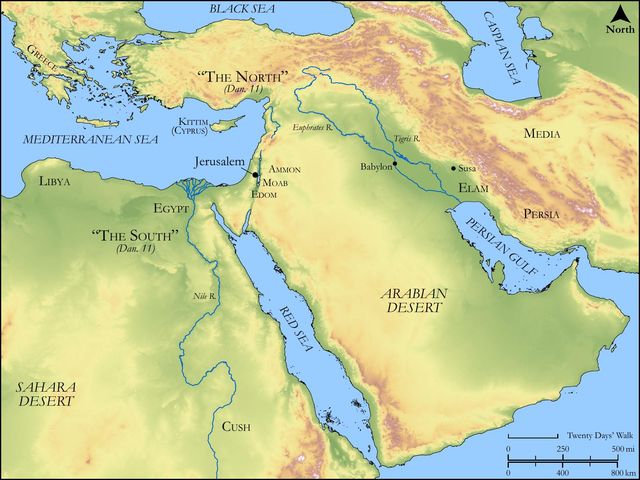
See on the biblical-era map
Study this verse
Public-domain commentary
Matthew Henry
From his Commentary on the Whole Bible. Henry comments on passages, not single verses — this entry covers Daniel 11:1–4.
Here, 1. The angel Gabriel lets Daniel know the good service he has done to the Jewish nation (Dan 11:1): "In the first year of Darius the Mede, who destroyed Babylon and released the Jews out of that house of bondage, I stood a strength and fortress to him, that is, I was instrumental to protect him, and give him success in his ward, and, after he had conquered Babylon, to confirm him in his resolution to release the Jews," which, it is likely, met with much opposition. Thus by the angel, and at the request of the watcher, the golden head was broken, and the axe laid to the root of the tree. Note, We must acknowledge the hand of God in the strengthening of those that are friends to the church for the service they are to do it, and confirming them in their good resolutions; herein he uses the ministry of angels more than we are aware of. And the many instances we have known of God's care of his church formerly encourage us to depend upon him in further straits and difficulties. 2. He foretels the reign of four Persian kings (Dan 11:2): Now I will tell thee the truth, that is, the true meaning of the visions of the great image, and of the four beasts, and expound in plain terms what was before represented by dark types. (1.) There shall stand up three kings in Persia, besides Darius, in whose reign this prophecy is dated, Dan 9:1. Mr. Broughton makes these three to be Cyrus, Artaxasta or Artaxerxes, called by the Greeks Cambyses, and Ahasuerus that married Esther, called Darius son of Hystaspes. To these three the Persians gave these attributes - Cyrus was a father, Cambyses a master, and Darius a hoarder up. So Herodotus. (2.) There shall be a fourth, far richer than they all, that is, Xerxes, of whose wealth the Greek authors take notice. By his strength (his vast army, consisting of 800,000 men at least) and his riches, with which he maintained and paid that vast army, he stirred up all against the realm of Greece. Xerxes's expedition against Greece is famous in history, and the shameful defeat that he met with. He who when he went out was the terror of Greece in his return was the scorn of Greece. Daniel needed not to be told what disappointment he would meet with, for he was a hinderer of the building of the temple; but soon after, about thirty years after the first return from captivity, Darius, a young king, revived the building of the temple, owning the hand of God against his predecessors for hindering it, Ezr 6:7. 3. He foretels Alexander's conquests and the partition of his kingdom, Dan 11:3. He is that mighty king that shall stand up against the kings of Persia, and he shall rule with great dominion, over many kingdoms, and with a despotic power, for he shall do according to his will, and undo likewise, which, by the law of the Medes and Persians, their kings could not. When Alexander, after he had conquered Asia, would be worshipped as a god, then this was fulfilled, that he shall do according to his will. That is God's prerogative, but was his pretension. But (Dan 11:4) his kingdom shall soon be broken, and divided into four parts, but not to his posterity, nor shall any of his successors reign according to his dominion; none of them shall have such large territories nor such an absolute power. His kingdom was plucked up for others besides those of his own family. Arideus, his brother, was made king in Macedonia; Olympias, Alexander's mother, killed him, and poisoned Alexander's two sons, Hercules and Alexander. Thus was his family rooted out by its own hands. See what decaying perishing things worldly pomp and possessions are, and the powers by which they are got. Never was the vanity of the world and its greatest things shown more evidently than in the story of Alexander. All is vanity and vexation of spirit.
Historical interpretation
Historical reception
4 surviving comments on this verse. Each one is dated, so this reads as a timeline rather than a list.
Select a marker to jump to its quote. Markers stagger vertically where authors wrote within a few decades of each other.
Understand this as referring to Alexander, who was certain that his last day was not close and therefore did not have children, who could be the heirs of his reign, and left it to his friends after dividing it into four parts.
Verses 3, 4. "But there shall rise up a strong king and shall rule with great power, and he shall do whatever he pleases. And when he shall have arisen, his kingdom shall be broken." He clearly refers to Alexander the Great, king of the Macedonians, and son of Philip. For after he had overcome the Illyrians and Thracians, and had conquered Greece and destroyed Thebes, he crossed over into Asia. And when he had routed Darius's generals and taken the city of Sardis, he afterwards captured India and founded the city of Alexandria. And then, when he had attained the age of thirty-two and the twelfth year of his reign, he died of poison.
"And it shall be divided towards the four winds of heaven, but not unto his own posterity nor according to his power with which he had borne rule." After Alexander his kingdom was divided towards the four winds, namely to the east, the west, the south, and the north. In Egypt, that is in the south, Ptolemy the son of Lagos was the first to become king. In Macedonia, that is in the west, the Philip who was also called Aridaeus, a brother of Alexander, became king. The king of Syria and Babylon and the remoter regions, that is, the east, was Seleucus Nicanor. Antigonus was king of Asia Minor and Pontus and of the other provinces in that whole area, that is, in the north. So much for the various regions of the world as a whole; but from the standpoint of Judea itself, the north would be Syria and the south would be Egypt. And as for the statement, "But not unto his own posterity," the implication is that Alexander would have no children, but rather, his kingdom would be rent asunder and fall to others who were not of his family, except of course for Philip, who kept Macedonia. Nor would it be according to the power of him who had borne rule, for the kingdom became feebler by division into four parts, for they constantly fought among themselves and raged with internecine fury.
"For his kingdom shall be rent in pieces (variant: destroyed), and that too among strangers besides these." Besides the four kingdoms of Macedonia, Asia Minor, Syria, and Egypt, the kingdom of the Macedonians was torn asunder among other rulers of less prominence and among petty kings. The reference here is to Perdiccas and Craterus and Lysimachus, for Cappadocia, Armenia, Bithynia, Heracleia, Bosphorus and various other provinces withdrew themselves from the Macedonian power and set up various kings for themselves.
He does not spend much time on the ruler of Asia Minor or Macedonia, especially since no grief befell the Jews through them. He mentions only the two through whom the Jews would be tested with grievous misfortunes. These are the king of Egypt and the one entrusted with the rule of the nations that lay to the east. The latter held palaces in both Antioch and Babylon.
When, as we have already mentioned, Alexander joined together the whole known world, so to speak, into his kingdom and then suffered the fate common to all humankind, the kingdom was divided into four parts.
Continue studying Daniel 11:4 across the web’s major study libraries — every link below opens this exact verse, chapter, or book on the destination site.
Read & Compare
 BibleGatewayThis verse in more than 200 translations and 70 languages.
 Bible.comThe YouVersion reader — hundreds of translations, reading plans, and highlights.
 ESV.orgCrossway's official English Standard Version reader.
 NET BibleThe NET translation with 60,000+ translators' notes on every rendering decision.
 STEP BibleTyndale House's free study tool — original text, vocabulary, and scholarly resources.
 BibliaLogos Bible Software's free web reader.
 USCCBThe New American Bible (Revised Edition) with the U.S. bishops' study notes.
Commentaries
 BibleHub CommentariesDozens of classic commentaries on this verse, gathered on one page.
 StudyLightMore than 100 commentary sets — the largest collection on the web.
 BibleRefPlain-English commentary on what this verse means, verse by verse.
 Enduring WordDavid Guzik's free commentary on this chapter, widely used by Bible teachers.
 Bible Study ToolsVerse commentary alongside Greek and Hebrew study aids.
Original Language & Research
- BibleHub InterlinearThe verse word by word — original language, transliteration, and English.
- BibleHub LexiconEvery word's original-language definition and Strong's entry.
 Blue Letter BibleDeep-study tools — Strong's numbers, concordance, and word studies.
 SefariaThe Hebrew text with Rashi and centuries of Jewish commentary.
Sermons, Hymns & Audio


TrulyRandomVerse is not affiliated with these sites and doesn’t control their content. They’re linked because they’re genuinely useful.
Summary
Daniel 11:4 prophesies the dramatic fragmentation of a powerful king's empire immediately following his rise. Instead of passing to his direct descendants or maintaining its original unified dominion, the vast kingdom would be violently shattered and distributed among others, specifically "toward the four winds of heaven," signifying a complete and widespread division among various successors. This verse precisely foretells the historical aftermath of Alexander the Great's sudden death and the subsequent partitioning of his Hellenistic empire.
Context
ShowHideLiterary Context
Daniel 11:4 immediately follows Daniel 11:3, which describes the rise of a "mighty king" who would rule with great dominion and do as he pleased. Historically, this king is understood to be Alexander the Great. Verse 4 then serves as a direct continuation, detailing the swift and unexpected demise of this king's empire. It acts as a crucial transition point, shifting the prophetic focus from the singular, powerful reign of one monarch to the subsequent, fragmented rule of multiple successors. This division sets the stage for the protracted conflicts between the "King of the North" and the "King of the South" that dominate the remainder of Daniel 11, providing the historical backdrop for the later prophecies concerning Antiochus IV Epiphanes.
Historical & Cultural Context
The prophecy in Daniel 11:4 finds its precise historical fulfillment in the events following the death of Alexander the Great in Babylon in 323 BC at the age of 32. Despite his unparalleled military conquests that stretched from Greece to India, Alexander died without a clear, adult heir. His infant son (Alexander IV) and mentally disabled half-brother (Philip III Arrhidaeus) were nominal successors but lacked real power. This power vacuum led to intense rivalries and prolonged wars among his leading generals, known as the Diadochi ("successors"). Over several decades, Alexander's vast empire was violently contested and eventually carved up into four major Hellenistic kingdoms: the Ptolemaic Kingdom (Egypt and Palestine, the "King of the South"), the Seleucid Empire (Syria, Mesopotamia, and Persia, the "King of the North"), the Antigonid Kingdom (Macedon and Greece), and the Kingdom of Lysimachus (Thrace and parts of Asia Minor). This division, explicitly stated as "not to his posterity, nor according to his dominion," accurately reflects the historical reality of his empire's dissolution.
Key Themes
ShowHideThe verse powerfully underscores several recurring themes found throughout the book of Daniel. First, it highlights Divine Sovereignty over Empires, demonstrating God's ultimate control over the rise and fall of human kingdoms. Even the most powerful rulers, like Alexander, operate within God's predetermined plan, as seen in Daniel 2:21. Second, the precise Fulfillment of Prophecy is a central theme. Daniel's detailed predictions about Alexander's empire being "broken" and "divided toward the four winds of heaven" were meticulously fulfilled by the historical emergence of the four Hellenistic kingdoms, a division also foreshadowed in the vision of the goat with the broken horn in Daniel 8:8. Finally, it emphasizes the Transient Nature of Earthly Power. Despite Alexander's immense dominion, his empire proved impermanent and unstable, unable to be passed down through his lineage, serving as a stark reminder of the fleeting and often unpredictable nature of human ambition and earthly authority.
Exposition and Analysis
ShowHideKey Word Analysis
ShowHideA primitive root meaning to burst (literally or figuratively); to break (down, off, in pieces, up), crush, destroy. In Daniel 11:4, it vividly conveys the violent and complete shattering of the king's unified kingdom, indicating a forceful and destructive fragmentation rather than a peaceful succession.
A primitive root meaning to cut or split in two; to halve. Here, it signifies the partitioning of the kingdom into distinct, separate entities. Coupled with "broken," it emphasizes that the division was not merely administrative but involved a fundamental splitting apart of the original whole.
From 'achar (after); meaning the last or end, hence, the future; also posterity. This word highlights that the kingdom would not be inherited by the king's direct descendants or future generations, underscoring the unexpected and unnatural end of his dynastic aspirations.
A primitive root meaning to tear away; to destroy, forsake, pluck (out, up, by the roots), pull up, root out. This verb reinforces the idea of a violent, forceful removal or uprooting of the kingdom from its established foundation, emphasizing that its end was not a natural decline but a forceful intervention, leading to its reallocation among "others."
Verse Breakdown
ShowHide"And when he shall stand up, his kingdom shall be broken,"
This clause refers to the mighty king's rise to power and the establishment of his vast empire, immediately followed by the prophecy of its violent end. The phrase "stand up" (Hebrew, H5975 'âmad) implies his establishment and reign, but the very next declaration is that his kingdom will be "broken," indicating a sudden and decisive collapse.
"and shall be divided toward the four winds of heaven;"
This specifies the manner and extent of the kingdom's fragmentation. "Four winds of heaven" is a common biblical idiom signifying the four cardinal directions (north, south, east, west), emphasizing a complete, widespread, and comprehensive division across the entire geographical expanse of the empire. It implies that the kingdom would be parceled out in every direction.
"and not to his posterity, nor according to his dominion which he ruled:"
This part clarifies the nature of the division, explicitly stating that the kingdom would not pass to the king's direct descendants (his "posterity"). Furthermore, it would not maintain the unified, singular "dominion" (Hebrew, H4915 môshel) that the king had established and "ruled" (Hebrew, H4910 mâshal). This negates both hereditary succession and the preservation of the empire's original scope and unity.
"for his kingdom shall be plucked up, even for others beside those."
This final clause reiterates the violent dissolution and reallocation of the kingdom. "Plucked up" (Hebrew, H5428 nâthash) conveys a forceful uprooting, reinforcing the idea of a violent seizure rather than a natural transition. The beneficiaries of this division are "others" (Hebrew, H312 ʼachêr), meaning individuals distinct from the king's lineage or original associates, specifically referring to his generals who seized power for themselves.
Literary Devices
ShowHideDaniel 11:4 employs several potent literary devices to convey its prophetic message. Prophetic Foreshadowing is the overarching device, as the entire verse serves as a precise prediction of future historical events—specifically, the post-Alexandrian era. The phrase "four winds of heaven" functions as a powerful Idiom and Symbolism, representing the four cardinal directions and thus signifying a complete, comprehensive, and widespread division of the empire across its entire geographical reach. This vivid imagery is further amplified by the use of strong, active verbs like "broken," "divided," and "plucked up." These verbs constitute Vivid Imagery and Figurative Language, painting a picture of violent fragmentation and forceful uprooting rather than a peaceful transition. The contrast between the king's initial vast "dominion" and its subsequent failure to pass to "his posterity" highlights a stark Juxtaposition, underscoring the impermanence of even the mightiest earthly power in the face of divine decree.
Theological and Thematic Connections
ShowHideDaniel 11:4 powerfully illustrates God's meticulous sovereignty over human history and the precise fulfillment of His prophetic word. The detailed prediction of Alexander's empire fracturing into four distinct entities, rather than passing to his heirs, serves as irrefutable evidence of God's foreknowledge and control, demonstrating that human kingdoms rise and fall according to His divine plan. This truth offers profound comfort and assurance to believers, reminding them that even amidst chaotic world events, a sovereign God is orchestrating all things toward His ultimate purposes. It underscores the reliability of Scripture and the certainty of God's promises, reinforcing faith in His overarching plan for humanity and the eventual establishment of His eternal kingdom.
Reflection and Application
ShowHideDaniel 11:4 offers profound lessons for contemporary believers. It serves as a powerful reminder that all earthly power, no matter how vast or seemingly invincible, is ultimately transient and subject to God's sovereign will. In a world often characterized by political instability, shifting alliances, and the rise and fall of nations, this prophecy encourages us to place our ultimate trust not in human leaders or earthly systems, but in the unchanging, eternal King of kings. It calls us to cultivate a perspective rooted in eternity, recognizing that while human empires crumble, God's kingdom endures forever. This should inspire a deeper sense of peace and confidence, knowing that God is actively working out His purposes in history, even when circumstances appear chaotic. It also challenges us to consider where our true allegiance lies and to invest our lives in that which has eternal significance, rather than in fleeting worldly pursuits.
Questions for Reflection
ShowHideFAQ
ShowHideWho is the "he" in Daniel 11:4, and why didn't his kingdom go to his posterity?
ShowHideThe "he" in Daniel 11:4 is widely understood by biblical scholars and historians to be Alexander the Great, the "mighty king" introduced in Daniel 11:3. His kingdom did not go to his posterity because he died suddenly in 323 BC at a young age, without a mature, legitimate heir. His infant son, Alexander IV, and his mentally disabled half-brother, Philip III Arrhidaeus, were nominal successors but were eventually murdered. This power vacuum led to intense rivalries and prolonged wars among Alexander's leading generals (the Diadochi), who ultimately carved up the vast empire among themselves, fulfilling the prophecy that it would be divided "not to his posterity."
What does "divided toward the four winds of heaven" mean in this context?
ShowHideThe phrase "divided toward the four winds of heaven" is a powerful biblical idiom signifying a complete and widespread division in every direction. The "four winds" represent the four cardinal points (north, south, east, west). In the context of Alexander's empire, it accurately foretold that his vast dominion would be fragmented into multiple separate kingdoms, each ruled by different generals, spreading across the entire geographical expanse of his former empire. Historically, this refers to the four major Hellenistic kingdoms that emerged: the Ptolemaic (South), Seleucid (East/North), Antigonid (West), and Lysimachian (North) territories. This imagery is also found in Daniel 8:8, further emphasizing the comprehensive nature of the division.
How does Daniel 11:4 relate to the broader prophetic themes in the book of Daniel?
ShowHideDaniel 11:4 is integral to the broader prophetic themes in Daniel, particularly the overarching theme of God's sovereignty over human history and the succession of Gentile empires. It builds upon the visions in Daniel 2 and Daniel 7, which depict a sequence of world powers leading up to the establishment of God's eternal kingdom. Specifically, it provides detailed historical precision to the prophecy of the Greek Empire's division, which was previously symbolized by the four-headed leopard in Daniel 7:6 and the broken horn giving way to four notable horns in Daniel 8:8. This verse underscores the meticulous accuracy of God's prophetic word and His ultimate control over the rise and fall of all earthly kingdoms.
Christ-Centered Fulfillment
ShowHideWhile Daniel 11:4 describes the fragmentation of a powerful earthly kingdom, its ultimate theological significance points forward to the enduring and eternal reign of Jesus Christ. The swift collapse and violent division of Alexander's empire, which could not be passed to his posterity or maintain its unified dominion, stands in stark contrast to the kingdom established by God through His Son. Earthly kingdoms, no matter how vast or mighty, are temporary and subject to decay, division, and ultimate replacement. This transience highlights the profound truth that only God's kingdom is everlasting, unshakeable, and without end. Jesus, the true King, establishes a dominion that will never be broken, divided, or plucked up. As prophesied in Luke 1:33, "He will reign over Jacob's descendants forever; his kingdom will never end." The ultimate fulfillment of all divine sovereignty over history culminates in Christ, who, unlike any earthly ruler, will reign eternally, and "the kingdom of the world has become the kingdom of our Lord and of his Messiah, and he will reign for ever and ever" (Revelation 11:15). Thus, Daniel 11:4, by illustrating the impermanence of human rule, implicitly magnifies the unyielding and everlasting nature of the kingdom of God, perfectly embodied in Christ.