


Daniel 11:2
Bible text: King James Version (1769 Blayney text) · Public domain
Bible text: King James Version with Strong's numbers · Public domain
Bible text: Berean Standard Bible · Public domain
Bible text: American Standard Version (1901) · Public domain
Bible text: World English Bible, Messianic edition · Public domain
Bible text: Geneva Bible (1599) · Public domain
Bible text: Young's Literal Translation · Public domain
- וְעַתָּהve·'a·Tahand nowH6258Conj-w ¦ AdvAdverbוְandעַתָּהnow
- אֱמֶת'e·MettruthH571N-fsNoun Singular Feminine Absolute
- אַגִּיד'a·GidI will tellH5046V-Hiphil-Imperf-1csVerb Hiphil Imperfect 1st Singular common gender
- לָךְLakhto youPrep-l ¦ 2msSuffix Personal 2nd Singular Masculineלָtoךְyou
- הִנֵּהhi·nehthere!H2009PrtParticle Interjection
- עוֹד'OdyetH5750Adj-msAdjective Numerical Singular Masculine Absolute
- שְׁלֹשָׁהshe·lo·ShahthreeH7969Adj-csAdjective Numerical Singular common gender Absolute
- מְלָכִיםme·la·KhimkingsH4428N-mpNoun Plural Masculine Absolute
- עֹמְדִים'o·me·Dim[are] about to ariseH5975V-Qal-Prtcpl-mpVerb Qal Participle Plural Masculine Absolute
- לְפָרַסle·fa·Rasfor PersiaH6539Prep-l ¦ N-properNoun Proper LocationלְforפָרַסPersia
- וְהָרְבִיעִיve·ha·re·vi·'Iand the fourth [king]H7243Conj-w ¦ Art ¦ Adj-msAdjective Numerical Position Singular Masculine Absoluteוְandהָtheרְבִיעִיfourth [king]
- יַעֲשִׁירya·'a·Shirhe will gain wealthH6238V-Hiphil-Imperf-3msVerb Hiphil Imperfect 3rd Singular Masculine
- עֹשֶׁר'o·sherwealthH6239N-msNoun Singular Masculine Absolute
- גָּדוֹלga·dOlgreatH1419Adj-msAdjective Singular Masculine Absolute
- מִכֹּלmi·Kolmore than everyoneH3605Prep-m ¦ N-msNoun Singular Masculine Absoluteמִmore thanכֹּלeveryone
- וּכְחֶזְקָתוֹu·khe·chez·ka·Toand according to his strengthH2393Conj-w ¦ Prep-k ¦ N-fsc ¦ 3msNoun Singular Feminine Constructוּandכְaccording toחֶזְקָתstrengthוֹhis
- בְעָשְׁרוֹve·'a·she·Roby his wealthH6239Prep-b ¦ N-msc ¦ 3msNoun Singular Masculine Constructבְbyעָשְׁרwealthוֹhis
- יָעִירya·'Irhe will stir upH5782V-Hiphil-Imperf-3msVerb Hiphil Imperfect 3rd Singular Masculine
- הַכֹּלha·Kol<the> everyoneH3605Art ¦ N-msNoun Singular Masculine Absoluteהַ<the>כֹּלeveryone
- אֵת'et<obj.>H853DirObjMParticle Object Indicator
- מַלְכוּתmal·Khut[the] kingdom ofH4438N-fscNoun Singular Feminine Construct
- יָוָןya·VanGreeceH3120N-properNoun Proper Location
English is a literal word-by-word gloss of the Hebrew, not the KJV's wording. Why?
This is the original text the KJV's translators worked from — each Hebrew word with its own literal English meaning in this verse, prepared by scholars at Tyndale House, Cambridge. The KJV translates whole sentences, not word by word, so its wording differs: one Hebrew word can become several English words, and the KJV may choose “the LORD” where the gloss reads “Yahweh”. Both are faithful — they answer different questions. For the KJV's own rendering, switch to the KJV text.
Details
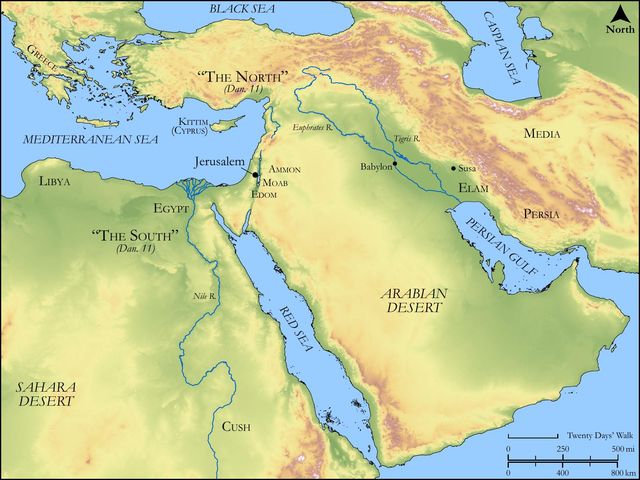
See on the biblical-era map
Study this verse
Public-domain commentary
Matthew Henry
From his Commentary on the Whole Bible. Henry comments on passages, not single verses — this entry covers Daniel 11:1–4.
Here, 1. The angel Gabriel lets Daniel know the good service he has done to the Jewish nation (Dan 11:1): "In the first year of Darius the Mede, who destroyed Babylon and released the Jews out of that house of bondage, I stood a strength and fortress to him, that is, I was instrumental to protect him, and give him success in his ward, and, after he had conquered Babylon, to confirm him in his resolution to release the Jews," which, it is likely, met with much opposition. Thus by the angel, and at the request of the watcher, the golden head was broken, and the axe laid to the root of the tree. Note, We must acknowledge the hand of God in the strengthening of those that are friends to the church for the service they are to do it, and confirming them in their good resolutions; herein he uses the ministry of angels more than we are aware of. And the many instances we have known of God's care of his church formerly encourage us to depend upon him in further straits and difficulties. 2. He foretels the reign of four Persian kings (Dan 11:2): Now I will tell thee the truth, that is, the true meaning of the visions of the great image, and of the four beasts, and expound in plain terms what was before represented by dark types. (1.) There shall stand up three kings in Persia, besides Darius, in whose reign this prophecy is dated, Dan 9:1. Mr. Broughton makes these three to be Cyrus, Artaxasta or Artaxerxes, called by the Greeks Cambyses, and Ahasuerus that married Esther, called Darius son of Hystaspes. To these three the Persians gave these attributes - Cyrus was a father, Cambyses a master, and Darius a hoarder up. So Herodotus. (2.) There shall be a fourth, far richer than they all, that is, Xerxes, of whose wealth the Greek authors take notice. By his strength (his vast army, consisting of 800,000 men at least) and his riches, with which he maintained and paid that vast army, he stirred up all against the realm of Greece. Xerxes's expedition against Greece is famous in history, and the shameful defeat that he met with. He who when he went out was the terror of Greece in his return was the scorn of Greece. Daniel needed not to be told what disappointment he would meet with, for he was a hinderer of the building of the temple; but soon after, about thirty years after the first return from captivity, Darius, a young king, revived the building of the temple, owning the hand of God against his predecessors for hindering it, Ezr 6:7. 3. He foretels Alexander's conquests and the partition of his kingdom, Dan 11:3. He is that mighty king that shall stand up against the kings of Persia, and he shall rule with great dominion, over many kingdoms, and with a despotic power, for he shall do according to his will, and undo likewise, which, by the law of the Medes and Persians, their kings could not. When Alexander, after he had conquered Asia, would be worshipped as a god, then this was fulfilled, that he shall do according to his will. That is God's prerogative, but was his pretension. But (Dan 11:4) his kingdom shall soon be broken, and divided into four parts, but not to his posterity, nor shall any of his successors reign according to his dominion; none of them shall have such large territories nor such an absolute power. His kingdom was plucked up for others besides those of his own family. Arideus, his brother, was made king in Macedonia; Olympias, Alexander's mother, killed him, and poisoned Alexander's two sons, Hercules and Alexander. Thus was his family rooted out by its own hands. See what decaying perishing things worldly pomp and possessions are, and the powers by which they are got. Never was the vanity of the world and its greatest things shown more evidently than in the story of Alexander. All is vanity and vexation of spirit.
Historical interpretation
Four Centuries of Reception
2 surviving comments on this verse. Each one is dated, so this reads as a timeline rather than a list.
Select a marker to jump to its quote. Markers stagger vertically where authors wrote within a few decades of each other.
Verse 2. "And now I shall proclaim the truth to thee." And the meaning is this: "Because thou desirest to know what shall befall the kings of Persia, hearken thou to the order of events and hear the answer to thy request."
"And behold, three more kings shall arise in Persia, and the fourth shall be enriched exceedingly above them all, and when he shall have grown mighty through his wealth, he shall stir up all men against the kingdom of Greece." He states that four kings shall arise in Persia after Cyrus, namely Cambyses, the son of Cyrus, and the Magus named Smerdis, who married Pantaptes, the daughter of Cambyses. Then, when he was slain by seven Magi and Darius had succeeeded to his throne, the same Pantaptes married Darius, and by him gave birth to Xerxes, who became a most powerful and wealthy king, and led an innumerable host against Greece and performed those deeds which are related by the Greek historians. For in the archonship of Callias he destroyed Athens by fire, and about that same time waged the war at Thermopylae and the naval battle at Salamis. It was in his time that Sophocles and Euripides became famous, and Themistocles fled in exile to Persia, where he died as a result of drinking the blood of a bull. And so that writer is in error who records as the fourth king that Darius who was defeated by Alexander, for he was not the fourth king, but the fourteenth king of the Persians after Cyrus. It was in the seventh year of his rule that Alexander defeated and slew him. Moreover it should be observed that after he has specified four kings of Persia after Cyrus, the author omits the nine others and passes right on to Alexander. For the Spirit of prophecy was not concerned about preserving historical detail but in summarizing only the most important matters.
After Cyrus, who reigned first, there were numerous kings in Persia until those three. But the angel indicates by “three kings” those who were called with the name Darius, because there were only three kings who had the same name Darius. And by revealing through whom the kingdom of the Persians would have ceased, he says, “The fourth shall be far richer than all of them,” that is, Darius, who became more powerful than all his predecessors; “and when he has become strong,” this Darius, he means, “in his homeland,” in power and riches, “he shall stir up,” that is, he will cause Alexander, of the house of the Greeks, to march against him.
Continue studying Daniel 11:2 across the web’s major study libraries — every link below opens this exact verse, chapter, or book on the destination site.
Read & Compare
 BibleGatewayThis verse in more than 200 translations and 70 languages.
 Bible.comThe YouVersion reader — hundreds of translations, reading plans, and highlights.
 ESV.orgCrossway's official English Standard Version reader.
 NET BibleThe NET translation with 60,000+ translators' notes on every rendering decision.
 STEP BibleTyndale House's free study tool — original text, vocabulary, and scholarly resources.
 BibliaLogos Bible Software's free web reader.
 USCCBThe New American Bible (Revised Edition) with the U.S. bishops' study notes.
Commentaries
 BibleHub CommentariesDozens of classic commentaries on this verse, gathered on one page.
 StudyLightMore than 100 commentary sets — the largest collection on the web.
 BibleRefPlain-English commentary on what this verse means, verse by verse.
 Enduring WordDavid Guzik's free commentary on this chapter, widely used by Bible teachers.
 Bible Study ToolsVerse commentary alongside Greek and Hebrew study aids.
Original Language & Research
- BibleHub InterlinearThe verse word by word — original language, transliteration, and English.
- BibleHub LexiconEvery word's original-language definition and Strong's entry.
 Blue Letter BibleDeep-study tools — Strong's numbers, concordance, and word studies.
 SefariaThe Hebrew text with Rashi and centuries of Jewish commentary.
Sermons, Hymns & Audio


TrulyRandomVerse is not affiliated with these sites and doesn’t control their content. They’re linked because they’re genuinely useful.
Summary
Daniel 11:2 initiates a remarkably precise prophetic revelation concerning the future of the Persian Empire, specifically detailing the succession of its kings after Cyrus the Great. The angelic messenger assures Daniel of the truthfulness of this vision, predicting the rise of three subsequent Persian kings and a fourth, exceptionally wealthy monarch who would marshal vast resources to launch a monumental campaign against the Greek city-states, directly foreshadowing the historical Greco-Persian Wars. This verse underscores God's meticulous foreknowledge and sovereign control over the unfolding of human history and the destinies of nations.
Context
ShowHideLiterary Context
Daniel 11:2 is an integral part of the extended prophetic vision that begins in Daniel 10. Chapter 10 sets the stage with Daniel's intense spiritual struggle, the appearance of a divine messenger (likely Gabriel), and the revelation that the prophecy concerns "what will happen to your people in the latter days" (Daniel 10:14). Chapter 11 then shifts from the symbolic visions of earlier chapters (like the beasts in Daniel 7 or the ram and goat in Daniel 8) to an extraordinarily detailed and literal account of historical events, beginning with the Persian kings and leading directly into the Hellenistic period and the conflicts between the Ptolemaic and Seleucid empires. This verse acts as the opening historical prediction, setting the stage for the subsequent, even more intricate prophecies.
Historical & Cultural Context
The prophecy in Daniel 11:2 immediately follows the reign of Cyrus the Great, the founder of the Achaemenid Persian Empire. Historically, after Cyrus, three significant kings ruled Persia before Xerxes I: Cambyses II (who conquered Egypt), Smerdis (or the usurper Gaumata, whose reign was brief), and Darius I Hystaspes (who consolidated the empire and expanded it significantly). The "fourth" king, Xerxes I, is well-documented in history for his immense wealth, which is also reflected in the biblical account of Esther, where he is known as Ahasuerus. His vast treasury enabled him to mount an unprecedented invasion of Greece around 480 BC, known as the Greco-Persian Wars. This conflict involved a massive land and naval force, engaging the Greek city-states in famous battles such as Thermopylae and Salamis, precisely as foretold in this verse. The term "Grecia" (Hebrew: Yavan) refers to the Greek world, encompassing the various independent city-states that would eventually unite to resist the Persian invasion.
Key Themes
ShowHideThis verse powerfully contributes to several overarching themes within the book of Daniel and biblical prophecy generally. Firstly, it highlights Divine Foreknowledge, demonstrating God's absolute and precise knowledge of future events, including the succession of kings and their specific actions, centuries before they occurred. This theme is central to Daniel, reinforcing that history is not random but unfolds according to God's predetermined plan, as seen in the detailed visions of empires in Daniel 2 and Daniel 7. Secondly, it underscores God's Sovereignty Over Empires. Human rulers, despite their power and ambition, are ultimately instruments in God's hands, their rise and fall orchestrated by His divine will. The prophecy of Xerxes' wealth and his specific military campaign against Greece serves as concrete evidence of God's control over global geopolitics. Thirdly, the remarkable accuracy of this specific prediction reinforces the Reliability and Divine Inspiration of Scripture, providing strong grounds for trust in God's prophetic word.
Exposition and Analysis
ShowHideKey Word Analysis
ShowHideH571 - This word signifies stability, certainty, and trustworthiness. When the angelic messenger declares, "I will shew thee the truth," it emphasizes that the forthcoming revelation is not a mere vision or symbolic dream, but a factual, reliable, and certain declaration of future historical events. It underscores the divine origin and infallible nature of the prophecy, assuring Daniel (and subsequent readers) of its absolute accuracy.
H6239 - Derived from a root meaning "to accumulate" or "to grow rich," this term denotes wealth, abundance, and material prosperity. The description of the fourth king as "far richer than they all" highlights his unparalleled financial resources. This wealth was not merely a personal attribute but a strategic asset, enabling him to fund the massive military mobilization described in the latter part of the verse, demonstrating how material power can be wielded for geopolitical ends.
H5782 - This verb, meaning "to wake," "to rouse," or "to excite," conveys an active and intentional mobilization. It implies that the fourth king will not merely stumble into conflict but will deliberately and vigorously incite and prepare "all" (meaning all his vast empire and its subject peoples) for a monumental military campaign. This word captures the proactive and aggressive nature of Xerxes' preparations for the Greco-Persian Wars.
Verse Breakdown
ShowHide"And now will I shew thee the truth."
The angelic messenger assures Daniel that the subsequent revelation is not a speculative vision but a factual and reliable account of future events, emphasizing the certainty and trustworthiness of God's prophetic word.
"Behold, there shall stand up yet three kings in Persia;"
This clause prophesies the immediate successors to Cyrus the Great, who was ruling at the time of this vision (Daniel 10:1). These are historically identified as Cambyses II, Smerdis (or the usurper Gaumata), and Darius I Hystaspes.
"and the fourth shall be far richer than [they] all:"
This precisely identifies Xerxes I, the son of Darius I. Historical accounts, including the Book of Esther (where he is called Ahasuerus), confirm his legendary wealth, which surpassed that of his predecessors. This immense wealth was crucial for his ambitious military endeavors.
"and by his strength through his riches he shall stir up all against the realm of Grecia."
This concludes the prophecy regarding Xerxes, stating that he would leverage his immense financial resources and military might to mobilize his entire empire for a massive offensive against the Greek city-states. This directly foretells the monumental Greco-Persian Wars, particularly Xerxes' invasion of Greece around 480 BC.
Literary Devices
ShowHideThe primary literary device at play in Daniel 11:2 is Prophecy, specifically Predictive Prophecy. Unlike symbolic visions found elsewhere in Daniel, this verse offers a remarkably literal and historically verifiable prediction of future events, including the number of kings, their relative wealth, and their specific military actions. This precision serves to authenticate the divine origin of the message. The phrase "far richer than they all" can be seen as a form of Hyperbole or Emphasis, underscoring the extraordinary and unparalleled wealth of the fourth king, which was a key factor in his ability to launch such a massive campaign. Furthermore, the entire verse functions as a form of Foreshadowing, setting the stage for the subsequent rise of the Greek empire under Alexander the Great, which will ultimately conquer Persia, as detailed later in Daniel 11.
Theological and Thematic Connections
ShowHideDaniel 11:2 serves as a profound testament to God's meticulous sovereignty over human history and the destinies of nations. The astonishing specificity of this prophecy, detailing the number of kings, their characteristics, and their military intentions centuries before their occurrence, unequivocally demonstrates God's omniscience and omnipotence. It highlights that even the most powerful earthly empires and their ambitious rulers operate within the confines of God's overarching plan. This divine control is not merely passive oversight but an active orchestration, where human choices and historical events are woven into the tapestry of His ultimate purposes. For the exiled Jewish people, this prophecy offered immense comfort and hope, assuring them that despite the rise and fall of formidable empires, God remained firmly in control, working all things toward the fulfillment of His covenant promises.
Reflection and Application
ShowHideDaniel 11:2 offers profound reassurance for believers living in a world often characterized by political upheaval, shifting global powers, and the ambitions of human leaders. The detailed foreknowledge displayed in this verse reminds us that God is not a distant observer but the active orchestrator of history. Even when circumstances seem chaotic or beyond human control, this passage calls us to trust in God's unwavering providence. It encourages us to look beyond the immediate political landscape to the eternal purposes of God, knowing that His prophetic word is always true and will ultimately be fulfilled. This truth liberates us from anxiety about the future and empowers us to live faithfully, knowing that our ultimate hope rests not in earthly kingdoms, but in the unshakeable kingdom of God. It compels us to pray for our leaders, to engage with the world with wisdom, and to proclaim the good news of a God who reigns supreme over all nations and empires.
Questions for Reflection
ShowHideFAQ
ShowHideWho are the "three kings" and the "fourth" king mentioned in this verse?
ShowHideThe "three kings" are generally identified by historians and biblical scholars as Cambyses II, Smerdis (or the usurper Gaumata), and Darius I Hystaspes, who ruled the Persian Empire after Cyrus the Great. The "fourth" king, described as "far richer than they all," is widely understood to be Xerxes I. Xerxes was renowned for his immense wealth, which is also alluded to in the book of Esther, where he is known as Ahasuerus. His vast resources were instrumental in funding his ambitious military campaigns.
What does "stir up all against the realm of Grecia" refer to historically?
ShowHideThis phrase directly refers to the monumental Greco-Persian Wars, particularly Xerxes I's massive invasion of Greece around 480 BC. Xerxes mobilized an enormous army and navy, drawing forces from across his vast empire to attack the Greek city-states. This campaign included famous battles such as Thermopylae, Artemisium, and Salamis. The prophecy's accuracy in predicting this specific conflict, its instigator, and the scale of the mobilization, centuries before it occurred, is a remarkable testament to the divine inspiration of Daniel's prophecy.
Christ-Centered Fulfillment
ShowHideWhile Daniel 11:2 directly details the historical succession of Persian kings and their conflicts, its Christ-centered fulfillment lies in the broader theological framework of God's sovereign control over all earthly kingdoms, ultimately pointing to the establishment of His eternal kingdom through Jesus Christ. The precision of this prophecy, like all fulfilled Old Testament prophecies, validates the trustworthiness of God's word and His overarching plan for history, a plan that culminates in the person and work of the Messiah. The rise and fall of these earthly empires, including Persia and Greece, serve as a backdrop against which God's redemptive purposes unfold, preparing the world for the coming of the true King. Jesus Christ is the ultimate "truth" (John 14:6) revealed, the one whose kingdom is not of this world (John 18:36) yet will ultimately encompass all realms. Unlike the temporary reigns of earthly kings, Christ's dominion is eternal, a kingdom that "shall never be destroyed" (Daniel 2:44). The meticulous foreknowledge of human history demonstrated in Daniel 11:2 assures us that God's plan for salvation, centered on the sacrifice and resurrection of Jesus, is equally certain and will inevitably lead to the day when "the kingdom of the world has become the kingdom of our Lord and of his Christ, and he shall reign forever and ever" (Revelation 11:15).