


Daniel 10:21
- אֲבָל'a·ValbutH61PrtParticle Interjection
- אַגִּיד'a·GidI will tellH5046V-Hiphil-Imperf-1csVerb Hiphil Imperfect 1st Singular common gender
- לְךָle·Khato youPrep-l ¦ 2msSuffix Personal 2nd Singular Masculineלְtoךָyou
- אֶת'et<obj.>H853DirObjMParticle Object Indicator
- הָרָשׁוּםha·ra·Shumthe [thing] inscribedH7559Art ¦ V-Qal-PassPrtcpl-msVerb Qal Participle Passive Singular Masculine Absoluteהָtheרָשׁוּם[thing] inscribed
- בִּכְתָבbikh·Tavin writing ofH3791Prep-b ¦ N-mscNoun Singular Masculine Constructבִּinכְתָבwriting of
- אֱמֶת'e·MettruthH571N-fsNoun Singular Feminine Absolute
- וְאֵיןve·'Einand there notH369Conj-w ¦ N-mscNoun Singular Masculine Constructוְandאֵיןthere not
- אֶחָד'e·Chad[is] oneH259Adj-fsAdjective Numerical Singular Feminine Absolute
- מִתְחַזֵּקmit·cha·Zek[who] shows himself strongH2388V-Hithpael-Prtcpl-msVerb Hithpael Participle Singular Masculine Absolute
- עִמִּי'i·Miwith meH5973Prep ¦ 1csPrepositionעִמִּwithיme
- עַל'alonH5921PrepPreposition
- אֵלֶּה'E·lehtheseH428PrtParticle Demonstrative
- כִּיkithatH3588PrtParticle Conditional
- אִם'imexceptH518PrtParticle Conditional
- מִיכָאֵלmi·kha·'ElMichaelH4317N-proper-mNoun Proper Masculine
- שַׂרְכֶםsar·Khemyour princeH8269N-msc ¦ 2mpNoun Singular Masculine Constructשַׂרְprinceכֶםyour
English is a literal word-by-word gloss of the Hebrew, not the KJV's wording. Why?
This is the original text the KJV's translators worked from — each Hebrew word with its own literal English meaning in this verse, prepared by scholars at Tyndale House, Cambridge. The KJV translates whole sentences, not word by word, so its wording differs: one Hebrew word can become several English words, and the KJV may choose “the LORD” where the gloss reads “Yahweh”. Both are faithful — they answer different questions. For the KJV's own rendering, switch to the KJV text.
Details
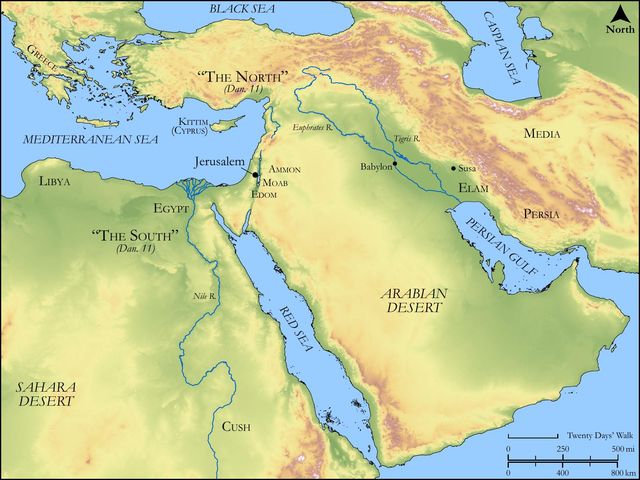
See on the biblical-era map
Study this verse
Public-domain commentary
Matthew Henry
From his Commentary on the Whole Bible. Henry comments on passages, not single verses — this entry covers Daniel 10:10–21. His four-level outline is real structure in the source text, so it is rendered as structure.
Much ado here is to bring Daniel to be able to bear what Christ has to say to him. Still we have him in a fright, hardly and very slowly recovering himself; but he is still answered and supported with good words and comfortable words. Let us see how Daniel is by degrees brought to himself, and gather up the several passages that are to the same purport.
I.Daniel is in a great consternation and finds it very difficult to get clear of it.
The hand that touched him set him at first upon his knees and the palms of his hands, Dan 10:10. Note, Strength and comfort commonly come by degrees to those that have been long cast down and disquieted; they are first helped up a little, and then more. After two days he will revive us, and then the third day he will raise us up. And we must not despise the day of small things, but be thankful for the beginnings of mercy. Afterwards he is helped up, but he stands trembling (Dan 10:11), for fear lest he fall again. Note, Before God gives strength and power unto his people he makes them sensible of their own weakness. I trembled in myself, that I might rest in the day of trouble, Hab 3:16. But when, afterwards, Daniel recovered so much strength in his limbs that he could stand steadily, yet he tells us (Dan 10:15) that he set his face towards the ground and became dumb; he was as a man astonished, who knew not what to say, struck dumb with admiration and fear, and was loth to enter into discourse with one so far above him; he kept silence, yea, even from good, till he had recollected himself a little. Well, at length he recovered, not only the use of his feet, but the use of his tongue; and, when he opened his mouth (Dan 10:16), that which he had to say was to excuse his having been so long silent, for really he durst not speak, he could not speak: "O my lord" (so, in great humility, this prophet calls the angel, though the angels, in great humility, called themselves fellow-servants to the prophets, Rev 22:9), "by the vision my sorrows are turned upon me; they break in upon me with violence; the sense of my sinful sorrowful state turns upon me when I see thy purity and brightness." Note, Man, who has lost his integrity, has reason to blush, and be ashamed of himself, when he sees or considers the glory of the blessed angels that keep their integrity. "My sorrows are turned upon me, and I have retained no strength to resist them or bear up a head against them." And again (Dan 10:17), like one half dead with the fright, he complains, "As for me, straightway there remained no strength in me to receive these displays of the divine glory and these discoveries of the divine will; nay, there is no breath left in me." Such a deliquium did he suffer that he could not draw one breath after another, but panted and languished, and was in a manner breathless. See how well it is for us that the treasure of divine revelation is put into earthen vessels, that God speaks to us by men like ourselves and not by angels. Whatever we may wish, in a peevish dislike of the method God takes in dealing with us, it is certain that if we were tried we should all be of Israel's mind at Mt. Sinai, when they said to Moses, Speak thou to us, and we will hear, but let not God speak to us lest we die, Exo 20:19. If Daniel could not bear it, how could we? Now this he insists upon as an excuse for his irreverent silence, which otherwise would have been blame-worthy: How can the servant of this my lord talk with this my lord? Dan 10:17. Note, Whenever we enter into communion with God it becomes us to have a due sense of the vast distance and disproportion that there are between us and the holy angels, and of the infinite distance, and no proportion at all, between us and the holy God, and to acknowledge that we cannot order our speech by reason of darkness. How shall we that are dust and ashes speak to the Lord of glory?
II.The blessed angel that was employed by Christ to converse with him gave him all the encouragement and comfort that could be.
It should seem, it was not he whose glory he saw in vision (Dan 10:5, Dan 10:6) that here touched him, and talked with him; that was Christ, but this seems to have been the angel Gabriel, whom Christ had once before ordered to instruct Daniel, Dan 8:16. That glorious appearance (as that of the God of glory to Abraham, Act 7:2) was to give authority and to gain attention to what the angel should say. Christ himself comforted John when he in a like case fell at his feet as dead (Rev 1:17); but here he did it by the angel, whom Daniel saw in a glory much inferior to that of the vision in the verses before; for he was like the similitude of the sons of men (Dan 10:16), one like the appearance of a man, Dan 10:18. When he only appeared, as he had done before (Dan 9:21), we do not find that Daniel was put into any disorder by it, as he was by this vision; and therefore he is here employed a third time with Daniel.
1.He lent him his hand to help him, touched him, and set him upon his hands and knees (Dan 10:10), else he would still have lain grovelling, touched his lips (Dan 10:16), else he would have been still dumb; again he touched him (Dan 10:18), and put strength into him, else he would still have been staggering and trembling. Note, The hand of God's power going along with the word of his grace is alone effectual to redress all our grievances, and to rectify whatever is amiss in us. One touch from heaven brings us to our knees, sets us on our feet, opens our lips, and strengthens us; for it is God that works on us, and works in us, both to will and to do that which is good.
2.He assured him of the great favour that God had for him: Thou art a man greatly beloved (Dan 10:11); and again (Dan 10:19), O man greatly beloved! Note, Nothing is more likely, nothing more effectual, to revive the drooping spirits of the saints than to be assured of God's love to them. Those are greatly beloved indeed whom God loves; and it is comfort enough to know it.
3.He silenced his fears, and encouraged his hopes, with good words and comfortable words. He said unto him, Fear not, Daniel (Dan 10:12); and again (Dan 10:19), O man greatly beloved! fear not; peace be unto thee; be strong, yea, be strong. Never did any tender mother quiet her child, when any thing had grieved or frightened it, with more compassion and affection than the angel here quieted Daniel. Those that are beloved of God have no reason to be afraid of any evil; peace is to them; God himself speaks peace to them; and they ought, upon the warrant of that, to speak peace to themselves; and that peace, that joy of the Lord, will be their strength. Will God plead against us with his great power? will he take advantage against us of our being overcome by his terror? No, but he will put strength into us, Job 23:6. So he did into Daniel here, when, by reason of the lustre of the vision, no strength of his own remained in him; and he acknowledges it (Dan 10:19): When he had spoken to me I was strengthened. Note, God by his word puts life, and strength, and spirit into his people; for if he says, Be strong, power goes along with the word. And, now that Daniel has experienced the efficacy of God's strengthening word and grace, he is ready for any thing: "Now, Let my lord speak, and I can hear it, I can bear it, and am ready to do according to it, for thou hast strengthened me." Note, To those that (like Daniel here) have no might God increases strength, Isa 40:29. And we cannot keep up our communion with God but by strength derived from him; but, when he is pleased to put strength into us, we must make a good use of it, and say, Speak, Lord, for thy servant hears. Let God enable us to comply with his will, and them, whatever it is, we will stand complete in it. Da quod jubes, et jube quod vis - Give what thou commandest, and then command what thou wilt.
4.He assured him that his fastings and prayers had come up for a memorial before God, as the angel told Cornelius (Act 10:4): Fear not, Daniel, Dan 10:12. It is natural to fallen man to be afraid of an extraordinary messenger from heaven, as dreading to hear evil tidings thence; but Daniel need not fear, for he has by his three weeks' humiliation and supplication sent extraordinary messengers to heaven, which he may expect to return with an olive-branch of peace: "From the first day that thou didst set thy heart to understand the word of God, which is to be the rule of thy prayers, and to chasten thyself before thy God, that thou mightest put an edge upon thy prayers, thy words were heard," as, before, at the beginning of thy supplication, Dan 9:23. Note, As the entrance of God's word is enlightening to the upright, so the entrance of their prayers is pleasing to God, Psa 119:130. From the first day that we begin to look towards God in a way of duty he is ready to meet us in a way of mercy. Thus ready is God to hear prayer. I said, I will confess, and thou forgavest.
5.He informed him that he was sent to him on purpose to bring him a prediction of the future state of the church, as a token of God's accepting his prayers for the church: "Knowest thou wherefore I come unto thee? If thou knewest on what errand I come, thou wouldst not be put into such a consternation by it." Note, If we rightly understood the meaning of God's dealings with us, and the methods of his providence and grace concerning us, we should be better reconciled to them. "I have come for thy words (Dan 10:12), to bring thee a gracious answer to thy prayers." Thus, when God's praying people call to him, he says, Here I am (Isa 58:9); what would you have with me? See the power of prayer, what glorious things it has, in its time, fetched from heaven, what strange discoveries! On what errand did this angel come to Daniel? He tells him (Dan 10:14): I have come to make thee understand what shall befal thy people in the latter days. Daniel was a curious inquisitive man, that had all his days been searching into secret things, and it would be a great gratification to him to be let into the knowledge of things to come. Daniel had always been concerned for the church; its interests lay much upon his heart, and it would be a particular satisfaction to him to know what its state should be, and he would know the better what to pray for as long as he lived. He was now lamenting the difficulties which his people met with in the present day; but, that he might not be offended in those, the angel must tell him what greater difficulties are yet before them; and, if they be wearied now that they only run with the footmen, how will they contend with horses? Note, It would abate our resentment of present troubles to consider that we know not but much greater are before us, which we are concerned to provide for. Daniel must be made to know what shall befal his people in the latter days of the church, after the cessation of prophecy, and when the time drew nigh for the Messiah to appear, for yet the vision is for many days; the principal things that this vision was intended to give the church the foresight of would come to pass in the days of Antiochus, nearly 300 years after this. Now that which the angel is entrusted to communicate to Daniel, and which Daniel is encouraged to expect from him, is not any curious speculations, moral prognostications, nor rational prospects of his own, though he is an angel, but what he has received from the Lord. It was the revelation of Jesus Christ that the angel gave to St. John to be delivered to the churches, Rev 1:1. So here (Dan 10:21): I will show thee what is written in the scriptures of truth, that is, what is fixed in the determinate counsel and foreknowledge of God. The decree of God is a thing written, it is a scripture which remains and cannot be altered. What I have written I have written. As there are scriptures for the revealed will of God, the letters-patent, which are published to the world, so there are scriptures for the secret will of God, the close rolls, which are sealed among his treasures, the book of his decrees. Both are scriptures of truth; nothing shall be added to nor taken from either of them. The secret things belong not to us, only now and then some few paragraphs have been copied out from the book of God's counsels, and delivered to the prophets for the use of the church, as here to Daniel; but they are the things revealed, even the words of this law, which belong to us and to our children; and we are concerned to study what is written in these scriptures of truth, for they are things which belong to our everlasting peace.
6.He gave him a general account of the adversaries of the church's cause, from whom it might be expected that troubles would arise, and of its patrons, under whose protection it might be assured of safety and victory at last.
(1.)The kings of the earth are and will be its adversaries; for they set themselves against the Lord, and against his Anointed, Psa 2:2. The angel told Daniel that he was to have come to him with a gracious answer to his prayers, but that the prince of the kingdom of Persia withstood him one and twenty days, just the three weeks that Daniel had been fasting and praying. Cambyses king of Persia had been very busy to embarrass the affairs of the Jews, and to do them all the mischief he could, and the angel had been all that time employed to counter-work him; so that he had been constrained to defer his visit to Daniel till now, for angels can be but in one place at a time. Or, as Dr. Lightfoot says, This new king of Persia, by hindering the temple, had hindered those good tidings which otherwise he should have brought him. The kings and kingdoms of the world were indeed sometimes helpful to the church, but more often they were injurious to it. "When I have gone forth from the kings of Persia, when their monarchy is brought down for their unkindness to the Jews, then the prince of Grecia shall come," Dan 10:20. The Grecian monarchy, though favourable to the Jews at first, as the Persian was, will yet come to be vexatious to them. Such is the state of the church-militant; when it has got clear of one enemy it has another to encounter: and such a hydra's head is that of the old serpent; when one storm has blown over it is not long before another rises.
(2.)The God of heaven is, and will be, its protector, and, under him, the angels of heaven are its patrons and guardians.
[1.]Here is the angel Gabriel busy in the service of the church, making his part good in defence of it twenty-one days, against the prince of Persia, and remaining there with the kings of Persia, as consul, or liege-ambassador, to take care of the affairs of the Jews in that court, and to do them service, Dan 10:13. And, though much was done against them by the kings of Persia (God permitting it), it is probably that much more mischief would have been done them, and they would have been quite ruined (witness Haman's plot) if God had not prevented it by the ministration of angels. Gabriel resolves, when he has despatched this errand to Daniel, that he will return to fight with the prince of Persia, will continue to oppose him, and will at length humble and bring down that proud monarchy (v. 20), though he knows that another as mischievous, even that of Grecia, will rise instead of it.
[2.]Here is Michael our prince, the great protector of the church, and the patron of its just but injured cause: The first of the chief princes, Dan 10:13. Some understand it of a created angel, but an archangel of the highest order, Th1 4:16; Jde 1:9. Others think that Michael the archangel is no other than Christ himself, the angel of the covenant, and the Lord of the angels, he whom Daniel saw in vision, Dan 10:5. He came to help me (Dan 10:13); and there is none but he that holds with me in these things, Dan 10:21. Christ is the church's prince; angels are not, Heb 2:5. He presides in the affairs of the church and effectually provides for its good. He is said to hold with the angels, for it is he that makes them serviceable to the heirs of salvation; and, if he were not on the church's side, its case were bad. But, says David, and so says the church, The Lord takes my part with those that help me, Psa 118:7. The Lord is with those that uphold my soul, Psa 54:4.
Historical interpretation
Historical reception
3 surviving comments on this verse. Each one is dated, so this reads as a timeline rather than a list.
Select a marker to jump to its quote. Markers stagger vertically where authors wrote within a few decades of each other.
The angel reported these events, so that Daniel might know that there were not many among the Jews who asked God for their return, nor did the angels approve Daniel’s vow, nor was everything you requested, Daniel, accepted by the angels, in order that the freedom of human will not be restricted.
Verse 21. "Nevertheless I will relate to thee what has been set down in the Scripture of truth." That is, this is the order which the words follow. The fulfilment is still in doubt. For even though thou dost beseech the Lord and I present thy prayers to Him, yet the prince of the Persians takes his stand on the opposite side, and is unwilling that thy people be freed from captivity. But because the prince of the Greeks has come, and in the meantime is contending against the prince of the Persians, and also because I have Michael there as my assistant, I shall, during their mutual conflict, report to thee the coming events which God has foretold to me and has bidden me relate to thee. And let no one be disturbed by the question as to why mention is made of the prince of the Greeks or Hellenes rather than of the Macedonians, for Alexander, king of the Macedonians, did not take up arms against the Persians until he had first overthrown Greece and subjected it to his power.
"And no one is my helper in all these things except Michael, your prince." He implies, "I am that angel who presents thy prayers to God, and I have no other helper in petitioning God on your behalf except the archangel Michael, to whose charge the Jewish nation has been entrusted. And meanwhile the prince of the Greeks is engaged in a common effort with me at this particular time, contending against the prince of the Persians. We should review our ancient history and consider whether by any chance that was the date of the conquest of the Persians by the Greeks. According to the Vulgate edition (of the Septuagint), this same vision is reckoned as extending to the end of the book, that is, the vision which appeared to Daniel in the third year of Cyrus, King of the Persians. On the other hand, according to the Hebrew original, the ensuing sections are separate from this, and recorded in an inverted order. The causes for this phenomenon we have already mentioned; that is, the matters here recorded are related as having occurred in the first year of the Darius who overthrew Belshazzar, not in the third year of Cyrus.
He says in effect, “Why then do I speak of one or two, the prince of the Persians or that of the Greeks? For none of the heavenly powers wishes your people to obtain anything good, manifestly because of their great lawlessness. Only Michael so desires, who was entrusted with the care of your people.” He used the expression “to wage war” instead of “to argue and persuade,” since he wished to show the just irritation of his opponent at the people and his own good will on their behalf. It is likely that the angel who is doing the debating is the holy Gabriel, for this angel had already interpreted the other dreams for him.
Continue studying Daniel 10:21 across the web’s major study libraries — every link below opens this exact verse, chapter, or book on the destination site.
Read & Compare
 BibleGatewayThis verse in more than 200 translations and 70 languages.
 Bible.comThe YouVersion reader — hundreds of translations, reading plans, and highlights.
 ESV.orgCrossway's official English Standard Version reader.
 NET BibleThe NET translation with 60,000+ translators' notes on every rendering decision.
 STEP BibleTyndale House's free study tool — original text, vocabulary, and scholarly resources.
 BibliaLogos Bible Software's free web reader.
 USCCBThe New American Bible (Revised Edition) with the U.S. bishops' study notes.
Commentaries
 BibleHub CommentariesDozens of classic commentaries on this verse, gathered on one page.
 StudyLightMore than 100 commentary sets — the largest collection on the web.
 BibleRefPlain-English commentary on what this verse means, verse by verse.
 Enduring WordDavid Guzik's free commentary on this chapter, widely used by Bible teachers.
 Bible Study ToolsVerse commentary alongside Greek and Hebrew study aids.
Original Language & Research
- BibleHub InterlinearThe verse word by word — original language, transliteration, and English.
- BibleHub LexiconEvery word's original-language definition and Strong's entry.
 Blue Letter BibleDeep-study tools — Strong's numbers, concordance, and word studies.
 SefariaThe Hebrew text with Rashi and centuries of Jewish commentary.
Sermons, Hymns & Audio


TrulyRandomVerse is not affiliated with these sites and doesn’t control their content. They’re linked because they’re genuinely useful.
Summary
Daniel 10:21 serves as a pivotal declaration by an angelic messenger to the prophet Daniel, revealing the certainty of divine revelation and the intense spiritual conflict unfolding behind the scenes of human history. The angel assures Daniel that the forthcoming prophecy is "noted in the scripture of truth," signifying God's unalterable, predetermined plan, and crucially, identifies Michael as the sole angelic ally who "holdeth with me in these things," underscoring his unique role as Israel's heavenly protector amidst cosmic spiritual warfare.
Context
ShowHideLiterary Context
Daniel 10 initiates the final and most extensive prophetic vision in the book of Daniel, spanning chapters 10-12. This vision, received in the third year of Cyrus, King of Persia, follows Daniel's period of fasting and mourning (Daniel 10:2-3). The chapter describes Daniel's encounter with a glorious angelic being, who explains his delayed arrival due to a fierce spiritual battle with the "prince of the kingdom of Persia" Daniel 10:13. Verse 21 functions as the angel's solemn preface to the detailed unfolding of future events concerning Persia, Greece, and the end times, as recorded in Daniel 11 and Daniel 12. It establishes the divine authority and certainty of the coming revelations, while also setting the stage for understanding the spiritual forces at play in human history.
Historical & Cultural Context
The vision in Daniel 10 occurs around 536 BC, approximately two years after the initial return of Jewish exiles to Jerusalem under Zerubbabel, but before the rebuilding of the temple had fully resumed or was completed. Daniel, now an elderly statesman serving in the Persian court, is deeply concerned about his people's future and the challenges they face in their homeland. The Persian Empire was the dominant world power, having overthrown Babylon. The mention of the "prince of the kingdom of Persia" and "the prince of Grecia" Daniel 10:20 reflects a worldview where spiritual entities are believed to exert influence over earthly nations and their leaders, a concept not uncommon in ancient Near Eastern thought, though uniquely articulated in Daniel within a monotheistic framework. This context highlights Daniel's anxiety for Israel's welfare amidst powerful gentile empires and the unseen spiritual forces that govern them.
Key Themes
ShowHideDaniel 10:21 profoundly contributes to several overarching themes within the book of Daniel and biblical theology. Firstly, it underscores Divine Sovereignty and Predetermined Plan. The phrase "noted in the scripture of truth" powerfully conveys that God's plan for history is not arbitrary but is meticulously pre-recorded and unalterable, assuring Daniel that all events, however chaotic they may seem, unfold according to God's precise will. This theme is foundational to Daniel's prophecies, demonstrating God's ultimate control over kingdoms and human affairs, as seen in Daniel 2. Secondly, the verse vividly portrays the reality of Intense Spiritual Warfare. The angelic messenger's need for Michael's assistance against the "prince of Persia" Daniel 10:13 and the declaration that "none that holdeth with me... but Michael" reveals a cosmic struggle between angelic forces and demonic powers that directly impacts earthly events. This unseen battle underscores the need for divine intervention and protection. Finally, the specific mention of God's Protectorate Over Israel through Michael as "your prince" emphasizes God's unwavering commitment to His covenant people. Michael's unique role as Israel's guardian angel provides assurance that even in the midst of formidable spiritual opposition, God's chosen nation is divinely defended, a theme further elaborated in Daniel 12:1.
Exposition and Analysis
ShowHideKey Word Analysis
ShowHideThis word refers to something written, a writing, record, or book. In this context, it is not necessarily a physical scroll but signifies a divine, eternal record or blueprint. It denotes the certainty and fixed nature of God's decrees and plans for history.
This word conveys stability, certainty, and trustworthiness. When combined with "scripture," it emphasizes the infallible and unalterable nature of God's divine plan. It is a "truth" that is firm, reliable, and absolutely certain to come to pass.
This primitive root means to fasten upon, seize, be strong, aid, confirm, or maintain. Here, it signifies providing strong support, assistance, or standing firm alongside someone in a struggle. The angel is stating that no one else provides the necessary strength or aid in these specific spiritual battles except Michael.
This name literally means "Who is like God?" He is identified as an archangel and is consistently portrayed in scripture as a powerful angelic warrior, specifically tasked with defending God's people, Israel. His name itself is a rhetorical question, affirming God's incomparable power and authority.
Verse Breakdown
ShowHide"But I will shew thee that which is noted in the scripture of truth:"
This opening clause establishes the divine origin and certainty of the prophecy Daniel is about to receive. The angelic messenger is not speaking his own words but revealing what is already "noted" or recorded in God's eternal, infallible blueprint for history. This "scripture of truth" is God's fixed, unchangeable plan, assuring Daniel of the absolute reliability and ultimate fulfillment of the forthcoming revelations.
"and [there is] none that holdeth with me in these things,"
This dramatic statement highlights the intensity and solitary nature of the spiritual warfare in which the angelic messenger is engaged. "These things" refers to the ongoing battles against the demonic "princes" influencing earthly kingdoms, particularly the "prince of Persia" mentioned earlier in the chapter. The angel reveals that he has no other ally or supporter in these specific, challenging conflicts. This underscores the formidable power of the opposing spiritual forces and the unique, critical need for specific divine assistance.
"but Michael your prince."
This concluding phrase identifies Michael as the sole and indispensable ally of the angelic messenger. The title "your prince" specifically designates Michael as Israel's guardian or chief prince, emphasizing his unique role as the divine protector of God's covenant people. His involvement signifies God's direct intervention and unwavering commitment to defend Israel amidst the unseen spiritual conflicts that shape human history.
Literary Devices
ShowHideThe verse employs several impactful literary devices. The phrase "scripture of truth" functions as a powerful metaphor for God's divine, unalterable blueprint or decree for history, emphasizing its certainty and reliability. It is not a physical scroll but a symbolic representation of God's sovereign plan. The angel's declaration, "none that holdeth with me... but Michael," utilizes contrast and emphasis. The contrast highlights the solitary nature of the angelic messenger's struggle against formidable spiritual foes, while the emphatic "none... but Michael" underscores Michael's unique and indispensable role as the only one providing effective aid. This also serves as a form of hyperbole to stress the critical importance of Michael's intervention. Furthermore, the naming of Michael as "your prince" is a form of apostrophe, directly addressing Daniel (and by extension, Israel) and affirming the specific, personal nature of Michael's protective role.
Theological and Thematic Connections
ShowHideDaniel 10:21 is a profound window into the unseen spiritual realm, affirming God's absolute sovereignty over history while revealing the intense spiritual warfare that influences earthly affairs. It teaches us that human events are not merely the product of political machinations or chance, but are deeply intertwined with a cosmic struggle between good and evil, orchestrated and ultimately controlled by God. The "scripture of truth" assures us that God's plans are fixed and will inevitably come to pass, providing immense comfort and stability in a chaotic world. The unique role of Michael, Israel's prince, serves as a powerful reminder that God actively defends His people, providing angelic assistance when needed. This verse thus connects to the broader biblical narrative of God's redemptive plan unfolding through history, His ultimate triumph over all opposing forces, and His unwavering faithfulness to His covenant promises.
Reflection and Application
ShowHideDaniel 10:21 offers profound encouragement and a vital perspective for believers navigating a world often marked by confusion, conflict, and a sense of powerlessness. Understanding that God has a "scripture of truth"—an unalterable, divine blueprint for history—should instill deep trust and peace. It reminds us that no human government, no global crisis, and no unseen spiritual force can ultimately thwart God's sovereign purposes. This knowledge frees us from anxiety about the future, enabling us to rest in His perfect plan. Furthermore, the revelation of Michael's active role in spiritual warfare on behalf of God's people underscores that we are not alone in our struggles. While we are called to engage in spiritual battles through prayer and faith, we are also assured that powerful angelic allies, commissioned by God, are at work on our behalf. This should cultivate a greater awareness of the unseen realm, fostering a more fervent prayer life and a deeper reliance on God's protection and provision, knowing that He is actively working to defend His children and bring His predetermined plan to fruition.
Questions for Reflection
ShowHideFAQ
ShowHideWhat is the "scripture of truth" mentioned in this verse?
ShowHideThe "scripture of truth" (Hebrew: mikhtav emet) is not a physical book or scroll that Daniel could read. Instead, it is a metaphorical expression referring to God's eternal, unchangeable, and absolutely reliable divine plan or decree for history. It signifies God's comprehensive blueprint for all events, from eternity past to eternity future. It emphasizes His omniscience and sovereignty, assuring Daniel that the prophecies he is about to receive are not speculative but are certain to come to pass because they are already "noted" in God's infallible counsel. This concept reinforces God's ultimate control over all kingdoms and human affairs, as seen throughout the book of Daniel, especially in passages like Daniel 2:28.
Who is Michael, and why is he called "your prince"?
ShowHideMichael (Hebrew: Mîykâʼêl, meaning "Who is like God?") is identified in biblical tradition as an archangel, a chief prince among the angelic host. He is consistently portrayed as a powerful angelic warrior, specifically tasked with defending God's people, Israel. The title "your prince" (Hebrew: sar'khem) is significant because it indicates his unique and special role as the guardian and protector of the nation of Israel. This designation underscores God's specific care for His covenant people, providing them with a powerful heavenly advocate in the midst of spiritual opposition. Michael's role is further emphasized in Daniel 12:1, where he is described as "the great prince who stands guard over the sons of your people."
What does "none that holdeth with me in these things" imply about spiritual warfare?
ShowHideThis statement reveals the intense and often solitary nature of the spiritual battles fought by angelic beings against demonic forces. The angelic messenger, who had been delayed by the "prince of the kingdom of Persia" Daniel 10:13, indicates that the opposition is so formidable that he has no other effective ally in these specific, high-stakes conflicts except Michael. It highlights that while many angels serve God, only certain powerful ones are equipped or commissioned for specific, intense engagements. This implies that spiritual warfare is a real, arduous, and often unseen reality, where even powerful angelic beings require specific, divine assistance to prevail against the forces of darkness that seek to influence human history and hinder God's plans.
Christ-Centered Fulfillment
ShowHideWhile Daniel 10:21 highlights the vital role of Michael as Israel's angelic protector and the certainty of God's "scripture of truth," its ultimate fulfillment and deeper meaning are found in Jesus Christ. The "scripture of truth" — God's eternal, predetermined plan — finds its ultimate purpose and culmination in Christ. He is the one in whom "all the treasures of wisdom and knowledge are hidden" Colossians 2:3, and through whom God's mystery and will are fully revealed Ephesians 1:9-10. Furthermore, while Michael is a powerful prince, Jesus Christ is the ultimate "Prince of Peace" Isaiah 9:6 and the "Prince of Life" Acts 3:15. He is not merely an angelic ally but the sovereign Lord over all creation, including all angelic and demonic powers Colossians 1:16. His victory on the cross disarmed and triumphed over all principalities and powers Colossians 2:15, rendering Michael's specific battle a foreshadowing of Christ's ultimate, decisive triumph. For believers in Christ, our protection is not merely through an archangel, but through the direct, indwelling presence of the Holy Spirit and the unshakeable power of Christ Himself, who assures us that no one can snatch us out of His hand John 10:28-29. Thus, Daniel 10:21 points us to the One who is the embodiment of God's truth and the supreme protector of His people.