


Daniel 11:1
Bible text: King James Version (1769 Blayney text) · Public domain
Bible text: Berean Standard Bible · Public domain
Bible text: American Standard Version (1901) · Public domain
Bible text: World English Bible, Messianic edition · Public domain
Bible text: Geneva Bible (1599) · Public domain
Bible text: Young's Literal Translation · Public domain
- וַאֲנִיva·'a·Niand IH589Conj-w ¦ Pro-1csPronoun Personal 1st Singular common genderוַandאֲנִיI
- בִּשְׁנַתbish·Natin yearH8141Prep-b ¦ N-fscNoun Singular Feminine Constructבִּinשְׁנַתyear
- אַחַת'a·ChatoneH259Adj-fsAdjective Numerical Singular Feminine Absolute
- לְדָרְיָוֶשׁle·da·re·Ya·veshof DariusH1867Prep-l ¦ N-proper-mNoun Proper MasculineלְofדָרְיָוֶשׁDarius
- הַמָּדִיha·ma·Dithe MedeH4075Art ¦ N-msNoun Gentilic Singular Masculine AbsoluteהַtheמָּדִיMede
- עָמְדִי'a·me·Distanding myH5975V-Qal-Inf ¦ 1csVerb Qal Infinitive Constructעָמְדִstandingיmy
- לְמַחֲזִיקle·ma·cha·Zik[was] to a strengthenerH2388Prep-l ¦ V-Hiphil-Prtcpl-msVerb Hiphil Participle Singular Masculine Absoluteלְ[was] toמַחֲזִיקa strengthener
- וּלְמָעוֹזu·le·ma·'ozand to a protectionH4581Conj-w ¦ Prep-l ¦ N-msNoun Singular Masculine Absoluteוּandלְtoמָעוֹזa protection
- לוֹlofor himPrep-l ¦ 3msSuffix Personal 3rd Singular Masculineלforוֹhim
English is a literal word-by-word gloss of the Hebrew, not the KJV's wording. Why?
This is the original text the KJV's translators worked from — each Hebrew word with its own literal English meaning in this verse, prepared by scholars at Tyndale House, Cambridge. The KJV translates whole sentences, not word by word, so its wording differs: one Hebrew word can become several English words, and the KJV may choose “the LORD” where the gloss reads “Yahweh”. Both are faithful — they answer different questions. For the KJV's own rendering, switch to the KJV text.
Details
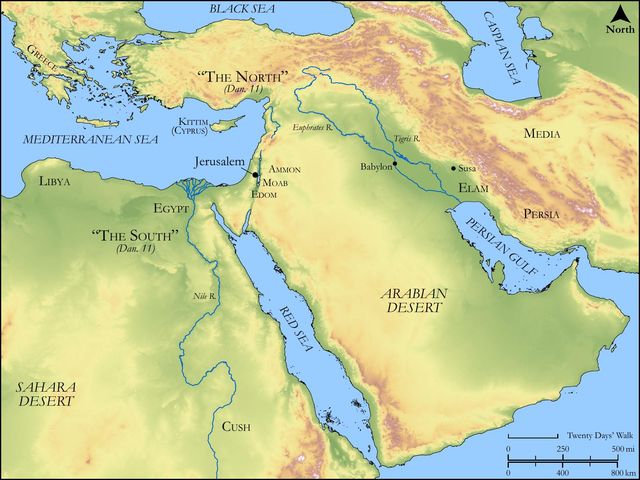
See on the biblical-era map
Study this verse
Public-domain commentary
Matthew Henry
From his Commentary on the Whole Bible. Henry comments on passages, not single verses — this entry covers Daniel 11:1–4.
Here, 1. The angel Gabriel lets Daniel know the good service he has done to the Jewish nation (Dan 11:1): "In the first year of Darius the Mede, who destroyed Babylon and released the Jews out of that house of bondage, I stood a strength and fortress to him, that is, I was instrumental to protect him, and give him success in his ward, and, after he had conquered Babylon, to confirm him in his resolution to release the Jews," which, it is likely, met with much opposition. Thus by the angel, and at the request of the watcher, the golden head was broken, and the axe laid to the root of the tree. Note, We must acknowledge the hand of God in the strengthening of those that are friends to the church for the service they are to do it, and confirming them in their good resolutions; herein he uses the ministry of angels more than we are aware of. And the many instances we have known of God's care of his church formerly encourage us to depend upon him in further straits and difficulties. 2. He foretels the reign of four Persian kings (Dan 11:2): Now I will tell thee the truth, that is, the true meaning of the visions of the great image, and of the four beasts, and expound in plain terms what was before represented by dark types. (1.) There shall stand up three kings in Persia, besides Darius, in whose reign this prophecy is dated, Dan 9:1. Mr. Broughton makes these three to be Cyrus, Artaxasta or Artaxerxes, called by the Greeks Cambyses, and Ahasuerus that married Esther, called Darius son of Hystaspes. To these three the Persians gave these attributes - Cyrus was a father, Cambyses a master, and Darius a hoarder up. So Herodotus. (2.) There shall be a fourth, far richer than they all, that is, Xerxes, of whose wealth the Greek authors take notice. By his strength (his vast army, consisting of 800,000 men at least) and his riches, with which he maintained and paid that vast army, he stirred up all against the realm of Greece. Xerxes's expedition against Greece is famous in history, and the shameful defeat that he met with. He who when he went out was the terror of Greece in his return was the scorn of Greece. Daniel needed not to be told what disappointment he would meet with, for he was a hinderer of the building of the temple; but soon after, about thirty years after the first return from captivity, Darius, a young king, revived the building of the temple, owning the hand of God against his predecessors for hindering it, Ezr 6:7. 3. He foretels Alexander's conquests and the partition of his kingdom, Dan 11:3. He is that mighty king that shall stand up against the kings of Persia, and he shall rule with great dominion, over many kingdoms, and with a despotic power, for he shall do according to his will, and undo likewise, which, by the law of the Medes and Persians, their kings could not. When Alexander, after he had conquered Asia, would be worshipped as a god, then this was fulfilled, that he shall do according to his will. That is God's prerogative, but was his pretension. But (Dan 11:4) his kingdom shall soon be broken, and divided into four parts, but not to his posterity, nor shall any of his successors reign according to his dominion; none of them shall have such large territories nor such an absolute power. His kingdom was plucked up for others besides those of his own family. Arideus, his brother, was made king in Macedonia; Olympias, Alexander's mother, killed him, and poisoned Alexander's two sons, Hercules and Alexander. Thus was his family rooted out by its own hands. See what decaying perishing things worldly pomp and possessions are, and the powers by which they are got. Never was the vanity of the world and its greatest things shown more evidently than in the story of Alexander. All is vanity and vexation of spirit.
Historical interpretation
Historical reception
2 surviving comments on this verse. Each one is dated, so this reads as a timeline rather than a list.
Select a marker to jump to its quote. Markers stagger vertically where authors wrote within a few decades of each other.
Verse 1. "And from the first year of Darius the Mede, I stood up that he might be strengthened and confirmed." Daniel implies, "From the first year of the reign of Darius, who overthrew the Chaldeans and delivered me from the hand of my enemies to the extent of his ability (for even his sealing of the pit of lions with his signet ring was for my protection, lest my adversaries should slay me), I for my part stood before God, and I besought God's mercy upon him, in view of the man's love for me, in order that either he or his kingdom might be strengthened and confirmed. And since I persevered in my prayer, I was answered by God and given to understand the following information. After all, it is a customary thing with the prophets to bring in new speakers abruptly and without warning. So it is in Psalm Thirty-one: for when the prophet has petitioned God and said: "Thou art my refuge from my tribulation which compassed me about; O Thou, who art my rejoicing, deliver me from those who now encompass me," then God is abruptly brought in as the speaker, replying, "I will give thee understanding, and I will instruct thee in this way in which thou shalt go; I will fasten Mine eyes upon thee" (Psalm 32:7-8). So also here, as the prophet relates, "From the first year of Darius the Mede, I stood up and interceded that he might be strengthened and that his rule might be confirmed," God suddenly responds:
[The divine angel says,] As soon as Cyrus came to the throne and the end of captivity had been reached, I took my place until I had secured release and liberation for the people.
Continue studying Daniel 11:1 across the web’s major study libraries — every link below opens this exact verse, chapter, or book on the destination site.
Read & Compare
 BibleGatewayThis verse in more than 200 translations and 70 languages.
 Bible.comThe YouVersion reader — hundreds of translations, reading plans, and highlights.
 ESV.orgCrossway's official English Standard Version reader.
 NET BibleThe NET translation with 60,000+ translators' notes on every rendering decision.
 STEP BibleTyndale House's free study tool — original text, vocabulary, and scholarly resources.
 BibliaLogos Bible Software's free web reader.
 USCCBThe New American Bible (Revised Edition) with the U.S. bishops' study notes.
Commentaries
 BibleHub CommentariesDozens of classic commentaries on this verse, gathered on one page.
 StudyLightMore than 100 commentary sets — the largest collection on the web.
 BibleRefPlain-English commentary on what this verse means, verse by verse.
 Enduring WordDavid Guzik's free commentary on this chapter, widely used by Bible teachers.
 Bible Study ToolsVerse commentary alongside Greek and Hebrew study aids.
Original Language & Research
- BibleHub InterlinearThe verse word by word — original language, transliteration, and English.
- BibleHub LexiconEvery word's original-language definition and Strong's entry.
 Blue Letter BibleDeep-study tools — Strong's numbers, concordance, and word studies.
 SefariaThe Hebrew text with Rashi and centuries of Jewish commentary.
Sermons, Hymns & Audio


TrulyRandomVerse is not affiliated with these sites and doesn’t control their content. They’re linked because they’re genuinely useful.
Summary
Daniel 11:1 serves as a crucial bridge between Daniel's intense spiritual vision in the preceding chapter and the detailed prophetic revelation that follows. In this verse, a powerful angelic messenger, likely Gabriel, declares his active involvement in the unfolding historical events, specifically stating that he "stood to confirm and to strengthen" Darius the Mede during his first year of reign. This declaration underscores the unseen spiritual forces at work behind the scenes of human history, influencing earthly rulers and kingdoms according to God's sovereign plan, setting the stage for the extensive prophecy concerning future empires and conflicts.
Context
ShowHideLiterary Context
Daniel 11:1 directly follows the profound and physically debilitating vision Daniel received in Daniel 10. Chapter 10 details Daniel's three-week fast, the appearance of a glorious angelic being (often identified as Christophany or a high-ranking angel), and the revelation of a spiritual battle between this angel and the "prince of Persia" (likely a demonic entity influencing the Persian kingdom). The angel explains that he was delayed by this spiritual opposition until Michael, one of the chief princes, came to help (Daniel 10:13). Thus, Daniel 11:1 acts as a chronological and thematic continuation, establishing the angel's ongoing involvement in earthly affairs, particularly in the Medo-Persian Empire, as a prelude to the extensive prophecy about future kings and conflicts in Daniel 11 and Daniel 12.
Historical & Cultural Context
The "first year of Darius the Mede" places this verse precisely at a pivotal moment in the history of Babylon and Persia: the transition of power from the Babylonian Empire to the Medo-Persian Empire. Babylon had fallen to Cyrus the Great, the Persian king, in 539 BC, as dramatically recounted in Daniel 5. Darius the Mede, introduced in Daniel 5:31, appears to have been a viceroy or governor appointed by Cyrus to administer the newly conquered territory of Babylon. His reign, though perhaps brief and subordinate to Cyrus, represented the initial phase of Medo-Persian rule. This period was crucial for the Jewish exiles, as it marked the beginning of their potential return to Jerusalem under Cyrus's decree (Ezra 1:1-4). The angel's statement of support for Darius highlights the divine orchestration of these geopolitical shifts, ensuring that even pagan rulers served God's ultimate purposes for His people.
Key Themes
ShowHideThis single verse powerfully reinforces several overarching themes found throughout the book of Daniel. Firstly, Divine Sovereignty over History is paramount; God is not merely an observer but an active participant, orchestrating the rise and fall of empires and rulers according to His plan. The angel's declaration of supporting Darius underscores that even the establishment of a pagan king is under divine purview. Secondly, the theme of Spiritual Warfare is vividly continued from Daniel 10, demonstrating that earthly conflicts and political transitions have unseen spiritual dimensions, with angelic and demonic forces vying for influence. The angel's mission to "confirm and to strengthen" Darius is part of this struggle. Lastly, the verse highlights Angelic Ministry, showcasing the active and crucial role of holy angels as God's agents, carrying out His will, protecting His people, and influencing the course of nations to fulfill His prophetic word.
Exposition and Analysis
ShowHideKey Word Analysis
ShowHideMeaning "a spot (as being fixed); place, (where) stood, upright." In this context, it conveys a position of readiness, steadfastness, and active engagement. The angel was not merely observing but was present and actively involved, taking a firm stand to execute his mission.
A primitive root meaning "to fasten upon; hence, to seize, be strong (figuratively, courageous, causatively strengthen, cure, help, repair, fortify), obstinate." This word suggests providing firm support, making something strong or secure, or holding fast. Here, it implies the angel's active role in stabilizing Darius's reign and ensuring his position was upheld according to God's will.
Meaning "a fortified place; figuratively, a defence; force, fort(-ress), strength(-en), (most) strong (hold)." This term emphasizes providing a source of power, a stronghold, or a defense. It indicates that the angel was not just confirming Darius's position but also empowering him, acting as a divine fortification against any opposing forces, whether human or spiritual.
Verse Breakdown
ShowHide"Also I in the first year of Darius the Mede,"
This opening phrase immediately establishes the precise chronological setting for the subsequent extensive prophecy. The "I" refers to the angelic messenger who had been speaking with Daniel in Daniel 10, emphasizing his direct involvement. The mention of "Darius the Mede" anchors the divine activity within a specific historical transition, marking the beginning of the Medo-Persian Empire's rule over Babylon.
"even I, stood"
The repetition of "I" (implied in "even I") adds emphasis, highlighting the angel's personal and deliberate action. "Stood" (from the Hebrew ʻômed') signifies a fixed, firm, and active posture. It implies that the angel took a resolute position, ready to intervene and carry out his divine mandate. This is not a passive observation but an active stance of readiness and commitment.
"to confirm and to strengthen him."
This clause reveals the angel's specific mission. "Confirm" (from châzaq) suggests providing stability, support, and firmness to Darius's rule. "Strengthen" (from mâʻôwz) implies acting as a source of power, a fortress, or a defense for him. Together, these terms indicate that the angel was divinely empowered to ensure the establishment and stability of Darius's reign, not for Darius's personal glory, but as part of God's overarching plan for the nations and for the protection of His people, Israel.
Literary Devices
ShowHideDaniel 11:1 employs several literary devices to convey its profound theological message. The most prominent is Divine Agency, where the angelic messenger explicitly states his active role in human history, demonstrating that God works through His heavenly emissaries to achieve His purposes. This highlights the unseen realm's direct influence on earthly affairs. There is also an element of Foreshadowing, as this verse sets the stage for the detailed prophecies of future kings and battles in Daniel 11, implying that the same divine and angelic involvement will continue throughout subsequent historical periods. The angel's declaration also uses Understatement to some extent, as "confirm and to strengthen" subtly hints at the immense spiritual struggle that was occurring behind the scenes, as revealed in Daniel 10:13, where the angel was resisted by the "prince of Persia." The seemingly simple statement belies a profound and ongoing conflict.
Theological and Thematic Connections
ShowHideDaniel 11:1 profoundly reinforces the biblical truth of God's absolute sovereignty over all of history and the active involvement of the unseen spiritual realm in human affairs. It reveals that the rise and fall of empires, the establishment of rulers, and the very course of nations are not merely the result of human will or geopolitical machinations, but are ultimately orchestrated and influenced by divine decree and angelic activity. The angel's mission to "confirm and to strengthen" Darius the Mede demonstrates that even pagan kings are instruments in God's hands, used to accomplish His purposes, particularly concerning His covenant people, Israel. This understanding provides immense comfort and assurance, reminding believers that even in times of political turmoil or global uncertainty, God remains firmly on His throne, working all things according to the counsel of His will.
Reflection and Application
ShowHideDaniel 11:1 offers a powerful and comforting perspective for believers navigating a complex world. It reminds us that behind the visible events of history—the shifting political landscapes, the rise and fall of leaders, and the conflicts between nations—there is an invisible, spiritual reality where God's sovereign plan is being meticulously unfolded. The angel's active role in supporting Darius the Mede assures us that God is intimately involved in the details of human governance, even using those who do not acknowledge Him to achieve His ultimate purposes. This perspective should instill a deep sense of peace, knowing that our God is in control, and nothing happens outside of His divine oversight. Furthermore, it highlights the ongoing reality of spiritual warfare, urging us to be vigilant in prayer and to recognize that our struggles often have unseen dimensions. Just as the angel stood to strengthen Darius, God provides His strength and support to us through His Spirit and His heavenly host in our personal battles, empowering us to stand firm in faith and to participate in His kingdom work.
Questions for Reflection
ShowHideFAQ
ShowHideWho is the "I" in Daniel 11:1, and why is his role significant?
ShowHideThe "I" in Daniel 11:1 refers to the powerful angelic messenger who had been speaking with Daniel throughout Daniel 10. While not explicitly named in this verse, he is widely understood to be Gabriel, who previously appeared to Daniel in Daniel 8:16 and Daniel 9:21. His role is highly significant because he reveals the active and direct involvement of heavenly beings in earthly affairs, particularly in the establishment and stability of human kingdoms. His declaration that he "stood to confirm and to strengthen" Darius the Mede demonstrates that God orchestrates historical events through His angelic agents, ensuring that even pagan rulers serve His ultimate purposes for His people and the unfolding of His prophetic plan. This highlights the unseen spiritual dimension behind visible historical transitions.
What is the significance of the angel's support for "Darius the Mede" in the context of God's plan?
ShowHideThe angel's support for Darius the Mede is highly significant because it underscores God's absolute sovereignty over all earthly powers. Darius the Mede was a transitional figure, likely a viceroy or governor appointed by Cyrus the Great after the fall of Babylon (Daniel 5:31). By "confirming and strengthening" Darius, the angel was ensuring the stability of the nascent Medo-Persian Empire, which was crucial for the fulfillment of God's plans for Israel. This new empire would eventually issue decrees allowing the Jewish exiles to return to their homeland and rebuild the Temple (Ezra 1:1-4). Thus, the angel's intervention was not about endorsing Darius personally, but about ensuring that the political landscape was aligned with God's redemptive purposes, demonstrating that even pagan rulers are instruments in God's hands to accomplish His will.
Christ-Centered Fulfillment
ShowHideWhile Daniel 11:1 focuses on an angelic messenger supporting an earthly king, its ultimate Christ-centered fulfillment lies in the absolute sovereignty and supreme authority of Jesus Christ over all powers, both seen and unseen. The angel's mission to "confirm and to strengthen" Darius the Mede foreshadows the comprehensive dominion that belongs to Christ alone. All authority in heaven and on earth has been given to Him (Matthew 28:18). He is the one by whom and for whom all things were created, including "thrones or dominions or rulers or authorities" (Colossians 1:16). The spiritual warfare depicted in Daniel 10 and the angelic intervention in Daniel 11:1 point to a battle that Christ has decisively won through His death and resurrection, triumphing over all principalities and powers (Colossians 2:15). Ultimately, the stability of earthly kingdoms and the unfolding of history serve His purposes, as He is the King of kings and Lord of lords (Revelation 19:16). The angelic ministry seen in Daniel 11:1 is subordinate to Christ's supreme rule, as angels are ministering spirits sent to serve Him and those who are heirs of salvation (Hebrews 1:14). Thus, the divine agency at work in Daniel 11:1 finds its perfect and ultimate expression in the person and work of Jesus Christ, who upholds the universe by the word of His power (Hebrews 1:3).