


Daniel 8:16
- וָאֶשְׁמַעva·'esh·Ma'and I heardH8085Conj-w ¦ V-Qal-ConsecImperf-1csVerb Qal Consecutive Imperfect 1st Singular common genderוָandאֶשְׁמַעI heard
- קוֹלkol[the] voice ofH6963N-mscNoun Singular Masculine Construct
- אָדָם'a·Dama personH120N-msNoun Singular Masculine Absolute
- בֵּיןbeinbetweenH996Adj-mscAdjective Numerical Singular Masculine Construct
- אוּלָי'u·LaiUlaiH195N-properNoun Proper Location
- וַיִּקְרָאvai·yik·Ra'and he calledH7121Conj-w ¦ V-Qal-ConsecImperf-3msVerb Qal Consecutive Imperfect 3rd Singular Masculineוַandיִּקְרָאhe called
- וַיֹּאמַרvai·yo·Marand he saidH559Conj-w ¦ V-Qal-ConsecImperf-3msVerb Qal Consecutive Imperfect 3rd Singular Masculineוַandיֹּאמַרhe said
- גַּבְרִיאֵלgav·ri·'ElO GabrielH1403N-proper-mNoun Proper Masculine
- הָבֵןha·VenexplainH995V-Hiphil-Imp-2msVerb Hiphil Imperative 2nd Singular Masculine
- לְהַלָּזle·ha·Lazto this [one]H1975Prep-l ¦ PrtParticle Demonstrativeלְtoהַלָּזthis [one]
- אֶת'et<obj.>H853DirObjMParticle Object Indicator
- הַמַּרְאֶהha·mar·'Ehthe visionH4758Art ¦ N-msNoun Singular Masculine Absoluteהַtheמַּרְאֶהvision
English is a literal word-by-word gloss of the Hebrew, not the KJV's wording. Why?
This is the original text the KJV's translators worked from — each Hebrew word with its own literal English meaning in this verse, prepared by scholars at Tyndale House, Cambridge. The KJV translates whole sentences, not word by word, so its wording differs: one Hebrew word can become several English words, and the KJV may choose “the LORD” where the gloss reads “Yahweh”. Both are faithful — they answer different questions. For the KJV's own rendering, switch to the KJV text.
Details
See on the biblical-era map
Study this verse
Public-domain commentary
Matthew Henry
From his Commentary on the Whole Bible. Henry comments on passages, not single verses — this entry covers Daniel 8:15–27. His four-level outline is real structure in the source text, so it is rendered as structure.
Here we have,
I.Daniel's earnest desire to have this vision explained to him (Dan 8:15):
I sought the meaning. Note, Those that rightly know the things of God cannot but desire to know more and more of them, and to be led further into the mystery of them; and those that would find the meaning of what they have seen or heard from God must seek it, and seek it diligently. Seek and you shall find. Daniel considered the thing, compared it with the former discoveries, to try if he could understand it; but especially he sought by prayer (as he had done Dan 2:18), and he did not seek in vain.
II.Orders given to the angel Gabriel to inform him concerning this vision.
One in the appearance of a man (who, some think, was Christ himself, for who besides could command angels?) orders Gabriel to make Daniel understand this vision. Sometimes God is pleased to make use of the ministration of angels, not only to protect his children, but to instruct them, to serve the kind intentions, not only of his providence, but of his grace.
III.The consternation that Daniel was in upon the approach of his instructor (Dan 8:17):
When he came near I was afraid. Though Daniel was a man of great prudence and courage, and had been conversant with the visions of the Almighty, yet the approach of an extraordinary messenger from heaven put him into this fright. He fell upon his face, not to worship the angel, but because he could no longer bear the dazzling lustre of his glory. Nay, being prostrate upon the ground, he fell into a deep sleep, (Dan 8:18), which came not from any neglect of the vision, or indifference towards it, but was an effect of his faintness and the oppression of spirit he was under, through the abundance of revelations. The disciples in the garden slept for sorrow; and, as there, so here, the spirit was willing, but the flesh was weak. Daniel would have kept awake, and could not.
IV.The relief which the angel gave to Daniel, with great encouragement to him to expect a satisfactory discovery of the meaning of this vision.
1.He touched him, and set him upon his feet, Dan 8:18. Thus when John, in a similar case, was in similar consternation, Christ laid his right hand upon him, Rev 1:17. It was a gentle touch that the angel here gave to Daniel, to show that he came not to hurt him, not to plead against him with his great power, or with a hand heavy upon him, but to help him, to put strength into him (Job 23:6), which God can do with a touch. When we are slumbering and grovelling on this earth we are very unfit to hear from God, and to converse with him. But, if God design instruction for us, he will be his grace awaken us out of our slumber, raise us from things below, and set us upright.
2.He promised to inform him: "Understand, O son of man! Dan 8:17. Thou shalt understand, if thou wilt but apply thy mind to understand." He calls him son of man to intimate that he would consider his frame, and would deal tenderly with him, accommodating himself to his capacity as a man. Or thus he preaches humility to him; though he be admitted to converse with angels, he must not be puffed up with it, but must remember that he is a son of man. Or perhaps this title puts honour upon him: the Messiah was lately called the Son of man (Dan 7:13), and Daniel is akin to him, and is a figure of him as a prophet and one greatly beloved. He assures him that he shall be made to know what shall be in the last end of the indignation, Dan 8:19. Let it be laid up for a comfort to those who shall live to see these calamitous times that there shall be an end of them; the indignation shall cease (Isa 10:25); it shall be overpast, Isa 26:20. It may intermit and return again, but the last end shall be glorious; good will follow it, nay, and good will be brought out of it. He tells him (Dan 8:17), "At the time of the end shall be the vision; when the last end of the indignation comes, when the course of this providence is completed, then the vision shall be made plain and intelligible by the event, as the event shall be made plain and intelligible by the vision." Or, "At the time of the end of the Jewish church, in the latter days of it, shall this vision be accomplished, 300 or 400 years hence; understand it therefore, that thou mayest leave it on record for the generations to come." But is he ask more particularly, "When is the time of the end? And how long will it be before it arrive?" let this answer suffice (Dan 8:19): At the time appointed the end shall be; it is fixed in the divine counsel, which cannot be altered and which must not be pried into.
V.The exposition which he gave him of the vision.
1.Concerning the two monarchies of Persia and Greece, Dan 8:20-22. The ram signified the succession of the kings of Media and Persia; the rough goat signified the kings of Greece; the great horn was Alexander; the four horns that rose in his room were the four kingdoms into which his conquests were cantoned, of which before, Dan 8:8. They are said to stand up out of the nations, but not in his power; none of them ever made the figure that Alexander did. Josephus relates that when Alexander had taken Tyre, and subdued Palestine, and was upon his march to Jerusalem, Jaddas, who was them high priest (Nehemiah mentions one of his name, Neh 12:11), fearing his rage, had recourse to God by prayer and sacrifice for the common safety, and was by him warned in a dream that upon Alexander's approach he should throw open the gates of the city, and that he and the rest of the priests should go forth to meet him in their habits, and all the people in white. Alexander, seeing this company at a distance, went himself alone to the high priest, and, having prostrated himself before that God whose name was engraven in the golden plate of his mitre, he first saluted him; and, being asked by one of his own captains why he did so, he said that while he was yet in Macedon, musing on the conquest of Asia, there appeared to him a man like unto this, and thus attired, who invited him into Asia, and assured him of success in the conquest of it. The priests led him to the temple, where he offered sacrifice to the God of Israel as they directed him; and there they showed him this book of the prophet Daniel, that it was there foretold that a Grecian should come and destroy the Persians, which animated him very much in the expedition he was now meditating against Darius. Hereupon he took the Jews and their religion under his protection, promised to be kind to those of their religion in Babylon and Media, whither he was now marching, and in honour of him all the priests that had sons born that year called them Alexander. Joseph. lib. 11.
2.Concerning Antiochus, and his oppression of the Jews. This is said to be in the latter time of the kingdom of the Greeks, when the transgressors are come to the full (Dan 8:23); that is, when the degenerate Jews have filled up the measure of their iniquity, and are ripe for this destruction, so that God cannot in honour bear with them any longer then shall stand up this king, to be flagellum Dei - the rod in God's hand for the chastising of the Jews. Now observe here,
(1.)His character: He shall be a king of fierce countenance, insolent and furious, neither fearing God nor regarding man, understanding dark sentences, or (rather) versed in dark practices, the hidden things of dishonesty; he was master of all the arts of dissimulation and deceit, and knew the depths of Satan as well as any man. He was wise to do evil.
(2.)His success. He shall make dreadful havoc of the nations about him: His power shall be mighty, bear down all before it, but not by his own power (Dan 8:24), but partly by the assistance of his allies, Eumenes and Attalus, partly by the baseness and treachery of many of the Jews, even of the priests that came into his interests, and especially by the divine permission. it was not by his own power, but by a power given him from above, that he destroyed wonderfully, and thought he made himself a great man by being a great destroyer. He destroys wonderfully indeed, for he destroys,
[1.]The mighty people, and they cannot resist him by their power. The princes of Egypt cannot stand before him with all their forces, but he practises against them and prospers. Note, The mighty ones of the earth commonly meet with those at length that are too hard for them, that are more mighty than they. Let not the strong man then glory in his strength, be it ever so great, unless he could be sure that there were none stronger than he.
[2.]He destroys the holy people, or the people of the holy ones; and their sacred character does neither deter him from destroying them nor defend them from being destroyed. All things come alike to all, and there is one event to the mighty and to the holy in this world.
[3.]The methods by which he will gain this success, not by true courage, wisdom, or justice, but by his policy and craft (Dan 8:25), by fraud and deceit, and serpentine subtlety: He shall cause craft to prosper; so cunningly shall he carry on his projects that he shall gain his point by the art of wheedling. By peace he shall destroy many, as others do by war; under the pretence of treaties, leagues, and alliances, with them, he shall encroach on their rights, and trick them into a subjection to him. Thus sometimes what a nation truly brave has gained in a righteous war a nation truly base has regained in a treacherous peace, and craft has been caused to prosper.
[4.]The mischief that he shall do to religion: He shall magnify himself in his heart, and think himself fit to prescribe and give law to every body, so that he shall stand up against the Prince of princes, that is, against God himself. He will profane his temple and altar, prohibit his worship, and persecute his worshippers. See what a height of impudence some men's impiety brings them to; they openly bid defiance to God himself though he is the Kings of kings.
[5.]The ruin that he shall be brought to at last: He shall be broken without hand, that is, without the hand of man. He shall not be slain in war, nor shall he be assassinated, as tyrants commonly were, but he shall fall into the hand of the living God and die by an immediate stroke of his vengeance. He, hearing that the Jews had cast the image of Jupiter Olympius out of the temple, where he had placed it, was so enraged at the Jews that he vowed he would make Jerusalem a common burial-place, and determined to march thither immediately; but no sooner had he spoken these proud words than he was struck with an incurable plague in his bowels; worms bred so fast in his body that whole flakes of flesh sometimes dropped from him; his torments were violent, and the stench of his disease such that none could endure to come near him. He continued in this misery very long. At first he persisted in his menaces against the Jews; but at length, despairing of his recovery, he called his friends together, and acknowledged all those miseries to have fallen upon him for the injuries he had done to the Jews and his profaning the temple at Jerusalem. Then he wrote courteous letters to the Jews, and vowed that if he recovered he would let them have the free exercise of their religion. But, finding his disease grow upon him, when he could no longer endure his own smell, he said, It is meet to submit to God, and for man who is mortal not to set himself in competition with God, and so died miserably in a strange land, on the mountains of Pacata near Babylon: so Ussher's Annals, A.M. 3840, about 160 years before the birth of Christ.
3.As to the time fixed for the continuance of the cessation of the daily sacrifice, it is not explained here, but only confirmed (Dan 8:26). That vision of the evening and morning is true, in the proper sense of the words, and needs no explication. How unlikely soever it might be that God should suffer his own sanctuary to be thus profaned, yet it is true, it is too true, so it shall be.
VI.Here is the conclusion of this vision, and here,
1.The charge given to Daniel to keep it private for the present: Shut thou up the vision; let it not be publicly know among the Chaldeans, lest the Persians, who were now shortly to possess the kingdom, should be incensed against the Jews by it, because the downfall of their kingdom was foretold by it, which would be unseasonable now that the edict for their release was expected from the king of Persia. Shut it up, for it shall be for many days. It was about 300 years from the time of this vision to the time of the accomplishment of it; therefore he must shut it up for the present, even from the people of the Jews, lest it should amaze and perplex them, but let it be kept safely for the generations to come, that should live about the time of the accomplishment of it, for to them it would be both most intelligible and most serviceable. Note, What we know of the things of God should be carefully laid up, that hereafter, when there is occasion, it may be faithfully laid out; and what we have not now any use for, yet we may have another time. Divine truths should be sealed up among our treasures, that we may find them again after many days.
2.The care he took to keep it private, having received such a charge, Dan 8:27. He fainted, and was sick, with the multitude of his thoughts within him occasioned by this vision, which oppressed and overwhelmed him the more because he was forbidden to publish what he had seen, so that his belly was as wine which has no vent, he was ready to burst like new bottles, Job 32:19. However, he kept it to himself, stifled and smothered the concern he was in; so that those he conversed with could not perceive it, but he did the king's business according to the duty of his place, whatever it was. Note, As long as we live in this world we must have something to do in it; and even those whom God has most dignified with his favours must not think themselves above their business; nor must the pleasure of communion with God take us off from the duties of our particular callings, but still we must in them abide with God. Those especially that are entrusted with public business must see to it that they conscientiously discharge their trust.
Historical interpretation
Historical reception
3 surviving comments on this verse. Each one is dated, so this reads as a timeline rather than a list.
Select a marker to jump to its quote. Markers stagger vertically where authors wrote within a few decades of each other.
The guardian angel of Daniel, who never parted from him, asked the angel Gabriel, who was now by him, now by all the other saints in everything concerning visions, to explain to Daniel his dream.
Verses 16, 17. "And I heard the voice of a man in the midst of the Ulai, and he cried out and said: 'Gabriel, make this vision intelligible (Vulgate: make this man to understand the vision).' And he came and stood near to where I was standing." The Jews claim that this man who directed Gabriel to explain the vision to Daniel was Michael. Quite appropriately it was Gabriel, who has been put in charge of battles, to whom this duty was assigned, inasmuch as the vision had to do with battles and contests between kings and even between kingdoms themselves. For Gabriel is translated into our language as "the strength of, or the mighty one of, God." And so at that time also when the Lord was about to be born and to declare war against the demons and to triumph over the world, Gabriel came to Zacharias (Luke 1:11-20) and to Mary (Luke 1:26-27). And then we read in the Psalms concerning the Lord in His triumph: "Who is this king of glory? The Lord strong and mighty, the Lord mighty in battle; He is the King of glory" (Psalm 24:8). But whenever it is medicine or healing that is needed, it is Raphael who is sent, for his name is rendered as "the healing of," or "the medicine of God" - that is, if one cares to accept the authority of the Book of Tobias (Tobit 12:11-15). And then, when favorable promises are made to the people, and hilasmos, which we might render as "propitiation" or "expiation," is the thing required, then it is Michael who is directed to go, for his name means, "Who is like God?" Of course the significance of the name indicates the fact that the only true remedy is to be found in God.
"And he said to me: 'Son of man, understand that in the time of the end the vision shall be fulfilled.'" Inasmuch as Ezekiel and Daniel and Zechariah behold themselves to be often in the company of angels, they were reminded of their frailty, lest they should be lifted up in pride and imagine themselves to partake of the nature or dignity of angels. Therefore they are addressed as sons of men, in order that they might realize that they are but human beings.
I heard someone else as well using a human voice and bidding the one standing near me, whom he called Gabriel, to interpret the riddle of the revelation to me. It is possible from what was said to come to the conclusion that the one giving the orders was the Lord.
Continue studying Daniel 8:16 across the web’s major study libraries — every link below opens this exact verse, chapter, or book on the destination site.
Read & Compare
 BibleGatewayThis verse in more than 200 translations and 70 languages.
 Bible.comThe YouVersion reader — hundreds of translations, reading plans, and highlights.
 ESV.orgCrossway's official English Standard Version reader.
 NET BibleThe NET translation with 60,000+ translators' notes on every rendering decision.
 STEP BibleTyndale House's free study tool — original text, vocabulary, and scholarly resources.
 BibliaLogos Bible Software's free web reader.
 USCCBThe New American Bible (Revised Edition) with the U.S. bishops' study notes.
Commentaries
 BibleHub CommentariesDozens of classic commentaries on this verse, gathered on one page.
 StudyLightMore than 100 commentary sets — the largest collection on the web.
 BibleRefPlain-English commentary on what this verse means, verse by verse.
 Enduring WordDavid Guzik's free commentary on this chapter, widely used by Bible teachers.
 Bible Study ToolsVerse commentary alongside Greek and Hebrew study aids.
Original Language & Research
- BibleHub InterlinearThe verse word by word — original language, transliteration, and English.
- BibleHub LexiconEvery word's original-language definition and Strong's entry.
 Blue Letter BibleDeep-study tools — Strong's numbers, concordance, and word studies.
 SefariaThe Hebrew text with Rashi and centuries of Jewish commentary.
Sermons, Hymns & Audio


TrulyRandomVerse is not affiliated with these sites and doesn’t control their content. They’re linked because they’re genuinely useful.
Summary
Daniel 8:16 marks a pivotal moment in the prophet Daniel's encounter with divine revelation, as an authoritative voice commands the archangel Gabriel to provide understanding of the bewildering vision Daniel has just witnessed. This verse underscores God's sovereign initiative in unveiling His prophetic plans and ensuring His chosen servants comprehend them, highlighting the crucial role of angelic messengers in facilitating divine communication and granting clarity.
Context
ShowHideLiterary Context
This verse immediately follows Daniel's profound and unsettling vision of a ram and a goat, which symbolically represent the Medo-Persian and Grecian empires, respectively. The vision details the rise of these powers and the emergence of a "little horn" from one of the goat's horns, symbolizing a future tyrannical ruler who would persecute God's people and desecrate the sanctuary, as described in Daniel 8:3-14. Daniel is deeply troubled and physically exhausted by the vision's intensity and obscure meaning, falling into a deep sleep and then being left "astonished at the vision, but none understood it," as indicated by Daniel 8:17 and Daniel 8:27. Verse 16 thus serves as the divine response to Daniel's confusion, initiating the crucial interpretive phase of the prophetic encounter and setting the stage for Gabriel's detailed explanation.
Historical & Cultural Context
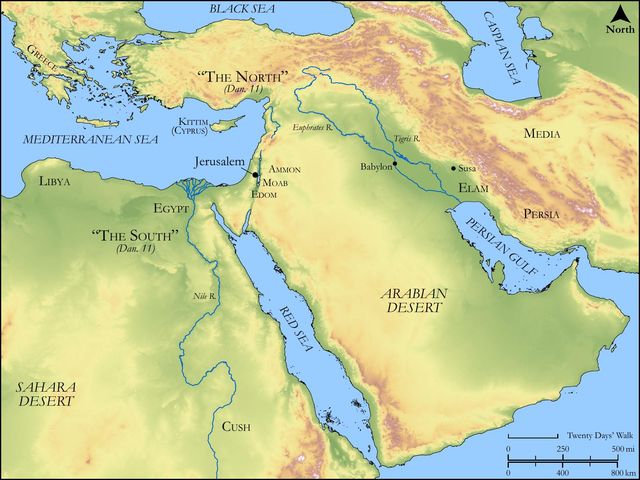
The vision takes place "in the third year of the reign of King Belshazzar," as stated in Daniel 8:1, placing it around 551 BC. Daniel is situated in Susa, the capital of Elam (later Persia), specifically "by the river Ulai," as mentioned in Daniel 8:2. The Ulai (or Eulaeus) was a significant river in ancient Persia, flowing near the city of Susa, which would become a prominent capital of the Persian Empire. This geographical setting is crucial because the vision itself concerns the future of the Persian and Greek empires, making Daniel's location within the heartland of future Persian power highly symbolic. Culturally, the ancient Near East was familiar with divine or angelic messengers conveying important messages, and dreams and visions were often seen as legitimate means of divine communication, frequently requiring interpretation by skilled individuals or divine agents.
Key Themes
ShowHideDaniel 8:16 contributes significantly to several overarching themes in the book of Daniel. Firstly, Divine Revelation and Interpretation is paramount; God not only reveals future events but actively ensures His prophet understands them, demonstrating His desire for His people to grasp His sovereign plan. Secondly, the Sovereignty of God over History is reinforced, as the vision details the rise and fall of empires, all under divine control, culminating in the ultimate triumph of God's kingdom. Thirdly, the Role of Angels as Divine Messengers is highlighted, with Gabriel specifically tasked as an interpreter, underscoring the active involvement of heavenly beings in executing God's will and communicating with humanity, a theme prevalent throughout Daniel, such as in Daniel 9:21-23. Finally, the theme of God's Compassion and Care for His Servants is evident in His immediate response to Daniel's distress, providing clarity and comfort in the face of overwhelming prophecy.
Exposition and Analysis
ShowHideKey Word Analysis
ShowHideReferring to a human being, an individual. In this context, "a man's voice" indicates an audible, distinct sound emanating from a figure appearing in human form, likely a divine or highly exalted angelic being who possesses the authority to command Gabriel. This emphasizes the tangible and personal nature of the divine intervention.
Meaning "man of God" or "God is my strength." The specific naming of Gabriel is highly significant. He is one of only two angels named in the Bible (the other being Michael), consistently appearing in roles of profound divine revelation and interpretation. His name itself underscores his power and divine commission, perfectly aligning with his task to convey God's strength through understanding.
Meaning "to separate mentally (or distinguish)," and by extension, "to understand" or "discern." This word emphasizes the necessity for profound intellectual and spiritual comprehension of the vision, not merely a superficial hearing. It implies a process of mental discernment, insight, and instruction, which Gabriel is specifically commanded to facilitate for Daniel, moving him from bewilderment to clarity.
Verse Breakdown
ShowHide"And I heard a man's voice between [the banks of] Ulai"
Daniel, still physically located by the Ulai River, hears an audible, distinct voice. The phrase "a man's voice" suggests a clear, authoritative sound emanating from a specific location, indicating a direct and personal divine intervention in Daniel's experience. This implies a higher authority than Gabriel, likely God Himself or a pre-incarnate Christ, issuing the command.
"which called, and said, Gabriel,"
The voice directly addresses Gabriel by name, indicating a clear, unambiguous command from a superior being. This highlights Gabriel's subordinate yet crucial role as a messenger and interpreter, subject to divine instruction. The direct address underscores the urgency and importance of the task at hand.
"make this [man] to understand the vision."
This is the explicit and central command. The purpose of Gabriel's appearance is unequivocally stated: to provide Daniel with comprehensive and profound understanding of the complex and disturbing vision he has just received. The phrase "this man" refers to Daniel, emphasizing his specific need for divine illumination to grasp the full prophetic implications and significance.
Literary Devices
ShowHideThe verse employs several significant literary devices that enhance its impact and meaning. Divine Command is central, as an authoritative, unnamed voice directly issues an imperative to Gabriel, underscoring God's active involvement in the prophetic process and His desire for His revelation to be understood. The use of Anthropomorphism is evident in "a man's voice," which attributes human-like characteristics (speech, an audible voice) to what is clearly a divine or highly exalted angelic being, making the divine communication relatable and immediate to Daniel. Furthermore, the verse functions as a crucial Transition in the narrative, moving from the presentation of the bewildering vision to its subsequent interpretation, signaling a decisive shift in focus and purpose within the chapter. The naming of Gabriel serves as a form of Characterization, immediately identifying the specific angelic agent chosen for this crucial interpretive task and leveraging his established biblical role as a messenger of significant divine announcements.
Theological and Thematic Connections
ShowHideDaniel 8:16 profoundly illustrates God's unwavering commitment to revealing His truth and ensuring its comprehension by His chosen servants. It underscores that divine revelation is not meant to remain obscure but is given with the explicit intent of being understood, especially when it pertains to God's sovereign plan for history and His people. The verse highlights the crucial intermediary role of angels in God's communication, demonstrating that God often uses heavenly agents to interact with humanity and convey His will. This divine initiative in providing understanding is a testament to God's compassion and desire for His people to be equipped with knowledge of His purposes, particularly in times of confusion or distress regarding future events.
Reflection and Application
ShowHideDaniel's experience in this verse offers profound comfort and instruction for believers today. Just as Daniel was overwhelmed by a vision beyond his natural comprehension, we too often encounter circumstances, biblical passages, or spiritual truths that seem impenetrable. This verse reminds us that God desires for us to understand His Word and His ways. When we humbly acknowledge our need for divine illumination and earnestly seek wisdom, He is faithful to provide it, often through His Holy Spirit, through the diligent study and teaching of His Word, or through the guidance of others He has gifted within the body of Christ. It encourages us to persist in prayer for understanding and to trust that even in our confusion, God is actively at work, orchestrating moments of clarity and revelation. Our perplexities are not ignored; rather, they can become profound opportunities for deeper divine encounter and transformative insight.
Questions for Reflection
ShowHideFAQ
ShowHideWho was the "man's voice" heard by Daniel?
ShowHideWhile the text does not explicitly name the speaker, the authoritative nature of the command given to Gabriel, an archangel, strongly suggests that the voice belongs to a higher divine authority. Many scholars believe it was either God Himself or a pre-incarnate appearance of Jesus Christ, demonstrating the ultimate source of all revelation and authority. The voice's direct command to an archangel underscores its supreme origin and the gravity of the instruction given to Gabriel.
Why was Gabriel specifically chosen to interpret the vision?
ShowHideGabriel is consistently portrayed in Scripture as a special messenger angel entrusted with delivering significant divine announcements and interpretations. In Daniel, he appears again in Daniel 9:21-27 to explain another complex prophecy. In the New Testament, he announces the births of John the Baptist to Zacharias in Luke 1:11-20 and Jesus Christ to Mary in Luke 1:26-38. His name, meaning "man of God" or "God is my strength," perfectly suits his role as a powerful and reliable conduit of divine revelation and understanding, chosen by God for tasks of utmost importance.
Christ-Centered Fulfillment
ShowHideDaniel 8:16, with its emphasis on the divine imperative to "make this man to understand the vision," finds its ultimate fulfillment and deepest meaning in Jesus Christ. While Gabriel was sent to interpret a specific prophetic vision for Daniel, Christ Himself is the ultimate revealer of God's truth and the very "wisdom of God," as declared in 1 Corinthians 1:24. In the New Testament, Jesus declares, "All things have been delivered to me by my Father, and no one knows the Son except the Father, and no one knows the Father except the Son and anyone to whom the Son chooses to reveal him" (Matthew 11:27). He is the Word made flesh, as beautifully articulated in John 1:14, the one through whom God has spoken His final and most complete revelation to humanity, as affirmed in Hebrews 1:1-2. Furthermore, just as Gabriel was commanded to provide understanding, Jesus promised the Holy Spirit, the "Spirit of truth," who would "guide you into all the truth" (John 16:13). Thus, the longing for divine comprehension expressed in Daniel's bewilderment is fully met in Christ, who not only reveals God's eternal plan but also empowers believers through His indwelling Spirit to grasp and live out that transformative truth.