


Daniel 11:6
- וּלְקֵץu·le·Ketzand to [the] end ofH7093Conj-w ¦ Prep-l ¦ N-mscNoun Singular Masculine Constructוּandלְtoקֵץ[the] end of
- שָׁנִיםsha·NimyearsH8141N-mpNoun Plural Masculine Absolute
- יִתְחַבָּרוּyit·cha·Ba·ruthey will make an allianceH2266V-Hithpael-Imperf-3mpVerb Hithpael Imperfect 3rd Plural Masculine
- וּבַתu·Vatand [the] daughter ofH1323Conj-w ¦ N-fscNoun Singular Feminine Constructוּandבַת[the] daughter of
- מֶלֶךְMe·lekh[the] king ofH4428N-mscNoun Singular Masculine Construct
- הַנֶּגֶבha·Ne·gevthe southH5045Art ¦ N-msNoun Singular Masculine Absoluteהַtheנֶּגֶבsouth
- תָּבוֹאta·Vo'she will comeH935V-Qal-Imperf-3fsVerb Qal Imperfect 3rd Singular Feminine
- אֶל'eltoH413PrepPreposition
- מֶלֶךְMe·lekh[the] king ofH4428N-mscNoun Singular Masculine Construct
- הַצָּפוֹןha·tza·Fonthe northH6828Art ¦ N-fsNoun Singular Feminine Absoluteהַtheצָּפוֹןnorth
- לַעֲשׂוֹתla·'a·Sotto doH6213Prep-l ¦ V-Qal-InfVerb Qal Infinitive Constructלַtoעֲשׂוֹתdo
- מֵישָׁרִיםmei·sha·Rimuprightness<es>H4339N-mpNoun Plural Masculine Absolute
- וְלֹאve·lo'and notH3808Conj-w ¦ NegParticle Negativeוְandלֹאnot
- תַעְצֹרta'·Tzorshe will retainH6113V-Qal-Imperf-3fsVerb Qal Imperfect 3rd Singular Feminine
- כּוֹחַKo·ach[the] power ofH3581N-mscNoun Singular Masculine Construct
- הַזְּרוֹעַha·ze·Ro·a'the armH2220Art ¦ N-fsNoun Singular Feminine Absoluteהַtheזְּרוֹעַarm
- וְלֹאve·Lo'and notH3808Conj-w ¦ NegParticle Negativeוְandלֹאnot
- יַעֲמֹדya·'a·Modhe will standH5975V-Qal-Imperf-3msVerb Qal Imperfect 3rd Singular Masculine
- וּזְרֹעוֹu·ze·ro·'O<and> his armH2220Conj-w ¦ N-fsc ¦ 3msNoun Singular Feminine Constructוּ<and>זְרֹעarmוֹhis
- וְתִנָּתֵןve·ti·na·Tenso she may be given upH5414Conj-w ¦ V-Niphal-ConjImperf-3fsVerb Niphal Conjunction+Imperfect 3rd Singular Feminineוְsoתִנָּתֵןshe may be given up
- הִיאhi'sheH1931Pro-3fsPronoun Personal 3rd Singular Feminine
- וּמְבִיאֶיהָu·me·vi·'Ei·haand [those who] brought herH935Conj-w ¦ V-Hiphil-Prtcpl-mp ¦ 3fsVerb Hiphil Participle Plural Masculine Constructוּandמְבִיאֶי[those who] broughtהָher
- וְהַיֹּלְדָהּve·hai·Yo·le·Dahand the [one who] fathered herH3205Conj-w ¦ Art ¦ V-Qal-Prtcpl-ms ¦ 3fsVerb Qal Participle Singular Masculine Constructוְandהַtheיֹּלְדָ[one who] fatheredהּher
- וּמַחֲזִקָהּu·ma·cha·zi·Kahand [the one who] strengthened herH2388Conj-w ¦ V-Hiphil-Prtcpl-ms ¦ 3fsVerb Hiphil Participle Singular Masculine Constructוּandמַחֲזִקָ[the one who] strengthenedהּher
- בָּעִתִּיםba·'i·Timin the timesH6256Prep-b ¦ N-cpNoun Plural common gender Absoluteבָּin theעִתִּיםtimes
English is a literal word-by-word gloss of the Hebrew, not the KJV's wording. Why?
This is the original text the KJV's translators worked from — each Hebrew word with its own literal English meaning in this verse, prepared by scholars at Tyndale House, Cambridge. The KJV translates whole sentences, not word by word, so its wording differs: one Hebrew word can become several English words, and the KJV may choose “the LORD” where the gloss reads “Yahweh”. Both are faithful — they answer different questions. For the KJV's own rendering, switch to the KJV text.
Details
See on the biblical-era map
Study this verse
Public-domain commentary
Matthew Henry
From his Commentary on the Whole Bible. Henry comments on passages, not single verses — this entry covers Daniel 11:5–20. His three-level outline is real structure in the source text, so it is rendered as structure.
Here are foretold,
I.The rise and power of two great kingdoms out of the remains of Alexander's conquests, Dan 11:5.
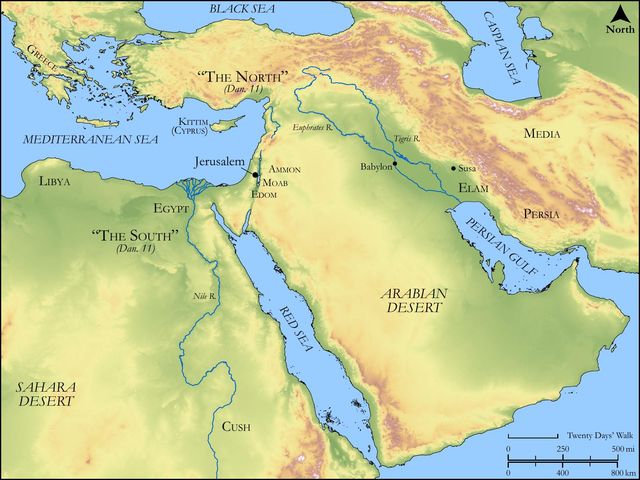
1.The kingdom of Egypt, which was made considerable by Ptolemaeus Lagus, one of Alexander's captains, whose successors were, from him, called the Lagidae. He is called the king of the south, that is, Egypt, named here, Dan 11:8, Dan 11:42, Dan 11:43. The countries that at first belonged to Ptolemy are reckoned to be Egypt, Phoenicia, Arabia, Libya, Ethiopia, etc. Theocr. Idyl. 17.
2.The kingdom of Syria, which was set up by Seleucus Nicanor, or the conqueror; he was one of Alexander's princes, and became stronger than the other, and had the greatest dominion of all, was the most powerful of all Alexander's successors. It was said that he had no fewer than seventy-two kingdoms under him. Both these were strong against Judah (the affairs of which are particularly eyed in this prediction); Ptolemy, soon after he gained Egypt, invaded Judea, and took Jerusalem on a sabbath, pretending a friendly visit. Seleucus also gave disturbance to Judea.
II.The fruitless attempt to unite these two kingdoms as iron and clay in Nebuchadnezzar's image (Dan 11:6):
"At the end of certain years, about seventy after Alexander's death, the Lagidae and the Seleucidae shall associate, but not in sincerity. Ptolemy Philadelphus, king of Egypt, shall marry his daughter Berenice to Antiochus Theos, king of Syria," who had already a wife called Laodice. "Berenice shall come to the king of the north, to make an agreement, but it shall not hold: She shall not retain the power of the arm; neither she nor her posterity shall establish themselves in the kingdom of the north, neither shall Ptolemy her father, nor Antiochus her husband (between whom there was to be a great alliance), stand, nor their arm, but she shall be given up and those that brought her," all that projected that unhappy marriage between her and Antiochus, which occasioned so much mischief, instead of producing a coalition between the northern and southern crowns, as was hoped. Antiochus divorced Berenice, took his former wife Laodice again, who soon after poisoned him, procured Berenice and her son to be murdered, and set up her own son by Antiochus to be king, who was called Seleucus Callinicus.
III.A war between the two kingdoms, Dan 11:7, Dan 11:8.
A branch from the same root with Berenice shall stand up in his estate. Ptolemaeus Euergetes, the son and successor of Ptolemaeus Philadelphus, shall come with an army against Seleucus Callinicus, king of Syria, to avenge his sister's quarrel, and shall prevail; and he shall carry away a rich booty both of persons and goods into Egypt, and shall continue more years than the king of the north. This Ptolemy reigned forty-six years; and Justin says that if his own affairs had not called him home he would, in this war, have made himself master of the whole kingdom of Syria. But (Dan 11:9) he shall be forced to come into his kingdom and return into his own land, to keep peace there, so that he can no longer carry on the war abroad. Note, It is very common for a treacherous peace to end in a bloody war.
IV.The long and busy reign of Antiochus the Great, king of Syria.
Seleucus Callinicus, that king of the north that was overcome (Dan 11:7) and died miserably, left two sons, Seleucus and Antiochus; these are his sons, the sons of the king of the north, that shall be stirred up, and shall assemble a multitude of great forces, to recover what their father had lost, Dan 11:10. But Seleucus the elder, being weak, and unable to rule his army, was poisoned by his friends, and reigned only two years; and his brother Antiochus succeeded him, who reigned thirty-seven years, and was called the Great. And therefore the angel, though he speaks of sons at first, goes on with the account of one only, who was but fifteen years old when he began to reign, and he shall certainly come, and overflow, and over-run, and shall be restored at length to what his father lost.
1.The king of the south, in this war, shall at first have very great success. Ptolemaeus Philopater, moved with indignation at the indignities done by Antiochus the Great, shall (though otherwise a slothful prince) come forth, and fight with him, and shall bring a vast army into the field of 70,000 foot, and 5000 horse, and seventy-three elephants. And the other multitude (the army of Antiochus, consisting of 62,000 foot, and 6000 horse, and 102 elephants) shall be given into his hand. Polybius, who lived with Scipio, has given a particular account of this battle of Raphia. Ptolemaeus Philopater, having gained this victory, grew very insolent; his heart was lifted up; then he went into the temple of God at Jerusalem, and, in defiance of the law, entered the most holy place, for which God has a controversy with him, so that, though he shall cast down many myriads, yet he shall not be strengthened by it, so as to secure his interest. For,
2.The king of the north, Antiochus the Great, shall return with a greater army than the former; and, at the end of times (that is, years) he shall come with a mighty army, and great riches, against the king of the south, that is, Ptolemaeus Epiphanes, who succeeded Ptolemaeus Philopater his father, when he was a child, which gave advantage to Antiochus the Great. In this expedition he had some powerful allies (Dan 11:14): Many shall stand up against the king of the south. Philip of Macedon was confederate with Antiochus against the king of Egypt, and Scopas his general, whom he sent into Syria; Antiochus routed him, destroyed a great part of his army; whereupon the Jews willingly yielded to Antiochus, joined with him, helped him to besiege Ptolemaeus's garrisons. They the robbers of thy people shall exalt themselves to establish the vision, to help forward the accomplishment of this prophecy; but they shall fall, and shall come to nothing, Dan 11:14. Hereupon (Dan 11:15) the king of the north, this same Antiochus Magnus, shall carry on his design against the king of the south another way.
(1.)He shall surprise his strong-holds; all that he has got in Syria and Samaria, and the arms of the south, all the power of the king of Egypt, shall not be able to withstand him. See how dubious and variable the turns of the scale of war are; like buying and selling, it is winning and losing; sometimes one side gets the better and sometimes the other; yet neither by chance; it is not, as they call it, the fortune of war, but according to the will and counsel of God, who brings some low and raises others up.
(2.)He shall make himself master of the land of Judea (Dan 11:16): He that comes against him (that is, the king of the north) shall carry all before him and do what he pleases, and he shall stand and get footing in the glorious land; so the land of Israel was, and by his hand it was wasted and consumed, for with the spoil of that good land he victualled his vast army. The land of Judea lay between these two potent kingdoms of Egypt and Syria, so that in all the struggles between them that was sure to suffer, for to it they both bore ill will. Yet some read this, By his hand it shall be perfected; as if it intimated that the land of Judea, being taken under the protection of this Antiochus, shall flourish, and be in better condition than it had been.
(3.)He shall still push on his war against the king of Egypt, and set his face to enter with the strength of his whole kingdom, taking advantage of the infancy of Ptolemy Epiphanes, and the upright ones, many of the pious Israelites, siding with him, Dan 11:17. In prosecution of his design, he shall give him his daughter Cleopatra to wife, designing, as Saul in giving his daughter Cleopatra to David, that she should be a snare to him, and do him a mischief; but she shall not stand on her father's side, nor be for him, but for her husband, and so that plot failed him.
(4.)His war with the Romans is here foretold (Dan 11:18): He shall turn his face to the isles (Dan 11:18), the isles of the Gentiles (Gen 10:5), Greece and Italy. He took many of the isles about the Hellespont-Rhodes, Samos, Delos, etc., which by war or treaty he made himself master of; but a prince, or state (so some), even the Roman senate, or a leader, even the Roman general, shall return his reproach with which he abused the Romans upon himself, or shall make his shame rest on himself, and without his own shame, or any disgrace to himself, shall pay him again. This was fulfilled when the two Scipios were sent with an army against Antiochus. Hannibal was then with him, and advised him to invade Italy and waste it as he had done; but he did not take hid advice; and Scipio joined battle with him, and gave him a total defeat, though Antiochus had 70,000 men and the Romans but 30,000. Thus he caused the reproach offered by him to cease.
(5.)His fall. When he was totally routed by the Romans, and was forced to abandon to them all he had in Europe, and had a very heavy tribute exacted from him, he turned to his own land, and, not knowing which way to raise money to pay his tribute, he plundered a temple of Jupiter, which so incensed his own subjects against him that they set upon him, and killed him; so he was overthrown, and fell, and was no more found, Dan 11:19.
(6.)His next successor, Dan 11:20. There rose up one in his place, a raiser of taxes, a sender forth of the extortioner, or extorter. This character was remarkably answered in Seleucus Philopater, the elder son of Antiochus the Great, who was a great oppressor of his own subjects, and exacted abundance of money from them; and, when he was told he would thereby lose his friends, he said he knew no better friend he had then money. He likewise attempted to rob the temple at Jerusalem, which this seems especially to refer to. But within a few days he shall be destroyed, neither in anger nor in battle, but poisoned by Heliodorus, one of his own servants, when he had reigned but twelve years, and done nothing remarkable.
V.From all this let us learn,
1.That God in his providence sets up one, and pulls down another, as he pleases, advances some from low beginnings and depresses others that were very high. Some have called great men the foot-balls of fortune; or, rather, they are the tools of Providence.
2.This world is full of wars and fightings, which come from men's lusts, and make it a theatre of sin and misery.
3.All the changes and revolutions of states and kingdoms, and every event, even the most minute and contingent, were plainly and perfectly foreseen by the God of heaven, and to him nothing is new.
4.No word of God shall fall to the ground; but what he has designed, what he has declared, shall infallibly come to pass; and even the sins of men shall be made to serve his purpose, and contribute to the b ringing of his counsels to birth in their season; and yet God is not the author of sin.
5.That, for the right understanding of some parts of scripture, it is necessary that heathen authors be consulted, which give light to the scripture, and show the accomplishment of what is there foretold; we have therefore reason to bless God for the human learning with which many have done great service to divine truths.
Historical interpretation
Historical reception
3 surviving comments on this verse. Each one is dated, so this reads as a timeline rather than a list.
Select a marker to jump to its quote. Markers stagger vertically where authors wrote within a few decades of each other.
Verse 6. "And at the end of the years they shall be leagued together (or, as Theodotion renders: And after his years they shall be united). And the daughter of the king of the South shall come to the king of the North in order to make friendship, but she shall not obtain strength of arm nor shall her seed endure. And she herself shall be handed over, as well as her young men (Vulgate: youths) who brought her and who were strengthening her in (these) times." As we have already said, it was Seleucus, surnamed Nicanor, who first ruled over Syria. The second king was Antiochus, who was called Soter. The third was Antiochus himself, who was called Theos, that is the Divine. He was the one who waged numerous wars with Ptolemy Philadelphus, who was the second ruler in Egypt, and he also fought with all the Babylonians and the men of the East, And so after many years Ptolemy Philadelphus wished to have done with this vexatious struggle, and so he gave his daughter, named Berenice, in marriage to Antiochus, who had already had by a previous wife, named Laodice, two sons, namely Seleucus, surnamed Callinicus, and the other, Antiochus. And Philadelphus conducted her as far as Pelusium and bestowed countless thousands of gold and silver by way of a dowry, from which circumstance he acquired the nickname of phernophoros or Dowry-giver (dotalis). But as for Antiochus, even though he had said he would regard Berenice as his royal consort and keep Laodice in the status of a concubine, he was finally prevailed upon by his love for Laodice to restore her to the status of queen, along with her children. But she was fearful that her husband might in his fickleness restore Berenice to favor once more, and so she had him put to death by her servants with the use of poison. And she handed over Berenice and the son whom she had born by Antiochus to Icadio and Genneus, princes of Antiochus, and then set up her elder son, Seleucus Callinicus, as king in his father's place. And so this is the matter referred to in this passage, namely that after many years Ptolemy Philadelphus and Antiochus Theos would conclude a friendship, and the daughter of the king of the South, that is Ptolemy, would go to the king of the North, that is Antiochus, in order to cement friendly relations between her father and her husband. And the text says that she will not be able to gain her end, nor shall her posterity remain upon the throne of Syria, but instead both Berenice and the men who had escorted her thither shall be put to death. And also the king, Antiochus, who had strengthened her, that is, through whom she could have obtained the mastery, was killed by his wife's poison.
But the marriage will not suffice to bring about an alliance. She will be returned to the one who had given her through those who brought her, along with the things that had been presented by her (for he says, “the one supporting her during those times”). Wealth was what had accomplished the strong and desired marriage.
After Ptolemy Philpator died, his son Ptolemy (surnamed Epiphanes) reigned. That is what he means, “After his years, they will make an alliance.” And he explains how they will make an alliance. By the king of the north he means Antiochus—not Antiochus Epiphanes but Antiochus the Great, who was the father of Antiochus Epiphanes. It was Antiochus the Great who was the contemporary with those Ptolemies.
Continue studying Daniel 11:6 across the web’s major study libraries — every link below opens this exact verse, chapter, or book on the destination site.
Read & Compare
 BibleGatewayThis verse in more than 200 translations and 70 languages.
 Bible.comThe YouVersion reader — hundreds of translations, reading plans, and highlights.
 ESV.orgCrossway's official English Standard Version reader.
 NET BibleThe NET translation with 60,000+ translators' notes on every rendering decision.
 STEP BibleTyndale House's free study tool — original text, vocabulary, and scholarly resources.
 BibliaLogos Bible Software's free web reader.
 USCCBThe New American Bible (Revised Edition) with the U.S. bishops' study notes.
Commentaries
 BibleHub CommentariesDozens of classic commentaries on this verse, gathered on one page.
 StudyLightMore than 100 commentary sets — the largest collection on the web.
 BibleRefPlain-English commentary on what this verse means, verse by verse.
 Enduring WordDavid Guzik's free commentary on this chapter, widely used by Bible teachers.
 Bible Study ToolsVerse commentary alongside Greek and Hebrew study aids.
Original Language & Research
- BibleHub InterlinearThe verse word by word — original language, transliteration, and English.
- BibleHub LexiconEvery word's original-language definition and Strong's entry.
 Blue Letter BibleDeep-study tools — Strong's numbers, concordance, and word studies.
 SefariaThe Hebrew text with Rashi and centuries of Jewish commentary.
Sermons, Hymns & Audio


TrulyRandomVerse is not affiliated with these sites and doesn’t control their content. They’re linked because they’re genuinely useful.
Summary
Daniel 11:6 presents a remarkably precise prophecy concerning a failed political alliance between the "king of the South" (Ptolemaic Egypt) and the "king of the North" (Seleucid Syria) during the Hellenistic period. It foretells a marriage intended to secure peace, specifically involving the daughter of the southern king, but unequivocally declares that this union will not achieve its desired outcome. Instead, both parties involved, including the princess and her supporters, will lose their power and ultimately be betrayed and given over to their enemies, highlighting the futility of human schemes apart from divine sovereignty.
Context
ShowHideLiterary Context
Daniel 11 is part of Daniel's final and most detailed prophetic vision, spanning chapters 10-12. Following an intense spiritual struggle (Daniel 10) and a revelation of future events (Daniel 11:1), the angel Gabriel provides Daniel with an astonishingly precise outline of historical events, primarily focusing on the conflicts between the Hellenistic kingdoms that emerged after Alexander the Great's death. This particular section, beginning around Daniel 11:2, details the intricate political and military struggles between the "king of the North" (the Seleucid dynasty ruling Syria and Mesopotamia) and the "king of the South" (the Ptolemaic dynasty ruling Egypt). The prophecy is characterized by its unparalleled specificity, describing alliances, betrayals, and wars that would unfold over centuries, leading up to the time of Antiochus IV Epiphanes, a major figure in the latter part of the chapter, and ultimately pointing towards the end times.
Historical & Cultural Context
The historical backdrop for Daniel 11:6 is the turbulent Intertestamental Period (roughly 400 BC to 0 AD), specifically the 3rd century BC. After Alexander the Great's empire fragmented, his generals (the Diadochi) established powerful dynasties. The Ptolemies ruled Egypt (the "South"), and the Seleucids controlled Syria and vast eastern territories (the "North"). The land of Israel (Judea) lay strategically between these two empires, becoming a constant battleground. Political marriages were a common diplomatic tool in the ancient Near East, intended to forge alliances and secure peace between rival powers. However, as history frequently demonstrates, such unions were often fragile, susceptible to personal ambition, betrayal, and shifts in power dynamics, frequently leading to renewed conflict rather than lasting stability. This verse specifically anticipates the marriage of Berenice, daughter of Ptolemy II Philadelphus (King of the South), to Antiochus II Theos (King of the North).
Key Themes
ShowHideDaniel 11:6 powerfully contributes to several overarching themes within the Book of Daniel and biblical theology. Firstly, it underscores the futility of human alliances and political maneuvering when they are not aligned with, or are in opposition to, God's sovereign plan. Despite the strategic intent of such a high-profile marriage, the prophecy declares its ultimate failure, highlighting that true peace and security cannot be found in human treaties or strength. Secondly, the verse serves as a profound demonstration of divine foreknowledge and sovereignty. The meticulous detail with which future events are predicted, including the specifics of a failed marriage alliance and the fate of its participants, unequivocally affirms that God is in complete control of history, "removing kings and setting up kings" as declared in Daniel 2:21. This detailed prophecy provides compelling evidence for the supernatural origin of Scripture. Finally, it illustrates the vulnerability and transient nature of earthly power. Even powerful monarchs and their royal families, seemingly secure in their positions, are shown to be subject to betrayal, political intrigue, and the unpredictable course of events, ultimately unable to "retain the power of the arm" or "stand" against the divine decree. This contrasts sharply with the enduring and unshakable kingdom of God, a central theme throughout Daniel, as seen in Daniel 7:14.
Exposition and Analysis
ShowHideKey Word Analysis
ShowHideFrom the primitive root H2266, meaning "to join (literally or figuratively); specifically (by means of spells) to fascinate; charm(-er), be compact, couple (together), have fellowship with, heap up, join (self, together), league." In this context, châbar denotes the formation of a political alliance or league, specifically through the act of coupling or joining together, referring to the marriage agreement between the two royal houses. It emphasizes the human effort to create unity and stability.
Kôach (H3581) means "vigor, literally (force, in a good or a bad sense) or figuratively (capacity, means, produce); also (from its hardiness) a large lizard; ability, able, chameleon, force, fruits, might, power(-ful), strength, substance, wealth." Zᵉrôwaʻ (H2220) means "the arm (as stretched out), or (of animals) the foreleg; figuratively, force; arm, [phrase] help, mighty, power, shoulder, strength." Combined, "power of the arm" is a powerful idiom for military might, political influence, and personal strength or authority. The prophecy explicitly states that neither the princess nor the king "shall retain the power of the arm," signifying a complete failure to maintain their position, influence, or physical safety through their own strength or that of their allies.
From the primitive root H5414, meaning "to give, used with greatest latitude of application (put, make, etc.); add, apply, appoint, ascribe, assign, [idiom] avenge, [idiom] be (healed), bestow, bring (forth, hither), cast, cause, charge, come, commit, consider, count, [phrase] cry, deliver (up), direct, distribute, do, [idiom] doubtless, [idiom] without fail, fasten, frame, [idiom] get, give (forth, over, up), grant, hang (up), [idiom] have, [idiom] indeed, lay (unto charge, up), (give) leave, lend, let (out), [phrase] lie, lift up, make, [phrase] O that, occupy, offer, ordain, pay, perform, place, pour, print, [idiom] pull, put (forth), recompense, render, requite, restore, send (out), set (forth), shew, shoot forth (up), [phrase] sing, [phrase] slander, strike, (sub-) mit, suffer, [idiom] surely, [idiom] take, thrust, trade, turn, utter, [phrase] weep, [phrase] willingly, [phrase] withdraw, [phrase] would (to) God, yield." In this context, nâthan carries the ominous sense of being delivered over, abandoned, or handed to an enemy or to destruction. It conveys the tragic fate of Berenice and her supporters, who will be betrayed and left defenseless.
Verse Breakdown
ShowHide"And in the end of years they shall join themselves together;"
This clause sets the timeframe, indicating that after a period of time (literally "at the end of years"), the two opposing powers will attempt to unify or form an alliance. The verb "join themselves together" (H2266, châbar) implies a deliberate act of forming a compact or league, in this case, a marriage alliance.
"for the king's daughter of the south shall come to the king of the north to make an agreement:"
This specifies the nature of the alliance: a political marriage. The "king's daughter of the south" refers to Berenice, daughter of Ptolemy II Philadelphus of Egypt. Her journey "to the king of the north" (Antiochus II Theos of the Seleucid Empire) is for the explicit purpose of making an "agreement" (H4339, mêyshâr), which signifies a treaty, concord, or arrangement intended to establish peace and equity between the two kingdoms.
"but she shall not retain the power of the arm;"
This is the first declaration of failure. "She" refers to the king's daughter, Berenice. "Not retain the power of the arm" (H6113, ʻâtsâr - retain; H3581, kôach - power; H2220, zᵉrôwaʻ - arm) means she will not maintain her position of influence, authority, or protection through her own strength or the strength of her allies. Her diplomatic mission and personal standing will ultimately fail.
"neither shall he stand, nor his arm:"
This extends the failure to the king of the North, Antiochus II. "He" refers to Antiochus II, and "his arm" again symbolizes his power, might, or military strength. The phrase "neither shall he stand" (H5975, ʻâmad - stand) indicates that he will not maintain his position, authority, or life. Both parties to the alliance will experience a loss of power and stability.
"but she shall be given up, and they that brought her, and he that begat her, and he that strengthened her in [these] times."
This final clause details the tragic outcome. "She shall be given up" (H5414, nâthan) implies betrayal, abandonment, or being handed over to destruction. This fate extends not only to Berenice herself but also to "they that brought her" (her attendants or escort), "he that begat her" (her father, Ptolemy II Philadelphus, who initiated the alliance), and "he that strengthened her in [these] times" (her supporters or those who upheld her position). This comprehensive downfall underscores the complete failure of the human-engineered peace and the devastating consequences for all involved.
Literary Devices
ShowHideThe passage in Daniel 11:6 is rich in literary devices that enhance its prophetic impact. The most prominent is Prophecy, specifically Predictive Prophecy, which is demonstrated by the astonishingly accurate foretelling of specific historical events centuries before their occurrence. This detailed prediction of a failed marriage alliance, the identities of the involved parties, and their ultimate fates serves as powerful evidence of divine inspiration. Symbolism is also evident, particularly in the phrase "power of the arm." The "arm" (Hebrew zᵉrôwaʻ) is a common biblical symbol for strength, might, and military power. Its failure to "retain" or "stand" signifies a complete loss of political influence, physical protection, and life itself. The narrative structure employs Foreshadowing, as the instability and ultimate failure of this human alliance foreshadow the broader theme in Daniel of the transience of all earthly kingdoms compared to the eternal and unshakable kingdom of God. There is also a subtle Irony in the verse: an agreement intended to bring peace and stability through a marriage alliance ultimately leads to betrayal, murder, and renewed conflict, highlighting the futility of human efforts to control destiny apart from divine will.
Theological and Thematic Connections
ShowHideDaniel 11:6 serves as a profound theological statement on God's absolute sovereignty over human history. It demonstrates that even the most meticulously planned political strategies and alliances, involving powerful monarchs and vast empires, are ultimately subject to the divine will. The failure of this seemingly advantageous marriage, despite its strategic intent to secure peace, underscores the biblical truth that human wisdom and strength are insufficient to establish lasting security or to thwart God's purposes. This passage reinforces the reliability of God's Word, as its detailed predictions were fulfilled with remarkable precision, compelling believers to trust in the unchanging character and infallible plan of the Almighty, rather than in the shifting sands of human power dynamics. It reminds us that true peace and stability are found not in earthly agreements but in alignment with the divine order.
Reflection and Application
ShowHideThe detailed prophecy of Daniel 11:6, and its precise historical fulfillment, offers profound lessons for contemporary believers. In a world often characterized by political instability, shifting alliances, and the pursuit of peace through human means, this verse serves as a powerful reminder that our ultimate trust must not be placed in earthly powers or human agreements. It encourages us to cultivate a deep confidence in God's sovereign control over all events, from the grand sweep of history to the intimate details of our personal lives. When we witness the rise and fall of nations, the breaking of treaties, and the fragility of human power, Daniel 11:6 calls us to fix our gaze on the unchanging God, whose plans cannot be thwarted and whose Word proves true. This should lead us to pray for our leaders, while simultaneously recognizing that true and lasting peace, security, and justice will only be fully realized in God's kingdom, not through the imperfect and often self-serving machinations of humanity. It also cautions against placing undue hope in worldly solutions for spiritual or existential problems, urging us instead to seek the kingdom of God first.
Questions for Reflection
ShowHideFAQ
ShowHideWho are the "king of the south" and "king of the north" mentioned in Daniel 11:6?
ShowHideIn the historical fulfillment of Daniel 11:6, the "king of the south" refers to Ptolemy II Philadelphus, the ruler of the Ptolemaic dynasty in Egypt. The "king of the north" refers to Antiochus II Theos, the ruler of the Seleucid dynasty in Syria. These two Hellenistic empires were the dominant powers in the region after the fragmentation of Alexander the Great's empire, and they frequently vied for control of the strategic land of Israel.
What was the specific historical event that fulfilled Daniel 11:6?
ShowHideDaniel 11:6 was precisely fulfilled by the marriage alliance in 252 BC between Antiochus II Theos (the "king of the North") and Berenice, the daughter of Ptolemy II Philadelphus (the "king of the South"). This marriage was intended to solidify peace and end the Second Syrian War. However, the prophecy stated it would fail. Antiochus II had to divorce his previous wife, Laodice, to marry Berenice. After Ptolemy II died, Antiochus II reinstated Laodice, who then poisoned him and arranged for the murder of Berenice and her infant son. Thus, Berenice did "not retain the power of the arm," Antiochus II did not "stand," and Berenice, along with her supporters, was indeed "given up," fulfilling the prophecy with chilling accuracy and reigniting the conflict between the empires.
Why is this prophecy so remarkably specific compared to other biblical prophecies?
ShowHideThe specificity of Daniel 11, including verse 6, is a hallmark of this particular prophetic chapter. It is often cited as a prime example of predictive prophecy, where future events are described with an extraordinary level of detail, including names, relationships, and outcomes. This precision serves to underscore the divine origin of the prophecy, demonstrating that only an omniscient God could know and declare such intricate future events. It distinguishes biblical prophecy from mere human foresight or general predictions, providing compelling evidence for the supernatural inspiration of Scripture and God's sovereign control over all of human history, as seen in Isaiah 42:9.
Christ-Centered Fulfillment
ShowHideWhile Daniel 11:6 directly concerns the political machinations of ancient kings, its ultimate Christ-centered fulfillment lies in the profound contrast it presents between the transient, fragile nature of earthly power and the eternal, unshakable reign of Jesus Christ. The prophecy of a failed human alliance, marked by betrayal and death, highlights the futility of seeking lasting peace and security in human efforts. In stark contrast, Christ's kingdom is not of this world (as He told Pilate in John 18:36), yet it is eternal and unassailable. Unlike the kings whose "arm" and "power" ultimately failed, Jesus Christ possesses all authority in heaven and on earth (as declared in Matthew 28:18). He is the true "Prince of Peace" (prophesied in Isaiah 9:6), whose covenant of peace is everlasting, unlike the broken agreements of human rulers. Ultimately, Daniel 11:6, by showcasing the collapse of human-orchestrated peace, points us to the only One who can truly bring reconciliation and establish a kingdom that "shall never be destroyed" (as seen in Daniel 2:44), the Lord Jesus Christ, through whom all things hold together (Colossians 1:17).