


Daniel 11:7
Bible text: King James Version (1769 Blayney text) · Public domain
Bible text: King James Version with Strong's numbers · Public domain
Bible text: Berean Standard Bible · Public domain
Bible text: American Standard Version (1901) · Public domain
Bible text: World English Bible, Messianic edition · Public domain
Bible text: Geneva Bible (1599) · Public domain
Bible text: Young's Literal Translation · Public domain
- וְעָמַדve·'a·Madand he will ariseH5975Conj-w ¦ V-Qal-ConsecPerf-3msVerb Qal Consecutive Perfect 3rd Singular Masculineוְandעָמַדhe will arise
- מִנֵּצֶרmi·Ne·tzerone of [the] shoot[s] ofH5342Prep-m ¦ N-mscNoun Singular Masculine Constructמִone ofנֵּצֶר[the] shoot[s] of
- שָׁרָשֶׁיהָsha·ra·Shei·haher rootsH8328N-mpc ¦ 3fsNoun Plural Masculine Constructשָׁרָשֶׁיrootsהָher
- כַּנּוֹka·Nohis placeH3653N-msc ¦ 3msNoun Singular Masculine Constructכַּנּplaceוֹhis
- וְיָבֹאve·ya·Vo'so he may comeH935Conj-w ¦ V-Qal-ConjImperf-3msVerb Qal Conjunction+Imperfect 3rd Singular Masculineוְsoיָבֹאhe may come
- אֶל'elagainstH413PrepPreposition
- הַחַיִלha·Cha·yilthe armyH2428Art ¦ N-msNoun Singular Masculine Absoluteהַtheחַיִלarmy
- וְיָבֹאve·ya·Vo'so he may goH935Conj-w ¦ V-Qal-ConjImperf-3msVerb Qal Conjunction+Imperfect 3rd Singular Masculineוְsoיָבֹאhe may go
- בְּמָעוֹזbe·ma·'Ozin [the] stronghold ofH4581Prep-b ¦ N-mscNoun Singular Masculine Constructבְּinמָעוֹז[the] stronghold of
- מֶלֶךְMe·lekh[the] king ofH4428N-mscNoun Singular Masculine Construct
- הַצָּפוֹןha·tza·Fonthe northH6828Art ¦ N-fsNoun Singular Feminine Absoluteהַtheצָּפוֹןnorth
- וְעָשָׂהve·'a·Sahand he will doH6213Conj-w ¦ V-Qal-ConsecPerf-3msVerb Qal Consecutive Perfect 3rd Singular Masculineוְandעָשָׂהhe will do
- בָהֶםva·Hemwith themPrep-b ¦ 3mpSuffix Personal 3rd Plural Masculineבָwithהֶםthem
- וְהֶחֱזִיקve·he·che·Zikand he will prevailH2388Conj-w ¦ V-Hiphil-ConsecPerf-3msVerb Hiphil Consecutive Perfect 3rd Singular Masculineוְandהֶחֱזִיקhe will prevail
English is a literal word-by-word gloss of the Hebrew, not the KJV's wording. Why?
This is the original text the KJV's translators worked from — each Hebrew word with its own literal English meaning in this verse, prepared by scholars at Tyndale House, Cambridge. The KJV translates whole sentences, not word by word, so its wording differs: one Hebrew word can become several English words, and the KJV may choose “the LORD” where the gloss reads “Yahweh”. Both are faithful — they answer different questions. For the KJV's own rendering, switch to the KJV text.
Details
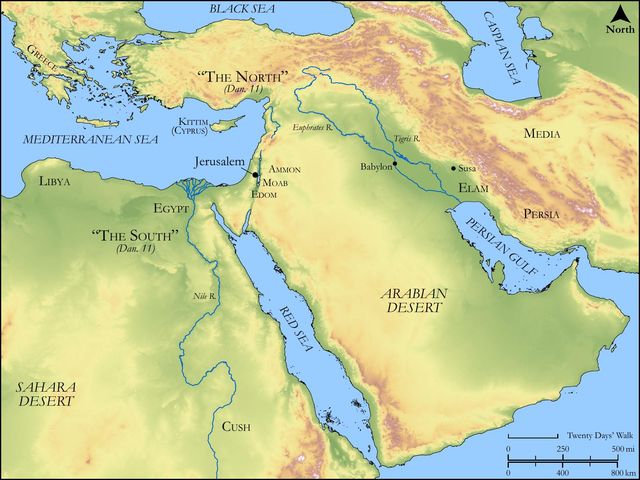
See on the biblical-era map
Study this verse
Public-domain commentary
Matthew Henry
From his Commentary on the Whole Bible. Henry comments on passages, not single verses — this entry covers Daniel 11:5–20. His three-level outline is real structure in the source text, so it is rendered as structure.
Here are foretold,
I.The rise and power of two great kingdoms out of the remains of Alexander's conquests, Dan 11:5.
1.The kingdom of Egypt, which was made considerable by Ptolemaeus Lagus, one of Alexander's captains, whose successors were, from him, called the Lagidae. He is called the king of the south, that is, Egypt, named here, Dan 11:8, Dan 11:42, Dan 11:43. The countries that at first belonged to Ptolemy are reckoned to be Egypt, Phoenicia, Arabia, Libya, Ethiopia, etc. Theocr. Idyl. 17.
2.The kingdom of Syria, which was set up by Seleucus Nicanor, or the conqueror; he was one of Alexander's princes, and became stronger than the other, and had the greatest dominion of all, was the most powerful of all Alexander's successors. It was said that he had no fewer than seventy-two kingdoms under him. Both these were strong against Judah (the affairs of which are particularly eyed in this prediction); Ptolemy, soon after he gained Egypt, invaded Judea, and took Jerusalem on a sabbath, pretending a friendly visit. Seleucus also gave disturbance to Judea.
II.The fruitless attempt to unite these two kingdoms as iron and clay in Nebuchadnezzar's image (Dan 11:6):
"At the end of certain years, about seventy after Alexander's death, the Lagidae and the Seleucidae shall associate, but not in sincerity. Ptolemy Philadelphus, king of Egypt, shall marry his daughter Berenice to Antiochus Theos, king of Syria," who had already a wife called Laodice. "Berenice shall come to the king of the north, to make an agreement, but it shall not hold: She shall not retain the power of the arm; neither she nor her posterity shall establish themselves in the kingdom of the north, neither shall Ptolemy her father, nor Antiochus her husband (between whom there was to be a great alliance), stand, nor their arm, but she shall be given up and those that brought her," all that projected that unhappy marriage between her and Antiochus, which occasioned so much mischief, instead of producing a coalition between the northern and southern crowns, as was hoped. Antiochus divorced Berenice, took his former wife Laodice again, who soon after poisoned him, procured Berenice and her son to be murdered, and set up her own son by Antiochus to be king, who was called Seleucus Callinicus.
III.A war between the two kingdoms, Dan 11:7, Dan 11:8.
A branch from the same root with Berenice shall stand up in his estate. Ptolemaeus Euergetes, the son and successor of Ptolemaeus Philadelphus, shall come with an army against Seleucus Callinicus, king of Syria, to avenge his sister's quarrel, and shall prevail; and he shall carry away a rich booty both of persons and goods into Egypt, and shall continue more years than the king of the north. This Ptolemy reigned forty-six years; and Justin says that if his own affairs had not called him home he would, in this war, have made himself master of the whole kingdom of Syria. But (Dan 11:9) he shall be forced to come into his kingdom and return into his own land, to keep peace there, so that he can no longer carry on the war abroad. Note, It is very common for a treacherous peace to end in a bloody war.
IV.The long and busy reign of Antiochus the Great, king of Syria.
Seleucus Callinicus, that king of the north that was overcome (Dan 11:7) and died miserably, left two sons, Seleucus and Antiochus; these are his sons, the sons of the king of the north, that shall be stirred up, and shall assemble a multitude of great forces, to recover what their father had lost, Dan 11:10. But Seleucus the elder, being weak, and unable to rule his army, was poisoned by his friends, and reigned only two years; and his brother Antiochus succeeded him, who reigned thirty-seven years, and was called the Great. And therefore the angel, though he speaks of sons at first, goes on with the account of one only, who was but fifteen years old when he began to reign, and he shall certainly come, and overflow, and over-run, and shall be restored at length to what his father lost.
1.The king of the south, in this war, shall at first have very great success. Ptolemaeus Philopater, moved with indignation at the indignities done by Antiochus the Great, shall (though otherwise a slothful prince) come forth, and fight with him, and shall bring a vast army into the field of 70,000 foot, and 5000 horse, and seventy-three elephants. And the other multitude (the army of Antiochus, consisting of 62,000 foot, and 6000 horse, and 102 elephants) shall be given into his hand. Polybius, who lived with Scipio, has given a particular account of this battle of Raphia. Ptolemaeus Philopater, having gained this victory, grew very insolent; his heart was lifted up; then he went into the temple of God at Jerusalem, and, in defiance of the law, entered the most holy place, for which God has a controversy with him, so that, though he shall cast down many myriads, yet he shall not be strengthened by it, so as to secure his interest. For,
2.The king of the north, Antiochus the Great, shall return with a greater army than the former; and, at the end of times (that is, years) he shall come with a mighty army, and great riches, against the king of the south, that is, Ptolemaeus Epiphanes, who succeeded Ptolemaeus Philopater his father, when he was a child, which gave advantage to Antiochus the Great. In this expedition he had some powerful allies (Dan 11:14): Many shall stand up against the king of the south. Philip of Macedon was confederate with Antiochus against the king of Egypt, and Scopas his general, whom he sent into Syria; Antiochus routed him, destroyed a great part of his army; whereupon the Jews willingly yielded to Antiochus, joined with him, helped him to besiege Ptolemaeus's garrisons. They the robbers of thy people shall exalt themselves to establish the vision, to help forward the accomplishment of this prophecy; but they shall fall, and shall come to nothing, Dan 11:14. Hereupon (Dan 11:15) the king of the north, this same Antiochus Magnus, shall carry on his design against the king of the south another way.
(1.)He shall surprise his strong-holds; all that he has got in Syria and Samaria, and the arms of the south, all the power of the king of Egypt, shall not be able to withstand him. See how dubious and variable the turns of the scale of war are; like buying and selling, it is winning and losing; sometimes one side gets the better and sometimes the other; yet neither by chance; it is not, as they call it, the fortune of war, but according to the will and counsel of God, who brings some low and raises others up.
(2.)He shall make himself master of the land of Judea (Dan 11:16): He that comes against him (that is, the king of the north) shall carry all before him and do what he pleases, and he shall stand and get footing in the glorious land; so the land of Israel was, and by his hand it was wasted and consumed, for with the spoil of that good land he victualled his vast army. The land of Judea lay between these two potent kingdoms of Egypt and Syria, so that in all the struggles between them that was sure to suffer, for to it they both bore ill will. Yet some read this, By his hand it shall be perfected; as if it intimated that the land of Judea, being taken under the protection of this Antiochus, shall flourish, and be in better condition than it had been.
(3.)He shall still push on his war against the king of Egypt, and set his face to enter with the strength of his whole kingdom, taking advantage of the infancy of Ptolemy Epiphanes, and the upright ones, many of the pious Israelites, siding with him, Dan 11:17. In prosecution of his design, he shall give him his daughter Cleopatra to wife, designing, as Saul in giving his daughter Cleopatra to David, that she should be a snare to him, and do him a mischief; but she shall not stand on her father's side, nor be for him, but for her husband, and so that plot failed him.
(4.)His war with the Romans is here foretold (Dan 11:18): He shall turn his face to the isles (Dan 11:18), the isles of the Gentiles (Gen 10:5), Greece and Italy. He took many of the isles about the Hellespont-Rhodes, Samos, Delos, etc., which by war or treaty he made himself master of; but a prince, or state (so some), even the Roman senate, or a leader, even the Roman general, shall return his reproach with which he abused the Romans upon himself, or shall make his shame rest on himself, and without his own shame, or any disgrace to himself, shall pay him again. This was fulfilled when the two Scipios were sent with an army against Antiochus. Hannibal was then with him, and advised him to invade Italy and waste it as he had done; but he did not take hid advice; and Scipio joined battle with him, and gave him a total defeat, though Antiochus had 70,000 men and the Romans but 30,000. Thus he caused the reproach offered by him to cease.
(5.)His fall. When he was totally routed by the Romans, and was forced to abandon to them all he had in Europe, and had a very heavy tribute exacted from him, he turned to his own land, and, not knowing which way to raise money to pay his tribute, he plundered a temple of Jupiter, which so incensed his own subjects against him that they set upon him, and killed him; so he was overthrown, and fell, and was no more found, Dan 11:19.
(6.)His next successor, Dan 11:20. There rose up one in his place, a raiser of taxes, a sender forth of the extortioner, or extorter. This character was remarkably answered in Seleucus Philopater, the elder son of Antiochus the Great, who was a great oppressor of his own subjects, and exacted abundance of money from them; and, when he was told he would thereby lose his friends, he said he knew no better friend he had then money. He likewise attempted to rob the temple at Jerusalem, which this seems especially to refer to. But within a few days he shall be destroyed, neither in anger nor in battle, but poisoned by Heliodorus, one of his own servants, when he had reigned but twelve years, and done nothing remarkable.
V.From all this let us learn,
1.That God in his providence sets up one, and pulls down another, as he pleases, advances some from low beginnings and depresses others that were very high. Some have called great men the foot-balls of fortune; or, rather, they are the tools of Providence.
2.This world is full of wars and fightings, which come from men's lusts, and make it a theatre of sin and misery.
3.All the changes and revolutions of states and kingdoms, and every event, even the most minute and contingent, were plainly and perfectly foreseen by the God of heaven, and to him nothing is new.
4.No word of God shall fall to the ground; but what he has designed, what he has declared, shall infallibly come to pass; and even the sins of men shall be made to serve his purpose, and contribute to the b ringing of his counsels to birth in their season; and yet God is not the author of sin.
5.That, for the right understanding of some parts of scripture, it is necessary that heathen authors be consulted, which give light to the scripture, and show the accomplishment of what is there foretold; we have therefore reason to bless God for the human learning with which many have done great service to divine truths.
Historical interpretation
Historical reception
1 surviving comment on this verse from the historical church.
Verses 7-9. "And a plant of the bud of her roots shall arise, and he shall come with an army and shall invade the province of the king of the North. And he shall abuse them and shall prevail. And he shall also carry away captive into Egypt their gods and their sculptures and their precious vessels of gold and silver; he shall prevail against the king of the North. And the king of the South shall enter into the kingdom and shall return to his own land." After the murder of Berenice and the death of her father, Ptolemy Philadelphus, in Egypt, her brother, who was also named Ptolemy and surnamed Euergetes, succeeded to the throne as the third of his dynasty, being in fact an offshoot of the same plant and a bud of the same root as she was, inasmuch as he was her brother. He came up with a great army and advanced into the province of the king of the North, that is Seleucus Callinicus, who together with his mother Laodice was ruling in Syria, and abused them, and not only did he seize Syria but also took Cilicia and the remoter regions beyond the Euphrates and nearly all of Asia as well. And then, when he heard that a rebellion was afoot in Egypt, he ravaged the kingdom of Seleucus and carried off as booty forty thousand talents of silver, and also precious vessels and images of the gods to the amount of two and a half thousand. Among them were the same images which Cambyses had brought to Persia at the time when he conquered Egypt. The Egyptian people were indeed devoted to idolatry, for when he had brought back their gods to them after so many years, they called him Euergetes (Benefactor). And he himself retained possession of Syria, but he handed over Cilicia to his friend, Antiochus, that he might govern it, and the provinces beyond the Euphrates he handed over to Xanthippus, another general.
Continue studying Daniel 11:7 across the web’s major study libraries — every link below opens this exact verse, chapter, or book on the destination site.
Read & Compare
 BibleGatewayThis verse in more than 200 translations and 70 languages.
 Bible.comThe YouVersion reader — hundreds of translations, reading plans, and highlights.
 ESV.orgCrossway's official English Standard Version reader.
 NET BibleThe NET translation with 60,000+ translators' notes on every rendering decision.
 STEP BibleTyndale House's free study tool — original text, vocabulary, and scholarly resources.
 BibliaLogos Bible Software's free web reader.
 USCCBThe New American Bible (Revised Edition) with the U.S. bishops' study notes.
Commentaries
 BibleHub CommentariesDozens of classic commentaries on this verse, gathered on one page.
 StudyLightMore than 100 commentary sets — the largest collection on the web.
 BibleRefPlain-English commentary on what this verse means, verse by verse.
 Enduring WordDavid Guzik's free commentary on this chapter, widely used by Bible teachers.
 Bible Study ToolsVerse commentary alongside Greek and Hebrew study aids.
Original Language & Research
- BibleHub InterlinearThe verse word by word — original language, transliteration, and English.
- BibleHub LexiconEvery word's original-language definition and Strong's entry.
 Blue Letter BibleDeep-study tools — Strong's numbers, concordance, and word studies.
 SefariaThe Hebrew text with Rashi and centuries of Jewish commentary.
Sermons, Hymns & Audio


TrulyRandomVerse is not affiliated with these sites and doesn’t control their content. They’re linked because they’re genuinely useful.
Summary
Daniel 11:7 continues the intricate prophetic unveiling of the Hellenistic era, specifically detailing the immediate aftermath of the failed dynastic alliance between the Ptolemaic and Seleucid empires. This verse foretells the rise of a new leader from the "king of the south's" lineage who will avenge a grievous wrong, launching a successful military campaign against the "king of the north" and demonstrating divine foreknowledge over the complex geopolitical struggles of ancient kingdoms.
Context
ShowHideLiterary Context
Daniel 11:7 follows directly from the tragic events described in Daniel 11:6. The previous verse details the "daughter of the king of the south" (Berenice, daughter of Ptolemy II Philadelphus) being given in marriage to the "king of the north" (Antiochus II Theos) in an attempt to forge peace. However, this alliance fails disastrously, leading to the murder of Berenice and her infant son. Verse 7 then introduces the "branch of her roots," a direct familial successor who will rise to avenge her death, setting the stage for the next phase of conflict between these two powerful dynasties. The detailed nature of these prophecies, stretching across centuries, underscores the overarching theme of God's sovereign control over human history, as seen in the broader prophetic visions of Daniel 2 and Daniel 7.
Historical & Cultural Context
The period described in Daniel 11, particularly verses 2-45, meticulously outlines the conflicts between the Ptolemaic dynasty (ruling Egypt, the "king of the south") and the Seleucid dynasty (ruling Syria and much of the former Persian Empire, the "king of the north"). This era, following the death of Alexander the Great, was marked by constant warfare as his generals (the Diadochi) carved up his vast empire. The specific events of Daniel 11:7 refer to the Third Syrian War (246-241 BC), also known as the Laodicean War. This conflict was ignited by Ptolemy III Euergetes, who was the brother of Berenice. His campaign was a direct response to her murder and the murder of her son, fulfilling the prophecy of a "branch of her roots" rising to confront the "king of the north." The cultural context includes the prevalent practice of dynastic marriages for political alliances, as well as the strong cultural imperative for vengeance, especially for high-ranking individuals.
Key Themes
ShowHideThis verse contributes significantly to several key themes within Daniel. Firstly, it powerfully illustrates Divine Foreknowledge and Sovereignty, demonstrating God's precise knowledge of future events, even down to the specific actions of individual rulers and the outcomes of their military campaigns. The accuracy of these predictions, centuries before their fulfillment, serves as a profound testament to the reliability of God's Word and His ultimate control over the course of human history, a theme echoed in Isaiah 46:9-10. Secondly, the verse highlights the Cycles of Conflict and Vengeance that characterized the Hellenistic period, where alliances were fragile and betrayals often led to retaliatory wars. The rise of Ptolemy III to "deal against them, and shall prevail" underscores the relentless nature of these struggles. Finally, the theme of Historical Fulfillment is paramount, as the detailed prophecy of Ptolemy III's successful invasion of Seleucid territory aligns remarkably with historical records of the Third Syrian War, where he indeed penetrated deep into enemy territory, reaching as far as Mesopotamia and Susa, and seizing vast plunder, thus fulfilling the prediction of entering the "fortress of the king of the north" and prevailing.
Exposition and Analysis
ShowHideKey Word Analysis
ShowHideThis word (H5342) literally means "a shoot" or "sprout," but figuratively refers to a descendant or successor. In the context of Daniel 11:7, it precisely identifies Ptolemy III Euergetes as a direct descendant or close familial successor ("from her roots") of Berenice, emphasizing his legitimate claim and motivation for avenging his sister. This term is also used messianically in other prophetic books, such as Isaiah 11:1, to refer to a future descendant of David.
The verb (H5975) signifies to "stand," "arise," "be established," or "take a stand." Here, it denotes the active emergence of a new power or ruler. It implies not just a passive succession but an assertive, decisive action to assume authority and engage in conflict. Ptolemy III did not merely inherit the throne; he actively "stood up" to challenge the Seleucid power.
This powerful verb (H2388) means "to be strong," "to seize," "to conquer," or "to fortify." Its use here indicates a decisive victory and successful military campaign. The prophecy asserts that the "branch" will not merely engage in conflict but will achieve a dominant and successful outcome, which aligns perfectly with historical accounts of Ptolemy III's deep penetration into Seleucid territory and his significant gains in the Third Syrian War.
Verse Breakdown
ShowHide"But out of a branch of her roots shall [one] stand up in his estate"
This clause introduces the avenger, Ptolemy III Euergetes, who is identified as a direct blood relation ("branch of her roots") to the murdered Berenice. The phrase "stand up in his estate" signifies his legitimate succession to the throne of Egypt (the "king of the south") and his assumption of power with the authority to act.
"which shall come with an army, and shall enter into the fortress of the king of the north"
This part describes the military action taken by Ptolemy III. He will lead a substantial military force ("with an army") and successfully invade the territory of the Seleucid king. "The fortress of the king of the north" refers to the fortified cities and strongholds within the Seleucid Empire, indicating a deep and successful penetration into enemy territory, not just a border skirmish.
"and shall deal against them, and shall prevail"
This final phrase details the outcome of the campaign. "Shall deal against them" implies engaging in battle and executing a strategy of attack. "And shall prevail" explicitly prophesies his overwhelming victory and success in this military endeavor, confirming that he will overcome the opposition and achieve his objectives, which historically included significant territorial gains and plunder.
Literary Devices
ShowHideThe passage employs several literary devices to convey its prophetic message with precision and impact. Symbolism is evident in the phrase "branch of her roots," which serves as a vivid metaphor for a direct descendant or close familial successor, emphasizing the lineage and the personal nature of the impending vengeance. The detailed description of military movements and outcomes functions as Prophecy, specifically Predictive Prophecy, where future events are foretold with remarkable accuracy. The narrative also employs Foreshadowing, as the successful campaign of Ptolemy III sets the stage for further, even more intense conflicts between the two kingdoms, building the tension towards the ultimate climax of the chapter. The use of strong, action-oriented verbs like "stand up," "come," "enter," "deal," and "prevail" creates a sense of dynamic movement and decisive action, contributing to the vividness of the prophetic vision.
Theological and Thematic Connections
ShowHideDaniel 11:7, with its precise foretelling of historical events, serves as a powerful testament to God's absolute sovereignty over human affairs. It underscores that even the most complex geopolitical machinations and dynastic struggles are not outside of His purview or control. The fulfillment of such specific prophecies demonstrates that God is not merely an observer but an active orchestrator of history, guiding events toward His ultimate purposes. This divine oversight provides profound comfort and assurance, reminding believers that even in times of global turmoil and conflict, God's plan is unfolding, and His Word is entirely trustworthy. The detailed nature of this prophecy also highlights the concept of divine judgment and justice, as the rise of Ptolemy III is depicted as a direct response to the injustice of Berenice's murder, reflecting God's concern for righteousness even amidst the ambitions of earthly kings.
Reflection and Application
ShowHideThe astonishing accuracy of the prophecies in Daniel 11, including the specific details of Daniel 11:7, offers a profound anchor for our faith in a world often characterized by uncertainty and chaos. When we witness the precise fulfillment of such ancient predictions, it reinforces the absolute trustworthiness of God's Word. This should inspire us to trust God not only with the grand sweep of history but also with the intricate details of our individual lives. Just as He meticulously orchestrated the rise and fall of ancient empires, He is intimately involved in our personal circumstances, guiding, protecting, and working all things for His good purposes. In moments of personal or global turmoil, remembering God's sovereign control, as demonstrated in this passage, can bring immense peace and stability. It calls us to look beyond immediate circumstances and fix our gaze on the God who knows the end from the beginning, encouraging us to live with unwavering faith and courage.
Questions for Reflection
ShowHideFAQ
ShowHideWho is the "branch of her roots" mentioned in Daniel 11:7?
ShowHideThe "branch of her roots" refers to Ptolemy III Euergetes, the brother of Berenice (the "daughter of the king of the south" from Daniel 11:6). He ascended to the throne of Egypt after his father, Ptolemy II Philadelphus, and launched a military campaign against the Seleucid Empire to avenge his sister's murder, fulfilling this prophecy.
What historical event does Daniel 11:7 describe?
ShowHideDaniel 11:7 accurately describes the Third Syrian War (246-241 BC), also known as the Laodicean War. This conflict was initiated by Ptolemy III Euergetes, who successfully invaded the Seleucid Empire, penetrating deep into its territory and achieving significant victories, thus fulfilling the prophecy that he would "enter into the fortress of the king of the north, and shall deal against them, and shall prevail." Historical records confirm his extensive campaign and the plunder he brought back to Egypt, including idols previously taken from Egypt by Persian kings.
Christ-Centered Fulfillment
ShowHideWhile Daniel 11:7 directly prophesies a historical event involving Ptolemy III, its deeper theological resonance points to the ultimate "Branch" who would stand up in His estate: Jesus Christ. Just as Ptolemy III arose from a specific lineage to avenge a wrong and conquer an enemy, Christ, the true "Branch" from the root of Jesse (Isaiah 11:1), arose from the lineage of David to conquer sin, death, and the devil. His "standing up" was not merely a military campaign but His resurrection from the dead, demonstrating His ultimate authority and victory over the spiritual "king of the north" (Satan) and his forces. Christ "came with an army" not of earthly soldiers but of heavenly hosts and, ultimately, His church, empowered by the Holy Spirit. He "entered into the fortress" of sin and death, breaking their power through His atoning sacrifice on the cross (Colossians 2:15). And indeed, He "dealt against them, and shall prevail," securing an eternal victory that far surpasses any earthly conquest. His kingdom is not of this world (John 18:36), yet it is a kingdom that will ultimately triumph over all earthly powers and establish an everlasting reign of righteousness and peace (Revelation 11:15). Thus, the temporary triumph of Ptolemy III foreshadows the eternal and universal triumph of Christ.