


Ezekiel 25:6
Bible text: King James Version (1769 Blayney text) · Public domain
Bible text: King James Version with Strong's numbers · Public domain
Bible text: Berean Standard Bible · Public domain
Bible text: American Standard Version (1901) · Public domain
Bible text: World English Bible, Messianic edition · Public domain
Bible text: Geneva Bible (1599) · Public domain
Bible text: Young's Literal Translation · Public domain
- כִּיkiforH3588PrtParticle Conditional
- כֹהkhohthusH3541AdvAdverb
- אָמַר'a·Marhe saysH559V-Qal-Perf-3msVerb Qal Perfect 3rd Singular Masculine
- אֲדֹנָי'a·do·Nai[the] LordH136N-properNoun Proper Title
- יְהוִהYah·wehYahwehH3069N-properNoun Proper Title
- יַעַןYa·'anbecauseH3282ConjConjunction
- מַחְאֲךָmach·'a·Khaclapping youH4222V-Qal-Inf ¦ 2msVerb Qal Infinitive Constructמַחְאֲclappingךָyou
- יָדYada handH3027N-csNoun Singular common gender Absolute
- וְרַקְעֲךָve·rak·'a·Chaand stamping youH7554Conj-w ¦ V-Qal-Inf ¦ 2msVerb Qal Infinitive Constructוְandרַקְעֲstampingךָyou
- בְּרָגֶלbe·Ra·gelwith a footH7272Prep-b ¦ N-fsNoun Singular Feminine Absoluteבְּwithרָגֶלa foot
- וַתִּשְׂמַחva·tis·Machand you rejoicedH8055Conj-w ¦ V-Qal-ConsecImperf-2msVerb Qal Consecutive Imperfect 2nd Singular Masculineוַandתִּשְׂמַחyou rejoiced
- בְּכָלbe·kholwith allH3605Prep-b ¦ N-mscNoun Singular Masculine Constructבְּwithכָלall
- שָׁאטְךָsha·te·Khayour scornH7589N-msc ¦ 2msNoun Singular Masculine Constructשָׁאטְscornךָyour
- בְּנֶפֶשׁbe·Ne·feshin [the] selfH5315Prep-b ¦ N-fsNoun Singular Feminine Absoluteבְּinנֶפֶשׁ[the] self
- אֶל'elconcerningH413PrepPreposition
- אַדְמַת'ad·Mat[the] land ofH127N-fscNoun Singular Feminine Construct
- יִשְׂרָאֵלYis·ra·'ElIsraelH3478N-properNoun Proper Location
English is a literal word-by-word gloss of the Hebrew, not the KJV's wording. Why?
This is the original text the KJV's translators worked from — each Hebrew word with its own literal English meaning in this verse, prepared by scholars at Tyndale House, Cambridge. The KJV translates whole sentences, not word by word, so its wording differs: one Hebrew word can become several English words, and the KJV may choose “the LORD” where the gloss reads “Yahweh”. Both are faithful — they answer different questions. For the KJV's own rendering, switch to the KJV text.
Details
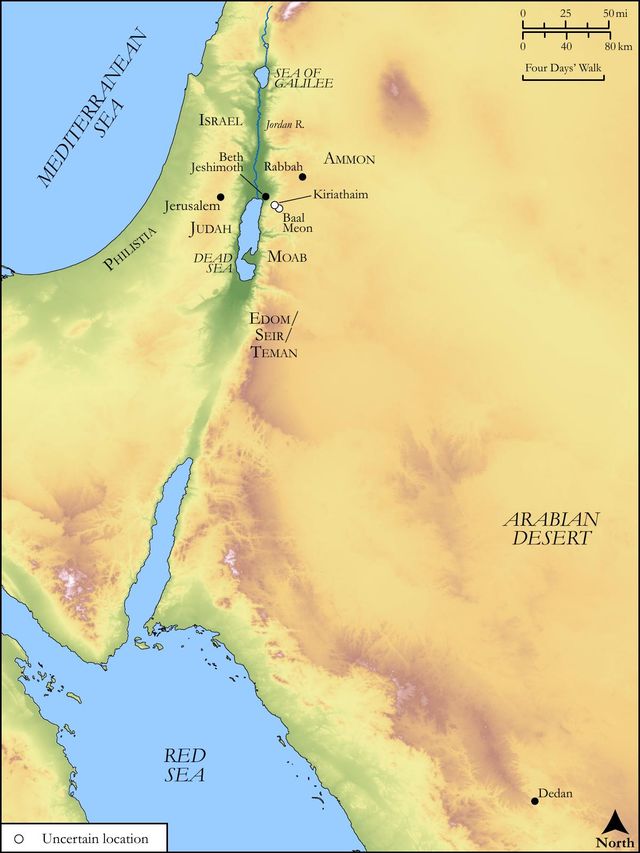
See on the biblical-era map
Study this verse
Public-domain commentary
Matthew Henry
From his Commentary on the Whole Bible. Henry comments on passages, not single verses — this entry covers Ezekiel 25:1–7. His four-level outline is real structure in the source text, so it is rendered as structure.
Here, I. The prophet is ordered to address himself to the Ammonites, in the name of the Lord Jehovah the God of Israel, who is also the God of the whole earth. But what can Chemosh, the god of the children of Ammon, say, in answer to it? He is bidden to set his face against the Ammonites, for he is God's representative as a prophet, and thus he must signify that God set his face against them, for the face of the Lord is against those that do evil, Psa 34:16. He must speak with boldness and assurance, as one that knew whose errand he went upon, and that he should be borne out in delivering it. He must therefore set his face as a flint, Isa 1:7. He must show his displeasure against these proud enemies of Israel, and face them down, though they were very impudent, and thus must show that, though he had prophesied so much and so long against Israel, yet still he was for Israel, and, while he witnessed against their corruptions, he adhered to and gloried in God's covenant with them. Note, Those are miserable that have the preaching and praying of God's prophets against them, against whom their faces are set.
II.He is directed what to say to them.
Ezekiel is now a captive in Babylon, and has been so many years, and knows little of the state of his own nation, much less of the nations that were about it; but God tells him both what they were doing and what he was about to do with them. And thus by the spirit of prophecy he is enabled to speak as pertinently to their case as if he had been among them.
1.He must upbraid the Ammonites with their insolent and barbarous triumphs over the people of Israel in their calamities, Eze 25:3. The Ammonites said, when all went against the Jews, Aha! so would we have it. They were glad to see,
(1.)The temple burned, the sanctuary profaned by the victorious Chaldeans. This is put first, to intimate what was the cause of the controversy; they had an enmity to the Jews for the sake of their religion, though it was only some poor remains of the profession of it that were to be found among them.
(2.)The nation ruined. They rejoiced when the land of Israel was made desolate, the cities burnt, the country wasted, and both depopulated, and when the house of Judah went into captivity. When they had not power to oppress God's Israel themselves they were pleased to see the Chaldeans oppress them, partly because they envied their wealth and the good land they enjoyed, partly because they feared their growing power, and partly because they hated their religion and the divine oracles they were favoured with. It is repeated again (Eze 25:6): They clapped with their hands, to irritate the rage of the Chaldeans, and to set them on as dogs upon the game; or they clapped their hands in triumph, attended this tragedy with their Plaudite - Give us your applause, thinking it well acted; never was there any thing more diverting or entertaining to them. They stamped with their feet, ready to leap and dance for joy upon this occasion; they not only rejoiced in heart, but they could not forbear showing it, though every one that had any sense of honour and humanity would cry shame upon them for it, especially considering that they rejoiced thus, not for any thing they got by Israel's fall (if so, they would have been the more excusable: most people are for themselves); but this as purely from a principle of malice and enmity: Thou hast rejoiced in heart with all thy despite (which signifies both scorn and hatred) against the land of Israel. Note, The people of God have always had a great deal of ill-will borne them by this wicked world; and their calamities have been their neighbours' entertainments. See to what unnatural instances of malice the enmity that is in the seed of the serpent against the seed of the woman will carry them. The Ammonites, of all people, should not have rejoiced in Jerusalem's ruin, but should rather have trembled, because they themselves had such a narrow escape at the same time; it was but "cross or pile" [the toss of a halfpenny] which should be besieged first, Rabbath or Jerusalem, Eze 21:20. And they had reason to think that the king of Babylon would set upon them next. But thus were their hearts hardened to their ruin, and their insolence against Jerusalem was to them an evident token of perdition, Phi 1:28. It is a very wicked thing to be glad at the calamities of any, especially of God's people, and a sin that God will surely reckon for; such delight has God in showing mercy, and so backward is he to punish, that nothing is more pleasing to him than to be stopped in the ways of his judgments by intercessions, not any thing more provoking than to help forward the affliction when he is but a little displeased, Zac 1:15.
2.He must threaten the Ammonites with utter ruin for this insolence which they were guilty of. God turns away his wrath from Israel against them, as is said, Pro 24:17, Pro 24:18. God is jealous for his people's honour, because his own is so nearly interested in it. And therefore those that touch that shall be made to know that they touch the apple of his eye. He had before predicted the destruction of the Ammonites, Eze 21:28. Had they repented, that would have been revoked; but now it is ratified.
(1.)A destroying enemy is brought against them: I will deliver thee to the men of the east, first to the Chaldeans, who came from the north-east, and whose army, under the command of Nebuchadnezzar, destroyed the country of the Ammonites, about five years after the destruction of Jerusalem (as Josephus relates, Antiq. 10.181), and then to the Arabians, who were properly the children of the east, who, when the Chaldeans had made the country desolate, and quitted it, came and took possession of it for themselves, probably with the consent of the conquerors. Shepherds' tents were their palaces; these they set up in the country of the Ammonites; there they made their dwellings, Eze 25:4. They enjoyed the products of the country: They shall eat thy fruit and drink thy milk; and the milk from the cattle is the fruit of the ground at second-hand. They made use even of the royal city for their cattle (Eze 25:5): I will make Rabbath, that was a nice and splendid city, to be a stable for camels; for its new masters, whose wealth lies all in cattle, will not think they can put the palaces of Rabbath to a better use. Rabbath had been a habitation of brutish men; justly therefore is it now made a stable for camels and the country a couching-lace for flocks, more innocent beasts than those with which it had been before replenished.
(2.)God himself acts as an enemy to them (Eze 25:7): I will stretch out my hand upon thee, a hand that will reach far and strike home, which there is no resisting the blow of, for it is a mighty hand, nor bearing the weight of, for it is a heavy hand. God's hand stretched out against the Ammonites will not only deliver them for a spoil to the heathen, so that all their neighbours shall prey upon them, but will cut them off from the people and made them perish out of the countries, so that there shall be no remains of them in that place. Compare with this, Jer 49:1, etc. What can sound more terrible than that resolution (Eze 25:7), I will destroy thee? For the almighty God is able both to save and to destroy, and it is a fearful thing to fall into his hands. Both the threatenings here (Eze 25:5 and Eze 25:7) conclude with this, You shall know that I am the Lord. For,
[1.]Thus God will maintain his own honour, and will make it appear that he is the God of Israel, though he suffers them for a time to be captives in Babylon.
[2.]Thus he will bring those that were strangers to him into an acquaintance with him, and it will be a blessed effect of their calamities. Better know God and be poor than be rich and ignorant of him.
Historical interpretation
Historical reception
3 surviving comments on this verse. Each one is dated, so this reads as a timeline rather than a list.
(Verse 35, 36, and following) And I will bring you into a desert of peoples, and there I will judge you face to face. Just as I contended with your fathers in the desert of the land of Egypt, so I will judge you, says the Lord. And I will subject you to my scepter, and I will bring you into the bonds of the covenant, and I will choose from among you the transgressors and the wicked: from their place of residence I will bring them out, and they will not enter the land of Israel, and you will know that I am the Lord. Thus says the Lord: I will do for you who are in Babylon, and now serve idols, what I did for your ancestors in Egypt. I will lead you into the desert of the peoples, and there I will judge you face to face, just as I contended with them in judgment when they came out of Egypt. And after I have judged you, I will subject you to my scepter and rule, and I will make a covenant with you and bring you into your land with the bonds of love, so that bound by my love, you will never be able to depart from me. But I will choose from among you the transgressors and the wicked, who persist in the hardness of their hearts in evil deeds, not for possession, but for rejection. And I will indeed bring them out of the land of their dwelling, so that when they are brought out, they will not enter the land of Israel; but they will perish in various regions. And by the distinction between good and evil, you shall know that I am the Lord, who judges all things. The rest of the discourse hastens, and we briefly go through each point, in order to provide only the meaning to the readers.
Chapter 25: And the word of the Lord came to me, saying: Son of man, set your face against the sons of Ammon, and prophesy against them. And you shall say to the sons of Ammon: Hear the word of the Lord God! Thus says the Lord God: Because you said, 'Aha!' over my sanctuary when it was profaned, and over the land of Israel when it was laid waste, and over the house of Judah when they went into exile, therefore behold, I am giving you to the people of the East for a possession, and they shall set their encampments in you and make their dwellings in you. They shall eat your fruit, and they shall drink your milk. I will make Rabbah a pasture for camels and the land of the Ammonites a fold for flocks. Then you will know that I am the Lord. Because the Lord God says these things: Because you clapped your hands, and stomped your feet, and rejoiced with all your heart (or insulted with all your soul) over the land of Israel; therefore (Vulgate adds behold) I will stretch out my hand against you, and deliver you to be plundered by the nations, and I will kill you from the peoples, and I will destroy you from the lands, and I will crush you, and you will know that I am the Lord. When Jerusalem was captured or besieged, after it came to Babylon, whoever could (or had the power to) escape, and he reported that the city was about to be captured very soon, or that the temple had been destroyed, according to the custom of all the prophets against the other surrounding nations, who insulted the ruins of Jerusalem, and the burning of the temple, the prophetic message turns, firstly against the sons of Ammon, who had a metropolis called Rabbath, which today is named Philadelphia by King Ptolemy of Egypt, also known as Philadelphus, who held both Arabia and Judah. Son, he says, of man, set your face against the sons of Ammon, who are descended from Lot, and say to them: Thus says the Lord God (for these are not the words of a prophet, but of the Lord. Concerning the hardening of the face, we have argued more fully in this same prophecy): Because you have said, 'Aha, Aha,' or have insulted and rejoiced because my temple and sanctuary have been defiled by the invasion of enemies, and over the land of Israel, which has been devastated, and especially over the house of Judah, that is, the two tribes that are now in captivity: therefore I will give you over to the sons of Edom, whom we interpret as the Easterners. There is no doubt, Madianites, that they border the entire wilderness of the land of Arabia, who have herds of camels, and multitudes of sheep and goats, and they sustain themselves with these resources. This is also narrated in the book of Judges (Judg. VI) about what happened to the land of Israel when the Midianites came and devoured all their regions up to Gaza. Metaphorically, therefore, by the term Midianites, it signifies the Ishmaelites and Hagarites, who are now called Saracens, taking for themselves the false name of Sarah so that they may appear to be born of a noble and mistress lineage. Scripture also says about king Nebuchadnezzar and his entire army that they come and capture the city of Rabbath, which either has this name specifically or because of its greatness. For Rabbath is said to be the greatest. And so that we do not doubt that Nebuchadnezzar overthrew Arabia after Jerusalem was captured, Scripture testifies above: And thou, son of man, set thee two ways, Ammon and Jerusalem, and there shall come the sword of the king of Babylon. And again: At the head of the city's way he shall cast it, and thou shalt set up a way, that the sword may come to Rabbath of the children of Ammon, and to the fortified Jerusalem (Above, XXI, 19, 20). And again, thus says the Lord God to the sons of Ammon, and to their reproach (verse 28). Therefore, the sons of Kedem will come and set up their tents like shepherds, and they will pitch their tents. They will destroy your crops and drink the milk and abundance of the land, with herds of camels and all the peoples, so that the sons of Ammon will be in the dwelling place of cattle and understand the necessity of evil, that it is the Lord himself who foretold the future and commanded it to be. And this was not enough for the Ammonites, that they insulted and said, 'Hurrah, hurrah for the temple and sanctuary of the Lord, which was defiled by the entrance of various nations'; but such was the wickedness of their insults that the whole people clapped their hands and stamped their feet, and with all their heart cried out: because the land of Israel was desolate. Therefore, not by angels, nor by other ministries, but by the Lord himself, extending his hand to strike, will he hand it over to plunder, not to camels and sheep herds, but more clearly to the nations, so that it may be completely eradicated from the number of peoples, and perish, and be reduced to nothingness: and after it has been crushed, then it will understand that he himself is the Lord who judges all things, and has power over all lands. We can understand the sons of Ammon according to the tropology, who were born from Lot in the cave, both born in drunkenness and incest, all heretics, of whom the Scripture and the Apostle John say: They went out from us, but they were not of us. For if they had been of us, they would have remained with us (John 2:19). For they arose from inclination, for this is how Lot is translated into our language: For all have turned aside, together they have become worthless; there is no one who does good, not even one (Psalm 14:3). Opposite to these, the prophetic face is set or hardened, in order to crush them with its severity, and it says to them: Because you have insulted my Church in the time of persecution, because my sanctuary was defiled by the fault of various people, either by those who served me, or by the cruelty of the enemies who persecuted me: and also the land of Israel, which saw the sense of God, is desolate of the choir of virtues; and how the children of the house of Judah, that is, those who confess God, in which true faith and right confession exist, were led into captivity and ceased serving the Lord: therefore, O all who insult, you will be handed over to the children of the East who have come from the true light, and you will be handed over as an inheritance, so that you too may learn to confess the Lord. And by way of translation it is said that the sons of the East will place their dwellings upon them, and pitch their tents, and drink milk, and eat fruit, and the city which was once full of pride will become a dwelling place for camels, so that they, having set aside the burden of sins, may enter through the eye of a needle (Matthew 19), and into the fold of the animals, which are guided by a good shepherd (John 10), so that when they have done this, mixed and handed over to the shepherds of the East, they may understand that he himself is the Lord. And again he reproached them, for insulting with excessive affection of the heart the ruins of the people of God, and for thinking that the land of Israel was completely deserted. For this they deserve the hand of God's avenger, as they had exceeded the limit of rejoicing and joy over the destruction of the house of Judah. They should by no means be delivered to the sons of the East, but be for plundering by all nations, and be killed and perish, and be crushed, and by no means be considered descendants of Abraham, but be believed to be for all nations. And then they shall know the magnitude of their evils, and their own contrition, and the killing of the people, that He Himself is the Lord. What we have understood in general about the Church can be understood about each of the saints, whose ruin the people of the world and the powers of the enemy rejoice in if they have lost their chastity for a long time: while the wicked think that they find comfort in their sins if they have more partners in crime and punishment: and no one does this, unless they are a son of Ammon, that is, a son of the people, who is born in a decline.
(Verse 27, 29 onwards) Therefore speak to the house of Israel, son of man, and tell them: Thus says the Lord God: Moreover, your fathers have blasphemed against me and have treated me with contempt, even as they spurned me. And I brought them into the land that I had lifted my hand to give them ((Vulgate adds: that land)): they saw every high hill and every leafy tree, and there they offered their sacrifices and presented there the irritation of their offerings, and they placed there the fragrance of their sweetness, and they poured out their ((Vulgate is silent on this)) libations there. And I said to them, 'What is the high place to which you are going?' And its name was called the High Place until this day. Therefore speak to the house of Israel, son of man, and say to them, 'Thus says the Lord God: As for your fathers, they have provoked Me to anger by their iniquities, by the fact that they have fallen away from Me. So I brought them into the land that I had lifted My hand in an oath to give them.' They saw every high hill and every leafy tree, and there they offered their sacrifices. They also presented there the provocation of their gifts, and they set there their pleasing aroma, and they poured out there their drink offerings. And I said to them: What is abbana, because you enter there? And they called its name abbana until this day. I wanted, he said, to scatter them in the wilderness, and to give them not good precepts, so that they would sacrifice to idols what they should have offered to me, and consecrate all their first-fruits to them by fire, so that I might kill them and destroy them. But when he says, I wanted, he shows that he did not do what he wanted. And that which follows: 'And they shall know that I am the Lord,' is not found in the Septuagint. For it did not seem fitting to them to know after their destruction that he himself is the Lord. But you, son of man, speak again to them, that is, to the elders of the house of Israel, who have come to inquire of you: Your fathers, from whom you have descended, have also blasphemed against me and held me in contempt; after I brought them into the land which I had given them to possess, they turned against me to provoke me. For when they saw every high hill and leafy tree, they would sacrifice on the mountains and in the groves and thickets, and offer victims to the idols, and pour out libations. And when I saw this, I said to them: What is this, Bama? for it is called high: or why do you enter into such a place which you have chosen for yourselves in all the hills, so that even today these places are called Bamoth, and the ancient error retains its original name? Regarding Bama, which we translate as excelsum, there is an error in the Septuagint edition, where it is written as ἀββανὰ, which does not resonate in the Hebrew language. Bama can mean 'in which' if the two syllables are divided into two words, but in the present context, that sense does not fit. However, wherever it is written in the Books of Kings and Chronicles: 'The people still sacrificed and offered incense on the high places,' Bama in the singular and Bamoth in the plural mean 'high places.'
Continue studying Ezekiel 25:6 across the web’s major study libraries — every link below opens this exact verse, chapter, or book on the destination site.
Read & Compare
 BibleGatewayThis verse in more than 200 translations and 70 languages.
 Bible.comThe YouVersion reader — hundreds of translations, reading plans, and highlights.
 ESV.orgCrossway's official English Standard Version reader.
 NET BibleThe NET translation with 60,000+ translators' notes on every rendering decision.
 STEP BibleTyndale House's free study tool — original text, vocabulary, and scholarly resources.
 BibliaLogos Bible Software's free web reader.
 USCCBThe New American Bible (Revised Edition) with the U.S. bishops' study notes.
Commentaries
 BibleHub CommentariesDozens of classic commentaries on this verse, gathered on one page.
 StudyLightMore than 100 commentary sets — the largest collection on the web.
 BibleRefPlain-English commentary on what this verse means, verse by verse.
 Enduring WordDavid Guzik's free commentary on this chapter, widely used by Bible teachers.
 Bible Study ToolsVerse commentary alongside Greek and Hebrew study aids.
Original Language & Research
- BibleHub InterlinearThe verse word by word — original language, transliteration, and English.
- BibleHub LexiconEvery word's original-language definition and Strong's entry.
 Blue Letter BibleDeep-study tools — Strong's numbers, concordance, and word studies.
 SefariaThe Hebrew text with Rashi and centuries of Jewish commentary.
Sermons, Hymns & Audio


TrulyRandomVerse is not affiliated with these sites and doesn’t control their content. They’re linked because they’re genuinely useful.
Summary
Ezekiel 25:6 delivers a severe divine indictment against the Ammonite nation, condemning their open and heartfelt celebration of Israel's suffering and the desolation of its land. This verse encapsulates God's profound displeasure with their malicious joy, highlighting a deep-seated contempt that violated historical kinship, defied the covenantal relationship, and demonstrated a profound lack of compassion for God's chosen people in their time of severe discipline. It serves as a powerful declaration of divine justice, asserting God's sovereignty over all nations and His unwavering commitment to hold accountable those who gloat over the misfortunes of others, especially His own.
Context
ShowHideLiterary Context
This verse is strategically positioned within Ezekiel's broader series of oracles against the surrounding nations (chapters 25-32), which immediately follows the prophecies detailing Jerusalem's destruction and Judah's exile (chapters 1-24). Having meticulously explained God's judgment upon His own people for their unfaithfulness, the narrative shifts to address the nations that witnessed, contributed to, or, in Ammon's case, rejoiced in Israel's downfall. Specifically, Ezekiel 25:1-7 targets Ammon, a nation historically related to Israel through Lot, yet consistently hostile. This section underscores God's universal sovereignty, demonstrating that His justice extends beyond Israel to all nations, holding them accountable for their actions and attitudes towards His covenant people, even when Israel is under divine discipline.
Historical & Cultural Context
The historical setting for Ezekiel 25:6 is the tumultuous period of the Babylonian conquest of Judah in the early 6th century BCE, culminating in the devastating fall of Jerusalem and its Temple in 586 BCE. The Ammonites, residing to the east of the Jordan River, were opportunistic neighbors who, instead of offering aid or sympathy, actively participated in the plundering and celebrated Judah's demise. Their actions were not mere indifference but active "despite" (contemptuous malice), expressed through public displays of joy. Such behavior was considered a profound breach of regional solidarity and a direct affront to the God of Israel, particularly given the historical ties and shared Abrahamic heritage. The "clapping of hands" and "stamping of feet" were common expressions of derision, triumph, or mocking celebration, often associated with public humiliation and scorn.
Key Themes
ShowHideEzekiel 25:6 powerfully contributes to several overarching themes within the book of Ezekiel and the broader prophetic literature. It underscores the theme of Divine Justice, demonstrating that God holds nations accountable not only for their direct actions against Israel but also for their malicious attitudes and emotional responses to Israel's suffering. The verse vividly portrays Malicious Joy (Schadenfreude) as a severe sin, particularly when directed at God's chosen people. This uncompassionate gloating is seen as a direct affront to God's purposes, revealing a heart devoid of empathy and filled with animosity. Furthermore, it highlights God's Vindication of Israel, even in their period of severe discipline. Despite Israel's unfaithfulness and the judgment they faced, God's covenantal care for them endures. Those who mock or exploit Israel's vulnerability will face divine reckoning, reinforcing the truth that God's people, though disciplined, are never abandoned, a truth echoed in passages like Isaiah 54:7-10. Finally, the phrase "rejoiced in heart" emphasizes the theme of the Reckoning of the Heart, revealing that God judges not only outward actions but also the hidden intentions and emotions of the human heart, as articulated in Jeremiah 17:10.
Exposition and Analysis
ShowHideKey Word Analysis
ShowHideFrom a primitive root meaning "to rub or strike the hands together (in exultation)." This word describes a physical act of applause, but in this context, it signifies a triumphant, mocking, or derisive celebration. It's an overt, public display of joy over another's misfortune, indicating scorn and contempt rather than mere happiness.
A primitive root meaning "to pound the earth (as a sign of passion); by analogy to expand (by hammering)." Here, it denotes a forceful, rhythmic striking of the feet, often accompanying the clapping of hands. Like "clapped," it conveys an intense, passionate expression of exultation, derision, or violent triumph, emphasizing the depth of Ammon's malicious glee.
From an unused root meaning "to push aside," this word conveys "contempt." It signifies a deep-seated disdain, scorn, or malice. It's not just indifference or lack of sympathy, but an active, malicious pleasure in the downfall of another, indicating a heart filled with animosity and arrogant disregard.
Verse Breakdown
ShowHide"For thus saith the Lord GOD;"
This opening phrase, a common prophetic formula, establishes the divine authority and certainty of the message. It signifies that the following words are not human opinion but a direct oracle from Yahweh, the sovereign Lord (Adonai YHWH), underscoring the gravity and infallibility of the impending judgment.
"Because thou hast clapped [thine] hands, and stamped with the feet,"
This clause describes the outward, physical manifestations of Ammon's malicious joy. The clapping of hands and stamping of feet are vivid, public gestures of celebration, mockery, and derision. These actions signify an open and unashamed display of triumph over Israel's calamity, indicating a profound lack of empathy and a hostile attitude.
"and rejoiced in heart with all thy despite"
This part of the verse delves into the internal motivation behind the outward actions. "Rejoiced in heart" (Hebrew: sâmach with nephesh) reveals that the celebration was not merely superficial but stemmed from a deep-seated, genuine pleasure in Israel's suffering, affecting their very being. The phrase "with all thy despite" intensifies this, indicating that their joy was fueled by utter contempt, malice, and arrogant disdain for the land and people of Israel. It emphasizes the comprehensive nature of their animosity, permeating their entire being.
"against the land of Israel;"
This final clause specifies the precise object of Ammon's malicious joy and contempt. It clarifies that their celebration was directed precisely at the desolation and suffering inflicted upon God's covenant land and people. This direct targeting underscores the profound offense against God's purposes and His chosen nation, making their actions a direct affront to the divine will.
Literary Devices
ShowHideEzekiel 25:6 employs several powerful literary devices to convey its message of divine condemnation. Anthropomorphism is evident in the depiction of God "saying" and observing the actions of Ammon, attributing human-like communication and perception to the divine, thereby emphasizing the personal nature of His judgment. The vivid imagery of "clapped hands" and "stamped with the feet" constitutes both Synecdoche, where a part (hands, feet) represents the whole person's actions, and Metonymy, as these physical actions stand in for the underlying emotion of malicious triumph and derision. This Sensory Imagery creates a powerful and immediate picture of Ammon's scornful celebration. The repetition of verbs of action ("clapped," "stamped," "rejoiced") combined with the intensifying phrase "with all thy despite" creates a sense of Climax and emphasizes the totality and depth of Ammon's malevolent attitude. The entire verse functions as a Prophetic Indictment, a formal charge laid out by God against a nation, detailing their specific sin and foreshadowing the ensuing judgment.
Theological and Thematic Connections
ShowHideEzekiel 25:6 profoundly illustrates God's unwavering commitment to justice and His deep concern for His people, even when they are undergoing discipline. It reveals that God not only judges overt acts of aggression but also the hidden attitudes of the heart, particularly the sin of schadenfreude—rejoicing in the misfortune of others. This malicious joy, born of contempt and despite, is seen as a direct affront to God's character, who calls His people to compassion and empathy. The Ammonites' celebration of Israel's downfall was a rejection of the divine order and a demonstration of hostility towards God's redemptive plan, thus incurring severe divine wrath. This principle extends beyond national judgments to individual conduct, reminding believers that our attitudes towards others' suffering are under divine scrutiny, reflecting the very nature of our hearts.
Reflection and Application
ShowHideEzekiel 25:6 serves as a potent spiritual mirror, challenging us to examine our own hearts and reactions to the struggles of others, especially those we might consider adversaries, rivals, or even those with whom we disagree. In a world often characterized by division, competition, and the rapid spread of negativity, the temptation to find satisfaction or even pleasure in the setbacks or misfortunes of others can be insidious and deeply ingrained. This verse unequivocally condemns such malicious joy, reminding us that God sees beyond outward actions into the deepest recesses of our hearts, where true attitudes reside. True spiritual maturity and Christ-likeness call us to profound empathy and compassion, to mourn with those who mourn, and to extend grace even to those who may have wronged us or hold differing views. It is a call to cultivate a heart that reflects God's own character—a heart of love, mercy, and justice, rather than one that revels in the pain of others or finds satisfaction in their downfall.
Questions for Reflection
ShowHideFAQ
ShowHideWhat is "despite" in the context of Ezekiel 25:6?
ShowHideIn Ezekiel 25:6, "despite" (Hebrew: shᵉʼâṭ') refers to a deep-seated contempt, scorn, or malicious pleasure. It's not merely a lack of sympathy but an active, hostile animosity that causes one to rejoice in the downfall or suffering of another. The Ammonites' "despite" against the land of Israel meant they harbored profound ill-will and took delight in the destruction and distress that befell God's people. This highlights that God judges not only actions but also the underlying attitudes and intentions of the heart, as seen in Proverbs 17:5.
Why was Ammon's reaction to Israel's suffering so offensive to God?
ShowHideAmmon's reaction was deeply offensive for several reasons. Firstly, it demonstrated a profound lack of compassion and empathy towards a neighboring nation, especially one with whom they shared a historical lineage (both descended from Lot, Abraham's nephew). Secondly, it was an act of gloating over the suffering of God's chosen people, Israel, who, despite their discipline, remained under God's covenantal care. To rejoice in Israel's downfall was, in essence, to mock God's purposes and His relationship with His people. Thirdly, it was a public and unashamed display of contempt, as evidenced by their "clapping hands" and "stamping feet," which went beyond mere indifference to active, malicious celebration, as condemned in Obadiah 1:12-14.
Christ-Centered Fulfillment
ShowHideEzekiel 25:6, with its condemnation of malicious joy over Israel's suffering, finds profound Christ-centered fulfillment in the person and work of Jesus. While Ammon rejoiced in the downfall of God's people, Christ embodies the antithesis of such despite. He did not come to gloat over humanity's fallen state but to redeem it. The ultimate suffering of God's "land of Israel" was the crucifixion of Jesus, the true Israel, the Lamb of God. Yet, instead of the world's nations rejoicing in His suffering, His death was the means of their salvation, transforming potential gloating into the opportunity for grace. The New Testament calls believers to a radical empathy that mirrors Christ's own, weeping with those who weep and rejoicing with those who rejoice (Romans 12:15). Jesus Himself wept over Jerusalem (Luke 19:41-44), demonstrating divine compassion even for those who would reject Him and bring about His suffering. Furthermore, Christ's victory on the cross ultimately vindicates God's people, not through the destruction of their enemies, but through the offer of reconciliation and peace to all who believe, transforming hearts of "despite" into hearts of love and mercy, fulfilling the promise of a new covenant where God's law is written on the heart (Jeremiah 31:33). The judgment against Ammon foreshadows the ultimate judgment of all who reject God's compassion and revel in sin, while Christ offers the path to eternal joy and true reconciliation, inviting all to partake in His triumph over sin and death, rather than finding joy in the suffering of others.