


Nahum 3:19
Bible text: King James Version (1769 Blayney text) · Public domain
Bible text: King James Version with Strong's numbers · Public domain
Bible text: Berean Standard Bible · Public domain
Bible text: American Standard Version (1901) · Public domain
Bible text: World English Bible, Messianic edition · Public domain
Bible text: Geneva Bible (1599) · Public domain
Bible text: Young's Literal Translation · Public domain
- אֵין'einthere notH369N-mscNoun Singular Masculine Construct
- כֵּהָהke·Hah[is] reliefH3545N-fsNoun Singular Feminine Absolute
- לְשִׁבְרֶךָle·shiv·Re·khafor your fractureH7667Prep-l ¦ N-msc ¦ 2msNoun Singular Masculine Constructלְforשִׁבְרֶfractureךָyour
- נַחְלָהnach·Lah[is] severeH2470V-Niphal-Prtcpl-fsVerb Niphal Participle Singular Feminine Absolute
- מַכָּתֶךָma·ka·Te·khayour woundH4347N-fsc ¦ 2msNoun Singular Feminine Constructמַכָּתֶwoundךָyour
- כֹּלkolallH3605N-mscNoun Singular Masculine Construct
- שֹׁמְעֵיsho·me·'Ei[those who] hearH8085V-Qal-Prtcpl-mpVerb Qal Participle Plural Masculine Construct
- שִׁמְעֲךָshim·'a·Kha<of> your reportH8088N-msc ¦ 2msNoun Singular Masculine Constructשִׁמְעֲ<of> reportךָyour
- תָּקְעוּTa·ke·'uthey strikeH8628V-Qal-Perf-3cpVerb Qal Perfect 3rd Plural common gender
- כַףkhafa palmH3709N-fsNoun Singular Feminine Absolute
- עָלֶיךָ'a·Lei·khaon youH5921Prep ¦ 2msPrepositionעָלֶיonךָyou
- כִּיKiforH3588PrtParticle Conditional
- עַל'aloverH5921PrepPreposition
- מִיmiwhom?H4310InterrogPronoun Interrogative
- לֹאlo'notH3808NegParticle Negative
- עָבְרָה'a·ve·Rahhas it passedH5674V-Qal-Perf-3fsVerb Qal Perfect 3rd Singular Feminine
- רָעָתְךָra·'a·te·Khayour evilH7451N-fsc ¦ 2msNoun Singular Feminine Constructרָעָתְevilךָyour
- תָּמִידta·MidcontinuallyH8548N-msNoun Singular Masculine Absolute
English is a literal word-by-word gloss of the Hebrew, not the KJV's wording. Why?
This is the original text the KJV's translators worked from — each Hebrew word with its own literal English meaning in this verse, prepared by scholars at Tyndale House, Cambridge. The KJV translates whole sentences, not word by word, so its wording differs: one Hebrew word can become several English words, and the KJV may choose “the LORD” where the gloss reads “Yahweh”. Both are faithful — they answer different questions. For the KJV's own rendering, switch to the KJV text.
Details
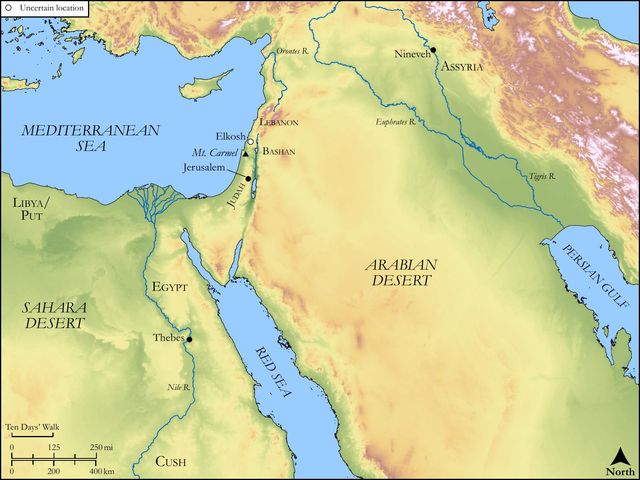
See on the biblical-era map
Study this verse
Public-domain commentary
Matthew Henry
From his Commentary on the Whole Bible. Henry comments on passages, not single verses — this entry covers Nahum 3:8–19. His three-level outline is real structure in the source text, so it is rendered as structure.
Nineveh has been told that God is against her, and then none can be for her, to stand her in any stead; yet she sets God himself at defiance, and his power and justice, and says, I shall have peace. Threatened folks live long; therefore here the prophet largely shows how vain her confidences would prove and insufficient to ward off the judgment of God. To convince them of this,
I.He shows them that other places, which had been as strong and as secure as they, could not keep their ground against the judgments of God.
Nineveh shall fall unpitied and uncomforted (for miserable comforters will those prove who speak peace to those on whom God will fasten trouble), and she shall not be able to help herself: Art thou better than populous No? Nah 3:8. He takes them off from their vain confidences by quoting precedents. The city mentioned is No, a great city in the land of Egypt (Jer 46:25), No-Ammon, so some read it both there and here. We read of it, Eze 30:14-16. Some think it was Diospolis, others Alexandria. As God said to Jerusalem, Go, see what I did to Shiloh (Jer 7:12), so to Nineveh that great city, Go, see what I did to populous No. Note, It will help to keep us in a holy fear of the judgments of God to consider that we are not better than those that have fallen under those judgments before us. We deserve them as much, and are as little able to grapple with them. This also should help to reconcile us to afflictions. Are we better than such and such, who were in like manner exercised? Nay, were not they better than we, and less likely to be afflicted? Now, concerning No, observe,
1.How firm her standing seemed to be, Nah 3:8. She was fortified both by nature and art, was situate among the rivers. Nile, in several branches, not only watered her fields, but guarded her wall. Her rampart was the sea, the lake of Mareotis, an Egyptian sea, like the sea of Tiberias. Her wall was from the sea; it was fenced with a wall which was thought to make the place impregnable. It was also supported by its interests and alliances abroad, Nah 3:9. Ethiopia, or Arabia, was her strength, either by the wealth brought to her in a way of trade or by the auxiliary forces furnished for military service. The whole country of Egypt also contributed to the strength of this populous city; so that it was infinite, and there was no end of it (so it might be rendered); She set no bounds to her ambition and knew no end of her wealth and strength; people flocked to her endlessly, and she thought there never would be any end of it; but it is God's prerogative to be infinite. Put and Lubim were thy helpers, two neighbouring countries of Africa, Mauritania and Libya, that is, Libya Cyrenica, a country that Egypt had much dependence upon. No, thus helped, seemed to sit as a queen, and was not likely to see any sorrow. But,
2.See how fatal her fall proved to be (v, 10): Yet was she carried away, and her strength failed her; even she that was so strong, so secure, yet went into captivity. This refers to some destruction of that city which was then well-known, and probably fresh in memory, though not recorded in history; for the destruction of it by Nebuchadnezzar (if we should understand this prophetically) could not be made an example to Nineveh; for the reducing of Nineveh was one of the first of his victories and that of Egypt one of the last. The strength and grandeur of that great city could not be its protection from military execution.
(1.)Not from that which was most barbarous; for her young children had no compassion shown them, but were dashed in pieces at the top of all the streets by the merciless conquerors.
(2.)Not from that which was most inglorious and disgraceful: They cast lots for her honourable men that were made prisoners of war, who should have them for their slaves. So many had they of them that they knew not what to do with them, but they made sport with throwing dice for them; all her great men, that used to be adorned on state-days with chains of gold, were now bound in chains of iron; they were pinioned or handcuffed (so the word properly signifies), not only as slaves, but as condemned malefactors. What a mortification was this to populous No, to have her honourable men and great men, that were her pride and confidence, thus abused! Now hence he infers against Nineveh (Nah 3:11), "Thou also shalt be intoxicated, infatuated; thou also shalt reel and stagger, as drunk with the cup of the Lord's fury, that shall be put into thy hand" (see Jer 25:17, Jer 25:27); "Thou shalt fall and rise no more. The cup shall go round, and come to thy turn, O Nineveh! to drink off at last, and shall be to thee as the waters of jealousy."
II.He shows them that all those things which they reposed a confidence in should fail them.
1.Did the men of Nineveh trust to their own magnanimity and bravery? Their hearts should sink and fail them. They shall be hid, shall abscond for shame, being in disgrace, abscond for fear, being in distress and danger, and not able to face the enemies, because of whose strength and terror, having no strength of their own, they shall seek strength, shall come sneaking to their neighbours to beg their assistance in a time of need. Thus God can cut off the spirit of princes, and take away their heart.
2.Did they depend upon their barrier, the garrisons and strongholds they had, which were regularly fortified and bravely manned? Those shall prove but paper-walls, and like the first-ripe figs, which, if you give the tree but a little shake, will fall into the mouth of the eater that gapes for them; so easily will all their strongholds be made to surrender to the advancing enemy, upon the first summons, Nah 3:12. Note, Strongholds, even the strongest, are no fence against the judgments of God, when they come with commission. The rich man's wealth is his strong city, and a high wall, but only in his own conceit, Pro 18:10. They are supposed to make their strongholds as strong as possible, and are challenged to do their utmost to make them tenable, and serviceable to them against the invader (Nah 3:14): Draw thee water for the siege; lay in great quantities of water, that that which is so necessary to the support of human life may not be wanting; it is put here for all manner of provision, with which Nineveh is ironically told to furnish herself, in expectation of a siege. "Take ever so much care that thou mayest not be starved out, and forced by famine to surrender, yet that shall not avail. Fortify the strongholds, by adding out-works to them, or putting men and arms into them," as with us by planting cannon upon them. "Go into clay, and tread the mortar, and make strong the brick-kiln; take all the pains thou canst in erecting new fortifications; but it shall be all in vain, for (Nah 3:15) there shall even the fire devour thee if it be taken by storm." It is by fire and sword that in time of war the great devastations are made.
3.Did they put confidence in the multitude of their inhabitants? Were they, from their number and valour, reckoned their strongest walls and fortifications? Alas! these shall stand them in no stead; they shall but sink the sooner under the weight of their own numbers (Nah 3:13): Thy people in the midst of thee are women; they have no wisdom, no courage; they shall be fickle, feeble, and faint-hearted, as women commonly are in such times of danger and distress; they shall be at their wits' end, adding to their griefs and fears by the power of their own imagination, and utterly unable to do any thing for themselves; the valiant men shall become cowards. O ver Phrygiae, neque enim Phryges - Phrygian dames, not Phrygian men. Though they make themselves many (Nah 3:15), as the canker-worm and as the locust, that come in vast swarms, though thou hast multiplied thy merchants above the stars of heaven, though thy exchange be thronged with wealthy traders, who, having so much money to stand up in defence of and so much to lay out in the means of their defence, should, one would think, give the enemy a warm reception, yet their hearts shall fail them too; though they be numerous as caterpillars, yet the fire and sword shall eat them up easily and irresistibly as the canker-worm, Nah 3:15. They are as numerous as those wasting insects, but their enemies shall be mischievous like them. He adds (Nah 3:16), The canker-worm spoils, or spreads herself, and flies away. Both the merchants and the enemies were compared to canker-worms. The enemies shall spoil Nineveh, and carry away the spoil, without opposition, or any hope of recovering it. Or the rich merchants, who have come from abroad to settle in Nineveh, and have raised vast estates there, out of which it was hoped they would contribute largely for the defence of the city, when they see the country invaded and the city likely to be besieged, will send away their effects, and remove to some other place, will spread their wings and fly away where they may be safe, and Nineveh shall be never the better for them. Note, It is rare to find even those that have shared with us in our joys willing to share with us in our griefs too. The canker-worms will continue upon the field while there is any thing to be had, but they are gone when all is gone. Those that men have got by they do not care to lose by. Nineveh's merchants bid her farewell in her distress. Riches themselves are as the canker-worms, which on a sudden fly away as the eagle towards heaven, Pro 23:5.
4.Did they put a confidence in the strength of their gates and bars? What fence will those be against the force of the judgments of God? Nah 3:13. The gates of thy land shall be set wide open unto thy enemies, the gates of thy rivers (Nah 2:6), the flood-gates, or the passes and avenues, by which the enemy would make his entrance into the country, or the gates of the cities; these, though ever so strong and well-guarded, shall not answer their end: The fire shall devour thy bars, the bars of thy gates, and then they shall fly open.
5.Did they put a confidence in their king and princes? They should do them no service (Nah 3:17): Thy crowned heads are as the locusts; those that had pomp and power, as crowned heads, were enfeebled, and had no power to make resistance, when the enemy came in like a flood. "Thy captains, that should lead thy forces into the field, are great indeed, and look great, but they are as the great grasshoppers, the maximum quod sic - the largest specimens of that species; still they are but grasshoppers, worthless things, that can do no service. They encamp in the hedges, in the cold day, the cold weather, but, when the sun arises, they flee away, and are gone, nobody knows whither. So these mercenary soldiers that lay slumbering about Nineveh, when any trouble arises, flee away, and shift for their own safety. The hireling flees, because he is a hireling." The king of Assyria is told, and it is a shame he needs to be told it (who might observe it himself), that his shepherds slumber; they have no life or spirit to appear for the flock, and are very remiss in the discharge of the duty of their place and the trust reposed in them: Thy nobles shall dwell in the dust, and be buried in silence.
6.Did they hope that they should yet recover themselves and rally again? In this also they should be disappointed; for, when the shepherds are smitten, the sheep are scattered; the people are dispersed upon the mountains and no man gathers them, nor will they ever come together of themselves, but will wander endlessly, as scattered sheep do. The judgment they are under is as a wound, and it is incurable; there is no relief for it, "no healing of thy bruise, no possibility that the wound, which is so grievous and painful to thee, should be so much as skinned over; thy case is desperate (Nah 3:19) and thy neighbours, instead of lending a hand to help thee, shall clap their hands over thee, and triumph in thy fall; and the reason is, because thou hast been one way or other injurious to them all: Upon whom has not thy wickedness passed continually? Thou hast been always doing mischief to those about thee; there is none of them but what thou hast abused and insulted; and therefore they shall be so far from pitying thee that they shall be glad to see thee reckoned with." Note, Those that have been abusive to their neighbours will, one time or another, find it come home to them; they are but preparing enemies to themselves against their day comes to fall: and those that dare not lay hands on them themselves will clap their hands over them, and upbraid them with their former wickedness, for which they are now well enough served and paid in their own coin. The troublers shall be troubled will be the burden of many, as it is here the burden of Nineveh.
Historical interpretation
Historical reception
1 surviving comment on this verse from the historical church.
(Verse 18 onwards) Your shepherds have fallen asleep, O king of Assyria; your princes shall be buried, your people are scattered on the mountains. There is no one to gather them, your injury is not hidden, your wound is severe. All who hear of your downfall clap their hands over you, for against whom has your evil not passed continually? Septuagint: Your shepherds have fallen asleep; the king of Assyria has fallen asleep, your strong men have gone away, your people have gone up to the mountains, and there was no one to support them, and there is no cure for your injury, your wound is swollen. All who have heard your message will applaud you, because against whom does your malice never attack? It is not surprising if your shepherds have fallen asleep, O king of Assyria, who ruled over Nineveh, and may they be buried or wander, your princes, the little kings and the rulers of all nations who once served you: when the women of your people are in the midst of your city; and the gates of the city are open to your enemies, and a multitude sits on the wall like a swarm of locusts, which flees at the approach of the scorching sun, so will Nebuchadnezzar flee from the fortifications and turn his back on the enemy, and no place will be found for him. Therefore, angry with God, because you devastated His people, O Assyria, and exalted yourself even to the heavens, where you are said to have great understanding, your city is destroyed. And with all the princes slain, who could resist your adversaries, the rest of your people, weak and ignoble, are scattered in the mountains, and there is no leader to be found who can gather them together, and from those scattered, gather an army again. Your wound is not hidden, nor is it such a blow that can be healed by the hand of physicians. All those who hear of the destruction of Nineveh and the defeat of the Assyrian king, and the once powerful city and its wounded and half-dead king, lying in his own blood and rolling around, will either be amazed at the greatness of the event and the unexpected news, and they will clasp their hands or, certainly, they will rejoice greatly and applaud you with their hands and make a joyful noise. For there is no one who can grieve over you and give tears to your destruction and wounds, because there is no one whom your malice does not always pass over. And it passes over beautifully: for the malice of the Assyrian king cannot always remain in his bones. Thus far let the order of the story be the text. But we must also, according to the Hebrew, before we discuss the Septuagint edition (for in that the meaning is far different and diverse), ascend a little from the story to the sublime, and teach that in the last prophecy of Nahum, a turning away is made to the devil, a great sense, the prince of the Assyrians, who once proudly said: By my strength I will do it, and by my wisdom I will remove the boundaries of nations, and I will break their powers, and I will shake the cities that are inhabited (Isaiah 10:13), and let it be said to him: O Lucifer, who used to rise in the morning, who used to send your flames to all the nations: how you have fallen to the earth, and you are shattered (Isaiah 14:12, 13)? Your beautiful and powerful city, Nineveh, has been destroyed, in which you presumed to have so much power that you dared to say to the Son of God: All these things have been given to me: if you fall down and worship me, I will give them to you (Matthew 4:9). Your shepherds and rulers slumbered, who did not feed the people for their salvation, but nourished them for your destruction, so that you could devour fatter sacrifices. Your entire population and the multitude of nations that once worshipped you have deserted you and your city, and have fled to the mountains, seeking refuge among the hiding places of the apostles of Christ and the learned, and in the meantime, none of your leaders are able to call back your once loyal followers. Your wound and your plague have spread throughout the whole world: all who were once deceived by your treachery have insulted you; for there is no one, or very few, whom you have not deceived at some point, and through whom your malice has not passed. And it should be noted that wherever the malice of the devil has stood, it cannot mock his downfall and wound, since it is from the shepherds and people of the king of Assyria; but wherever it passes, let it mock him, and let it resound upon his good and righteous works, as if the hands were clapping over him. And appropriately, according to the Hebrew, it has been said about the destruction of the world: in the end, it is also said about the devil himself, who was the prince of the world. For the world is placed in wickedness, it is proclaimed as a wound and a plague. But in the Septuagint it is still said to be mixed, that is, a mixture of the world, because its shepherds have slept and have been lulled to sleep by the Assyrian king; and thus it happens that while it is described among them what the Assyrian does among others, and not what he himself suffers, there is silence about the wound, plague, and killing of the devil. Woe therefore to those who are masters of perverse doctrines in Nineveh. And it is rightly said to them: Your shepherds have slumbered (Ps. CXXXI): for they have given sleep to their eyes, and slumber to their eyelids. And therefore they have not found a place for the Lord, nor a tabernacle for the God of Jacob. They have not heard of Ephrata, that is, the fruitful Church; nor have they found her in the thickets of the forests. But not only have the mixed shepherds of this generation, and the locusts, which, with impending frost, sit on the hedges, slumbered; but even the king of the Assyrians himself has been put to sleep. For the Assyrian king knows that he cannot deceive the sheep unless he first puts the shepherds to sleep. It is always the devil's endeavor to put to sleep vigilant souls. Finally, even in the Passion of the Lord, he oppresses the eyes of the apostles with a deep sleep, whom the Savior awakens and says: Watch and pray, lest you enter into temptation (Mark 14:38). And again: What I say to you, I say to all: Watch (Ibid., 13:37). And because he never stops putting to sleep those who are vigilant, whomever he deceives, and bewitches as with a sweet and pernicious song of the Sirens to make them sleep, the divine word awakens and says: Rise, you who sleep, and arise from the dead, and Christ will enlighten you (Ephesians 5:14). Therefore, with the arrival of Christ and the word of God and the teaching of the Church, and the destruction of Nineveh, once a beautiful prostitute, the people who had previously been asleep under their masters will be raised up and will hurry to the mountains of Scripture. There they will find the mountains of Moses and Joshua son of Nun; the mountains of the prophets; the mountains of the apostles and evangelists of the New Testament. And when they take refuge in such mountains and become skilled in their reading, if they do not find someone to teach them (for the harvest is plentiful, but the workers are few, Matt. IX, 37), then their zeal will be proven because they have sought refuge in the mountains, and the laziness of their teachers will be exposed: for they bring forth fruits, but there was no one to receive them. It follows: There is no healing for your fracture, your wound swells. Therefore, the mixed people of Nineveh cannot be healed, because they do not cast off their pride, and the wound is always fresh, and they are struck by the devil daily. And after all this, there is no healing for their fracture: although he may seem to be healthy, his soul is broken and crushed, struck by the hammer of the whole earth from above, and he is not healed, because he is always standing erect. But if he humbles himself and submits to Christ: God does not despise a contrite and humble heart (Ps. 50:19); And: The sacrifice acceptable to God is a broken spirit. In the end it is said: All who have heard of you will clap their hands over you. Against whom does your wickedness not always rush? When it begins, O shameless one, to endure punishments, all who have heard of it, with harmonious clapping and vocal sound, and (so to speak) with the sound and harmony of actions, will insult you and rejoice. For there is no one, or certainly very few, into whom your malice has not rushed or has not come upon. For if the city of Nineveh has mixed shepherds and strong ones, and every false doctrine and deceitful opinion of knowledge comes from the mixture, it must be feared that there is no one upon whom the malice of the mixture has not come. And carefully observe, because it does not say: Into whom your malice has not entered, O mixture, but into whom it has not come upon. For often false dogmas shoot their arrows at us, and they desire to enter into the secret of the soul: but with us closing the gates, there certainly comes σύμμικτος (a mixed thing), and as much as it can, it rushes forth, and it always does this: but with the help of Christ the Lord, and with all watchfulness guarding (or preserving), our heart (Prov. IV), it does indeed rush forth, but it cannot enter.
Continue studying Nahum 3:19 across the web’s major study libraries — every link below opens this exact verse, chapter, or book on the destination site.
Read & Compare
 BibleGatewayThis verse in more than 200 translations and 70 languages.
 Bible.comThe YouVersion reader — hundreds of translations, reading plans, and highlights.
 ESV.orgCrossway's official English Standard Version reader.
 NET BibleThe NET translation with 60,000+ translators' notes on every rendering decision.
 STEP BibleTyndale House's free study tool — original text, vocabulary, and scholarly resources.
 BibliaLogos Bible Software's free web reader.
 USCCBThe New American Bible (Revised Edition) with the U.S. bishops' study notes.
Commentaries
 BibleHub CommentariesDozens of classic commentaries on this verse, gathered on one page.
 StudyLightMore than 100 commentary sets — the largest collection on the web.
 BibleRefPlain-English commentary on what this verse means, verse by verse.
 Enduring WordDavid Guzik's free commentary on this chapter, widely used by Bible teachers.
 Bible Study ToolsVerse commentary alongside Greek and Hebrew study aids.
Original Language & Research
- BibleHub InterlinearThe verse word by word — original language, transliteration, and English.
- BibleHub LexiconEvery word's original-language definition and Strong's entry.
 Blue Letter BibleDeep-study tools — Strong's numbers, concordance, and word studies.
 SefariaThe Hebrew text with Rashi and centuries of Jewish commentary.
Sermons, Hymns & Audio


TrulyRandomVerse is not affiliated with these sites and doesn’t control their content. They’re linked because they’re genuinely useful.
Summary
Nahum 3:19 delivers a climactic and devastating pronouncement of Nineveh's irreversible doom, declaring that its fatal "bruise" and "grievous wound" are beyond remedy. The verse vividly portrays the widespread relief and even celebratory reaction of nations upon hearing the news of its downfall, attributing this global exultation to Nineveh's relentless and pervasive wickedness that had afflicted countless peoples without cessation.
Context
ShowHideLiterary Context
Nahum 3:19 serves as the concluding statement of the prophet Nahum's oracle against Nineveh, the capital of the Assyrian Empire. The preceding verses in chapter 3 detail the city's depravity, describing it as a "bloody city" Nahum 3:1 steeped in lies, plunder, and idolatry. Chapters 1 and 2 establish God's character as a jealous and avenging God who will execute judgment upon His enemies, particularly Nineveh. The vivid imagery of siege, destruction, and the complete collapse of Assyrian power culminates in this verse, which emphasizes the finality of Nineveh's demise and the universal rejoicing that will accompany it. It acts as a powerful summary of the entire book's message of divine retribution.
Historical & Cultural Context
The book of Nahum is typically dated to the late 7th century BC, likely between the fall of Thebes (No-amon) to Assyria in 663 BC (referenced in Nahum 3:8-10) and the actual fall of Nineveh in 612 BC. At this time, Assyria was the dominant superpower, known for its brutal military campaigns, forced deportations, and oppressive rule over conquered nations. Nineveh, its magnificent capital, was a symbol of this ruthless power. The "wickedness" mentioned in the verse refers to Assyria's widespread cruelty, idolatry, and insatiable appetite for conquest and tribute. The "clapping of hands" over Nineveh's fall reflects the deep-seated resentment and suffering experienced by the many peoples who had endured Assyrian tyranny, making its destruction a cause for global celebration rather than mourning.
Key Themes
ShowHideThis verse powerfully contributes to several overarching themes within Nahum and broader biblical theology. It underscores the theme of Divine Justice and Retribution, demonstrating that God, in His righteousness, will ultimately hold even the most powerful nations accountable for their unrepentant sin and oppression. The phrase "no healing of thy bruise; thy wound is grievous" highlights the Irreversible Judgment that awaits those who persistently defy God and brutalize others, signifying a point of no return for Nineveh. Furthermore, the global reaction of "clapping the hands" emphasizes the theme of Vindication for the Oppressed, illustrating that God hears the cries of His suffering people and will bring about deliverance by overthrowing their oppressors. This aligns with the broader biblical narrative of God's concern for justice for the vulnerable, as seen in passages like Psalm 9:12.
Exposition and Analysis
ShowHideKey Word Analysis
ShowHideThis feminine noun properly denotes "a weakening" or "alleviation," and figuratively, a "cure." In Nahum 3:19, its negation ("no healing") emphasizes the absolute and incurable nature of Nineveh's destruction. There is no possibility of recovery, restoration, or remedy for the fatal blow it has received.
This noun signifies "a fracture," "ruin," or "destruction." It can also refer to "affliction" or "breaking." Here, "bruise" is a powerful metaphor for the catastrophic and irreparable damage inflicted upon Nineveh, indicating its complete political, military, and existential collapse. It's not a superficial injury but a deep, structural shattering.
This term encompasses "bad" or "evil" in both natural and moral senses, including "adversity," "affliction," "calamity," and "mischief." In this context, "wickedness" refers to Nineveh's pervasive moral corruption, its cruel and oppressive actions, its violence, and its idolatry that had spread its destructive influence "continually" to all nations it encountered.
This primitive root means "to clatter," "slap" (the hands together), or "clang." When paired with "hands" (H3709, kaph), it forms an idiom for expressing strong emotion—often joy, triumph, or mockery. In Nahum 3:19, it signifies the universal exultation and relief felt by the nations over Nineveh's downfall, contrasting sharply with the expected mourning for a fallen empire.
Verse Breakdown
ShowHide"There is no healing of thy bruise;"
This declarative statement immediately establishes the irreversible nature of Nineveh's impending destruction. The "bruise" (or fracture/ruin) is so severe and comprehensive that no remedy, no recovery, and no alleviation is possible. It signifies a fatal, unrecoverable blow to the city and empire.
"thy wound is grievous:"
This clause reiterates and intensifies the previous statement. The "wound" (a blow, a strike, a plague) is not merely painful but "grievous" (literally, "sick" or "incurable"). It emphasizes the depth and severity of Nineveh's affliction, confirming that its demise is not a temporary setback but a terminal condition.
"all that hear the bruit of thee shall clap the hands over thee:"
This powerful image describes the widespread and enthusiastic reaction to Nineveh's fall. The "bruit" (an archaic term for a rumor, report, or widespread public announcement) of its destruction will spread far and wide. The act of "clapping the hands" is a gesture of celebration, triumph, or derisive joy, indicating that Nineveh's demise will be met with universal relief and even jubilation by the nations it had terrorized.
"for upon whom hath not thy wickedness passed continually?"
This rhetorical question provides the divine justification for Nineveh's judgment and the global rejoicing. It asserts that Nineveh's "wickedness"—its brutality, oppression, and moral corruption—had relentlessly and ceaselessly impacted virtually every nation around it. The question implies a resounding "no one," thereby validating the universal condemnation and celebration of its downfall.
Literary Devices
ShowHideNahum 3:19 employs several potent literary devices to convey its message of irreversible judgment and widespread relief. Metaphor is central, with "bruise" and "wound" serving as vivid images for Nineveh's catastrophic and irreparable destruction, extending beyond physical injury to encompass its complete political and military collapse. The phrase "no healing" further emphasizes the finality of this metaphorical injury. A powerful Rhetorical Question concludes the verse: "for upon whom hath not thy wickedness passed continually?" This question is not meant to be answered but to underscore the pervasive and relentless nature of Nineveh's evil, implying that its destructive influence was universal and undeniable. The description of "all that hear the bruit of thee shall clap the hands over thee" uses Hyperbole to convey the sheer scale of the global relief and celebration, suggesting that the news of Nineveh's fall would be met with almost universal acclaim due to its tyrannical reign. There is also an element of Irony, as the city that instilled terror and suffering in countless nations will itself become the object of public rejoicing at its demise, a stark reversal of its feared power.
Theological and Thematic Connections
ShowHideNahum 3:19 stands as a profound testament to God's unwavering commitment to justice and His sovereign control over the rise and fall of nations. It underscores the biblical principle that persistent, unrepentant wickedness, especially when it involves oppression and cruelty, will inevitably incur divine judgment. Nineveh, despite its immense power and military might, was not beyond God's reach. Its downfall serves as a stark reminder that no empire, no individual, and no system of evil can ultimately escape God's righteous reckoning. The universal rejoicing over Nineveh's demise highlights God's vindication of the oppressed, demonstrating His compassion for those who suffer under tyranny and His promise to bring about ultimate deliverance. This verse offers hope to those facing oppression, assuring them that the reign of evil is temporary and God's justice will prevail.
Reflection and Application
ShowHideNahum 3:19 offers timeless truths that resonate deeply with both individuals and societies. It compels us to recognize that while God is abundant in mercy and slow to anger, His patience is not infinite, and there are indeed consequences for persistent, unrepentant sin. For nations, it serves as a powerful warning against the abuse of power, oppression, and the perpetration of widespread injustice; no empire, however mighty, is exempt from divine accountability. For individuals, it prompts introspection: are our lives characterized by actions that bring healing and blessing, or by "wickedness passed continually" that causes hurt and division? The verse also provides profound comfort and hope to those who feel oppressed or witness injustice in the world. It reminds us that God sees, God hears, and God will ultimately act to deliver justice, ensuring that the scales are balanced and the suffering of the innocent is not in vain. This should inspire us to trust in God's sovereign plan and to actively work for righteousness and justice in our own spheres of influence, knowing that His kingdom will ultimately prevail.
Questions for Reflection
ShowHideFAQ
ShowHideWhat does the KJV word "bruit" mean in this verse?
ShowHideIn Nahum 3:19, "bruit" (from Old French) refers to a rumor, report, or widespread public announcement. It signifies the news or report of Nineveh's catastrophic downfall spreading far and wide among the nations. The verse emphasizes that this news will not be met with sorrow, but with widespread relief and celebration.
Why is Nineveh's destruction described as having "no healing" and a "grievous wound"?
ShowHideThese phrases underscore the absolute and irreversible nature of Nineveh's destruction. They are metaphors indicating that the city's collapse is not a temporary setback from which it can recover, but a fatal, terminal blow. Its political power, military might, and very existence as a dominant empire are completely and permanently eradicated, leaving no hope for restoration or recovery. This highlights the finality of God's judgment upon its persistent wickedness.
Christ-Centered Fulfillment
ShowHideWhile Nahum 3:19 speaks directly to the historical judgment of Nineveh, its themes find ultimate fulfillment and profound spiritual resonance in the person and work of Jesus Christ. The "no healing of thy bruise" for Nineveh foreshadows the ultimate, eternal judgment upon all unrepentant sin and rebellion against God, a judgment that is perfectly executed in Christ's final victory over sin and death. Yet, for humanity, the "grievous wound" of sin, which would otherwise lead to eternal separation, finds its only true "healing" in the atoning sacrifice of Jesus. He is the Lamb of God who takes away the sin of the world, offering a remedy for the spiritual bruise that no human effort or earthly power could ever cure. The "wickedness passed continually" by Nineveh mirrors the pervasive sinfulness of humanity, which Christ came to redeem. Furthermore, the "clapping of hands" over Nineveh's fall, signifying the joy of the oppressed, finds its ultimate and righteous expression in the joy of the redeemed over the defeat of spiritual oppression—the triumph of Christ over Satan, sin, and death. Believers are called to rejoice not in the downfall of earthly empires, but in the establishment of Christ's eternal kingdom, where true justice, peace, and righteousness reign (Revelation 19:1-7). Through Christ, the curse of sin is broken, and a new creation emerges, offering eternal healing and liberation to all who believe (2 Corinthians 5:17).