


Nahum 3:1
Bible text: King James Version (1769 Blayney text) · Public domain
Bible text: Berean Standard Bible · Public domain
Bible text: American Standard Version (1901) · Public domain
Bible text: World English Bible, Messianic edition · Public domain
Bible text: Geneva Bible (1599) · Public domain
Bible text: Young's Literal Translation · Public domain
- הוֹיHowoe to!H1945PrtParticle Interjection
- עִיר'ir[the] city ofH5892N-fscNoun Singular Feminine Construct
- דָּמִיםda·Mimblood<s>H1818N-mpNoun Plural Masculine Absolute
- כֻּלָּהּku·Lahall of itH3605N-msc ¦ 3fsNoun Singular Masculine Constructכֻּלָּall ofהּit
- כַּחַשׁKa·chashlyingH3585N-msNoun Singular Masculine Absolute
- פֶּרֶקpe·rekplunderH6563N-msNoun Singular Masculine Absolute
- מְלֵאָהme·le·'Ah[is] fullH4392Adj-fsAdjective Singular Feminine Absolute
- לֹאlo'notH3808NegParticle Negative
- יָמִישׁya·Mishit will departH4185V-Qal-Imperf-3msVerb Qal Imperfect 3rd Singular Masculine
- טָרֶףTa·refpreyH2964N-msNoun Singular Masculine Absolute
English is a literal word-by-word gloss of the Hebrew, not the KJV's wording. Why?
This is the original text the KJV's translators worked from — each Hebrew word with its own literal English meaning in this verse, prepared by scholars at Tyndale House, Cambridge. The KJV translates whole sentences, not word by word, so its wording differs: one Hebrew word can become several English words, and the KJV may choose “the LORD” where the gloss reads “Yahweh”. Both are faithful — they answer different questions. For the KJV's own rendering, switch to the KJV text.
Details
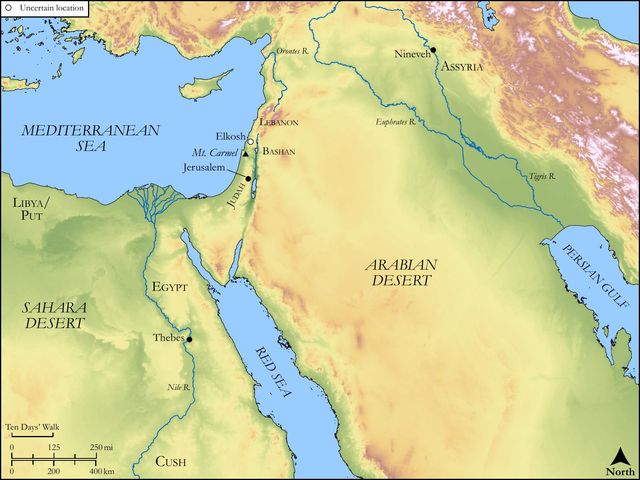
See on the biblical-era map
Study this verse
Public-domain commentary
Matthew Henry
From his Commentary on the Whole Bible. Henry comments on passages, not single verses — this entry covers Nahum 3:1–7. His three-level outline is real structure in the source text, so it is rendered as structure.
Here is, I. Nineveh arraigned and indicted. It is a high charge that is here drawn up against that great city, and neither her numbers nor her grandeur shall secure her from prosecution. 1. It is a city of blood, in which a great deal of innocent blood is shed by unrighteous war, or under colour and pretence of public justice, or by suffering barbarous murders to go unpunished; for this the righteous God will make inquisition. 2. It is all full of lies; truth is banished from among them; there is no such thing as honesty; one knows not whom to believe nor whom to trust. 3. It is all full of robbery and rapine; no man cares what mischief he does, nor to whom he does it: The prey departs not, that is, they never know when they have got enough by spoil and oppression. They shed blood, and told lies, in pursuit of the prey, that they might enrich themselves. 4. There is a multitude of whoredoms in it, that is, idolatries, spiritual whoredoms, by which she defiled herself, and to which she seduced the neighbouring nations, as a well-favoured harlot, and sold and ruined nations through her whoredoms. 5. She is a mistress of witchcrafts, and by them she sells families, Nah 3:4. That which Nineveh aimed at was a universal monarchy, to be the metropolis of the world, and to have all her neighbours under her feet; to compass this, she used not only arms, but arts, compelling some, deluding others, into subjection to her, and wheedling them as a harlot by her charms to lay their necks under her yoke, suggesting to them that it would be for their advantage. She courted them to join with her in her idolatrous rites, to tie them the faster to her interests, and made use of her wealth, power, and greatness, to draw people into alliances with her, by which she gained advantages over them, and made a hand of them. These were her whoredoms, like those of Tyre, Isa 23:15, Isa 23:17. These were her witchcrafts, with which she unaccountably gained dominion. And for this that God has a quarrel with her who, having made of one blood all nations of men, never designed one to be a nation of tyrants and another of slaves, and who claims it as his own prerogative to be universal Monarch.
II.Nineveh condemned to ruin upon this indictment. Woe to this bloody city! Nah 3:1. See what this woe is.
1.Nineveh had with her cruelties been a terror and destruction to others, and therefore destruction and terror shall be brought upon her. Those that are for overthrowing all that come in their way will, sooner or later, meet with their match.
(1.)Hear the alarm with which Nineveh shall be terrified, Nah 3:2. It is a formidable army that advances against it; you may hear them at a distance, the noise of the whip, driving the chariot-horses with fury; you may hear the noise of the rattling of the wheels, the prancing horses, and the jumping chariots; the very noise is frightful, but much more so when they know that all this force is coming with all this speed against them, and they are not able to make head against it.
(2.)See the slaughter with which Nineveh shall be laid waste (Nah 3:3), the sword drawn with which execution shall be done, the bright sword lifted up and the glittering spear, the dazzling brightness of which is very terrible to those whom they are lifted up against. See what havoc these make when they are commissioned to slay: There is a great number of carcases, for the slain of the land shall be many; there is no end of their corpses; there is such a multitude of slain that it is in vain to go about to take the number of them; they lie so thick that passengers are ready to stumble upon their corpses at every step. The destruction of Sennacherib's army, which, in the morning, were all dead corpses, is perhaps looked upon here as a figure of the like destruction that should afterwards be in Nineveh; for those that will not take warning by judgments at a distance shall have them come nearer.
2.Nineveh had with her whoredoms and witchcrafts drawn others to shameful wickedness, and therefore God will load her with shame and contempt (Nah 3:5-7): The Lord of hosts is against her, and then she shall be exposed to the highest degree of disgrace and ignominy, shall not only lose all her charms, but shall be made to appear very odious. When it shall be seen that while she courted her neighbours it was with design to ruin their liberty and property, when all her wicked artifices shall be brought to light, then her shame is discovered to the nations. When her proud pretensions are baffled, and her vain towering hopes of an absolute and universal dominion brought to nought, and she appears not to have been so strong and considerable as she would have been thought to be, then to see the nakedness of the land do they come, and it appears ridiculous. Then do they cast abominable filth upon her, as upon a carted strumpet, and make her vile as the offscouring of all things; that great city, which all nations had made court to and coveted an alliance with, has become a gazing-stock, a laughing stock. Those that formerly looked upon her, and fled to her, in hopes of protection from her, now look upon her and flee from her, for fear of being ruined with her. Note, Those that abuse their honour and interest will justly be disgraced and abandoned, and, because miserable, will be made contemptible, and thereby be made more miserable. When Nineveh is laid waste who will bemoan her? Her trouble will be so great, and her sense of it so deep, as not to admit relief from sympathy, or any comforting considerations; or, if it would, none shall do any such good office: When shall I seek comforters for thee? Note, Those that showed no pity in the day of their power can expect to find no pity in the day of their fall. When those about Nineveh, that had been deceived by her wiles, come to be undeceived in her ruin, every one shall insult over her, and none bemoan her. This was Nineveh's fate, when she was made a spectacle, or gazing-stock. Note, The greater men's show was in the day of their abused prosperity the greater will their shame be in the day of their deserved destruction. I will make thee an example; so Drusus reads it. Note, When proud sinners are humbled and brought down it is designed that others should take example by them not to lift up themselves in security and insolence when they prosper in the world.
Historical interpretation
Historical reception
3 surviving comments on this verse. Each one is dated, so this reads as a timeline rather than a list.
Select a marker to jump to its quote. Markers stagger vertically where authors wrote within a few decades of each other.
Let us mourn with Nahum and let us say with him, “Woe to him that builds up this house [by injustice].” Or rather let us mourn for them as Christ did in his day, when he said, “Woe to you rich, for you are now having your reward and your comfort.” Let us not, I beseech you, cease mourning in this way, and if it is not unbecoming, let us also bewail the apathy of our brothers. Let us not weep loudly for him who is already dead, but let us weep for the robber, the grasping, miserly, greedy man.
(Chapter 3, verses 1 and following) Woe to the city of blood, full of deceit and torn apart. The plunder will not cease. The sound of the whip, the sound of the rattling wheel, the galloping horses and the blazing chariots, the ascending knight and the flashing sword, the gleaming spear and the multitude of the slain, and the weighty destruction. There is no end to the corpses. They will stumble over their own bodies because of the multitude of the prostitute's charming and enticing acts of fornication, and her sorceries which she sold to the nations through her acts of fornication, and her enchantments which she used to deceive the families. LXX: O city of blood, completely deceitful, full of wickedness, the hunting will not touch you: the sound of scourges, and the sound of turning wheels, and of pursuing horses, and of a blazing chariot, of a rider ascending, and a gleaming sword, and of shining armor, and of a multitude of wounded, and of a heavy downfall, and there will be no end to its nations, and they will be weakened in their bodies by the multitude of their fornication. A beautiful and pleasing harlot, leader of wickedness, who sells nations in her fornication, and tribes in her wickedness. Where we have been placed, full of laceration, is called Pherec Malea in Hebrew, which Aquila interpreted as 'full of decapitation', that is, full of excision. Symmachus, on the other hand, interpreted it as 'full of amputation', which we can say is full of cruelty or severity. In another edition of his work, I found 'full of dismemberment', that is, with the sections of flesh and pieces torn through the limbs: finally, he immediately added, where there is uninterrupted prey. The Hebrew scholar Pherec does not interpret it as 'exervicationem', which we find in the edition of Aquila, but as 'gubernaculum', that is, 'governance': to show that the city was royal, and as if it held the governance of all nations like a ship. Its power, that is, Nineveh, is described, and it is condemned under the lamentation of cruelty. Woe, city of blood, in which there is no truth, but all falsehood, full of plunder and tearing of prey. The voice of a cruel whip always and of a raging empire, and the voice of the wheel's momentum. Let us understand the voice as a sound: the roaring wheel, racing through different places, and the snorting horses, and the fiery chariot, are heard in all. However, the description of an army preparing for battle, so beautiful and resembling the Hebrew and the pictures, is worthy of all my speech being considered cheap. For what is said: And heavy is the downfall, and there is no end to the corpses, let us understand it as referring to the adversaries who were killed by them. And they will fall in their own bodies, or they will fall from their multitude, while they crowd themselves together: or they will fall on the corpses of the slain; for it signifies both their own and others'. Because of the multitude, he says, of the harlot's fornications: because she has fornicated with many nations and has cultivated idols of the whole world, which she had subjected to herself. It signifies the beautiful and pleasing, and those having evil deeds, the magicians: who have sold nations in their own fornications, and families in their own evil deeds, that is, those whom she had power over all nations. These things about Nineveh are said simply. But if we understand the name 'world' in a rational manner, because of its beauty, rightly the world, which is situated in evil, is called the city of blood because of the multitude of archers and those who kill people with their tongues like swords. Therefore, consequently, the whole world is a liar, which pertains to the perversity of teachings, not having the word of God, where it should find its foundation, when all perverse doctrines possess it. There is none that understandeth, or seeketh after God: they are all gone out of the way; they are together become unprofitable; there is none that doeth good, no, not one. (Psalm 14:2-3). Although these things are partly done even now, they will be more completely fulfilled in the end, when charity of many shall cool because of the multiplied iniquity. (Matthew 24). How many are caught by the giant Nimrod, the most cruel hunter, who, being proud against God, has ensnared many with the snare of his own vices, of whom many will not touch as prey or game. For he has many followers, and likewise hunters who delight in his hunt, and they stand around him like captives. But the sound of whips is also heard in the world, for there are many tribulations of the just (Psalms 33), to which those who are whipped cry out and testify to the magnitude of their pain with a mournful voice: when one is seized by a demon, another by anger, which is similar to madness, another by desire, hatred, envy, and pride, the whip of the king of Assyria sound in them. But even in bodily ailments, we understand the whip of the devil, concerning which it is said to the just: And the whip will not approach your tent (Ps. XC, 10); when we see this royal disease decay, and its corpse still remaining: one cut open from water, and the body floating while swollen, with the limbs growing, the form of the former man diminishing, which we recently saw in the dissecting room: him expelling certain purulences and the wounds suffered by the damaged lung: him experiencing the dryness of the moisture turned to stones, the bitterness of the urine, and the torments of the bladder, let us not hesitate to say that the voice of the whips is in Nineveh: although some suspect that these things happen either from the corrupted air or from the variety of food and bodies. Let us who read and tremble at the feverishness (Luke IV), and the woman who had been bound by the devil for eighteen years (Ibid., XIII), healed by the Lord, know that all these are scourges for Nineveh. Hence it follows: And the voice of the wheels; while here and there the human race is carried away, uncertainly wandering in all directions, where there is danger, where there is safety, we do not know; concerning which wheel it is also written at the beginning of Ezekiel (Ezek. I): in the seventy-sixth psalm we read: The voice of your thunder is in the wheel (Psalm LXXVI, 19). But Nineveh also has a pursuing horse, whose neighing and hooves digging into the ground and chest boiling, always desires war, while the Lord speaks against the devil. From afar, war can be smelled: it does not spare those who flee with a leap and a cry; it does not allow those who turn their backs to escape; but it pursues in order to overthrow, kill, trample, and crush them. There is also in Nineveh the sound of a steaming chariot, like I imagine Pharaoh had, which were submerged by the Lord (Exodus 14). To this team are harnessed four horses, namely the four disturbances, about which both philosophers argue and Virgil does not remain silent, saying (Virg., VI Aeneid.):
They desire, fear, grieve, and rejoice... With these horses and this chariot, he disturbs all of Nineveh. But also the voice of the mounting knight resounds in it, who, prepared by a certain skill and a circuit, advances to battle not without danger against the one fighting against himself. This knight has a sword of speech, sharpened with the blade of dialectic and smoothed with the oil of rhetorical art: he has shining weapons, Satan transforming himself into an angel of light (II Cor. XI), which are contrary to the arms of apostolic armor. It is not surprising if there is a multitude of wounded in Nineveh, since there is a multitude of arrows. And just as we have four shields with which we fight and protect ourselves, they are the virtues of wisdom, justice, temperance, and courage; similarly, there are four vices: foolishness, injustice, luxury, and fear, with which we are struck by the enemy. Each of these vices contains numerous kinds of arrows that cause wounds. If these wounds are not immediately healed by medicine, they become a heavy burden and, I wish, as heavy as they are in Nineveh, falling lightly and being lightly wounded, they are so great in their weight of ruin that they sink down to the depths of hell. And there is no end to their nations' groaning: their wickedness has no end. As there are so many forms of sins, there are as many nations as Nineveh, which will be weakened in their bodies by the multitude of fornication. Although it can also be understood about those who, due to sexual desires, are also weakened in their bodies, and with the destruction of their soul, they also break the flesh they serve: nevertheless, these nations, of which we have spoken, do not fall, according to the Hebrew, except in their bodies, and do not offend (as Symmachus interpreted) except in the corpses of the dead, which are laid low by the multiplication of fornication. In this place, the 70 interpreters, when we have followed the Hebrew, because of the multitude of the harlot's fornications, wanted there to be another beginning, so that they would say: Before the multitude of fornication; and up to this point is the end of the sentence, afterwards they would begin, a beautiful and pleasing harlot, leader of evils. Aquila and Symmachus translated leader of evils, having evils. And it will not be surprising if Nineveh is now the most pleasing of harlots, who has seen such a great multitude of people fornicate with her, and is almost able to lead everyone to love her through her evils and certain enchantments. These sell nations in their fornications, which take away the members of Christ, and make them the members of a harlot; and they delight in their evil deeds. For they make themselves love those that they ought to hate, and hate those that they ought to love, so that when they are deceived, according to what is written: 'Evil communications corrupt good manners' (1 Corinthians 15:33), they may also overthrow others by their wicked arts. I have read in the Holy Scriptures that even malefactors can be taken in a good sense: 'The wise malefactor enchants' (Psalm 57). But this sorcerer uses such incantations that he can bring back those captivated by the love of a harlot of Nineveh to their right mind.
Woe to the bloody city, all full of lies and injustice. He has called it a city of blood; for those who had reigned in Nineveh were most ready for murder and exceedingly bloodthirsty; and those in it were otherwise warlike, and always eager to make their attacks untamable against whomever they might go. And he says "full of lies," because it was also full of idols, in which falsehood is especially not unproven. For they are falsely named, and the handmade gods steal the glory of divinity, "Silver and gold, according to what is written, the works of men's hands." And the wise Jeremiah somewhere also called it a land of graven images. But "full of lies" might also be understood in another way, with falsehood being understood as villainy and guile and deceit hateful to God, with injustice clearly running alongside. For where there is deceit and guile, there injustice will surely follow. And a city of blood, full of lies and injustice, is also Jerusalem, which killed the Lord. For we remember Christ saying, "O Jerusalem, Jerusalem, who kills the prophets and stones those who are sent to her." And he said somewhere through the voice of the prophets, "Woe to them, because they have departed from me; they are miserable, because they have acted impiously against me; I redeemed them, but they have spoken lies against me." For they have spoken against the glory of Christ, at one time saying that he casts out demons by Beelzebul; at another time calling him a winebibber, and in addition to this, a Samaritan, and things much more shameful. For it would be fitting for their foul mouths alone to babble those things which they have dared to say.
Continue studying Nahum 3:1 across the web’s major study libraries — every link below opens this exact verse, chapter, or book on the destination site.
Read & Compare
 BibleGatewayThis verse in more than 200 translations and 70 languages.
 Bible.comThe YouVersion reader — hundreds of translations, reading plans, and highlights.
 ESV.orgCrossway's official English Standard Version reader.
 NET BibleThe NET translation with 60,000+ translators' notes on every rendering decision.
 STEP BibleTyndale House's free study tool — original text, vocabulary, and scholarly resources.
 BibliaLogos Bible Software's free web reader.
 USCCBThe New American Bible (Revised Edition) with the U.S. bishops' study notes.
Commentaries
 BibleHub CommentariesDozens of classic commentaries on this verse, gathered on one page.
 StudyLightMore than 100 commentary sets — the largest collection on the web.
 BibleRefPlain-English commentary on what this verse means, verse by verse.
 Enduring WordDavid Guzik's free commentary on this chapter, widely used by Bible teachers.
 Bible Study ToolsVerse commentary alongside Greek and Hebrew study aids.
Original Language & Research
- BibleHub InterlinearThe verse word by word — original language, transliteration, and English.
- BibleHub LexiconEvery word's original-language definition and Strong's entry.
 Blue Letter BibleDeep-study tools — Strong's numbers, concordance, and word studies.
 SefariaThe Hebrew text with Rashi and centuries of Jewish commentary.
Sermons, Hymns & Audio


TrulyRandomVerse is not affiliated with these sites and doesn’t control their content. They’re linked because they’re genuinely useful.
Summary
Nahum 3:1 opens with a stark prophetic indictment against Nineveh, the capital of the Assyrian Empire, declaring a "woe" upon it. The verse vividly portrays the city as utterly steeped in violence, deception, and relentless plunder, a place where the spoils of its conquests never cease. This pronouncement immediately establishes the prophet's central message: God's righteous judgment is imminent upon a city whose very foundation is built upon bloodshed, lies, and rapacious exploitation, signaling the inevitable downfall of a wicked and unrepentant empire.
Context
ShowHideLiterary Context
Nahum 3:1 serves as the dramatic opening of the second major section of the book, which focuses on the explicit reasons for Nineveh's impending destruction, following the initial declaration of God's character and general judgment in Nahum 1 and the detailed description of Nineveh's siege and fall in Nahum 2. This verse shifts from the "how" of Nineveh's destruction to the "why," laying bare the city's profound moral depravity. It sets the stage for the graphic descriptions of Nineveh's demise that follow, emphasizing that its end is a just consequence of its inherent wickedness, particularly its relentless cruelty and deceit. The "woe" pronouncement is a common prophetic literary device, signaling a solemn curse or judgment against a person, city, or nation, often preceding a detailed list of their offenses.
Historical & Cultural Context
The prophecy of Nahum is directed against Nineveh, the formidable capital of the Neo-Assyrian Empire, which was the dominant superpower of that day from the 9th to the 7th centuries BCE. Assyria was notorious for its brutal military campaigns, its policy of mass deportation, and its cruel treatment of conquered peoples, including the Northern Kingdom of Israel (which it had destroyed) and the Southern Kingdom of Judah (which it had severely oppressed, as seen in 2 Kings 18-19). Nineveh itself was a massive, heavily fortified city, a symbol of Assyrian might and imperial ambition. The prophet's message would have been delivered around 630-612 BCE, a period when Assyria's power was beginning to wane, but it still posed a significant threat. The description of Nineveh as "bloody" and "full of lies and robbery" accurately reflects its historical reputation as a ruthless, predatory empire that thrived on conquest and plunder, often achieved through deceitful treaties and overwhelming force.
Key Themes
ShowHideThis verse powerfully contributes to several key themes within the book of Nahum and broader biblical theology. Firstly, it underscores the theme of Divine Justice and Sovereignty, demonstrating that no nation, however powerful, is beyond God's judgment for its persistent wickedness. Nineveh's depravity, characterized by "bloodshed" and "lies and robbery," illustrates the theme of Moral Corruption and Unrepentance. Unlike its temporary repentance in Jonah 3, Nineveh has reverted to its violent ways, highlighting the cyclical nature of sin and the ultimate consequences of unaddressed evil. Finally, the verse implicitly points to the theme of God's Vindication of the Oppressed. While not explicitly stating it, the judgment pronounced against Nineveh serves as a divine assurance to those who suffered under Assyrian tyranny that God sees their affliction and will bring retribution upon their oppressors, affirming God's character as a righteous judge who defends the vulnerable, as echoed in Psalm 9:9-10.
Exposition and Analysis
ShowHideKey Word Analysis
ShowHideThis interjection (H1945) is a lament, a cry of sorrow, or a dire warning of impending doom. It is a common prophetic declaration, signaling a curse or judgment, often used to express grief over a coming catastrophe or to denounce moral corruption. Here, it functions as a solemn pronouncement of condemnation against Nineveh, emphasizing the certainty and severity of its impending judgment.
Derived from the root for "blood" (H1818), this term, often used in the plural (dâmîm), signifies not just the presence of blood but extensive bloodshed, violence, and the guilt associated with murder and wanton destruction. It points to Nineveh's history of military aggression, mass slaughter, and the pervasive violence that characterized its empire-building and maintenance. The city is not merely stained with blood; it is defined by it.
This word (H2964) refers to something torn, plunder, or food obtained by tearing. In this context, it vividly describes the spoils of war, the wealth and resources violently seized from conquered nations. The phrase "the prey departeth not" emphasizes Nineveh's insatiable appetite for plunder and its relentless, continuous acquisition of wealth through violent means, suggesting a city perpetually engaged in rapine and exploitation.
Verse Breakdown
ShowHide"Woe to the bloody city!"
This opening exclamation immediately sets a tone of divine condemnation. The term "woe" (H1945) is a prophetic lament and a declaration of impending judgment. "Bloody" (H1818) refers to the extensive bloodshed and violence that characterize Nineveh's history and identity. It signifies a city saturated with the guilt of countless acts of murder, conquest, and oppression, marking it as an object of God's righteous wrath.
"it [is] all full of lies [and] robbery;"
This clause further elaborates on Nineveh's profound moral corruption. The city is not merely stained by violence but is entirely permeated by deceit ("lies," H3585, implying hypocrisy and treachery) and rapacious plunder ("robbery," H6563, conveying violent tearing apart and seizure). This indicates that Nineveh's power and wealth were built on a foundation of both strategic deception and brutal exploitation, reflecting a pervasive lack of integrity and an insatiable greed.
"the prey departeth not;"
This phrase underscores the relentless and continuous nature of Nineveh's predatory behavior. "Prey" (H2964) refers to the spoils of war and the victims of its aggression. The declaration that the prey "departeth not" (H4185) means that the city is perpetually engaged in plundering, constantly acquiring new victims and wealth through its military might. It paints a picture of an empire whose very existence depends on ceaseless conquest and exploitation, never satisfied with its gains.
Literary Devices
ShowHideNahum 3:1 employs several powerful literary devices to convey its message of judgment. The most prominent is Apostrophe, a direct address to an absent or personified entity, as the prophet directly pronounces "Woe to the bloody city!" This direct address imbues the pronouncement with immediacy and solemnity. Hyperbole is evident in the description of the city as "all full of lies and robbery," emphasizing the pervasive and overwhelming nature of Nineveh's corruption rather than a literal saturation. This exaggeration highlights the city's complete moral bankruptcy. Furthermore, Metonymy is used where "bloody" represents the city's actions and character (bloodshed), and "prey" stands for the victims and spoils of its conquests. The phrase "the prey departeth not" also functions as Synecdoche, where a part (the departing prey) represents the whole process of continuous plunder and exploitation.
Theological and Thematic Connections
ShowHideNahum 3:1 profoundly articulates God's unwavering justice against nations characterized by pervasive violence, deceit, and oppression. It serves as a stark reminder that divine patience has limits and that unchecked wickedness will inevitably incur divine judgment. The verse highlights that God is not indifferent to human suffering or the abuse of power, but actively intervenes in history to bring accountability to those who perpetrate injustice. This theological truth assures believers that despite the apparent triumph of evil in the world, God's moral order will ultimately prevail, and His righteous character will be vindicated.
Reflection and Application
ShowHideNahum 3:1 confronts us with the sobering reality of divine judgment against unrepentant wickedness, urging us to consider its implications for our own lives and societies. The characteristics attributed to Nineveh—bloodshed, lies, and robbery—are not confined to ancient empires but manifest in various forms today, from pervasive injustices and economic exploitation to personal deceit and violent tendencies. This verse calls us to a rigorous self-examination, prompting us to ask whether our own hearts or communities harbor similar sins, even in subtle forms. It reminds us that true flourishing, whether for an individual or a nation, cannot be built on foundations of violence, falsehood, or insatiable greed. Instead, it must be rooted in justice, truth, and compassion. Ultimately, this passage offers a profound assurance that God is actively engaged in the affairs of humanity, and His justice will ultimately prevail, providing hope for the oppressed and a warning to the oppressor.
Questions for Reflection
ShowHideFAQ
ShowHideWhy is Nineveh called "the bloody city"?
ShowHideNineveh is called "the bloody city" because it was the capital of the Neo-Assyrian Empire, which was infamous for its brutal military campaigns, massacres, and cruel treatment of conquered peoples. The term "bloody" (H1818, dâm') signifies not just the shedding of blood but the pervasive guilt and violence that characterized the city's history and the empire's policies. Their expansion and maintenance of power were built upon relentless aggression and the systematic oppression of other nations, leaving a trail of bloodshed and devastation among the nations round about, as detailed throughout the historical books of the Old Testament (e.g., 2 Kings 18).
What does "the prey departeth not" mean in this context?
ShowHideThe phrase "the prey departeth not" (H2964, ṭereph' for prey; H4185, mûwsh' for departeth) vividly illustrates Nineveh's insatiable and continuous appetite for plunder and exploitation. It means that the city was constantly engaged in acquiring spoils of war, wealth, and resources from its victims, never ceasing its predatory activities. This highlights Nineveh's relentless pursuit of material gain through violent means, signifying a city whose very existence and prosperity were dependent on the perpetual subjugation and robbery of others. It portrays an empire that was never satisfied with its conquests but always sought more "prey."
Is this prophecy relevant today, given that Nineveh no longer exists?
ShowHideYes, this prophecy remains highly relevant today, even though ancient Nineveh has long since fallen. Nahum 3:1 articulates timeless principles about divine justice and the consequences of unchecked wickedness. It serves as a powerful reminder that God holds nations and individuals accountable for their actions, particularly for violence, deceit, and oppression. The characteristics of Nineveh—a city built on bloodshed, lies, and robbery—are archetypal of any society or system that prioritizes power and gain over justice and truth. Thus, the prophecy offers a universal warning against such depravity and provides assurance that God is sovereign over history, ultimately bringing justice to bear against all forms of evil, as seen in the ultimate judgment described in Revelation 18.
Christ-Centered Fulfillment
ShowHideWhile Nahum 3:1 directly condemns Nineveh, its pronouncement of "woe" against a city steeped in bloodshed, lies, and robbery finds its ultimate resolution and antithesis in the person and work of Jesus Christ. The "bloody city" represents the culmination of human sin and rebellion, a world stained by violence and deceit. Christ, however, is the very embodiment of truth and righteousness, the one in whom there is no lie (John 14:6). He did not come to plunder or oppress, but to give His life as a ransom for many (Mark 10:45). The "bloody" nature of Nineveh, built on the shedding of innocent blood, stands in stark contrast to the innocent blood of Christ, which was shed not for conquest but for the forgiveness of sins, establishing a new covenant of grace (Hebrews 9:22). Furthermore, the "prey" that never departs from Nineveh speaks of ceaseless exploitation; yet, Christ, as the Good Shepherd, protects His flock from predators and gathers His own, offering eternal security and true freedom from the bondage of sin and death (John 10:11). Ultimately, while Nahum prophesied the judgment of a wicked city, Christ will return as the righteous judge, not only to condemn all forms of "bloody" and deceitful systems but also to establish His kingdom of perfect justice and peace, where truth reigns and exploitation is no more (Revelation 19:11-16).