


Zephaniah 2:10
Bible text: King James Version (1769 Blayney text) · Public domain
Bible text: Berean Standard Bible · Public domain
Bible text: American Standard Version (1901) · Public domain
Bible text: World English Bible, Messianic edition · Public domain
Bible text: Geneva Bible (1599) · Public domain
Bible text: Young's Literal Translation · Public domain
- זֹאתzotthisH2063PrtParticle Demonstrative
- לָהֶםla·Hem[will belong] to themPrep-l ¦ 3mpSuffix Personal 3rd Plural Masculineלָ[will belong] toהֶםthem
- תַּחַתTa·chatin place ofH8478N-mscNoun Singular Masculine Construct
- גְּאוֹנָםge·'o·Namtheir prideH1347N-msc ¦ 3mpNoun Singular Masculine Constructגְּאוֹנָprideםtheir
- כִּיkiforH3588PrtParticle Conditional
- חֵרְפוּche·re·Futhey reproachedH2778V-Piel-Perf-3cpVerb Piel Perfect 3rd Plural common gender
- וַיַּגְדִּלוּvai·yag·Di·luand they magnified themselvesH1431Conj-w ¦ V-Hiphil-ConsecImperf-3mpVerb Hiphil Consecutive Imperfect 3rd Plural Masculineוַandיַּגְדִּלוּthey magnified themselves
- עַל'alonH5921PrepPreposition
- עַם'am[the] people ofH5971N-mscNoun Singular Masculine Construct
- יְהוָהYah·wehYahwehH3068N-properNoun Proper Title
- צְבָאוֹתtze·va·'otof hostsH6635N-fpNoun Plural Feminine Absolute
English is a literal word-by-word gloss of the Hebrew, not the KJV's wording. Why?
This is the original text the KJV's translators worked from — each Hebrew word with its own literal English meaning in this verse, prepared by scholars at Tyndale House, Cambridge. The KJV translates whole sentences, not word by word, so its wording differs: one Hebrew word can become several English words, and the KJV may choose “the LORD” where the gloss reads “Yahweh”. Both are faithful — they answer different questions. For the KJV's own rendering, switch to the KJV text.
Details
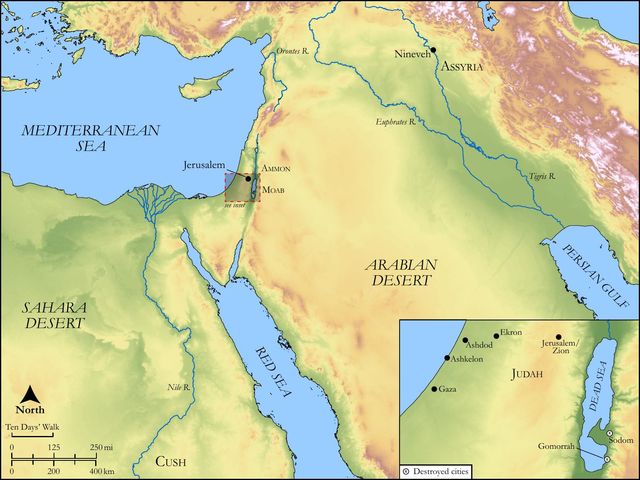
See on the biblical-era map
Study this verse
Public-domain commentary
Matthew Henry
From his Commentary on the Whole Bible. Henry comments on passages, not single verses — this entry covers Zephaniah 2:8–11. His two-level outline is real structure in the source text, so it is rendered as structure.
The Moabites and Ammonites were both of the posterity of Lot; their countries joined, and, both adjoining to Israel, they are here put together in the prophecy against them.
I.They are both charged with the same crime, and that was reproaching and reviling the people of God and triumphing in their calamities (Zep 2:8): They have reproached my people; while God's people kept close to their duty it is probable that they reproached them for the singularities of their religion; and now that they had revolted from God, and fallen under his displeasure, they reproached them for that too. It has been the common lot of God's people in all ages to be reproached and reviled upon one account or other. Thus the old serpent spits his venom; and pride is at the bottom of it; it is in their pride that they have magnified themselves against the people of the Lord of hosts, thinking themselves as good as they, as great, and every way as happy. It is the comtempt of the proud that God's people are filled with, Psa 123:4. They have spoken big (so some read it, magna locuti sunt - they have spoken great things) against their border (Zep 2:8), against those of them that bordered upon their country, whom upon all occasions they insulted, or against the property they claimed, which they disputed, or the protection they boasted of, which they ridiculed; they spoke big against the people of the Lord of hosts as a deserted abandoned people. Great swelling words of vanity are the genuine language of the church's enemies. "But I have heard them" (says God), "and will let you know that I have heard them. I have heard, and I will reckon for them," Jde 1:15. And, if God hears the reproaches and revilings we are under, it is a good reason why we should be as a deaf man that hears not, Psa 38:14, Psa 38:15. Nay, God not only takes notice of, but interests himself in the reproaches cast on his people, because they are his; and it is certain that those who look with disdain upon the people of the Lord of hosts thereby dishonour the Lord of hosts himself. See this very thing charged on Moab and Ammon, Eze 25:3, Eze 25:8.
II.They are both laid under the same doom.
Associates in iniquity may expect to be such in desolation. See with what solemnity sentence is pronounced upon them, Zep 2:9. It is the Lord of hosts, the sovereign Lord of all, who has authority to pass this sentence and ability to execute it; it is the God of Israel, who is jealous for their honour; it is he that has said it, nay, he has sworn it, As I live, saith the Lord. The sentence is,
1.That the Moabites and Ammonites shall be quite destroyed; they shall be as Sodom and Gomorrah, the marks of whose ruins in the Dead Sea lay near adjoining to the countries of Moab and Ammon; they shall, though not by the same means (even fire from heaven), Yet almost in the same manner, be laid waste; not again to be inhabited, or not of a long time. The country shall produce nothing but nettles, instead of corn; and there shall be brine-pits, instead of the pleasant fountains of water with which the country had abounded.
2.That Israel shall be too hard for them, shall spoil them of their goods and possess their country by lawful war. Note, Proud men sometimes, by the just judgment of God, fall under the mortification of being trampled upon themselves by those whom once they haughtily trampled upon. And this shall they have for their pride.
III.Other nations shall in like manner be humbled, that the Lord alone may be exalted (Zep 2:11):
The Lord will be terrible unto the Moabites and Ammonites in particular, who have made themselves a terror to his Israel. For,
1.Heathen gods must be abolished. They have long had possession, and their worshippers have both glorified them and gloried in them. But the Lord will famish all the gods of the earth, will starve them out of their strong-holds. The Pagans had a fond conceit that their idols were regaled by their offerings, and did eat the fat of their sacrifices, Deu 32:38. Omnia comesta Belo - Bel has eaten all. But it is here promised that when the Christian religion is set up in the world men shall be turned from the service of these dumb idols, shall forsake their altars, and bring no more sacrifices to them, and thus they shall be famished, or made lean (as the word is), their priests shall. This intimates the vanity of those idols; it lies in the power of their worshippers to famish them; whereas the true God says, If I were hungry, I would not tell thee. It intimates also the victory of the God of Israel over them. Now know we that he is greater than all gods.
2.Heathen nations must be converted; when the gospel gets ground, by it men shall be brought to worship him who lives for ever (for that is the command of the everlasting gospel, Rev 14:7), every one from his place; they shall not need to go up to Jerusalem to worship the God of Israel, but wherever they are, they may have access to him. I will that men pray every where. God shall be worshipped, not only by all the tribes of Israel and the strangers who join themselves to them, but by all the isles of the heathen. This is a promise which looks favourably upon our native country, for it is one of the most considerable of the isles of the Gentiles, by which God will be glorified.
Historical interpretation
Historical reception
1 surviving comment on this verse from the historical church.
(Ver. 8 onwards) I have heard the reproach of Moab and the blasphemies of the sons of Ammon, who have reproached my people and magnified themselves against their borders. Therefore, as I live, says the Lord God (God remains silent), the Lord of hosts, the God of Israel: Moab shall be like Sodom, and the sons of Ammon like Gomorrah, a land of thorns and salt pits, and a desolation forever. The remnant of my people shall plunder them; the survivors of my nation shall possess them. This will happen to them because of their pride, for they have blasphemed and exalted themselves above the people of the Lord of hosts. The Lord will be terrible against them; He will destroy all the gods of the earth, and men from their places will worship Him, even all the coastlands of the nations. I have heard the reproach of Moab, and the insults of the people of Ammon, with which they have reproached My people and exalted themselves against their borders. Therefore, as I live, says the Lord of hosts, the God of Israel, surely Moab shall be like Sodom, and the people of Ammon like Gomorrah, a possession of nettles and salt pits, and a perpetual desolation. The remnant of My people shall plunder them, and the remainder of My nation shall possess them. This shall be their lot in return for their pride, because they have reproached and exalted themselves against the Lord of hosts. The Lord will be known to them; He will destroy all the gods of the nations on the earth, and men from their places will worship Him, even all the coastlands of the nations. Except for the prophet Daniel, who frequently sees visions of four kingdoms and explains their differences using various images (Dan. VIII), Isaiah, Jeremiah, and Ezekiel also do this, so that after seeing the vision of Judah against the other nations surrounding it, they prophesy and proclaim what will happen to them according to the specific events, and they dwell on the description of these events for a longer time. Now the prophet Zephaniah does the same, although briefly, in the same manner. For against the Philistines, against whom the previous threat has been made, he says, 'Gaza shall be destroyed, and Ascalon shall be turned into a desert, Ashdod shall be driven away to the south, and Accaron shall be uprooted.' Now a prophecy is woven against Moab and the sons of Ammon, or as it has been added in the Septuagint, against Damascus, which is called Aram in Isaiah (Chapter 17), because they, who had offered aid to Nebuchadnezzar, devastated Judah, trampled on its sanctuary, and even destroyed the temple, and having subjugated the people of Israel, they blasphemed the Lord. Indeed, Nebuchadnezzar and the Chaldeans, after destroying the cities of the Jews, oppressed other nations, and so it happened that those who had insulted the people of God were themselves pressed by the same distress of evils, and held captive Judah, whom they thought they had subjected. Therefore, before the captivity came under King Josiah, while Jerusalem and the temple were still standing, a prophecy is directed against the insolent, so that the evils that once afflicted the people of God would be alleviated by the evils of other nations. I heard, he said, the reproach of Moab, which is now called Areopolis, and the blasphemies of the sons of Ammon, which itself is also called the second city of Arabia after Bosra Philadelphia: in which they reproached my people, and having expelled the Jews, they extended their borders in their land. Therefore, because they blasphemed me and reproached my people, I, the Lord of hosts, who am able to fulfill what I threaten, and the God of Israel, who myself suffer injury among my people, will make Moab like Sodom, and the sons of Ammon like Gomorrah. We find such visions in Isaiah and Jeremiah, and we will find the same things that we now read here. The dryness of thorns and heaps of salt, and a desert forever, for which I do not know why the Seventy translated Damascus as uprooted and abandoned, unless I am mistaken, deceived by the ambiguity of the word: for the dryness that is said in Hebrew Mamasac (), if the first letter Mem is changed and Dalath is taken, has the same remaining letters as Damascus, and can be read instead of the previous word Damasec. But it is asked how these cities, that is, Moab and the sons of Ammon, were reduced to Sodom and Gomorrah, and as dry as thorns and heaps of salt, they will not be built again forever? And indeed, there is no difficulty in explaining that they were laid waste like Sodom and Gomorrah. However, what follows: They will be deserted forever, we interpret either as the destruction of their kingdom (because they were later overthrown by the Chaldeans and lost their kingdom, and then were either attacked by the Antiochians or the Ptolemies, and finally submitted their necks to the Roman Empire), or certainly it must be taken exceedingly: for Lolam signifies both eternity and age: from which it can be understood as referring to one age, or for some time, or one generation. And those who remain from the people of Israel shall be devastated, and they shall possess the blasphemous aid once of the Chaldeans. But this shall happen to them because of their pride, for they have blasphemed and magnified themselves against the people of the Lord of hosts, who will be terrible over them, and his terror will not destroy the proud. He will not shed the blood of blasphemers, but he will destroy and weaken all their idols, so that those who were previously held by error and did not feel the blessings of the Lord, pressed by the necessity of evils, may know that idols are of no use and may each worship him from his own place, all the islands of the nations. So far according to the Hebrew. Now let us turn to the Septuagint interpreters, and let us compel the Jews, who only follow the history, to explain to us when Moab and the sons of Ammon became like Sodom and Gomorrah, and like a heap of ruins, and deserted forever; they should show the sulphurous rains, the vineyards, the land turned into ashes and dust, the sea that once was a well of salt, now called the Dead Sea, flooded: when the Jews plundered them, when the remaining Israelite nations possessed them. But what is the indignation of the Lord against blasphemy and insults? Not against Moab and Ammon, but against the whole earth, so that every person from their own place may worship Him, all the islands of the nations? What is more, He grants more favor to those who blaspheme, so that they may turn from error to salvation. But if they wish to say that after the return from Babylon these nations were subject to the people of Israel, first we will demand the authority of the Scriptures, from which they can prove this: then, when they are unable to demonstrate it, we will grant them that it happened as they say: that it was the justice of God to blaspheme the ancestors and reproach the forefathers, and then repay it to the grandchildren. Since certainly that statement, which was previously said in the Law, that the sins of the fathers will be visited upon the children in the third and fourth generation (Exodus 20), is dissolved by Ezekiel: 'As I live,' says the Lord, 'this parable shall no longer be spoken; but the soul that sins, it shall die' (Ezekiel 18:20). And at the same time, observe that it is a parable that has been spoken, and it does not mean what the words on the surface suggest. But if it is unjust to impute to grandchildren the sins of their grandfather that they have committed, how much more unjust is it for the folly of the Jews to hope for this to happen at the end of the world, when it is not their Christ, as they suppose; but the Antichrist that is to come. For whenever they are pressed in history, so that they may teach that what has been said is completed, they immediately leap to future times of Christ, and they promise and say to themselves after many centuries all the things that they cannot explain, and that Moab, and the sons of Ammon, and Egypt, and the Philistines, and Edom, which now insult the Jews, will be punished at that time. Let us therefore ask them why God punishes these nations in particular, and not the entire world in which the Jews have been scattered far and wide. For if Moab deserves rebuke, insulting the Jews, and the sons of Ammon and the other nations around, why isn't Gaul rebuked? why doesn't he threaten Britain? why is Spain exempt from punishment? for what reason is nothing said about Italy? why is Africa silent? and to say it once, when the whole world holds the Jews captive, why do only the nations that are around it commit so much wickedness, to the point that they are particularly named? Now, as for what we said before, that Damascus is not named in Hebrew either by the Prophet, or by any of the other Prophets anywhere when predicting what will happen to the Gentiles, we will also prove from the very order of the Scripture. For in connection with the words: 'I have heard the reproach of Moab, and the blasphemies of the children of Ammon', he adds immediately afterwards: 'because Moab will be as Sodom, and the sons of Ammon as Gomorrah.' Therefore, what follows: 'And Damascus, deserted, like a heap of grain, should have sent something from Damascus, as he had said about two nations: Moab will be like Sodom, and the sons of Ammon like Gomorrah, whose sins he had already mentioned: thus he would have described the insults or blasphemies of the Damascenes, so that it would appear fitting to inflict punishment afterwards. But even this itself that is said: 'Like a heap of grain', which in Greek is said ὡς θιμωνία ἁλὸς, we think were translated by the LXX as ἁλὸς, that is, of salt; but by the uneducated, who mistook θιμωνίαν, that is, a heap of grain or produce, for ἁλὸς, adding the two letters ω and ν, as if to indicate the abundance of produce, ἅλωνος, that is, of a threshing floor, was used. It is said about the variety and error of interpretation, and about the difficulty of history. However, the learned man compares spiritual things with spiritual things, and does not seek the things that are below, but the things that are above, and with Christ rises from the underworld, and taking off the old man, puts on the new, he will bring accusations against the teachers of the contrary doctrines of the Church, who themselves also seem to be of the lineage of Abraham, and to have escaped the fire of Sodom and Gomorrah, and to dwell in the city of Segor. But because their generation is in darkness, and they cannot see the light of truth (for they have turned away from God the Father, which is interpreted from the names Lot and Moab), and they have ceased to be the sons of God (which is called my people), and they have stood still in a dark cave conceived from incestuous marriages: therefore, even to this day, insulting the simplicity of the children of Judah, they desire to magnify their possession beyond its boundaries, of which it is said in Proverbs: Do not move the everlasting boundaries, which your fathers have set (Prov. XXII, 28). See heretics in dialectics, applauding themselves in rhetoric and in all the dogmas of sophisms, despising the simplicity of the Church, and considering it unworthy of their mysteries, which they have imagined as idols for themselves, and mocking them as worthless. And you do not seek out what are the reproaches of Moab and the insults of the sons of Ammon, in which they reproached the people of God. Therefore, the Lord swore by Himself, saying: As I live, says the Lord. And beautifully to distinguish the dead gods, who are called idols, God of Israel speaks of Himself as living, that is, the God of the people who see Him: and thus these nations, that is, Moab and the sons of Ammon, of whom we have spoken above, are blaspheming. They will be like Sodom and Gomorrah, not because they come from Sodom and Gomorrah, but because they blaspheme the people of God and act against Israel. They will be reckoned as Sodom and Gomorrah, and they will be destroyed in the same way as those cities were destroyed before, having no trace of strength and life. It is no wonder if we understand this about heretics, since they are considered like Sodom and Gomorrah, as it is also said to the ecclesiastics who did not observe God's commandments and have departed from his precepts, through Isaiah: Hear the word of the Lord, you rulers of Sodom, and give ear to the law of the Lord, you people of Gomorrah (Isaiah 1:10). And to the elders desiring to corrupt the chastity of the Church under the guise of Susanna, Daniel says: This is the judgment of God: the seed of Canaan, and not of Judah (Daniel 13). And so that you may know that whenever Sodom and Gomorrah and Egypt are mentioned, it is not about those provinces that we see with our eyes, but about other spiritual things that the prophetic discourse warns us about: read in the Apocalypse of John: The place in which the Lord was crucified is spiritually called Sodom and Egypt (Rev. XI, 8). Therefore, if Jerusalem, in which the Lord was crucified, is spiritually called Sodom and Egypt, why should not, on the other hand, Egypt and Sodom and Gomorrah, if they have done the works of Jerusalem and the land of Judah, be transferred to the land of the Lord's inheritance? Finally, David was not of the priests, nor was he allowed to eat the showbread (I Sam. 21), but because his works were increasing one by one, and Saul's persecution was advancing his virtues, therefore in his flight he doesn't hesitate, suddenly he becomes a high priest, and he receives the showbread, and he does not violate God's command. We have said all of this because Moab will be like Sodom, and the sons of Ammon like Gomorrah. Damascus, which also means 'drinking blood' or 'blood shed,' will be abandoned by God's mercy, like a heap of salt. For since its ruler is King Aretha, and the people of Damascus want to kill Paul, and he is let down through the wall in a basket (Acts 9), it is not said to Damascus: You are the salt of the earth; nor is that called salt, which is always offered in sacrifices, but rather that which is tasteless and about which it is written in the Gospel: But if salt has lost its taste, with what shall it be salted? It is useless, neither for the earth, nor for the dung heap; but it is thrown out, so that it may be trampled underfoot by men (Matthew 5, 13). And so Moab, and Ammon, and Damascus, who prepared themselves against the knowledge of the Lord, and blasphemed the people of God, and said many insults against him, and wanted to extend their boundaries in the land of the Church, and possess the people of God, they will be deserted and destroyed, and the remaining people of God, that is, the men educated in the Holy Scriptures, will plunder them, and the remaining of the Lord's people will possess them, and this will be their disgrace, because they reproached and magnified themselves against the Almighty Lord. See the mercy, see the compassion of the Lord: His boundaries are insulted, He is blasphemed, His territories are plundered. And what does He do? He sends to the remnants of His people, of whom we have spoken, to divide those who blaspheme against Him, and to lead them into His possession. For it is much better for a fool to serve the wise, and for his foolishness to be corrected by the wisdom of the Lord, than for him to be abandoned to his own foolishness. Therefore, the almighty Lord will come, and He will be more clearly revealed to those who now do not know Him, whom they are ignorant of. And He will destroy all doctrines, that is, their gods, and the idols of the various nations, so that when the statues, which they had composed in their own understanding, are demolished, the nations may turn to the Lord, and each one may worship Him in his own place whom they did not know before.
Continue studying Zephaniah 2:10 across the web’s major study libraries — every link below opens this exact verse, chapter, or book on the destination site.
Read & Compare
 BibleGatewayThis verse in more than 200 translations and 70 languages.
 Bible.comThe YouVersion reader — hundreds of translations, reading plans, and highlights.
 ESV.orgCrossway's official English Standard Version reader.
 NET BibleThe NET translation with 60,000+ translators' notes on every rendering decision.
 STEP BibleTyndale House's free study tool — original text, vocabulary, and scholarly resources.
 BibliaLogos Bible Software's free web reader.
 USCCBThe New American Bible (Revised Edition) with the U.S. bishops' study notes.
Commentaries
 BibleHub CommentariesDozens of classic commentaries on this verse, gathered on one page.
 StudyLightMore than 100 commentary sets — the largest collection on the web.
 BibleRefPlain-English commentary on what this verse means, verse by verse.
 Enduring WordDavid Guzik's free commentary on this chapter, widely used by Bible teachers.
 Bible Study ToolsVerse commentary alongside Greek and Hebrew study aids.
Original Language & Research
- BibleHub InterlinearThe verse word by word — original language, transliteration, and English.
- BibleHub LexiconEvery word's original-language definition and Strong's entry.
 Blue Letter BibleDeep-study tools — Strong's numbers, concordance, and word studies.
 SefariaThe Hebrew text with Rashi and centuries of Jewish commentary.
Sermons, Hymns & Audio


TrulyRandomVerse is not affiliated with these sites and doesn’t control their content. They’re linked because they’re genuinely useful.
Summary
Zephaniah 2:10 declares a severe divine judgment upon the nations of Moab and Ammon, and by extension, all who exhibit contemptuous arrogance against God's chosen people. This verse underscores that their downfall is a direct consequence of their excessive pride, manifested in their verbal abuse and self-exaltation directed at the people belonging to the Almighty God, the Lord of hosts. It serves as a powerful testament to God's unwavering commitment to defending His covenant community and His ultimate sovereignty over all nations.
Context
ShowHideLiterary Context
Zephaniah 2:10 is embedded within a broader prophetic oracle concerning God's judgment on surrounding nations, immediately following a detailed pronouncement against the Philistines (Zephaniah 2:4-7) and a specific condemnation of Moab and Ammon (Zephaniah 2:8-9). The preceding verses establish the nature of their offenses—mocking, taunting, and encroaching upon the territory of God's people. Verse 10 serves as the culminating declaration of the reason for their impending desolation, linking their pride and reproach directly to their punishment. This section of Zephaniah's prophecy (chapter 2) contrasts sharply with the initial, sweeping judgment on Judah (Zephaniah 1) and sets the stage for the universal judgment and eventual restoration described in chapter 3.
Historical & Cultural Context
Zephaniah prophesied during the reign of King Josiah (Zephaniah 1:1), a period of significant geopolitical flux among the nations round about Judah. The Assyrian Empire, which had long dominated the region, was in decline, creating a power vacuum. This led to increased assertiveness from smaller nations like Moab and Ammon, who seized opportunities to expand their territories and assert their influence, often at the expense of Judah. Historically, Moab and Ammon were perennial adversaries of Israel, rooted in ancient conflicts (e.g., Numbers 22-24 and Judges 3). Their actions described in Zephaniah—reproaching and magnifying themselves against God's people—reflect a long-standing pattern of hostility, including territorial incursions and verbal taunts, which were deeply offensive in the cultural context where honor and shame played significant roles. Such acts were not merely political but were seen as an affront to the God whom Israel served.
Key Themes
ShowHideThis verse powerfully contributes to several key themes within Zephaniah and the broader biblical narrative. Firstly, it highlights the theme of Divine Judgment on Pride. God consistently opposes the arrogant, and their self-exaltation is a direct affront to His supreme authority, as seen in passages like Proverbs 16:18. Secondly, it emphasizes God's Protection of His People. The nations are condemned precisely because they "reproached and magnified themselves against the people of the LORD of hosts." This underscores God's unwavering commitment to defending His covenant people, viewing any attack or scorn directed at them as an attack on Himself, as articulated in Zechariah 2:8. Thirdly, the use of the title "LORD of hosts" (YHWH Sabaoth) reinforces the theme of God's Absolute Sovereignty and Power. This title, signifying God's command over heavenly and earthly armies, assures that those who defy His people are defying the Almighty Ruler of the universe, ensuring their ultimate downfall and the triumph of His divine justice.
Exposition and Analysis
ShowHideKey Word Analysis
ShowHideThis term denotes arrogance, insolence, and haughtiness in this context, though it can also refer to majesty or excellency. Here, it specifically captures the self-exaltation and overweening confidence of Moab and Ammon, which led them to despise and mock God's chosen people. It signifies a spiritual posture of self-sufficiency and defiance against divine authority.
This word means to taunt, defy, scorn, or defame. It points to the verbal abuse, ridicule, and contempt that Moab and Ammon hurled at the people of the Lord. This was not merely casual insult but a deliberate act of shaming and dishonoring, intended to undermine their morale and their trust in God.
While often meaning "to be great" or "to grow," in this context, it implies self-exaltation, boasting, and lifting oneself up in defiance. It describes the nations' inflated sense of their own power and importance, which led them to look down upon and act aggressively against God's people, believing themselves superior.
Verse Breakdown
ShowHide"This shall they have for their pride"
This opening clause immediately establishes the cause-and-effect relationship between the nations' attitude and their impending judgment. The "this" refers to the desolation and ruin described in the preceding verses (Zephaniah 2:8-9). Their "pride" (Hebrew: gâʼôwn) is identified as the root sin, indicating that their arrogance and haughtiness are the primary reasons for God's severe retribution. It highlights that divine judgment is not arbitrary but a just response to human sin, particularly the sin of self-exaltation.
"because they have reproached and magnified [themselves] against"
This clause elaborates on the specific manifestations of their pride. "Reproached" (Hebrew: châraph) signifies their verbal taunts, insults, and contemptuous speech directed at God's people. "Magnified [themselves]" (Hebrew: gâdal) denotes their self-exaltation and boasting, a lifting up of themselves in defiance. The combination of these two actions paints a picture of active, aggressive disdain and contempt, not merely a passive state of pride. Their actions were not just against the people, but implicitly against the God who identifies with His people.
"the people of the LORD of hosts."
This final phrase identifies the object of their scorn and self-magnification. They did not merely reproach a random group, but "the people of the LORD of hosts." This designation is crucial. "The people" refers to Israel/Judah, God's covenant nation. The title "LORD of hosts" (Hebrew: YHWH Sabaoth) emphasizes God's supreme power and authority as the commander of all heavenly and earthly armies. By reproaching and magnifying themselves against His people, Moab and Ammon were, in essence, directly challenging the Almighty God Himself. This elevates their sin from a merely human offense to a direct affront against the divine, ensuring a powerful and inevitable response from the Sovereign Lord.
Literary Devices
ShowHideZephaniah 2:10 employs several potent literary devices to convey its message of divine judgment. The most prominent is Divine Retribution, where the punishment is presented as a direct, inevitable consequence of the nations' specific sin of pride and reproach. This creates a strong sense of moral justice. The phrase "magnified themselves" can be seen as a form of Hyperbole, emphasizing the extreme nature of their self-exaltation, which contrasts sharply with the true greatness of the "LORD of hosts." The use of the specific divine title, "LORD of hosts," functions as a powerful Symbolism of God's omnipotence and His readiness to defend His honor and His people. It serves as a stark warning to those who dare to defy Him. Furthermore, the entire verse is an example of Prophetic Declaration, a direct pronouncement of God's will and judgment, delivered with authority and certainty.
Theological and Thematic Connections
ShowHideZephaniah 2:10 powerfully articulates the biblical principle that pride is an abomination to God, particularly when it manifests as contempt for His chosen people. The Lord identifies so closely with His covenant community that an attack on them is considered an attack on Him directly. This verse establishes a theological foundation for understanding God's justice, demonstrating that He will not tolerate open defiance or the mistreatment of His own. It reinforces the theme of divine sovereignty, asserting that the "LORD of hosts" possesses ultimate authority and will ensure that all who exalt themselves against Him or His people will be brought low. This divine defense of His people is a consistent thread throughout Scripture, assuring believers of God's steadfast protection and ultimate vindication.
Reflection and Application
ShowHideZephaniah 2:10 offers profound lessons for believers today, serving as both a warning and an encouragement. It is a stark reminder that pride, whether individual or corporate, is a dangerous and destructive sin that inevitably invites divine opposition. In a world that often celebrates self-assertion and boasting, this verse calls us to cultivate humility, recognizing that all true greatness comes from God. It challenges us to examine our own hearts for any traces of arrogance, particularly in how we view or treat others, especially fellow believers. Conversely, for those who are "the people of the LORD," this verse provides immense comfort and assurance. When facing scorn, opposition, or persecution, we can rest in the knowledge that God Himself is our defender. Our struggles are not unseen, and our taunters are ultimately challenging the Almighty. This should embolden us to stand firm in our faith, knowing that the "LORD of hosts" is on our side and will ultimately bring justice.
Questions for Reflection
ShowHideFAQ
ShowHideWho are "the people of the LORD of hosts" in this verse, and why is their identity significant?
ShowHide"The people of the LORD of hosts" primarily refers to the nation of Israel, specifically Judah, the remnant of God's covenant people during Zephaniah's time. Their identity is profoundly significant because they were chosen by God, set apart as His own possession, and were the recipients of His covenant promises. To "reproach and magnify themselves against" them was not merely an act of political or social hostility but a direct affront to God Himself. It challenged His sovereignty, His faithfulness to His covenant, and His very character. This phrase underscores that God intimately identifies with His people, and any attack on them is perceived as an attack on Him, as seen in passages like Acts 9:4-5.
Why is pride so offensive to God, leading to such severe judgment?
ShowHidePride is offensive to God because it is fundamentally a usurpation of His rightful place. It involves self-exaltation, attributing to oneself the glory, power, or wisdom that belongs solely to God. When humans "magnify themselves," they are essentially attempting to elevate themselves to a position of autonomy or superiority over their Creator. This stands in direct opposition to God's nature as the supreme, sovereign, and only truly great being. Throughout Scripture, pride is depicted as the root of many sins, leading to rebellion, disobedience, and a rejection of divine authority. It was the sin of Lucifer (Isaiah 14:12-15) and the original sin in the Garden of Eden (Genesis 3:5). Therefore, God's judgment on pride, as seen in Zephaniah 2:10, is a demonstration of His holiness, His justice, and His unwavering commitment to His own glory.
Christ-Centered Fulfillment
ShowHideZephaniah 2:10, with its declaration of judgment against pride and its affirmation of God's defense of His people, finds its ultimate fulfillment in Jesus Christ. While the verse speaks of earthly nations reproaching Israel, Christ himself became the ultimate "people of the LORD" who was reproached and magnified against. He endured the ultimate scorn, humiliation, and suffering at the hands of proud men, yet in His humility, He perfectly embodied the opposite of the nations' arrogance (Philippians 2:5-8). Furthermore, Jesus is the one who perfectly defends His new covenant people, the Church. Any scorn or persecution directed at His followers is considered by Him as an attack on Himself, as He famously declared to Saul, "Saul, Saul, why are you persecuting me?" Through His atoning sacrifice, Christ not only defeats the power of sin, including pride, but also establishes a new community, His body, whom He eternally protects and vindicates. The judgment against pride, therefore, points to Christ's victory over the very sin that condemns the nations, and His role as the sovereign "LORD of hosts" who will ultimately bring all His enemies to naught while securing His people for eternity (Revelation 19:11-16).