


Deuteronomy 2:27
Bible text: King James Version (1769 Blayney text) · Public domain
Bible text: Berean Standard Bible · Public domain
Bible text: American Standard Version (1901) · Public domain
Bible text: World English Bible, Messianic edition · Public domain
Bible text: Geneva Bible (1599) · Public domain
Bible text: Young's Literal Translation · Public domain
- אֶעְבְּרָה'e'·be·Rahlet me passH5674V-Qal-Imperf-1csVerb Qal Imperfect 1st Singular common gender
- בְאַרְצֶךָve·'ar·Tze·khain your landH776Prep-b ¦ N-fsc ¦ 2msNoun Singular Feminine Constructבְinאַרְצֶlandךָyour
- בַּדֶּרֶךְba·De·rekhon the roadH1870Prep-b ¦ N-csNoun Singular common gender Absoluteבַּon theדֶּרֶךְroad
- בַּדֶּרֶךְba·De·rekhon the roadH1870Prep-b ¦ N-csNoun Singular common gender Absoluteבַּon theדֶּרֶךְroad
- אֵלֵךְ'e·LekhI will goH1980V-Qal-Imperf-1csVerb Qal Imperfect 1st Singular common gender
- לֹאlo'notH3808NegParticle Negative
- אָסוּר'a·SurI will turn asideH5493V-Qal-Imperf-1csVerb Qal Imperfect 1st Singular common gender
- יָמִיןya·Minright [hand]H3225N-fsNoun Singular Feminine Absolute
- וּשְׂמֹאולu·se·Moland left [hand]H8040Conj-w ¦ N-msNoun Singular Masculine Absoluteוּandשְׂמֹאולleft [hand]
English is a literal word-by-word gloss of the Hebrew, not the KJV's wording. Why?
This is the original text the KJV's translators worked from — each Hebrew word with its own literal English meaning in this verse, prepared by scholars at Tyndale House, Cambridge. The KJV translates whole sentences, not word by word, so its wording differs: one Hebrew word can become several English words, and the KJV may choose “the LORD” where the gloss reads “Yahweh”. Both are faithful — they answer different questions. For the KJV's own rendering, switch to the KJV text.
Details
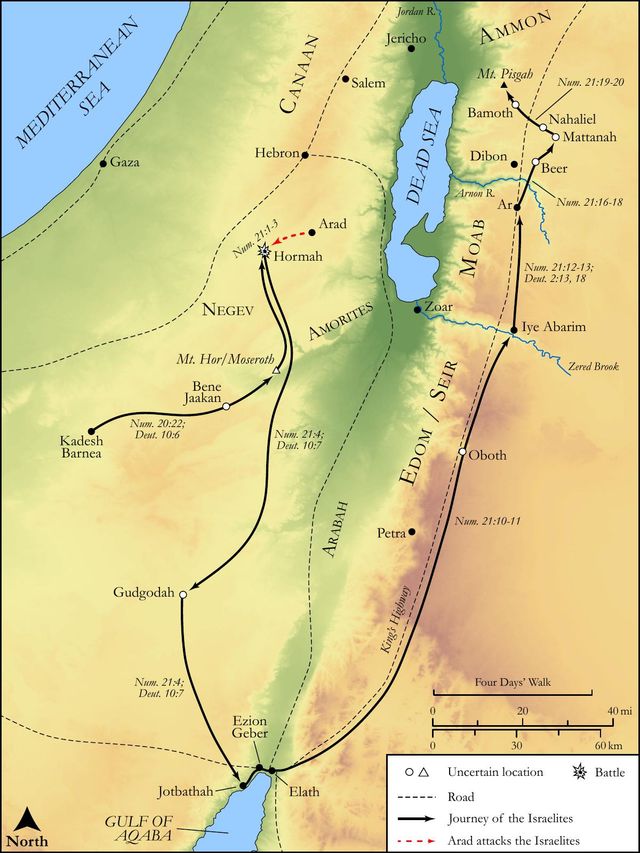
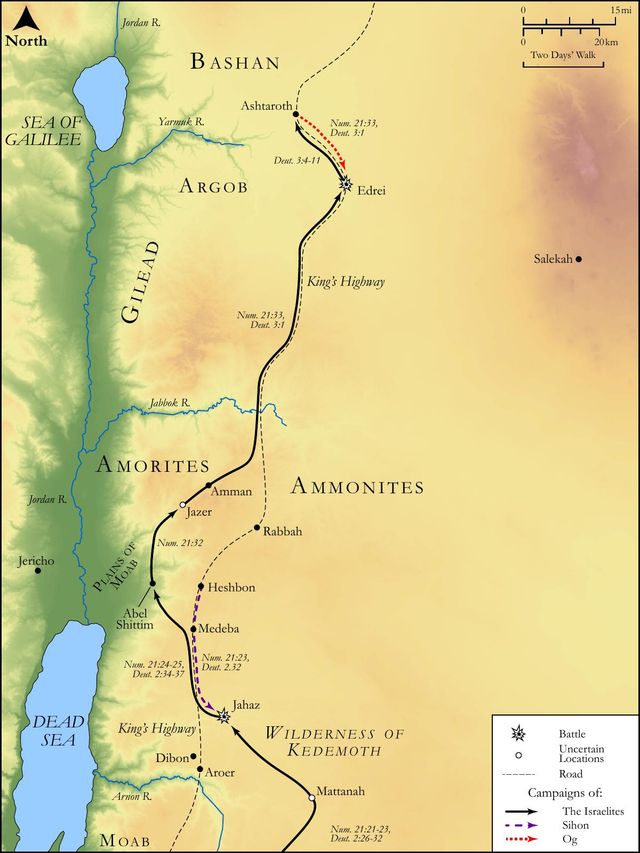
See on the biblical-era maps
Study this verse
Public-domain commentary
Matthew Henry
From his Commentary on the Whole Bible. Henry comments on passages, not single verses — this entry covers Deuteronomy 2:24–37. His two-level outline is real structure in the source text, so it is rendered as structure.
God having tried the self-denial of his people in forbidding them to meddle with the Moabites and Ammonites, and they having quietly passed by those rich countries, and, though superior in number, not made any attack upon them, here he recompenses them for their obedience by giving them possession of the country of Sihon king of the Amorites. If we forbear what God forbids, we shall receive what he promises, and shall be no losers at last by our obedience, though it may seem for the present to be to our loss. Wrong not others, and God shall right thee.
I.God gives them commission to seize upon the country of Sihon king of Heshbon, Deu 2:24, Deu 2:25.
This was then God's way of disposing of kingdoms, but such particular grants are not now either to be expected or pretended. In this commission observe,
1.Though God assured them that the land should be their own, yet they must bestir themselves, and contend in battle with the enemy. What God gives we must endeavour to get.
2.God promises that when they fight he will fight for them. Do you begin to possess it, and I will begin to put the dread of you upon them. God would dispirit the enemy and so destroy them, would magnify Israel and so terrify all those against whom they were commissioned. See Exo 15:14.
II.Moses sends to Sihon a message of peace, and only begs a passage through his land, with a promise to give his country no disturbance, but the advantage of trading for ready money with so great a body, Deu 2:26-29. Moses herein did neither disobey God, who bade him contend with Sihon, nor dissemble with Sihon; but doubtless it was by divine direction that he did it, that Sihon might be left inexcusable, though God hardened his heart. This may illustrate the method of God's dealing with those to whom he gives his gospel, but does not give grace to believe it.
III.Sihon began the war (Deu 2:32), God having made his heart obstinate, and hidden from his eyes the thing that belonged to his peace (Deu 2:30), that he might deliver him into the hand of Israel. Those that meddle with the people of God meddle to their own hurt; and God sometimes ruins his enemies by their own resolves. See Mic 4:11-13; Rev 16:14.
IV.Israel was victorious.
1.They put all the Amorites to the sword, men, women, and children (Deu 2:33, Deu 2:34); this they did as the executioners of God's wrath; now the measure of the Amorites' iniquity was full (Gen 15:16), and the longer it was in the filling the sorer was the reckoning at last. This was one of the devoted nations. They died, not as Israel's enemies, but as sacrifices to divine justice, in the offering of which sacrifices Israel was employed, as a kingdom of priests. The case being therefore extraordinary, it ought not to be drawn into a precedent for military executions, which make no distinction and give no quarter: those will have judgment without mercy that show no mercy.
2.They took possession of all they had; their cities (Deu 2:34), their goods (Deu 2:35), and their land, Deu 2:36. The wealth of the sinner is laid up for the just. What a new world did Israel now come into! Most of them were born, and had lived all their days, in a vast howling wilderness, where they knew not what either fields or cities were, had no houses to dwell in, and neither sowed nor reaped; and now of a sudden to become masters of a country so well built, so well husbanded, this made them amends for their long waiting, and yet it was but the earnest of a great deal more. Much more joyful will the change be which holy souls will experience when they remove out of the wilderness of this world to the better country, that is, the heavenly, to the city that has foundations.
Continue studying Deuteronomy 2:27 across the web’s major study libraries — every link below opens this exact verse, chapter, or book on the destination site.
Read & Compare
 BibleGatewayThis verse in more than 200 translations and 70 languages.
 Bible.comThe YouVersion reader — hundreds of translations, reading plans, and highlights.
 ESV.orgCrossway's official English Standard Version reader.
 NET BibleThe NET translation with 60,000+ translators' notes on every rendering decision.
 STEP BibleTyndale House's free study tool — original text, vocabulary, and scholarly resources.
 BibliaLogos Bible Software's free web reader.
 USCCBThe New American Bible (Revised Edition) with the U.S. bishops' study notes.
Commentaries
 BibleHub CommentariesDozens of classic commentaries on this verse, gathered on one page.
 StudyLightMore than 100 commentary sets — the largest collection on the web.
 BibleRefPlain-English commentary on what this verse means, verse by verse.
 Enduring WordDavid Guzik's free commentary on this chapter, widely used by Bible teachers.
 Bible Study ToolsVerse commentary alongside Greek and Hebrew study aids.
Original Language & Research
- BibleHub InterlinearThe verse word by word — original language, transliteration, and English.
- BibleHub LexiconEvery word's original-language definition and Strong's entry.
 Blue Letter BibleDeep-study tools — Strong's numbers, concordance, and word studies.
 SefariaThe Hebrew text with Rashi and centuries of Jewish commentary.
Sermons, Hymns & Audio


TrulyRandomVerse is not affiliated with these sites and doesn’t control their content. They’re linked because they’re genuinely useful.
Summary
Deuteronomy 2:27 records Moses' diplomatic overture to King Sihon of the Amorites, requesting peaceful passage for the Israelites through his territory. This plea, delivered as Israel approached the Promised Land, emphasizes their sincere intention to travel strictly along the established "King's Highway" without deviating, thereby assuring Sihon of their non-aggressive posture and respect for his sovereign boundaries. It highlights Israel's initial desire for a peaceful resolution, even as the narrative foreshadows the eventual conflict.
Context
ShowHideLiterary Context
This verse is embedded within Moses' second major discourse in the book of Deuteronomy, a retrospective recounting of Israel's forty-year wilderness journey. Following their successful navigation around Edom and Moab, who had denied them passage (as detailed in Deuteronomy 2:1-25), Moses now describes sending messengers to King Sihon of Heshbon with a similar, carefully worded request. This plea serves as a crucial narrative pivot, setting the stage for the first major military confrontation and conquest recounted in Deuteronomy, demonstrating God's sovereign hand in clearing the way for His people. The detailed recounting of these diplomatic efforts underscores Israel's adherence to divine instruction to avoid conflict where possible.
Historical & Cultural Context
The "high way" mentioned in the verse refers to the ancient and strategically vital trade route known as the King's Highway (Hebrew: derekh ha-melekh). This major north-south artery traversed the Transjordan plateau, connecting Egypt to Mesopotamia. For any nation, controlling or granting passage along such a route was a significant geopolitical matter. The request for passage was a common practice among the nations of that day, as when Moses asked the king of Edom to let Israel pass, often accompanied by assurances of non-aggression, as seen in Moses' promise to stay on the main road and avoid infringing on private lands or resources. King Sihon ruled the Amorite kingdom from Heshbon, a powerful city-state that had recently expanded its territory by conquering land from Moab (Numbers 21:26), making him a formidable and cautious ruler.
Key Themes
ShowHideThe verse powerfully articulates several key themes. Firstly, it underscores Israel's peaceful intent and non-aggression, demonstrating a commitment to diplomacy before resorting to conflict, aligning with broader biblical principles of seeking peace (Romans 12:18). Secondly, it highlights respect for sovereignty and boundaries, as Israel explicitly sought permission and promised to adhere to the public road, acknowledging Sihon's territorial rights. This reflects a divine order that respects the established boundaries of nations. Thirdly, the commitment to "neither turn unto the right hand nor to the left" signifies discipline and focused adherence to a declared path. This idiom is a recurring motif in the Old Testament, symbolizing unwavering obedience to God's commands and staying true to His appointed way, as seen in Moses' later exhortation to Israel in Deuteronomy 5:32 and Joshua's instructions in Joshua 1:7.
Exposition and Analysis
ShowHideKey Word Analysis
ShowHidePass (Hebrew, ʻâbar', H5674): From a primitive root; to cross over; used very widely of any transition (literal or figurative; transitive, intransitive, intensive, causative); specifically, to cover (in copulation); alienate, alter, [idiom] at all, beyond, bring (over, through), carry over, (over-) come (on, over), conduct (over), convey over, current, deliver, do away, enter, escape, fail, gender, get over, (make) go (away, beyond, by, forth, his way, in, on, over, through), have away (more), lay, meddle, overrun, make partition, (cause to, give, make to, over) pass(-age, along, away, beyond, by, -enger, on, out, over, through), (cause to, make) [phrase] proclaim(-amation), perish, provoke to anger, put away, rage, [phrase] raiser of taxes, remove, send over, set apart, [phrase] shave, cause to (make) sound, [idiom] speedily, [idiom] sweet smelling, take (away), (make to) transgress(-or), translate, turn away, (way-) faring man, be wrath.
Way (Hebrew, derek', H1870): From דָּרַךְ; a road (as trodden); figuratively, a course of life or mode of action, often adverb; along, away, because of, [phrase] by, conversation, custom, (east-) ward, journey, manner, passenger, through, toward, (high-) (path-) way(-side), whither(-soever).
Turn (Hebrew, çûwr', H5493): Or שׂוּר; (Hosea 9:12), a primitive root; to turn off (literal or figurative); be(-head), bring, call back, decline, depart, eschew, get (you), go (aside), [idiom] grievous, lay away (by), leave undone, be past, pluck away, put (away, down), rebel, remove (to and fro), revolt, [idiom] be sour, take (away, off), turn (aside, away, in), withdraw, be without.
Verse Breakdown
ShowHide"Let me pass through thy land"
This opening clause represents Moses' direct and diplomatic request to King Sihon. It is a formal appeal for permission, acknowledging Sihon's authority and sovereignty over his territory. The tone is one of respectful petition, seeking a peaceful and authorized transit rather than a forceful invasion.
"I will go along by the high way"
This clause specifies the exact route Israel intends to take. By committing to the "King's Highway," Moses assures Sihon that Israel will stick to the well-defined, public thoroughfare, avoiding any private lands, cultivated fields, or populated areas that might be sensitive or provoke conflict. It is a concrete demonstration of their stated peaceful intentions.
"I will neither turn unto the right hand nor to the left"
This concluding clause reinforces the previous assurance with a powerful idiom. It emphasizes Israel's unwavering commitment to their declared path, promising absolute non-deviation. This signifies that they would not engage in any plundering, raiding, or territorial encroachment. It is a pledge of disciplined, focused movement, leaving no room for suspicion of ulterior motives or opportunistic expansion.
Literary Devices
ShowHideDeuteronomy 2:27 primarily employs Plea/Supplication as Moses directly addresses King Sihon with a formal request. This highlights the diplomatic and respectful approach Israel initially takes. The phrase "neither turn unto the right hand nor to the left" is a prominent Idiom, a common Hebrew expression signifying strict adherence and unwavering focus. Its use here serves to powerfully convey Israel's commitment to non-aggression and their disciplined movement. Furthermore, the entire request carries Symbolism, representing Israel's journey not just geographically, but also spiritually. Their desire to stay on the "high way" and not deviate can be seen as a metaphor for their commitment to God's path and commands, even when facing human resistance.
Theological and Thematic Connections
ShowHideDeuteronomy 2:27 reveals a profound theological tension between human agency and divine sovereignty. While Israel, under divine guidance, genuinely sought peaceful passage, their efforts were ultimately thwarted by King Sihon's hardened heart, which the text later attributes to God's purpose to deliver Sihon into Israel's hand (Deuteronomy 2:30). This demonstrates that even when God's people act with integrity and seek peace, circumstances may unfold according to a larger divine plan that involves conflict. The verse also underscores the importance of clear communication and integrity in our dealings, reflecting God's character of truthfulness. It reminds us that while we are called to pursue peace and respect boundaries, God's ultimate purposes for His people will prevail, sometimes requiring a path different from our initial peaceful intentions.
Reflection and Application
ShowHideDeuteronomy 2:27 offers timeless principles for navigating life's journey, both personally and communally. It calls us to cultivate integrity in our interactions, ensuring our words are clear, our intentions transparent, and our commitments reliable. Just as Israel sought to respect Sihon's territorial boundaries, we are challenged to honor the boundaries of others—whether in relationships, personal space, or professional dealings—demonstrating humility and respect rather than presumption or encroachment. Most profoundly, the imagery of not turning "to the right hand nor to the left" serves as a powerful spiritual metaphor for our walk with God. It encourages a disciplined, focused adherence to God's revealed will, avoiding the myriad distractions, temptations, or competing desires that seek to pull us off the "highway" of His commands and purposes. Our spiritual journey demands unwavering commitment and a clear-eyed pursuit of Christ, resisting the urge to deviate from the path He has laid out for us.
Questions for Reflection
ShowHideFAQ
ShowHideWhy did Sihon refuse Israel's peaceful request, and what was the outcome?
ShowHideDespite Israel's sincere and peaceful overture in Deuteronomy 2:27, King Sihon of Heshbon refused passage. The biblical text explicitly states that "the Lord your God hardened his spirit and made his heart obstinate, that he might give him into your hand" (Deuteronomy 2:30). This indicates a divine purpose behind Sihon's refusal; God intended to deliver Sihon and his land into Israel's possession as part of their inheritance. Consequently, Sihon mustered his army and attacked Israel at Jahaz, but the Lord gave Israel victory, and they conquered all of Sihon's territory, from Aroer to the Jabbok River (Deuteronomy 2:31-37). This conquest was a significant step in Israel's journey towards the Promised Land.
Is the "King's Highway" still relevant today?
ShowHideWhile not a modern highway in the contemporary sense, the ancient King's Highway remains historically and archaeologically significant. Its route, or remnants of it, can still be traced through modern-day Jordan. It was a crucial artery for trade and communication for generations, connecting the nations from Egypt to Mesopotamia. Today, modern roads often follow parts of its ancient course, and archaeological sites along its path continue to reveal insights into the history and cultures of the region, making it a point of interest for historians, archaeologists, and biblical scholars.
Christ-Centered Fulfillment
ShowHideDeuteronomy 2:27, with its depiction of Israel's journey and their commitment to a specific path, finds profound Christ-centered fulfillment. Israel's wilderness wanderings and their ultimate destination in the Promised Land foreshadow the believer's spiritual pilgrimage towards the heavenly inheritance, a journey made possible only through Christ. Jesus Himself declares, "I am the way, and the truth, and the life; no one comes to the Father except through Me" (John 14:6). He is the ultimate "high way" to God, the singular path of salvation and righteousness. Furthermore, the idiom "neither turn unto the right hand nor to the left" perfectly describes Christ's unwavering obedience to the Father's will. Unlike Israel, who often strayed, Jesus perfectly fulfilled the Father's commands, even to the point of death on a cross (Philippians 2:8). He never deviated from His mission, even when facing opposition and rejection, embodying the peaceful, non-aggressive posture of the "Lamb of God" (Isaiah 53:7; 1 Peter 2:23). Ultimately, the "highway of holiness" prophesied by Isaiah (Isaiah 35:8) is paved by Christ's perfect life, atoning death, and glorious resurrection, inviting all who believe to walk a straight path to eternal life with God.