


Deuteronomy 2:28
Bible text: King James Version (1769 Blayney text) · Public domain
Bible text: Berean Standard Bible · Public domain
Bible text: American Standard Version (1901) · Public domain
Bible text: World English Bible, Messianic edition · Public domain
Bible text: Geneva Bible (1599) · Public domain
Bible text: Young's Literal Translation · Public domain
- אֹכֶל'O·khelfoodH400N-msNoun Singular Masculine Absolute
- בַּכֶּסֶףba·Ke·seffor <the> silverH3701Prep-b ¦ N-msNoun Singular Masculine Absoluteבַּfor <the>כֶּסֶףsilver
- תַּשְׁבִּרֵנִיtash·bi·Re·niyou will sell meH7666V-Hiphil-Imperf-2ms ¦ 1csVerb Hiphil Imperfect 2nd Singular Masculineתַּשְׁבִּרֵyou will sellנִיme
- וְאָכַלְתִּיve·'a·Khal·tiand I will eatH398Conj-w ¦ V-Qal-ConsecPerf-1csVerb Qal Consecutive Perfect 1st Singular common genderוְandאָכַלְתִּיI will eat
- וּמַיִםu·Ma·yimand waterH4325Conj-w ¦ N-mpNoun Plural Masculine Absoluteוּandמַיִםwater
- בַּכֶּסֶףba·Ke·seffor <the> silverH3701Prep-b ¦ N-msNoun Singular Masculine Absoluteבַּfor <the>כֶּסֶףsilver
- תִּתֶּןti·tenyou will giveH5414V-Qal-Imperf-2msVerb Qal Imperfect 2nd Singular Masculine
- לִיlito mePrep-l ¦ 1csSuffix Personal 1st Singular common genderלִtoיme
- וְשָׁתִיתִיve·sha·Ti·tiand I will drinkH8354Conj-w ¦ V-Qal-ConsecPerf-1csVerb Qal Consecutive Perfect 1st Singular common genderוְandשָׁתִיתִיI will drink
- רַקrakonlyH7535AdvAdverb
- אֶעְבְּרָה'e'·be·Rahlet me pass throughH5674V-Qal-Imperf-1csVerb Qal Imperfect 1st Singular common gender
- בְרַגְלָיve·rag·Laion my feetH7272Prep-b ¦ N-fdc ¦ 1csNoun Dual Feminine Constructבְonרַגְלָfeetיmy
English is a literal word-by-word gloss of the Hebrew, not the KJV's wording. Why?
This is the original text the KJV's translators worked from — each Hebrew word with its own literal English meaning in this verse, prepared by scholars at Tyndale House, Cambridge. The KJV translates whole sentences, not word by word, so its wording differs: one Hebrew word can become several English words, and the KJV may choose “the LORD” where the gloss reads “Yahweh”. Both are faithful — they answer different questions. For the KJV's own rendering, switch to the KJV text.
Details
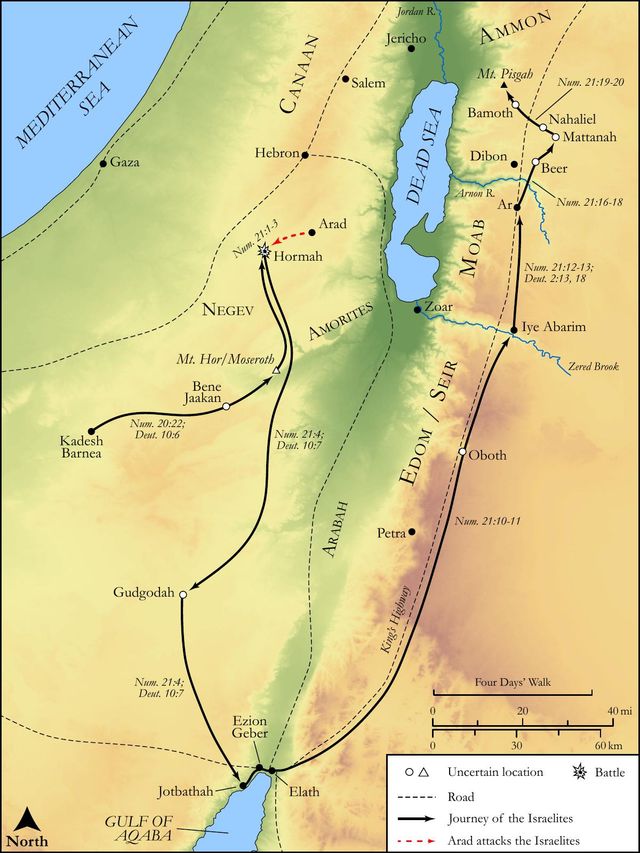
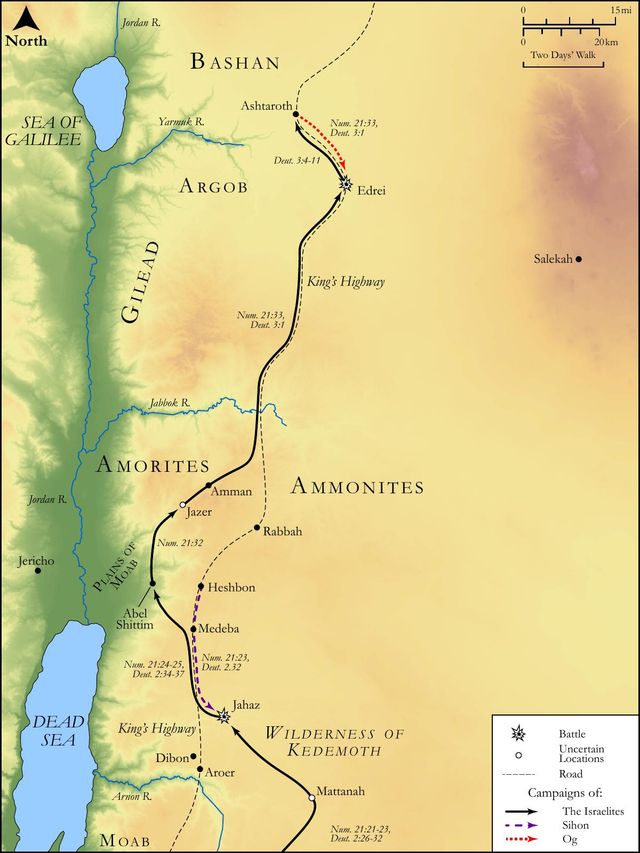
See on the biblical-era maps
Study this verse
Public-domain commentary
Matthew Henry
From his Commentary on the Whole Bible. Henry comments on passages, not single verses — this entry covers Deuteronomy 2:24–37. His two-level outline is real structure in the source text, so it is rendered as structure.
God having tried the self-denial of his people in forbidding them to meddle with the Moabites and Ammonites, and they having quietly passed by those rich countries, and, though superior in number, not made any attack upon them, here he recompenses them for their obedience by giving them possession of the country of Sihon king of the Amorites. If we forbear what God forbids, we shall receive what he promises, and shall be no losers at last by our obedience, though it may seem for the present to be to our loss. Wrong not others, and God shall right thee.
I.God gives them commission to seize upon the country of Sihon king of Heshbon, Deu 2:24, Deu 2:25.
This was then God's way of disposing of kingdoms, but such particular grants are not now either to be expected or pretended. In this commission observe,
1.Though God assured them that the land should be their own, yet they must bestir themselves, and contend in battle with the enemy. What God gives we must endeavour to get.
2.God promises that when they fight he will fight for them. Do you begin to possess it, and I will begin to put the dread of you upon them. God would dispirit the enemy and so destroy them, would magnify Israel and so terrify all those against whom they were commissioned. See Exo 15:14.
II.Moses sends to Sihon a message of peace, and only begs a passage through his land, with a promise to give his country no disturbance, but the advantage of trading for ready money with so great a body, Deu 2:26-29. Moses herein did neither disobey God, who bade him contend with Sihon, nor dissemble with Sihon; but doubtless it was by divine direction that he did it, that Sihon might be left inexcusable, though God hardened his heart. This may illustrate the method of God's dealing with those to whom he gives his gospel, but does not give grace to believe it.
III.Sihon began the war (Deu 2:32), God having made his heart obstinate, and hidden from his eyes the thing that belonged to his peace (Deu 2:30), that he might deliver him into the hand of Israel. Those that meddle with the people of God meddle to their own hurt; and God sometimes ruins his enemies by their own resolves. See Mic 4:11-13; Rev 16:14.
IV.Israel was victorious.
1.They put all the Amorites to the sword, men, women, and children (Deu 2:33, Deu 2:34); this they did as the executioners of God's wrath; now the measure of the Amorites' iniquity was full (Gen 15:16), and the longer it was in the filling the sorer was the reckoning at last. This was one of the devoted nations. They died, not as Israel's enemies, but as sacrifices to divine justice, in the offering of which sacrifices Israel was employed, as a kingdom of priests. The case being therefore extraordinary, it ought not to be drawn into a precedent for military executions, which make no distinction and give no quarter: those will have judgment without mercy that show no mercy.
2.They took possession of all they had; their cities (Deu 2:34), their goods (Deu 2:35), and their land, Deu 2:36. The wealth of the sinner is laid up for the just. What a new world did Israel now come into! Most of them were born, and had lived all their days, in a vast howling wilderness, where they knew not what either fields or cities were, had no houses to dwell in, and neither sowed nor reaped; and now of a sudden to become masters of a country so well built, so well husbanded, this made them amends for their long waiting, and yet it was but the earnest of a great deal more. Much more joyful will the change be which holy souls will experience when they remove out of the wilderness of this world to the better country, that is, the heavenly, to the city that has foundations.
Continue studying Deuteronomy 2:28 across the web’s major study libraries — every link below opens this exact verse, chapter, or book on the destination site.
Read & Compare
 BibleGatewayThis verse in more than 200 translations and 70 languages.
 Bible.comThe YouVersion reader — hundreds of translations, reading plans, and highlights.
 ESV.orgCrossway's official English Standard Version reader.
 NET BibleThe NET translation with 60,000+ translators' notes on every rendering decision.
 STEP BibleTyndale House's free study tool — original text, vocabulary, and scholarly resources.
 BibliaLogos Bible Software's free web reader.
 USCCBThe New American Bible (Revised Edition) with the U.S. bishops' study notes.
Commentaries
 BibleHub CommentariesDozens of classic commentaries on this verse, gathered on one page.
 StudyLightMore than 100 commentary sets — the largest collection on the web.
 BibleRefPlain-English commentary on what this verse means, verse by verse.
 Enduring WordDavid Guzik's free commentary on this chapter, widely used by Bible teachers.
 Bible Study ToolsVerse commentary alongside Greek and Hebrew study aids.
Original Language & Research
- BibleHub InterlinearThe verse word by word — original language, transliteration, and English.
- BibleHub LexiconEvery word's original-language definition and Strong's entry.
 Blue Letter BibleDeep-study tools — Strong's numbers, concordance, and word studies.
 SefariaThe Hebrew text with Rashi and centuries of Jewish commentary.
Sermons, Hymns & Audio


TrulyRandomVerse is not affiliated with these sites and doesn’t control their content. They’re linked because they’re genuinely useful.
Summary
Deuteronomy 2:28 records Moses' diplomatic overture to the Edomites, descendants of Esau, as the Israelites sought peaceful transit through their ancestral territory on their journey toward the Promised Land. This verse encapsulates Israel's commitment to respectful engagement, offering to purchase all necessary provisions—food and water—and explicitly promising a direct, non-interfering passage "on my feet." It underscores a divine directive for peaceful coexistence with kin nations, highlighting Israel's integrity and reliance on God's provision even amidst their wilderness wanderings.
Context
ShowHideLiterary Context
Deuteronomy 2:28 is situated within Moses' recounting of Israel's wilderness journey, specifically detailing their approach to the land of Canaan after forty years of wandering. Chapters 1-3 of Deuteronomy serve as a historical prologue, reviewing the crucial events from Mount Horeb (Sinai) to the plains of Moab, just before entering the Promised Land. This verse falls within the narrative of Israel's circumvention of Edom, Moab, and Ammon, nations with whom God had commanded Israel not to engage in conflict, as their lands had been divinely allotted to them. Moses' request for passage, offering payment for supplies, demonstrates Israel's obedience to this divine directive for peaceful and respectful interaction, contrasting sharply with their later confrontation with Sihon, king of Heshbon, who refused similar terms, leading to his defeat as recounted in Deuteronomy 2:26-37. The divine instruction to avoid conflict with Edom is explicitly stated in Deuteronomy 2:4-6.
Historical & Cultural Context
The Edomites were descendants of Esau, Jacob's brother, making them kin to the Israelites. Despite this familial tie, their relationship was often strained, marked by historical animosity. At this time, Edom controlled a vital trade route known as the King's Highway, which the Israelites desired to use. In that day, requesting passage through another nation's territory, especially for a large group like Israel, was a significant diplomatic act. Offering to pay for provisions and promising not to stray from the path were customary assurances to prevent conflict and demonstrate peaceful intent. This diplomatic protocol was essential for maintaining regional stability and avoiding unnecessary warfare, reflecting a common understanding of sovereignty and territorial rights among nations.
Key Themes
ShowHideThis verse powerfully illustrates several key themes central to Deuteronomy and the broader Pentateuch. Firstly, it highlights peaceful coexistence and respect for sovereignty. Despite Israel's divine mandate to inherit Canaan, God explicitly commanded them to respect the boundaries of Edom, Moab, and Ammon, demonstrating that even God's chosen people must adhere to principles of international law and neighborly respect, as seen in Deuteronomy 2:5. Secondly, it underscores integrity and orderliness. Moses' offer to pay for provisions and promise a direct passage showcases Israel as an organized, disciplined nation, willing to abide by fair dealings rather than acting as a marauding force. This commitment to ethical conduct is a recurring theme in the Mosaic Law, emphasizing that God's people are called to live with righteousness in all their interactions. Finally, the ability to offer payment for "meat" and "water" implicitly points to God's faithful provision for Israel throughout their wilderness journey. Despite their nomadic existence, God had sustained them, ensuring they had the resources necessary for their travels, just as their clothes did not wear out and their feet did not swell, as promised in Deuteronomy 8:4.
Exposition and Analysis
ShowHideKey Word Analysis
ShowHideThis term, derived from the verb "to eat," refers broadly to food or any edible sustenance. In this context, it signifies the comprehensive range of foodstuffs necessary to sustain a large traveling multitude, demonstrating Israel's willingness to pay for all their dietary needs rather than foraging or demanding supplies from the Edomites. It emphasizes their commitment to fair commercial exchange for basic provisions.
Literally meaning "silver" (from its pale color), this word by implication refers to money or price. Its inclusion here highlights Israel's intention to engage in a legitimate financial transaction for the provisions. This act of offering payment for goods was a clear signal of peaceful intent and respect for Edomite property rights, distinguishing Israel's passage from that of an invading army.
This primitive root signifies a broad range of transitions, including to cross over or to go through. In Deuteronomy 2:28, it emphasizes the temporary and non-intrusive nature of Israel's request. It conveys that their presence would be solely for transit, without any intention of lingering, settling, or engaging in any activity beyond moving directly through the territory.
Verse Breakdown
ShowHide"Thou shalt sell me meat for money, that I may eat;"
This clause initiates Moses' diplomatic request, explicitly stating Israel's intention to engage in fair commerce. The offer to "sell me meat for money" (literally, "food for silver") highlights their willingness to pay for all necessary provisions, demonstrating respect for Edomite sovereignty and property rights. This was a clear sign of peaceful intent, reassuring Edom that Israel would not plunder or demand resources.
"and give me water for money, that I may drink:"
Parallel to the request for food, this clause reiterates the commitment to purchase even the most basic necessities, water. In an arid region, water was a precious commodity, and Israel's offer to pay for it further underscored their honorable intentions and their desire to avoid any imposition on Edom's resources. It reinforced the message that their passage was purely for transit, not exploitation.
"only I will pass through on my feet;"
This final clause serves as a crucial assurance, defining the precise nature of their passage. The phrase "only I will pass through on my feet" implies a direct route without deviation, a non-military posture, and a commitment to not lingering or establishing any presence within Edomite territory. It was a pledge of minimal impact, designed to alleviate any fears of invasion or settlement, reinforcing their peaceful and temporary presence.
Literary Devices
ShowHideDeuteronomy 2:28 employs several literary devices to convey its message. Diplomacy is central, as Moses articulates a carefully worded, respectful request designed to avoid conflict and foster peaceful relations. The Repetition of the concept of "for money" (explicitly for "meat" and implicitly for "water" through the parallel structure) underscores Israel's commitment to fair economic exchange and ethical conduct. The phrase "only I will pass through on my feet" functions as a powerful Litotes or Understatement, minimizing the perceived impact of a massive nation's movement to emphasize their peaceful and non-threatening intent. This deliberate choice of language aims to disarm potential hostility and highlight Israel's adherence to God's command for peaceful engagement with their kin.
Theological and Thematic Connections
ShowHideDeuteronomy 2:28 is not merely a record of ancient diplomacy; it is a profound theological statement about the character of God's people and the nature of their mission. It demonstrates that even when divinely appointed to a land, Israel was not to act as a conquering horde but as a disciplined nation, respecting established boundaries and engaging in fair dealings. This reflects God's own character of order, justice, and respect for the sovereignty He grants to all nations, even those outside the covenant. The willingness to pay for provisions, despite being sustained by manna for forty years, teaches reliance on God's provision while simultaneously exercising human responsibility and integrity. It sets a precedent for how God's people should interact with the world, prioritizing peace and ethical conduct over brute force or entitlement, even when their ultimate destination is divinely ordained. This principle of peaceful, respectful interaction with neighbors is a recurring motif throughout Scripture, echoing God's desire for justice and order in human society.
Reflection and Application
ShowHideDeuteronomy 2:28 offers enduring lessons for contemporary believers, emphasizing the profound importance of integrity, respect, and peaceful engagement in all our interactions. Just as Israel, a people with a divine mandate, was called to honor the sovereignty and property of others, so too are we, as followers of Christ, called to be exemplary citizens and neighbors. This verse challenges us to consider how we conduct ourselves in our daily lives, whether in business dealings, community interactions, or personal relationships. Are we willing to "pay our way" and demonstrate respect for boundaries, even when we believe we have a higher purpose or a divine calling? The principle of not being a burden, but rather contributing fairly and peacefully, is a powerful witness to the character of God. It reminds us that our spiritual journey does not exempt us from ethical responsibilities but rather compels us to embody Christ's love and justice in practical, tangible ways, fostering harmony and trust rather than discord or imposition.
Questions for Reflection
ShowHideFAQ
ShowHideWhy did Israel need to pay for food and water if God had been miraculously providing for them in the wilderness?
ShowHideWhile God had indeed provided miraculously for Israel through manna and water from the rock for forty years, as recorded in Exodus 16:35 and Exodus 17:6, this provision was primarily for their sustenance in the barren wilderness. As they approached settled lands with established economies, God expected them to engage in normal, ethical commerce. Their willingness to pay for provisions demonstrated respect for the Edomites' sovereignty and property rights, fostering peaceful relations rather than demanding resources. It also showed that God's provision was not meant to excuse Israel from responsible and fair dealings with other nations, but rather to equip them to live righteously in all contexts.
What was the Edomites' response to this diplomatic request?
ShowHideUnfortunately, despite Moses' polite and respectful request, the Edomites refused Israel's passage. Numbers 20:18-21 records that Edom came out with a large and powerful army to block Israel's path, forcing them to turn away and take a longer, more arduous route around Edomite territory. This refusal highlighted the deep-seated animosity between these brother nations, foreshadowing future conflicts and demonstrating Edom's distrust, despite Israel's peaceful overtures.
Christ-Centered Fulfillment
ShowHideDeuteronomy 2:28, though a historical account of Israel's journey, finds profound Christ-centered fulfillment in the person and mission of Jesus, and in the nature of His kingdom. Jesus, the ultimate "passer-through," did not come to conquer by force but to establish His kingdom through humility and sacrificial love. He did not demand allegiance or resources, but rather "emptied himself, by taking the form of a servant" as described in Philippians 2:7. Unlike the nations that often took what they wanted, Christ came to give, paying the ultimate price for humanity's sin, becoming the Lamb of God who takes away the sin of the world. His journey was one of peaceful passage, offering reconciliation and life to those who would receive it, rather than imposing His will through coercion. Furthermore, the church, as the new Israel, is called to embody this same spirit. We are pilgrims and sojourners in this world, as 1 Peter 2:11 reminds us, called to live peaceably with all people (Romans 12:18), to pay our taxes (Romans 13:7), and to be a blessing to the communities we inhabit, demonstrating integrity and respect in all our dealings. Our mission, like Christ's, is to offer the good news, not to demand compliance, reflecting the peaceful and just character of our King, who truly "passed through on His feet" to redeem us.