


Numbers 20:17
Bible text: King James Version (1769 Blayney text) · Public domain
Bible text: King James Version with Strong's numbers · Public domain
Bible text: Berean Standard Bible · Public domain
Bible text: American Standard Version (1901) · Public domain
Bible text: World English Bible, Messianic edition · Public domain
Bible text: Geneva Bible (1599) · Public domain
Bible text: Young's Literal Translation · Public domain
- נַעְבְּרָהna'·be·rahlet us passH5674V-Qal-Imperf-1cpVerb Qal Imperfect 1st Plural common gender
- נָּאna'pleaseH4994PrtParticle Interjection
- בְאַרְצֶךָve·'ar·Tze·khain your landH776Prep-b ¦ N-fsc ¦ 2msNoun Singular Feminine Constructבְinאַרְצֶlandךָyour
- לֹאlo'notH3808NegParticle Negative
- נַעֲבֹרna·'a·Vorwe will passH5674V-Qal-Imperf-1cpVerb Qal Imperfect 1st Plural common gender
- בְּשָׂדֶהbe·sa·Dehin a fieldH7704Prep-b ¦ N-msNoun Singular Masculine Absoluteבְּinשָׂדֶהa field
- וּבְכֶרֶםu·ve·Khe·remand in a vineyardH3754Conj-w ¦ Prep-b ¦ N-msNoun Singular Masculine Absoluteוּandבְinכֶרֶםa vineyard
- וְלֹאve·Lo'and notH3808Conj-w ¦ NegParticle Negativeוְandלֹאnot
- נִשְׁתֶּהnish·Tehwe will drinkH8354V-Qal-Imperf-1cpVerb Qal Imperfect 1st Plural common gender
- מֵיmeiwater ofH4325N-mpcNoun Plural Masculine Construct
- בְאֵרve·'Era wellH875N-fsNoun Singular Feminine Absolute
- דֶּרֶךְDe·rekh[the] way ofH1870N-cscNoun Singular common gender Construct
- הַמֶּלֶךְha·Me·lekhthe kingH4428Art ¦ N-msNoun Singular Masculine Absoluteהַtheמֶּלֶךְking
- נֵלֵךְne·Lekhwe will goH1980V-Qal-Imperf-1cpVerb Qal Imperfect 1st Plural common gender
- לֹאlo'notH3808NegParticle Negative
- נִטֶּהni·Tehwe will turn asideH5186V-Qal-Imperf-1cpVerb Qal Imperfect 1st Plural common gender
- יָמִיןya·MinrightH3225N-fsNoun Singular Feminine Absolute
- וּשְׂמֹאולu·se·Moland leftH8040Conj-w ¦ N-msNoun Singular Masculine Absoluteוּandשְׂמֹאולleft
- עַד'aduntilH5704PrepPreposition
- אֲשֶׁר'a·SherthatH834RelParticle Relative
- נַעֲבֹרna·'a·Vorwe will pass throughH5674V-Qal-Imperf-1cpVerb Qal Imperfect 1st Plural common gender
- גְּבוּלֶךָge·vu·Le·khayour territoryH1366N-msc ¦ 2msNoun Singular Masculine Constructגְּבוּלֶterritoryךָyour
English is a literal word-by-word gloss of the Hebrew, not the KJV's wording. Why?
This is the original text the KJV's translators worked from — each Hebrew word with its own literal English meaning in this verse, prepared by scholars at Tyndale House, Cambridge. The KJV translates whole sentences, not word by word, so its wording differs: one Hebrew word can become several English words, and the KJV may choose “the LORD” where the gloss reads “Yahweh”. Both are faithful — they answer different questions. For the KJV's own rendering, switch to the KJV text.
Details
See on the biblical-era maps
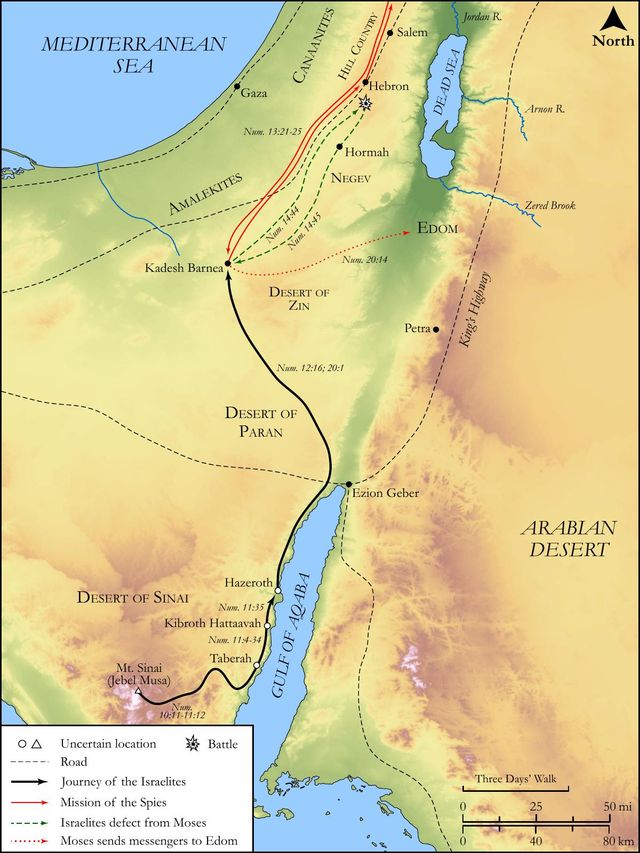
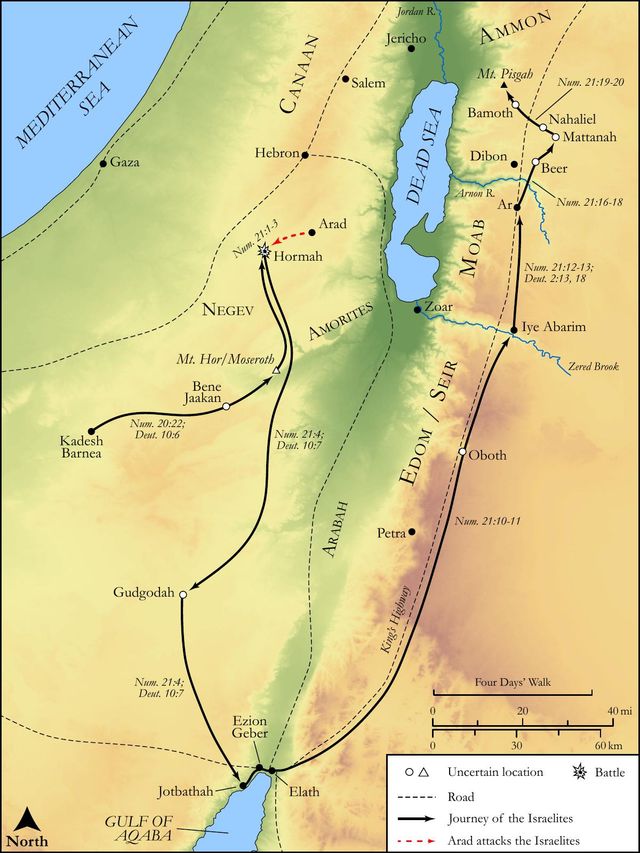
Study this verse
Public-domain commentary
Matthew Henry
From his Commentary on the Whole Bible. Henry comments on passages, not single verses — this entry covers Numbers 20:14–21. His two-level outline is real structure in the source text, so it is rendered as structure.
We have here the application made by Israel to the Edomites. The nearest way to Canaan from the place where Israel now lay encamped was through the country of Edom. Now,
I.Moses sends ambassadors to treat with the king of Edom for leave to pass through his country, and gives them instructions what to say, Num 20:14-17.
1.They are to claim kindred with the Edomites: Thus saith thy brother Israel. Both nations descended from Abraham and Isaac, their common ancestors; Esau and Jacob, the two fathers of their respective nations, were twin-brothers; and therefore, for relation-sake, they might reasonably expect this kindness from them; nor needed the Edomites to fear that their brother Israel had any ill design upon them, or would take any advantages against them.
2.They are to give a short account of the history and present state of Israel, which, they take it for granted, the Edomites were no strangers to. And in this there was a double plea: - (1.) Israel had been abused by the Egyptians, and therefore ought to be pitied and succoured by their relations: "The Egyptians vexed us and our fathers, but we may hope our brethren the Edomites will not be so vexatious." (2.) Israel had been wonderfully saved by the Lord, and therefore ought to be countenanced and favoured (Num 20:16): "We cried unto the Lord, and he sent an angel, the angel of his presence, the angel of the covenant, the eternal Word, who had brought us forth out of Egypt, and led us hither." It was therefore the interest of the Edomites to ingratiate themselves with a people that had so great an interest in heaven and were so much its favourites, and it was at their peril if they offered them any injury. It is our wisdom and duty to be kind to those whom God is pleased to own, and to take his people for our people. Come in, thou blessed of the Lord.
3.They are humbly to beg a passport through their country. Though God himself, in the pillar of cloud and fire, was Israel's guide, in following which they might have justified their passing through any man's ground against all the world, yet God would have this respect paid to the Edomites, to show that no man's property ought to be invaded under colour of religion. Dominion is founded in providence, not in grace. Thus when Christ was to pass through a village of the Samaritans, to whom his coming was likely to be offensive, he sent messengers before his face to ask leave, Luk 9:52. Those that would receive kindness must not disdain to request it.
4.They are to give security for the good behaviour of the Israelites in this march, that they would keep in the king's high road, that they would commit no trespass upon any man's property, either in ground or water, that they would not so much as make use of a well without paying for it, and that they would make all convenient speed, as fast as they could well go on their feet, Num 20:17, Num 20:19. Nothing could be offered more fair and neighbourly.
II.The ambassadors returned with a denial, Num 20:18.
Edom, that is, the king of Edom, as protector of his country, said, Thou shalt not pass by me; and, when the ambassadors urged it further, he repeated the denial (Num 20:20) and threatened, if they offered to enter his country, it should be at their peril; he raised his trained bands to oppose them. Thus Edom refused to give Israel passage. This was owing,
1.To their jealousy of the Israelites; they feared they should receive promises. And truly, had this numerous army been under any other discipline and command than that of the righteous God himself, who would no more suffer them to do wrong than to take wrong, there might have been cause for this jealousy; but what could they fear from a nation that had statutes and judgments so righteous?
2.It was owing to the old enmity which Esau bore to Israel. If they had no reason to fear damage by them, yet they were not willing to show so much kindness to them. Esau hated Jacob because of the blessing, and now the hatred revived, when the blessing was ready to be inherited. God would hereby discover the ill-nature of the Edomites to their shame, and try the good-nature of the Israelites to their honour: they turned away from him, and did not take this occasion to quarrel with him. Note, We must not think it strange if the most reasonable requests be denied by unreasonable men, and if those be affronted by men whom God favours. I as a deaf man heard not. After this indignity which the Edomites offered to Israel God gave them a particular caution not to abhor an Edomite (Deu 23:7), though the Edomites had shown such an abhorrence of them, to teach us in such cases not to meditate revenge.
Historical interpretation
Historical reception
1 surviving comment on this verse from the historical church.
So in the case of one of us, if he leans to either side, whether from vice or ignorance, no slight danger of a fall into sin from vice or ignorance, no slight danger of a fall into sin is incurred, both for himself and those who are led by him. But we must really walk in the king’s highway and take care not to turn aside from it either to the right hand or to the left, as the Proverbs say. For such is the case with our passions, and such in this matter is the straight path of the good shepherd, if he is to know properly the souls of his flock, and to guide them according to the methods of a pastoral care which is right and just and be worthy of our true Shepherd.
Continue studying Numbers 20:17 across the web’s major study libraries — every link below opens this exact verse, chapter, or book on the destination site.
Read & Compare
 BibleGatewayThis verse in more than 200 translations and 70 languages.
 Bible.comThe YouVersion reader — hundreds of translations, reading plans, and highlights.
 ESV.orgCrossway's official English Standard Version reader.
 NET BibleThe NET translation with 60,000+ translators' notes on every rendering decision.
 STEP BibleTyndale House's free study tool — original text, vocabulary, and scholarly resources.
 BibliaLogos Bible Software's free web reader.
 USCCBThe New American Bible (Revised Edition) with the U.S. bishops' study notes.
Commentaries
 BibleHub CommentariesDozens of classic commentaries on this verse, gathered on one page.
 StudyLightMore than 100 commentary sets — the largest collection on the web.
 BibleRefPlain-English commentary on what this verse means, verse by verse.
 Enduring WordDavid Guzik's free commentary on this chapter, widely used by Bible teachers.
 Bible Study ToolsVerse commentary alongside Greek and Hebrew study aids.
Original Language & Research
- BibleHub InterlinearThe verse word by word — original language, transliteration, and English.
- BibleHub LexiconEvery word's original-language definition and Strong's entry.
 Blue Letter BibleDeep-study tools — Strong's numbers, concordance, and word studies.
 SefariaThe Hebrew text with Rashi and centuries of Jewish commentary.
Sermons, Hymns & Audio


TrulyRandomVerse is not affiliated with these sites and doesn’t control their content. They’re linked because they’re genuinely useful.
Summary
Numbers 20:17 presents Israel's earnest and meticulously articulated plea to the King of Edom for peaceful transit through his territory. This significant diplomatic overture, occurring late in the wilderness wanderings, reflects Israel's strategic need for the most direct route to the Promised Land. Moses, as the nation's representative, meticulously assures Edom that Israel will adhere strictly to the public "king's highway," pledging to avoid all private agricultural lands, vineyards, and vital water sources. This detailed commitment underscores Israel's non-aggressive intentions and their profound respect for Edomite sovereignty and resources, setting a tone of integrity in their geopolitical interactions.
Context
ShowHideLiterary Context
This verse is strategically placed within Numbers 20, a pivotal chapter marking the transition of generations and significant events leading up to Israel's entry into Canaan. Immediately preceding this diplomatic request, Miriam, Moses' sister, dies (Numbers 20:1), followed by the people's familiar complaint about lack of water at Kadesh (Numbers 20:2-5). This complaint leads to Moses' fateful sin at Meribah, where he strikes the rock instead of speaking to it, resulting in God's decree that he will not enter the Promised Land (Numbers 20:6-13). It is in the immediate aftermath of these profound events—death, rebellion, and divine judgment—that Moses dispatches messengers to Edom. The Edomite refusal (Numbers 20:18-21) then forces Israel to take a longer, more arduous detour around Edomite territory, highlighting both Israel's persistent challenges and God's sovereign guidance even through obstacles. This narrative sequence emphasizes Israel's continued reliance on God's provision while navigating complex human and geopolitical realities on the cusp of their inheritance.
Historical & Cultural Context
The Edomites were descendants of Esau, Jacob's brother, making them a kindred nation to Israel, though often marked by rivalry and conflict. Their territory, Mount Seir, was a rugged, mountainous region strategically situated along the "King's Highway," a vital ancient trade route connecting Egypt with Mesopotamia and Arabia. This highway was crucial for commerce, communication, and military movements, typically controlled and maintained by the ruling power. Moses' request was therefore not merely for a simple path but for access to a significant economic and military artery. The meticulous emphasis on avoiding fields, vineyards, and wells reflects the common concerns of ancient peoples regarding large foreign groups or armies passing through their lands. Such movements often resulted in foraging, plundering, or the depletion and contamination of vital water sources. Moses' diplomatic overture, therefore, was a standard, respectful practice aimed at preventing conflict and ensuring safe, unhindered passage for the vast Israelite multitude.
Key Themes
ShowHideNumbers 20:17 powerfully illustrates several key themes central to the Pentateuch and Israel's journey. Firstly, it showcases diplomacy and peaceful intent as Israel, despite its numerical strength and divine backing, seeks to avoid conflict with a related nation, adhering to God's earlier command not to provoke the Edomites (Deuteronomy 2:4-5). Secondly, the detailed promises regarding avoiding fields, vineyards, and wells highlight respect for sovereignty and property rights, demonstrating Israel's commitment to ethical conduct and non-intrusion, even when under duress. Thirdly, the explicit focus on the "king's highway" emphasizes orderly conduct and adherence to established paths, reinforcing Israel's desire to be a disciplined and non-threatening presence. This entire episode, culminating in Edom's refusal (Numbers 20:21), ultimately underscores the theme of divine guidance and provision, as God sovereignly leads Israel around obstacles, demonstrating His faithfulness even when human negotiations fail.
Exposition and Analysis
ShowHideKey Word Analysis
ShowHideThis primitive root signifies "to cross over" or "to go over," encompassing a wide range of transitions, both literal and figurative. In Numbers 20:17, it is used repeatedly ("Let us pass," "we will not pass," "until we have passed") to emphasize the Israelites' sole intention: to move through Edomite territory. It denotes a temporary, non-permanent transit, reinforcing their promise of non-intrusion and peaceful movement.
Literally "the way of the king," this phrase refers to a well-established, public road, typically maintained by the ruling authority for trade, communication, and military purposes. By specifying their intent to use only this "king's highway," Israel conveyed a clear message of their non-aggressive posture, indicating they would not deviate into private properties for plunder or sustenance. This term denotes a recognized, official route, reinforcing the formality and specificity of Israel's request for controlled passage.
Properly meaning "a cord" (as twisted), this word by implication refers to a boundary or the territory enclosed by such a boundary. In this context, "thy borders" clearly defines the geographical limits of Edom's sovereign territory. Israel's promise to not turn "until we have passed thy borders" underscores their commitment to respect Edom's territorial integrity and to exit their land as soon as possible, further assuring Edom of their temporary and non-threatening presence.
Verse Breakdown
ShowHide"Let us pass, I pray thee, through thy country:"
This opening phrase establishes Moses' polite, humble, and earnest request on behalf of Israel. The phrase "I pray thee" (literally "please") softens the demand, acknowledging Edom's sovereignty over their land and seeking permission rather than asserting a right. This sets a tone of respectful negotiation and deference.
"we will not pass through the fields, or through the vineyards,"
This clause offers a specific and crucial assurance of non-intrusion into Edom's agricultural resources. Fields and vineyards represented the primary means of sustenance and wealth for the Edomites. By explicitly promising to avoid them, Israel commits to not foraging, plundering, or causing any damage to their valuable food sources, thereby alleviating a major concern for the Edomite king.
"neither will we drink [of] the water of the wells:"
This promise addresses another critical and often scarce resource in an arid region. Wells were communal or privately owned and vital for survival. A large group like Israel could quickly deplete or contaminate water sources, posing a significant burden or threat. This assurance demonstrates Israel's commitment to self-sufficiency and respect for Edom's limited water supply, further emphasizing their non-burdensome intent.
"we will go by the king's [high] way,"
This is the positive declaration of their intended route, specifying the public, recognized thoroughfare. As analyzed above, the "king's highway" was a main road. This commitment means Israel would stick to this main road, avoiding any detours that might be perceived as exploratory, invasive, or threatening, thereby maintaining an orderly and predictable movement.
"we will not turn to the right hand nor to the left, until we have passed thy borders."
This final, emphatic promise reinforces the previous one, signifying strict adherence to the designated path. It emphasizes disciplined movement and a complete lack of deviation from the "king's highway." The concluding phrase "until we have passed thy borders" clearly defines the temporary and limited nature of their presence, assuring Edom that Israel's sole objective was transit, not occupation or interference, and that they would leave the territory promptly.
Literary Devices
ShowHideNumbers 20:17 employs several effective literary devices to convey Israel's earnest and diplomatic intentions. Repetition is prominent, particularly with the phrase "we will not," which is used multiple times ("we will not pass through," "neither will we drink," "we will not turn"). This repeated negation serves to underscore the absolute nature of their promises and their unwavering commitment to non-interference. The detailed enumeration of what they will not do (pass through fields/vineyards, drink from wells, turn aside) alongside what they will do (go by the king's highway) creates a strong sense of contrast, highlighting their peaceful and disciplined approach against the potential for conflict or disruption. The language itself is highly diplomatic and persuasive, carefully crafted to assure the Edomite king of Israel's benign intentions and profound respect for his nation's sovereignty, demonstrating a sophisticated approach to inter-state relations.
Theological and Thematic Connections
ShowHideNumbers 20:17 reveals profound theological and thematic insights into God's dealings with His people and their responsibility in the world. It showcases God's people, even under divine leading and with a divine promise of land, engaging in human diplomacy and demonstrating integrity in their interactions with other nations. While God had promised Israel the land of Canaan, He also established boundaries and relationships with other peoples, requiring His covenant nation to act with respect and honor. The detailed promises made by Moses reflect a commitment to ethical conduct, even when dealing with those who might be perceived as obstacles or adversaries. This passage implicitly teaches that divine promises do not negate human responsibility for wise, respectful, and peace-seeking engagement with the world. Even when a direct path seems providentially ordained, human effort in negotiation and demonstration of good faith are still required, trusting God to open the way or provide an alternative if human efforts fail. It is a powerful example of seeking peace as far as it depends on us, while ultimately resting in God's sovereign plan.
Reflection and Application
ShowHideNumbers 20:17 offers a timeless lesson in respectful communication, integrity, and the pursuit of peace, even in challenging circumstances. In our own lives, whether in personal relationships, professional dealings, or community interactions, this verse calls us to adopt a posture of humility and profound respect for others' boundaries and resources. It teaches us the immense value of clear, specific commitments and the importance of demonstrating our good intentions through our words and actions. Even when we believe we are on a divinely appointed path or pursuing a righteous goal, we are still called to navigate the world with wisdom, seeking peaceful resolutions and honoring the sovereignty and dignity of others. While Edom ultimately refused Israel's reasonable request, Moses' approach remains a powerful model for how we, as believers, should engage with those around us. It encourages us to be people of our word, to act with integrity, and to pursue peace as far as it depends on us, knowing that our ultimate trust is in God's sovereign guidance to open the desired path or reveal a better alternative when one door closes.
Questions for Reflection
ShowHideFAQ
ShowHideWhat was the "king's highway" and why was it significant in this context?
ShowHideThe "king's highway" (Hebrew: derekh hammelekh) was a major, well-established trade route east of the Jordan, connecting various kingdoms and cities. In the context of Numbers 20:17, it referred to a specific public road running through Edom's territory, likely a vital artery for commerce and military movement. Its significance lay in its public nature and its strategic importance. By promising to stick exclusively to this highway, Israel assured Edom that they would not deviate into private lands, agricultural areas, or settlements. This commitment minimized any potential disruption, resource depletion, or perceived threat to Edomite sovereignty and security. It was a clear signal of Israel's peaceful and temporary transit intentions, demonstrating their respect for Edomite law and property.
Christ-Centered Fulfillment
ShowHideWhile Numbers 20:17 depicts a specific historical negotiation for a physical passage, it resonates with deeper Christ-centered truths concerning the ultimate "way" to the true Promised Land. Just as Israel sought a clear, non-deviating path through a potentially hostile world to reach their earthly inheritance, humanity, estranged from God, requires a "way" to the heavenly inheritance. Jesus declares, "I am the way, the truth, and the life: no man cometh unto the Father, but by me" (John 14:6). He is the ultimate "King's Highway," the divinely appointed and perfectly maintained path that leads directly to God's presence. Unlike Edom, who refused passage, Christ has opened the way through His perfect life, atoning sacrifice, and glorious resurrection, inviting all to pass through Him without cost, without fear of depleting His resources, and without needing to turn "to the right hand nor to the left" from His perfect will. His peaceful, non-intrusive approach, culminating in His self-giving on the cross, cleared the path for us, fulfilling the spirit of Israel's request for a peaceful passage, but on an eternal scale, leading us to the eternal rest promised in Hebrews 4:9-10. He is the Lamb of God who takes away the sin of the world (John 1:29), making our passage from death to life, and from earth to glory, not merely possible, but certain.