


Genesis 25:25
- וַיֵּצֵאvai·ye·Tze'and he came outH3318Conj-w ¦ V-Qal-ConsecImperf-3msVerb Qal Consecutive Imperfect 3rd Singular Masculineוַandיֵּצֵאhe came out
- הָרִאשׁוֹןha·ri·shOnthe firstH7223Art ¦ Adj-msAdjective Numerical Position Singular Masculine Absoluteהָtheרִאשׁוֹןfirst
- אַדְמוֹנִי'ad·mo·NiredH132Adj-msAdjective Singular Masculine Absolute
- כֻּלּוֹku·Loall of himH3605N-msc ¦ 3msNoun Singular Masculine Constructכֻּלּall ofוֹhim
- כְּאַדֶּרֶתke·'a·De·ret[was] like a cloak ofH155Prep-k ¦ N-fscNoun Singular Feminine Constructכְּ[was] likeאַדֶּרֶתa cloak of
- שֵׂעָרse·'ArhairH8181N-msNoun Singular Masculine Absolute
- וַיִּקְרְאוּvai·yik·re·'Uand they calledH7121Conj-w ¦ V-Qal-ConsecImperf-3mpVerb Qal Consecutive Imperfect 3rd Plural Masculineוַandיִּקְרְאוּthey called
- שְׁמוֹshe·Mohis nameH8034N-msc ¦ 3msNoun Singular Masculine Constructשְׁמnameוֹhis
- עֵשָׂו'e·SavEsauH6215N-proper-mNoun Proper Masculine
English is a literal word-by-word gloss of the Hebrew, not the KJV's wording. Why?
This is the original text the KJV's translators worked from — each Hebrew word with its own literal English meaning in this verse, prepared by scholars at Tyndale House, Cambridge. The KJV translates whole sentences, not word by word, so its wording differs: one Hebrew word can become several English words, and the KJV may choose “the LORD” where the gloss reads “Yahweh”. Both are faithful — they answer different questions. For the KJV's own rendering, switch to the KJV text.
Details
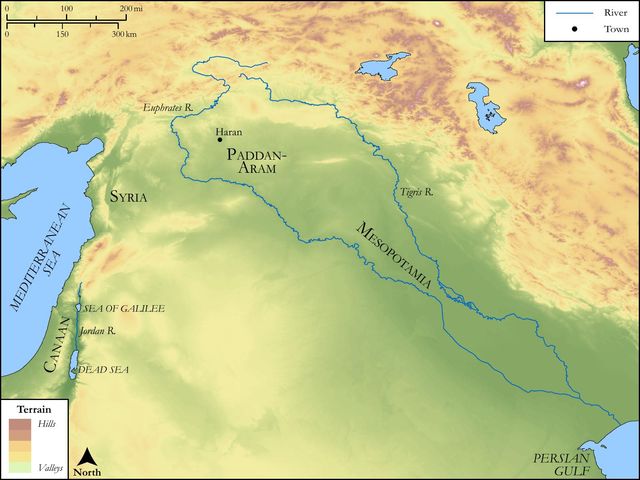
See on the biblical-era map


Study this verse
Public-domain commentary
Matthew Henry
From his Commentary on the Whole Bible. Henry comments on passages, not single verses — this entry covers Genesis 25:19–28. His four-level outline is real structure in the source text, so it is rendered as structure.
We have here an account of the birth of Jacob and Esau, the twin sons of Isaac and Rebekah: their entrance into the world was (which is not usual) one of the most considerable parts of their story; nor is much related concerning Isaac but what had reference to his father while he lived and to his sons afterwards. For Isaac seems not to have been a man of action, nor much tried, but to have spent his days in quietness and silence. Now concerning Jacob and Esau we are here told,
I.That they were prayed for.
Their parents, after they had been long childless, obtained them by prayer, Gen 25:20, Gen 25:21. Isaac was forty years old when he was married; though he was an only son, and the person from whom the promised seed was to come, yet he made no haste to marry. He was sixty years old when his sons were born (Gen 25:26), so that, after he was married, he had no child for twenty years. Note, Though the accomplishment of God's promise is always sure, yet it is often slow, and seems to be crossed and contradicted by Providence, that the faith of believers may be tried, their patience exercised, and mercies long waited for may be the more welcome when they come. While this mercy was delayed, Isaac did not approach to a handmaid's bed, as Abraham had done, and Jacob afterwards; for he loved Rebekah, Gen 24:67. But,
1.He prayed: he entreated the Lord for his wife. Though God had promised to multiply his family, he prayed for its increase; for God's promises must not supersede, but encourage, our prayers, and be improved as the ground of our faith. Though he had prayed for this mercy very often, and had continued his supplication many years, and it was not granted, yet he did not leave off praying for it; for men ought always to pray, and not to faint (Luk 18:1), to pray without ceasing, and knock till the door be opened, He prayed for his wife; some read it with his wife. Note, Husbands and wives should pray together, which is intimated in the apostle's caution, that their prayers be not hindered, Pe1 3:7. The Jews have a tradition that Isaac, at length, took his wife with him to mount Moriah, where God had promised that he would multiply Abraham's seed (ch. 22:17), and there, in his prayer with her and for her, pleaded the promise made in that very place.
2.God heard his prayer, and was entreated of him. Note, Children are the gift of God. Those that continue instant in prayer, as Isaac did, shall find, at last, that they did not seek in vain, Isa 45:19.
II.That they were prophesied of before they were born, and great mysteries were wrapped up in the prophecies which went before of them, Gen 25:22, Gen 25:23. Long had Isaac prayed for a son; and now his wife is with child of two, to recompense him for his long waiting. Thus God often outdoes our prayers, and gives more than we are able to ask or think. Now Rebekah being with child of these two sons, observe here,
1.How she was perplexed in her mind concerning her present case: The children struggled together within her. The commotion she felt was altogether extraordinary and made her very uneasy. Whether she was apprehensive that the birth would be her death, or whether she was weary of the intestine tumult, or whether she suspected it to be an ill omen, it seems she was ready to wish that either she had not been with child or that she might die immediately, and not bring forth such a struggling brood: If it be so, or, since it is so, Why am I thus? Before, the want of children was her trouble, now, the struggle of the children is no loss so. Note,
(1.)The comforts we are most desirous of are sometimes found to bring along with them more occasion of trouble and uneasiness that we thought of; vanity being written upon all things under the sun, God thus teaches us to read it.
(2.)We are too apt to be discontented with our comforts, because of the uneasiness that attends them. We know not when we are pleased; we know neither how to want nor how to abound. This struggle between the kingdom of God and the kingdom of Satan,
[1.]In the world. The seed of the woman and the seed of the serpent have been contending ever since the enmity was put between them (Gen 3:15), and this has occasioned a constant uneasiness among men. Christ himself came to send fire on earth, and this division, Luk 12:49, Luk 12:51. But let not this be offence to us. A holy war is better than the peace of the devil's palace.
[2.]In the hearts of believers. No sooner is Christ formed in the soul than immediately there begins a conflict between the flesh and spirit, Gal 5:17. The stream is not turned without a mighty struggle, which yet ought not to discourage us. It is better to have a conflict with sin than tamely to submit to it.
2.What course she took for her relief: She went to enquire of the Lord. Some think Melchizedek was now consulted as an oracle, or perhaps some Urim or Teraphim were now used to enquire of God by, as afterwards in the breast-plate of judgment. Note, The word and prayer, by both which we now enquire of the Lord, give great relief to those that are upon any account perplexed. It is a great relief to the mind to spread our case before the Lord, and ask counsel at his mouth. Go into the sanctuary, Psa 73:17.
3.The information given her, upon her enquiry, which expounded the mystery: Two nations are in thy womb, Gen 25:23. She was now pregnant, not only with two children, but two nations, which should not only in their manners and dispositions greatly differ from each other, but in their interests clash and contend with each other; and the issue of the contest should be that the elder should serve the younger, which was fulfilled in the subjection of the Edomites, for many ages, to the house of David, till they revolted, Ch2 21:8. Observe here, (1.) God is a free agent in dispensing his grace; it is his prerogative to make a difference between those who have not as yet themselves done either good or evil. This the apostle infers hence, Rom 9:12 (2.) In the struggle between grace and corruption in the soul, grace, the younger, shall certainly get the upper hand at last.
III.That when they were born there was a great difference between them, which served to confirm what had been foretold (Gen 25:23), was presage of the accomplishment of it, and served greatly to illustrate the type.
1.There was a great difference in their bodies, Gen 25:25. Esau, when he was born, was rough and hairy, as if he had been already a grown man, whence he had his name Esau, made, reared already. This was an indication of a very strong constitution, and gave cause to expect that he would be a very robust, daring, active man. But Jacob was smooth and tender as other children. Note,
(1.)The difference of men's capacities, and consequently of their condition in the world, arises very much from the difference of their natural constitution; some are plainly designed by nature for activity and honour, others as manifestly marked for obscurity. This instance of the divine sovereignty in the kingdom of providence may perhaps help to reconcile us to the doctrine of the divine sovereignty in the kingdom of grace.
(2.)It is God's usual way to choose the weak things of the world, and to pass by the mighty, Co1 1:26, Co1 1:27.
2.There was a manifest contest in their births. Esau, the stronger, came forth first; but Jacob's hand took hold of his heel, Gen 25:26. This signified,
(1.)Jacob's pursuit of the birthright and blessing; from the first, he reached forth to catch hold of it, and, if possible, to prevent his brother.
(2.)His prevailing for it at last, that, in precess of time, he should undermine his brother, and gain his point. This passage is referred to (Hos 12:8), and hence he had his name, Jacob, a supplanter.
3.They were very unlike in the temper of their minds, and the way of living they chose, Gen 25:27. They soon appeared to be of very different dispositions.
(1.)Esau was a man for this world. He was a man addicted to his sports, for he was a hunter; and a man who knew how to live by his wits, for he was a cunning hunter. Recreation was his business; he studied the art of it, and spent all his time in it. He never loved a book, nor cared for being within doors; but he was a man of the field, like Nimrod and Ishmael, all for the game, and never well but when he was upon the stretch in pursuit of it: in short, he set up for a gentleman and a soldier.
(2.)Jacob was a man for the other world. He was not cut out for a statesman, nor did he affect to look great, but he was a plain man, dwelling in tents, an honest man that always meant well, and dealt fairly, that preferred the true delights of solitude and retirement to all the pretended pleasure of busy noisy sports: he dwelt in tents,
[1.]As a shepherd. he was attached to that safe and silent employment of keeping sheep, to which also he bred up his children, Gen 46:34. Or,
[2.]As a student. He frequented the tents of Melchizedek, or Heber, as some understand it, to be taught by them divine things. And this was that son of Isaac on whom the covenant was entailed.
4.Their interest in the affections of their parents was likewise different. They had but these two children, and, it seems, one was the father's darling and the other the mother's, Gen 25:28.
(1.)Isaac, though he was not a stirring man himself (for when he went into the fields he went to meditate and pray, not to hunt), yet loved to have his son active. Esau knew how to please him, and showed a great respect for him, by treating him often with venison, which gained him the affections of the good old man, and won upon him more than one would have thought.
(2.)Rebekah was mindful of the oracle of God, which had given the preference to Jacob, and therefore she preferred him in her love. And, if it be lawful for parents to make a difference between their children upon any account, doubtless Rebekah was in the right, that loved him whom God loved.
Historical interpretation
Two Centuries of Reception
3 surviving comments on this verse. Each one is dated, so this reads as a timeline rather than a list.
Select a marker to jump to its quote. Markers stagger vertically where authors wrote within a few decades of each other.
This Esau proceeded from his mother’s womb “hairy all over like a skin,” but Jacob was smooth and simple. Thus Jacob received his name from wrestling or supplanting, but Esau—as those who interpret Hebrew names say—received his name either from redness or from earth, that is, “red” or “earthly,” or, as it seemed to others, his name appears to mean “something made.”Certainly, as the apostle says, both sons were conceived “from our one father Isaac.” But why these prerogatives are given is not mine to know. Neither do I know why one “supplanted his brother” and was born smooth and simple, nor why the other was born “hairy all over” and shaggy and, so to speak, enwrapped in the squalor of sin and vileness. This is not mine to discuss.
(Verse 25) And the first came out red, all over like a hairy garment; and they called his name Esau. And after that came his brother out, and his hand took hold on Esau’s heel; and his name was called Jacob. And Isaac was threescore years old when Rebekah bare them.
Two twins were born at so short an interval of time that the second had a hold on the foot of the first. Yet they were so unlike in their lives, character, conduct and the love their parents bore them that this unlikeness made them enemies one of the other. When I say unlike, I do not mean that one would sit while the other walked, or that one slept while the other was awake or that one talked while the other kept quiet.One of our twins led a life of servile toil, while the other served no one. One was loved by his mother; the other was not. One lost the title to primogeniture, which was then so highly esteemed, and the other obtained it. Further, there were immense differences between them in regard to their wives, children and possessions. If such differences are to be explained by those split seconds between the births of twins which are considered negligible in their horoscopes, why are such matters mentioned when other people’s horoscopes are in question?
Continue studying Genesis 25:25 across the web’s major study libraries — every link below opens this exact verse, chapter, or book on the destination site.
Read & Compare
 BibleGatewayThis verse in more than 200 translations and 70 languages.
 Bible.comThe YouVersion reader — hundreds of translations, reading plans, and highlights.
 ESV.orgCrossway's official English Standard Version reader.
 NET BibleThe NET translation with 60,000+ translators' notes on every rendering decision.
 STEP BibleTyndale House's free study tool — original text, vocabulary, and scholarly resources.
 BibliaLogos Bible Software's free web reader.
 USCCBThe New American Bible (Revised Edition) with the U.S. bishops' study notes.
Commentaries
 BibleHub CommentariesDozens of classic commentaries on this verse, gathered on one page.
 StudyLightMore than 100 commentary sets — the largest collection on the web.
 BibleRefPlain-English commentary on what this verse means, verse by verse.
 Enduring WordDavid Guzik's free commentary on this chapter, widely used by Bible teachers.
 Bible Study ToolsVerse commentary alongside Greek and Hebrew study aids.
Original Language & Research
- BibleHub InterlinearThe verse word by word — original language, transliteration, and English.
- BibleHub LexiconEvery word's original-language definition and Strong's entry.
 Blue Letter BibleDeep-study tools — Strong's numbers, concordance, and word studies.
 SefariaThe Hebrew text with Rashi and centuries of Jewish commentary.
Sermons, Hymns & Audio


TrulyRandomVerse is not affiliated with these sites and doesn’t control their content. They’re linked because they’re genuinely useful.
Summary
Genesis 25:25 meticulously records the birth of Esau, the firstborn twin son of Isaac and Rebekah, highlighting his distinctive physical characteristics as "red" and "hairy." This pivotal verse not only marks the initial, tangible fulfillment of God's prior prophecy to Rebekah concerning two nations within her womb but also immediately sets the stage for the unfolding narrative of divine election, the complex relationship between the patriarchs, and the eventual establishment of the covenant line through Jacob, not Esau.
Context
ShowHideLiterary Context
Genesis 25:25 is nestled within the patriarchal narratives, specifically detailing the lineage and early lives of Isaac's sons. It immediately follows Isaac's fervent prayer for Rebekah's barrenness in Genesis 25:21, which God graciously answered. Crucially, it comes on the heels of Rebekah's troubled pregnancy and her divine encounter, where the Lord revealed, "Two nations are in thy womb, and two manner of people shall be separated from thy bowels; and the one people shall be stronger than the other people; and the elder shall serve the younger" (Genesis 25:23). Thus, Esau's birth, as the firstborn, directly initiates the visible manifestation of this prophetic word, introducing a key figure whose life will dramatically illustrate God's sovereign choice and the unfolding of His redemptive plan despite human expectations. The subsequent narrative, particularly the account of Esau selling his birthright in Genesis 25:29-34, immediately establishes the tension and trajectory of his relationship with Jacob.
Historical & Cultural Context
In the ancient Near East, the status of the firstborn son (primogeniture) carried immense significance. The firstborn typically received a double portion of the inheritance, the patriarchal blessing, and the leadership of the family. This cultural norm made God's prophecy in Genesis 25:23 particularly counter-cultural and shocking, as it inverted the expected order. The physical descriptions of Esau – "red" and "hairy" – would have been immediately recognizable and symbolic to an ancient audience. "Redness" could denote a robust, earthy, or even fiery disposition, and its later association with Edom (meaning "red") would be a powerful etiological link. Hairiness was often associated with strength, wildness, or a connection to nature, setting Esau apart from the more "plain" Jacob, as described in Genesis 25:27. These descriptions are not merely superficial but carry deep cultural and prophetic weight, shaping the perception of Esau and foreshadowing his character and destiny.
Key Themes
ShowHideGenesis 25:25 contributes significantly to several overarching themes within Genesis and the broader biblical narrative. Foremost among these is the theme of Divine Sovereignty and Election, where God's purposes are shown to transcend human customs and expectations, as evidenced by the prophecy that the elder would serve the younger, despite Esau's firstborn status. It also introduces the theme of Distinctive Identity and Character, as Esau's unique physical appearance immediately sets him apart and foreshadows his later actions and the identity of the nation that descends from him. The verse lays the groundwork for the theme of Birthright and Blessing, setting up the dramatic tension surrounding the inheritance and spiritual legacy that would play out between the twin brothers. Furthermore, it subtly introduces the theme of Covenant Continuity, as the narrative of Isaac's family continues the divine promise made to Abraham, albeit with new challenges and divine interventions.
Exposition and Analysis
ShowHideGenesis 25:25 vividly describes the emergence of Isaac and Rebekah's firstborn son: "And the first came out red, all over like an hairy garment; and they called his name Esau." This verse provides crucial details that are both descriptive and deeply prophetic, laying the groundwork for the subsequent narrative.
Key Word Analysis
ShowHideFrom a root meaning "head" or "beginning," this word denotes priority in place, time, or rank. Here, it explicitly states Esau's position as the elder twin, carrying with it the cultural expectation of primogeniture and all its associated rights and privileges, which God's prophecy would dramatically subvert.
This adjective, derived from the root for "red" (אדם, ʼadam), describes Esau's complexion or hair color. It is a highly significant descriptive term, directly linking to the later name of the nation descended from him, Edom (meaning "red"), and foreshadowing his impulsive act of selling his birthright for "red pottage" in Genesis 25:30. This color often symbolizes earthiness, vitality, or even a fiery disposition.
This noun refers to hair, specifically in a dishevelled or bristly sense. It emphasizes the remarkable and pronounced hairiness of Esau's body, which was so distinctive that it likely influenced his given name, Esau, and became a critical element in Jacob's later deception of Isaac, who relied on touch to distinguish his sons in Genesis 27:11.
This proper noun is the given name of Isaac's firstborn son. While its precise etymology is debated, it is often associated with the Hebrew root for "hairy" or "rough," directly reflecting his physical appearance. It can also imply "completed" or "made," perhaps suggesting a fully formed or robust individual at birth. The name itself becomes a marker of his unique identity and foreshadows the character of the nation that would descend from him.
Verse Breakdown
ShowHide"And the first came out red,"
This phrase immediately establishes Esau's birth order as the elder twin, a position of significant cultural privilege. The description "red" is the first striking detail, not merely a physical observation but a powerful symbolic and prophetic identifier. It foreshadows his connection to the land and nation of Edom and subtly hints at his earthly, perhaps impulsive, nature.
"all over like an hairy garment;"
This vivid simile emphasizes the extraordinary extent of Esau's hairiness, describing his body as if covered by a rough, animal-like cloak. This pronounced physical trait distinguishes him sharply from his twin brother Jacob and becomes a crucial plot device later in the narrative, particularly in the deception surrounding Isaac's blessing. It also suggests a robust, perhaps wild or untamed, character.
"and they called his name Esau."
The naming of the child is a significant act, often reflecting circumstances of birth, physical characteristics, or hopes for the future. In Esau's case, his name (Hebrew: ʻÊsâv) is widely understood to be connected to his striking hairiness or "roughness." This act of naming solidifies his unique identity within the narrative and sets him on a distinct path from his brother, fulfilling the initial part of God's prophecy to Rebekah.
Literary Devices
ShowHideThe verse employs several significant literary devices. The most prominent is Imagery, particularly visual and tactile, through the descriptions "red" and "hairy garment." These vivid details not only create a clear mental picture of the newborn but also serve as Symbolism, where Esau's "redness" foreshadows his later association with Edom and his "hairiness" becomes emblematic of his rugged, outdoorsman character, contrasting with Jacob. The phrase "like an hairy garment" is a Simile, directly comparing his body to a specific type of clothing, emphasizing the density and texture of his hair. Furthermore, the entire verse functions as Foreshadowing, subtly hinting at future events and character developments, such as Esau's connection to the land of Edom, his impulsive nature, and the role his physical appearance will play in the narrative of the stolen blessing.
Theological and Thematic Connections
ShowHideGenesis 25:25, while seemingly a straightforward birth announcement, is rich with theological implications, primarily highlighting God's sovereign prerogative in election and the distinct paths He ordains for individuals and nations. Esau's physical distinctiveness and firstborn status are immediately juxtaposed with God's prior declaration that "the elder shall serve the younger" (Genesis 25:23). This establishes a profound theological truth: God's divine plan is not bound by human conventions, cultural norms, or even natural birth order, but is rooted in His unmerited grace and sovereign will. The narrative of Esau and Jacob profoundly illustrates that God chooses whom He will, not based on their works or merits, but according to His purpose, a theme later expounded by Paul in the New Testament. Esau's story thus becomes a foundational example of how human choices (like his valuing of a meal over his birthright) interact with divine election, revealing the significance of spiritual inheritance over temporal gratification.
Reflection and Application
ShowHideGenesis 25:25 serves as a profound reminder that God's intricate plans often unfold through seemingly ordinary events like birth, yet with extraordinary purpose. Esau's distinctive physical traits emphasize that while individuals are uniquely created, outward appearances do not dictate one's spiritual destiny or character. The subsequent narrative of Esau and Jacob profoundly illustrates God's sovereign choice and purpose, demonstrating that His divine will is not contingent upon human conventions such as birth order or physical attributes. This narrative encourages believers to recognize and trust in God's overarching plan, even when it defies human expectations or cultural norms, and to value spiritual inheritance above all else, understanding that true blessings often transcend immediate gratification. It challenges us to look beyond the superficial and discern God's deeper purposes, embracing His call on our lives regardless of our perceived strengths or weaknesses, and to prioritize eternal values over fleeting earthly comforts.
Questions for Reflection
ShowHideFAQ
ShowHideWhy is Esau described as "red" and "hairy"?
ShowHideEsau's description as "red" (Hebrew: ʼadmônîy) and "hairy" (Hebrew: sêʻâr) is highly significant, serving both descriptive and prophetic purposes. His "redness" directly links to the nation of Edom, which descended from him, and foreshadows his impulsive choice to sell his birthright for "red pottage" in Genesis 25:30. This color also hints at his earthy, robust, and perhaps fiery disposition. His "hairiness" was so pronounced that it likely contributed to his name, Esau (Hebrew: ʻÊsâv, possibly meaning "hairy" or "rough"), and became a crucial element in Jacob's later deception of Isaac, who relied on touch to distinguish his sons in Genesis 27:11. These physical traits are not merely superficial but carry deep symbolic and prophetic weight, foreshadowing his character and the destiny of his descendants.
Did Esau's birth as the firstborn contradict the prophecy that the elder would serve the younger?
ShowHideNo, Esau's birth as the firstborn did not contradict the prophecy in Genesis 25:23; rather, it established the very tension and narrative context through which the prophecy would be fulfilled. God's declaration that "the elder shall serve the younger" revealed His sovereign choice, indicating that His divine plan would transcend the customary rights and expectations associated with primogeniture in ancient Near Eastern culture. The subsequent events in the lives of Esau and Jacob, including Esau's selling of his birthright and Jacob's obtaining of the blessing, demonstrate how God works through human choices and circumstances to bring about His predetermined purposes, highlighting His sovereignty over human traditions and the ultimate triumph of His divine will. This narrative underscores that God's election is not based on human merit or birth order but on His own gracious purpose.
Christ-Centered Fulfillment
ShowHideWhile Genesis 25:25 directly describes the birth of Esau, its profound Christ-centered fulfillment lies in the broader narrative of God's sovereign election and the establishment of a covenant line through Jacob, which ultimately leads to the Messiah. Esau's story, marked by his disregard for his birthright and his focus on immediate gratification, stands in stark contrast to the spiritual lineage chosen by God. This narrative underscores that God's redemptive plan is not based on human merit, birth order, or physical attributes, but on His unmerited grace and sovereign choice, culminating in Christ. Just as God chose Jacob over Esau, so too in the New Covenant, God chooses those who are "not of blood, nor of the will of the flesh, nor of the will of man, but of God" (John 1:13). Through Christ, God perfectly fulfilled His covenant promises, offering a true, eternal birthright to all who believe, far surpassing any earthly inheritance or privilege. He is the ultimate "firstborn" in a new creation, through whom all spiritual blessings flow (Colossians 1:15-18). The narrative of Esau's loss of blessing foreshadows the greater blessing found only in Christ, the true Seed of Abraham, through whom all nations are blessed (Galatians 3:16).