


Numbers 20:14
Bible text: King James Version (1769 Blayney text) · Public domain
Bible text: King James Version with Strong's numbers · Public domain
Bible text: Berean Standard Bible · Public domain
Bible text: American Standard Version (1901) · Public domain
Bible text: World English Bible, Messianic edition · Public domain
Bible text: Geneva Bible (1599) · Public domain
Bible text: Young's Literal Translation · Public domain
- וַיִּשְׁלַחvai·yish·Lachand he sentH7971Conj-w ¦ V-Qal-ConsecImperf-3msVerb Qal Consecutive Imperfect 3rd Singular Masculineוַandיִּשְׁלַחhe sent
- מֹשֶׁהmo·ShehMosesH4872N-proper-mNoun Proper Masculine
- מַלְאָכִיםmal·'a·KhimmessengersH4397N-mpNoun Plural Masculine Absolute
- מִקָּדֵשׁmi·ka·Deshfrom KadeshH6946Prep-m ¦ N-properNoun Proper LocationמִfromקָּדֵשׁKadesh
- אֶל'eltoH413PrepPreposition
- מֶלֶךְMe·lekh[the] king ofH4428N-mscNoun Singular Masculine Construct
- אֱדוֹם'e·DomEdomH123N-proper-mNoun Proper Masculine
- כֹּהkohthusH3541AdvAdverb
- אָמַר'a·Marhe saysH559V-Qal-Perf-3msVerb Qal Perfect 3rd Singular Masculine
- אָחִיךָ'a·Chi·khayour brotherH251N-msc ¦ 2msNoun Singular Masculine Constructאָחִיbrotherךָyour
- יִשְׂרָאֵלYis·ra·'ElIsraelH3478N-properNoun Proper Location
- אַתָּה'a·TahyouH859Pro-2msPronoun Personal 2nd Singular Masculine
- יָדַעְתָּya·Da'·tayou knowH3045V-Qal-Perf-2msVerb Qal Perfect 2nd Singular Masculine
- אֵת'et<obj.>H853DirObjMParticle Object Indicator
- כָּלkolallH3605N-mscNoun Singular Masculine Construct
- הַתְּלָאָהha·te·la·'Ahthe hardshipH8513Art ¦ N-fsNoun Singular Feminine Absoluteהַtheתְּלָאָהhardship
- אֲשֶׁר'a·SherwhichH834RelParticle Relative
- מְצָאָתְנוּme·tza·'A·te·nuit has come upon usH4672V-Qal-Perf-3fs ¦ 1cpVerb Qal Perfect 3rd Singular Feminineמְצָאָתְit has come uponנוּus
English is a literal word-by-word gloss of the Hebrew, not the KJV's wording. Why?
This is the original text the KJV's translators worked from — each Hebrew word with its own literal English meaning in this verse, prepared by scholars at Tyndale House, Cambridge. The KJV translates whole sentences, not word by word, so its wording differs: one Hebrew word can become several English words, and the KJV may choose “the LORD” where the gloss reads “Yahweh”. Both are faithful — they answer different questions. For the KJV's own rendering, switch to the KJV text.
Details
See on the biblical-era maps
Study this verse
Public-domain commentary
Matthew Henry
From his Commentary on the Whole Bible. Henry comments on passages, not single verses — this entry covers Numbers 20:14–21. His two-level outline is real structure in the source text, so it is rendered as structure.
We have here the application made by Israel to the Edomites. The nearest way to Canaan from the place where Israel now lay encamped was through the country of Edom. Now,
I.Moses sends ambassadors to treat with the king of Edom for leave to pass through his country, and gives them instructions what to say, Num 20:14-17.
1.They are to claim kindred with the Edomites: Thus saith thy brother Israel. Both nations descended from Abraham and Isaac, their common ancestors; Esau and Jacob, the two fathers of their respective nations, were twin-brothers; and therefore, for relation-sake, they might reasonably expect this kindness from them; nor needed the Edomites to fear that their brother Israel had any ill design upon them, or would take any advantages against them.
2.They are to give a short account of the history and present state of Israel, which, they take it for granted, the Edomites were no strangers to. And in this there was a double plea: - (1.) Israel had been abused by the Egyptians, and therefore ought to be pitied and succoured by their relations: "The Egyptians vexed us and our fathers, but we may hope our brethren the Edomites will not be so vexatious." (2.) Israel had been wonderfully saved by the Lord, and therefore ought to be countenanced and favoured (Num 20:16): "We cried unto the Lord, and he sent an angel, the angel of his presence, the angel of the covenant, the eternal Word, who had brought us forth out of Egypt, and led us hither." It was therefore the interest of the Edomites to ingratiate themselves with a people that had so great an interest in heaven and were so much its favourites, and it was at their peril if they offered them any injury. It is our wisdom and duty to be kind to those whom God is pleased to own, and to take his people for our people. Come in, thou blessed of the Lord.
3.They are humbly to beg a passport through their country. Though God himself, in the pillar of cloud and fire, was Israel's guide, in following which they might have justified their passing through any man's ground against all the world, yet God would have this respect paid to the Edomites, to show that no man's property ought to be invaded under colour of religion. Dominion is founded in providence, not in grace. Thus when Christ was to pass through a village of the Samaritans, to whom his coming was likely to be offensive, he sent messengers before his face to ask leave, Luk 9:52. Those that would receive kindness must not disdain to request it.
4.They are to give security for the good behaviour of the Israelites in this march, that they would keep in the king's high road, that they would commit no trespass upon any man's property, either in ground or water, that they would not so much as make use of a well without paying for it, and that they would make all convenient speed, as fast as they could well go on their feet, Num 20:17, Num 20:19. Nothing could be offered more fair and neighbourly.
II.The ambassadors returned with a denial, Num 20:18.
Edom, that is, the king of Edom, as protector of his country, said, Thou shalt not pass by me; and, when the ambassadors urged it further, he repeated the denial (Num 20:20) and threatened, if they offered to enter his country, it should be at their peril; he raised his trained bands to oppose them. Thus Edom refused to give Israel passage. This was owing,
1.To their jealousy of the Israelites; they feared they should receive promises. And truly, had this numerous army been under any other discipline and command than that of the righteous God himself, who would no more suffer them to do wrong than to take wrong, there might have been cause for this jealousy; but what could they fear from a nation that had statutes and judgments so righteous?
2.It was owing to the old enmity which Esau bore to Israel. If they had no reason to fear damage by them, yet they were not willing to show so much kindness to them. Esau hated Jacob because of the blessing, and now the hatred revived, when the blessing was ready to be inherited. God would hereby discover the ill-nature of the Edomites to their shame, and try the good-nature of the Israelites to their honour: they turned away from him, and did not take this occasion to quarrel with him. Note, We must not think it strange if the most reasonable requests be denied by unreasonable men, and if those be affronted by men whom God favours. I as a deaf man heard not. After this indignity which the Edomites offered to Israel God gave them a particular caution not to abhor an Edomite (Deu 23:7), though the Edomites had shown such an abhorrence of them, to teach us in such cases not to meditate revenge.
Continue studying Numbers 20:14 across the web’s major study libraries — every link below opens this exact verse, chapter, or book on the destination site.
Read & Compare
 BibleGatewayThis verse in more than 200 translations and 70 languages.
 Bible.comThe YouVersion reader — hundreds of translations, reading plans, and highlights.
 ESV.orgCrossway's official English Standard Version reader.
 NET BibleThe NET translation with 60,000+ translators' notes on every rendering decision.
 STEP BibleTyndale House's free study tool — original text, vocabulary, and scholarly resources.
 BibliaLogos Bible Software's free web reader.
 USCCBThe New American Bible (Revised Edition) with the U.S. bishops' study notes.
Commentaries
 BibleHub CommentariesDozens of classic commentaries on this verse, gathered on one page.
 StudyLightMore than 100 commentary sets — the largest collection on the web.
 BibleRefPlain-English commentary on what this verse means, verse by verse.
 Enduring WordDavid Guzik's free commentary on this chapter, widely used by Bible teachers.
 Bible Study ToolsVerse commentary alongside Greek and Hebrew study aids.
Original Language & Research
- BibleHub InterlinearThe verse word by word — original language, transliteration, and English.
- BibleHub LexiconEvery word's original-language definition and Strong's entry.
 Blue Letter BibleDeep-study tools — Strong's numbers, concordance, and word studies.
 SefariaThe Hebrew text with Rashi and centuries of Jewish commentary.
Sermons, Hymns & Audio


TrulyRandomVerse is not affiliated with these sites and doesn’t control their content. They’re linked because they’re genuinely useful.
Summary
Numbers 20:14 marks a pivotal moment in Israel's wilderness journey, detailing Moses' diplomatic initiative to the king of Edom. Having endured nearly four decades of wandering, the Israelites, now encamped at Kadesh, seek peaceful passage through Edomite territory, a direct route to the Promised Land. Moses' message is a strategic appeal, invoking the shared ancestral kinship between Israel (descendants of Jacob) and Edom (descendants of Esau), coupled with a poignant and empathetic reminder of the profound "travail" and hardships Israel has experienced since their exodus from Egypt. This establishes the opening gambit in a critical interaction that will test Israel's reliance on divine guidance amidst human resistance and ultimately shape the final leg of their arduous journey.
Context
ShowHideLiterary Context
Numbers 20 is a crucial chapter, marking a significant transition as Israel approaches the end of their forty years of wilderness wandering. Immediately preceding this verse, the narrative recounts the death of Miriam and the second instance of water scarcity at Meribah (Kadesh), where Moses, in an act of disobedience, strikes the rock instead of speaking to it, resulting in God's judgment that he and Aaron will not enter the Promised Land (Numbers 20:1-13). Following this divine discipline and renewed hardship, the diplomatic mission to Edom in Numbers 20:14 represents a strategic human effort to navigate the final stages of their journey. The subsequent verses (Numbers 20:15-21) detail Edom's unyielding refusal, forcing Israel to take a longer, more arduous detour around Edomite territory. This detour directly leads to Aaron's death on Mount Hor (Numbers 20:22-29), underscoring how this diplomatic failure profoundly impacted the immediate trajectory of Israel's journey and the lives of its leaders.
Historical & Cultural Context
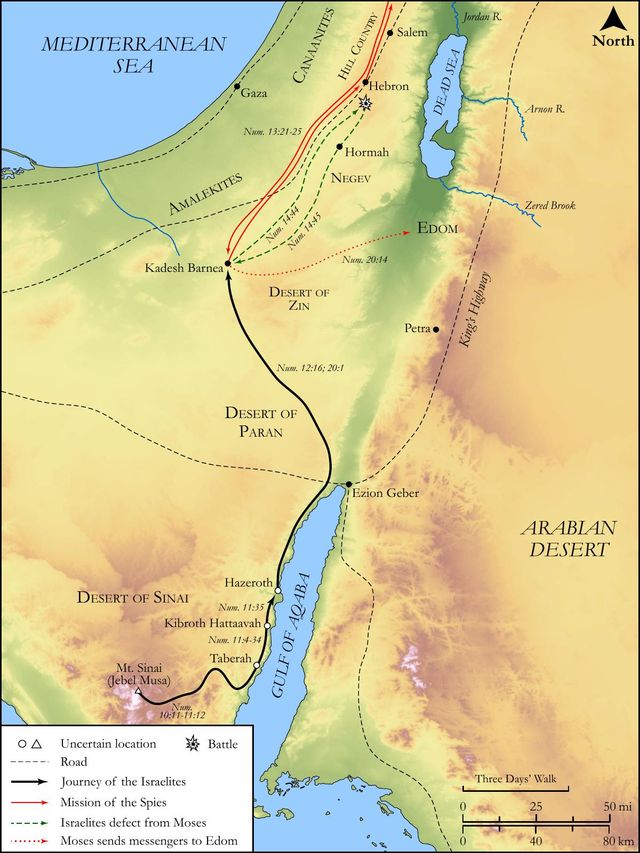
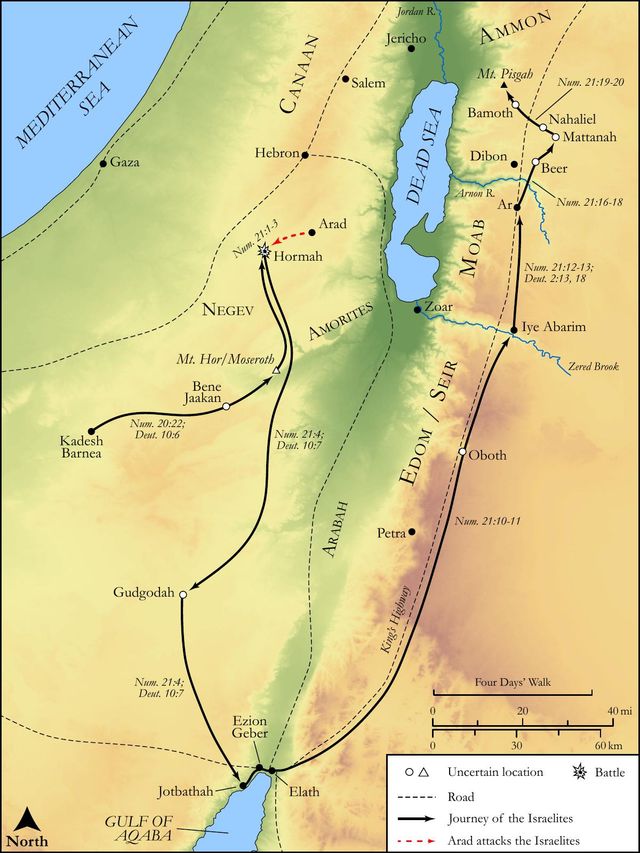
The setting for this diplomatic overture is Kadesh, a vital oasis and strategic encampment located on the southern border of Edom. The kingdom of Edom occupied a mountainous and fortified region south and east of the Dead Sea, controlling important trade routes. The Edomites were understood to be descendants of Esau, Jacob's twin brother (Genesis 36:1-8), a fact Moses leverages in his appeal. Despite this shared ancestry, historical and prophetic texts reveal a long-standing tension and often hostile relationship between Israel and Edom (Amos 1:11). Requesting passage through another king's territory was a common diplomatic practice, as when Israel later sent messengers to Sihon king of the Amorites, typically involving explicit assurances of peaceful conduct and often payment for resources consumed. Moses' dispatch of "messengers" (ambassadors) reflects standard diplomatic protocol for inter-state communication. The reference to Israel's "travail" would have been common regional knowledge, encompassing their bondage in Egypt and their subsequent forty-year exodus and wilderness wanderings, which had likely impacted surrounding nations through trade and rumor.
Key Themes
ShowHideNumbers 20:14 encapsulates several significant themes. Firstly, Diplomacy and Peacemaking are central, as Moses proactively seeks a peaceful resolution for passage, demonstrating a commitment to avoiding conflict even with a potentially adversarial neighbor. This highlights Israel's mandate to pursue peace where possible. Secondly, the theme of Kinship and Shared Heritage is powerfully invoked through the appeal to "thy brother Israel," attempting to leverage the ancient familial ties between Jacob and Esau for a practical and peaceful outcome. This underscores the complex interplay between divine promises and human relationships, even those strained by history. Thirdly, Israel's Identity and Suffering are underscored by the collective memory of "travail," reminding both Edom and the reader of God's faithfulness in sustaining His people through immense hardship, from Egyptian slavery to the rigors of the wilderness (Deuteronomy 8:2-5). Finally, the verse subtly introduces the theme of Divine Sovereignty and Human Obstacles, as Israel's divinely ordained path to Canaan encounters a human barrier, ultimately leading to a detour that, though seemingly an impediment, remains within God's overarching and perfect plan for His people.
Exposition and Analysis
ShowHideKey Word Analysis
ShowHideThis term (H4397) refers to an envoy, ambassador, or deputy, implying a formal and official diplomatic mission. While malʼâk can also denote a divine messenger or angel, its usage here underscores the seriousness and formality of Moses' appeal to the King of Edom. It signifies that this was not a casual request but a state-to-state communication, adhering to recognized protocols for relations between kings.
This place name (H6946), meaning "sanctuary" or "holy," identifies a crucial strategic oasis in the Desert of Zin, serving as a significant base for Israel during their wilderness wanderings. Its location near the borders of Edom and other territories made it the logical and necessary point for initiating diplomatic contact for passage into Canaan. The name itself might subtly hint at the sacred nature of Israel's journey and their divine mandate, even as they engage in human diplomacy.
This powerful word (H8513) denotes weariness, hardship, distress, or trouble. It encapsulates the full spectrum of Israel's suffering: the physical oppression in Egypt, the arduous journey through the wilderness, the lack of food and water, the internal rebellions, and the divine judgments. Moses uses this term to evoke empathy from Edom, presenting Israel not as a conquering army but as a people who have endured immense suffering and are simply seeking a peaceful way forward, appealing to a shared human experience of hardship.
Verse Breakdown
ShowHide"¶ And Moses sent messengers from Kadesh unto the king of Edom,"
This opening clause establishes the initiator of the action, Moses, and the formal nature of the communication, the sending of "messengers." It specifies the point of origin, Kadesh, Israel's current encampment, and the recipient of the diplomatic overture, the king of Edom. The "¶" symbol, often used in the KJV, denotes a new paragraph or a significant shift in the narrative, highlighting the importance of this diplomatic encounter as a distinct phase in Israel's journey. This act demonstrates Moses' commitment to seeking a peaceful and orderly passage.
"Thus saith thy brother Israel,"
This is the core of Moses' diplomatic appeal, grounding his request in kinship. By referring to Israel as Edom's "brother," Moses invokes the ancestral relationship between Jacob (Israel) and Esau (Edom), twin sons of Isaac. This appeal to shared lineage was a powerful cultural tool among the descendants of Abraham, designed to elicit a sense of familial obligation, hospitality, and solidarity, despite the known historical tensions between their progenitors. It frames the request not as from a foreign power but from a related people seeking assistance.
"Thou knowest all the travail that hath befallen us:"
This final clause serves as a plea for empathy and understanding, a strategic rhetorical move. Moses reminds the Edomite king of Israel's well-known history of profound suffering, from their harsh bondage in Egypt to their arduous forty-year journey through the wilderness. The phrase "Thou knowest" implies that this history was common knowledge in the region, and it is presented as a compelling reason for Edom to grant their request, appealing to compassion for a people who have already endured so much and are simply seeking a peaceful resolution to their journey.
Literary Devices
ShowHideThe verse primarily employs Pathos, an appeal to emotion, by highlighting Israel's "travail" or immense suffering. Moses strategically uses this to evoke sympathy and compassion from the King of Edom, hoping that a shared understanding of hardship will incline him to grant passage. This is coupled with an appeal to Ethos through the invocation of shared Kinship ("thy brother Israel"), attempting to establish a moral ground for the request based on familial ties and the implied obligations of brotherhood. The entire message functions as a Diplomatic Overture, a formal and carefully worded communication designed to achieve a specific political and logistical objective through peaceful negotiation rather than confrontation. The use of "messengers" also points to the formal nature of this Rhetorical Strategy, setting the stage for a significant interaction that has profound implications for Israel's journey.
Theological and Thematic Connections
ShowHideNumbers 20:14 serves as a powerful reminder of Israel's journey as a people chosen by God, yet navigating a world full of human obstacles and complex relationships. It highlights the tension between divine promise and human agency, illustrating that even when God has a clear path for His people, He often allows them to engage in human-level diplomacy and encounter resistance. This episode underscores that God's plan is not always executed without friction, and His people are called to act with integrity and seek peaceful resolutions where possible, even when facing potential adversaries. The reference to "travail" is a consistent theme throughout Israel's history, emphasizing their reliance on God's sustaining grace through hardship, a pattern that points to a deeper theological truth about the journey of faith and the character of God who accompanies His people through all their afflictions.
Reflection and Application
ShowHideNumbers 20:14 offers profound lessons for the contemporary believer. Moses' approach to Edom, though ultimately unsuccessful in its immediate aim, exemplifies a commitment to peace and diplomacy before resorting to conflict. It reminds us that even when we are on a divinely appointed journey, we are called to exercise wisdom, humility, and good faith in our interactions with others, even those who may be estranged, difficult, or potentially hostile. We are to seek peaceful paths and appeal to common ground where it exists, demonstrating the love and wisdom of Christ in our dealings. The verse also highlights the reality that not every appeal, even one based on legitimate need or shared history, will be met with favor. We may encounter resistance, rejection, or indifference on our spiritual journey or in our efforts to live out our faith. Yet, God's ultimate plan for us will prevail, often leading us through unexpected detours that serve His higher purposes, teaching us greater reliance on Him rather than on human cooperation or ideal circumstances. It encourages us to persist in faith, knowing that God will make a way, even when the path is not the one we initially sought, and that His providence extends even to human rejections.
Questions for Reflection
ShowHideFAQ
ShowHideWhy did Moses send messengers instead of just marching through Edom?
ShowHideMoses sent messengers as a diplomatic gesture, adhering to the common practice among kings of seeking permission for passage through sovereign territory. This was an attempt to avoid conflict and ensure a peaceful journey for the vast Israelite multitude, who would need to cross Edomite land to reach the Promised Land by the most direct route. It demonstrated Moses' commitment to peace and respect for Edom's sovereignty, even though Israel was under divine command to proceed towards Canaan. This approach highlights God's expectation that His people engage in wise and peaceful human interaction whenever possible, even while trusting in His ultimate guidance.
What was the significance of calling Edom "thy brother Israel"?
ShowHideThis phrase highlights the shared ancestry of the two nations, as Edom was descended from Esau and Israel from Jacob, twin brothers and sons of Isaac (Genesis 25:24-26). Moses invoked this familial bond to appeal to a sense of kinship, hoping it would foster hospitality and cooperation. It was a strategic attempt to leverage a historical relationship, however strained, to gain peaceful passage, appealing to a common heritage that should ideally transcend political differences.
What does "travail" refer to in this context?
ShowHide"Travail" (Hebrew: tᵉlâʼâh) refers to the immense suffering, hardship, and weariness that the Israelites had endured. This included their centuries of slavery in Egypt, the arduous journey through the wilderness for forty years, the lack of food and water, the various plagues, and the internal rebellions and divine judgments. Moses used this term to evoke empathy from the Edomite king, reminding him of Israel's long history of affliction and their current vulnerable state, hoping compassion would lead to a favorable response.
Christ-Centered Fulfillment
ShowHideNumbers 20:14, with its depiction of Israel's "travail" and their journey towards a promised land, finds profound Christ-centered fulfillment in the person and work of Jesus. Just as Israel endured immense hardship on their journey, so too did Christ, the ultimate "brother" (Hebrews 2:11-12), experience profound "travail" for the sake of His people. His entire earthly life, from His humble birth to His agonizing death on the cross, was marked by suffering, rejection, and hardship (Isaiah 53:3-5). He is the true Lamb of God who takes away the sin of the world, enduring the ultimate "travail" to open the way to a greater, eternal Promised Land—the new heavens and new earth (Revelation 21:1-4). Furthermore, Moses' diplomatic mission, though initially met with human resistance, foreshadows Christ's ultimate mission of reconciliation. Jesus, the supreme Messenger (John 3:17), came to offer peace and passage into God's kingdom, not through a geographical route, but through His atoning sacrifice. He established a new kinship, not based on earthly lineage, but on spiritual adoption into God's family through faith in Him (Galatians 3:26-29). The seemingly circuitous route Israel was forced to take ultimately led them to their destination, just as Christ's suffering and death, though appearing to be a detour from glory, was the very path to our salvation and the fulfillment of God's eternal promises (Luke 24:26).