


Genesis 32:3
Bible text: King James Version (1769 Blayney text) · Public domain
Bible text: Berean Standard Bible · Public domain
Bible text: American Standard Version (1901) · Public domain
Bible text: World English Bible, Messianic edition · Public domain
Bible text: Geneva Bible (1599) · Public domain
Bible text: Young's Literal Translation · Public domain
- וַיִּשְׁלַחvai·yish·Lachand he sentH7971Conj-w ¦ V-Qal-ConsecImperf-3msVerb Qal Consecutive Imperfect 3rd Singular Masculineוַandיִּשְׁלַחhe sent
- יַעֲקֹבya·'a·KoJacobH3290N-proper-mNoun Proper Masculine
- מַלְאָכִיםmal·'a·KhimmessengersH4397N-mpNoun Plural Masculine Absolute
- לְפָנָיוle·fa·Nav<to> before himH6440Prep-l ¦ N-mpc ¦ 3msNoun Plural Masculine Constructלְ<to>פָנָיbeforeוhim
- אֶל'eltoH413PrepPreposition
- עֵשָׂו'e·SavEsauH6215N-proper-mNoun Proper Masculine
- אָחִיו'a·Chivhis brotherH251N-msc ¦ 3msNoun Singular Masculine Constructאָחִיbrotherוhis
- אַרְצָה'Ar·tzah[the] land of towardsH776N-fsc ¦ SfxNoun Singular Feminine Constructאַרְצָ[the] land ofהtowards
- שֵׂעִירse·'IrSeirH8165N-properNoun Proper Location
- שְׂדֵהse·Deh[the] region ofH7704N-mscNoun Singular Masculine Construct
- אֱדוֹם'e·DomEdomH123N-proper-mNoun Proper Masculine
English is a literal word-by-word gloss of the Hebrew, not the KJV's wording. Why?
This is the original text the KJV's translators worked from — each Hebrew word with its own literal English meaning in this verse, prepared by scholars at Tyndale House, Cambridge. The KJV translates whole sentences, not word by word, so its wording differs: one Hebrew word can become several English words, and the KJV may choose “the LORD” where the gloss reads “Yahweh”. Both are faithful — they answer different questions. For the KJV's own rendering, switch to the KJV text.
Details
See on the biblical-era maps


Study this verse
Public-domain commentary
Matthew Henry
From his Commentary on the Whole Bible. Henry comments on passages, not single verses — this entry covers Genesis 32:3–8. His two-level outline is real structure in the source text, so it is rendered as structure.
Now that Jacob was re-entering Canaan God, by the vision of angels, reminded him of the friends he had when he left it, and thence he takes occasion to remind himself of the enemies he had, particularly Esau. It is probable that Rebekah had sent him word of Esau's settlement in Seir, and of the continuance of his enmity to him. What shall poor Jacob do? He longs to see his father, and yet he dreads to see his brother. He rejoices to see Canaan again, and yet cannot but rejoice with trembling because of Esau.
I.He sends a very kind and humble message to Esau.
It does not appear that his way lay through Esau's country, or that he needed to ask his leave for a passage; but his way lay near it, and he would not go by him without paying him the respect due to a brother, a twin-brother, an only brother, an elder brother, a brother offended. Note,
1.Though our relations fail in their duty to us, yet we must make conscience of doing our duty to them.
2.It is a piece of friendship and brotherly love to acquaint our friends with our condition, and enquire into theirs. Acts of civility may help to slay enmities. Jacob's message to him is very obliging, v. 4, 5. (1.) He calls Esau his lord, himself his servant, to intimate that he did not insist upon the prerogatives of the birthright and blessing he had obtained for himself, but left it to God to fulfil his own purpose in his seed. Note, Yielding pacifies great offences, Ecc 10:4. We must not refuse to speak in a respectful an submissive manner to those that are ever so unjustly exasperated against it (2.) He gives him a short account of himself, that he was not a fugitive and a vagabond, but, though long absent, had had a certain dwelling-place, with his own relations: I have sojourned with Laban, and staid there till now; and that he was not a beggar, nor did he come home, as the prodigal son, destitute of necessaries and likely to be a charge to his relations; no, I have oxen and asses. This he knew would (if any thing) recommend him to Esau's good opinion. And, (3.) He courts his favour: I have sent, that I might find grace in thy sight. Note, It is no disparagement to those that have the better cause to become petitioners for reconciliation, and to sue for peace as well as right.
II.He receives a very formidable account of Esau's warlike preparations against him (Gen 32:6), not a word, but a blow, a very coarse return to his kind message, and a sorry welcome home to a poor brother: He comes to meet thee, and four hundred men with him. He is now weary of waiting for the days of mourning for this good father, and even before they come he resolves to slay his brother.
1.He remembers the old quarrel, and will now be avenged on him for the birthright and blessing, and, if possible, defeat Jacob's expectations from both. Note, malice harboured will last long, and find an occasion to break out with violence a great while after the provocations given. Angry men have good memories.
2.He envies Jacob what little estate he had, and, though he himself was now possessed of a much better, yet nothing will serve him but to feed his eyes upon Jacob's ruin, and fill his fields with Jacob's spoils. Perhaps the account Jacob sent him of his wealth did but provoke him the more.
3.He concludes it easy to destroy him, now that he was upon the road, a poor weary traveller, unfixed, and (as he thinks) unguarded. Those that have the serpent's poison have commonly the serpent's policy, to take the first and fairest opportunity that offers itself for revenge.
4.He resolves to do it suddenly, and before Jacob had come to his father, lest he should interpose and mediate between them. Esau was one of those that hated peace; when Jacob speaks, speaks peaceably, he is for war, Psa 120:6, Psa 120:7. Out he marches, spurred on with rage, and intent on blood and murders; four hundred men he had with him, probably such as used to hunt with him, armed, no doubt, rough and cruel like their leader, ready to execute the word of command though ever so barbarous, and now breathing nothing but threatenings and slaughter. The tenth part of these were enough to cut off poor Jacob, and his guiltless helpless family, root and branch. No marvel therefore that it follows (Gen 32:7), then Jacob was greatly afraid and distressed, perhaps the more so from having scarcely recovered the fright Laban had put him in. Note, Many are the troubles of the righteous in this world, and sometimes the end of one is but the beginning of another. The clouds return after the rain. Jacob, though a man of great faith, yet was now greatly afraid. Note, A lively apprehension of danger, and a quickening fear arising from it, may very well consist with a humble confidence in God's power and promise. Christ himself, in his agony, was sorely amazed.
III.He puts himself into the best posture of defence that his present circumstances will admit.
It was absurd to think of making resistance, all his contrivance is to make an escape, Gen 32:7, Gen 32:8. He thinks it prudent not to venture all in one bottom, and therefore divides what he had into two companies, that, if one were smitten, the other might escape. Like a tender careful master of a family, he is more solicitous for their safety than for his own. He divided his company, not as Abraham (Gen 14:15), for fight, but for flight.
Historical interpretation
Historical reception
2 surviving comments on this verse. Each one is dated, so this reads as a timeline rather than a list.
Select a marker to jump to its quote. Markers stagger vertically where authors wrote within a few decades of each other.
See how great was Jacob’s fear even after the vision had affected the good man. He was afraid of his brother’s aggression and was concerned lest the memory of what had been done by him previously might provoke Esau into an attack on him. “Say to my lord Esau, ‘Thus says your servant Jacob: I was dwelling with Laban and tarried until now; I acquired cattle and asses and sheep, servants male and female. I have sent word to my lord in the hope that your servant may find favor with you.’ ” Notice how Jacob was afraid of his brother, and hence out of a wish to placate him he sent word ahead alerting him to his coming, the wealth acquired by him and where he had spent all the time, so as to calm Esau’s anger and succeed in making him gracious. This in fact happened, for God placated his heart, allayed his anger and rendered him gracious. After all, if by the words Jacob spoke to Laban, who had hunted him down in such awful rage, he caused him to suffer such great apprehension, much more did he cause his brother to be more affable to the good man.
Jacob did not want to see Esau before he had appeased him with presents, and he only saw him afterward when the presents had been accepted. And when Jacob came to him, he bowed down to him from a long way off. So how shall the elder be slave to the younger, when the younger manifestly bows down to the elder? But the reason why these things were not fulfilled in the actual history of the two men is to make us understand that they were said of a future Jacob. The younger son received the first place, and the elder son, the people of the Jews, lost the first place. See how Jacob has filled the whole world, has taken possession of nations and kingdoms.
Continue studying Genesis 32:3 across the web’s major study libraries — every link below opens this exact verse, chapter, or book on the destination site.
Read & Compare
 BibleGatewayThis verse in more than 200 translations and 70 languages.
 Bible.comThe YouVersion reader — hundreds of translations, reading plans, and highlights.
 ESV.orgCrossway's official English Standard Version reader.
 NET BibleThe NET translation with 60,000+ translators' notes on every rendering decision.
 STEP BibleTyndale House's free study tool — original text, vocabulary, and scholarly resources.
 BibliaLogos Bible Software's free web reader.
 USCCBThe New American Bible (Revised Edition) with the U.S. bishops' study notes.
Commentaries
 BibleHub CommentariesDozens of classic commentaries on this verse, gathered on one page.
 StudyLightMore than 100 commentary sets — the largest collection on the web.
 BibleRefPlain-English commentary on what this verse means, verse by verse.
 Enduring WordDavid Guzik's free commentary on this chapter, widely used by Bible teachers.
 Bible Study ToolsVerse commentary alongside Greek and Hebrew study aids.
Original Language & Research
- BibleHub InterlinearThe verse word by word — original language, transliteration, and English.
- BibleHub LexiconEvery word's original-language definition and Strong's entry.
 Blue Letter BibleDeep-study tools — Strong's numbers, concordance, and word studies.
 SefariaThe Hebrew text with Rashi and centuries of Jewish commentary.
Sermons, Hymns & Audio


TrulyRandomVerse is not affiliated with these sites and doesn’t control their content. They’re linked because they’re genuinely useful.
Summary
Genesis 32:3 marks a pivotal and apprehensive moment in Jacob's journey back to Canaan, detailing his strategic decision to send messengers ahead to his estranged brother, Esau. After two decades of separation following Jacob's deceit, this proactive diplomatic gesture towards Esau in the land of Seir, Edom, initiates the long-awaited confrontation and potential reconciliation, revealing Jacob's fear, prudence, and reliance on divine guidance as he prepares to face the consequences of his past.
Context
ShowHideLiterary Context
This verse immediately follows Jacob's departure from Laban and his significant encounter with angels at Mahanaim, a name meaning "two camps" or "two armies," symbolizing divine protection and perhaps the impending confrontation with Esau. The narrative flow positions Jacob at a critical juncture: he has resolved his conflict with Laban, but the most formidable challenge remains his reunion with Esau, whom he had grievously wronged years earlier. This act of sending messengers is the first practical step Jacob takes to address this deep-seated familial rift, setting the stage for the dramatic and transformative events of his wrestling match with God later in the chapter (Genesis 32:24-32).
Historical & Cultural Context
In the days of the patriarchs, sending messengers ahead was a customary and crucial diplomatic protocol, especially when approaching a powerful or potentially hostile relative or ruler. It served to announce one's arrival, convey intentions, and gauge the disposition of the recipient, thereby avoiding an unannounced and potentially dangerous encounter. Jacob's choice to send messengers to "the land of Seir, the country of Edom" is significant, as this region was already known as Esau's burgeoning territory, indicating Jacob's recognition of Esau's established domain and his desire to approach him on his own ground, demonstrating respect and a conciliatory posture. The historical animosity between the descendants of Jacob (Israel) and Esau (Edom) underscores the profound tension inherent in this initial overture.
Key Themes
ShowHideGenesis 32:3 contributes to several overarching themes within the book of Genesis and Jacob's narrative. It highlights the theme of reconciliation and peacemaking, as Jacob actively seeks to mend a broken relationship despite deep-seated fear. It underscores the consequences of past actions, demonstrating that Jacob must eventually confront the fallout of his earlier deception (Genesis 27:1-40). The verse also subtly introduces the theme of divine providence amidst human effort, as Jacob's strategic human actions are taken in the wake of a divine encounter at Mahanaim, suggesting that even his fear-driven preparations are part of God's larger plan for his life and the fulfillment of the covenant promises.
Exposition and Analysis
ShowHideKey Word Analysis
ShowHideMeaning "a messenger; specifically, of God, i.e. an angel (also a prophet, priest or teacher)." While here it refers to human envoys, the term's broader association with angels is noteworthy, especially given Jacob's recent encounter with divine messengers at Mahanaim. This dual meaning subtly hints at the spiritual dimension underlying Jacob's human diplomacy.
Meaning "the face (as the part that turns); used in a great variety of applications (literally and figuratively); also (with prepositional prefix) as a preposition (before, etc.)." This phrase emphasizes the directness and intentionality of Jacob's action. He is not merely sending a message; he is sending representatives in his stead to prepare the way for his own physical presence, indicating both his caution and his resolve to face Esau directly.
Meaning "red (see Genesis 25:25); Edom, the elder twin-brother of Jacob; hence the region (Idumaea) occupied by him." The name "Edom" is intrinsically linked to Esau, deriving from his reddish appearance at birth and his sale of the birthright for red pottage (Genesis 25:25-30). By specifying "the land of Seir, the country of Edom," the text underscores that Jacob is approaching Esau in his established territory, acknowledging his brother's identity and domain, and thereby setting the stage for a confrontation rooted in their shared, yet contentious, history.
Verse Breakdown
ShowHide"And Jacob sent messengers before him"
This clause highlights Jacob's proactive and strategic initiative. After years of separation and the recent divine assurance at Mahanaim, Jacob takes a deliberate step to engage with his past. The act of sending messengers was a standard diplomatic practice among the nations, signaling respect, gauging intentions, and preparing for a formal encounter, rather than an unannounced arrival.
"to Esau his brother"
This phrase emphasizes the familial, yet deeply strained, relationship at the core of Jacob's concern. The use of "his brother" reminds the reader of their shared lineage and the profound betrayal that had driven them apart, setting the stage for a highly personal and emotionally charged reunion.
"unto the land of Seir, the country of Edom"
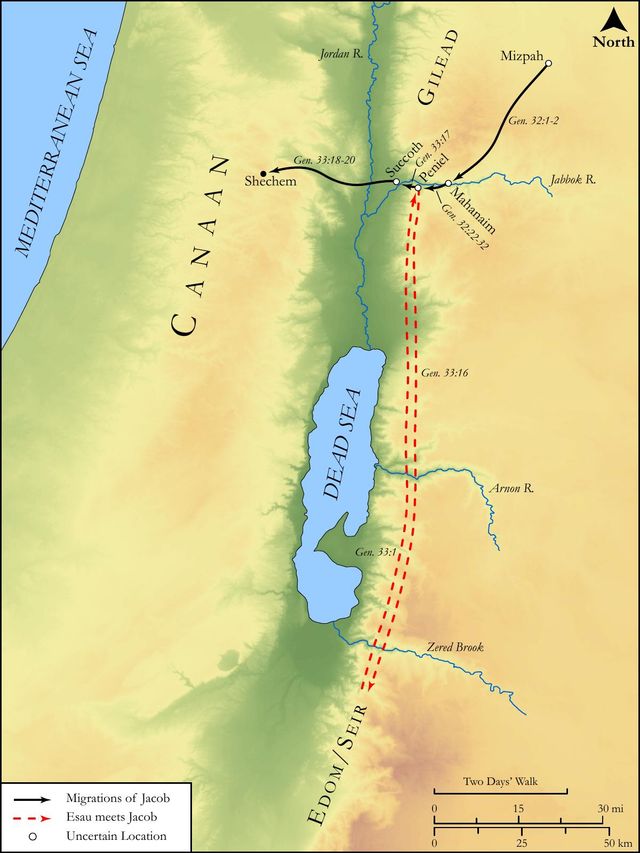
This specifies Esau's established territory. Seir was a mountainous region south of the Dead Sea, which became the primary dwelling place of Esau's descendants. The mention of "Edom" (meaning "red") further links the land directly to Esau's personal history and identity, signifying that Jacob is approaching Esau on his own terms and in his own domain, a gesture of both humility and strategic foresight.
Literary Devices
ShowHideThe verse employs several literary devices. Foreshadowing is prominent, as Jacob's act of sending messengers directly anticipates the dramatic and pivotal confrontation with Esau that will unfold in the subsequent verses. This diplomatic overture sets the stage for the resolution of a long-standing familial conflict. There is also an element of Irony present; Jacob, the "supplanter" who once deceitfully took what was not his, now sends messengers to humble himself before the one he wronged, initiating a process of potential restoration. Furthermore, the detailed geographical specification of "the land of Seir, the country of Edom" serves as a form of Symbolism, grounding the personal narrative in a specific historical and territorial context, emphasizing Esau's established identity and domain, which Jacob must now acknowledge.
Theological and Thematic Connections
ShowHideGenesis 32:3 embodies profound theological and thematic connections, primarily revolving around reconciliation, divine sovereignty, and human responsibility. Jacob's decision to send messengers, though born of fear, is a courageous step towards mending a relationship fractured by his past deceit. It illustrates that genuine reconciliation often requires proactive, humble, and strategic effort, even when the outcome is uncertain. This act also serves as a testament to God's faithfulness; despite Jacob's manipulative past, God continues to guide him, even through his apprehension, towards fulfilling the covenant promises. The tension between Jacob's human fear and his divine encounter at Mahanaim underscores the principle that God's plan unfolds amidst and through human agency and emotion.
Reflection and Application
ShowHideGenesis 32:3 offers a powerful model for navigating difficult relationships and confronting past wrongs. Jacob's willingness to initiate contact, despite his deep-seated fear of Esau's potential wrath, challenges us to move beyond avoidance and take proactive steps towards reconciliation in our own lives. This isn't about naivety, but about prudent preparation and courageous humility. Just as Jacob sent messengers to gauge the situation, we are called to approach strained relationships with wisdom, seeking understanding and extending grace, even when the outcome is uncertain. It reminds us that while we must take responsibility for our actions and seek to make amends, we can also trust in God's sovereign hand to guide us through daunting encounters, transforming fear into faith and conflict into peace. Facing our past, though uncomfortable, is a vital step in our spiritual journey towards wholeness and healthy relationships.
Questions for Reflection
ShowHideFAQ
ShowHideWhy did Jacob send messengers instead of just going directly to Esau?
ShowHideJacob sent messengers as a strategic and diplomatic gesture, a common and essential practice among the patriarchs when approaching a powerful or estranged relative. This allowed him to announce his arrival, convey his intentions, and, most importantly, gauge Esau's disposition and prepare for a potential reunion or confrontation. Given Esau's previous vow of vengeance against Jacob (Genesis 27:41), Jacob's prudence was paramount for the safety of himself and his large family. This act also demonstrated Jacob's humility and desire for reconciliation, signaling a willingness to approach Esau on his terms rather than making a forceful or unexpected arrival that might provoke further hostility. The messengers served as a vital reconnaissance mission before Jacob committed himself and his entire household to the encounter.
Christ-Centered Fulfillment
ShowHideJacob's journey from a deceiver, fleeing his brother's wrath, to one who proactively seeks reconciliation, marked by apprehension and reliance on divine guidance, profoundly foreshadows the ultimate reconciliation offered through Jesus Christ. Just as Jacob initiated contact with Esau to mend a broken relationship and prepare the way for his own arrival, Christ, the greater Jacob, initiated contact with humanity, not to confront our past wrongs with vengeance, but to offer forgiveness and peace. He is the ultimate "messenger" sent from God, embodying the divine initiative to reconcile a fallen world to its Creator. His incarnation and sacrificial death on the cross are the supreme act of divine diplomacy, taking away the enmity that separated humanity from God (Ephesians 2:14-16). Through Christ, we are not merely offered peace, but are transformed from enemies into adopted sons and daughters (Romans 5:10-11), receiving a new identity and relationship with God, much as Jacob's name was later changed to Israel, signifying his transformed character and covenant standing (Genesis 32:28).