


Genesis 14:6
Bible text: King James Version (1769 Blayney text) · Public domain
Bible text: Berean Standard Bible · Public domain
Bible text: American Standard Version (1901) · Public domain
Bible text: World English Bible, Messianic edition · Public domain
Bible text: Geneva Bible (1599) · Public domain
Bible text: Young's Literal Translation · Public domain
- וְאֶתve·'Etand <obj.>H853Conj-w ¦ DirObjMParticle Object Indicatorוְandאֶת<obj.>
- הַחֹרִיha·cho·Rithe Horite[s]H2752Art ¦ N-msNoun Gentilic Singular Masculine AbsoluteהַtheחֹרִיHorite[s]
- בְּהַרְרָםbe·ha·Ramin their hill country ofH2022Prep-b ¦ N-msc ¦ 3mpNoun Singular Masculine Constructבְּinהַרְרָhill country ofםtheir
- שֵׂעִירse·'IrSeirH8165N-properNoun Proper Location
- עַד'adtoH5704PrepPreposition
- אֵיל'eilElH364N-properNoun Proper Location
- פָּארָןpa·RanParanH364N-properNoun Proper Location
- אֲשֶׁר'a·SherwhichH834RelParticle Relative
- עַל'al[is] atH5921PrepPreposition
- הַמִּדְבָּרha·mid·Barthe wildernessH4057Art ¦ N-msNoun Singular Masculine Absoluteהַtheמִּדְבָּרwilderness
English is a literal word-by-word gloss of the Hebrew, not the KJV's wording. Why?
This is the original text the KJV's translators worked from — each Hebrew word with its own literal English meaning in this verse, prepared by scholars at Tyndale House, Cambridge. The KJV translates whole sentences, not word by word, so its wording differs: one Hebrew word can become several English words, and the KJV may choose “the LORD” where the gloss reads “Yahweh”. Both are faithful — they answer different questions. For the KJV's own rendering, switch to the KJV text.
Details
See on the biblical-era maps


Study this verse
Public-domain commentary
Matthew Henry
From his Commentary on the Whole Bible. Henry comments on passages, not single verses — this entry covers Genesis 14:1–12. His three-level outline is real structure in the source text, so it is rendered as structure.
We have here an account of the first war that ever we read of in scripture, which (though the wars of the nations make the greatest figure in history) we should not have had the history of if Abram and Lot had not been concerned in it. Now, concerning this war, we may observe,
I.The parties engaged in it.
The invaders were four kings, two of them no less than kings of Shinar and Elam (that is, Chaldea and Persia), yet probably not the sovereign princes of those great kingdoms in their own persons, but either officers under them, or rather the heads and leaders of some colonies which came out of those great nations, and settled themselves near Sodom, but retained the names of the countries from which they had their origin. The invaded were the kings of five cities that lay near together in the plain of Jordan, namely, Sodom, Gomorrah, Admah, Zeboiim, and Zoar. Four of them are named, but not the fifth, the king of Zoar or Bela, either because he was much more mean and inconsiderable or because he was much more wicked and inglorious than the rest, and worthy to be forgotten.
II.The occasion of this war was the revolt of the five kings from under the government of Chedorlaomer.
Twelve years they served him. Small joy they had of their fruitful land, while thus they were tributaries to a foreign power, and could not call what they had their own. Rich countries are a desirable prey, and idle luxurious countries are an easy prey, to growing greatness. The Sodomites were the posterity of Canaan whom Noah had pronounced a servant to Shem, from whom Elam descended; thus soon did that prophecy begin to e fulfilled. In the thirteenth year, beginning to be weary of their subjection, they rebelled, denied their tribute, and attempted to shake off the yoke and retrieve their ancient liberties. In the fourteenth year, after some pause and preparation, Chedorlaomer, in conjunction with his allies, set himself to chastise and reduce the rebels, and, since he could not have it otherwise, to fetch his tribute from them on the point of his sword. Note, Pride, covetousness, and ambition, are the lusts from which wars and fightings come. To these insatiable idols the blood of thousands has been sacrificed.
III.The progress and success of the war.
The four kings laid the neighbouring countries waste and enriched themselves with the spoil of them (Gen 14:5-7), upon the alarm of which it had been the wisdom of the king of Sodom to submit, and desire conditions of peace; for how could he grapple with an enemy thus flushed with victory? But he would rather venture the utmost extremity than yield, and it sped accordingly. Quos Deus destruet eos dementat - Those whom God means to destroy he delivers up to infatuation.
1.The forces of the king of Sodom and his allies were routed; and, it should seem, many of them perished in the slime-pits who had escaped the sword, Gen 14:10. In all places we are surrounded with deaths of various kinds, especially in the field of battle.
2.The cities were plundered, Gen 14:11. All the goods of Sodom, and particularly their stores and provisions of victuals, were carried off by the conquerors. Note, When men abuse the gifts of a bountiful providence to gluttony and excess, it is just with God, and his usual way, by some judgment or other to strip them of that which they have so abused, Hos 2:8, Hos 2:9.
3.Lot was carried captive, Gen 14:12. They took Lot among the rest, and his goods. Now Lot may here be considered,
(1.)As sharing with his neighbours in this common calamity. Though he was himself a righteous man, and (which is here expressly noticed) Abram's brother's son, yet he was involved with the rest in all this trouble. Note, All things come alike to all, Ecc 9:2. The best of men cannot promise themselves an exemption from the greatest troubles in this life; neither from our own piety nor our relation to those that are the favourites of heaven will be our security, when God's judgments are abroad. Note, further, Many an honest man fares the worse for his wicked neighbours. It is therefore our wisdom to separate ourselves, or at least to distinguish ourselves, from them (Co2 6:17), and so deliver ourselves, Rev 18:4.
(2.)As smarting for the foolish choice he made of a settlement here. This is plainly intimated when it is said, They took Abram's brother's son, who dwelt in Sodom. So near a relation of Abram should have been a companion and disciple of Abram, and should have abode by his tents; but, if he choose to dwell in Sodom, he must thank himself if he share in Sodom's calamities. Note, When we go out of the way of our duty we put ourselves from under God's protection, and cannot expect that the choices which are made by our lusts should issue to our comfort. Particular mention is made of their taking Lot's goods, those goods which had occasioned his contest with Abram and his separation from him. Note, It is just with God to deprive us of those enjoyments by which we have suffered ourselves to be deprived of our enjoyment of him.
Historical interpretation
Historical reception
1 surviving comment on this verse from the historical church.
And the Horites in the mountains of Seir. Indeed, these mountains, along with the neighboring regions, were possessed by the sons of Esau, who was also called Seir, because he was hairy, after the Horites were expelled. However, it seems likely that it was not he (i.e., Esau) himself, but another Seir from whom the mountains of Seir took their name: namely, the patriarch of the Horites, from whose lineage Esau took a wife. The Scripture says in the following: "Esau took wives from the daughters of Canaan, Ada the daughter of Elon the Hittite, and Oholibamah the daughter of Anah the son of Zibeon the Hivite" (Genesis 36:2). What this lineage was or from where it originated is revealed shortly after, when, enumerating the lineage of Esau, it concludes thus: "These are the chiefs of Oholibamah the daughter of Anah, wife of Esau, these are the sons of Esau, and these are their chiefs. He is Edom"; and immediately a new title is attached, which says: "These are the sons of Seir the Horite, inhabitants of the land, Lotan, Shobal, and Zibeon." And soon after: "And these are the sons of Zibeon, Aiah and Anah. This is Anah who found the hot springs in the wilderness while he was pasturing the donkeys of Zibeon, his father, and he had a son Dishan and a daughter Oholibamah." Therefore, when Esau had a wife from the lineage of the Horites, Oholibamah the daughter of Anah the son of Zibeon the son of Seir, it is established that the mountains of Seir, where the Horites were struck down, did not take their name from Esau who began to possess those places long after he was born, but from Seir the patriarch of those same Horites.
Continue studying Genesis 14:6 across the web’s major study libraries — every link below opens this exact verse, chapter, or book on the destination site.
Read & Compare
 BibleGatewayThis verse in more than 200 translations and 70 languages.
 Bible.comThe YouVersion reader — hundreds of translations, reading plans, and highlights.
 ESV.orgCrossway's official English Standard Version reader.
 NET BibleThe NET translation with 60,000+ translators' notes on every rendering decision.
 STEP BibleTyndale House's free study tool — original text, vocabulary, and scholarly resources.
 BibliaLogos Bible Software's free web reader.
 USCCBThe New American Bible (Revised Edition) with the U.S. bishops' study notes.
Commentaries
 BibleHub CommentariesDozens of classic commentaries on this verse, gathered on one page.
 StudyLightMore than 100 commentary sets — the largest collection on the web.
 BibleRefPlain-English commentary on what this verse means, verse by verse.
 Enduring WordDavid Guzik's free commentary on this chapter, widely used by Bible teachers.
 Bible Study ToolsVerse commentary alongside Greek and Hebrew study aids.
Original Language & Research
- BibleHub InterlinearThe verse word by word — original language, transliteration, and English.
- BibleHub LexiconEvery word's original-language definition and Strong's entry.
 Blue Letter BibleDeep-study tools — Strong's numbers, concordance, and word studies.
 SefariaThe Hebrew text with Rashi and centuries of Jewish commentary.
Sermons, Hymns & Audio


TrulyRandomVerse is not affiliated with these sites and doesn’t control their content. They’re linked because they’re genuinely useful.
Summary
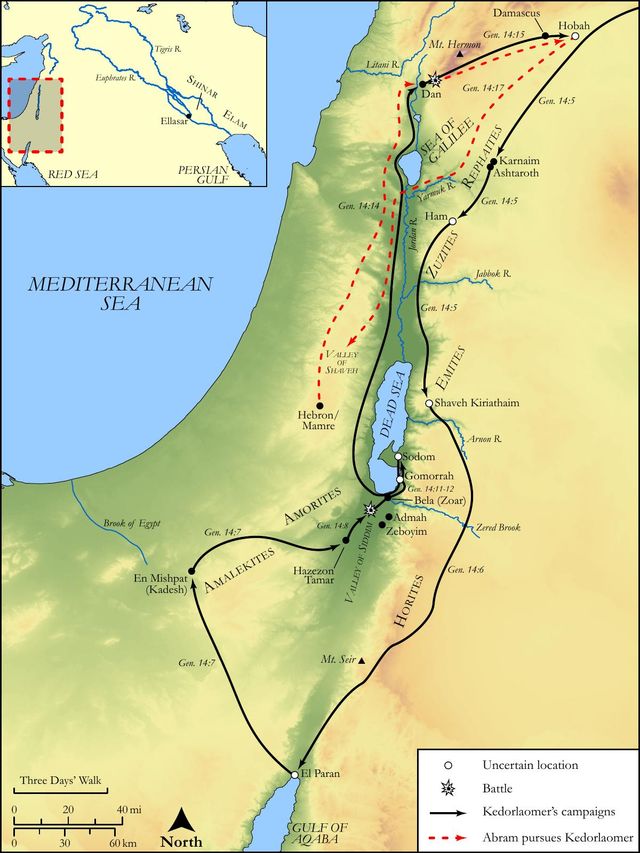
Genesis 14:6 precisely details a segment of Chedorlaomer's military campaign, recording the conquest of the Horites, an ancient people inhabiting the rugged region of Mount Seir, with the campaign extending as far south as El-paran, situated by the wilderness. This verse provides crucial geographical and historical specificity within the broader narrative of the War of the Kings, illustrating the extensive reach and strategic movements of the invading forces and setting the stage for subsequent events involving Abram.
Context
ShowHideLiterary Context
Genesis 14:6 is embedded within a unique chapter in Genesis, often referred to as "The War of the Kings." This chapter interrupts the patriarchal narratives, providing a rare glimpse into the geopolitical landscape of the kings of Abram's time. Verses 1-4 introduce the conflict: a coalition of four eastern kings, led by Chedorlaomer of Elam, against five rebellious city-states in the Jordan Valley, including Sodom and Gomorrah. Before confronting the Jordan Valley kings, the eastern coalition embarks on a sweeping southern campaign (verses 5-7), systematically subduing various peoples and territories. Verse 6 specifically focuses on the Horites in Mount Seir, following the defeat of the Rephaim, Zuzim, and Emim, and preceding the conquest of the Amalekites and Amorites. This detailed itinerary underscores the methodical and comprehensive nature of Chedorlaomer's military expedition, establishing his dominance over a vast region before the climactic battle near the Dead Sea.
Historical & Cultural Context
The Horites (Hebrew: Chôrîy) were an aboriginal people group inhabiting the mountainous region of Seir, located south of the Dead Sea and stretching towards the Gulf of Aqaba. Their name, often linked to the Hebrew word ḥor ("cave" or "hole"), suggests they were "cave-dwellers" or "troglodytes," a fitting description for a people living in a region characterized by its numerous natural caves and rugged terrain. Historically, this area was strategically important, controlling trade routes between Arabia, Egypt, and the Levant. The mention of El-paran, generally identified with Elath (modern Aqaba/Eilat) at the northern tip of the Red Sea, underscores the deep penetration of Chedorlaomer's forces into the Arabian Peninsula's western fringes. This campaign reflects the common practice of ancient empires asserting dominance over subject peoples and rebellious territories, often through brutal military expeditions designed to re-establish control and secure tribute. The narrative thus provides a snapshot of the power dynamics and territorial claims prevalent in the early second millennium BCE.
Key Themes
ShowHideThis verse, as part of Genesis 14, contributes to several overarching themes. Firstly, it highlights the historical veracity and geographical precision of the biblical narrative, grounding the unfolding story of God's covenant people within a tangible, verifiable history. The meticulous listing of peoples and places, such as the Horites and Mount Seir, lends credibility to the biblical account. Secondly, it subtly introduces the theme of territorial succession and divine sovereignty over nations. While the Horites are conquered here, Mount Seir later becomes the homeland of Esau's descendants, the Edomites, who displace the Horites as recounted in Deuteronomy 2:12. This foreshadows God's active role in allocating lands and establishing nations, even through human conflicts. Finally, the entire campaign, including the conquest of the Horites, serves as a providential setup for Abram's intervention to rescue Lot (Genesis 14:14-16), which in turn leads to his encounter with Melchizedek, a pivotal moment in the unfolding redemptive narrative.
Exposition and Analysis
ShowHideKey Word Analysis
ShowHideMeaning "cave-dweller or troglodyte; a Chorite or aboriginal Idumaean." This term identifies an ancient ethnic group, the original inhabitants of the region of Seir. Their name itself provides insight into their likely dwelling habits, suggesting a people who utilized the natural caves and rugged terrain of their mountainous homeland for shelter and defense.
Meaning "from an unused root meaning to loom up; a mountain; hill, mount(-ain)." This word specifies the geographical feature where the Horites resided, emphasizing the rugged, elevated nature of their territory. The term "Mount Seir" thus refers to a specific mountain range, not merely a general area.
Meaning "from דָבַר in the sense of driving; a pasture (i.e. open field, whither cattle are driven); by implication, a desert." This term describes the arid, uncultivated land adjacent to El-paran. Its inclusion highlights the challenging and remote nature of the terrain through which Chedorlaomer's forces advanced, underscoring the vastness of their campaign.
Verse Breakdown
ShowHide"And the Horites in their mount Seir"
This clause identifies the specific people group and their primary dwelling place that were targeted by Chedorlaomer's coalition. The Horites, known for inhabiting the rugged, cave-filled region of Mount Seir, were an indigenous population group in what would later become Edom. Their inclusion here signifies the comprehensive nature of the invading kings' sweep through the region.
"unto Elparan"
This phrase specifies the geographical extent of the Horite territory that was conquered, or the furthest southern reach of Chedorlaomer's campaign against them. El-paran, often identified with modern Elath/Aqaba, was a significant location at the northern tip of the Gulf of Aqaba, indicating a deep penetration into the southern Arabian Peninsula.
"which [is] by the wilderness"
This final descriptive phrase further contextualizes El-paran, situating it in proximity to a vast, arid, and sparsely populated desert region. It emphasizes the remote and challenging nature of the terrain, highlighting the impressive logistical and military capabilities of the invading forces to operate effectively in such an environment.
Literary Devices
ShowHideThe verse employs Geographical Specificity to root the narrative in a tangible, verifiable world. The precise mention of "the Horites," "Mount Seir," and "El-paran" serves to authenticate the historical account, lending credibility to the biblical record. This detailed mapping of the military campaign reinforces the idea that these are not mythical events but occurrences within real human history. Furthermore, the use of Concise Description allows for a significant amount of information—who was conquered, where they lived, and the geographical extent of the conquest—to be conveyed in a brief statement, maintaining the fast pace of the narrative while providing essential context for the reader.
Theological and Thematic Connections
ShowHideGenesis 14:6, though seemingly a mere historical detail, serves to underscore the Bible's commitment to historical veracity and geographical precision, grounding the unfolding story of God's covenant people within a tangible history. This meticulous attention to detail invites trust in the broader biblical narrative, demonstrating that God's redemptive plan unfolds not in a mythical realm, but within the real, often chaotic, movements of human history. The conquest of the Horites, though a secular event, is part of the larger divine tapestry, setting the stage for Abram's providential involvement and highlighting God's ultimate sovereignty over nations and territories, even those far removed from the immediate focus of the covenant.
Reflection and Application
ShowHideGenesis 14:6 reminds us that God's grand narrative of redemption is deeply embedded in real-world history, involving actual people, places, and geopolitical events. This grounding in verifiable details underscores the Bible's reliability, inviting us to place our trust not only in its historical accuracy but also in its profound theological message of divine purpose and sovereignty. Even seemingly minor geographical or historical details, like the conquest of the Horites in Mount Seir, contribute to the rich tapestry of God's interaction with humanity, setting the stage for future events and highlighting His ultimate control over nations and territories. We are encouraged to discern God's hand at work even amidst the complex and often chaotic movements of human history, recognizing that His purposes are always unfolding, even when they seem distant or unrelated to our immediate concerns. This perspective fosters a deeper faith in a God who is intimately involved in the affairs of the world, orchestrating events for His ultimate glory and the good of His people.
Questions for Reflection
ShowHideFAQ
ShowHideWho were the Horites mentioned in Genesis 14:6?
ShowHideThe Horites (Hebrew: Chôrîy) were an ancient people group inhabiting the mountainous region of Mount Seir, located south of the Dead Sea. Their name is often associated with "cave-dwellers," a fitting description for a people living in a rugged, cave-filled terrain. They are significant in biblical history as the aboriginal inhabitants of Seir before being displaced by the descendants of Esau, the Edomites, as explicitly stated in Deuteronomy 2:12.
What is the significance of Mount Seir in biblical history?
ShowHideMount Seir is a prominent mountainous region south of the Dead Sea, extending towards the Gulf of Aqaba. It is primarily known as the ancestral homeland of the Horites, who were later dispossessed by Esau's descendants, the Edomites (Genesis 36:8). Its mention in Genesis 14:6 highlights its geopolitical importance in Abram's day and foreshadows future territorial developments related to Israel's lineage and their interactions with Edom.
Why does Genesis include such specific geographical and historical details like El-paran?
ShowHideThe inclusion of precise geographical and historical details, such as El-paran (often identified with modern Elath/Aqaba), serves multiple crucial purposes. Firstly, it underscores the Bible's commitment to presenting a narrative grounded in real-world events and locations, authenticating the historical record. This demonstrates that the biblical story is not mythical but unfolds within a verifiable historical and geographical context. Secondly, these details highlight the extensive reach and strategic movements of ancient powers, providing a fuller picture of the world in which the covenant history of Israel began. They also serve as markers for later biblical events and prophecies, connecting the early patriarchal narratives to the broader sweep of redemptive history.
Christ-Centered Fulfillment
ShowHideWhile Genesis 14:6 primarily offers a historical and geographical detail about ancient peoples and their conquests, it contributes to the broader narrative of God's sovereign control over nations and territories, ultimately setting the stage for the unfolding of His redemptive plan. The seemingly disparate movements of kings and the subjugation of peoples, such as the Horites, are ultimately orchestrated by divine providence to prepare the way for the coming of the Messiah. The ultimate fulfillment of God's sovereignty over all lands and peoples is found in Jesus Christ, who is the true King of kings and Lord of lords (Revelation 19:16). All earthly kingdoms and their conquests, however grand, are but fleeting shadows compared to Christ's eternal and universal reign, to which all nations will one day bow (Philippians 2:10-11). Furthermore, the broader context of Genesis 14 leads directly to Abram's encounter with Melchizedek, a mysterious priestly king who prefigures Christ's unique role as both King and High Priest, a theme richly developed in Hebrews 7:1-3. Thus, even in the details of ancient battles, we see the subtle hand of God guiding history towards its Christ-centered climax.