


Numbers 13:3
Bible text: King James Version (1769 Blayney text) · Public domain
Bible text: Berean Standard Bible · Public domain
Bible text: American Standard Version (1901) · Public domain
Bible text: World English Bible, Messianic edition · Public domain
Bible text: Geneva Bible (1599) · Public domain
Bible text: Young's Literal Translation · Public domain
- וַיִּשְׁלַחvai·yish·Lachand he sentH7971Conj-w ¦ V-Qal-ConsecImperf-3msVerb Qal Consecutive Imperfect 3rd Singular Masculineוַandיִּשְׁלַחhe sent
- אֹתָם'o·Tam<obj.> themH853DirObjM ¦ 3mpParticle Object Indicatorאֹתָ<obj.>םthem
- מֹשֶׁהmo·ShehMosesH4872N-proper-mNoun Proper Masculine
- מִמִּדְבַּרmi·mid·Barfrom [the] wilderness ofH4057Prep-m ¦ N-mscNoun Singular Masculine Constructמִfromמִּדְבַּר[the] wilderness of
- פָּארָןpa·RanParanH6290N-properNoun Proper Location
- עַל'alonH5921PrepPreposition
- פִּיpi[the] mouth ofH6310N-mscNoun Singular Masculine Construct
- יְהוָהYah·wehYahwehH3068N-properNoun Proper Title
- כֻּלָּםku·Lamall of themH3605N-msc ¦ 3mpNoun Singular Masculine Constructכֻּלָּall ofםthem
- אֲנָשִׁים'a·na·Shim[were] menH582N-mpNoun Plural Masculine Absolute
- רָאשֵׁיra·Shei[who were] [the] heads ofH7218N-mpcNoun Plural Masculine Construct
- בְנֵיve·nei[the] people ofH1121N-mpcNoun Plural Masculine Construct
- יִשְׂרָאֵלYis·ra·'ElIsraelH3478N-properNoun Proper Location
- הֵמָּהHe·mahtheyH1992Pro-3mpPronoun Personal 3rd Plural Masculine
English is a literal word-by-word gloss of the Hebrew, not the KJV's wording. Why?
This is the original text the KJV's translators worked from — each Hebrew word with its own literal English meaning in this verse, prepared by scholars at Tyndale House, Cambridge. The KJV translates whole sentences, not word by word, so its wording differs: one Hebrew word can become several English words, and the KJV may choose “the LORD” where the gloss reads “Yahweh”. Both are faithful — they answer different questions. For the KJV's own rendering, switch to the KJV text.
Details
See on the biblical-era maps
Study this verse
Public-domain commentary
Matthew Henry
From his Commentary on the Whole Bible. Henry comments on passages, not single verses — this entry covers Numbers 13:1–20. His two-level outline is real structure in the source text, so it is rendered as structure.
Here we have, I. Orders given to send spies to search out the land of Canaan. It is here said, God directed Moses to send them (Num 13:1, Num 13:2), but it appears by the repetition of the story afterwards (Deu 1:22) that the motion came originally from the people; they came to Moses, and said, We will send men before us; and it was the fruit of their unbelief. They would not take God's word that it was a good land, and that he would, without fail, put them in possession of it. They could not trust the pillar of cloud and fire to show them the way to it, but had a better opinion of their own politics than of God's wisdom. How absurd was it for them to send to spy out a land which God himself had spied out for them, to enquire the way into it when God himself had undertaken to show them the way! But thus we ruin ourselves by giving more credit to the reports and representations of sense than to divine revelation; we walk by sight, not by faith; whereas, if we will receive the witness of men, without doubt the witness of God is greater. The people making this motion to Moses, he (perhaps not aware of the unbelief at the bottom of it) consulted God in the case, who bade him gratify the people in this matter, and send spies before them: "Let them walk in their own counsels." Yet God was no way accessory to the sin that followed, for the sending of these spies was so far from being the cause of the sin that if the spies had done their duty, and the people theirs, it might have been the confirmation of their faith, and of good service to them.
II.The persons nominated that were to be employed in this service (Num 13:4, etc.), one of each tribe, that it might appear to be the act of the people in general; and rulers, person of figure in their respective tribes, some of the rulers of thousands or hundreds, to put the greater credit upon their embassy. This was designed for the best, but it proved to have this ill effect that the quality of the persons occasioned the evil report they brought up to be the more credited and the people to be the more influenced by it. Some think that they are all named for the sake of two good ones that were among them, Caleb and Joshua. Notice is taken of the change of Joshua's name upon this occasion, Num 13:16. He was Moses's minister, but had been employed, though of the tribe of Ephraim, as general of the forces that were sent out against Amalek. The name by which he was generally called and known in his own tribe was Oshea, but Moses called him Joshua, in token of his affection to him and power over him; and now, it should seem, he ordered others to call him so, and fixed that to be his name henceforward. Oshea signifies a prayer for salvation, Save thou; Joshua signifies a promise of salvation, He will save, in answer to that prayer: so near is the relation between prayers and promises. Prayers prevail for promises, and promises direct and encourage prayers. Some think that Moses designed, by taking the first syllable of the name Jehovah and prefixing it to his name, which turned Hoshea into Jehoshua, to put an honour upon him, and to encourage him in this and all his future services with the assurances of God's presence. Yet after this he is called Hoshea, Deu 32:44. Jesus is the same name with Joshua, and it is the name of our Lord Christ, of whom Joshua was a type as successor to Moses, Israel's captain, and conqueror of Canaan. There was another of the same name, who was also a type of Christ, Zac 6:11. Joshua was the saviour of God's people from the powers of Canaan, but Christ is their Saviour from the powers of hell.
III.The instructions given to those spies.
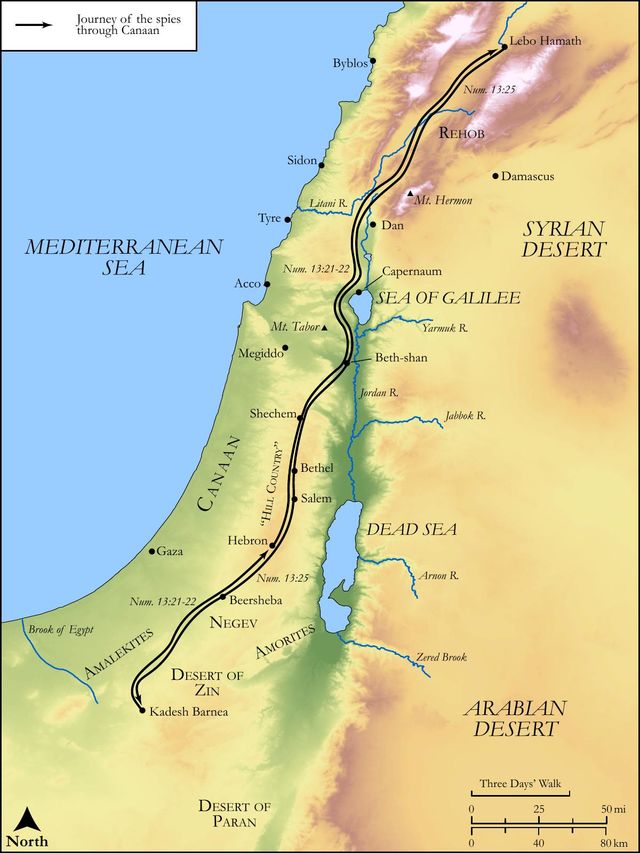
They were sent into the land of Canaan the nearest way, to traverse the country, and to take account of its present state, Num 13:17. Two heads of enquiry were given them in charge,
1.Concerning the land itself: See what that is (Num 13:18, and again, Num 13:19), see whether it be good or bad, and (Num 13:20) whether it be fat or lean. All parts of the earth do not share alike in the blessing of fruitfulness; some countries are blessed with a richer soil than others. Moses himself was well satisfied that Canaan was a very good land, but he sent these spies to bring an account of it for the satisfaction of the people; as John Baptist sent to Jesus, to ask whether he was the Christ, not to inform himself, but to inform those he sent. They must take notice whether the air was healthful or no, what the soil was, and what the productions; and, for the better satisfaction of the people, they must bring with them some of the fruits.
2.Concerning the inhabitants - their number, few or many - their size and stature, whether strong able-bodied men or weak, - their habitations, whether they lived in tents or houses, whether in open villages or in walled towns, - whether the woods were standing as in those countries that are uncultivated, through the unskillfulness and slothfulness of the inhabitants, or whether the woods were cut down, and the country made champaign, for the convenience of tillage. These were the things they were to enquire about. Perhaps there had not been of late years such commerce between Egypt and Canaan as there was in Jacob's time, else they might have informed themselves of these things without sending men on purpose to search. See the advantage we may derive from books and learning, which acquaint those that are curious and inquisitive with the state of foreign countries, at a much greater distance than Canaan was now from Israel, without this trouble and expense.
IV.Moses dismisses the spies with this charge, Be of good courage, intimating, not only that they should be themselves encouraged against the difficulties of this expedition, but that they should bring an encouraging account to the people and make the best of every thing. It was not only a great undertaking they were put upon, which required good management and resolution, but it was a great trust that was reposed in them, which required that they should be faithful.
Continue studying Numbers 13:3 across the web’s major study libraries — every link below opens this exact verse, chapter, or book on the destination site.
Read & Compare
 BibleGatewayThis verse in more than 200 translations and 70 languages.
 Bible.comThe YouVersion reader — hundreds of translations, reading plans, and highlights.
 ESV.orgCrossway's official English Standard Version reader.
 NET BibleThe NET translation with 60,000+ translators' notes on every rendering decision.
 STEP BibleTyndale House's free study tool — original text, vocabulary, and scholarly resources.
 BibliaLogos Bible Software's free web reader.
 USCCBThe New American Bible (Revised Edition) with the U.S. bishops' study notes.
Commentaries
 BibleHub CommentariesDozens of classic commentaries on this verse, gathered on one page.
 StudyLightMore than 100 commentary sets — the largest collection on the web.
 BibleRefPlain-English commentary on what this verse means, verse by verse.
 Enduring WordDavid Guzik's free commentary on this chapter, widely used by Bible teachers.
 Bible Study ToolsVerse commentary alongside Greek and Hebrew study aids.
Original Language & Research
- BibleHub InterlinearThe verse word by word — original language, transliteration, and English.
- BibleHub LexiconEvery word's original-language definition and Strong's entry.
 Blue Letter BibleDeep-study tools — Strong's numbers, concordance, and word studies.
 SefariaThe Hebrew text with Rashi and centuries of Jewish commentary.
Sermons, Hymns & Audio


TrulyRandomVerse is not affiliated with these sites and doesn’t control their content. They’re linked because they’re genuinely useful.
Summary
Numbers 13:3 recounts the pivotal moment when Moses, acting under the direct and authoritative command of the LORD, dispatched twelve chosen leaders from their encampment in the wilderness of Paran. These men, representing the "heads of the children of Israel," were sent to scout the land of Canaan, a mission that would ultimately serve as a profound test of Israel's faith and obedience on the very threshold of the Promised Land.
Context
ShowHideLiterary Context
Numbers 13:3 serves as the immediate fulfillment of the divine instruction given in the preceding verses. Numbers 13:1-2 explicitly states, "The LORD spoke to Moses, saying, 'Send men to scout the land of Canaan, which I am giving to the children of Israel; from each tribe of their fathers you shall send a man, every one a leader among them.'" Thus, verse 3 details Moses' obedient response to this precise mandate, initiating the reconnaissance mission. The narrative immediately following this verse (Numbers 13:4-16) lists the names of the twelve chosen men, underscoring their tribal representation and leadership status. This careful sequencing highlights the deliberate, divinely ordered nature of the entire undertaking, setting the stage for the dramatic events that unfold as a result of the spies' report.
Historical & Cultural Context
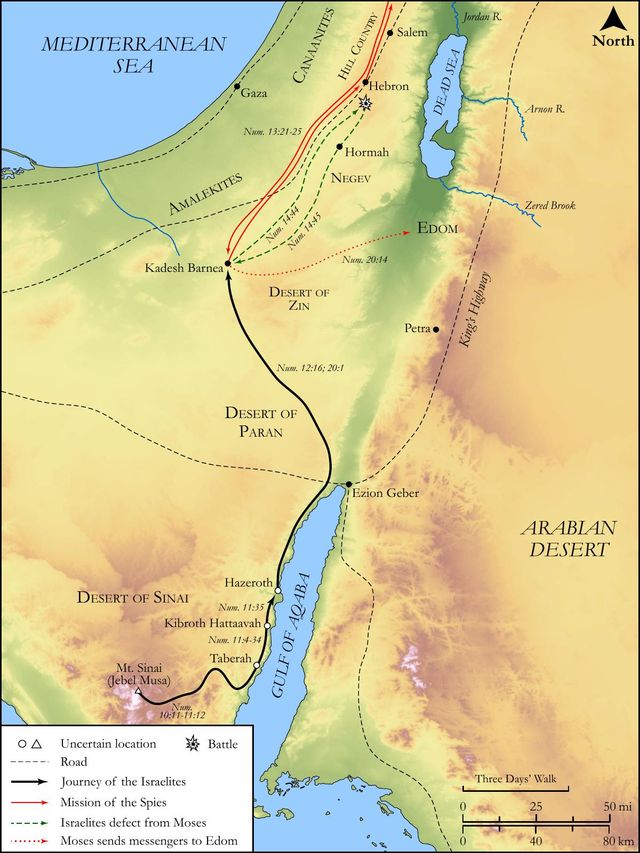
The Israelites, having journeyed from Mount Sinai where they received the Law, had arrived at Kadesh-Barnea, a significant oasis located within the vast and arid wilderness of Paran. This region, bordering the southern reaches of Canaan, was a strategic staging ground for their intended entry into the Promised Land. Culturally, the practice of sending scouts or spies before a military campaign or territorial acquisition was a common and prudent strategy among the nations, reflecting practical wisdom in warfare and settlement. The selection of "heads of the children of Israel" for this crucial task was also culturally significant; these were not ordinary individuals but tribal chieftains or princes, men of considerable authority, influence, and presumed wisdom, whose reports would carry immense weight and shape the collective decision-making of the entire nation.
Key Themes
ShowHideThis verse contributes to several overarching themes within the book of Numbers and the Pentateuch as a whole. The phrase "by the commandment of the LORD" immediately establishes the theme of Divine Mandate and God's active involvement in Israel's journey, even in seemingly pragmatic endeavors like reconnaissance. It underscores that God's promises are accompanied by His guidance, though human agency and obedience remain crucial. The selection of tribal leaders highlights the theme of Leadership and Responsibility, emphasizing the profound impact of those in authority on the faith and destiny of the community. Ultimately, this mission, though divinely initiated, becomes a critical test of Faith versus Unbelief, foreshadowing the Israelites' catastrophic failure to trust God's promise to deliver the land, as vividly seen in Numbers 14:1-10. This failure leads to the tragic consequence of the wilderness wandering, a stark reminder of the cost of disobedience and doubt, as detailed in Numbers 14:34-35.
Exposition and Analysis
ShowHideKey Word Analysis
ShowHideThe phrase "by the commandment of the LORD" translates the Hebrew "על פי יהוה" (al pi YHWH), literally "by the mouth of the LORD." The word peh (H6310) means "mouth," but idiomatically signifies direct, authoritative instruction or decree from God Himself. It emphasizes that Moses' action was not a human strategic initiative but a divinely ordained mandate, underscoring God's sovereignty and active involvement in the details of Israel's journey. This divine origin is crucial for understanding the gravity of the mission and the subsequent consequences of Israel's response.
The term midbâr (H4057), translated here as "wilderness," refers to a pasture or open field where cattle are driven, and by implication, a desert. The "wilderness of Paran" thus denotes a vast, arid, and desolate desert plateau located in the northern Sinai Peninsula and extending into the Negeb. It was a significant waypoint in Israel's journey from Mount Sinai towards Canaan. Its challenging environment would have been a constant reminder of Israel's dependence on God for provision and direction, setting a stark backdrop for the impending decision about entering the fertile Promised Land.
The term rôʼsh (H7218), translated as "heads," literally means "head" but is used metaphorically to denote chieftains, leaders, princes, or principal men. It signifies individuals who hold positions of authority, influence, and prominence within their respective tribes. Their selection for this mission was not arbitrary; it indicated that these were the most respected and capable men, whose report would carry significant weight and sway the opinion of the entire Israelite community. Their status made their subsequent unfaithful report, and the resulting national rebellion, all the more devastating.
Verse Breakdown
ShowHide"And Moses by the commandment of the LORD sent them"
This clause establishes the divine authority behind the mission. Moses, as God's chosen leader, acts not on his own volition or strategic insight, but as an obedient instrument of the LORD's will. This highlights the principle that true leadership in God's kingdom is characterized by faithful adherence to His revealed word and direction. The mission, therefore, was not inherently flawed by its divine origin, but its outcome would depend entirely on human response and obedience.
"from the wilderness of Paran"
This specifies the geographical starting point of the reconnaissance mission. The wilderness of Paran served as the Israelites' encampment before their final push into Canaan. It underscores their proximity to the Promised Land, heightening the anticipation and significance of the spies' venture. The location also emphasizes the stark contrast between the barren wilderness they were leaving and the fertile land they were about to enter, a land promised to be flowing with milk and honey.
"all those men [were] heads of the children of Israel"
This final clause emphasizes the caliber and standing of the individuals chosen for this critical task. They were not ordinary foot soldiers but respected tribal leaders, men of influence and authority. Their elevated status meant that their report, whether positive or negative, would profoundly impact the morale, faith, and decisions of the entire Israelite nation. This choice underscores the immense weight of responsibility placed upon leadership and the far-reaching consequences of their actions and words.
Literary Devices
ShowHideNumbers 13:3 employs several literary devices to convey its meaning and significance. The most prominent is Divine Mandate, where the explicit statement "by the commandment of the LORD" functions as a recurring motif throughout the Pentateuch, emphasizing God's direct involvement and sovereign control over Israel's history. This phrase also serves as a form of Authorization, legitimizing Moses' actions and the mission itself as divinely sanctioned. There is a strong element of Foreshadowing present; while the verse itself is descriptive and factual, the reader familiar with the broader narrative knows that this divinely commanded mission, despite its noble intent and the high standing of the participants, will paradoxically lead to a catastrophic failure of faith and a prolonged period of wilderness wandering. Finally, the use of "heads" for leaders is a classic example of Synecdoche, where a part (the head, representing intellectual capacity, leadership, or authority) stands for the whole person (the leader or chieftain), succinctly conveying their prominent status and the weight of their responsibility.
Theological and Thematic Connections
ShowHideNumbers 13:3 powerfully illustrates the intricate relationship between divine command, human obedience, and the consequences of faith or unbelief. God's initiative in sending the spies demonstrates His methodical approach to fulfilling His covenant promises, even providing for practical reconnaissance. However, the subsequent narrative reveals that even a divinely ordained mission can become a critical test of human faith. The selection of "heads of the children of Israel" highlights the immense responsibility of leadership, where the decisions and reports of a few can profoundly shape the destiny of an entire community. This verse sets the stage for one of the most tragic episodes in Israel's wilderness journey, where fear and unbelief, fueled by the majority report of the spies, led to a generation being denied entry into the Promised Land. It underscores that God's promises are conditional upon a faithful response, and that even when God leads, human doubt and disobedience can derail His purposes for individuals and communities, delaying or even forfeiting promised blessings.
Reflection and Application
ShowHideNumbers 13:3 invites us to consider the profound nature of divine guidance and the critical importance of human response in our own lives. God often leads us into situations that require both our active participation and our unwavering trust. While He provides the command and the resources, our obedience and faith are crucial for the successful fulfillment of His purposes. The example of the "heads of the children of Israel" reminds us that those in positions of influence, whether in families, churches, workplaces, or communities, bear a heavy responsibility. Their words and actions can either inspire faith and courage or sow seeds of doubt and fear, with far-reaching consequences for those they lead. This verse challenges us to examine our own hearts when faced with daunting tasks or seemingly insurmountable obstacles. Do we lean on God's command and promises, or do we allow fear, human assessment, or worldly wisdom to dictate our response? True progress in our spiritual journey often hinges on our willingness to step out in faith, even when the path ahead seems uncertain or fraught with challenges, trusting that God's command is always accompanied by His power to accomplish His will.
Questions for Reflection
ShowHideFAQ
ShowHideWhy was it the "commandment of the LORD" if it ultimately led to Israel's failure in entering the Promised Land?
ShowHideThe "commandment of the LORD" for Moses to send spies was a legitimate and divinely ordained instruction, not a flawed command. God's purpose was to provide Israel with a practical understanding of the land He was giving them, fostering confidence and strategic preparation. The failure was not in the command itself, but in the response of the people and the majority of the spies. Instead of trusting God's promise to deliver the land, they succumbed to fear and unbelief based on the formidable appearance of the inhabitants and their fortified cities. The mission was a test of faith, and Israel failed that test, leading to the tragic consequence of 40 years of wandering in the wilderness, as detailed in Numbers 14:34. God's commands are always good and for our ultimate good, but human sin and unbelief can thwart the immediate fulfillment of His blessings and lead to prolonged hardship.
What was the significance of the "wilderness of Paran" as the starting point?
ShowHideThe "wilderness of Paran" was a vast, arid region in the northern Sinai Peninsula, serving as a significant encampment for the Israelites after their departure from Mount Sinai (Numbers 10:12). Its significance lies primarily in its strategic location: it was the very threshold to the Promised Land. Standing in this barren, challenging environment, the Israelites were on the cusp of entering a land described as "flowing with milk and honey," a stark contrast to their present surroundings. This geographical contrast heightened the anticipation and the gravity of the spies' mission, making their report all the more impactful. It symbolized the transition from a place of testing and dependence to a place of promised blessing and inheritance, making the subsequent failure of faith even more poignant.
Why were "heads of the children of Israel" chosen for this mission, rather than ordinary individuals?
ShowHideThe selection of "heads of the children of Israel"—meaning tribal leaders, chieftains, or princes—was crucial due to their inherent authority, influence, and respected standing within their respective tribes. God's command specifically stated that a leader from each tribe be sent (Numbers 13:2), indicating that the mission required individuals of high repute whose report would be taken seriously and believed by the entire community. These were not ordinary men but those whose words carried immense weight and whose judgments were expected to be wise. Their elevated status meant that their subsequent report, particularly the fearful one from the ten spies, had a devastating impact on the morale and faith of the entire nation, leading to widespread rebellion and ultimately, divine judgment and the tragic delay of entry into the Promised Land.
Christ-Centered Fulfillment
ShowHideNumbers 13:3, while detailing a pivotal moment in Israel's historical journey, finds profound Christ-centered fulfillment in the person and work of Jesus. The mission of the spies, divinely commanded to scout the way into the Promised Land, foreshadows Christ's ultimate mission to open the way into the true, spiritual Promised Land—God's eternal kingdom. Just as the spies were sent from the wilderness, Jesus, after His temptation in the wilderness, began His public ministry, revealing the path to salvation and eternal life. He is the ultimate "scout" who has gone before us, not merely to report on a physical land, but to conquer sin and death, thereby securing our inheritance. Unlike the majority of the spies who brought back a report of fear and unbelief, leading to a generation's exclusion, Jesus, the faithful Son, perfectly fulfilled His Father's command, demonstrating unwavering faith and obedience, even unto death on the cross (Hebrews 5:8-9). He is the true Joshua, leading His people into rest. Through His perfect life, atoning death, and glorious resurrection, Jesus has opened a "new and living way" into the presence of God (Hebrews 10:19-20). Our entry into this spiritual inheritance is not based on our own scouting or strength, but solely on faith in Him, the faithful Leader who has already overcome every obstacle, inviting us to follow Him (John 14:6) into the eternal "land flowing with milk and honey" (Exodus 3:8).