


Numbers 12:16
Bible text: King James Version (1769 Blayney text) · Public domain
Bible text: Berean Standard Bible · Public domain
Bible text: American Standard Version (1901) · Public domain
Bible text: World English Bible, Messianic edition · Public domain
Bible text: Geneva Bible (1599) · Public domain
Bible text: Young's Literal Translation · Public domain
- וְאַחַרve·'a·Charand afterH310Conj-w ¦ Adj-msAdjective Numerical Singular Masculine Absoluteוְandאַחַרafter
- נָסְעוּna·se·'Uthey set outH5265V-Qal-Perf-3cpVerb Qal Perfect 3rd Plural common gender
- הָעָםha·'Amthe peopleH5971Art ¦ N-msNoun Singular Masculine Absoluteהָtheעָםpeople
- מֵחֲצֵרוֹתme·cha·tze·Rotfrom HazerothH2698Prep-m ¦ N-properNoun Proper LocationמֵfromחֲצֵרוֹתHazeroth
- וַיַּחֲנוּvai·ya·cha·Nuand they encampedH2583Conj-w ¦ V-Qal-ConsecImperf-3mpVerb Qal Consecutive Imperfect 3rd Plural Masculineוַandיַּחֲנוּthey encamped
- בְּמִדְבַּרbe·mid·Barin [the] wilderness ofH4057Prep-b ¦ N-mscNoun Singular Masculine Constructבְּinמִדְבַּר[the] wilderness of
- פָּארָןpa·RanParanH6290N-properNoun Proper Location
English is a literal word-by-word gloss of the Hebrew, not the KJV's wording. Why?
This is the original text the KJV's translators worked from — each Hebrew word with its own literal English meaning in this verse, prepared by scholars at Tyndale House, Cambridge. The KJV translates whole sentences, not word by word, so its wording differs: one Hebrew word can become several English words, and the KJV may choose “the LORD” where the gloss reads “Yahweh”. Both are faithful — they answer different questions. For the KJV's own rendering, switch to the KJV text.
Details
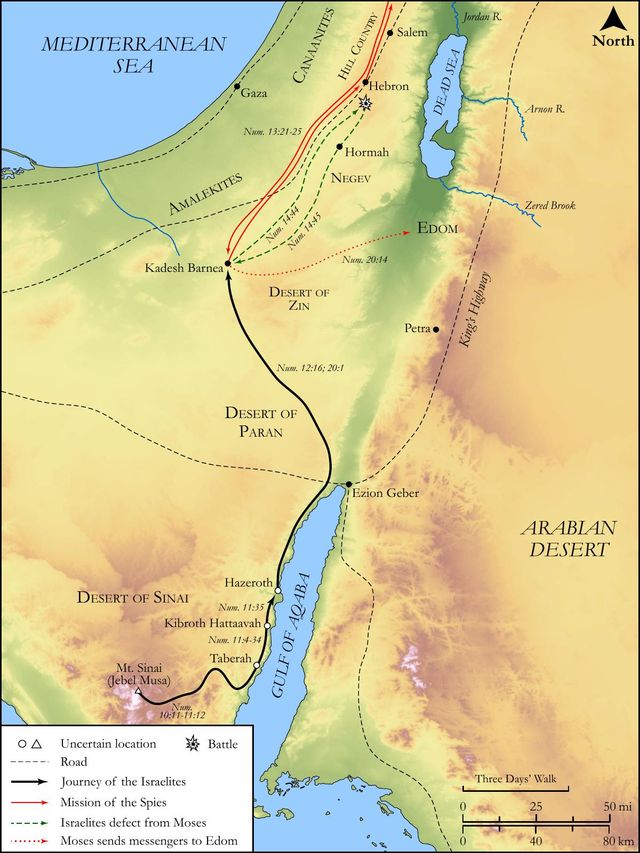
See on the biblical-era map
Study this verse
Public-domain commentary
Matthew Henry
From his Commentary on the Whole Bible. Henry comments on passages, not single verses — this entry covers Numbers 12:10–16. His two-level outline is real structure in the source text, so it is rendered as structure.
Here is, I. God's judgment upon Miriam (Num 12:10): The cloud departed from off that part of the tabernacle, in token of God's displeasure, and presently Miriam became leprous; when God goes, evil comes; expect no good when God departs. The leprosy was a disease often inflicted by the immediate hand of God as the punishment of some particular sin, as on Gehazi for lying, on Uzziah for invading the priest's office, and here on Miriam for scolding and making mischief among relations. The plague of the leprosy, it is likely, appeared in her face, so that it appeared to all that saw her that she was struck with it, with the worst of it, she was leprous as snow; not only so white, but so soft, the solid flesh losing its consistency, as that which putrefies does. Her foul tongue (says bishop Hall) is justly punished with a foul face, and her folly in pretending to be a rival with Moses is made manifest to all men, for every one sees his face to be glorious, and hers to be leprous. While Moses needs a veil to hide his glory, Miriam needs one to hide her shame. Note, Those distempers which any way deform us ought to be construed as a rebuke to our pride, and improved for the cure of it, and under such humbling providences we ought to be very humble. It is a sign that the heart is hard indeed if the flesh be mortified, and yet the lusts of the flesh remain unmortified. It should seem that this plague upon Miriam was designed for an exposition of the law concerning the leprosy (Lev. 13), for it is referred to upon the rehearsal of that law, Deu 24:8, Deu 24:9. Miriam was struck with a leprosy, but not Aaron, because she was first in the transgression, and God would put a difference between those that mislead and those that are misled. Aaron's office, though it saved him not from God's displeasure, yet helped to secure him from this token of his displeasure, which would not only have suspended him for the present from officiating, when (there being no priests but himself and his two sons) he could ill be spared, but it would have rendered him and his office mean, and would have been a lasting blot upon his family. Aaron as priest was to be the judge of the leprosy, and his performing that part of his office upon this occasion, when he looked upon Miriam, and behold she was leprous, was a sufficient mortification to him. He was struck through her side, and could not pronounce her leprous without blushing and trembling, knowing himself to be equally obnoxious. This judgment upon Miriam is improvable by us as a warning to take heed of putting any affront upon our Lord Jesus. If she was thus chastised for speaking against Moses, what will become of those that sin against Christ?
II.Aaron's submission hereupon (Num 12:11, Num 12:12); he humbles himself to Moses, confesses his fault, and begs pardon.
He that but just now joined with his sister in speaking against Moses is here forced for himself and his sister to make a penitent address to him, and in the highest degree to magnify him (as if he had the power of God to forgive and heal) whom he had so lately vilified. Note, Those that trample upon the saints and servants of God will one day be glad to make court to them; at furthest, in the other world, as the foolish virgins to the wise for a little oil, and the rich man to Lazarus for a little water; and perhaps in this world, as Job's friend to him for his prayers, and here Aaron to Moses. Rev 3:9. In his submission,
1.He confesses his own and his sister's sin, Num 12:11. He speaks respectfully to Moses, of whom he had spoken slightly, calls him his lord, and now turns the reproach upon himself, speaks as one ashamed of what he had said: We have sinned, we have done foolishly. Those sin, and do foolishly, who revile and speak evil of any, especially of good people or of those in authority. Repentance is the unsaying of that which we have said amiss, and it had better be unsaid than that we be undone by it.
2.He begs Moses's pardon: Lay not this sin upon us. Aaron was to bring his gift to the altar, but, knowing that his brother had something against him, he of all men was concerned to reconcile himself to his brother, that he might be qualified to offer his gift. Some think that this speedy submission which God saw him ready to make was that which prevented his being struck with a leprosy as his sister was.
3.He recommends the deplorable condition of his sister to Moses's compassionate consideration (Num 12:12): Let her not be as one dead, that is, "Let her not continue so separated from conversation, defiling all she touches, and even to putrefy above ground as one dead." He eloquently describes the misery of her case, to move his pity.
III.The intercession made for Miriam (Num 12:13):
He cried unto the Lord with a loud voice, because the cloud, the symbol of his presence, was removed and stood at some distance, and to express his fervency in this request, Heal her now, O Lord, I beseech thee. By this he made it to appear that he did heartily forgive her the injury she had one him, that he had not accused her to God, nor called for justice against her; so far from this that, when God in tenderness to his honour had chastised her insolence, he was the first that moved for reversing the judgment. By this example we are taught to pray for those that despitefully use us; and not to take pleasure in the most righteous punishment inflicted either by God or man on those that have been injurious to us. Jeroboam's withered hand was restored at the special instance and request of the prophet against whom it had been stretched out, Kg1 13:6. So Miriam here was healed by the prayer of Moses, whom she had abused, and Abimelech by the prayer of Abraham, Gen 20:17. Moses might have stood off, and have said, "She is served well enough, let her govern her tongue better next time;" but, not content with being able to say that he had not prayed for the inflicting of the judgment, he prays earnestly for the removal of it. This pattern of Moses, and that of our Saviour, Father, forgive them, we must study to conform to.
IV.The accommodating of this matter so as that mercy and justice might meet together.
1.Mercy takes place so far as that Miriam shall be healed; Moses forgives her, and God will. See Co2 2:10. But,
2.Justice takes place so far as that Miriam shall be humbled (Num 12:14): Let her be shut out from the camp seven days, that she herself might be made more sensible of her fault and penitent for it, and that her punishment might be the more public, and all Israel might take notice of it and take warning by it not to mutiny. If Miriam the prophetess be put under such marks of humiliation for one hasty word spoken against Moses, what may we expect for our murmurings? If this be done in a green tree, what shall be done in the dry? See how people debase and diminish themselves by sin, stain their glory, and lay their honour in the dust. When Miriam praised God, we find her at the head of the congregation and one of the brightest ornaments of it, Exo 15:20. Now that she quarrelled with God we find her expelled as the filth and off-scouring of it. A reason is given for her being put out of the camp for seven days, because thus she ought to accept of the punishment of her iniquity. If her father, her earthly father, had but spit in her face, and so signified his displeasure against her, would she not be so troubled and concerned at it, and so sorry that she had deserved it, as to shut herself up for some time in her room, and not come into his presence, or show her face in the family, being ashamed of her own folly and unhappiness? If such reverence as this be owing to the fathers of our flesh, when they correct us, much more ought we to humble ourselves under the mighty hand of the Father of spirits, Heb 12:9. Note, When we are under the tokens of God's displeasure for sin, it becomes us to take shame to ourselves, and to lie down in that shame, owning that to us belongs confusion of face. If by our own fault and folly we expose ourselves to the reproach and contempt of men, the just censures of the church, or the rebukes of the divine Providence, we must confess that our Father justly spits in our face, and be ashamed.
V.The hindrance that this gave to the people's progress:
The people journeyed not till Miriam was brought in again, Num 12:15. God did not remove the cloud, and therefore they did not remove their camp. This was intended,
1.As a rebuke to the people, who were conscious to themselves of having sinned after the similitude of Miriam's transgression, in speaking against Moses: thus far therefore they shall share in her punishment, that it shall retard their march forward towards Canaan. Many things oppose us, but nothing hinders us in the way to heaven as sin does.
2.As a mark of respect to Miriam. If the camp had removed during the days of her suspension, her trouble and shame had been the greater; therefore, in compassion to her, they shall stay till her excommunication be taken off, and she taken in again, it is probable with the usual ceremonies of the cleansing of lepers. Note, Those that are under censure and rebuke for sin ought to be treated with a great deal of tenderness, and not be over-loaded, no, not with the shame they have deserved, not counted as enemies (Th2 3:15), but forgiven and comforted, Co2 2:7. Sinners must be cast out with grief, and penitents taken in with joy. When Miriam was absolved and re-admitted, the people went forward into the wilderness of Paran, which joined up to the south border of Canaan, and thither their next remove would have been if they had not put a bar in their own way.
Continue studying Numbers 12:16 across the web’s major study libraries — every link below opens this exact verse, chapter, or book on the destination site.
Read & Compare
 BibleGatewayThis verse in more than 200 translations and 70 languages.
 Bible.comThe YouVersion reader — hundreds of translations, reading plans, and highlights.
 ESV.orgCrossway's official English Standard Version reader.
 NET BibleThe NET translation with 60,000+ translators' notes on every rendering decision.
 STEP BibleTyndale House's free study tool — original text, vocabulary, and scholarly resources.
 BibliaLogos Bible Software's free web reader.
 USCCBThe New American Bible (Revised Edition) with the U.S. bishops' study notes.
Commentaries
 BibleHub CommentariesDozens of classic commentaries on this verse, gathered on one page.
 StudyLightMore than 100 commentary sets — the largest collection on the web.
 BibleRefPlain-English commentary on what this verse means, verse by verse.
 Enduring WordDavid Guzik's free commentary on this chapter, widely used by Bible teachers.
 Bible Study ToolsVerse commentary alongside Greek and Hebrew study aids.
Original Language & Research
- BibleHub InterlinearThe verse word by word — original language, transliteration, and English.
- BibleHub LexiconEvery word's original-language definition and Strong's entry.
 Blue Letter BibleDeep-study tools — Strong's numbers, concordance, and word studies.
 SefariaThe Hebrew text with Rashi and centuries of Jewish commentary.
Sermons, Hymns & Audio


TrulyRandomVerse is not affiliated with these sites and doesn’t control their content. They’re linked because they’re genuinely useful.
Summary
Numbers 12:16 marks a significant juncture in the Israelites' wilderness journey, indicating the collective resumption of their travels after a period of enforced stillness and divine discipline. Following the seven-day isolation of Miriam due to leprosy, a direct consequence of her challenge to Moses' unique prophetic authority, the entire congregation faithfully broke camp from Hazeroth and re-established their encampment in the vast and formidable wilderness of Paran. This concise geographical and chronological statement underscores God's unwavering guidance and the community's obedient progression, even in the aftermath of severe judgment and internal strife, setting the stage for crucial events to come.
Context
ShowHideLiterary Context
Numbers 12:16 serves as the concluding verse of a pivotal narrative in the book of Numbers, specifically the account of Miriam and Aaron's rebellion against Moses' divinely appointed leadership. The preceding verses detail their questioning of Moses' unique relationship with God (Numbers 12:1-2). God's swift and decisive response firmly establishes Moses' unparalleled prophetic authority, as He speaks to Moses "mouth to mouth, clearly and not in riddles" (Numbers 12:6-8). As a direct consequence of her presumption, Miriam is immediately struck with a severe form of leprosy (Numbers 12:9-10). Moses, demonstrating his characteristic humility and intercessory heart, pleads for her healing (Numbers 12:13). God commands that she be isolated outside the camp for seven days, a period mirroring the purification rites for a leper, and, significantly, the entire community, in an act of corporate solidarity and obedience, waited for her return before proceeding with their journey (Numbers 12:14-15). Thus, Numbers 12:16 signifies the resolution of this profound crisis, the completion of the disciplinary period, and the physical continuation of Israel's divinely directed journey towards the Promised Land.
Historical & Cultural Context
The Israelites' journey from Egypt to Canaan was fundamentally a nomadic existence, entirely dependent on divine provision and guidance. Hazeroth, meaning "enclosures" or "villages," was a known encampment site, likely chosen for its access to water or pasture, serving as a temporary dwelling. The "wilderness of Paran" (Hebrew: Midbar Paran) was an expansive, arid, and formidable desert region stretching from the Sinai Peninsula northward towards the borders of Canaan. It was a notoriously challenging and often dangerous environment, demanding constant divine protection and precise direction for survival. Culturally, the acts of "removing" (breaking camp) and "pitching" (setting up camp) were central to their nomadic life, representing an organized, collective movement under the direct leadership of Moses, and ultimately, God. The communal act of waiting for Miriam, as commanded by God, underscores the deeply communal nature of ancient Israelite society, where the purity and well-being of one member, particularly in a case of divine judgment and ritual impurity, directly impacted the entire congregation's ability to proceed. This collective responsibility was a hallmark of their covenant relationship with Yahweh.
Key Themes
ShowHideThough concise, Numbers 12:16 contributes significantly to several overarching themes within the book of Numbers and the broader Pentateuch. Firstly, it powerfully reiterates the theme of Divine Direction and Providence, demonstrating that even after severe internal conflict and divine discipline, God's overarching plan for His people's journey remains steadfast. The movement is not arbitrary but part of His unfolding purpose for Israel. Secondly, it highlights the theme of Consequence and Continuation. Miriam's leprosy was a severe consequence of challenging God-appointed authority, yet her eventual restoration and the subsequent resumption of the journey illustrate God's grace and His unwavering commitment to His covenant people, even through their failures. The community's waiting also emphasizes Corporate Responsibility and Solidarity, underscoring that the actions and purification of individuals affect the entire body, necessitating communal patience and obedience. Finally, it functions as a critical Geographical Marker in the Wilderness Journey, setting the stage for the next monumental events, particularly the sending of the spies into Canaan from this very wilderness of Paran (Numbers 13:3), which would tragically lead to the forty years of wandering described in Numbers 14:33).
Exposition and Analysis
ShowHideKey Word Analysis
ShowHideThis verb (H5265) is a primitive root meaning "to pull up," especially tent-pins, and by extension, "to start on a journey" or "to set out." It conveys the decisive action of breaking camp and commencing a new stage of travel. In the context of the wilderness wanderings, nâçaʻ often implies a divinely initiated movement, as the Israelites only moved when the cloud lifted from the tabernacle (Numbers 9:17). Here, it emphasizes the resumption of their journey under God's continued guidance following a period of enforced stillness due to Miriam's discipline.
This verb (H2583) means "to incline," and by implication, "to decline" (as in the setting sun), but specifically, "to pitch a tent" or "to encamp." It describes the act of establishing a temporary dwelling place. It stands in contrast to nâçaʻ, marking the end of one leg of the journey and the beginning of a period of rest and preparation before the next move. The act of pitching implies order, organization, and a temporary sense of stability within their otherwise nomadic existence, always anticipating the next divine directive.
This proper noun (H6290) is a geographical name referring to a vast, arid wilderness region, likely meaning "ornamental" (perhaps referring to its sparse, rugged beauty). Its mention here is profoundly significant as it sets the immediate stage for future critical events, particularly the dispatch of the twelve spies into Canaan from this very wilderness (Numbers 13:3). Paran thus becomes a place of immense testing and, tragically, a major site of Israel's rebellion and unbelief, leading directly to the forty-year delay in entering the Promised Land (Numbers 14:29-35).
Verse Breakdown
ShowHide"And afterward the people removed from Hazeroth"
This opening clause chronologically links the verse to the preceding narrative of Miriam's discipline and subsequent restoration. The phrase "and afterward" (Hebrew: ʼachar, H310) indicates a direct temporal progression, emphasizing that the community's movement was contingent upon the resolution of the crisis and Miriam's re-entry into the camp, signifying the completion of the required purification. It highlights the collective nature of their journey; the entire "people" (Hebrew: ʻam, H5971), as a congregated unit, moved together, demonstrating their corporate obedience to God's command and the importance of communal purity. Hazeroth (Hebrew: Chătsêrôwth, H2698) was their previous encampment, and leaving it signifies the end of that particular phase of their journey.
"and pitched in the wilderness of Paran."
This concluding clause specifies their new destination, marking a significant geographical shift. The "wilderness of Paran" (Hebrew: midbâr Pâʼrân, H4057, H6290) was a vast, desolate, and challenging region, known for its harsh conditions. This new encampment was not merely a random stopping point but a divinely appointed location that would serve as the staging ground for the next crucial phase of their journey, including the fateful mission of the spies and the subsequent consequences of their unbelief. The act of "pitched" (Hebrew: chânâh, H2583) implies a temporary settling, a pause before the next major movement towards the Promised Land, a pause that would prove to be tragically prolonged.
Literary Devices
ShowHideNumbers 12:16, though seemingly a simple statement of movement, employs several significant literary devices. It functions primarily as a Transition, marking the narrative shift from the internal conflict and divine discipline detailed in chapter 12 to the critical events of chapter 13, where the spies are dispatched. It serves as a precise Geographical Marker, locating the Israelites at a specific, strategically important point in their journey, which is crucial for understanding the subsequent narrative developments. The brevity of the verse, following the detailed account of Miriam's sin and punishment, creates a sense of Resolution and Consequence, indicating that the period of divine judgment has concluded and the journey can now resume. Furthermore, the mention of the "wilderness of Paran" implicitly uses Foreshadowing, as this specific location will become the setting for the pivotal decision regarding the Promised Land, ultimately leading to the long period of wandering and the tragic loss of a generation.
Theological and Thematic Connections
ShowHideNumbers 12:16, while a concise geographical note, carries profound theological weight, underscoring God's unwavering commitment to His covenant people, even when they falter. Despite the serious rebellion of Miriam and Aaron, and the subsequent divine discipline, God's ultimate purpose for Israel to reach the Promised Land remained unchanged. The act of the people moving forward signifies that God's plan is not derailed by human sin, though sin certainly brings consequences and delays. It underscores the principle that discipline, though painful, is ultimately restorative and purificatory, enabling the community to move forward in holiness and obedience. The communal waiting for Miriam also highlights the interconnectedness of the body of believers; the health and purity of one member impact the whole, and corporate progress is often dependent on collective repentance and restoration. This verse reminds us that God's faithfulness endures, even when His people are unfaithful, and His sovereign plan will ultimately be accomplished.
Reflection and Application
ShowHideThis seemingly simple verse offers profound lessons for the believer's journey of faith. Just as the Israelites moved forward after a period of divine discipline and communal waiting, we are called to learn from our mistakes and periods of correction, allowing God to guide us onward rather than remaining stuck in past failures or the shame of discipline. God's ultimate purpose for our lives—our sanctification and conformity to Christ—remains steadfast, even through difficult "wilderness" experiences. This verse reminds us that God's grace is sufficient to bring us through, and His leading continues even after we've faced consequences for our disobedience. Furthermore, the community's act of waiting for Miriam underscores the vital importance of corporate responsibility and solidarity within the body of Christ. When one member is disciplined or struggles, the entire community is affected and has a role to play in support, prayer, and patient waiting, demonstrating the interconnectedness and unity essential for the collective journey of faith. We are not meant to walk alone, but to bear one another's burdens and move forward together in humble reliance on God's continuing guidance and grace.
Questions for Reflection
ShowHideFAQ
ShowHideWhy did the people wait for Miriam before moving on?
ShowHideThe people waited for Miriam for several crucial reasons, primarily because it was a direct command from God (Numbers 12:14-15). This command emphasized the seriousness of her sin and the necessity of her complete purification before she could re-enter the holy camp. Secondly, it demonstrated the corporate solidarity and interconnectedness of the Israelite community. Miriam's sin and subsequent ritual uncleanness affected the entire camp's purity and ability to move forward. The waiting period underscored that the community's progress was tied to the spiritual health and obedience of its individual members. It was a visible act of communal discipline and a powerful reminder that God's holiness demands purity within His people, and that the defilement of one could impede the progress of all.
What is the significance of the Wilderness of Paran in the broader biblical narrative?
ShowHideThe Wilderness of Paran is a highly significant geographical location in the book of Numbers, serving as a critical staging ground for the Israelites' journey. It was from this very wilderness that Moses dispatched the twelve spies to scout out the land of Canaan (Numbers 13:3). Tragically, it was in Paran that ten of the spies brought back a discouraging report, leading to the people's rebellion, their refusal to enter the Promised Land, and God's subsequent judgment of forty years of wandering in the wilderness (Numbers 14:29-35). Thus, Paran is associated with a critical turning point in Israel's history—a place of profound testing, widespread unbelief, and divine judgment. Yet, it is also a place where God's faithfulness to His covenant, despite Israel's persistent failures, was ultimately demonstrated through His continued presence and provision during the long years of wandering.
Christ-Centered Fulfillment
ShowHideNumbers 12:16, a simple geographical marker in Israel's journey, finds its profound Christ-centered fulfillment in several ways. The wilderness journey of Israel, marked by both divine leading and human rebellion, foreshadows the spiritual pilgrimage of God's people through this fallen world. Just as Israel was led by the cloud and fire, we are led by the Holy Spirit, guided by Christ, who is "the way, the truth, and the life" (John 14:6). Miriam's discipline and subsequent restoration, enabling the community to move forward, powerfully points to Christ as the ultimate cleanser and reconciler. Our sin, far more grievous than Miriam's, would render us eternally stuck, unable to advance towards God's promised rest. However, Jesus, the perfect Lamb of God, took away the sin of the world (John 1:29), bearing our judgment on the cross and becoming "our peace" (Ephesians 2:14). Through His sacrifice, we are not merely disciplined but fully cleansed and reconciled, enabling us to "remove" from the wilderness of sin and "pitch" our lives in the promised land of God's grace and eternal presence. He is the one who perfectly obeyed where Israel failed, enduring His own "wilderness" of temptation (Matthew 4:1-11) to secure our passage. The church, as the new Israel, is now on a journey towards the heavenly Canaan, not by our own merit or perfect obedience, but by the grace and continuous leading of our Lord Jesus Christ, who has already secured our inheritance and empowers us to move forward, even after our failures, towards the ultimate fulfillment of God's promises in His eternal kingdom (Hebrews 4:9-11).