


Numbers 11:35
Bible text: King James Version (1769 Blayney text) · Public domain
Bible text: Berean Standard Bible · Public domain
Bible text: American Standard Version (1901) · Public domain
Bible text: World English Bible, Messianic edition · Public domain
Bible text: Geneva Bible (1599) · Public domain
Bible text: Young's Literal Translation · Public domain
- מִקִּבְרוֹתmi·kiv·Rotfrom KibrothH6914Prep-m ¦ N-properNoun Proper LocationמִfromקִּבְרוֹתKibroth
- הַתַּאֲוָהha·ta·'a·VahHattaavahH6914N-properNoun Proper Location
- נָסְעוּna·se·'Uthey set outH5265V-Qal-Perf-3cpVerb Qal Perfect 3rd Plural common gender
- הָעָםha·'Amthe peopleH5971Art ¦ N-msNoun Singular Masculine Absoluteהָtheעָםpeople
- חֲצֵרוֹתcha·tze·RotHazerothH2698N-properNoun Proper Location
- וַיִּהְיוּvai·yih·Yuand they wereH1961Conj-w ¦ V-Qal-ConsecImperf-3mpVerb Qal Consecutive Imperfect 3rd Plural Masculineוַandיִּהְיוּthey were
- בַּחֲצֵרוֹתba·cha·tze·Rotat HazerothH2698Prep-b ¦ N-properNoun Proper LocationבַּatחֲצֵרוֹתHazeroth
English is a literal word-by-word gloss of the Hebrew, not the KJV's wording. Why?
This is the original text the KJV's translators worked from — each Hebrew word with its own literal English meaning in this verse, prepared by scholars at Tyndale House, Cambridge. The KJV translates whole sentences, not word by word, so its wording differs: one Hebrew word can become several English words, and the KJV may choose “the LORD” where the gloss reads “Yahweh”. Both are faithful — they answer different questions. For the KJV's own rendering, switch to the KJV text.
Details
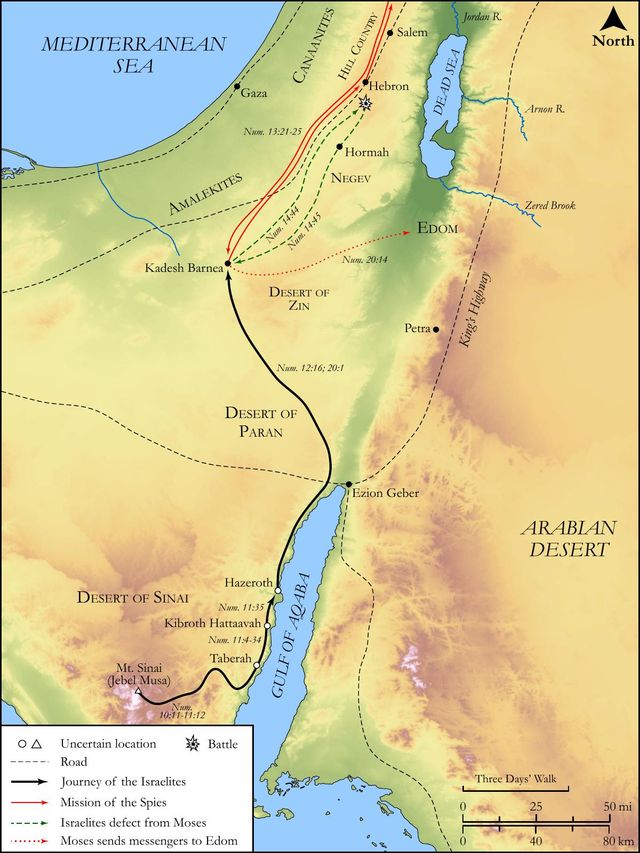
See on the biblical-era map
Study this verse
Public-domain commentary
Matthew Henry
From his Commentary on the Whole Bible. Henry comments on passages, not single verses — this entry covers Numbers 11:31–35.
God, having performed his promise to Moses by giving him assessors in the government, thereby proving the power he has over the spirits of men by his Spirit, he here performs his promise to the people by giving them flesh, proving thereby his power over the inferior creatures and his dominion in the kingdom of nature. Observe, 1. How the people were gratified with flesh in abundance: A wind (a south-east wind, as appears, Psa 78:26) brought quails, Num 11:31. It is uncertain what sort of animals they were; the psalmist calls them feathered fowl, or fowl of wing. The learned bishop Patrick inclines to agree with some modern writers, who think they were locusts, a delicious sort of food well known in those parts, the rather because they were brought with a wind, lay in heaps, and were dried in the sun for use. Whatever they were, they answered the intention, they served for a month's feast for Israel, such an indulgent Father was God to his froward family. Locusts, that had been a plague to fruitful Egypt, feeding upon the fruits, were a blessing to a barren wilderness, being themselves fed upon. 2. How greedy they were of this flesh that God sent them. They flew upon the spoil with an unsatiable appetite, not regarding what Moses had told them from God, that they would surfeit upon it, Num 11:32. Two days and a night they were at it, gathering flesh, till every master of a family had brought home ten homers (that is, ten ass-loads) at least. David longed for the water of the well of Bethlehem, but would not drink it when he had it, because it was obtained by venturing; much more reason these Israelites had to refuse this flesh, which was obtained by murmuring, and which, they might easily perceive, by what Moses said, was given them in anger; but those that are under the power of a carnal mind will have their lusts fulfilled, though it be to the certain damage and ruin of their precious souls. 3. How dearly they paid for their feasts, when it came into the reckoning: The Lord smote them with a very great plague (Num 11:33), some bodily disease, which probably was the effect of their surfeit, and was the death of many of them, and those, it is likely, the ringleaders in the mutiny. Note, God often grants the desires of his own people in love. He gave them their request, but sent leanness into their soul, Psa 106:15. By all that was said to them they were not estranged from their lusts, and therefore, while the meat was in their mouths, the wrath of God came upon them, Psa 78:30, Psa 78:31. What we inordinately desire, if we obtain it (we have reason to fear), will be some way or other a grief and cross to us. God satiated them first, and then plagued them, (1.) To save the reputation of his own power, that it might not be said, "He would not have cut them off had he been able to supply them." And, (2.) To show us the meaning of the prosperity of sinners; it is their preparation for ruin, they are fed as an ox for the slaughter. Lastly, The remembrance of this is preserved in the name given to the place, Num 11:34. Moses called it Kibroth-hattaavah, the graves of lusters or of lust. And well it had been if these graves of Israel's lusters had proved the graves of Israel's lust: the warning was designed to be so, but it had not its due effect, for it follows (Psa 78:32), For all this, they sinned still.
Continue studying Numbers 11:35 across the web’s major study libraries — every link below opens this exact verse, chapter, or book on the destination site.
Read & Compare
 BibleGatewayThis verse in more than 200 translations and 70 languages.
 Bible.comThe YouVersion reader — hundreds of translations, reading plans, and highlights.
 ESV.orgCrossway's official English Standard Version reader.
 NET BibleThe NET translation with 60,000+ translators' notes on every rendering decision.
 STEP BibleTyndale House's free study tool — original text, vocabulary, and scholarly resources.
 BibliaLogos Bible Software's free web reader.
 USCCBThe New American Bible (Revised Edition) with the U.S. bishops' study notes.
Commentaries
 BibleHub CommentariesDozens of classic commentaries on this verse, gathered on one page.
 StudyLightMore than 100 commentary sets — the largest collection on the web.
 BibleRefPlain-English commentary on what this verse means, verse by verse.
 Enduring WordDavid Guzik's free commentary on this chapter, widely used by Bible teachers.
 Bible Study ToolsVerse commentary alongside Greek and Hebrew study aids.
Original Language & Research
- BibleHub InterlinearThe verse word by word — original language, transliteration, and English.
- BibleHub LexiconEvery word's original-language definition and Strong's entry.
 Blue Letter BibleDeep-study tools — Strong's numbers, concordance, and word studies.
 SefariaThe Hebrew text with Rashi and centuries of Jewish commentary.
Sermons, Hymns & Audio


TrulyRandomVerse is not affiliated with these sites and doesn’t control their content. They’re linked because they’re genuinely useful.
Summary
Numbers 11:35 succinctly records the next stage of Israel's journey through the wilderness, marking their departure from Kibrothhattaavah, a place forever etched with the memory of divine judgment following the people's intense craving for meat, and their subsequent arrival and encampment at Hazeroth. This seemingly simple itinerary note serves as a solemn reminder of past rebellion and its consequences, while simultaneously highlighting God's continued, albeit disciplined, leading of His covenant people toward the Promised Land.
Context
ShowHideLiterary Context
Numbers 11:35 concludes the dramatic narrative of the Israelites' insatiable craving for meat, often referred to as the "quail incident," which spans the majority of Numbers 11. Following their bitter complaints against God and Moses regarding the manna and their longing for the varied diet of Egypt, as detailed in Numbers 11:4-6, the Lord, in a display of both power and judgment, provided an overwhelming abundance of quail. However, the people's gluttonous consumption, driven by a lack of faith and an unholy desire, provoked a severe plague that struck them down while the meat was still in their mouths, as recorded in Numbers 11:33. The previous encampment, Kibrothhattaavah, meaning "graves of craving" or "graves of greed," was named to commemorate this tragic event and the burial of those who perished, as explained in Numbers 11:34. Thus, Numbers 11:35 serves as the immediate geographical and narrative transition, documenting the Israelites' movement away from this site of divine wrath to their next destination, Hazeroth.
Historical & Cultural Context
The wilderness journey of the Israelites was a forty-year period of divine testing, purification, and instruction, designed to transform a nation of former slaves into a people ready to inherit the Promised Land. Their nomadic existence, guided by the pillar of cloud by day and fire by night, as described in Numbers 9:15-23, was punctuated by various encampments, each with its own lessons and challenges. The journey from Kibrothhattaavah to Hazeroth represents a typical stage in this divinely orchestrated pilgrimage. Culturally, the naming of places after significant events was a common practice from the days of the patriarchs, as at Bethel and Massah, serving as a perpetual memorial and a didactic tool for future generations. Kibrothhattaavah, therefore, was not merely a geographical marker but a theological signpost, reminding Israel of the consequences of discontent and rebellion against their covenant God.
Key Themes
ShowHideThis verse contributes to several overarching themes within the book of Numbers and the Pentateuch. Firstly, it powerfully illustrates the Consequences of Discontent and Rebellion. The very name Kibrothhattaavah permanently etches the lesson of the severe repercussions of unbridled desire and ingratitude towards God's provision. Israel's repeated failures in the wilderness, of which the quail incident is a prime example, serve as stark warnings for future generations, as later highlighted in 1 Corinthians 10:6. Secondly, the verse underscores the theme of Divine Judgment and Persistent Guidance. While God's judgment was swift and severe, He nonetheless continued to lead His people forward. The journey to Hazeroth signifies that even after experiencing the consequences of sin, God's plan for His covenant people continued to unfold, demonstrating His unwavering commitment to His promises despite their unfaithfulness. Lastly, it is a small but significant step in the broader theme of The Wilderness Journey as a Period of Formation. This long, arduous trek was designed by God to teach Israel obedience, dependence, and the nature of His holiness and faithfulness, preparing them for their inheritance.
Exposition and Analysis
ShowHideKey Word Analysis
ShowHideThis compound Hebrew word literally means "graves of craving" or "graves of lust." It is a highly significant toponym, not merely a geographical location but a memorial name. It serves as a perpetual, tangible reminder of the Israelites' sin of gluttony, discontent, and lack of faith in God's provision, and the swift, severe judgment that followed. The name itself embodies the historical lesson, ensuring that the tragic consequences of their "craving" would not be forgotten.
Meaning "enclosures" or "settlements," Hazeroth is a more neutral name compared to Kibrothhattaavah. It denotes a temporary dwelling place, typical of nomadic encampments. While this verse simply notes their arrival, Hazeroth would later become the site of another significant event: Miriam and Aaron's challenge to Moses' leadership, resulting in Miriam's temporary leprosy, as recorded in Numbers 12:1-15. This highlights that even after experiencing severe judgment, the Israelites' propensity for rebellion persisted.
This verb signifies the act of pulling up stakes and moving on, often in the context of a military or nomadic expedition. In the book of Numbers, it frequently describes the divinely directed movements of the Israelites through the wilderness, always under the guidance of the Lord's cloud, as seen in Numbers 9:17. Even after the profound failure at Kibrothhattaavah, the Lord continues to lead His people, demonstrating His persistent covenant faithfulness despite their repeated unfaithfulness.
Verse Breakdown
ShowHide"And the people journeyed from Kibrothhattaavah"
This clause signifies a physical departure from a place of profound spiritual and physical consequence. Leaving Kibrothhattaavah meant moving away from the immediate site of divine judgment, but not necessarily from its lessons. The act of "journeying" implies God's continued guidance, even after a severe disciplinary action, demonstrating His commitment to His covenant purposes for Israel.
"unto Hazeroth; and abode at Hazeroth"
This indicates the destination and the subsequent act of settling down, even if temporarily. Hazeroth represents the next stage in their divinely ordained itinerary. The phrase "abode at Hazeroth" confirms their establishment of a new encampment, providing a pause in their travels before the next phase of their journey and, as subsequent chapters reveal, the next set of challenges and tests.
Literary Devices
ShowHideNumbers 11:35, though brief, employs several significant literary devices. The most prominent is Toponymy, the naming of places, which in this context carries immense theological weight. The preceding verse's naming of Kibrothhattaavah ("graves of craving") is a powerful example of Etymology providing a perpetual memorial and a stark reminder of the consequences of the people's sin. This place name functions as a Mnemonic Device, ensuring that the lesson of the quail incident and the subsequent plague is not forgotten. The verse also serves as a crucial Narrative Transition, smoothly moving the story forward from a point of crisis and judgment to the next stage of the wilderness journey. This transition, from a place named for judgment to a seemingly neutral encampment, subtly highlights God's ongoing Sovereignty and Faithfulness in leading His people, even in the aftermath of their rebellion.
Theological and Thematic Connections
ShowHideNumbers 11:35, while a simple statement of movement, is profoundly theological. It underscores the reality of divine discipline as a necessary component of God's covenant relationship with His people. The memory of Kibrothhattaavah serves as a perpetual reminder that God takes sin seriously and that unchecked desires lead to severe consequences. Yet, the very act of journeying forward demonstrates God's unwavering commitment to His promises and His patient, persistent guidance. Even in the wake of grievous sin and judgment, God does not abandon His people but continues to lead them, albeit through a path of purification and instruction. This tension between human rebellion and divine faithfulness is a recurring theme throughout the Old Testament, pointing to the ultimate need for a perfect mediator and a new covenant. The wilderness journey itself is a metaphor for the Christian life, fraught with temptations and trials, but always under the watchful eye and guiding hand of a faithful God who disciplines those He loves.
Reflection and Application
ShowHideNumbers 11:35 offers timeless lessons for believers today. Just as Kibrothhattaavah stood as a memorial, we are called to reflect on our own past failures and the consequences of desires that contradict God's will. Learning from history, both biblical and personal, is crucial for spiritual growth. The Israelites' craving stemmed from a lack of contentment with God's daily provision, a spiritual malady that can afflict us all. This verse encourages us to cultivate profound gratitude for what God has given us, rather than constantly longing for more or different things, which can lead to spiritual pitfalls and discontentment. True contentment is found not in the abundance of possessions or the satisfaction of every desire, but in Christ alone. Furthermore, the fact that God continued to lead His people even after significant failures provides immense hope. It reminds us that even in our imperfections and after our own moments of spiritual rebellion, God's purposes for us persist, and He continues to guide us forward on our spiritual journey, always working for our good and His glory. We are invited to trust in His persistent grace and to learn from the "graves of craving" in our own lives, turning from self-serving desires to humble dependence on Him.
Questions for Reflection
ShowHideFAQ
ShowHideWhat is the primary significance of the name Kibrothhattaavah mentioned in this verse?
ShowHideKibrothhattaavah, meaning "graves of craving" or "graves of lust," is profoundly significant because it serves as a perpetual memorial to the Israelites' sin of gluttony and discontent, and God's subsequent swift and severe judgment. It marks the site where many Israelites died due to a plague after greedily consuming the quail God provided in response to their complaints about the manna. The name itself is a didactic reminder of the spiritual danger of unbridled desires and ingratitude toward divine provision, a lesson emphasized in Numbers 11:34.
What happened at Hazeroth after the Israelites arrived there?
ShowHideWhile Numbers 11:35 simply states their arrival and encampment at Hazeroth, the subsequent chapter, Numbers 12, records another significant event occurring at this location. It was at Hazeroth that Miriam and Aaron challenged Moses' unique prophetic authority and leadership. As a result of their rebellion and questioning of God's chosen leader, Miriam was afflicted with leprosy for a period, serving as another powerful demonstration of divine judgment against those who oppose God's appointed servants.
Why is a verse that simply describes a journey important for theological understanding?
ShowHideAlthough seemingly a mere logistical detail, Numbers 11:35 is theologically significant for several reasons. Firstly, it highlights God's continued faithfulness and sovereignty in leading His people, even after a severe act of judgment. The journey forward demonstrates that God's covenant plan persists despite human sin. Secondly, it emphasizes the importance of remembering historical lessons; the very act of leaving Kibrothhattaavah implies a movement away from a place of consequences, urging reflection on past failures. Thirdly, it underscores the wilderness journey as a process of divine formation and purification, where each stop, whether a place of judgment or a new beginning, contributes to Israel's spiritual development and preparation for the Promised Land.
Christ-Centered Fulfillment
ShowHideNumbers 11:35, marking the movement from the "graves of craving" to the next encampment, finds profound Christ-centered fulfillment in several ways. The Israelites' insatiable craving for meat, leading to death, foreshadows humanity's deeper spiritual hunger for satisfaction outside of God, a hunger that ultimately leads to spiritual death. Jesus, however, declares Himself to be the "bread of life," as recorded in John 6:35, the true manna from heaven that fully satisfies spiritual hunger and grants eternal life, unlike the temporary quail that brought judgment. The wilderness journey, with its cycles of rebellion, judgment, and God's persistent leading, points to Christ as the ultimate faithful leader and guide. While Israel repeatedly failed to trust God's provision and guidance, Jesus perfectly obeyed His Father, even enduring the ultimate wilderness experience of temptation, as recounted in Matthew 4:1-11. He is the true Lamb of God, whose sacrifice takes away the sin of the world, as proclaimed in John 1:29, offering forgiveness and a new beginning far beyond any mere geographical transition from a place of judgment. Through Christ, believers are led not just from one encampment to another, but from spiritual death to life, from the bondage of sin to the freedom of grace, ultimately to the heavenly Promised Land, a journey made possible by His perfect obedience and atoning work, as anticipated in Hebrews 4:9-11. He is the one who satisfies every true longing of the soul, ensuring that those who come to Him will never hunger or thirst again, a promise reiterated in John 6:35.