


Genesis 36:8
Bible text: King James Version (1769 Blayney text) · Public domain
Bible text: Berean Standard Bible · Public domain
Bible text: American Standard Version (1901) · Public domain
Bible text: World English Bible, Messianic edition · Public domain
Bible text: Geneva Bible (1599) · Public domain
Bible text: Young's Literal Translation · Public domain
- וַיֵּשֶׁבvai·Ye·shevand he dweltH3427Conj-w ¦ V-Qal-ConsecImperf-3msVerb Qal Consecutive Imperfect 3rd Singular Masculineוַandיֵּשֶׁבhe dwelt
- עֵשָׂו'e·SavEsauH6215N-proper-mNoun Proper Masculine
- בְּהַרbe·Harin [the] hill country ofH2022Prep-b ¦ N-mscNoun Singular Masculine Constructבְּinהַר[the] hill country of
- שֵׂעִירse·'IrSeirH8165N-properNoun Proper Location
- עֵשָׂו'e·SavEsauH6215N-proper-mNoun Proper Masculine
- הוּאhu'thatH1931Pro-3msPronoun Personal 3rd Singular Masculine
- אֱדוֹם'e·Dom[is] EdomH123N-proper-mNoun Proper Masculine
English is a literal word-by-word gloss of the Hebrew, not the KJV's wording. Why?
This is the original text the KJV's translators worked from — each Hebrew word with its own literal English meaning in this verse, prepared by scholars at Tyndale House, Cambridge. The KJV translates whole sentences, not word by word, so its wording differs: one Hebrew word can become several English words, and the KJV may choose “the LORD” where the gloss reads “Yahweh”. Both are faithful — they answer different questions. For the KJV's own rendering, switch to the KJV text.
Details
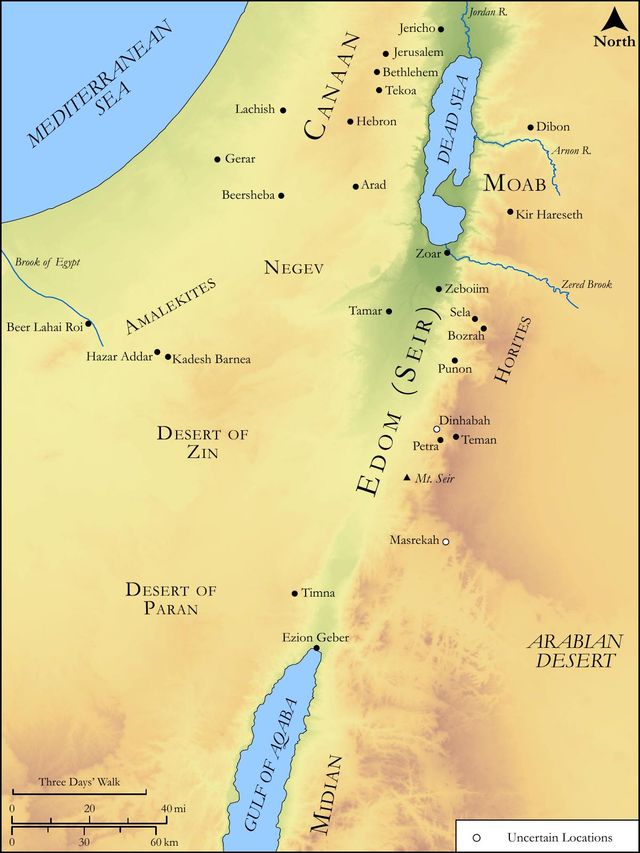
See on the biblical-era maps


Study this verse
Public-domain commentary
Matthew Henry
From his Commentary on the Whole Bible. Henry comments on passages, not single verses — this entry covers Genesis 36:1–8.
Observe here, 1. Concerning Esau himself, Gen 36:1. He is called Edom (and again, Gen 36:8), that name by which was perpetuated the remembrance of the foolish bargain he made, when he sold his birthright for that red, that red pottage. The very mention of that name is enough to intimate the reason why his family is turned off with such a short account. Note, If men do a wrong thing they must thank themselves, when it is, long afterwards, remembered against them to their reproach. 2. Concerning his wives, and the children they bore him in the land of Canaan. He had three wives, and, by them all, but five sons: many a one has more by one wife. God in his providence often disappoints those who take indirect courses to build up a family; yet here the promise prevailed, and Esau's family was built up. 3. Concerning his removal to mount Seir, which was the country God had given him for a possession, when he reserved Canaan for the seed of Jacob. God owns it, long afterwards: I gave to Esau mount Seir (Deu 2:5; Jos 24:4), which was the reason why the Edomites must not be disturbed in their possession. Those that have not a right by promise, such as Jacob had, to Canaan, may have a very good title by providence to their estates, such as Esau had to mount Seir. Esau had begun to settle among his wives' relations, in Seir, before Jacob came from Padan-aram, Gen 32:3. Isaac, it is likely, had sent him thither (as Abraham in his life-time had sent the sons of the concubines from Isaac his son into the east country, Gen 25:6), that Jacob might have the clearer way made for him to the possession of the promised land. During the life of Isaac, however, Esau had probably still some effects remaining in Canaan; but, after his death, he wholly withdrew to mount Seir, took with him what came to his share of his father's personal estate, and left Canaan to Jacob, not only because he had the promise of it, but because Esau perceived that if they should continue to thrive as they had begun there would not be room for both. Thus dwelt Esau in Mount Seir, Gen 36:8. Note, Whatever opposition may be made, God's word will be accomplished, and even those that have opposed it will see themselves, some time or other, under a necessity of yielding to it, and acquiescing in it. Esau had struggled for Canaan, but now he tamely retires to mount Seir; for God's counsels shall certainly stand, concerning the times before appointed, and the bounds of our habitation.
Continue studying Genesis 36:8 across the web’s major study libraries — every link below opens this exact verse, chapter, or book on the destination site.
Read & Compare
 BibleGatewayThis verse in more than 200 translations and 70 languages.
 Bible.comThe YouVersion reader — hundreds of translations, reading plans, and highlights.
 ESV.orgCrossway's official English Standard Version reader.
 NET BibleThe NET translation with 60,000+ translators' notes on every rendering decision.
 STEP BibleTyndale House's free study tool — original text, vocabulary, and scholarly resources.
 BibliaLogos Bible Software's free web reader.
 USCCBThe New American Bible (Revised Edition) with the U.S. bishops' study notes.
Commentaries
 BibleHub CommentariesDozens of classic commentaries on this verse, gathered on one page.
 StudyLightMore than 100 commentary sets — the largest collection on the web.
 BibleRefPlain-English commentary on what this verse means, verse by verse.
 Enduring WordDavid Guzik's free commentary on this chapter, widely used by Bible teachers.
 Bible Study ToolsVerse commentary alongside Greek and Hebrew study aids.
Original Language & Research
- BibleHub InterlinearThe verse word by word — original language, transliteration, and English.
- BibleHub LexiconEvery word's original-language definition and Strong's entry.
 Blue Letter BibleDeep-study tools — Strong's numbers, concordance, and word studies.
 SefariaThe Hebrew text with Rashi and centuries of Jewish commentary.
Sermons, Hymns & Audio


TrulyRandomVerse is not affiliated with these sites and doesn’t control their content. They’re linked because they’re genuinely useful.
Summary
Genesis 36:8 serves as a pivotal genealogical statement, succinctly recording Esau's permanent settlement in Mount Seir and formally identifying him with the name Edom. This verse solidifies the distinct trajectory of Esau's descendants, establishing the foundational link between the individual and the nation that would become a significant, often adversarial, entity in biblical history, thereby underscoring the fulfillment of divine prophecy regarding two separate peoples.
Context
ShowHideLiterary Context
Genesis chapter 36 is an extensive genealogical record, meticulously detailing the descendants of Esau. This chapter follows the significant reconciliation between Jacob and Esau in Genesis 33, after which Esau departs for Seir, while Jacob journeys to Succoth and then Canaan. The placement of Esau's genealogy immediately after Jacob's return to the promised land and before the detailed account of Joseph's life (beginning in Genesis 37) serves to clearly differentiate the two familial lines. It emphasizes that while Jacob's lineage is the focus of the covenant narrative, Esau's line also developed into a significant nation, fulfilling earlier prophecies. The chapter's comprehensive nature, listing wives, sons, chiefs, and kings, highlights the establishment of Edom as a distinct and formidable entity.
Historical & Cultural Context
The nations descended from the sons of Noah were characterized by tribal and national formations, often defined by patriarchal lineage and geographical settlement. The transition from nomadic or semi-nomadic family units to settled nations was a common developmental stage. Mount Seir, located in the rugged, reddish sandstone mountains south of the Dead Sea, provided a natural stronghold and distinct territory for Esau's burgeoning family. This region, also known as Edom, became a significant geopolitical player in the Levant, often interacting, and frequently conflicting, with the nascent nation of Israel. The cultural practice of associating a people with their patriarch's name or a defining characteristic was common, solidifying identity and lineage.
Key Themes
ShowHideThis verse contributes to several overarching themes within Genesis and the broader Pentateuch. It powerfully illustrates Divine Sovereignty in the formation of nations, demonstrating God's meticulous orchestration of human history, even outside the direct covenant line of Israel. The distinct paths of Esau and Jacob, leading to the formation of Edom and Israel respectively, directly fulfill the prophecy given to Rebekah in Genesis 25:23, where the Lord declared that "two nations are in your womb, and two peoples from within you will be separated; one people will be stronger than the other, and the older will serve the younger." Furthermore, the naming of Edom reinforces the theme of Consequences of Personal Choices, as Esau's impulsive decision to sell his birthright for a bowl of red pottage (Genesis 25:29-34) becomes the enduring identifier for his descendants.
Exposition and Analysis
ShowHideKey Word Analysis
ShowHideA primitive root meaning "to sit down," but by implication, "to dwell, to remain." This word signifies a settled, permanent residence rather than a temporary encampment. In the context of Genesis 36:8, it emphasizes Esau's definitive establishment and the enduring nature of his presence in Mount Seir, marking a clear geographical and national separation from Jacob's eventual dwelling in Canaan. It speaks to the foundation of a lasting habitation.
Apparently a passive participle of a root meaning "to handle," implying "rough" or "hairy." This name, given to Isaac's son, directly refers to his physical appearance at birth as described in Genesis 25:25. In this verse, it serves as the personal name of the patriarch, who then becomes synonymous with the nation. The name's original meaning subtly reinforces the distinct identity of the individual who would found a nation characterized by its rugged land.
Meaning "red." This name is directly linked to Esau's physical characteristic (reddish skin) and, more significantly, to the incident where he sold his birthright for "red pottage" (Genesis 25:30). The name "Edom" thus becomes a perpetual reminder of Esau's valuing of immediate gratification over spiritual inheritance. Its application here formally equates the individual Esau with the collective nation, solidifying their identity and connecting their national character to a foundational personal choice.
Verse Breakdown
ShowHide"Thus dwelt Esau in mount Seir:"
This clause establishes the geographical and residential reality of Esau. The adverb "Thus" (וַיֵּשֶׁב, vayyeshev, "and he dwelt") indicates a consequence or culmination of previous events, specifically Esau's decision to move away from Jacob after their reconciliation. His dwelling in Mount Seir signifies a permanent settlement, laying the groundwork for the development of a distinct nation. Mount Seir, a rugged, mountainous region, became the ancestral homeland and stronghold of Esau's descendants, providing a natural boundary and identity separate from the land promised to Jacob.
"Esau [is] Edom."
This declarative statement is the theological and historical crux of the verse. It explicitly equates the individual patriarch Esau with the collective nation that descended from him. The verb "is" is implied in the Hebrew, making the identification direct and emphatic. This formal designation solidifies the link between Esau's personal history, particularly the incident of the red pottage, and the national identity of the Edomites. It signifies the transition from a personal characteristic or event to the defining name of an entire people and their territory.
Literary Devices
ShowHideGenesis 36:8, though concise, employs several literary devices. The most prominent is Metonymy, where the name of the individual patriarch, Esau, is used to represent the entire nation descended from him, Edom. The phrase "Esau is Edom" is a direct statement of this association, demonstrating how the identity of the founder becomes synonymous with the identity of the people. There is also an element of Symbolism embedded in the name "Edom" itself. Meaning "red," it not only alludes to Esau's physical appearance but more significantly symbolizes his impulsive decision to trade his birthright for "red pottage" (Genesis 25:30). This color, and the name derived from it, serves as a constant reminder of a pivotal moment of spiritual disregard that shaped the destiny of a nation. The verse also functions as a Summary Statement, encapsulating the outcome of Esau's trajectory and setting the stage for the detailed genealogy that follows in the rest of the chapter.
Theological and Thematic Connections
ShowHideGenesis 36:8, while a seemingly simple genealogical note, is replete with theological significance. It underscores God's sovereign hand in the formation and separation of nations, demonstrating that His plans unfold not only through the chosen line of Jacob but also through the distinct trajectories of other peoples. The verse highlights the enduring consequences of personal choices, as Esau's defining moment of valuing immediate gratification over spiritual inheritance is forever etched into the national identity of Edom. This separation of Esau and Jacob into two distinct nations, with Edom settling in Mount Seir, directly fulfills the divine prophecy given to Rebekah before their birth, confirming God's foreknowledge and control over human history.
Reflection and Application
ShowHideGenesis 36:8, though a brief historical marker, invites profound reflection on the interwoven themes of divine sovereignty, personal choice, and national identity. It reminds us that God's overarching plan encompasses all peoples, even those who diverge from the direct covenant line, and that He meticulously records their histories. For us today, Esau's story, encapsulated in his identification as Edom, serves as a powerful cautionary tale. His impulsive decision to trade a priceless spiritual inheritance for immediate, fleeting satisfaction resulted in a national identity rooted in that very act. This should prompt us to examine our own priorities: are we valuing the eternal over the temporal, spiritual blessings over momentary comforts? Like Esau, we face choices that can have long-lasting consequences, not only for ourselves but potentially for those who follow us. The verse subtly encourages us to cultivate spiritual discernment and patience, prioritizing God's promises and purposes above all else, lest we, too, sell our "birthright" for something of far lesser value.
Questions for Reflection
ShowHideFAQ
ShowHideWhy is Esau also called Edom?
ShowHideEsau received the name Edom, meaning "red," primarily due to a pivotal incident where he impulsively sold his birthright to his brother Jacob for a bowl of "red pottage" or lentil stew, as recorded in Genesis 25:29-34. This event was so significant that the name became inextricably linked with him and subsequently with the nation that descended from him. Additionally, Esau was born with a reddish complexion, as noted in Genesis 25:25, further reinforcing the association with "red." The land of Mount Seir, where his descendants settled, is also characterized by reddish sandstone, solidifying the name Edom for both the people and their territory.
What was the significance of Esau dwelling in Mount Seir?
ShowHideEsau's dwelling in Mount Seir marked a definitive geographical, cultural, and national separation from Jacob, who remained in Canaan, the land of promise. This move, as detailed in Genesis 36:6-7, was a deliberate choice by Esau to find sufficient land for his growing family and possessions, avoiding conflict with Jacob's burgeoning household. The establishment of Esau's lineage in the rugged, defensible territory of Mount Seir formally laid the groundwork for the nation of Edom, distinct from Israel. This separation was a direct fulfillment of the divine prophecy given to Rebekah, stating that "two nations are in your womb, and two peoples from within you will be separated" (Genesis 25:23). It set the stage for the future interactions, often adversarial, between the Edomites and the Israelites throughout biblical history.
Christ-Centered Fulfillment
ShowHideWhile Genesis 36:8 details the lineage of Esau, distinct from the covenant line of Jacob from which Christ would come, it indirectly highlights the profound scope of God's redemptive plan. The meticulous recording of all nations, even those seemingly outside the direct covenant and often opposed to Israel (like Edom), underscores God's absolute sovereignty over all humanity and history. This separation of peoples, as seen in Esau and Jacob, finds its ultimate reconciliation and unity in the person and work of Jesus Christ. Through His atoning sacrifice, Christ broke down the dividing wall of hostility between peoples, whether Jew or Gentile, Edomite or Israelite (Ephesians 2:14-16). The national distinctions and historical animosities that began with figures like Esau and Jacob are transcended in the new humanity formed by those who are "in Christ," where there is "neither Jew nor Gentile, neither slave nor free, nor is there male and female, for you are all one in Christ Jesus" (Galatians 3:28). Thus, the seemingly disparate paths of Esau and Jacob ultimately point to the universal reach of the Gospel, which gathers all peoples into one family under the Lordship of Christ.