


Genesis 36:7
- כִּיkiforH3588PrtParticle Conditional
- הָיָהha·Yahit wasH1961V-Qal-Perf-3msVerb Qal Perfect 3rd Singular Masculine
- רְכוּשָׁםre·khu·Shamtheir possession[s]H7399N-msc ¦ 3mpNoun Singular Masculine Constructרְכוּשָׁpossession[s]םtheir
- רָבrav[too] muchH7227Adj-msAdjective Singular Masculine Absolute
- מִשֶּׁבֶתmi·She·vetfor dwellingH3427Prep-m ¦ V-Qal-InfVerb Qal Infinitive Constructמִforשֶּׁבֶתdwelling
- יַחְדָּוyach·DavtogetherH3162AdvAdverb
- וְלֹאve·Lo'and notH3808Conj-w ¦ NegParticle Negativeוְandלֹאnot
- יָכְלָהya·khe·Lahit was ableH3201V-Qal-Perf-3fsVerb Qal Perfect 3rd Singular Feminine
- אֶרֶץ'E·retz[the] land ofH776N-fscNoun Singular Feminine Construct
- מְגוּרֵיהֶםme·gu·rei·Hemtheir sojourningsH4033N-mpc ¦ 3mpNoun Plural Masculine Constructמְגוּרֵיsojourningsהֶםtheir
- לָשֵׂאתla·Setto supportH5375Prep-l ¦ V-Qal-InfVerb Qal Infinitive Constructלָtoשֵׂאתsupport
- אֹתָם'o·Tam<obj.> themH853DirObjM ¦ 3mpParticle Object Indicatorאֹתָ<obj.>םthem
- מִפְּנֵיmi·pe·Nei<from> because ofH6440Prep-m ¦ N-mpcNoun Plural Masculine Constructמִ<from>פְּנֵיbecause of
- מִקְנֵיהֶםmik·nei·Hemtheir livestockH4735N-msc ¦ 3mpNoun Singular Masculine Constructמִקְנֵיlivestockהֶםtheir
English is a literal word-by-word gloss of the Hebrew, not the KJV's wording. Why?
This is the original text the KJV's translators worked from — each Hebrew word with its own literal English meaning in this verse, prepared by scholars at Tyndale House, Cambridge. The KJV translates whole sentences, not word by word, so its wording differs: one Hebrew word can become several English words, and the KJV may choose “the LORD” where the gloss reads “Yahweh”. Both are faithful — they answer different questions. For the KJV's own rendering, switch to the KJV text.
Details
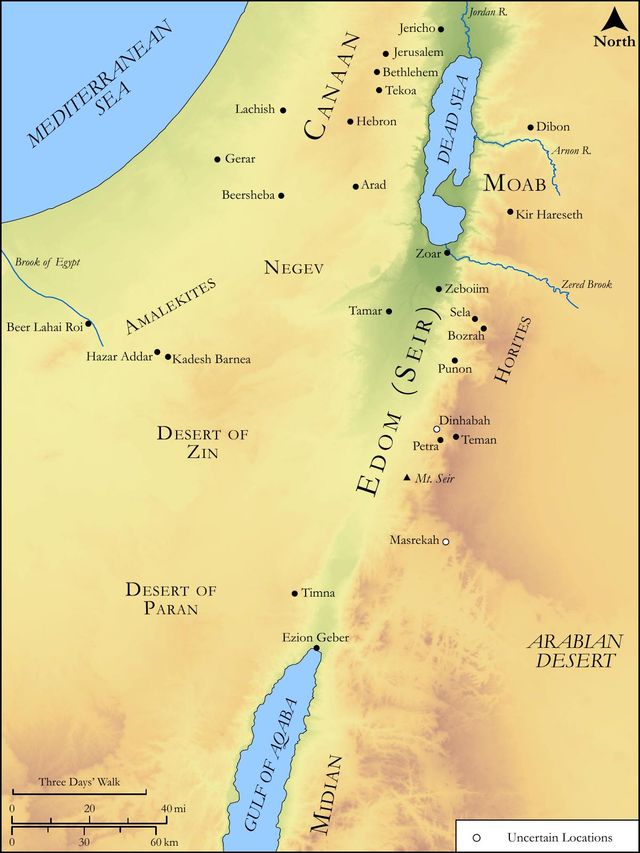
See on the biblical-era map


Study this verse
Public-domain commentary
Matthew Henry
From his Commentary on the Whole Bible. Henry comments on passages, not single verses — this entry covers Genesis 36:1–8.
Observe here, 1. Concerning Esau himself, Gen 36:1. He is called Edom (and again, Gen 36:8), that name by which was perpetuated the remembrance of the foolish bargain he made, when he sold his birthright for that red, that red pottage. The very mention of that name is enough to intimate the reason why his family is turned off with such a short account. Note, If men do a wrong thing they must thank themselves, when it is, long afterwards, remembered against them to their reproach. 2. Concerning his wives, and the children they bore him in the land of Canaan. He had three wives, and, by them all, but five sons: many a one has more by one wife. God in his providence often disappoints those who take indirect courses to build up a family; yet here the promise prevailed, and Esau's family was built up. 3. Concerning his removal to mount Seir, which was the country God had given him for a possession, when he reserved Canaan for the seed of Jacob. God owns it, long afterwards: I gave to Esau mount Seir (Deu 2:5; Jos 24:4), which was the reason why the Edomites must not be disturbed in their possession. Those that have not a right by promise, such as Jacob had, to Canaan, may have a very good title by providence to their estates, such as Esau had to mount Seir. Esau had begun to settle among his wives' relations, in Seir, before Jacob came from Padan-aram, Gen 32:3. Isaac, it is likely, had sent him thither (as Abraham in his life-time had sent the sons of the concubines from Isaac his son into the east country, Gen 25:6), that Jacob might have the clearer way made for him to the possession of the promised land. During the life of Isaac, however, Esau had probably still some effects remaining in Canaan; but, after his death, he wholly withdrew to mount Seir, took with him what came to his share of his father's personal estate, and left Canaan to Jacob, not only because he had the promise of it, but because Esau perceived that if they should continue to thrive as they had begun there would not be room for both. Thus dwelt Esau in Mount Seir, Gen 36:8. Note, Whatever opposition may be made, God's word will be accomplished, and even those that have opposed it will see themselves, some time or other, under a necessity of yielding to it, and acquiescing in it. Esau had struggled for Canaan, but now he tamely retires to mount Seir; for God's counsels shall certainly stand, concerning the times before appointed, and the bounds of our habitation.
Continue studying Genesis 36:7 across the web’s major study libraries — every link below opens this exact verse, chapter, or book on the destination site.
Read & Compare
 BibleGatewayThis verse in more than 200 translations and 70 languages.
 Bible.comThe YouVersion reader — hundreds of translations, reading plans, and highlights.
 ESV.orgCrossway's official English Standard Version reader.
 NET BibleThe NET translation with 60,000+ translators' notes on every rendering decision.
 STEP BibleTyndale House's free study tool — original text, vocabulary, and scholarly resources.
 BibliaLogos Bible Software's free web reader.
 USCCBThe New American Bible (Revised Edition) with the U.S. bishops' study notes.
Commentaries
 BibleHub CommentariesDozens of classic commentaries on this verse, gathered on one page.
 StudyLightMore than 100 commentary sets — the largest collection on the web.
 BibleRefPlain-English commentary on what this verse means, verse by verse.
 Enduring WordDavid Guzik's free commentary on this chapter, widely used by Bible teachers.
 Bible Study ToolsVerse commentary alongside Greek and Hebrew study aids.
Original Language & Research
- BibleHub InterlinearThe verse word by word — original language, transliteration, and English.
- BibleHub LexiconEvery word's original-language definition and Strong's entry.
 Blue Letter BibleDeep-study tools — Strong's numbers, concordance, and word studies.
 SefariaThe Hebrew text with Rashi and centuries of Jewish commentary.
Sermons, Hymns & Audio


TrulyRandomVerse is not affiliated with these sites and doesn’t control their content. They’re linked because they’re genuinely useful.
Summary
Genesis 36:7 provides the practical and economic rationale for the permanent separation of Jacob and Esau, explaining that their immense wealth, primarily in livestock, had grown so vast that the land in which they were temporarily residing could no longer sustain both of their households and their burgeoning herds, thus necessitating their distinct geographical dwelling places.
Context
ShowHideLiterary Context
This verse appears within the genealogical record of Esau (Edom), following the detailed account of his descendants and the kings who reigned in Edom before any king reigned over the Israelites. Chapter 36 serves as a significant interlude, providing the background for the Edomite nation, which would become a recurring antagonist to Israel throughout biblical history. Verse 7 specifically harks back to the reconciliation between Jacob and Esau in Genesis 33, explaining why their reunion was not followed by a shared dwelling, but rather a permanent geographical separation. This verse establishes the practical foundation for the distinct national trajectories of Israel and Edom.
Historical & Cultural Context
During the patriarchal period, wealth was largely measured in livestock (sheep, goats, cattle) and servants. As nomadic pastoralists, Jacob and Esau, like their grandfather Abraham, required vast expanses of grazing land and access to water sources for their immense herds. The "land wherein they were strangers" refers to Canaan, a territory not yet fully possessed by Abraham's descendants, but rather where they lived as sojourners, dependent on agreements with local inhabitants for grazing rights. Such a lifestyle, while blessed with prosperity, inherently limited the carrying capacity of any single region for two such large and growing households, making conflict over resources a constant threat, as seen earlier with Abraham and Lot.
Key Themes
ShowHideGenesis 36:7 contributes to several overarching themes. It highlights the theme of Divine Blessing and its Challenges, showing how God's favor, manifested in abundant wealth, can lead to practical dilemmas requiring strategic solutions. It underscores Stewardship and Resource Management, demonstrating the need for wise decisions when resources become strained. Furthermore, it reinforces the theme of Divine Sovereignty in Human Affairs, illustrating how even seemingly mundane economic realities can serve God's larger redemptive plan by facilitating the distinct development of two nations, Israel and Edom, preventing inter-familial conflict and setting the stage for their unique roles in salvation history. This separation, driven by practical necessity, ultimately serves to fulfill God's covenant promises to both Jacob and Esau, as outlined in Genesis 25:23.
Exposition and Analysis
ShowHideKey Word Analysis
ShowHideThis term refers specifically to acquired property, emphasizing tangible assets like livestock, goods, and servants. In this context, it highlights the vast material prosperity of Jacob and Esau, which had grown to an extent that it became a logistical challenge rather than solely a blessing, necessitating their separation due to the sheer volume of their possessions.
The verb yâshab means "to sit down, to dwell, to remain," indicating a settled existence, while yachad signifies "unitedly" or "together." The combination emphasizes their inability to cohabit or share the same immediate territory due to the scale of their respective households and herds. This phrase underscores the practical impossibility of maintaining peaceful coexistence given their immense wealth.
This verb means "to lift," "to carry," or "to sustain." In this context, it metaphorically describes the land's inability to "sustain" or "support" the combined weight and needs of their vast herds. It speaks to the limited carrying capacity of the land, which could not provide sufficient pasture and water for both patriarchs' burgeoning livestock.
Verse Breakdown
ShowHide"For their riches were more than that they might dwell together"
This clause establishes the primary reason for the separation: the sheer magnitude of Jacob and Esau's wealth. Their possessions, predominantly livestock, had grown so extensive that sharing a common dwelling place or immediate grazing area became impractical and unsustainable. The phrase implies an overflow of resources that exceeded the capacity for a shared, peaceful existence.
"and the land wherein they were strangers could not bear them because of their cattle"
This second clause provides the specific logistical constraint. The land they occupied, Canaan, was not their inherited property but a place where they resided as temporary inhabitants or "strangers." This transient status meant limited access to resources. Crucially, the land itself lacked the carrying capacity—sufficient pasture and water—to support the combined, ever-growing herds of both Jacob and Esau, forcing their separation.
Literary Devices
ShowHideGenesis 36:7 employs several Literary Devices to convey its message effectively. Hyperbole is evident in the statement that their riches were "more than that they might dwell together," suggesting an overwhelming abundance that made cohabitation literally impossible. While not strictly impossible, it emphasizes the extreme impracticality. Metonymy is present where "riches" primarily stands for "livestock," the most significant form of wealth for nomadic pastoralists, and "the land" stands for its "carrying capacity" or "resources." The verse also serves as Foreshadowing, subtly prefiguring the distinct national identities and territories of Israel (Jacob's descendants) and Edom (Esau's descendants). This practical separation, driven by economic necessity, lays the groundwork for the future geopolitical realities and often contentious relationship between these two nations.
Theological and Thematic Connections
ShowHideThis verse profoundly illustrates that divine blessing, while wonderful, often comes with practical implications and responsibilities. The abundance granted to Jacob and Esau, a sign of God's faithfulness to His covenant promises, paradoxically necessitated their physical separation. This highlights the principle that even in prosperity, wisdom in resource management and a proactive approach to potential conflict are essential. God's sovereign hand is evident even in these mundane logistical details, guiding the patriarchs to distinct paths that would ultimately serve His larger redemptive purposes for their respective nations.
Reflection and Application
ShowHideGenesis 36:7 offers valuable insights into the practicalities of life, even for those blessed by God. It teaches us that growth and prosperity, whether in personal resources, family, or ministry, often necessitate strategic adjustments, including expansion, relocation, or even amicable separation, to maintain peace and sustainability. This verse reminds us that ignoring practical limitations, even when abundant blessings are present, can lead to conflict and inefficiency. Wise stewardship involves not only managing what we have but also recognizing when current circumstances or resources are insufficient for continued shared growth. It encourages proactive decision-making to prevent discord and ensure the flourishing of all parties involved, even if it means forging separate paths for the greater good.
Questions for Reflection
ShowHideFAQ
ShowHideWhy did Jacob and Esau not simply divide the land they were in?
ShowHideThe text states they were "strangers" (Hebrew, mâgûwr' H4033) in the land of Canaan, meaning they did not own the land outright. Their nomadic lifestyle involved grazing rights and temporary encampments, often negotiated with local inhabitants or tribes. Their immense wealth in livestock simply exceeded the carrying capacity of the available, non-owned land for two such large and growing households. A simple division would have been impractical or insufficient, as they were not dividing owned territory but rather attempting to share limited, communal, or temporarily accessible grazing grounds. Their status as sojourners meant they had no inherent claim to permanently divide the land, only to utilize what was available and permissible for their transient needs.
Christ-Centered Fulfillment
ShowHideWhile Genesis 36:7 describes a necessary physical separation between two patriarchs and their burgeoning nations due to earthly limitations, it ultimately points to a greater spiritual reconciliation and unity achieved in Christ. The divisions and constraints imposed by finite earthly resources, human sin, and national identities are transcended in the gospel. Through His atoning work, Christ breaks down the dividing walls of hostility, uniting all who believe—whether Jew or Gentile, descendants of Jacob or Esau—into one new humanity, the Church. In Him, the ultimate "land" of blessing is not a physical territory that can be over-burdened, but a spiritual inheritance and a heavenly citizenship where all God's people can dwell together in perfect harmony, transcending all earthly constraints and conflicts. As Ephesians 2:14 declares, "He himself is our peace, who has made the two groups one and has destroyed the barrier, the dividing wall of hostility." This spiritual reality in Christ fulfills the longing for a place where all God's people can truly "dwell together" without limitation, as described in Colossians 3:11, where "Christ is all, and is in all."