


Genesis 13:6
- וְלֹאve·lo'and notH3808Conj-w ¦ NegParticle Negativeוְandלֹאnot
- נָשָׂאna·Sa'it supportedH5375V-Qal-Perf-3msVerb Qal Perfect 3rd Singular Masculine
- אֹתָם'o·Tam<obj.> themH853DirObjM ¦ 3mpParticle Object Indicatorאֹתָ<obj.>םthem
- הָאָרֶץha·'A·retzthe landH776Art ¦ N-fsNoun Singular Feminine Absoluteהָtheאָרֶץland
- לָשֶׁבֶתla·She·vetto dwellH3427Prep-l ¦ V-Qal-InfVerb Qal Infinitive Constructלָtoשֶׁבֶתdwell
- יַחְדָּוyach·DavtogetherH3162AdvAdverb
- כִּיkiforH3588PrtParticle Conditional
- הָיָהha·Yahit wasH1961V-Qal-Perf-3msVerb Qal Perfect 3rd Singular Masculine
- רְכוּשָׁםre·khu·Shamtheir possession[s]H7399N-msc ¦ 3mpNoun Singular Masculine Constructרְכוּשָׁpossession[s]םtheir
- רָבRavmuchH7227Adj-msAdjective Singular Masculine Absolute
- וְלֹאve·Lo'and notH3808Conj-w ¦ NegParticle Negativeוְandלֹאnot
- יָכְלוּya·khe·Luthey were ableH3201V-Qal-Perf-3cpVerb Qal Perfect 3rd Plural common gender
- לָשֶׁבֶתla·She·vetto dwellH3427Prep-l ¦ V-Qal-InfVerb Qal Infinitive Constructלָtoשֶׁבֶתdwell
- יַחְדָּוyach·DavtogetherH3162AdvAdverb
English is a literal word-by-word gloss of the Hebrew, not the KJV's wording. Why?
This is the original text the KJV's translators worked from — each Hebrew word with its own literal English meaning in this verse, prepared by scholars at Tyndale House, Cambridge. The KJV translates whole sentences, not word by word, so its wording differs: one Hebrew word can become several English words, and the KJV may choose “the LORD” where the gloss reads “Yahweh”. Both are faithful — they answer different questions. For the KJV's own rendering, switch to the KJV text.
Details
See on the biblical-era map


Study this verse
Public-domain commentary
Matthew Henry
From his Commentary on the Whole Bible. Henry comments on passages, not single verses — this entry covers Genesis 13:5–9. His three-level outline is real structure in the source text, so it is rendered as structure.
We have here an unhappy falling out between Abram and Lot, who had hitherto been inseparable companions (see Gen 13:1, and Gen 12:4), but now parted.
I.The occasion of their quarrel was their riches.
We read (Gen 13:2) how rich Abram was; now here we are told (Gen 13:5) that Lot, who went with Abram, was rich too; and therefore God blessed him with riches because he went with Abram. Note,
1.It is good being in good company, and going with those with whom God is, Zac 8:23.
2.Those that are partners with God's people in their obedience and sufferings shall be sharers with them in their joys and comforts, Isa 66:10. Now, they both being very rich, the land was not able to bear them, that they might dwell comfortably and peaceably together. So that their riches may be considered,
(1.)As setting them at a distance one from another. Because the place was too strait for them, and they had not room for their stock, it was necessary they should live asunder. Note, Every comfort in this world has its cross attending it. Business is a comfort; but it has this inconvenience in it, that it allows us not the society of those we love, so often, nor so long, as we could wish.
(2.)As setting them at variance one with another. Note, Riches are often an occasion of strife and contention among relations and neighbours. this is one of those foolish and hurtful lusts which those that will be rich fall into, Ti1 6:9. Riches not only afford matter for contention, and are the things most commonly striven about, but they also stir up a spirit of contention, by making people proud and covetous. Meum and tuum - Mine and thine, are the great make-bates of the world. Poverty and travail, wants and wanderings, could not separate between Abram and Lot; but riches did. Friends are soon lost; but God is a friend from whose love neither the height of prosperity nor the depth of adversity shall separate us.
II.The immediate instruments of the quarrel were their servants.
The strife began between the herdsmen of Abram's cattle and the herdsmen of Lot's cattle, Gen 13:7. They strove, it is probable, which should have the better pasture or the better water; and both interested their masters in the quarrel. Note, Bad servants often make a great deal of mischief in families, by the pride and passion, their lying slandering, and tale-bearing. It is a very wicked thing for servants to do ill offices between relations and neighbours, and to sow discord; those that do so are the devil's agents and their masters' worst enemies.
III.The aggravation of the quarrel was that the Canaanite and the Perizzite dwelt then in the land; this made the quarrel,
1.Very dangerous. If Abram and Lot cannot agree to feed their flocks together, it is well if the common enemy do not come upon them and plunder them both. Note, The division of families and churches often proves the ruin of them.
2.Very scandalous. No doubt the eyes of all the neighbours were upon them, especially because of the singularity of their religion, and the extraordinary sanctity they professed; and notice would soon be taken of this quarrel, and improvement made of it, to their reproach, by the Canaanites and Perizzites. Note, The quarrels of professors are the reproach of profession, and give occasion, as much as any thing, to the enemies of the Lord to blaspheme.
IV.The making up of this quarrel was very happy.
It is best to preserve the peace, that it be not broken; but the next best is, if differences do happen, with all speed to accommodate them, and quench the fire that has broken out. The motion for staying this strife was made by Abram, though he was the senior and superior relation, Gen 13:8.
1.His petition for peace was very affectionate: Let there be not strife, I pray thee. Abram here shows himself to be a man, (1.) of a cool spirit, that had the command of his passion, and knew how to turn away wrath with a soft answer. Those that would keep the peace must never render railing for railing. (2.) Of a condescending spirit; he was willing to beseech even his inferior to be at peace, and made the first overture of reconciliation. Conquerors reckon it their glory to give peace by power; and it is no less so to give peace by the meekness of wisdom. Note, The people of God should always approve themselves a peaceable people; whatever others are for, they must be for peace.
2.His plea for peace was very cogent. (1.) "Let there be no strife between me and thee. Let the Canaanites and Perizzites contend about trifles; but let not thee and me fall out, who know better things, and look for a better country." Note, Professors of religion should, of all others, be careful to avoid contention. You shall not be so, Luk 22:26. We have no such custom, Co1 11:16. "Let there be no strife between me and thee, who have lived together and loved one another so long." Note, The remembrance of old friendships should quickly put an end to new quarrels which at any time happen. (2.) Let it be remembered that we are brethren, Heb. we are men brethren; a double argument. [1.] We are men; and, as men, we are mortal creatures - we may die tomorrow, and are concerned to be found in peace. We are rational creatures, and should be ruled by reason. We are men, and not brutes, men, and not children; we are sociable creatures, let us be so to the uttermost. [2.] We are brethren. Men of the same nature, of the same kindred and family, of the same religion, companions in obedience, companions in patience. Note, The consideration of our relation to each other, as brethren, should always prevail to moderate our passions, and either to prevent or put an end to our contentions. Brethren should love as brethren.
3.His proposal for peace was very fair. Many who profess to be for peace yet will do nothing towards it; but Abram hereby approved himself a real friend to peace that he proposed an unexceptionable expedient for the preserving of it: Is not the whole land before thee? Gen 13:9. As if he had said, "Why should we quarrel for room, while there is room enough for us both?" (1.) He concludes that they must part, and is very desirous that they should part friends: Separate thyself, I pray thee, from me. What could be expressed more affectionately? He does not expel him, and force him away, but advises that he should separate himself. Nor does he charge him to depart, but humbly desires him to withdraw. Note, Those that have power to command, yet sometimes, for love's sake, and peace' sake, should rather beseech us, we may well afford to beseech one another, to be reconciled, Co2 5:20. (2.) He offers him a sufficient share of the land they were in. Though God had promised Abram to give this land to his seed (Gen 12:7), and it does not appear that ever any such promise was made to Lot, which Abram might have insisted on, to the total exclusion of Lot, yet he allows him to come in partner with him, and tenders an equal share to one that had not an equal right, and will not make God's promise to patronise his quarrel, nor, under the protection of that, put any hardship on his kinsman. (3.) He give him his choice, and offers to take up with his leavings: If thou wilt take the left hand, I will go to the right. There was all the reason in the world that Abram should choose first; yet he recedes from his right. Note, It is a noble conquest to be willing to yield for peace' sake; it is the conquest of ourselves, and our own pride and passion, Mat 5:39, Mat 5:40. It is not only the punctilios of honour, but even interest itself, that in many cases must be sacrificed to peace.
Historical interpretation
Three Centuries of Reception
2 surviving comments on this verse. Each one is dated, so this reads as a timeline rather than a list.
Select a marker to jump to its quote. Markers stagger vertically where authors wrote within a few decades of each other.
In fact, since [Lot] had already deliberately begun to deviate from his uncle, the land could not support both of them dwelling together; indeed, no space can be large enough for those who love discord.… Even limited spaces are more than adequate for those who are meek and peace-loving, while for those whose mentality is one of discord even wide open spaces are too restricted.
But Lot also, who was with Abram, had flocks of sheep, and herds, and tents; nor could the land bear them so that they might dwell together: for their substance was great, and they could not dwell together: hence there was a quarrel between the herdsmen of Abram's flocks and Lot's, and it is detailed how Lot departed from Abraham with their love preserved, preferring to separate physically from his dearest and most holy brother rather than to remain with him amidst scandals and disputes, which were troubling the weak ones; yet he in no way let his bodily separation from him separate him from the deepest love of his mind, as the following sacred history most clearly proves: where having been captured by enemies, he saved him with all his might with his men, and rightly so because Lot himself did not at all alter the course of virtue and faith, which he had been accustomed to practice with his elder brother, even living apart.
Continue studying Genesis 13:6 across the web’s major study libraries — every link below opens this exact verse, chapter, or book on the destination site.
Read & Compare
 BibleGatewayThis verse in more than 200 translations and 70 languages.
 Bible.comThe YouVersion reader — hundreds of translations, reading plans, and highlights.
 ESV.orgCrossway's official English Standard Version reader.
 NET BibleThe NET translation with 60,000+ translators' notes on every rendering decision.
 STEP BibleTyndale House's free study tool — original text, vocabulary, and scholarly resources.
 BibliaLogos Bible Software's free web reader.
 USCCBThe New American Bible (Revised Edition) with the U.S. bishops' study notes.
Commentaries
 BibleHub CommentariesDozens of classic commentaries on this verse, gathered on one page.
 StudyLightMore than 100 commentary sets — the largest collection on the web.
 BibleRefPlain-English commentary on what this verse means, verse by verse.
 Enduring WordDavid Guzik's free commentary on this chapter, widely used by Bible teachers.
 Bible Study ToolsVerse commentary alongside Greek and Hebrew study aids.
Original Language & Research
- BibleHub InterlinearThe verse word by word — original language, transliteration, and English.
- BibleHub LexiconEvery word's original-language definition and Strong's entry.
 Blue Letter BibleDeep-study tools — Strong's numbers, concordance, and word studies.
 SefariaThe Hebrew text with Rashi and centuries of Jewish commentary.
Sermons, Hymns & Audio


TrulyRandomVerse is not affiliated with these sites and doesn’t control their content. They’re linked because they’re genuinely useful.
Summary
Genesis 13:6 succinctly explains the practical necessity for Abram and Lot's separation: their combined wealth, particularly in livestock, had grown so immense that the land they inhabited could no longer adequately sustain both households simultaneously. This resource strain led to contention and ultimately mandated their division, marking a pivotal moment in the narrative of Abram's journey and God's unfolding covenantal plan.
Context
ShowHideLiterary Context
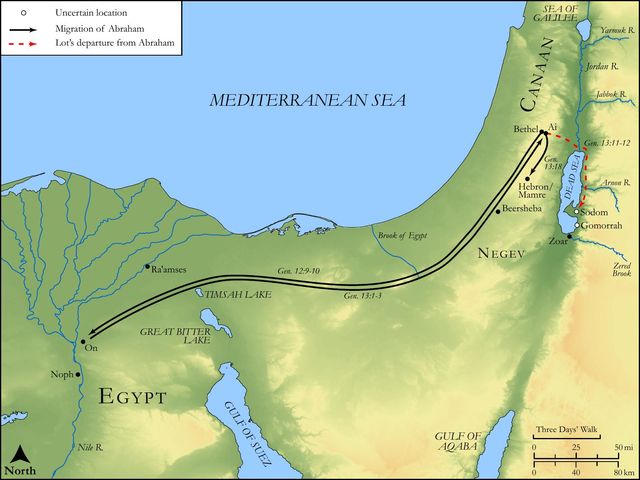
This verse immediately follows Abram's return from Egypt, where he and Lot had significantly prospered, accumulating vast wealth in livestock, silver, and gold (Genesis 13:1-2). Having returned to the region between Bethel and Ai, where Abram had previously built an altar (Genesis 13:3-4), the narrative highlights the burgeoning size of their combined encampments. Verse 6 serves as the direct explanation for the conflict that arises among their herdsmen in Genesis 13:7, setting the stage for Abram's magnanimous offer to Lot and their subsequent separation, which is crucial for the distinct development of God's covenant with Abram.
Historical & Cultural Context
The setting is the land of Canaan, which at this time was inhabited by the Canaanites and the Perizzites (Genesis 13:7). Abram and Lot were nomadic pastoralists, whose livelihood depended entirely on access to sufficient pasture and water for their extensive flocks and herds. In the semi-arid regions of the ancient Near East, such resources were often scarce and highly contested. The presence of other inhabitants meant that available grazing land was limited, intensifying the competition for vital resources between two large, growing households. This economic reality made cohabitation increasingly unsustainable, leading to inevitable friction.
Key Themes
ShowHideGenesis 13:6 contributes to several overarching themes. Firstly, it underscores the paradox of prosperity, showing how even divine blessings, like abundant wealth, can bring practical challenges and necessitate difficult decisions. Secondly, it highlights the theme of resource limitations and stewardship, emphasizing that even a promised land has finite immediate capacity, requiring wise management and adaptation. Thirdly, it subtly introduces the theme of divine orchestration, as this seemingly mundane logistical problem ultimately serves to separate Abram from Lot, clearing the path for the distinct and singular fulfillment of God's covenant promises to Abram, as seen in Genesis 13:14-17.
Exposition and Analysis
ShowHideGenesis 13:6 vividly describes the practical impasse faced by Abram and Lot: "And the land was not able to bear them, that they might dwell together: for their substance was great, so that they could not dwell together." This verse highlights a direct consequence of their immense prosperity. The phrase "the land was not able to bear them" signifies more than just a lack of physical space; it points to the depletion of vital resources like pasture and water necessary to sustain their immense flocks and herds.
Key Word Analysis
ShowHideRefers to the physical territory or region, specifically the Canaanite land they were inhabiting. Its inability to "bear" them highlights a literal, geographical constraint due to the sheer volume of their assets.
This verb means to lift, carry, or support. In this context, it conveys the idea of the land being unable to sustain or support the combined weight and resource demands of Abram and Lot's vast possessions and households. It implies a burden that exceeds capacity.
This term specifically denotes accumulated possessions, property, or wealth, often emphasizing movable goods such as livestock, slaves, and precious metals. Its use here underscores that the sheer, tangible accumulation of their combined assets was the direct and undeniable cause of their inability to coexist.
Verse Breakdown
ShowHide"And the land was not able to bear them"
This clause establishes the core problem: the physical territory, with its limited natural resources (pasture, water), was insufficient to sustain the combined households of Abram and Lot. The verb "bear" (נָשָׂא, nasa') implies a burden or capacity, indicating that the land was literally overwhelmed by their presence.
"that they might dwell together"
This phrase clarifies the consequence of the land's inability to bear them—it was impossible for them to continue living side-by-side in close proximity. Their nomadic lifestyle required extensive resources, and these were becoming scarce for two such large groups.
"for their substance was great"
This provides the direct reason for the land's insufficiency. Their "substance" (רְכּוּשׁ, rekush), referring to their vast material wealth, particularly their livestock, had grown to an unmanageable size for the available resources. This abundance, while a blessing, paradoxically created a logistical challenge.
"so that they could not dwell together"
This final clause reiterates and emphasizes the unavoidable conclusion. The repetition of "could not dwell together" underscores the inevitability and necessity of their impending separation, a practical reality driven by their immense prosperity.
Literary Devices
ShowHideThe verse employs Repetition ("that they might dwell together" / "so that they could not dwell together") to emphasize the unavoidable nature of the situation and the impossibility of continued cohabitation. This rhetorical device highlights the logical progression from cause (great substance) to effect (inability to dwell together). There is also an element of Hyperbole in describing the land's inability to "bear" them, as it vividly communicates the overwhelming scale of their combined possessions, implying a strain beyond normal capacity. This sets the stage for the dramatic resolution that follows, underscoring the severity of the practical conflict.
Theological and Thematic Connections
ShowHideGenesis 13:6 offers profound insights into the complex interplay of divine blessing, human prosperity, and practical limitations within God's overarching plan. It illustrates that even immense material blessings can introduce logistical challenges, necessitating difficult decisions for the sake of peace and the advancement of God's purposes. The verse highlights the practical reality of finite resources in the physical world, even within a promised land, underscoring the need for wise stewardship and adaptation. Ultimately, this seemingly mundane conflict serves as a catalyst, demonstrating how God orchestrates even the practicalities of life to guide His chosen ones and advance His redemptive narrative, clearing the path for Abram's distinct covenantal journey.
Reflection and Application
ShowHideGenesis 13:6 provides a timeless lesson on the dynamics of growth, resource management, and relational harmony. It reminds us that prosperity, while a blessing, often introduces new challenges that demand wise decision-making and adaptable strategies. We are called to recognize the limitations of our resources—whether material, relational, or temporal—and be willing to make difficult but necessary choices for the sake of peace and continued progress. Just as Abram and Lot needed to expand their territory, individuals, families, and organizations frequently face moments where growth strains existing structures, requiring adjustments or even separation for healthier functioning. This verse sets the stage for Abram's exemplary demonstration of humility and generosity in Genesis 13:8-9, choosing peace over personal gain—a powerful model for resolving conflicts rooted in material concerns and prioritizing relationships above possessions.
Questions for Reflection
ShowHideFAQ
ShowHideWhat does "substance" mean in this context?
ShowHideIn Genesis 13:6, "substance" translates the Hebrew word rᵉkûwsh (רְכוּשׁ), which refers specifically to accumulated possessions, property, or wealth. This includes movable assets like livestock (sheep, cattle, donkeys), servants, silver, and gold, as indicated earlier in Genesis 13:2. Its use here emphasizes that the sheer volume of their material wealth, particularly their extensive herds, was the direct cause of the land's inability to support both Abram and Lot's households.
Was the land truly "not able to bear them," or was it a lack of cooperation?
ShowHideWhile cooperation is always important, the text explicitly states the land's inability to "bear them" due to their "great substance." This indicates a genuine practical limitation of the available pastures and water sources for two such large, nomadic households. Though contention arose among their herdsmen (Genesis 13:7), this strife was a symptom of the underlying resource scarcity, not the primary cause of the land's insufficiency. The problem was fundamentally logistical and environmental, necessitating a physical separation, which Abram wisely facilitated.
Christ-Centered Fulfillment
ShowHideGenesis 13:6, by precipitating the separation of Abram and Lot, serves a crucial role in the unfolding of God's redemptive plan, which finds its ultimate fulfillment in Christ. This division ensured that Abram's lineage, through whom the covenant promises of land, seed, and blessing would flow, could develop distinctly and without hindrance, preserving the purity of the messianic line. Just as the earthly land could not contain their material wealth, so too the limitations of this world point to a greater, spiritual kingdom established through Christ. He is the ultimate "substance" and provider, offering spiritual pastures and living water that are inexhaustible, fulfilling the deeper longings that earthly resources can only temporarily satisfy. In Christ, the divisions necessitated by earthly limitations are overcome; He breaks down the "dividing wall of hostility" (Ephesians 2:14) and unites all who believe into one body, transcending earthly boundaries and conflicts, as the true "seed" promised to Abraham (Galatians 3:16).