


Genesis 36:6
- וַיִּקַּחvai·yi·Kachand he tookH3947Conj-w ¦ V-Qal-ConsecImperf-3msVerb Qal Consecutive Imperfect 3rd Singular Masculineוַandיִּקַּחhe took
- עֵשָׂו'e·SavEsauH6215N-proper-mNoun Proper Masculine
- אֶת'et<obj.>H853DirObjMParticle Object Indicator
- נָשָׁיוNa·shavhis wivesH802N-mpc ¦ 3msNoun Plural Masculine Constructנָשָׁיwivesוhis
- וְאֶתve·'Etand <obj.>H853Conj-w ¦ DirObjMParticle Object Indicatorוְandאֶת<obj.>
- בָּנָיוba·Navhis sonsH1121N-mpc ¦ 3msNoun Plural Masculine Constructבָּנָיsonsוhis
- וְאֶתve·'Etand <obj.>H853Conj-w ¦ DirObjMParticle Object Indicatorוְandאֶת<obj.>
- בְּנֹתָיוbe·no·Tavhis daughtersH1323N-fpc ¦ 3msNoun Plural Feminine Constructבְּנֹתָיdaughtersוhis
- וְאֶתve·'Etand <obj.>H853Conj-w ¦ DirObjMParticle Object Indicatorוְandאֶת<obj.>
- כָּלkolallH3605N-mscNoun Singular Masculine Construct
- נַפְשׁוֹתnaf·Shot[the] people ofH5315N-fpcNoun Plural Feminine Construct
- בֵּיתוֹbei·Tohis householdH1004N-msc ¦ 3msNoun Singular Masculine Constructבֵּיתhouseholdוֹhis
- וְאֶתve·'Etand <obj.>H853Conj-w ¦ DirObjMParticle Object Indicatorוְandאֶת<obj.>
- מִקְנֵהוּmik·Ne·huhis livestockH4735N-msc ¦ 3msNoun Singular Masculine Constructמִקְנֵlivestockהוּhis
- וְאֶתve·'Etand <obj.>H853Conj-w ¦ DirObjMParticle Object Indicatorוְandאֶת<obj.>
- כָּלkolallH3605N-mscNoun Singular Masculine Construct
- בְּהֶמְתּוֹbe·hem·Tohis animal[s]H929N-fsc ¦ 3msNoun Singular Feminine Constructבְּהֶמְתּanimal[s]וֹhis
- וְאֵתve·'Etand <obj.>H853Conj-w ¦ DirObjMParticle Object Indicatorוְandאֵת<obj.>
- כָּלkolallH3605N-mscNoun Singular Masculine Construct
- קִנְיָנוֹkin·ya·Nohis possession[s]H7075N-msc ¦ 3msNoun Singular Masculine Constructקִנְיָנpossession[s]וֹhis
- אֲשֶׁר'a·SherwhichH834RelParticle Relative
- רָכַשׁra·Khashhe had accumulatedH7408V-Qal-Perf-3msVerb Qal Perfect 3rd Singular Masculine
- בְּאֶרֶץbe·'E·retzin [the] land ofH776Prep-b ¦ N-fscNoun Singular Feminine Constructבְּinאֶרֶץ[the] land of
- כְּנָעַןke·Na·'anCanaanH3667N-properNoun Proper Location
- וַיֵּלֶךְvai·Ye·lekhand he wentH1980Conj-w ¦ V-Qal-ConsecImperf-3msVerb Qal Consecutive Imperfect 3rd Singular Masculineוַandיֵּלֶךְhe went
- אֶל'eltoH413PrepPreposition
- אֶרֶץ'E·retza landH776N-fsNoun Singular Feminine Absolute
- מִפְּנֵיmi·pe·Nei[away] from beforeH6440Prep-m ¦ N-mpcNoun Plural Masculine Constructמִ[away] fromפְּנֵיbefore
- יַעֲקֹבya·'a·KoJacobH3290N-proper-mNoun Proper Masculine
- אָחִיו'a·Chivhis brotherH251N-msc ¦ 3msNoun Singular Masculine Constructאָחִיbrotherוhis
English is a literal word-by-word gloss of the Hebrew, not the KJV's wording. Why?
This is the original text the KJV's translators worked from — each Hebrew word with its own literal English meaning in this verse, prepared by scholars at Tyndale House, Cambridge. The KJV translates whole sentences, not word by word, so its wording differs: one Hebrew word can become several English words, and the KJV may choose “the LORD” where the gloss reads “Yahweh”. Both are faithful — they answer different questions. For the KJV's own rendering, switch to the KJV text.
Details
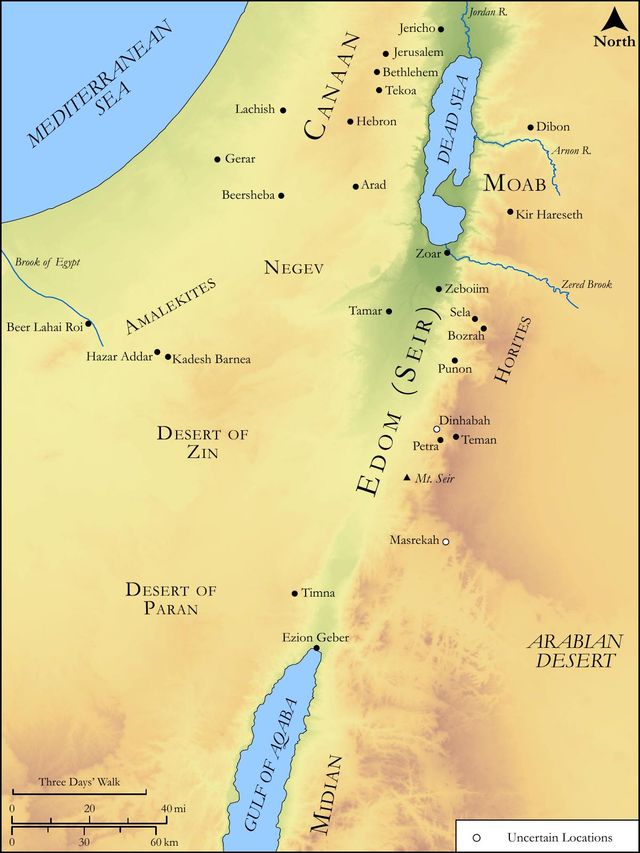
See on the biblical-era map


Study this verse
Public-domain commentary
Matthew Henry
From his Commentary on the Whole Bible. Henry comments on passages, not single verses — this entry covers Genesis 36:1–8.
Observe here, 1. Concerning Esau himself, Gen 36:1. He is called Edom (and again, Gen 36:8), that name by which was perpetuated the remembrance of the foolish bargain he made, when he sold his birthright for that red, that red pottage. The very mention of that name is enough to intimate the reason why his family is turned off with such a short account. Note, If men do a wrong thing they must thank themselves, when it is, long afterwards, remembered against them to their reproach. 2. Concerning his wives, and the children they bore him in the land of Canaan. He had three wives, and, by them all, but five sons: many a one has more by one wife. God in his providence often disappoints those who take indirect courses to build up a family; yet here the promise prevailed, and Esau's family was built up. 3. Concerning his removal to mount Seir, which was the country God had given him for a possession, when he reserved Canaan for the seed of Jacob. God owns it, long afterwards: I gave to Esau mount Seir (Deu 2:5; Jos 24:4), which was the reason why the Edomites must not be disturbed in their possession. Those that have not a right by promise, such as Jacob had, to Canaan, may have a very good title by providence to their estates, such as Esau had to mount Seir. Esau had begun to settle among his wives' relations, in Seir, before Jacob came from Padan-aram, Gen 32:3. Isaac, it is likely, had sent him thither (as Abraham in his life-time had sent the sons of the concubines from Isaac his son into the east country, Gen 25:6), that Jacob might have the clearer way made for him to the possession of the promised land. During the life of Isaac, however, Esau had probably still some effects remaining in Canaan; but, after his death, he wholly withdrew to mount Seir, took with him what came to his share of his father's personal estate, and left Canaan to Jacob, not only because he had the promise of it, but because Esau perceived that if they should continue to thrive as they had begun there would not be room for both. Thus dwelt Esau in Mount Seir, Gen 36:8. Note, Whatever opposition may be made, God's word will be accomplished, and even those that have opposed it will see themselves, some time or other, under a necessity of yielding to it, and acquiescing in it. Esau had struggled for Canaan, but now he tamely retires to mount Seir; for God's counsels shall certainly stand, concerning the times before appointed, and the bounds of our habitation.
Continue studying Genesis 36:6 across the web’s major study libraries — every link below opens this exact verse, chapter, or book on the destination site.
Read & Compare
 BibleGatewayThis verse in more than 200 translations and 70 languages.
 Bible.comThe YouVersion reader — hundreds of translations, reading plans, and highlights.
 ESV.orgCrossway's official English Standard Version reader.
 NET BibleThe NET translation with 60,000+ translators' notes on every rendering decision.
 STEP BibleTyndale House's free study tool — original text, vocabulary, and scholarly resources.
 BibliaLogos Bible Software's free web reader.
 USCCBThe New American Bible (Revised Edition) with the U.S. bishops' study notes.
Commentaries
 BibleHub CommentariesDozens of classic commentaries on this verse, gathered on one page.
 StudyLightMore than 100 commentary sets — the largest collection on the web.
 BibleRefPlain-English commentary on what this verse means, verse by verse.
 Enduring WordDavid Guzik's free commentary on this chapter, widely used by Bible teachers.
 Bible Study ToolsVerse commentary alongside Greek and Hebrew study aids.
Original Language & Research
- BibleHub InterlinearThe verse word by word — original language, transliteration, and English.
- BibleHub LexiconEvery word's original-language definition and Strong's entry.
 Blue Letter BibleDeep-study tools — Strong's numbers, concordance, and word studies.
 SefariaThe Hebrew text with Rashi and centuries of Jewish commentary.
Sermons, Hymns & Audio


TrulyRandomVerse is not affiliated with these sites and doesn’t control their content. They’re linked because they’re genuinely useful.
Summary
Genesis 36:6 narrates Esau's significant relocation from the land of Canaan, taking his entire household, vast livestock, and all his accumulated wealth to another country, away from his brother Jacob. This strategic and peaceful separation, driven by the immense prosperity of both brothers, marks a pivotal moment in the unfolding narrative, establishing distinct geographical and national trajectories for the descendants of Jacob (Israel) and Esau (Edom).
Context
ShowHideLiterary Context
Genesis 36 serves as a detailed genealogical interlude, meticulously tracing the lineage and descendants of Esau, also known as Edom. This chapter follows the dramatic reconciliation between Jacob and Esau in Genesis 33, where their long-standing animosity seemingly dissolves into a tearful embrace. The narrative immediately preceding verse 6 highlights Esau's family and his dwelling in Seir (Genesis 36:1-5), setting the stage for the explanation of his full departure. This verse, therefore, provides the practical reason for Esau's permanent move, explaining how the two brothers, having both grown exceedingly prosperous, could no longer comfortably co-exist in the same limited territory, thus paving the way for Jacob's sole inheritance of Canaan, as the divine promise dictated.
Historical & Cultural Context
In the ancient Near East, pastoralists like Jacob and Esau required extensive grazing lands for their large flocks and herds. As their wealth in livestock and human dependents grew, the available resources in a specific region could become strained. Such situations often necessitated the separation of kin groups to prevent conflict over pasturage and water sources. This economic reality is also seen in the separation of Abraham and Lot in Genesis 13:6, where their combined possessions became too great for the land to support them together. Esau's move to the hill country of Seir, a region known for its rugged terrain and distinct resources, was a practical and common solution for large, prosperous nomadic or semi-nomadic groups seeking sustainable livelihoods.
Key Themes
ShowHideThis verse contributes to several overarching themes in Genesis. Firstly, it underscores the theme of Divine Sovereignty and Covenant Fulfillment. While Esau's departure is presented as a practical necessity, it perfectly aligns with God's promise to Abraham and Jacob that their descendants would inherit the land of Canaan. Esau's relocation ensures that the land is reserved for Jacob's burgeoning family, who will become the nation of Israel. Secondly, it highlights the theme of Reconciliation and Peaceful Coexistence. Unlike their tumultuous past, the separation here is amicable, demonstrating the lasting impact of their reunion in Genesis 33:4. Finally, it reinforces the theme of Distinction of Nations. Esau's move to Seir solidifies the separate destinies and geographical territories of the Edomites (from Esau) and the Israelites (from Jacob), fulfilling the prophetic word given to Rebekah in Genesis 25:23 that two nations would be separated from her womb.
Exposition and Analysis
ShowHideKey Word Analysis
ShowHideThis term (H1004) refers not merely to a physical dwelling but encompasses the entire household, including family members, servants, and all associated possessions. In this context, it emphasizes the comprehensive nature of Esau's departure, indicating he moved with his entire established domestic and economic unit, not just a portion of it.
The word nephesh (H5315), often translated as "soul" or "life," here refers to "persons" or "living beings" within Esau's household. Its inclusion underscores the human element of his vast entourage, highlighting the significant number of individuals under his care and authority who were part of this migration.
The term pânîym (H6440), meaning "face" or "presence," is key to interpreting "from the face of his brother Jacob." It denotes a departure from Jacob's immediate sphere of influence or shared territory. It does not necessarily imply avoidance due to conflict, but rather a physical separation from the shared space, indicating that the land could no longer sustain both their extensive "presences" or enterprises.
Verse Breakdown
ShowHide"And Esau took his wives, and his sons, and his daughters, and all the persons of his house"
This clause emphasizes the comprehensive nature of Esau's departure, indicating that he moved with his entire family unit, including his wives, children, and all other individuals associated with his household. This highlights his status as a patriarch leading a significant group, not merely an individual.
"and his cattle, and all his beasts, and all his substance, which he had got in the land of Canaan"
This part details the vast material wealth Esau had accumulated, specifically mentioning livestock ("cattle" and "beasts") and "substance" (general possessions or wealth). The phrase "which he had got in the land of Canaan" underscores his prosperity within the very land where Jacob also resided, setting up the practical necessity for their separation.
"and went into the country from the face of his brother Jacob"
This final clause describes the action of departure and its motivation. Esau "went into the country" (likely referring to the hill country of Seir, as indicated elsewhere in the chapter), and the reason given—"from the face of his brother Jacob"—signifies a move away from Jacob's immediate presence or shared territory, driven by the practical impossibility of both their large households thriving in the same limited land. It implies a peaceful, pragmatic separation rather than an escape from hostility.
Literary Devices
ShowHideThe verse employs Enumeration to detail the comprehensive nature of Esau's possessions and household, emphasizing the sheer scale of his wealth and dependents. The repeated use of "all" ("all the persons of his house," "all his beasts," "all his substance") serves as a form of Hyperbole or Emphasis, highlighting the immense prosperity that necessitated the move. Furthermore, the phrase "from the face of his brother Jacob" functions as a Euphemism or Idiom, subtly conveying the practical reason for separation—insufficient land for both their large enterprises—without implying ongoing animosity, thereby reinforcing the theme of their earlier reconciliation.
Theological and Thematic Connections
ShowHideGenesis 36:6, while seemingly a simple logistical detail, profoundly illustrates God's sovereign hand guiding human affairs, even through practical decisions, to fulfill His covenantal promises. Esau's departure, driven by the economic reality of insufficient land for two burgeoning patriarchs, served to clear the way for Jacob's descendants to exclusively inherit Canaan, the land promised to Abraham. This separation underscores the distinct destinies God had ordained for the two brothers and their nations, ensuring that the lineage through which the Messiah would come would be firmly established in the promised land, unhindered by potential conflict over resources. It also subtly reinforces the theme of reconciliation, as this separation is presented as a peaceful, pragmatic solution rather than a continuation of past strife.
Reflection and Application
ShowHideGenesis 36:6 offers valuable insights into managing relationships and resources, even within family contexts. It reminds us that sometimes, for the sake of peace and mutual flourishing, establishing healthy boundaries or even physical separation can be a necessary and wise decision, especially when shared resources become strained. This passage illustrates how God can orchestrate seemingly mundane or practical choices to further His grand redemptive plan, guiding individuals and nations towards their designated paths. It encourages us to seek peaceful solutions and trust that God can work through our pragmatic choices to accomplish His divine will. We are called to be wise stewards of our resources and relationships, prioritizing peace and long-term well-being over short-term gain or clinging to what is no longer sustainable. Just as Esau and Jacob found a way to coexist peacefully through separation, we too can find healthy ways to navigate relational complexities, trusting that God's purposes will prevail.
Questions for Reflection
ShowHideFAQ
ShowHideDoes "from the face of his brother Jacob" imply hostility or that Esau was fleeing?
ShowHideNo, the Hebrew phrase min p'nei achiv Ya'akov (from the face of his brother Jacob) in this context does not imply hostility or flight. Instead, it suggests a move "from the presence of" or "because of" his brother. It indicates that the land was insufficient to sustain both their vast households comfortably, making a practical separation necessary rather than a hostile one. This interpretation aligns with their recent and genuine reconciliation in Genesis 33, where they parted amicably.
Why was Esau's departure from Canaan so significant?
ShowHideEsau's departure was significant for several reasons. Practically, it resolved the issue of insufficient land and resources for both his and Jacob's burgeoning households, preventing potential conflict. Theologically, it was a pivotal step in God's plan to prepare the land of Canaan exclusively for Jacob's descendants, who would become the nation of Israel and the inheritors of the covenant promises. It also solidified the distinct national identities and territories of Edom (from Esau, in Seir) and Israel (from Jacob, in Canaan), fulfilling the divine prophecy given to Rebekah in Genesis 25:23.
Christ-Centered Fulfillment
ShowHideWhile Genesis 36:6 primarily details a practical separation, it implicitly points towards Christ by demonstrating God's meticulous orchestration of human history to preserve the lineage through which the Messiah would come. Esau's departure ensured that the land of promise would be reserved for Jacob's descendants, the very line that would eventually produce Jesus Christ, the ultimate heir of all promises. This strategic separation, driven by practical necessity yet serving a divine purpose, foreshadows Christ's work in establishing a new, spiritual inheritance for His people, far surpassing any earthly land. Just as Esau and Jacob's physical separation led to distinct nations, Christ's work on the cross brings about a spiritual separation from sin and death, uniting believers into one new humanity, the Church, where there is no longer Jew or Gentile, slave or free, male or female, for all are one in Christ Jesus (Galatians 3:28). He is the one who truly takes away the dividing wall of hostility (Ephesians 2:14), reconciling all things to Himself, whether on earth or in heaven (Colossians 1:20).