


Genesis 36:5
- וְאָהֳלִיבָמָהve·'o·ho·li·va·Mahand OholibamahH173Conj-w ¦ N-proper-fNoun Proper FeminineוְandאָהֳלִיבָמָהOholibamah
- יָלְדָהYal·dahshe boreH3205V-Qal-Perf-3fsVerb Qal Perfect 3rd Singular Feminine
- אֶת'et<obj.>H853DirObjMParticle Object Indicator
- יְעוּשׁye'·ushJeushH3266N-proper-mNoun Proper Masculine
- וְאֶתve·'Etand <obj.>H853Conj-w ¦ DirObjMParticle Object Indicatorוְandאֶת<obj.>
- יַעְלָםya'·LamJalamH3281N-proper-mNoun Proper Masculine
- וְאֶתve·'Etand <obj.>H853Conj-w ¦ DirObjMParticle Object Indicatorוְandאֶת<obj.>
- קֹרַחKo·rachKorahH7141N-proper-mNoun Proper Masculine
- אֵלֶּה'E·lehtheseH428PrtParticle Demonstrative
- בְּנֵיbe·Nei[were] [the] sons ofH1121N-mpcNoun Plural Masculine Construct
- עֵשָׂו'e·SavEsauH6215N-proper-mNoun Proper Masculine
- אֲשֶׁר'a·SherwhoH834RelParticle Relative
- יֻלְּדוּyu·le·duthey were bornH3205V-Pual-Perf-3cpVerb Pual Perfect 3rd Plural common gender
- לוֹloto <the> himPrep-l ¦ 3msSuffix Personal 3rd Singular Masculineלto <the>וֹhim
- בְּאֶרֶץbe·'E·retzin [the] land ofH776Prep-b ¦ N-fscNoun Singular Feminine Constructבְּinאֶרֶץ[the] land of
- כְּנָעַןke·Na·'anCanaanH3667N-properNoun Proper Location
English is a literal word-by-word gloss of the Hebrew, not the KJV's wording. Why?
This is the original text the KJV's translators worked from — each Hebrew word with its own literal English meaning in this verse, prepared by scholars at Tyndale House, Cambridge. The KJV translates whole sentences, not word by word, so its wording differs: one Hebrew word can become several English words, and the KJV may choose “the LORD” where the gloss reads “Yahweh”. Both are faithful — they answer different questions. For the KJV's own rendering, switch to the KJV text.
Details
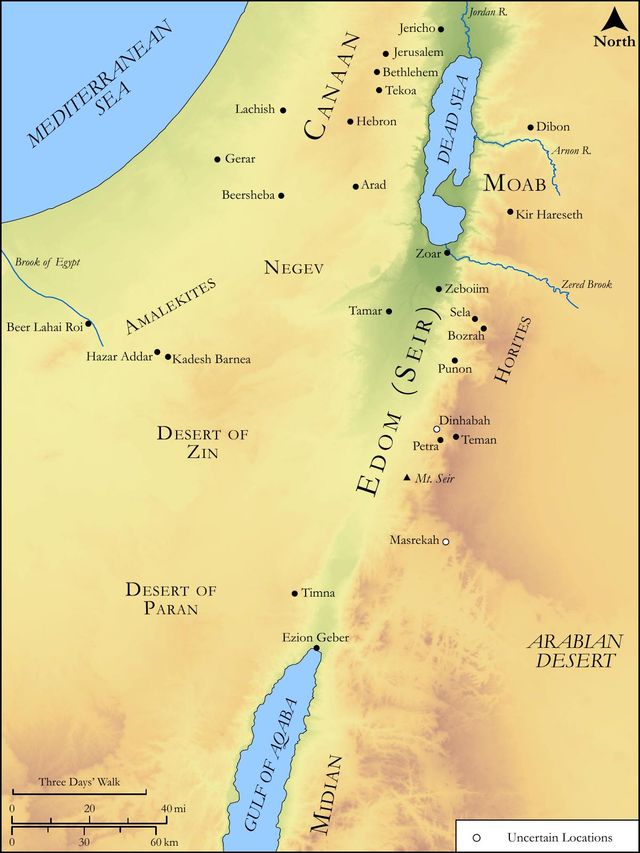
See on the biblical-era map


Study this verse
Public-domain commentary
Matthew Henry
From his Commentary on the Whole Bible. Henry comments on passages, not single verses — this entry covers Genesis 36:1–8.
Observe here, 1. Concerning Esau himself, Gen 36:1. He is called Edom (and again, Gen 36:8), that name by which was perpetuated the remembrance of the foolish bargain he made, when he sold his birthright for that red, that red pottage. The very mention of that name is enough to intimate the reason why his family is turned off with such a short account. Note, If men do a wrong thing they must thank themselves, when it is, long afterwards, remembered against them to their reproach. 2. Concerning his wives, and the children they bore him in the land of Canaan. He had three wives, and, by them all, but five sons: many a one has more by one wife. God in his providence often disappoints those who take indirect courses to build up a family; yet here the promise prevailed, and Esau's family was built up. 3. Concerning his removal to mount Seir, which was the country God had given him for a possession, when he reserved Canaan for the seed of Jacob. God owns it, long afterwards: I gave to Esau mount Seir (Deu 2:5; Jos 24:4), which was the reason why the Edomites must not be disturbed in their possession. Those that have not a right by promise, such as Jacob had, to Canaan, may have a very good title by providence to their estates, such as Esau had to mount Seir. Esau had begun to settle among his wives' relations, in Seir, before Jacob came from Padan-aram, Gen 32:3. Isaac, it is likely, had sent him thither (as Abraham in his life-time had sent the sons of the concubines from Isaac his son into the east country, Gen 25:6), that Jacob might have the clearer way made for him to the possession of the promised land. During the life of Isaac, however, Esau had probably still some effects remaining in Canaan; but, after his death, he wholly withdrew to mount Seir, took with him what came to his share of his father's personal estate, and left Canaan to Jacob, not only because he had the promise of it, but because Esau perceived that if they should continue to thrive as they had begun there would not be room for both. Thus dwelt Esau in Mount Seir, Gen 36:8. Note, Whatever opposition may be made, God's word will be accomplished, and even those that have opposed it will see themselves, some time or other, under a necessity of yielding to it, and acquiescing in it. Esau had struggled for Canaan, but now he tamely retires to mount Seir; for God's counsels shall certainly stand, concerning the times before appointed, and the bounds of our habitation.
Continue studying Genesis 36:5 across the web’s major study libraries — every link below opens this exact verse, chapter, or book on the destination site.
Read & Compare
 BibleGatewayThis verse in more than 200 translations and 70 languages.
 Bible.comThe YouVersion reader — hundreds of translations, reading plans, and highlights.
 ESV.orgCrossway's official English Standard Version reader.
 NET BibleThe NET translation with 60,000+ translators' notes on every rendering decision.
 STEP BibleTyndale House's free study tool — original text, vocabulary, and scholarly resources.
 BibliaLogos Bible Software's free web reader.
 USCCBThe New American Bible (Revised Edition) with the U.S. bishops' study notes.
Commentaries
 BibleHub CommentariesDozens of classic commentaries on this verse, gathered on one page.
 StudyLightMore than 100 commentary sets — the largest collection on the web.
 BibleRefPlain-English commentary on what this verse means, verse by verse.
 Enduring WordDavid Guzik's free commentary on this chapter, widely used by Bible teachers.
 Bible Study ToolsVerse commentary alongside Greek and Hebrew study aids.
Original Language & Research
- BibleHub InterlinearThe verse word by word — original language, transliteration, and English.
- BibleHub LexiconEvery word's original-language definition and Strong's entry.
 Blue Letter BibleDeep-study tools — Strong's numbers, concordance, and word studies.
 SefariaThe Hebrew text with Rashi and centuries of Jewish commentary.
Sermons, Hymns & Audio


TrulyRandomVerse is not affiliated with these sites and doesn’t control their content. They’re linked because they’re genuinely useful.
Summary
Genesis 36:5 meticulously records the birth of three sons—Jeush, Jaalam, and Korah—to Esau through his wife Aholibamah, explicitly noting their birth in the land of Canaan. This detail is crucial within the broader genealogical account of Esau (Edom), establishing the early presence of his burgeoning family within the promised land before their eventual and definitive relocation to the hill country of Seir, thereby laying the foundational lineage for a nation that would hold significant historical and prophetic interactions with Israel.
Context
ShowHideLiterary Context
Genesis chapter 36 serves as a comprehensive and detailed genealogical record of Esau, also known as Edom, and his descendants. Positioned immediately after the narratives focusing on Jacob's family, this chapter provides a parallel account, meticulously tracing Esau's wives, sons, and the chiefs that descended from him. Verse 5 specifically fits into the initial listing of Esau's children, following the general introduction of his wives and preceding the more extensive enumeration of his chieftains and kings. The precise mention of the birthplace of these sons in Canaan sets the stage for understanding the eventual separation and distinct national development of the Edomites from the Israelites, a theme that resonates throughout the Pentateuch and beyond.
Historical & Cultural Context
During the patriarchal period, genealogies were not mere lists but vital records establishing lineage, inheritance rights, tribal identity, and national origins. The mention of "the land of Canaan" as the birthplace for these sons of Esau highlights a period of shared geography between the nascent families of Jacob and Esau, both descendants of Isaac. This co-existence in Canaan, a land promised to Abraham's descendants, underscores the initial intertwined destinies of these two brothers before their eventual geographical and national divergence. The subsequent relocation of Esau to Seir, as detailed in Genesis 36:6-8, was likely driven by the practicalities of supporting two large, growing families with their extensive flocks and herds, a common reason for migration in the ancient Near East.
Key Themes
ShowHideGenesis 36 contributes significantly to several overarching themes within the book of Genesis. It reinforces the theme of Divine Sovereignty in the formation of nations, demonstrating God's meticulous oversight not only of the covenant line through Jacob but also of the development of other peoples, like the Edomites. The chapter also highlights the theme of Distinction and Separation, as the detailed account of Esau's lineage and his move to Seir underscores the divinely ordained separation of the Edomites from the Israelites, despite their shared ancestry through Isaac. This distinction is crucial for understanding future biblical narratives concerning the unique role of Israel as God's covenant people and the complex relationship between the two nations, as seen in passages like Numbers 20:14-21. Furthermore, the chapter contributes to the theme of Fulfillment of Blessing, as Esau, though having forfeited his birthright, still receives the general blessing of numerous descendants, echoing the promises of fertility and multiplication given to Abraham and Isaac in Genesis 17:6.
Exposition and Analysis
ShowHideKey Word Analysis
ShowHideFrom the Hebrew words for "tent" (אֹהֶל, ʼohel) and "height" (בָּמָה, bamah), meaning "tent of (the) height." Aholibamah is identified as one of Esau's wives and the mother of Jeush, Jaalam, and Korah. Her name may subtly allude to the mountainous region of Edom where her descendants would eventually settle, or perhaps indicate a significant tribal or religious background, suggesting a connection to high places often associated with worship or prominent dwelling.
A primitive root meaning "to bear young" or "to beget." This verb is fundamental in biblical genealogies, signifying the act of childbirth and the continuation of lineage. Its use here emphasizes the physical act of Aholibamah giving birth to these specific sons, thereby expanding Esau's family and contributing to the formation of the Edomite nation. The repetition of this root (also translated "born" later in the verse) underscores the theme of procreation and the establishment of distinct family lines.
A versatile term derived from a root meaning "to build," signifying a son as a "builder of the family name." In its widest sense, it encompasses literal and figurative relationships, including grandsons, subjects, or members of a nation. Here, it directly refers to the male offspring of Esau and Aholibamah, who are crucial for establishing the patriarchal foundation of the Edomite clans and chiefs detailed later in Genesis 36.
Verse Breakdown
ShowHide"And Aholibamah bare Jeush, and Jaalam, and Korah:"
This clause identifies Aholibamah, one of Esau's wives, as the mother and explicitly names her three sons: Jeush, Jaalam, and Korah. This precise naming is characteristic of biblical genealogies, ensuring the clear establishment of familial lines and the distinct branches of Esau's burgeoning family, which would eventually form the various clans and chiefs of Edom.
"these [are] the sons of Esau,"
This phrase serves as a clarifying statement, explicitly linking the previously named individuals (Jeush, Jaalam, Korah) directly to Esau as their father. It reinforces their place within the broader lineage of Esau, ensuring that the reader understands their direct patriarchal connection and their role in the expansion of his family.
"which were born unto him in the land of Canaan."
This crucial geographical detail specifies the location of their birth. The "land of Canaan" is significant as it is the very land promised to Abraham and his descendants (including Isaac and Jacob). This indicates that Esau's family, at least initially, shared the same territory as Jacob's family, highlighting their early proximity before the eventual and divinely orchestrated separation of the two nations, with Esau's descendants settling permanently in Seir.
Literary Devices
ShowHideThe primary literary device at play in Genesis 36:5, and indeed throughout the chapter, is Genealogy. This meticulous listing of names and relationships serves to establish the lineage of Esau, providing a detailed historical record of the origins of the Edomite nation. The specific mention of the birthplace, "in the land of Canaan," functions as a device of Geographical Emphasis, highlighting the initial shared territory of Esau and Jacob before their eventual divergence. This geographical precision underscores the historical reality of their co-existence and sets the stage for their distinct national developments. Furthermore, the very act of recording this lineage, in parallel with Jacob's, demonstrates Contrast and Parallelism, subtly emphasizing the distinct paths and destinies of the two brothers and their descendants, even while acknowledging their shared patriarchal root.
Theological and Thematic Connections
ShowHideGenesis 36:5, though a seemingly simple genealogical entry, carries profound theological and thematic weight. It underscores God's meticulous oversight of all humanity and the precise unfolding of His sovereign plan, not limited solely to the covenant line of Israel. The detailed record of Esau's descendants, born even in the promised land, demonstrates God's faithfulness to His general blessing of multiplication given to Abraham, extending even to those outside the specific covenant of election. This verse, therefore, contributes to the grand narrative of God's providential governance over all nations, setting the stage for the distinct national identities and the complex, often adversarial, relationship between Israel and Edom in subsequent biblical history.
Reflection and Application
ShowHideWhile Genesis 36:5 is a historical record, it invites us to reflect on the broader tapestry of God's providential care and the significance of lineage and place in His unfolding plan. It reminds us that God's intricate design encompasses the origins and development of all peoples, not just those directly in the covenant line. For believers, recognizing the precise details of nations like Edom helps us appreciate the intricate connections and distinctions within biblical history, leading to a deeper understanding of later interactions, conflicts, and the ultimate purpose of God's chosen people. It encourages us to see God's hand in all of history, orchestrating events and establishing nations according to His divine will, ultimately for the glory of His name and the advancement of His redemptive purposes. The meticulous nature of biblical genealogies also underscores the value of heritage and the continuity of God's work through generations, prompting us to consider our own place within God's ongoing story.
Questions for Reflection
ShowHideFAQ
ShowHideWhy does the Bible include such detailed genealogies for Esau?
ShowHideThe detailed genealogies for Esau, like those for other nations, serve multiple crucial purposes. They establish the historical origins of peoples who will interact with Israel throughout the biblical narrative, fulfilling God's general promise of multiplication given to Abraham in Genesis 17:6. Furthermore, they highlight the distinct development of nations in relation to Israel, underscoring the unique covenant relationship God established with Jacob's descendants. These records also demonstrate the Bible's commitment to historical accuracy and provide a foundational framework for understanding the unfolding of God's redemptive plan through various lineages.
What is the significance of "born unto him in the land of Canaan"?
ShowHideThis phrase is highly significant because it indicates that Esau's family initially resided in the same geographical territory as Jacob's family before Esau's complete relocation to the hill country of Seir. It emphasizes the initial proximity and subsequent divergence of these two related but distinct nations, setting the stage for their future interactions and separate destinies. This detail underscores God's providential hand in guiding the geographical separation that would allow both nations to develop according to His distinct purposes.
Who was Aholibamah?
ShowHideAholibamah was one of Esau's three wives mentioned in Genesis 36, specifically identified as the mother of Jeush, Jaalam, and Korah. Her name, 'Ohŏlîybâmâh, meaning "tent of (the) height," may subtly connect to the mountainous region of Edom where her descendants would eventually settle, or refer to her tribal or religious background. She represents a significant branch of Esau's lineage, contributing to the diverse origins of the Edomite nation.
Christ-Centered Fulfillment
ShowHideWhile Genesis 36:5 is a genealogical record of Esau's lineage, it indirectly points to Christ by highlighting the meticulous nature of God's sovereign plan for all humanity and, more specifically, the divinely orchestrated separation of nations. The detailed tracing of Esau's descendants, even those born in Canaan, underscores the distinct path of Jacob's lineage, through which the Messiah would ultimately come. This careful distinction in the Old Testament ultimately emphasizes the singular, chosen line through which God's redemptive promise, culminating in Jesus Christ, would be fulfilled. Christ's coming breaks down the very barriers of national and ethnic distinction that Genesis genealogies establish, as seen in Ephesians 2:14-16, where He is described as our peace who has made the two groups (Jew and Gentile) one. Moreover, the fulfillment of the promise of numerous descendants, even to Esau, foreshadows the spiritual multitude from every tribe and nation that will worship the Lamb, as envisioned in Revelation 7:9-10, demonstrating God's ultimate plan to gather all peoples into His kingdom through the redemptive work of Christ.