


Genesis 36:4
- וַתֵּלֶדva·Te·ledand she boreH3205Conj-w ¦ V-Qal-ConsecImperf-3fsVerb Qal Consecutive Imperfect 3rd Singular Feminineוַandתֵּלֶדshe bore
- עָדָה'a·DahAdahH5711N-proper-fNoun Proper Feminine
- לְעֵשָׂוle·'e·Savto EsauH6215Prep-l ¦ N-proper-mNoun Proper MasculineלְtoעֵשָׂוEsau
- אֶת'et<obj.>H853DirObjMParticle Object Indicator
- אֱלִיפָז'e·li·FazEliphazH464N-proper-mNoun Proper Masculine
- וּבָשְׂמַתu·Va·se·Matand BasemathH1315Conj-w ¦ N-proper-fNoun Proper FeminineוּandבָשְׂמַתBasemath
- יָלְדָהYal·dahshe boreH3205V-Qal-Perf-3fsVerb Qal Perfect 3rd Singular Feminine
- אֶת'et<obj.>H853DirObjMParticle Object Indicator
- רְעוּאֵלre·'u·'ElReuelH7467N-proper-mNoun Proper Masculine
English is a literal word-by-word gloss of the Hebrew, not the KJV's wording. Why?
This is the original text the KJV's translators worked from — each Hebrew word with its own literal English meaning in this verse, prepared by scholars at Tyndale House, Cambridge. The KJV translates whole sentences, not word by word, so its wording differs: one Hebrew word can become several English words, and the KJV may choose “the LORD” where the gloss reads “Yahweh”. Both are faithful — they answer different questions. For the KJV's own rendering, switch to the KJV text.
Details
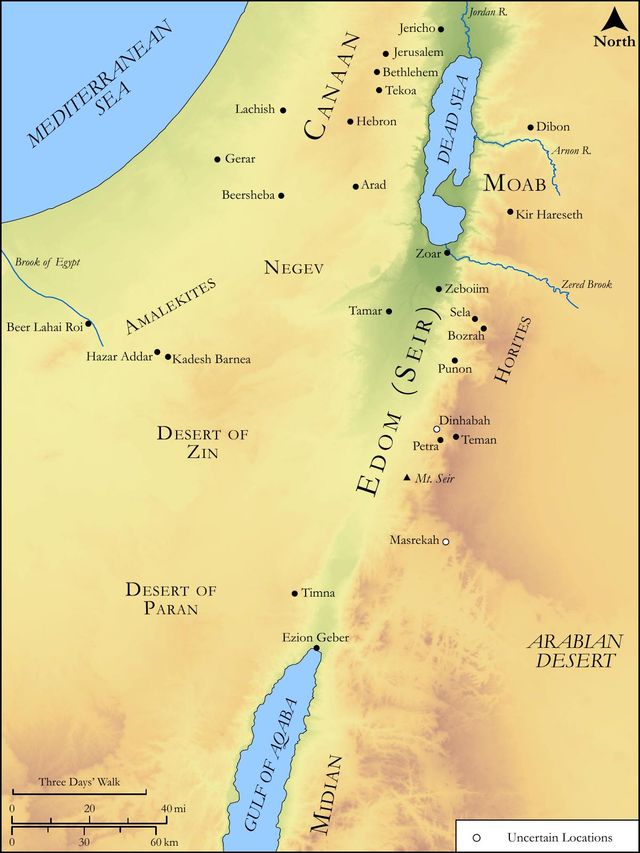
See on the biblical-era map


Study this verse
Public-domain commentary
Matthew Henry
From his Commentary on the Whole Bible. Henry comments on passages, not single verses — this entry covers Genesis 36:1–8.
Observe here, 1. Concerning Esau himself, Gen 36:1. He is called Edom (and again, Gen 36:8), that name by which was perpetuated the remembrance of the foolish bargain he made, when he sold his birthright for that red, that red pottage. The very mention of that name is enough to intimate the reason why his family is turned off with such a short account. Note, If men do a wrong thing they must thank themselves, when it is, long afterwards, remembered against them to their reproach. 2. Concerning his wives, and the children they bore him in the land of Canaan. He had three wives, and, by them all, but five sons: many a one has more by one wife. God in his providence often disappoints those who take indirect courses to build up a family; yet here the promise prevailed, and Esau's family was built up. 3. Concerning his removal to mount Seir, which was the country God had given him for a possession, when he reserved Canaan for the seed of Jacob. God owns it, long afterwards: I gave to Esau mount Seir (Deu 2:5; Jos 24:4), which was the reason why the Edomites must not be disturbed in their possession. Those that have not a right by promise, such as Jacob had, to Canaan, may have a very good title by providence to their estates, such as Esau had to mount Seir. Esau had begun to settle among his wives' relations, in Seir, before Jacob came from Padan-aram, Gen 32:3. Isaac, it is likely, had sent him thither (as Abraham in his life-time had sent the sons of the concubines from Isaac his son into the east country, Gen 25:6), that Jacob might have the clearer way made for him to the possession of the promised land. During the life of Isaac, however, Esau had probably still some effects remaining in Canaan; but, after his death, he wholly withdrew to mount Seir, took with him what came to his share of his father's personal estate, and left Canaan to Jacob, not only because he had the promise of it, but because Esau perceived that if they should continue to thrive as they had begun there would not be room for both. Thus dwelt Esau in Mount Seir, Gen 36:8. Note, Whatever opposition may be made, God's word will be accomplished, and even those that have opposed it will see themselves, some time or other, under a necessity of yielding to it, and acquiescing in it. Esau had struggled for Canaan, but now he tamely retires to mount Seir; for God's counsels shall certainly stand, concerning the times before appointed, and the bounds of our habitation.
Historical interpretation
Historical reception
1 surviving comment on this verse from the historical church.
(Chapter 36, Verse 4) And Ada gave birth to Esau Eliphaz. This is Eliphaz, whose name is mentioned in the book of Job.
Continue studying Genesis 36:4 across the web’s major study libraries — every link below opens this exact verse, chapter, or book on the destination site.
Read & Compare
 BibleGatewayThis verse in more than 200 translations and 70 languages.
 Bible.comThe YouVersion reader — hundreds of translations, reading plans, and highlights.
 ESV.orgCrossway's official English Standard Version reader.
 NET BibleThe NET translation with 60,000+ translators' notes on every rendering decision.
 STEP BibleTyndale House's free study tool — original text, vocabulary, and scholarly resources.
 BibliaLogos Bible Software's free web reader.
 USCCBThe New American Bible (Revised Edition) with the U.S. bishops' study notes.
Commentaries
 BibleHub CommentariesDozens of classic commentaries on this verse, gathered on one page.
 StudyLightMore than 100 commentary sets — the largest collection on the web.
 BibleRefPlain-English commentary on what this verse means, verse by verse.
 Enduring WordDavid Guzik's free commentary on this chapter, widely used by Bible teachers.
 Bible Study ToolsVerse commentary alongside Greek and Hebrew study aids.
Original Language & Research
- BibleHub InterlinearThe verse word by word — original language, transliteration, and English.
- BibleHub LexiconEvery word's original-language definition and Strong's entry.
 Blue Letter BibleDeep-study tools — Strong's numbers, concordance, and word studies.
 SefariaThe Hebrew text with Rashi and centuries of Jewish commentary.
Sermons, Hymns & Audio


TrulyRandomVerse is not affiliated with these sites and doesn’t control their content. They’re linked because they’re genuinely useful.
Summary
Genesis 36:4 serves as a pivotal genealogical entry, meticulously recording the initial progeny of Esau, also known as Edom. This concise verse specifically names his first two sons: Eliphaz, born to his wife Adah, and Reuel, born to his wife Bashemath. It immediately follows the introduction of Esau's wives and sets the stage for the comprehensive enumeration of his descendants, thereby establishing the foundational lineage and early generations of the Edomite nation, distinct from the emerging nation of Israel.
Context
ShowHideLiterary Context
Genesis 36 stands as a distinct genealogical interlude within the larger Jacob narrative, serving as a "toledot" (generations) section dedicated to Esau. Following the reconciliation and subsequent separation of Jacob and Esau in Genesis 33, this chapter provides a detailed account of Esau's family, contrasting sharply with the focus on Jacob's lineage that dominates the subsequent chapters leading to the Joseph narrative. Genesis 36:1-3 introduces Esau's three wives, and verse 4 immediately proceeds to list the first sons born to two of them, Adah and Bashemath. This structure emphasizes the rapid growth of Esau's family, paralleling the divine promise of numerous descendants, even for the non-covenantal line. The chapter continues to enumerate grandsons, chiefs, and kings, meticulously tracing the origins of the Edomite nation, providing a complete picture of Esau's posterity before the narrative shifts back to Jacob's family in Genesis 37.
Historical & Cultural Context
In the ancient Near East, genealogies were far more than mere family trees; they were vital documents establishing identity, inheritance rights, land claims, and tribal affiliations. The detailed record of Esau's descendants in Genesis 36 reflects this cultural importance, validating the Edomite nation's existence and their claim to the land of Seir, where Esau settled (Genesis 36:6-8). The mention of multiple wives (Adah and Bashemath in this verse, plus Oholibamah in Genesis 36:2) reflects the practice of polygyny, common among patriarchs and tribal leaders in that era, often for reasons of alliance, status, or the desire for many offspring. The specific naming of sons born to different wives underscores the distinct family units within the larger patriarchal household, each contributing to the expanding lineage that would eventually form the Edomite tribal structure.
Key Themes
ShowHideThis verse, as part of Genesis 36, contributes to several key themes. Firstly, it highlights the distinction of nations, meticulously differentiating the lineage of Esau (Edom) from that of Jacob (Israel). This separation is crucial for understanding the future geopolitical landscape and the often-antagonistic relationship between these two sibling nations, as seen in later biblical accounts like Numbers 20:14-21. Secondly, it demonstrates the fulfillment of divine blessing, even for the non-covenantal line. While the primary covenant promises of nationhood and land passed through Jacob, God's earlier promise to Abraham included making him the "father of many nations" (Genesis 17:6). Esau's numerous progeny, beginning with Eliphaz and Reuel, illustrate a broader aspect of God's providential care and His capacity to bring forth great nations, even from those not directly chosen for the covenantal inheritance. Lastly, the meticulous record-keeping and historical accuracy of the biblical narrative are underscored, emphasizing the importance of lineage and historical continuity in God's unfolding plan.
Exposition and Analysis
ShowHideThe verse "And Adah bare to Esau Eliphaz; and Bashemath bare Reuel;" is a straightforward genealogical statement, typical of the biblical emphasis on lineage and family records. It serves to introduce two of Esau's sons, each born from a different wife, initiating the detailed account of his descendants.
Key Word Analysis
ShowHideThis primitive root verb signifies "to bear young," "to beget," or "to bring forth." In this context, it precisely denotes the act of giving birth, emphasizing the maternal role of Adah and Bashemath in producing Esau's offspring. The repetition of this verb underscores the primary purpose of the verse: to record the birth of these foundational figures in the Edomite lineage.
Derived from "El" (God) and "paz" (gold, or fine gold), this name means "God of gold" or "my God is fine gold." It suggests a connection to wealth or preciousness, or perhaps a divine attribute. This Eliphaz is a significant figure, later identified as the progenitor of the Temanites, a prominent Edomite clan, and famously appears as one of Job's three friends, Eliphaz the Temanite (Job 2:11).
Composed of "re'u" (friend) and "El" (God), this name means "friend of God." This name, like Eliphaz, carries theological weight, reflecting a desired relationship with the divine. While this Reuel is Esau's son, the name also appears elsewhere in the Bible, notably as the father-in-law of Moses, also known as Jethro (Exodus 2:18). This commonality highlights shared naming conventions across various ancient Near Eastern peoples.
Verse Breakdown
ShowHide"And Adah bare to Esau Eliphaz;"
This clause identifies Adah as one of Esau's wives and records the birth of their son, Eliphaz. It establishes a direct parental link, initiating the specific lineage that will contribute to the Edomite nation. The phrasing is concise and factual, typical of genealogical records, focusing on the essential information of parentage and offspring.
"and Bashemath bare Reuel;"
This second clause parallels the first, introducing Bashemath as another of Esau's wives and documenting the birth of her son, Reuel. The conjunction "and" links these two births as simultaneous or sequential events within the early formation of Esau's family, further contributing to the foundational generations of the Edomites. This structure efficiently conveys the dual origins of Esau's immediate progeny from different maternal lines.
Literary Devices
ShowHideThe primary literary device at play in Genesis 36:4 is Genealogy, which is a form of List or Register. This device serves to establish lineage, validate claims, and provide historical continuity. The verse's Conciseness and factual presentation are characteristic of genealogical entries, prioritizing the clear transmission of names and relationships over narrative embellishment. The Parallelism in the phrasing ("Adah bare... Eliphaz; and Bashemath bare Reuel;") creates a rhythmic structure that efficiently conveys the information about two distinct maternal lines contributing to Esau's family. Furthermore, the use of Nominalism is significant, where the names themselves (Eliphaz, Reuel) often carry inherent meanings ("God of gold," "friend of God"), subtly enriching the text with theological or aspirational undertones, even within a seemingly dry list.
Theological and Thematic Connections
ShowHideGenesis 36:4, while a simple genealogical record, is theologically significant as it underscores God's meticulous and sovereign ordering of all nations, not just Israel. It demonstrates that God's providential hand extends beyond the direct covenant line of Jacob, fulfilling His broader promise to Abraham to make him the "father of many nations." The detailed enumeration of Esau's descendants, beginning with Eliphaz and Reuel, highlights the divine intention for distinct peoples to emerge, each with their own history and destiny within God's overarching plan. This precision validates the historical claims and identities of various peoples mentioned in the biblical narrative, affirming the Bible's commitment to historical truth and the reality of God's engagement with all of humanity.
Reflection and Application
ShowHideWhile a genealogical list like Genesis 36:4 might initially seem like a mere historical footnote, it serves as a profound reminder of God's sovereign plan unfolding through generations and across diverse peoples. Every individual and family, even those seemingly on the periphery of the main biblical narrative, plays a part in the larger tapestry of history and God's providence. This verse invites us to consider the intricate ways God works through various peoples and their lineages, even those who later become adversaries to His chosen people. It underscores the Bible's commitment to historical foundation, reminding us that our faith is rooted in real events and real people. For us today, it encourages a deeper appreciation for the diverse human family and God's overarching dominion, recognizing that every life has a place in His grand design, even if not directly in the Messianic line. It challenges us to look beyond immediate narrative focus and see the broader scope of God's work in the world.
Questions for Reflection
ShowHideFAQ
ShowHideWhy does the Bible include such detailed genealogies like Genesis 36:4, especially for a lineage not directly leading to the Messiah?
ShowHideGenealogies in the Bible serve several crucial purposes, even for lineages not directly in the Messianic line. They establish historical accuracy and verify the fulfillment of divine promises, particularly those related to descendants and the formation of nations. In ancient societies, these records were vital for inheritance, tribal identity, and legal claims. Specifically, the genealogy of Esau's family in Genesis 36 delineates the origins of the Edomite nation, distinguishing them from Israel and setting the stage for future interactions—often conflicts—between the two peoples. This provides essential context for the unfolding biblical narrative, explaining the relationships and geopolitical realities encountered by Israel in later books, such as their encounter with Edom in Numbers 20. It also demonstrates God's broader sovereignty over all peoples, not just His chosen covenant nation.
Christ-Centered Fulfillment
ShowHideWhile the lineage of Esau, detailed in Genesis 36:4 and the subsequent verses, does not directly lead to the Messiah, its inclusion in the biblical record points to God's overarching sovereignty and meticulous plan for all humanity. The detailed account of nations, even those outside the direct covenant line of Abraham through Jacob, underscores that God is the Lord of all history and peoples. The very existence of these distinct nations, as outlined in genealogies like this, forms the broader world stage upon which God's redemptive drama unfolds. This universal scope of God's plan ultimately culminates in the coming of Christ, who is the Savior not only of Israel but of all nations, fulfilling the promise that "in your offspring all the nations of the earth shall be blessed" (Genesis 22:18). The New Testament affirms this universal reach, declaring that in Christ, "there is neither Jew nor Gentile, neither slave nor free, nor is there male and female, for you are all one in Christ Jesus" (Galatians 3:28). Thus, even the seemingly peripheral genealogies in the Old Testament serve to broaden our understanding of God's vast redemptive purpose, which embraces all peoples, culminating in the inclusive salvation offered through Jesus Christ, the Lamb of God who takes away the sin of the world.