


Exodus 2:18
Bible text: King James Version (1769 Blayney text) · Public domain
Bible text: Berean Standard Bible · Public domain
Bible text: American Standard Version (1901) · Public domain
Bible text: World English Bible, Messianic edition · Public domain
Bible text: Geneva Bible (1599) · Public domain
Bible text: Young's Literal Translation · Public domain
- וַתָּבֹאנָהva·ta·Vo·nahand they wentH935Conj-w ¦ V-Qal-ConsecImperf-3fpVerb Qal Consecutive Imperfect 3rd Plural Feminineוַandתָּבֹאנָהthey went
- אֶל'eltoH413PrepPreposition
- רְעוּאֵלre·'u·'ElReuelH7467N-proper-mNoun Proper Masculine
- אֲבִיהֶן'a·vi·Hentheir fatherH1N-msc ¦ 3fpNoun Singular Masculine Constructאֲבִיfatherהֶןtheir
- וַיֹּאמֶרvai·Yo·merand he saidH559Conj-w ¦ V-Qal-ConsecImperf-3msVerb Qal Consecutive Imperfect 3rd Singular Masculineוַandיֹּאמֶרhe said
- מַדּוּעַma·Du·a'why?H4069InterrogParticle Interrogative
- מִהַרְתֶּןmi·har·Tendid you hurryH4116V-Piel-Perf-2fpVerb Piel Perfect 2nd Plural Feminine
- בֹּאbo'to comeH935V-Qal-InfVerb Qal Infinitive Construct
- הַיּוֹםhai·Yomthis dayH3117Art ¦ N-msNoun Singular Masculine Absoluteהַthisיּוֹםday
English is a literal word-by-word gloss of the Hebrew, not the KJV's wording. Why?
This is the original text the KJV's translators worked from — each Hebrew word with its own literal English meaning in this verse, prepared by scholars at Tyndale House, Cambridge. The KJV translates whole sentences, not word by word, so its wording differs: one Hebrew word can become several English words, and the KJV may choose “the LORD” where the gloss reads “Yahweh”. Both are faithful — they answer different questions. For the KJV's own rendering, switch to the KJV text.
Details
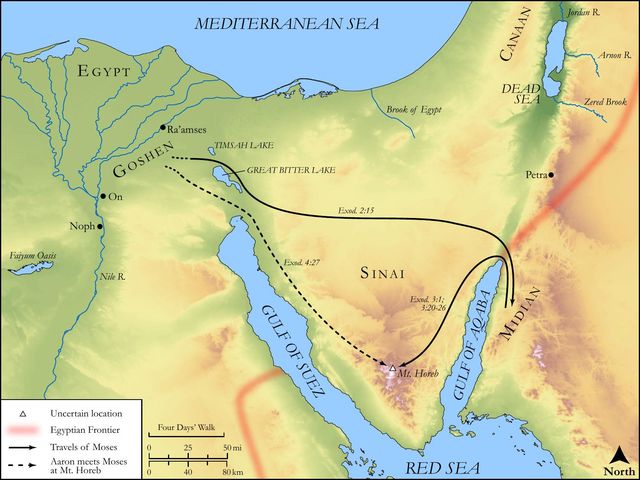
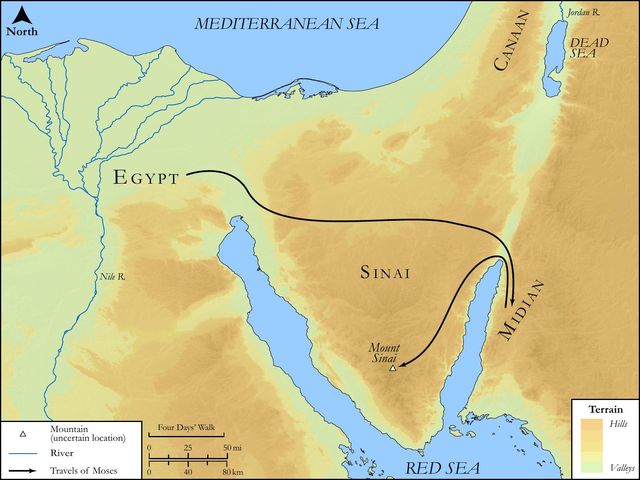
See on the biblical-era maps

Study this verse
Public-domain commentary
Matthew Henry
From his Commentary on the Whole Bible. Henry comments on passages, not single verses — this entry covers Exodus 2:16–22. His four-level outline is real structure in the source text, so it is rendered as structure.
Moses here gains a settlement in Midian, just as his father Jacob had gained one in Syria, Gen 29:2, etc. And both these instances should encourage us to trust Providence, and to follow it. Events that seem inconsiderable, and purely accidental, afterwards appear to have been designed by the wisdom of God for very good purposes, and of great consequence to his people. A casual transient occurrence has sometimes occasioned the greatest and happiest turns of a man's life. Observe,
I.Concerning the seven daughters of Reuel the priest or prince of Midian.
1.They were humble, and very industrious, according as the employment of the country was: they drew water for their father's flock, Exo 2:16. If their father was a prince, it teaches us that even those who are honourably born, and are of quality and distinction in their country, should yet apply themselves to some useful business, and what their hand finds to do do it with all their might. Idleness can be no one's honour. If their father was a priest, it teaches us that ministers' children should, in a special manner, be examples of humility and industry.
2.They were modest, and would not ask this strange Egyptian to come home with them (though handsome and a great courtier), till their father sent for him. Modesty is the ornament of woman.
II.Concerning Moses.
He was taken for an Egyptian (Exo 2:19); and strangers must be content to be the subjects of mistake; but it is observable,
1.How ready he was to help Reuel's daughters to water their flocks. Though bred in learning and at court, yet he knew how to turn his hand to such an office as this when there was occasion; nor had he learned of the Egyptians to despise shepherds. Note, Those that have had a liberal education yet should not be strangers to servile work, because they know not what necessity Providence may put them in of working for themselves, or what opportunity Providence may give them of being serviceable to others. These young women, it seems, met with some opposition in their employment, more than they and their servants could conquer; the shepherds of some neighbouring prince, as some think, or some idle fellows that called themselves shepherds, drove away their flocks; but Moses, though melancholy and in distress, stood up and helped them, not only to get clear of the shepherds, but, when that was done, to water the flocks. This he did, not only in complaisance to the daughters of Reuel (though that also did very well become him), but because, wherever he was, as occasion offered itself,
(1.)He loved to be doing justice, and appearing in the defence of such as he saw injured, which every man ought to do as far as it is in the power of his hand to do it.
(2.)He loved to be doing good. Wherever the Providence of God casts us we should desire and endeavour to be useful; and, when we cannot do the good we would, we must be ready to do the good we can. And he that is faithful in a little shall be entrusted with more.
2.How well he was paid for his serviceableness. When the young women acquainted their father with the kindnesses they had received from this stranger, he sent to invite him to his house, and made much of him, Exo 2:20. Thus God will recompense the kindnesses which are at any time shown to his children; they shall in no wise lose their reward. Moses soon recommended himself to the esteem and good affection of this prince of Midian, who took him into his house, and, in process of time, married one of his daughters to him (Exo 2:21), by whom he had a son, whom he called Gershom, a stranger there (Exo 2:22), that if ever God should give him a home of his own he might keep in remembrance the land in which he had been a stranger. Now this settlement of Moses in Midian was designed by Providence,
(1.)To shelter him for the present. God will find hiding-places for his people in the day of their distress; nay, he will himself be to them a little sanctuary, and will secure them, either under heaven or in heaven. But,
(2.)It was also designed to prepare him for the great services he was further designed for. His manner of life in Midian, where he kept the flock of his father-in-law (having none of his own to keep), would be of use to him,
[1.]To inure him to hardship and poverty, that he might learn how to want as well as how to abound. Those whom God intends to exalt he first humbles.
[2.]To inure him to contemplation and devotion. Egypt accomplished him as a scholar, a gentleman, a statesman, a soldier, all which accomplishments would be afterwards of use to him; but yet he lacked one thing, in which the court of Egypt could not befriend him. He that was to do all by divine revelation must know, by a long experience, what it was to live a life of communion with God; and in this he would be greatly furthered by the solitude and retirement of a shepherd's life in Midian. By the former he was prepared to rule in Jeshurun, but by the latter he was prepared to converse with God in Mount Horeb, near which mount he had spent much of his time. Those that know what it is to be alone with God in holy exercises are acquainted with better delights than ever Moses tasted in the court of Pharaoh.
Historical interpretation
Historical reception
1 surviving comment on this verse from the historical church.
Raguel: He had two names, being also called Jethro, as appears from the first verse of the following chapter.
Continue studying Exodus 2:18 across the web’s major study libraries — every link below opens this exact verse, chapter, or book on the destination site.
Read & Compare
 BibleGatewayThis verse in more than 200 translations and 70 languages.
 Bible.comThe YouVersion reader — hundreds of translations, reading plans, and highlights.
 ESV.orgCrossway's official English Standard Version reader.
 NET BibleThe NET translation with 60,000+ translators' notes on every rendering decision.
 STEP BibleTyndale House's free study tool — original text, vocabulary, and scholarly resources.
 BibliaLogos Bible Software's free web reader.
 USCCBThe New American Bible (Revised Edition) with the U.S. bishops' study notes.
Commentaries
 BibleHub CommentariesDozens of classic commentaries on this verse, gathered on one page.
 StudyLightMore than 100 commentary sets — the largest collection on the web.
 BibleRefPlain-English commentary on what this verse means, verse by verse.
 Enduring WordDavid Guzik's free commentary on this chapter, widely used by Bible teachers.
 Bible Study ToolsVerse commentary alongside Greek and Hebrew study aids.
Original Language & Research
- BibleHub InterlinearThe verse word by word — original language, transliteration, and English.
- BibleHub LexiconEvery word's original-language definition and Strong's entry.
 Blue Letter BibleDeep-study tools — Strong's numbers, concordance, and word studies.
 SefariaThe Hebrew text with Rashi and centuries of Jewish commentary.
Sermons, Hymns & Audio


TrulyRandomVerse is not affiliated with these sites and doesn’t control their content. They’re linked because they’re genuinely useful.
Summary
Exodus 2:18 captures the surprised inquiry of Reuel, a Midianite priest, to his daughters upon their unusually swift return from watering their flocks. This seemingly simple question serves as a pivotal moment, highlighting Moses's recent act of justice and intervention at the well, and setting the stage for his welcome into Reuel's household, demonstrating God's providential hand guiding Moses's path even in exile.
Context
ShowHideLiterary Context
This verse immediately follows Moses's heroic intervention at the well in Midian, where he defended Reuel's daughters from hostile shepherds and watered their flocks (Exodus 2:17). The narrative flow is direct and consequential: Moses helps the women, they return home, and their father, Reuel, notices their uncharacteristic speed. His question, "How [is it that] ye are come so soon to day?", acts as a narrative device to prompt the daughters to recount Moses's actions, thereby introducing Moses to Reuel and leading to his integration into their family. This brief exchange is crucial, as it transitions Moses from a solitary fugitive to a welcomed member of a household, a necessary step in God's long-term plan for his life.
Historical & Cultural Context
In the lands of the patriarchs, wells were vital communal gathering places, often scenes of both social interaction and conflict, particularly over access to water for livestock. For women to be watering flocks was not uncommon, but they were often vulnerable to stronger, male shepherds, as indicated by the daughters being driven away in Exodus 2:17. The act of watering flocks was laborious and time-consuming, making the daughters' early return highly unusual. Hospitality was a deeply ingrained cultural value, especially towards strangers who had performed a good deed. Reuel's immediate concern for his daughters and his subsequent invitation to Moses reflect this cultural norm, where welcoming a benefactor into one's home was a moral imperative and a sign of honor.
Key Themes
ShowHideThis verse contributes significantly to several overarching themes in the book of Exodus and beyond. It powerfully illustrates Divine Providence, showing how God orchestrates seemingly random events—Moses's flight, his arrival at a specific well, and his encounter with Reuel's daughters—to fulfill His larger redemptive purposes. It also reinforces the theme of Justice and Compassion, as Moses, even in his personal crisis, instinctively acts to defend the vulnerable, foreshadowing his future role as a deliverer of the oppressed Israelites. Furthermore, the narrative subtly introduces the theme of Preparation for Leadership, as Moses's time in Midian, commencing with this encounter, serves as a crucial forty-year period of formation and spiritual maturation before his divine calling at the burning bush.
Exposition and Analysis
ShowHideKey Word Analysis
ShowHideFrom the same root as "friend" and "God," meaning "friend of God" or "shepherd of God." This name is highly significant, fitting for a priest of Midian and for the man who would become Moses's father-in-law, a key figure in Moses's life and a recipient of divine counsel through Moses (e.g., Exodus 18). His name foreshadows his role in God's plan.
Derived from "what (is) known?" and implying "why?" or "wherefore." Reuel's use of this interrogative particle conveys genuine surprise and curiosity. It's not a mere rhetorical question but an earnest inquiry into the unexpected circumstances of his daughters' early return, signaling that something highly unusual, and likely beneficial, has occurred.
A primitive root meaning "to be liquid or flow easily," implying "to hurry" or "to be prompt." When used adverbially, as here, it emphasizes the unexpected speed of their return. This word highlights the stark contrast between their usual arduous experience at the well and the sudden ease they encountered due to Moses's intervention, making Reuel's question all the more pertinent.
A primitive word for "father," used literally here to denote Reuel's paternal relationship with his daughters. This term underscores the familial context of the verse, emphasizing the natural concern and authority of a father over his household, and setting the stage for Moses to be integrated into this family unit.
From an unused root meaning "to be hot," referring to a day (as the warm hours), or a space of time. Here, "to day" (or "today") functions adverbially to specify the particular time of their unexpected early return, contrasting it with their usual, longer duration at the well.
Verse Breakdown
ShowHide"And when they came to Reuel their father"
This clause establishes the immediate action following the daughters' encounter with Moses at the well. Their arrival home is presented as a direct consequence of Moses's intervention, setting the scene for the subsequent dialogue. The mention of "Reuel their father" emphasizes the familial context and the natural authority figure to whom they would report.
"he said"
This simple phrase introduces Reuel's direct speech, indicating his immediate response to his daughters' presence. It highlights his active role in the narrative, as his words initiate the crucial conversation that will bring Moses into their lives.
"How [is it that] ye are come so soon to day?"
This is the core of Reuel's inquiry, expressing his profound surprise. The phrase "How [is it that]" (from the Hebrew maddûwaʻ') conveys his perplexity and implies an understanding of the usual difficulties his daughters faced at the well. The adverb "so soon" (from mâhar') emphasizes the unexpected promptness of their return, signaling that their routine had been significantly altered, prompting his curiosity and setting the stage for their explanation of Moses's heroic deed.
Literary Devices
ShowHideThe verse employs Inquiry as a narrative device, where Reuel's question serves to propel the plot forward by eliciting the daughters' explanation, which in turn leads to Moses's invitation into the household. There is a subtle Dramatic Irony at play, as Reuel asks "how" they returned so quickly, unaware that the very man who would become his son-in-law and the future deliverer of Israel was the cause. The unexpected "soon" also creates a sense of Anticipation, building curiosity in the reader about the reason for their early arrival and the identity of their helper. Furthermore, the scene functions as Foreshadowing, subtly hinting at Moses's future role as a deliverer and protector, as his actions here mirror the larger deliverance he will orchestrate for Israel.
Theological and Thematic Connections
ShowHideExodus 2:18 profoundly illustrates God's meticulous Sovereignty and Providence, demonstrating how seemingly ordinary or even adverse circumstances are woven into His grand tapestry of redemption. Moses's flight from Pharaoh, an act of desperation, leads him directly to this providential encounter, highlighting that God's plans are not thwarted but rather advanced through human events. This incident underscores God's active involvement in the lives of His chosen instruments, guiding them to the right place at the right time for His purposes. The prompt return of the daughters, facilitated by Moses, is a small but significant detail orchestrated by divine design, ensuring Moses's integration into a family that would nurture him for his future colossal task.
Reflection and Application
ShowHideExodus 2:18, though brief, offers profound lessons for contemporary believers. It encourages us to cultivate an awareness of God's unseen hand at work, even in the mundane or unexpected turns of our lives. Just as Moses's desperate flight led him to a divinely appointed encounter, our own detours, setbacks, or seemingly random interactions may be precisely orchestrated steps toward God's next season or calling for us. This verse also challenges us to embody Moses's proactive compassion and sense of justice: to be attentive to the needs of those around us, especially the vulnerable, and to offer help without being asked, reflecting God's own character. Furthermore, Reuel's simple question and subsequent welcoming of Moses remind us of the transformative power of hospitality and the importance of acknowledging the good deeds of others. Simple acts of kindness and welcome can have far-reaching, even globally significant, impacts, opening doors for God's purposes to unfold through us and others.
Questions for Reflection
ShowHideFAQ
ShowHideWho was Reuel, and why is he also called Jethro?
ShowHideReuel is identified in this verse as the father of Moses's wife, Zipporah, and he is described as a priest of Midian. In later chapters of Exodus, particularly from Exodus 3:1 onwards, he is consistently referred to as Jethro. Biblical scholars commonly understand that Jethro was likely his personal name, while Reuel might have been a clan name, an ancestral name, or perhaps a title. The biblical text uses both names interchangeably to refer to the same individual, highlighting his significant role in Moses's life and the early history of Israel.
Why was it unusual for Reuel's daughters to return so soon?
ShowHideAs indicated in the preceding verse, Exodus 2:17, other shepherds would typically drive Reuel's daughters away from the well, making the task of watering their flocks arduous and time-consuming. This competition and harassment meant they usually spent a much longer time at the well. Their early return signaled that the usual obstacles had been overcome and that their task had been completed with unusual ease and speed, implying that someone had intervened to help them, which naturally piqued Reuel's curiosity.
What does this verse reveal about Moses's character?
ShowHideThis verse, in conjunction with Exodus 2:17, profoundly highlights Moses's innate sense of justice, his courage, and his willingness to intervene on behalf of the oppressed. He had previously defended a Hebrew slave in Egypt (Exodus 2:11-12) and now, without hesitation, defends Midianite women who are strangers to him. This consistent pattern of righteous action and compassion, regardless of tribal or national affiliation, demonstrates a core aspect of his character that foreshadows his future role as Israel's divinely appointed deliverer and lawgiver.
Christ-Centered Fulfillment
ShowHideWhile Exodus 2:18 primarily details a pivotal moment in Moses's life, it subtly points to Christ through its underlying themes of divine providence, the unexpected arrival of a deliverer, and the provision of refuge. Moses, as a significant type of Christ, intervenes to bring justice and provide for the vulnerable, much as Christ would ultimately intervene to deliver humanity from the oppression of sin and provide the living water of salvation (John 4:10-14). The welcoming of Moses, a stranger and a fugitive, into Reuel's home foreshadows Christ's radical invitation for us to enter His family, where He provides ultimate refuge, belonging, and provision for all who come to Him (Matthew 11:28-30). Just as Moses was a shepherd to Reuel's flock and later to the nation of Israel, Christ is the Good Shepherd who lays down His life for His sheep, ensuring their eternal provision, protection, and guidance (John 10:11). This seemingly small domestic scene thus reflects the broader divine narrative of God's sovereign care and His ultimate provision of a Deliverer in Christ.