


Exodus 18:1
Bible text: King James Version (1769 Blayney text) · Public domain
Bible text: King James Version with Strong's numbers · Public domain
Bible text: Berean Standard Bible · Public domain
Bible text: American Standard Version (1901) · Public domain
Bible text: World English Bible, Messianic edition · Public domain
Bible text: Geneva Bible (1599) · Public domain
Bible text: Young's Literal Translation · Public domain
- וַיִּשְׁמַעvai·yish·Ma'and he heardH8085Conj-w ¦ V-Qal-ConsecImperf-3msVerb Qal Consecutive Imperfect 3rd Singular Masculineוַandיִּשְׁמַעhe heard
- יִתְרוֹyit·RoJethroH3503N-proper-mNoun Proper Masculine
- כֹהֵןkho·Hen[the] priest ofH3548N-mscNoun Singular Masculine Construct
- מִדְיָןmid·YanMidianH4080N-properNoun Proper Location
- חֹתֵןcho·Ten[the] father-in-law ofH2859V-Qal-Prtcpl-msVerb Qal Participle Singular Masculine Construct
- מֹשֶׁהmo·ShehMosesH4872N-proper-mNoun Proper Masculine
- אֵת'et<obj.>H853DirObjMParticle Object Indicator
- כָּלkolallH3605N-msNoun Singular Masculine Absolute
- אֲשֶׁר'a·SherthatH834RelParticle Relative
- עָשָׂה'a·Sahhe had doneH6213V-Qal-Perf-3msVerb Qal Perfect 3rd Singular Masculine
- אֱלֹהִים'E·lo·HimGodH430N-mpNoun Plural Masculine Absolute
- לְמֹשֶׁהle·mo·Shehfor MosesH4872Prep-l ¦ N-proper-mNoun Proper MasculineלְforמֹשֶׁהMoses
- וּלְיִשְׂרָאֵלu·le·Yis·ra·'Eland for IsraelH3478Conj-w ¦ Prep-l ¦ N-properNoun Proper LocationוּandלְforיִשְׂרָאֵלIsrael
- עַמּוֹa·Mohis peopleH5971N-msc ¦ 3msNoun Singular Masculine Constructעַמּpeopleוֹhis
- כִּיkithatH3588PrtParticle Conditional
- הוֹצִיאho·Tzi'he had brought outH3318V-Hiphil-Perf-3msVerb Hiphil Perfect 3rd Singular Masculine
- יְהוָהYah·wehYahwehH3068N-properNoun Proper Title
- אֶת'et<obj.>H853DirObjMParticle Object Indicator
- יִשְׂרָאֵלYis·ra·'ElIsraelH3478N-properNoun Proper Location
- מִמִּצְרָיִםmi·mitz·Ra·yimfrom EgyptH4714Prep-m ¦ N-properNoun Proper LocationמִfromמִּצְרָיִםEgypt
English is a literal word-by-word gloss of the Hebrew, not the KJV's wording. Why?
This is the original text the KJV's translators worked from — each Hebrew word with its own literal English meaning in this verse, prepared by scholars at Tyndale House, Cambridge. The KJV translates whole sentences, not word by word, so its wording differs: one Hebrew word can become several English words, and the KJV may choose “the LORD” where the gloss reads “Yahweh”. Both are faithful — they answer different questions. For the KJV's own rendering, switch to the KJV text.
Details
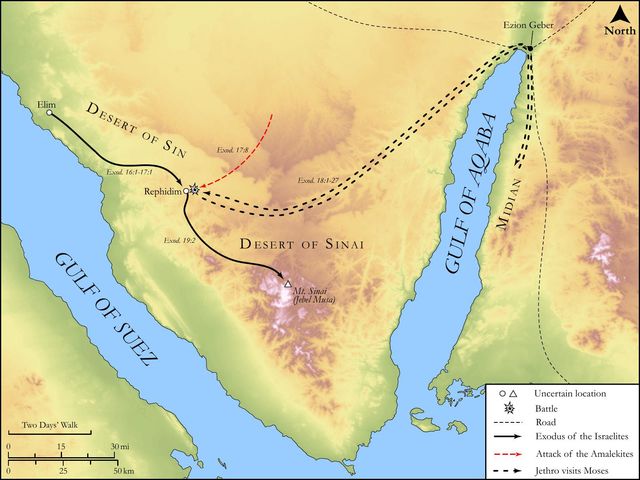
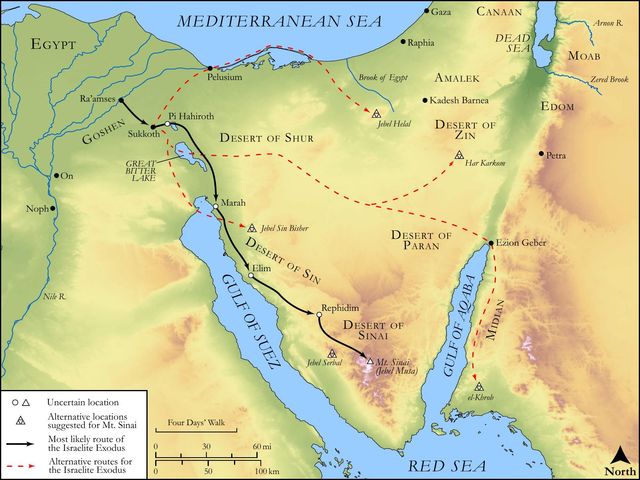
See on the biblical-era maps

Study this verse
Public-domain commentary
Matthew Henry
From his Commentary on the Whole Bible. Henry comments on passages, not single verses — this entry covers Exodus 18:1–6. His two-level outline is real structure in the source text, so it is rendered as structure.
This incident may very well be allowed to have happened as it is placed here, before the giving of the law, and not, as some place it, in connection with what is recorded, Num 10:11, Num 10:29, etc. Sacrifices were offered before; in these mentioned here (Exo 18:12) it is observable that Jethro is said to take them, not Aaron. And as to Jethro's advising Moses to constitute judges under him, though it is intimate (Exo 18:13) that the occasion of his giving that advice was on the morrow, yet it does not follow but that Moses's settlement of that affair might be some time after, when the law was given, as it is placed, Deu 1:9. It is plain that Jethro himself would not have him make this alteration in the government till he had received instructions from God about it (Exo 18:23), which he did not till some time after. Jethro comes,
I.To congratulate the happiness of Israel, and particularly the honour of Moses his son-in-law; and now Jethro thinks himself well paid for all the kindness he had shown to Moses in his distress, and his daughter better matched than he could have expected. Jethro could not but hear what all the country rang of, the glorious appearances of God for his people Israel (Exo 18:1); and he comes to enquire, and inform himself more fully thereof (see Psa 111:2), and to rejoice with them as one that had a true respect both for them and for their God. Though he, as a Midianite, was not to share with them in the promised land, yet he shared with them in the joy of their deliverance. We may thus make the comforts of others our own, by taking pleasure, as God does, in the prosperity of the righteous.
II.To bring Moses's wife and children to him.
It seems, he had sent them back, probably from the inn where his wife's aversion to the circumcision of her son had like to have cost him his life (Exo 4:25); fearing lest they should prove a further hindrance, he sent them home to his father-in-law. He foresaw what discouragements he was likely to meet with in the court of Pharaoh, and therefore would not take any with him in his own family. He was of that tribe that said to his father, I have not known him, when service was to be done for God, Deu 33:9. Thus Christ's disciples, when they were to go upon an expedition not much unlike that of Moses, were to forsake wife and children, Mat 19:29. But though there might be reason for the separation that was between Moses and his wife for a time, yet they must come together again, as soon as ever they could with any convenience. It is the law of the relation. You husbands, dwell with your wives, Pe1 3:7. Jethro, we may suppose, was glad of his daughter's company, and fond of her children, yet he would not keep her from her husband, nor them from their father, Exo 18:5, Exo 18:6. Moses must have his family with him, that while he ruled the church of God he might set a good example of prudence in family-government, Ti1 3:5. Moses had now a great deal both of honour and care put upon him, and it was fit that his wife should be with him to share with him in both. Notice is taken of the significant names of his two sons.
1.The eldest was called Gershom (Exo 18:3), a stranger, Moses designing thereby, not only a memorial of his own condition, but a memorandum to his son of his condition also: for we are all strangers upon earth, as all our fathers were. Moses had a great uncle almost of the same name, Gershon, a stranger; for though he was born in Canaan (Gen 46:11), yet even there the patriarchs confessed themselves strangers.
2.The other he called Eliezer (Exo 18:4), My God a help, as we translate it; it looks back to his deliverance from Pharaoh, when he made his escape, after the slaying of the Egyptian; but, if this was (as some think) the son that was circumcised at the inn as he was going, I would rather translate it so as to look forward, which the original will bear, The Lord is my help, and will deliver me from the sword of Pharaoh, which he had reason to expect would be drawn against him when he was going to fetch Israel out of bondage. Note, When we are undertaking any difficult service for God and our generation, it is good for us to encourage ourselves in God as our help: he that has delivered does and will deliver.
Continue studying Exodus 18:1 across the web’s major study libraries — every link below opens this exact verse, chapter, or book on the destination site.
Read & Compare
 BibleGatewayThis verse in more than 200 translations and 70 languages.
 Bible.comThe YouVersion reader — hundreds of translations, reading plans, and highlights.
 ESV.orgCrossway's official English Standard Version reader.
 NET BibleThe NET translation with 60,000+ translators' notes on every rendering decision.
 STEP BibleTyndale House's free study tool — original text, vocabulary, and scholarly resources.
 BibliaLogos Bible Software's free web reader.
 USCCBThe New American Bible (Revised Edition) with the U.S. bishops' study notes.
Commentaries
 BibleHub CommentariesDozens of classic commentaries on this verse, gathered on one page.
 StudyLightMore than 100 commentary sets — the largest collection on the web.
 BibleRefPlain-English commentary on what this verse means, verse by verse.
 Enduring WordDavid Guzik's free commentary on this chapter, widely used by Bible teachers.
 Bible Study ToolsVerse commentary alongside Greek and Hebrew study aids.
Original Language & Research
- BibleHub InterlinearThe verse word by word — original language, transliteration, and English.
- BibleHub LexiconEvery word's original-language definition and Strong's entry.
 Blue Letter BibleDeep-study tools — Strong's numbers, concordance, and word studies.
 SefariaThe Hebrew text with Rashi and centuries of Jewish commentary.
Sermons, Hymns & Audio


TrulyRandomVerse is not affiliated with these sites and doesn’t control their content. They’re linked because they’re genuinely useful.
Summary
Exodus 18:1 introduces Jethro, Moses' father-in-law and the priest of Midian, who receives news of the extraordinary acts of God on behalf of Moses and the nation of Israel, specifically their miraculous deliverance from Egyptian bondage. This verse serves as a crucial narrative hinge, setting the stage for Jethro's visit to Moses in the wilderness and the significant counsel he will offer regarding the administration of justice and leadership within the burgeoning Israelite community. It highlights the widespread renown of God's power, even among those outside the immediate covenant community.
Context
ShowHideLiterary Context
The preceding chapters of Exodus detail Israel's arduous journey through the wilderness, marked by divine provision and protection, yet also by human grumbling and conflict. Following the miraculous provision of manna and quail and water from the rock at Rephidim, as well as the decisive victory over the Amalekites, Exodus 18:1 shifts focus from the internal struggles of Israel to an external acknowledgment of God's power. This verse serves as a narrative interlude, bridging the initial wilderness wanderings with the momentous events at Mount Sinai, where Israel will receive the Law. Jethro's arrival is not merely a family reunion but a divinely orchestrated encounter that prepares Moses for the immense task of leading a nation under God's covenant. It sets a tone of external validation for God's mighty deeds, contrasting with Israel's often-wavering faith.
Historical & Cultural Context
Jethro's connection to Moses dates back to Moses' flight from Egypt, where he found refuge in Midian after killing an Egyptian. During his forty years in Midian, Moses married Jethro's daughter, Zipporah, and became a shepherd, a period of divine preparation for his calling. Midianites were nomadic or semi-nomadic peoples inhabiting regions east of the Gulf of Aqaba, known for their trade routes. Jethro's title, "priest of Midian," suggests a spiritual authority within his community, and his recognition of "all that God had done" implies a broader understanding of divine power that transcends tribal deities, possibly even a nascent monotheistic inclination or at least an acknowledgment of Yahweh's supremacy. The news of the Exodus and the crossing of the Red Sea would have spread rapidly through these trade routes and oral tradition, demonstrating God's renown among the nations, as prophesied in Exodus 15:14-16.
Key Themes
ShowHideThis verse contributes significantly to several key themes within Exodus and the broader Pentateuch. Firstly, it underscores the universal renown of God's power and glory, demonstrating that His mighty acts are not confined to Israel but are recognized even by those outside the immediate covenant community. Secondly, it highlights God's providential care, not only in delivering Israel from bondage but also in orchestrating Jethro's timely arrival to provide Moses with crucial administrative guidance, which will prove essential for the nascent nation's governance. Thirdly, it subtly introduces the theme of wise counsel and delegation, foreshadowing the practical wisdom Jethro will impart to Moses in the subsequent verses. Finally, it reinforces the theme of God's faithfulness to His people, as the events Jethro hears about are direct manifestations of Yahweh's commitment to His covenant promises to Israel, demonstrating His active presence and protection throughout their wilderness journey.
Exposition and Analysis
ShowHideKey Word Analysis
ShowHideThis name, derived from a root meaning "his excellence" or "his abundance," is fitting for a figure who brings valuable counsel and wisdom to Moses and the nascent nation of Israel. His arrival signifies a moment of enrichment and strategic guidance, underscoring the providential nature of his visit and the abundance of wisdom he is about to impart.
This refers to the son of Abraham and Keturah, as well as the country and collective descendants. Jethro's identity as a "priest of Midian" highlights that God's mighty acts were recognized even by those outside the direct Abrahamic covenant line. This demonstrates the far-reaching impact of God's revelation and the potential for individuals from diverse backgrounds to acknowledge His supreme power.
This primitive root implies more than just passive reception of sound; it denotes an active, intelligent listening, often with the implication of attention, understanding, and a responsive action. Jethro's "hearing" is not merely informational but transformative, compelling him to travel and engage with Moses and the Israelites, setting the stage for his crucial role in the chapter and demonstrating the compelling power of God's testimony.
Verse Breakdown
ShowHide"When Jethro, the priest of Midian, Moses' father in law, heard"
This opening clause immediately establishes the subject of the verse as Jethro, clearly identifying his relationship to Moses (father-in-law) and his influential position (priest of Midian). The temporal adverb "When" sets the stage for his subsequent actions, emphasizing that his visit is a direct and intentional response to divine events rather than a casual encounter. His titles underscore his authority and the significance of his acknowledgment of God's deeds.
"of all that God had done for Moses, and for Israel his people"
This phrase specifies the comprehensive content of what Jethro heard. The use of "all" (Hebrew, kol) emphasizes the totality of God's interventions, from the plagues to the Red Sea crossing and wilderness provisions. The distinction between "for Moses" (the leader and God's chosen servant) and "for Israel his people" (the nation as a whole) highlights God's dual care for both His appointed leader and His chosen community. The general term "God" (Hebrew, Elohim) here suggests His universal power and authority, which would be recognizable even to a non-Israelite priest.
"[and] that the LORD had brought Israel out of Egypt;"
This final clause specifies the crowning act of God's intervention: the Exodus. The KJV's bracketed "and" clarifies that this is the climactic and most significant of "all that God had done," serving as the ultimate proof of God's power and faithfulness. The use of "the LORD" (Hebrew, YHWH), God's personal covenant name, emphasizes His faithful and powerful presence with His people, a specific understanding that Jethro, though an outsider, seems to grasp or at least acknowledge as the source of such mighty deeds. This specific mention highlights the covenantal nature of God's deliverance.
Literary Devices
ShowHideThe verse employs several literary devices to convey its meaning and significance. Foreshadowing is evident as Jethro's hearing of God's acts directly precedes his arrival and subsequent offering of invaluable counsel to Moses, hinting at the positive impact he will have on the nascent Israelite administration. There is a subtle contrast between the Israelite people's frequent grumbling and lack of faith in previous chapters and Jethro, an outsider, who immediately recognizes and responds with awe to the undeniable power of God. The repetition of the idea of God's actions—"all that God had done" and "that the LORD had brought Israel out of Egypt"—serves as a form of emphasis, underscoring the magnitude and undeniable nature of God's work. Furthermore, the very act of God's deliverance and provision, which Jethro hears about, functions as an indirect theophany, a manifestation of God's presence and power that extends beyond the immediate covenant community, demonstrating His universal sovereignty.
Theological and Thematic Connections
ShowHideExodus 18:1 powerfully illustrates God's universal renown and the pervasive nature of His divine acts. The fact that Jethro, a Midianite priest, hears and responds to the news of God's work for Israel underscores that God's power and glory are not confined to a single nation but are meant to be known among all peoples. This verse highlights God's providential care, not only in delivering Israel but also in orchestrating Jethro's timely arrival to provide Moses with crucial administrative guidance, demonstrating that God equips His servants and provides for His people through unexpected means. It emphasizes the compelling power of God's testimony, which can reach and impact individuals from diverse backgrounds, drawing them to acknowledge His supremacy and the reality of His active presence in the world.
Reflection and Application
ShowHideExodus 18:1 serves as a profound reminder that God's actions speak volumes, often reaching far beyond our immediate circles. The testimony of His faithfulness and power, when demonstrated in our lives and communities, possesses an undeniable magnetic quality that can draw others to acknowledge His presence and power. Just as the news of God's mighty deeds reached Jethro, our lives, transformed by God's grace, can become powerful witnesses to those who do not yet know Him. This verse also encourages us to cultivate a humble posture, recognizing that God can bring wisdom, support, and insight from unexpected sources. Jethro, an "outsider" in terms of the covenant community, brought invaluable counsel to Moses, demonstrating that God's provision can come through diverse channels, challenging us to be open to receiving wisdom from those who may not share our exact background or theological framework. It calls us to consider how our own lives, and the life of our faith communities, testify to God's ongoing work in the world.
Questions for Reflection
ShowHideFAQ
ShowHideWho was Jethro and what was his significance?
ShowHideJethro was Moses' father-in-law and the priest of Midian. His significance in Exodus 18:1, and the subsequent verses, is multifaceted. He represents an external acknowledgment of Yahweh's power, demonstrating that the fame of God's deeds extended beyond Israel. More importantly, his visit is providential, as he later offers Moses crucial, wise counsel regarding the delegation of judicial responsibilities, which was foundational for the efficient administration of justice within the burgeoning Israelite nation (see Exodus 18:13-26). He embodies the idea that wisdom and divine recognition can come from unexpected sources, even outside the direct covenant line.
Why is it important that Jethro "heard" of God's deeds?
ShowHideJethro "hearing" of God's deeds is crucial because it underscores the widespread impact and undeniable nature of God's miraculous intervention in the Exodus. It highlights that God's renown was not confined to the Israelite camp but was actively spreading among the nations, fulfilling God's purpose to be known throughout the earth (see Exodus 9:16). This external recognition validates the magnitude of the events and sets the stage for Jethro's active response and subsequent involvement in the narrative, demonstrating that God can use even those outside the direct covenant line to further His plans. His hearing and subsequent action serve as a powerful testament to the compelling nature of God's self-revelation.
Christ-Centered Fulfillment
ShowHideJethro's hearing of "all that God had done" and his subsequent journey to Moses in the wilderness beautifully foreshadows the universal recognition of God's ultimate redemptive act in Jesus Christ. The Exodus, which Jethro heard about, serves as a powerful type of salvation, pointing forward to the greater deliverance from sin and death accomplished through Christ's atoning work on the cross. Just as the news of Israel's liberation spread, so too does the good news of the gospel, which is to be proclaimed to all nations through the Great Commission. Jethro, an outsider who acknowledges the power of Yahweh, prefigures the inclusion of Gentiles into God's family through faith in Christ, as described by Paul in Ephesians 2:11-13, where those who were once far off are brought near by the blood of Christ. The ultimate "hearing" of God's greatest act of salvation is through the gospel of Jesus Christ, which brings light and life to all who believe, regardless of their background or previous religious affiliation, drawing them into the new covenant community.