


Exodus 18:2
Bible text: King James Version (1769 Blayney text) · Public domain
Bible text: Berean Standard Bible · Public domain
Bible text: American Standard Version (1901) · Public domain
Bible text: World English Bible, Messianic edition · Public domain
Bible text: Geneva Bible (1599) · Public domain
Bible text: Young's Literal Translation · Public domain
- וַיִּקַּחvai·yi·Kachand he had takenH3947Conj-w ¦ V-Qal-ConsecImperf-3msVerb Qal Consecutive Imperfect 3rd Singular Masculineוַandיִּקַּחhe had taken
- יִתְרוֹyit·RoJethroH3503N-proper-mNoun Proper Masculine
- חֹתֵןcho·Ten[the] father-in-law ofH2859V-Qal-Prtcpl-msVerb Qal Participle Singular Masculine Construct
- מֹשֶׁהmo·ShehMosesH4872N-proper-mNoun Proper Masculine
- אֶת'et<obj.>H853DirObjMParticle Object Indicator
- צִפֹּרָהtzi·po·RahZipporahH6855N-proper-fNoun Proper Feminine
- אֵשֶׁת'E·shet[the] wife ofH802N-fscNoun Singular Feminine Construct
- מֹשֶׁהmo·ShehMosesH4872N-proper-mNoun Proper Masculine
- אַחַר'a·CharafterH310Adj-mscAdjective Numerical Singular Masculine Construct
- שִׁלּוּחֶיהָshi·lu·Chei·haher dismissal<s>H7964N-mpc ¦ 3fsNoun Plural Masculine Constructשִׁלּוּחֶיdismissal<s>הָher
English is a literal word-by-word gloss of the Hebrew, not the KJV's wording. Why?
This is the original text the KJV's translators worked from — each Hebrew word with its own literal English meaning in this verse, prepared by scholars at Tyndale House, Cambridge. The KJV translates whole sentences, not word by word, so its wording differs: one Hebrew word can become several English words, and the KJV may choose “the LORD” where the gloss reads “Yahweh”. Both are faithful — they answer different questions. For the KJV's own rendering, switch to the KJV text.
Details
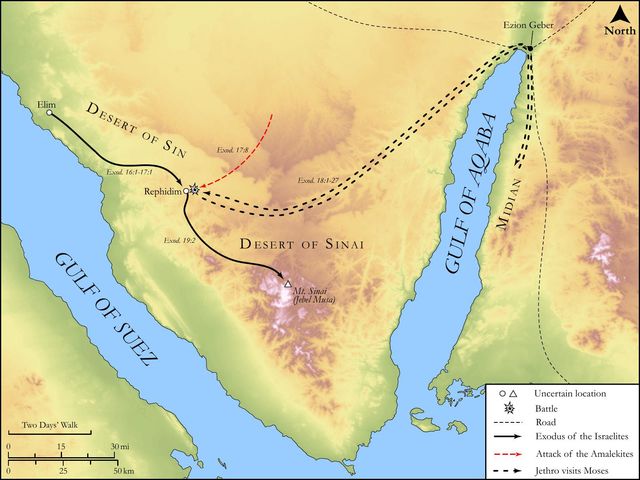
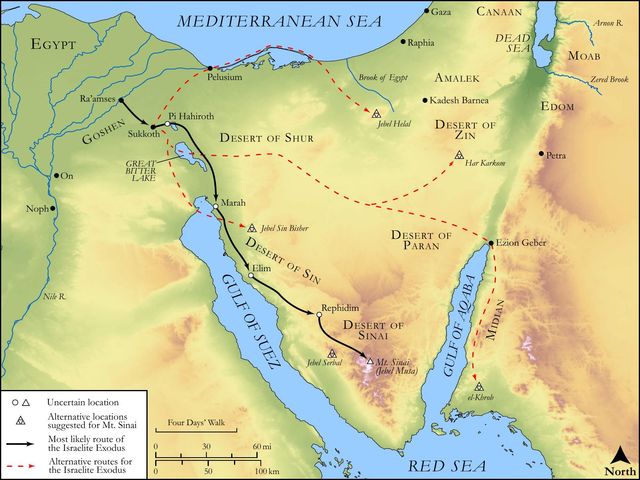
See on the biblical-era maps

Study this verse
Public-domain commentary
Matthew Henry
From his Commentary on the Whole Bible. Henry comments on passages, not single verses — this entry covers Exodus 18:1–6. His two-level outline is real structure in the source text, so it is rendered as structure.
This incident may very well be allowed to have happened as it is placed here, before the giving of the law, and not, as some place it, in connection with what is recorded, Num 10:11, Num 10:29, etc. Sacrifices were offered before; in these mentioned here (Exo 18:12) it is observable that Jethro is said to take them, not Aaron. And as to Jethro's advising Moses to constitute judges under him, though it is intimate (Exo 18:13) that the occasion of his giving that advice was on the morrow, yet it does not follow but that Moses's settlement of that affair might be some time after, when the law was given, as it is placed, Deu 1:9. It is plain that Jethro himself would not have him make this alteration in the government till he had received instructions from God about it (Exo 18:23), which he did not till some time after. Jethro comes,
I.To congratulate the happiness of Israel, and particularly the honour of Moses his son-in-law; and now Jethro thinks himself well paid for all the kindness he had shown to Moses in his distress, and his daughter better matched than he could have expected. Jethro could not but hear what all the country rang of, the glorious appearances of God for his people Israel (Exo 18:1); and he comes to enquire, and inform himself more fully thereof (see Psa 111:2), and to rejoice with them as one that had a true respect both for them and for their God. Though he, as a Midianite, was not to share with them in the promised land, yet he shared with them in the joy of their deliverance. We may thus make the comforts of others our own, by taking pleasure, as God does, in the prosperity of the righteous.
II.To bring Moses's wife and children to him.
It seems, he had sent them back, probably from the inn where his wife's aversion to the circumcision of her son had like to have cost him his life (Exo 4:25); fearing lest they should prove a further hindrance, he sent them home to his father-in-law. He foresaw what discouragements he was likely to meet with in the court of Pharaoh, and therefore would not take any with him in his own family. He was of that tribe that said to his father, I have not known him, when service was to be done for God, Deu 33:9. Thus Christ's disciples, when they were to go upon an expedition not much unlike that of Moses, were to forsake wife and children, Mat 19:29. But though there might be reason for the separation that was between Moses and his wife for a time, yet they must come together again, as soon as ever they could with any convenience. It is the law of the relation. You husbands, dwell with your wives, Pe1 3:7. Jethro, we may suppose, was glad of his daughter's company, and fond of her children, yet he would not keep her from her husband, nor them from their father, Exo 18:5, Exo 18:6. Moses must have his family with him, that while he ruled the church of God he might set a good example of prudence in family-government, Ti1 3:5. Moses had now a great deal both of honour and care put upon him, and it was fit that his wife should be with him to share with him in both. Notice is taken of the significant names of his two sons.
1.The eldest was called Gershom (Exo 18:3), a stranger, Moses designing thereby, not only a memorial of his own condition, but a memorandum to his son of his condition also: for we are all strangers upon earth, as all our fathers were. Moses had a great uncle almost of the same name, Gershon, a stranger; for though he was born in Canaan (Gen 46:11), yet even there the patriarchs confessed themselves strangers.
2.The other he called Eliezer (Exo 18:4), My God a help, as we translate it; it looks back to his deliverance from Pharaoh, when he made his escape, after the slaying of the Egyptian; but, if this was (as some think) the son that was circumcised at the inn as he was going, I would rather translate it so as to look forward, which the original will bear, The Lord is my help, and will deliver me from the sword of Pharaoh, which he had reason to expect would be drawn against him when he was going to fetch Israel out of bondage. Note, When we are undertaking any difficult service for God and our generation, it is good for us to encourage ourselves in God as our help: he that has delivered does and will deliver.
Continue studying Exodus 18:2 across the web’s major study libraries — every link below opens this exact verse, chapter, or book on the destination site.
Read & Compare
 BibleGatewayThis verse in more than 200 translations and 70 languages.
 Bible.comThe YouVersion reader — hundreds of translations, reading plans, and highlights.
 ESV.orgCrossway's official English Standard Version reader.
 NET BibleThe NET translation with 60,000+ translators' notes on every rendering decision.
 STEP BibleTyndale House's free study tool — original text, vocabulary, and scholarly resources.
 BibliaLogos Bible Software's free web reader.
 USCCBThe New American Bible (Revised Edition) with the U.S. bishops' study notes.
Commentaries
 BibleHub CommentariesDozens of classic commentaries on this verse, gathered on one page.
 StudyLightMore than 100 commentary sets — the largest collection on the web.
 BibleRefPlain-English commentary on what this verse means, verse by verse.
 Enduring WordDavid Guzik's free commentary on this chapter, widely used by Bible teachers.
 Bible Study ToolsVerse commentary alongside Greek and Hebrew study aids.
Original Language & Research
- BibleHub InterlinearThe verse word by word — original language, transliteration, and English.
- BibleHub LexiconEvery word's original-language definition and Strong's entry.
 Blue Letter BibleDeep-study tools — Strong's numbers, concordance, and word studies.
 SefariaThe Hebrew text with Rashi and centuries of Jewish commentary.
Sermons, Hymns & Audio


TrulyRandomVerse is not affiliated with these sites and doesn’t control their content. They’re linked because they’re genuinely useful.
Summary
Exodus 18:2 narrates the significant reunion of Moses with his wife Zipporah and their two sons, brought to him in the wilderness by his father-in-law, Jethro. This pivotal verse resolves a prior narrative thread concerning Zipporah's separation from Moses, highlighting God's meticulous providence in orchestrating the restoration of family for His servant, and setting the immediate stage for Jethro's crucial, divinely-inspired counsel regarding the administration of justice among the burgeoning Israelite nation.
Context
ShowHideLiterary Context
This verse marks a distinct narrative shift within the Book of Exodus, moving from the dramatic events of the Exodus itself and the foundational covenant at Sinai to the practicalities of leadership, community organization, and personal well-being. It directly follows Exodus 18:1, where Jethro, a Midianite priest, hears of the Lord's mighty acts in delivering Israel from Egyptian bondage. The reunion described in verse 2 is the direct consequence of Jethro's concern and his initiative to bring Moses' family back to him. This family interlude provides the essential backdrop for Jethro's profound and practical advice to Moses on delegating judicial responsibilities, a crucial administrative development for the nascent nation, as detailed in Exodus 18:13-26. The phrase "after he had sent her back" serves as a critical narrative link, elliptically referencing the intense and life-threatening encounter at the lodging place described in Exodus 4:24-26, which necessitated Zipporah's return to Midian for her safety.
Historical & Cultural Context
At this point in the narrative, the Israelites are encamped in the wilderness of Sinai, a pivotal geographical and theological location where they would receive the Law and solidify their covenant relationship with Yahweh. Moses' arduous and perilous mission to confront Pharaoh and lead a nation out of slavery made it prudent for Zipporah and their two sons, Gershom and Eliezer, to return to the relative safety of Jethro's home in Midian. Jethro, as a priest of Midian, likely held a position of respect and authority within his community, and the Midianites, descendants of Abraham through Keturah (Genesis 25:1-2), shared a distant familial and possibly a rudimentary theological connection to the Israelites, even if their worship practices differed. This reunion highlights the strong emphasis on family ties, tribal relationships, and the importance of extended kinship networks prevalent in the households of the patriarchs, which provided crucial support and security. Jethro's proactive initiative in bringing Zipporah back demonstrates not only his paternal care but also his recognition of the Lord's power, as indicated by his hearing of the great deeds done for Israel (Exodus 18:1).
Key Themes
ShowHideExodus 18:2 contributes to several overarching themes within the book and the broader Pentateuch. Firstly, it underscores the theme of Divine Providence, showing God's care not only for the grand narrative of Israel's redemption but also for the personal well-being and familial stability of His chosen leader, Moses. Secondly, it highlights the importance of Family and Community Support for those in leadership, demonstrating that even a divinely appointed figure like Moses requires the solace and strength of his intimate relationships. This sets the stage for the theme of Wise Counsel and Delegation, as Jethro's arrival and the subsequent reunion facilitate his ability to offer crucial administrative advice that is vital for the nascent Israelite nation's governance, as seen in Exodus 18:17-23. Finally, the verse subtly touches upon the theme of Resolution and Restoration, bringing closure to the unexplained separation of Zipporah and Moses hinted at earlier in Exodus 4, signifying a return to wholeness for Moses' personal life.
Exposition and Analysis
ShowHideKey Word Analysis
ShowHideThis primitive root signifies a deliberate and active bringing or taking, encompassing a wide variety of applications. In this context, it indicates Jethro's intentional, responsible, and caring action in escorting Zipporah back to Moses. It is not a casual encounter but a formal re-establishment of the family unit, demonstrating Jethro's foresight and commitment to ensuring Zipporah's safety and her eventual reunion with her husband.
This term, derived from a primitive root meaning "to give (a daughter) away in marriage" or "to contract affinity by marriage," emphasizes the familial relationship and the respect, authority, and responsibility inherent in it within the family life of Israel. Jethro's role as Moses' father-in-law gives significant weight to his actions and his subsequent counsel, highlighting the importance of extended family in providing support and wisdom.
This noun, derived from the verb "to send away," refers to a dismissal or sending back, particularly in the context of a wife. Its use here, in the perfect tense, indicates a completed action in the past. This phrase is crucial as it refers to a prior, definitive separation, understood to be the consequence of the dramatic, life-threatening events of Exodus 4:24-26. It implies that Moses had formally dispatched Zipporah and his sons for their safety, making her return a significant rejoining rather than a mere visit.
Verse Breakdown
ShowHide"Then Jethro, Moses' father in law"
This opening clause immediately introduces the key actor in this reunion and precisely defines his relationship to Moses. By establishing Jethro's identity as Moses' father-in-law, the text signals his familial authority, concern, and the personal nature of the impending action, setting the stage for his involvement in Moses' life and the broader Israelite narrative.
"took Zipporah, Moses' wife"
This specifies the direct object of Jethro's action, highlighting the central event of the verse: the reunion of Moses with his immediate family. The explicit mention of "Moses' wife" underscores the personal and intimate nature of this re-establishment of the family unit, which is vital for a leader bearing immense burdens and facing the challenges of leading a nation.
"after he had sent her back"
This critical explanatory clause provides the essential background for Zipporah's return. It is an elliptical reference, alluding to the unstated but implied prior separation of Zipporah from Moses, which occurred after the life-threatening incident in Exodus 4. This phrase resolves a narrative loose end, confirming that Zipporah's absence was not permanent but a strategic measure for her safety during Moses' dangerous and all-consuming mission.
Literary Devices
ShowHideThe brevity and specific phrasing of Exodus 18:2, particularly the clause "after he had sent her back," expertly employ Ellipsis and Allusion. The text does not explicitly detail the circumstances of Zipporah's initial departure, but it alludes to a prior, well-known event (the incident in Exodus 4:24-26), assuming the reader's prior knowledge. This Narrative Economy allows the writer to efficiently resolve a previous plot point without unnecessary repetition, maintaining the swift flow of the broader Exodus narrative. The verse also functions as a subtle form of Foreshadowing, as the reunion with Jethro sets the stage for his subsequent, highly significant counsel to Moses regarding the delegation of judicial authority (Exodus 18:13-26), which is crucial for the efficient governance of the nascent Israelite nation. The very presence of Jethro and Zipporah signals that a new, more settled and administrative phase of the journey is beginning, where relational and organizational matters can be addressed.
Theological and Thematic Connections
ShowHideExodus 18:2 profoundly illustrates God's meticulous providence, extending His divine care even to the personal and familial well-being of His chosen servants. While Moses was deeply engrossed in his demanding divine calling, leading millions through the wilderness and receiving the Law, God orchestrated the reunion of his family, providing him with essential personal support and stability. This demonstrates that God cares not only for the grand sweep of redemptive history but also for the individual needs and intimate relationships of those He uses. It highlights the divine wisdom in providing human support systems for leaders, recognizing that even those mightily used by God require the solace, strength, and counsel found within their family unit and community. Jethro, a non-Israelite, acts as an instrument of this divine care, demonstrating that God's grace, wisdom, and provision can flow through unexpected channels and relationships.
Reflection and Application
ShowHideThis seemingly simple verse offers rich ground for reflection on the interplay between divine calling and personal life. It powerfully reminds us that even for those burdened with immense responsibilities, the stability, encouragement, and counsel of family and trusted relationships are invaluable. Moses, the great leader and prophet, was not meant to operate in isolation; God, in His wisdom and providence, reunited him with Zipporah and his sons, and brought Jethro to offer crucial, practical counsel. This speaks to the universal human need for robust support systems—be they family, friends, mentors, or spiritual community—especially during challenging and demanding seasons of life. We are called to pursue our vocations with diligence and faithfulness, but never at the expense of neglecting those relationships that nourish our souls, provide a foundation of love and stability, and offer wise perspective. The reunion also subtly speaks to the importance of reconciliation and reconnection, addressing past separations and bringing healing and wholeness where there was once distance or difficulty, mirroring God's own heart for restoration.
Questions for Reflection
ShowHideFAQ
ShowHideWhy was Zipporah sent back in the first place?
ShowHideWhile the Bible does not explicitly state that Moses "sent her back" in Exodus 4, it is strongly inferred from the narrative. In Exodus 4:24-26, the Lord confronted Moses in a life-threatening manner because his son had not been circumcised, a critical sign of the Abrahamic covenant. Zipporah quickly performed the circumcision, saving Moses' life. Following this intense and perilous incident, it is widely understood that Moses, recognizing the immense danger and all-consuming nature of his mission to confront Pharaoh and lead the Israelites out of slavery, sent Zipporah and their two sons, Gershom and Eliezer, back to her father Jethro in Midian for their safety and well-being. Exodus 18:2 marks their formal reunion after this period of strategic separation.
What is the significance of Jethro bringing Zipporah back to Moses?
ShowHideJethro's action is highly significant for several reasons. Firstly, it demonstrates his deep care, responsibility, and wisdom as a father-in-law, ensuring the safety of his daughter and grandsons and then facilitating their reunion with Moses once the immediate dangers of the Exodus from Egypt had passed. Secondly, it signifies the re-establishment of Moses' personal family unit, which was crucial for a leader bearing such immense responsibility; the support and stability of his family would have been invaluable for his demanding role. Thirdly, and perhaps most importantly, this reunion sets the stage for Jethro's subsequent, divinely inspired counsel to Moses in Exodus 18:13-26, which proves vital for the efficient and just governance of the nascent Israelite nation. It underscores God's providence in providing both personal and administrative support for His chosen leader through human relationships.
Does this reunion imply anything about Moses' leadership or personal life?
ShowHideYes, this reunion carries significant implications for both Moses' leadership and his personal life. For his leadership, it highlights that even the most divinely appointed and gifted leaders are still human and require personal support systems; God cares for the holistic well-being of His servants, not just their public ministry. It shows that effective leadership is often sustained by a stable personal foundation. For Moses' personal life, the reunion suggests a resolution to the previous family crisis and a restoration of marital and paternal fellowship, which was temporarily suspended for the sake of his mission. The re-establishment of his family provides a foundation of emotional and spiritual stability for Moses as he continues to lead the Israelites through the wilderness and prepare them for the reception of the Law at Sinai. It reminds us that personal flourishing and well-being often undergird and empower effective public service.
Christ-Centered Fulfillment
ShowHideExodus 18:2, with its narrative of separation and providential reunion, subtly points to the ultimate reconciliation accomplished in Jesus Christ. Moses' temporary separation from his family for the sake of a demanding, redemptive mission, and their eventual reunion through Jethro's care, can be seen as a faint echo of Christ's greater work. Jesus, the ultimate leader and deliverer, experienced a profound separation, enduring the cross and bearing the weight of sin, not for a temporary mission, but to reconcile a separated humanity to God eternally. Just as Jethro brought Zipporah back to Moses, signifying a restoration of family and fellowship, so Christ, through His atoning sacrifice, "brings near those who were far off" (Ephesians 2:13), reconciling us to God and to one another, forming a new spiritual family—the Church. He is the one who gathers His scattered sheep into one flock (John 10:16) and restores fellowship, not just for a season, but eternally. The support Jethro provided to Moses' family foreshadows Christ as the ultimate provider, sustainer, and Head of His new covenant family, the church, where He Himself is the source of all strength, wisdom, and unity (Colossians 1:18). In Christ, the ultimate "reunion" takes place, bringing us into an eternal, unbroken fellowship with God and with His people, fulfilling the deep human longing for belonging and support that is evident even in the life of Moses.