


Exodus 18:6
Bible text: King James Version (1769 Blayney text) · Public domain
Bible text: Berean Standard Bible · Public domain
Bible text: American Standard Version (1901) · Public domain
Bible text: World English Bible, Messianic edition · Public domain
Bible text: Geneva Bible (1599) · Public domain
Bible text: Young's Literal Translation · Public domain
- וַיֹּאמֶרvai·Yo·merand he saidH559Conj-w ¦ V-Qal-ConsecImperf-3msVerb Qal Consecutive Imperfect 3rd Singular Masculineוַandיֹּאמֶרhe said
- אֶל'eltoH413PrepPreposition
- מֹשֶׁהmo·ShehMosesH4872N-proper-mNoun Proper Masculine
- אֲנִי'a·NiIH589Pro-1csPronoun Personal 1st Singular common gender
- חֹתֶנְךָcho·ten·Khayour father-in-lawH2859V-Qal-Prtcpl-ms ¦ 2msVerb Qal Participle Singular Masculine Constructחֹתֶנְfather-in-lawךָyour
- יִתְרוֹyit·RoJethroH3503N-proper-mNoun Proper Masculine
- בָּאba'[am] comingH935V-Qal-Perf-3msVerb Qal Perfect 3rd Singular Masculine
- אֵלֶיךָ'e·Lei·khato youH413Prep ¦ 2msPrepositionאֵלֶיtoךָyou
- וְאִשְׁתְּךָve·'Ish·te·khaand your wifeH802Conj-w ¦ N-fsc ¦ 2msNoun Singular Feminine Constructוְandאִשְׁתְּwifeךָyour
- וּשְׁנֵיu·she·Neiand [the] twoH8147Conj-w ¦ Adj-cdcAdjective Numerical Dual common gender Constructוּandשְׁנֵי[the] two
- בָנֶיהָva·Nei·haher sonsH1121N-mpc ¦ 3fsNoun Plural Masculine Constructבָנֶיsonsהָher
- עִמָּהּ'i·Mahwith herH5973Prep ¦ 3fsPrepositionעִמָּwithהּher
English is a literal word-by-word gloss of the Hebrew, not the KJV's wording. Why?
This is the original text the KJV's translators worked from — each Hebrew word with its own literal English meaning in this verse, prepared by scholars at Tyndale House, Cambridge. The KJV translates whole sentences, not word by word, so its wording differs: one Hebrew word can become several English words, and the KJV may choose “the LORD” where the gloss reads “Yahweh”. Both are faithful — they answer different questions. For the KJV's own rendering, switch to the KJV text.
Details
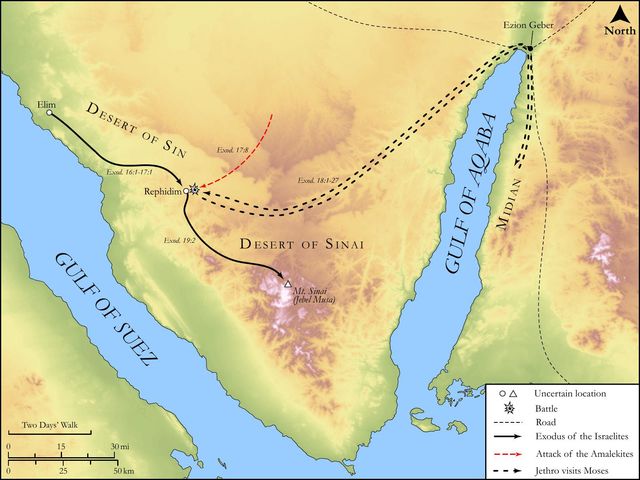
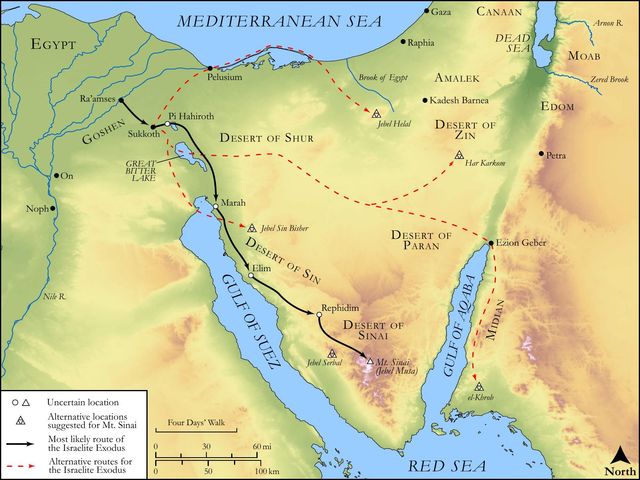
See on the biblical-era maps

Study this verse
Public-domain commentary
Matthew Henry
From his Commentary on the Whole Bible. Henry comments on passages, not single verses — this entry covers Exodus 18:1–6. His two-level outline is real structure in the source text, so it is rendered as structure.
This incident may very well be allowed to have happened as it is placed here, before the giving of the law, and not, as some place it, in connection with what is recorded, Num 10:11, Num 10:29, etc. Sacrifices were offered before; in these mentioned here (Exo 18:12) it is observable that Jethro is said to take them, not Aaron. And as to Jethro's advising Moses to constitute judges under him, though it is intimate (Exo 18:13) that the occasion of his giving that advice was on the morrow, yet it does not follow but that Moses's settlement of that affair might be some time after, when the law was given, as it is placed, Deu 1:9. It is plain that Jethro himself would not have him make this alteration in the government till he had received instructions from God about it (Exo 18:23), which he did not till some time after. Jethro comes,
I.To congratulate the happiness of Israel, and particularly the honour of Moses his son-in-law; and now Jethro thinks himself well paid for all the kindness he had shown to Moses in his distress, and his daughter better matched than he could have expected. Jethro could not but hear what all the country rang of, the glorious appearances of God for his people Israel (Exo 18:1); and he comes to enquire, and inform himself more fully thereof (see Psa 111:2), and to rejoice with them as one that had a true respect both for them and for their God. Though he, as a Midianite, was not to share with them in the promised land, yet he shared with them in the joy of their deliverance. We may thus make the comforts of others our own, by taking pleasure, as God does, in the prosperity of the righteous.
II.To bring Moses's wife and children to him.
It seems, he had sent them back, probably from the inn where his wife's aversion to the circumcision of her son had like to have cost him his life (Exo 4:25); fearing lest they should prove a further hindrance, he sent them home to his father-in-law. He foresaw what discouragements he was likely to meet with in the court of Pharaoh, and therefore would not take any with him in his own family. He was of that tribe that said to his father, I have not known him, when service was to be done for God, Deu 33:9. Thus Christ's disciples, when they were to go upon an expedition not much unlike that of Moses, were to forsake wife and children, Mat 19:29. But though there might be reason for the separation that was between Moses and his wife for a time, yet they must come together again, as soon as ever they could with any convenience. It is the law of the relation. You husbands, dwell with your wives, Pe1 3:7. Jethro, we may suppose, was glad of his daughter's company, and fond of her children, yet he would not keep her from her husband, nor them from their father, Exo 18:5, Exo 18:6. Moses must have his family with him, that while he ruled the church of God he might set a good example of prudence in family-government, Ti1 3:5. Moses had now a great deal both of honour and care put upon him, and it was fit that his wife should be with him to share with him in both. Notice is taken of the significant names of his two sons.
1.The eldest was called Gershom (Exo 18:3), a stranger, Moses designing thereby, not only a memorial of his own condition, but a memorandum to his son of his condition also: for we are all strangers upon earth, as all our fathers were. Moses had a great uncle almost of the same name, Gershon, a stranger; for though he was born in Canaan (Gen 46:11), yet even there the patriarchs confessed themselves strangers.
2.The other he called Eliezer (Exo 18:4), My God a help, as we translate it; it looks back to his deliverance from Pharaoh, when he made his escape, after the slaying of the Egyptian; but, if this was (as some think) the son that was circumcised at the inn as he was going, I would rather translate it so as to look forward, which the original will bear, The Lord is my help, and will deliver me from the sword of Pharaoh, which he had reason to expect would be drawn against him when he was going to fetch Israel out of bondage. Note, When we are undertaking any difficult service for God and our generation, it is good for us to encourage ourselves in God as our help: he that has delivered does and will deliver.
Continue studying Exodus 18:6 across the web’s major study libraries — every link below opens this exact verse, chapter, or book on the destination site.
Read & Compare
 BibleGatewayThis verse in more than 200 translations and 70 languages.
 Bible.comThe YouVersion reader — hundreds of translations, reading plans, and highlights.
 ESV.orgCrossway's official English Standard Version reader.
 NET BibleThe NET translation with 60,000+ translators' notes on every rendering decision.
 STEP BibleTyndale House's free study tool — original text, vocabulary, and scholarly resources.
 BibliaLogos Bible Software's free web reader.
 USCCBThe New American Bible (Revised Edition) with the U.S. bishops' study notes.
Commentaries
 BibleHub CommentariesDozens of classic commentaries on this verse, gathered on one page.
 StudyLightMore than 100 commentary sets — the largest collection on the web.
 BibleRefPlain-English commentary on what this verse means, verse by verse.
 Enduring WordDavid Guzik's free commentary on this chapter, widely used by Bible teachers.
 Bible Study ToolsVerse commentary alongside Greek and Hebrew study aids.
Original Language & Research
- BibleHub InterlinearThe verse word by word — original language, transliteration, and English.
- BibleHub LexiconEvery word's original-language definition and Strong's entry.
 Blue Letter BibleDeep-study tools — Strong's numbers, concordance, and word studies.
 SefariaThe Hebrew text with Rashi and centuries of Jewish commentary.
Sermons, Hymns & Audio


TrulyRandomVerse is not affiliated with these sites and doesn’t control their content. They’re linked because they’re genuinely useful.
Summary
Exodus 18:6 chronicles the significant arrival of Jethro, Moses' father-in-law, accompanied by Moses' wife, Zipporah, and their two sons, Gershom and Eliezer, at the Israelite encampment in the wilderness. This pivotal reunion not only restores Moses' immediate family unit but also sets the stage for Jethro's divinely-inspired and profoundly impactful counsel regarding the administrative structure and judicial system of the nascent nation of Israel. The verse underscores the importance of family, the value of external wisdom, and God's providential care in providing support for His chosen leaders.
Context
ShowHideLiterary Context
This verse is strategically placed within the narrative of Exodus 18, which serves as a crucial interlude between the Israelites' miraculous deliverance from Egypt and their reception of the Law at Mount Sinai. The preceding verses Exodus 18:1-5 establish Jethro's awareness of Yahweh's mighty acts on behalf of Israel, particularly the dramatic exodus from Egypt and the victory over Amalek. Jethro, having heard these reports, takes Zipporah (whom Moses had apparently sent back to him) and their two sons to reunite them with Moses at the "mountain of God." Verse 6 is the direct announcement of their physical presence, immediately followed by the warm greetings, shared meal, and worship recounted in Exodus 18:7-12. This familial reunion is not merely a personal moment but a narrative prerequisite for Jethro's comprehensive administrative advice to Moses, detailed in Exodus 18:13-26, which would fundamentally transform Israel's leadership structure.
Historical & Cultural Context
At this juncture, the Israelites were encamped at Mount Horeb (Sinai), having recently experienced the miraculous crossing of the Red Sea and the provision of manna and water in the wilderness. The journey was arduous, and it is widely inferred that Moses had sent his wife and sons back to Jethro's care, perhaps after the life-threatening incident at the lodging place where Zipporah circumcised their son to save Moses Exodus 4:24-26. In the households of Israel and Midian, the father-in-law held a position of significant respect, authority, and often acted as a wise counselor. Jethro's identity as a priest of Midian, a people related to Israel through Abraham (via Keturah, as seen in Genesis 25:1-2), suggests a shared, albeit distinct, religious heritage. His deliberate journey to Moses was a profound act of familial solidarity and an acknowledgment of Yahweh's power, demonstrating a desire to support his son-in-law in his monumental leadership task.
Key Themes
ShowHideExodus 18:6 contributes to several overarching themes within the book of Exodus and the broader Pentateuch. It highlights the theme of Divine Providence, demonstrating how God orchestrates events and uses various individuals, even those outside the immediate Israelite community, to provide support and wisdom for His chosen leaders. The verse also introduces the theme of Wise Counsel, setting the stage for Jethro's practical and divinely-inspired advice that proves indispensable for the nascent nation's governance. Furthermore, it subtly reinforces the theme of Leadership and Delegation, as Moses, despite his unique divine calling, is shown to be in need of practical assistance and a sustainable administrative structure. Finally, the reunion underscores the Importance of Family and personal well-being, even for a leader burdened with immense national responsibility, reminding us that God cares for the whole person. These themes are echoed throughout the Pentateuch, emphasizing the importance of community and wise governance for God's people, as seen in later passages like Deuteronomy 1:9-18.
Exposition and Analysis
ShowHideKey Word Analysis
ShowHideA primitive root meaning "to say," used with great latitude. In this context, it signifies a direct and intentional communication from Jethro to Moses. It's not a casual utterance but a formal announcement, carrying the weight of Jethro's identity and the purpose of his visit. This verb sets the stage for the personal interaction and the significant counsel that will follow, emphasizing that Jethro's words are deliberate and purposeful.
A primitive root meaning "to give (a daughter) away in marriage; hence (generally) to contract affinity by marriage." This term specifically denotes the relationship of a father-in-law. Its use here is crucial as it immediately establishes the familial bond and the inherent respect and authority associated with such a relationship in a patriarchal household. Jethro's counsel, which is forthcoming, derives much of its legitimacy and persuasive power from this established familial connection, making his advice not merely an outsider's opinion but the loving, experienced guidance of a respected elder within Moses' extended family.
Meaning "his excellence." The name Jethro itself carries a profound significance, derived from a root suggesting "abundance," "excellency," or "superiority." This etymology is remarkably fitting for Jethro's role in Exodus 18. He arrives not empty-handed, but with an "abundance" of practical wisdom and organizational insight that proves "excellent" and "superior" to Moses' current, unsustainable method of leadership. His name thus subtly foreshadows the invaluable contribution he is about to make to the nascent nation of Israel, embodying the very qualities he brings to the situation.
Verse Breakdown
ShowHide"And he said unto Moses,"
This opening clause immediately identifies the speaker as Jethro, who has just arrived, and the recipient as Moses. The direct address "unto Moses" indicates a personal, intentional, and perhaps formal communication, establishing the tone for the significant interaction that is about to unfold. It highlights the directness of Jethro's approach and his desire to engage Moses personally.
"I thy father in law Jethro am come unto thee,"
Jethro explicitly identifies himself, first by his relational title ("thy father in law") and then by his personal name ("Jethro"). This dual identification, while seemingly redundant, serves to emphasize the profound nature of the visit: it is both a familial reunion and an arrival of a respected figure. The phrase "am come unto thee" signifies a deliberate journey undertaken specifically to reunite with Moses, underscoring the purposefulness and importance of his presence.
"and thy wife, and her two sons with her."
This final clause completes the picture of the family reunion, confirming the presence of Zipporah, Moses' wife, and their two sons, Gershom and Eliezer (whose names are explicitly given in Exodus 18:3-4). This detail humanizes Moses, reminding the reader that even the greatest leaders have personal lives and family needs. The re-establishment of Moses' immediate family unit provides a foundation of personal stability amidst the immense public demands of his divine mission.
Literary Devices
ShowHideExodus 18:6 employs several effective literary devices. Identification is paramount, as Jethro explicitly names himself and clarifies his familial relationship to Moses. This immediate clarification of the speaker and the nature of the encounter sets the personal and familial context for the subsequent narrative, emphasizing that the counsel to come is not from a stranger but a trusted relative. The verse also subtly uses Foreshadowing. The mere arrival of Jethro, identified as "thy father in law," along with Moses' complete family, hints at a moment of stability, support, and preparation before the immense task of receiving the Law and establishing a nation. His presence suggests that something significant, beyond a simple reunion, is about to transpire. Furthermore, there is an element of Emphasis achieved through the specific re-introduction of Jethro and the detailed mention of the family members. This highlights the importance of this reunion, not just as a personal event for Moses, but as a providential moment for the entire Israelite community. The personal address ("unto thee," "thy wife," "her two sons with her") further humanizes Moses, reminding the reader of the personal sacrifices and joys intertwined with his demanding public role.
Theological and Thematic Connections
ShowHideExodus 18:6 profoundly illustrates God's comprehensive providential care, extending beyond miraculous deliverance to encompass the provision of human support and wisdom for His servants. The reunion of Moses with his family, orchestrated by Jethro, demonstrates that God uses diverse means—including familial relationships, external counsel, and wise mentorship—to strengthen, sustain, and equip His chosen leaders for their immense tasks. It underscores the divine wisdom in providing community, accountability, and practical resources, ensuring that even those entrusted with the greatest responsibilities are not isolated but are supported in fulfilling their divine calling. This passage serves as a powerful reminder that God often works through human relationships to accomplish His purposes, valuing both the personal well-being of His servants and the effective administration of His people.
Reflection and Application
ShowHideThe reunion described in Exodus 18:6 offers a profound and practical lesson for every believer: no one, regardless of their calling or position, is meant to operate in isolation. Even Moses, the preeminent leader chosen by God, needed the support of his family and the wise counsel of his father-in-law. This passage encourages us to actively cultivate and cherish healthy relationships—with family, friends, mentors, and fellow believers—recognizing that God frequently uses these connections as channels of wisdom, encouragement, and practical assistance. It also serves as a humble challenge, particularly for those in leadership roles, to remain open to receiving counsel from diverse sources, even those seemingly outside our immediate sphere of influence. Our willingness to embrace humility and integrate wise advice can be as vital to our effectiveness and spiritual well-being as our own gifts and talents. True strength often lies in recognizing our need for others and embracing the community God has provided.
Questions for Reflection
ShowHideFAQ
ShowHideWhy did Moses' wife and sons return to Jethro in the first place?
ShowHideThe Bible does not explicitly state the exact moment or reason Moses sent Zipporah and their sons back to Jethro. However, the most commonly accepted and biblically supported theory is that Moses sent them away after the traumatic incident recorded in Exodus 4:24-26. In this passage, the Lord sought to kill Moses because his son, Gershom, had not been circumcised, a covenant requirement. Zipporah's quick action saved Moses' life. This harrowing event, coupled with the imminent and perilous mission to confront Pharaoh and lead the Israelites out of Egypt, likely prompted Moses to send his family to the safety and care of Jethro. The arduous journey through the wilderness and the challenges of leading a vast nation would have been an incredibly difficult environment for a wife and young children, making Jethro's home a logical refuge.
What is the significance of Jethro's role in the Exodus narrative beyond this reunion?
ShowHideJethro plays a critical and often underestimated role in the Exodus narrative, extending far beyond this reunion. After observing Moses' unsustainable practice of personally judging all the people's disputes from morning till evening Exodus 18:13-18, Jethro offers Moses invaluable administrative and organizational advice. He counsels Moses to delegate authority by appointing capable, trustworthy, and God-fearing men to judge smaller matters, bringing only the most difficult cases to Moses himself Exodus 18:19-23. Moses wisely heeds this counsel Exodus 18:24, establishing a foundational judicial and administrative structure for Israel. Jethro's wisdom demonstrates the importance of wise counsel, even from outside the immediate Israelite community, and highlights God's strategic use of various individuals to equip and sustain His leaders, ensuring the well-being and effective governance of His people.
Christ-Centered Fulfillment
ShowHideThe reunion of Moses with his family and the subsequent wise counsel from Jethro in Exodus 18:6 beautifully foreshadows aspects of Christ's perfect leadership and the comprehensive support He provides to His church, the new Israel. While Moses, even as God's chosen leader, needed external wisdom and familial support to sustain his demanding ministry, Jesus Christ, as the Son of God, possesses all wisdom and authority inherently, for in Him "are hidden all the treasures of wisdom and knowledge" Colossians 2:3. He does not receive counsel from others to govern His people; rather, He gives perfect counsel through His Holy Spirit and His infallible Word John 14:26 and John 16:13. However, just as Moses was reunited with his family, Christ gathers His own spiritual family—the church—to Himself, providing a community of support, mutual edification, and shared mission for the advancement of His kingdom Ephesians 2:19-22. Jethro's wise delegation of authority to Moses points to Christ as the ultimate delegator, empowering His disciples with the Holy Spirit to carry on His mission after His ascension, extending His work to the ends of the earth Acts 1:8. In Christ, we find the ultimate source of perfect wisdom, sustainable leadership, and the loving embrace of a spiritual family that transcends all earthly bonds, fulfilling the needs for guidance and community that even Moses experienced.