


Exodus 18:4
Bible text: King James Version (1769 Blayney text) · Public domain
Bible text: Berean Standard Bible · Public domain
Bible text: American Standard Version (1901) · Public domain
Bible text: World English Bible, Messianic edition · Public domain
Bible text: Geneva Bible (1599) · Public domain
Bible text: Young's Literal Translation · Public domain
- וְשֵׁםve·Shemand [the] name ofH8034Conj-w ¦ N-mscNoun Singular Masculine Constructוְandשֵׁם[the] name of
- הָאֶחָדha·'e·Chadthe oneH259Art ¦ Adj-fsAdjective Numerical Singular Feminine Absoluteהָtheאֶחָדone
- אֱלִיעֶזֶר'e·li·'E·zer[was] EliezerH461N-proper-mNoun Proper Masculine
- כִּיkiforH3588PrtParticle Conditional
- אֱלֹהֵי'e·lo·Hei[the] God ofH430N-mpcNoun Plural Masculine Construct
- אָבִי'a·Vimy fatherH1N-msc ¦ 1csNoun Singular Masculine Constructאָבִfatherיmy
- בְּעֶזְרִיbe·'ez·Ri[has been] <in> my helpH5828Prep-b ¦ N-msc ¦ 1csNoun Singular Masculine Constructבְּ[has been] <in>עֶזְרִhelpיmy
- וַיַּצִּלֵנִיvai·ya·tzi·Le·niand he has delivered meH5337Conj-w ¦ V-Hiphil-ConsecImperf-3ms ¦ 1csVerb Hiphil Consecutive Imperfect 3rd Singular Masculineוַandיַּצִּלֵhe has deliveredנִיme
- מֵחֶרֶבme·Che·revfrom [the] sword ofH2719Prep-m ¦ N-fscNoun Singular Feminine Constructמֵfromחֶרֶב[the] sword of
- פַּרְעֹהpar·'OhPharaohH6547N-msNoun Title Singular Masculine Absolute
English is a literal word-by-word gloss of the Hebrew, not the KJV's wording. Why?
This is the original text the KJV's translators worked from — each Hebrew word with its own literal English meaning in this verse, prepared by scholars at Tyndale House, Cambridge. The KJV translates whole sentences, not word by word, so its wording differs: one Hebrew word can become several English words, and the KJV may choose “the LORD” where the gloss reads “Yahweh”. Both are faithful — they answer different questions. For the KJV's own rendering, switch to the KJV text.
Details
See on the biblical-era maps

Study this verse
Public-domain commentary
Matthew Henry
From his Commentary on the Whole Bible. Henry comments on passages, not single verses — this entry covers Exodus 18:1–6. His two-level outline is real structure in the source text, so it is rendered as structure.
This incident may very well be allowed to have happened as it is placed here, before the giving of the law, and not, as some place it, in connection with what is recorded, Num 10:11, Num 10:29, etc. Sacrifices were offered before; in these mentioned here (Exo 18:12) it is observable that Jethro is said to take them, not Aaron. And as to Jethro's advising Moses to constitute judges under him, though it is intimate (Exo 18:13) that the occasion of his giving that advice was on the morrow, yet it does not follow but that Moses's settlement of that affair might be some time after, when the law was given, as it is placed, Deu 1:9. It is plain that Jethro himself would not have him make this alteration in the government till he had received instructions from God about it (Exo 18:23), which he did not till some time after. Jethro comes,
I.To congratulate the happiness of Israel, and particularly the honour of Moses his son-in-law; and now Jethro thinks himself well paid for all the kindness he had shown to Moses in his distress, and his daughter better matched than he could have expected. Jethro could not but hear what all the country rang of, the glorious appearances of God for his people Israel (Exo 18:1); and he comes to enquire, and inform himself more fully thereof (see Psa 111:2), and to rejoice with them as one that had a true respect both for them and for their God. Though he, as a Midianite, was not to share with them in the promised land, yet he shared with them in the joy of their deliverance. We may thus make the comforts of others our own, by taking pleasure, as God does, in the prosperity of the righteous.
II.To bring Moses's wife and children to him.
It seems, he had sent them back, probably from the inn where his wife's aversion to the circumcision of her son had like to have cost him his life (Exo 4:25); fearing lest they should prove a further hindrance, he sent them home to his father-in-law. He foresaw what discouragements he was likely to meet with in the court of Pharaoh, and therefore would not take any with him in his own family. He was of that tribe that said to his father, I have not known him, when service was to be done for God, Deu 33:9. Thus Christ's disciples, when they were to go upon an expedition not much unlike that of Moses, were to forsake wife and children, Mat 19:29. But though there might be reason for the separation that was between Moses and his wife for a time, yet they must come together again, as soon as ever they could with any convenience. It is the law of the relation. You husbands, dwell with your wives, Pe1 3:7. Jethro, we may suppose, was glad of his daughter's company, and fond of her children, yet he would not keep her from her husband, nor them from their father, Exo 18:5, Exo 18:6. Moses must have his family with him, that while he ruled the church of God he might set a good example of prudence in family-government, Ti1 3:5. Moses had now a great deal both of honour and care put upon him, and it was fit that his wife should be with him to share with him in both. Notice is taken of the significant names of his two sons.
1.The eldest was called Gershom (Exo 18:3), a stranger, Moses designing thereby, not only a memorial of his own condition, but a memorandum to his son of his condition also: for we are all strangers upon earth, as all our fathers were. Moses had a great uncle almost of the same name, Gershon, a stranger; for though he was born in Canaan (Gen 46:11), yet even there the patriarchs confessed themselves strangers.
2.The other he called Eliezer (Exo 18:4), My God a help, as we translate it; it looks back to his deliverance from Pharaoh, when he made his escape, after the slaying of the Egyptian; but, if this was (as some think) the son that was circumcised at the inn as he was going, I would rather translate it so as to look forward, which the original will bear, The Lord is my help, and will deliver me from the sword of Pharaoh, which he had reason to expect would be drawn against him when he was going to fetch Israel out of bondage. Note, When we are undertaking any difficult service for God and our generation, it is good for us to encourage ourselves in God as our help: he that has delivered does and will deliver.
Continue studying Exodus 18:4 across the web’s major study libraries — every link below opens this exact verse, chapter, or book on the destination site.
Read & Compare
 BibleGatewayThis verse in more than 200 translations and 70 languages.
 Bible.comThe YouVersion reader — hundreds of translations, reading plans, and highlights.
 ESV.orgCrossway's official English Standard Version reader.
 NET BibleThe NET translation with 60,000+ translators' notes on every rendering decision.
 STEP BibleTyndale House's free study tool — original text, vocabulary, and scholarly resources.
 BibliaLogos Bible Software's free web reader.
 USCCBThe New American Bible (Revised Edition) with the U.S. bishops' study notes.
Commentaries
 BibleHub CommentariesDozens of classic commentaries on this verse, gathered on one page.
 StudyLightMore than 100 commentary sets — the largest collection on the web.
 BibleRefPlain-English commentary on what this verse means, verse by verse.
 Enduring WordDavid Guzik's free commentary on this chapter, widely used by Bible teachers.
 Bible Study ToolsVerse commentary alongside Greek and Hebrew study aids.
Original Language & Research
- BibleHub InterlinearThe verse word by word — original language, transliteration, and English.
- BibleHub LexiconEvery word's original-language definition and Strong's entry.
 Blue Letter BibleDeep-study tools — Strong's numbers, concordance, and word studies.
 SefariaThe Hebrew text with Rashi and centuries of Jewish commentary.
Sermons, Hymns & Audio


TrulyRandomVerse is not affiliated with these sites and doesn’t control their content. They’re linked because they’re genuinely useful.
Summary
Exodus 18:4 presents Moses' naming of his second son, Eliezer, a deeply personal and theological act that serves as a profound testimony to God's active, faithful, and specific intervention in his life. The name, meaning "My God is help," commemorates God's decisive deliverance of Moses from the life-threatening power of Pharaoh, thereby underscoring God's character as a reliable helper and rescuer who acts sovereignly on behalf of His people.
Context
ShowHideLiterary Context
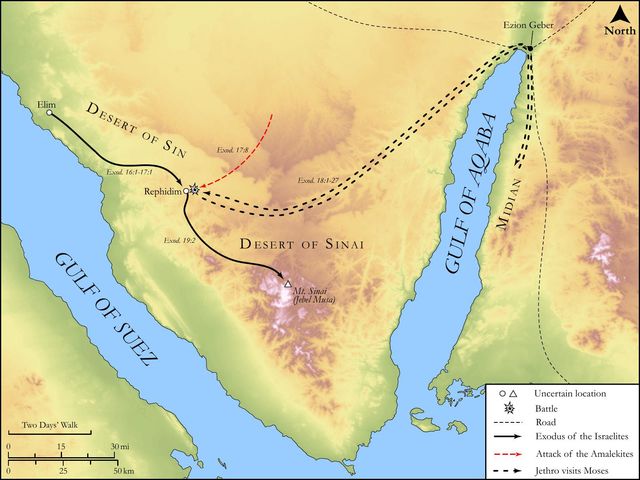
This verse is situated within Exodus 18, a pivotal chapter detailing the reunion of Moses with his father-in-law Jethro, his wife Zipporah, and his two sons, Gershom and Eliezer, in the wilderness near Mount Horeb. This reunion occurs after the momentous events of the Exodus and the miraculous crossing of the Red Sea, but before the giving of the Law at Mount Sinai. The chapter acts as a narrative interlude, shifting focus from the grand acts of national deliverance to Moses' personal life and family, and Jethro's subsequent counsel on judicial administration. The naming of Moses' sons—Gershom (meaning "a stranger there") in Exodus 2:22 and Eliezer here—bookends Moses' early narrative, reflecting his journey from exile and his profound experiences of divine providence. Both names are profoundly autobiographical, encapsulating Moses' past struggles and God's specific deliverances, setting a tone of remembrance and gratitude that permeates the entire chapter.
Historical & Cultural Context
In Scripture, and particularly within Hebrew culture, names were far more than mere identifiers; they often encapsulated significant events, expressed parental hopes, or served as theological declarations. Hebrew names frequently functioned as miniature creeds or memorials, embedding a narrative or a statement of faith within a person's identity. Moses' naming of Eliezer is a prime example of this practice, as the verse explicitly states the theological rationale behind the name. The "sword of Pharaoh" refers to the existential threat Moses faced personally, particularly after he killed an Egyptian and fled from Pharaoh's wrath, as recounted in Exodus 2:11-15. More broadly, it symbolizes the entire oppressive regime and military might of Egypt that sought to enslave and destroy the Israelites, culminating in the pursuit to the Red Sea detailed in Exodus 14. Moses' testimony, enshrined in his son's name, acknowledges God's miraculous intervention that thwarted Pharaoh's power and secured deliverance for both Moses personally and, by extension, for the nascent nation of Israel.
Key Themes
ShowHideExodus 18:4 contributes significantly to several key themes woven throughout the book of Exodus and the broader Pentateuch. Foremost among these is the theme of Divine Deliverance and Providence, highlighting God's active involvement in the lives of His chosen people, rescuing them from seemingly insurmountable odds. The name Eliezer itself is a testament to God as a Personal Helper and Rescuer, emphasizing His intimate care for individuals, not just nations. This verse also reinforces the theme of Remembering God's Faithfulness, as the name serves as a perpetual memorial of God's past interventions. Furthermore, it subtly touches upon Covenant Continuity, as Moses attributes his deliverance to "the God of my father," linking his personal experience to the promises made to the patriarchs, a theme central to the divine self-revelation in Exodus 3. The naming also exemplifies the Theological Significance of Names in Hebrew culture, where names convey profound meaning and often serve as declarations of faith.
Exposition and Analysis
ShowHideKey Word Analysis
ShowHideThis is a compound Hebrew name derived from two elements: ʼEl (אֵל), meaning "God," and ʻezer (עֵזֶר), meaning "help" or "aid." Thus, it translates to "God of help" or "My God is help." The name functions as a declarative statement of faith, a personal creed inscribed upon his son, perpetually reminding Moses and all who heard it of God's active and personal intervention. It signifies not merely general assistance, but a powerful, divine rescue from overwhelming danger, embodying God's character as the supreme deliverer.
This word denotes aid or assistance, particularly from a superior or indispensable source. While it can refer to human help, its application to God, as seen here, emphasizes divine power and capability to deliver where human strength utterly fails. It speaks to God's indispensable and sovereign support. The root word is also used to describe Eve as a "helper" (ʻezer) fit for Adam, implying not subservience but a vital, complementary strength. In this context, it highlights God's unique ability to provide the necessary aid for deliverance.
This primitive root means "to snatch away," whether in a good or bad sense, but here specifically implies rescue, preservation, or recovery. It conveys the idea of being pulled out of danger or from a perilous situation. In Moses' case, it signifies God's decisive and powerful act of rescuing him from the direct threat posed by Pharaoh. This deliverance was not passive but an active, forceful intervention by God to save Moses from certain death, underscoring God's dynamic and protective nature.
Verse Breakdown
ShowHide"And the name of the other [was] Eliezer;"
This clause introduces Moses' second son, distinguishing him from Gershom. The immediate explanation of his name within the verse itself highlights its profound theological significance, signaling that this name is a deliberate and public declaration of Moses' gratitude and theological understanding of God's character and actions.
"for the God of my father, [said he, was] mine help,"
Here, Moses explicitly provides the spiritual rationale for the name. The phrase "the God of my father" is crucial, connecting Moses' personal experience of divine help to the covenant God of Abraham, Isaac, and Jacob. This underscores the continuity of God's faithfulness across generations, assuring Moses and the reader that the God who sustained his ancestors was also his personal helper and protector, actively involved in his life.
"and delivered me from the sword of Pharaoh:"
This specifies the particular act of divine intervention that prompted the naming. The "sword of Pharaoh" represents the ultimate threat from the Egyptian empire—not just Pharaoh's initial attempt to kill Moses, but also, by extension, the pervasive and deadly threat that Pharaoh and his army posed to Moses and the entire Israelite nation during the Exodus. This deliverance was absolute and decisive, demonstrating God's sovereign power over human oppressors and His unwavering commitment to His people.
Literary Devices
ShowHideExodus 18:4 employs several powerful literary devices to convey its profound message. Etymological Significance is central, as the name Eliezer is not merely a label but a direct theological statement, explicitly explained by Moses himself. This makes the name a potent Personal Testimony, a declarative act of faith and remembrance that encapsulates Moses' profound experience of God's saving power. The phrase "sword of Pharaoh" functions as a striking Metonymy or Synecdoche, where the part (the sword, representing military might and lethal intent) stands in for the whole (Pharaoh's entire oppressive regime, his murderous decrees, and the formidable Egyptian army). This vivid imagery highlights the immense magnitude of the threat from which God delivered Moses. Furthermore, there is an implicit Parallelism between "mine help" and "delivered me from the sword of Pharaoh," where the second phrase elaborates on the nature and extent of the "help" provided by God, emphasizing its specific, life-saving quality.
Theological and Thematic Connections
ShowHideExodus 18:4 profoundly highlights God's character as a personal, active, and generational Deliverer. Moses' naming of Eliezer is a testament to divine providence, demonstrating that God is not a distant deity but intimately involved in the lives of His people, providing specific and powerful help in times of dire need. This verse reinforces the theme of remembering God's faithfulness, urging believers to acknowledge and commemorate His past interventions as a foundation for future trust. It connects Moses' personal deliverance to the broader narrative of Israel's salvation, emphasizing that the God who helped Moses was the same God who liberated an entire nation from slavery, underscoring His covenant loyalty and omnipotent power. The name Eliezer serves as a perpetual reminder that God is indeed "our refuge and strength, a very present help in trouble."
Reflection and Application
ShowHideThe naming of Eliezer serves as a powerful invitation for us to reflect on the "Eliezer" moments in our own lives – those specific instances where God intervened, provided help, and delivered us from overwhelming circumstances, whether physical, emotional, or spiritual. Just as Moses permanently inscribed God's faithfulness into his family's history, we are called to cultivate a deep and lasting memory of God's past deliverances. This practice of remembrance is not merely nostalgic; it is a vital spiritual discipline that strengthens our faith, builds our confidence in God's ongoing presence, and equips us to face future challenges with trust rather than fear. Acknowledging God as "my help" transforms our perspective, fostering profound gratitude and a deeper dependence on His sovereign care in every season of life. It compels us to share our testimonies, allowing our lives to become living memorials to God's unfailing help, just as Eliezer's name was for Moses.
Questions for Reflection
ShowHideFAQ
ShowHideWhy did Moses name his sons with such significant meanings?
ShowHideIn ancient Hebrew culture, names were often chosen to reflect significant events, circumstances, or profound theological truths. Moses' naming of his sons, Gershom and Eliezer, is deeply autobiographical and theological. Gershom (meaning "a stranger there"), named in Exodus 2:22, reflected Moses' feelings of alienation and exile in Midian. Eliezer (meaning "My God is help") commemorated God's specific act of delivering Moses from Pharaoh's direct threat and, by extension, the broader oppressive power of Egypt. These names served as perpetual reminders to Moses, his family, and future generations of God's personal providence, protection, and faithfulness throughout his challenging journey. They were living testimonies to his experiences and God's unchanging character.
What is the significance of "the God of my father" in this verse?
ShowHideThe phrase "the God of my father" is a crucial theological link, connecting Moses' personal experience of deliverance to the covenant God of Abraham, Isaac, and Jacob. When God first revealed Himself to Moses at the burning bush, He identified Himself as "the God of your father, the God of Abraham, the God of Isaac, and the God of Jacob" (Exodus 3:6). By using this phrase, Moses acknowledges the continuity of God's covenant faithfulness across generations. It emphasizes that the same God who made promises to the patriarchs, and who had been faithful to them, was now personally intervening and providing help to Moses. This continuity provided a deep sense of security and assurance, grounding Moses' personal testimony within the broader narrative of God's redemptive plan for His people, demonstrating that God is eternally faithful to His covenant.
Christ-Centered Fulfillment
ShowHideThe profound testimony embedded in the name Eliezer, "My God is help," finds its ultimate and most glorious fulfillment in the person and work of Jesus Christ. While Moses was delivered from the "sword of Pharaoh," a potent symbol of earthly oppression, tyranny, and death, Christ delivers humanity from far greater enemies: the spiritual "Pharaoh" of sin, the dominion of death, and the power of the devil. Jesus' very name, Yeshua (Jesus), means "The Lord saves" or "Yahweh is salvation," perfectly embodying and expanding upon the "God is help" theme. His entire life, culminating in His sacrificial death on the cross and triumphant resurrection, constitutes the supreme act of divine help and deliverance for all humanity. Through His atoning work, Christ disarmed the powers of darkness (Colossians 2:15), delivering us from the fear of death and its bondage (Hebrews 2:14-15), and reconciling us to God. Thus, Jesus is the supreme Eliezer, the embodiment of God's active, personal, and complete help for all who believe, demonstrating God's immeasurable love in that "while we were still sinners, Christ died for us" (Romans 5:8), offering eternal salvation and true freedom.