


Exodus 18:3
Bible text: King James Version (1769 Blayney text) · Public domain
Bible text: Berean Standard Bible · Public domain
Bible text: American Standard Version (1901) · Public domain
Bible text: World English Bible, Messianic edition · Public domain
Bible text: Geneva Bible (1599) · Public domain
Bible text: Young's Literal Translation · Public domain
- וְאֵתve·'Etand <obj.>H853Conj-w ¦ DirObjMParticle Object Indicatorוְandאֵת<obj.>
- שְׁנֵיshe·Nei[the] twoH8147Adj-cdcAdjective Numerical Dual common gender Construct
- בָנֶיהָva·Nei·haher sonsH1121N-mpc ¦ 3fsNoun Plural Masculine Constructבָנֶיsonsהָher
- אֲשֶׁר'a·SherwhoH834RelParticle Relative
- שֵׁםshem[the] name ofH8034N-mscNoun Singular Masculine Construct
- הָאֶחָדha·'e·Chadthe oneH259Art ¦ Adj-fsAdjective Numerical Singular Feminine Absoluteהָtheאֶחָדone
- גֵּרְשֹׁםge·re·Shom[was] GershomH1647N-proper-mNoun Proper Masculine
- כִּיkiforH3588PrtParticle Conditional
- אָמַר'a·Marhe had saidH559V-Qal-Perf-3msVerb Qal Perfect 3rd Singular Masculine
- גֵּרgera sojournerH1616N-msNoun Singular Masculine Absolute
- הָיִיתִיha·Yi·tiI have becomeH1961V-Qal-Perf-1csVerb Qal Perfect 1st Singular common gender
- בְּאֶרֶץbe·'E·retzin a landH776Prep-b ¦ N-fsNoun Singular Feminine Absoluteבְּinאֶרֶץa land
- נָכְרִיָּהna·khe·ri·YahforeignH5237Adj-fsAdjective Singular Feminine Absolute
English is a literal word-by-word gloss of the Hebrew, not the KJV's wording. Why?
This is the original text the KJV's translators worked from — each Hebrew word with its own literal English meaning in this verse, prepared by scholars at Tyndale House, Cambridge. The KJV translates whole sentences, not word by word, so its wording differs: one Hebrew word can become several English words, and the KJV may choose “the LORD” where the gloss reads “Yahweh”. Both are faithful — they answer different questions. For the KJV's own rendering, switch to the KJV text.
Details
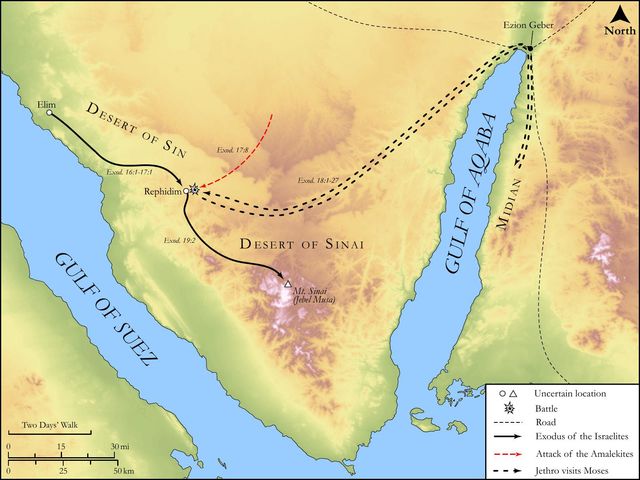
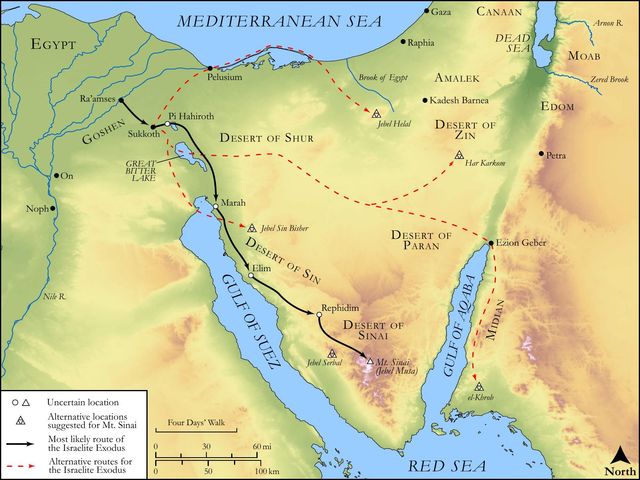
See on the biblical-era maps

Study this verse
Public-domain commentary
Matthew Henry
From his Commentary on the Whole Bible. Henry comments on passages, not single verses — this entry covers Exodus 18:1–6. His two-level outline is real structure in the source text, so it is rendered as structure.
This incident may very well be allowed to have happened as it is placed here, before the giving of the law, and not, as some place it, in connection with what is recorded, Num 10:11, Num 10:29, etc. Sacrifices were offered before; in these mentioned here (Exo 18:12) it is observable that Jethro is said to take them, not Aaron. And as to Jethro's advising Moses to constitute judges under him, though it is intimate (Exo 18:13) that the occasion of his giving that advice was on the morrow, yet it does not follow but that Moses's settlement of that affair might be some time after, when the law was given, as it is placed, Deu 1:9. It is plain that Jethro himself would not have him make this alteration in the government till he had received instructions from God about it (Exo 18:23), which he did not till some time after. Jethro comes,
I.To congratulate the happiness of Israel, and particularly the honour of Moses his son-in-law; and now Jethro thinks himself well paid for all the kindness he had shown to Moses in his distress, and his daughter better matched than he could have expected. Jethro could not but hear what all the country rang of, the glorious appearances of God for his people Israel (Exo 18:1); and he comes to enquire, and inform himself more fully thereof (see Psa 111:2), and to rejoice with them as one that had a true respect both for them and for their God. Though he, as a Midianite, was not to share with them in the promised land, yet he shared with them in the joy of their deliverance. We may thus make the comforts of others our own, by taking pleasure, as God does, in the prosperity of the righteous.
II.To bring Moses's wife and children to him.
It seems, he had sent them back, probably from the inn where his wife's aversion to the circumcision of her son had like to have cost him his life (Exo 4:25); fearing lest they should prove a further hindrance, he sent them home to his father-in-law. He foresaw what discouragements he was likely to meet with in the court of Pharaoh, and therefore would not take any with him in his own family. He was of that tribe that said to his father, I have not known him, when service was to be done for God, Deu 33:9. Thus Christ's disciples, when they were to go upon an expedition not much unlike that of Moses, were to forsake wife and children, Mat 19:29. But though there might be reason for the separation that was between Moses and his wife for a time, yet they must come together again, as soon as ever they could with any convenience. It is the law of the relation. You husbands, dwell with your wives, Pe1 3:7. Jethro, we may suppose, was glad of his daughter's company, and fond of her children, yet he would not keep her from her husband, nor them from their father, Exo 18:5, Exo 18:6. Moses must have his family with him, that while he ruled the church of God he might set a good example of prudence in family-government, Ti1 3:5. Moses had now a great deal both of honour and care put upon him, and it was fit that his wife should be with him to share with him in both. Notice is taken of the significant names of his two sons.
1.The eldest was called Gershom (Exo 18:3), a stranger, Moses designing thereby, not only a memorial of his own condition, but a memorandum to his son of his condition also: for we are all strangers upon earth, as all our fathers were. Moses had a great uncle almost of the same name, Gershon, a stranger; for though he was born in Canaan (Gen 46:11), yet even there the patriarchs confessed themselves strangers.
2.The other he called Eliezer (Exo 18:4), My God a help, as we translate it; it looks back to his deliverance from Pharaoh, when he made his escape, after the slaying of the Egyptian; but, if this was (as some think) the son that was circumcised at the inn as he was going, I would rather translate it so as to look forward, which the original will bear, The Lord is my help, and will deliver me from the sword of Pharaoh, which he had reason to expect would be drawn against him when he was going to fetch Israel out of bondage. Note, When we are undertaking any difficult service for God and our generation, it is good for us to encourage ourselves in God as our help: he that has delivered does and will deliver.
Continue studying Exodus 18:3 across the web’s major study libraries — every link below opens this exact verse, chapter, or book on the destination site.
Read & Compare
 BibleGatewayThis verse in more than 200 translations and 70 languages.
 Bible.comThe YouVersion reader — hundreds of translations, reading plans, and highlights.
 ESV.orgCrossway's official English Standard Version reader.
 NET BibleThe NET translation with 60,000+ translators' notes on every rendering decision.
 STEP BibleTyndale House's free study tool — original text, vocabulary, and scholarly resources.
 BibliaLogos Bible Software's free web reader.
 USCCBThe New American Bible (Revised Edition) with the U.S. bishops' study notes.
Commentaries
 BibleHub CommentariesDozens of classic commentaries on this verse, gathered on one page.
 StudyLightMore than 100 commentary sets — the largest collection on the web.
 BibleRefPlain-English commentary on what this verse means, verse by verse.
 Enduring WordDavid Guzik's free commentary on this chapter, widely used by Bible teachers.
 Bible Study ToolsVerse commentary alongside Greek and Hebrew study aids.
Original Language & Research
- BibleHub InterlinearThe verse word by word — original language, transliteration, and English.
- BibleHub LexiconEvery word's original-language definition and Strong's entry.
 Blue Letter BibleDeep-study tools — Strong's numbers, concordance, and word studies.
 SefariaThe Hebrew text with Rashi and centuries of Jewish commentary.
Sermons, Hymns & Audio


TrulyRandomVerse is not affiliated with these sites and doesn’t control their content. They’re linked because they’re genuinely useful.
Summary
Exodus 18:3 introduces Moses' firstborn son, Gershom, and elucidates the profound meaning behind his name, which signifies "a sojourner there." This verse captures Moses' deep sense of displacement and alienation during his forty years in Midian, reflecting his enduring longing for his true home and people, even as he established a family in a foreign land. It serves as a brief, yet deeply personal, interlude within the grand narrative of the Exodus, highlighting the human experience and inner world of a leader chosen by God.
Context
ShowHideLiterary Context
Exodus 18 opens with a significant family reunion, as Jethro, Moses' father-in-law, brings Moses' wife Zipporah and their two sons, Gershom and Eliezer, to him in the wilderness, having heard of God's mighty acts of deliverance for Israel. The immediate verses (Exodus 18:1-2) set the stage for this encounter, emphasizing the divine power that brought Israel out of Egypt. The mention of Gershom and the explanation of his name in this verse is immediately followed by the introduction of his younger brother, Eliezer, in Exodus 18:4, whose name also carries a significant theological meaning related to God's help. This personal reunion serves as a narrative pause, grounding the epic journey of the Exodus in Moses' personal life and family, before the chapter shifts to Jethro's wise counsel regarding the administration of justice among the burgeoning Israelite nation (Exodus 18:13-27).
Historical & Cultural Context
In Hebrew thought, names were rarely arbitrary labels; they often conveyed significant meaning, reflecting circumstances of birth, parental experiences, hopes, or even prophecies. Moses' decision to name his firstborn son Gershom ("a sojourner there") vividly expresses his personal feelings during his forty-year exile in Midian, a period following his flight from Pharaoh and preceding his divine call at the burning bush. The Hebrew term for "alien" or "sojourner" (גֵּר, ger) is crucial, denoting a non-native resident who lives among a people but retains a distinct identity. This status often conferred certain rights and protections in ancient Israelite law, reflecting Israel's own history as sojourners in Egypt and their subsequent identity as God's chosen people dwelling in a land promised to them. Moses' self-identification as a ger highlights his profound sense of not belonging in Midian, despite having established a family there.
Key Themes
ShowHideThis verse contributes to several key themes within Exodus and the broader Pentateuch. Firstly, it underscores the theme of Divine Providence and Preparation, showing how God prepared Moses not only through his upbringing in Pharaoh's court but also through his period of exile and personal reflection in Midian, where he learned humility and reliance on God. Secondly, it introduces the pervasive theme of Sojourning and Pilgrimage, both on a personal level for Moses and on a national level for Israel, who are themselves about to embark on a forty-year journey as sojourners in the wilderness before entering their promised land. This concept is deeply interwoven with Israel's identity, as seen in later commands to treat the sojourner justly, remembering their own experience as aliens in Egypt (Deuteronomy 10:19). Finally, the verse touches on the theme of Identity and Belonging, revealing Moses' enduring connection to his Israelite heritage despite his long absence from his people.
Exposition and Analysis
ShowHideKey Word Analysis
ShowHideThe name גֵּרְשֹׁם (Gêrᵉshôm) is derived from two Hebrew elements: גֵּר (gêr), meaning "sojourner" or "alien," and שָׁם (sham), meaning "there." Thus, the name literally means "a sojourner there" or "an alien in that place." This etymology directly encapsulates Moses' declaration in the latter part of the verse, serving as a perpetual reminder of his displacement and transient existence in Midian. The name is a testament to Moses' enduring connection to his Israelite heritage and a poignant reflection of his inner state despite his long absence.
The Hebrew word גֵּר (gêr) is central to understanding Moses' self-perception and the broader theological implications of this verse. From the root גּוּר (gur), meaning "to sojourn" or "to dwell temporarily," gêr properly denotes a "guest" or, by implication, a "foreigner" or "sojourner." It describes someone living in a land not their own, a resident foreigner who is distinct from the native population. This term carries significant theological weight throughout the Old Testament, often used to describe Israel's experience in Egypt and their subsequent calling to treat sojourners with justice and compassion, remembering their own past as aliens (Leviticus 19:34). Moses' use of this term for himself highlights his deep-seated feeling of not belonging in Midian, despite having married and started a family there.
Verse Breakdown
ShowHide"And her two sons; of which the name of the one [was] Gershom;"
This initial clause introduces the children of Zipporah, Moses' wife, specifically naming the firstborn, Gershom. The mention of "her two sons" (referring to Zipporah's children) emphasizes the family unit's reunion with Moses, setting a personal tone for the narrative. The immediate naming of Gershom signals the importance of his name's meaning, which the subsequent clause will explain.
"for he said, I have been an alien in a strange land:"
This explanatory phrase provides the deeply personal and theological reason behind Gershom's name. Moses, the speaker ("he said"), articulates his profound sense of being an outsider, a "sojourner" (גֵּר, gêr) in a "strange land" (אֶרֶץ נָכְרִיָּה, ʼerets nokrîyâ). This confession underscores his enduring connection to his true heritage and the land of his birth, even after decades in Midian. It speaks to a persistent longing and a provisional sense of belonging, despite having established a life there, revealing his inner spiritual and national identity.
Literary Devices
ShowHideThe verse employs Etymology as a primary literary device, where the meaning of Gershom's name is explicitly explained by Moses' personal declaration. This direct connection between the name and Moses' lived experience deepens the reader's understanding of his inner state and the circumstances that shaped him. There is also subtle Foreshadowing at play; Moses' personal experience as an "alien" subtly anticipates and mirrors the larger narrative of the Israelites, who are themselves about to embark on a forty-year journey as sojourners in the wilderness before entering their promised land. This personal narrative thus becomes a microcosm of the national experience. Furthermore, the verse uses Symbolism, where Moses' personal displacement symbolizes the broader human condition of being a sojourner, a profound theme that resonates throughout biblical theology, pointing to humanity's transient existence on earth and the ultimate longing for a true, eternal home.
Theological and Thematic Connections
ShowHideExodus 18:3 offers a profound glimpse into the personal cost and emotional landscape of Moses, a man chosen by God for an extraordinary mission. His naming of Gershom reveals a deep-seated sense of longing and a provisional identity, even amidst apparent stability. This theme of being a "sojourner" is not unique to Moses but is a recurring motif throughout Scripture, highlighting humanity's transient existence on earth and the ultimate longing for a true, eternal home. It underscores God's providential hand in preparing His leaders, allowing them to experience displacement and dependence, which often cultivates humility and reliance on Him. This experience of alienation serves as a crucible for faith, shaping Moses into the empathetic and reliant leader Israel would need.
Reflection and Application
ShowHideMoses' naming of Gershom, born out of his personal experience as an "alien in a strange land," speaks powerfully to the human condition of longing for belonging and a true home. For believers today, this resonates deeply with the understanding that our ultimate citizenship is in heaven, and we are but "strangers and pilgrims on the earth" (1 Peter 2:11). This perspective fundamentally shapes our values, priorities, and how we engage with the world around us. It reminds us that while we are called to live faithfully and engage with our earthly responsibilities, our deepest identity and ultimate hope lie beyond this temporal existence. Embracing this "sojourner" identity can free us from undue attachment to worldly comforts and pursuits, fostering a greater reliance on God and a fervent anticipation of our eternal dwelling with Him. It encourages us to live with an eternal perspective, investing in what truly lasts and seeking first the kingdom of God.
Questions for Reflection
ShowHideFAQ
ShowHideWhy is Moses' family reunion and the naming of his sons included in the Exodus narrative?
ShowHideThe inclusion of Moses' family reunion in Exodus 18 serves several important purposes. Firstly, it provides a personal and humanizing touch to Moses' character, reminding us that even great leaders have family lives and personal struggles. It shows God's care for Moses' personal well-being amidst his immense public responsibilities. Secondly, the names of his sons, Gershom and Eliezer, are deeply significant, reflecting Moses' personal journey, his faith in God's deliverance, and his evolving sense of identity. Gershom's name (Exodus 18:3) highlights Moses' past as a sojourner, while Eliezer's name (Exodus 18:4) celebrates God's help. This personal interlude also sets the stage for Jethro's wise counsel, which helps Moses manage the immense burden of leading the Israelites, demonstrating the importance of delegation and community support in ministry.
What is the theological significance of the term "alien" or "sojourner" (ger) in the Bible?
ShowHideThe term "alien" or "sojourner" (גֵּר, gêr) holds profound theological significance throughout the Bible. It first describes individuals like Moses who are living outside their native land. More broadly, it becomes a metaphor for Israel's own experience in Egypt and their subsequent status as a people dwelling in the Promised Land under God's covenant, acknowledging that the land ultimately belongs to God (Leviticus 25:23). The Law often commanded kindness and justice towards sojourners, reminding Israel of their own past vulnerability and God's compassion towards them (Deuteronomy 10:19). In the New Testament, this concept extends to all believers, who are seen as "strangers and pilgrims on the earth" (1 Peter 2:11), awaiting their true, eternal home in God's presence. It emphasizes that our ultimate allegiance and belonging are not to this world, but to God's heavenly kingdom.
Christ-Centered Fulfillment
ShowHideMoses' experience as an "alien in a strange land," profoundly reflected in the naming of Gershom, finds its ultimate fulfillment and transformation in the person and work of Jesus Christ. While Moses was an alien by circumstance, Jesus, the eternal Son of God, willingly became an "alien" to His heavenly home through the incarnation, taking on human flesh to dwell among us (John 1:14). He entered a world that was not His true home, often having "nowhere to lay his head" (Matthew 8:20) as He ministered. Through His perfect life, atoning death, and glorious resurrection, Christ not only identified with humanity's fallen, alienated state but also provided the means for us to be reconciled to God and brought into our true, eternal home. Believers, united with Christ by faith, now share in His "alien" status in this world, recognizing that our true citizenship is in heaven (Philippians 3:20), and we are merely sojourners awaiting the full realization of God's kingdom. Thus, Moses' personal longing for home foreshadows the spiritual pilgrimage of all those who are "in Christ," journeying towards the new heavens and new earth where God will dwell with His people forever, wiping away every tear (Revelation 21:3-4).