


Exodus 2:15
Bible text: King James Version (1769 Blayney text) · Public domain
Bible text: King James Version with Strong's numbers · Public domain
Bible text: Berean Standard Bible · Public domain
Bible text: American Standard Version (1901) · Public domain
Bible text: World English Bible, Messianic edition · Public domain
Bible text: Geneva Bible (1599) · Public domain
Bible text: Young's Literal Translation · Public domain
- וַיִּשְׁמַעvai·yish·Ma'and he heardH8085Conj-w ¦ V-Qal-ConsecImperf-3msVerb Qal Consecutive Imperfect 3rd Singular Masculineוַandיִּשְׁמַעhe heard
- פַּרְעֹהpar·'OhPharaohH6547N-msNoun Title Singular Masculine Absolute
- אֶת'et<obj.>H853DirObjMParticle Object Indicator
- הַדָּבָרha·da·Varthe matterH1697Art ¦ N-msNoun Singular Masculine Absoluteהַtheדָּבָרmatter
- הַזֶּהha·Zeh<the> thisH2088Art ¦ PrtParticle Demonstrativeהַ<the>זֶּהthis
- וַיְבַקֵּשׁvay·va·Keshand he soughtH1245Conj-w ¦ V-Piel-ConsecImperf-3msVerb Piel Consecutive Imperfect 3rd Singular Masculineוַandיְבַקֵּשׁhe sought
- לַהֲרֹגla·ha·Rogto killH2026Prep-l ¦ V-Qal-InfVerb Qal Infinitive Constructלַtoהֲרֹגkill
- אֶת'et<obj.>H853DirObjMParticle Object Indicator
- מֹשֶׁהmo·ShehMosesH4872N-proper-mNoun Proper Masculine
- וַיִּבְרַחvai·yiv·Rachand he fledH1272Conj-w ¦ V-Qal-ConsecImperf-3msVerb Qal Consecutive Imperfect 3rd Singular Masculineוַandיִּבְרַחhe fled
- מֹשֶׁהmo·ShehMosesH4872N-proper-mNoun Proper Masculine
- מִפְּנֵיmi·pe·Neifrom beforeH6440Prep-m ¦ N-mpcNoun Plural Masculine Constructמִfromפְּנֵיbefore
- פַרְעֹהfar·'OhPharaohH6547N-msNoun Title Singular Masculine Absolute
- וַיֵּשֶׁבvai·Ye·shevand he dweltH3427Conj-w ¦ V-Qal-ConsecImperf-3msVerb Qal Consecutive Imperfect 3rd Singular Masculineוַandיֵּשֶׁבhe dwelt
- בְּאֶרֶץbe·'e·retzin [the] land ofH776Prep-b ¦ N-fscNoun Singular Feminine Constructבְּinאֶרֶץ[the] land of
- מִדְיָןmid·YanMidianH4080N-properNoun Proper Location
- וַיֵּשֶׁבvai·Ye·shevand he satH3427Conj-w ¦ V-Qal-ConsecImperf-3msVerb Qal Consecutive Imperfect 3rd Singular Masculineוַandיֵּשֶׁבhe sat
- עַל'alatH5921PrepPreposition
- הַבְּאֵרha·be·'Erthe wellH875Art ¦ N-fsNoun Singular Feminine Absoluteהַtheבְּאֵרwell
English is a literal word-by-word gloss of the Hebrew, not the KJV's wording. Why?
This is the original text the KJV's translators worked from — each Hebrew word with its own literal English meaning in this verse, prepared by scholars at Tyndale House, Cambridge. The KJV translates whole sentences, not word by word, so its wording differs: one Hebrew word can become several English words, and the KJV may choose “the LORD” where the gloss reads “Yahweh”. Both are faithful — they answer different questions. For the KJV's own rendering, switch to the KJV text.
Details
See on the biblical-era maps

Study this verse
Public-domain commentary
Matthew Henry
From his Commentary on the Whole Bible. Henry comments on passages, not single verses — this entry covers Exodus 2:11–15. His four-level outline is real structure in the source text, so it is rendered as structure.
Moses had now passed the first forty years of his life in the court of Pharaoh, preparing himself for business; and now it was time for him to enter upon action, and,
I.He boldly owns and espouses the cause of God's people:
When Moses was grown he went out unto his brethren, and looked on their burdens, Exo 2:11. The best exposition of these words we have from an inspired pen, Heb 11:24-26, where we are told that by this he expressed,
1.His holy contempt of the honours and pleasures of the Egyptian court; he refused to be called the son of Pharaoh's daughter, for he went out. The temptation was indeed very strong. He had a fair opportunity (as we say) to make his fortune, and to have been serviceable to Israel too, with his interest at court. He was obliged, in gratitude as well as interest, to Pharaoh's daughter, and yet he obtained a glorious victory by faith over his temptation. He reckoned it much more his honour and advantage to be a son of Abraham than to be the son of Pharaoh's daughter.
2.His tender concern for his poor brethren in bondage, with whom (though he might easily have avoided it) he chose to suffer affliction; he looked on their burdens as one that not only pitied them, but was resolved to venture with them, and, if occasion were, to venture for them.
II.He gives a specimen of the great things he was afterwards to do for God and his Israel in two little instances, related particularly by Stephen (Act 7:23, etc.) with design to show how their fathers had always resisted the Holy Ghost (v. 51), even in Moses himself, when he first appeared as their deliverer, wilfully shutting their eyes against this day-break of their enlargement. He found himself, no doubt, under a divine direction and impulse in what he did, and that he was in an extraordinary manner called of God to do it. Now observe,
1.Moses was afterwards to be employed in plaguing the Egyptians for the wrongs they had done to God's Israel; and, as a specimen of that, he killed the Egyptian who smote the Hebrew (Exo 2:11, Exo 2:12); probably it was one of the Egyptian taskmasters, whom he found abusing his Hebrew slave, a relation (as some think) of Moses, a man of the same tribe. It was by special warrant from Heaven (which makes not a precedent in ordinary cases) that Moses slew the Egyptian, and rescued his oppressed brother. The Jew's tradition is that he did not slay him with any weapon, but, as Peter slew Ananias and Sapphira, with the word of his mouth. His hiding him in the sand signified that hereafter Pharaoh and all his Egyptians should, under the control of the rod of Moses, be buried in the sand of the Red Sea. His taking care to execute this justice privately, when no man saw, was a piece of needful prudence and caution, it being but an assay; and perhaps his faith was as yet weak, and what he did was with some hesitation. Those who come to be of great faith, yet began with a little, and at first spoke tremblingly.
2.Moses was afterwards to be employed in governing Israel, and as a specimen of this, we have him here trying to end a controversy between two Hebrews, in which he is forced (as he did afterwards for forty years) to suffer their manners. Observe here,
(1.)The unhappy quarrel which Moses observed between two Hebrews, Exo 2:13. It does not appear what was the occasion; but, whatever it was, it was certainly very unseasonable for Hebrews to strive with one another when they were all oppressed and ruled with rigour by the Egyptians. Had they not beating enough from the Egyptians, but they must beat one another? Note,
[1.]Even sufferings in common do not always unite God's professing people to one another, so much as one might reasonably expect.
[2.]When God raises up instruments of salvation for the church they will find enough to do, not only with oppressing Egyptians, to restrain them, but with quarrelsome Israelites, to reconcile them.
(2.)The way he took of dealing with them; he marked him that caused the division, that did the wrong, and mildly reasoned with him: Wherefore smitest thou thy fellow? The injurious Egyptian was killed, the injurious Hebrew was only reprimanded; for what the former did was from a rooted malice, what the latter did we may suppose was only upon a sudden provocation. The wise God makes, and, according to his example, all wise governors make, a difference between one offender and another, according to the several qualities of the same offence. Moses endeavoured to make them friends, a good office; thus we find Christ often reproving his disciples' strifes (Luk 9:46, etc.; Luk 22:24, etc.), for he was a prophet like unto Moses, a healing prophet, a peacemaker, who visited his brethren with a design to slay all enmities. The reproof Moses gave on this occasion may still be of use, Wherefore smitest thou thy fellow? Note, Smiting our fellows is bad in any, especially in Hebrews, smiting with tongue or hand, either in a way of persecution or in a way of strife and contention. Consider the person thou smitest; it is thy fellow, thy fellow-creature, thy fellow-christian, it is thy fellow-servant, thy fellow-sufferer. Consider the cause, Wherefore smitest? Perhaps it is for no cause at all, or no just cause, or none worth speaking of.
(3.)The ill success of his attempt (v. 14): He said, Who made thee a prince? He that did the wrong thus quarrelled with Moses; the injured party, it should seem, was inclinable enough to peace, but the wrong-doer was thus touchy. Note, It is a sign of guilt to be impatient of reproof; and it is often easier to persuade the injured to bear the trouble of taking wrong than the injurious to bear the conviction of having done wrong. Co1 6:7, Co1 6:8. It was a very wise and mild reproof which Moses gave to this quarrelsome Hebrew, but he could not bear it, he kicked against the pricks (Act 9:5), and crossed questions with his reprover.
[1.]He challenges his authority: Who made thee a prince? A man needs no great authority for the giving of a friendly reproof, it is an act of kindness; yet this man needs will interpret it an act of dominion, and represents his reprover as imperious and assuming. Thus when people dislike good discourse, or a seasonable admonition, they will call it preaching, as if a man could not speak a work for God and against sin but he took too much upon him. Yet Moses was indeed a prince and a judge, and knew it, and thought the Hebrews would have understood it, and struck in with him; but they stood in their own light, and thrust him away, Act 7:25, Act 7:27.
[2.]He upbraids him with what he had done in killing the Egyptian: Intendest thou to kill me? See what base constructions malice puts upon the best words and actions. Moses, for reproving him is immediately charged with a design to kill him. An attempt upon his sin was interpreted an attempt upon his life; and his having killed the Egyptian was thought sufficient to justify the suspicion; as if Moses made no difference between an Egyptian and a Hebrew. If Moses, to right an injured Hebrew, had put his life in his hand, and slain an Egyptian, he ought therefore to have submitted to him, not only as a friend to the Hebrews, but as a friend that had more than ordinary power and zeal. But he throws that in his teeth as a crime which was bravely done, and was intended as a specimen of the promised deliverance; if the Hebrews had taken the hint, and come in to Moses as their head and captain, it is probable that they would have been delivered now; but, despising their deliverer, their deliverance was justly deferred, and their bondage prolonged forty years, as afterwards their despising Canaan kept them out of it forty years more. I would, and you would not. Note, Men know not what they do, nor what enemies they are to their own interest, when they resist and despise faithful reproofs and reprovers. When the Hebrews strove with Moses, God sent him away into Midian, and they never heard of him for forty years; thus the things that belonged to their peace were hidden from their eyes, because they knew not the day of their visitation. As to Moses, we may look on it as a great damp and discouragement to him. He was now choosing to suffer affliction with the people of God, and embracing the reproach of Christ; and now, at his first setting out, to meet with this affliction and reproach from them was a very sore trial of his resolution. He might have said, "If this be the spirit of the Hebrews, I will go to court again, and be the son of Pharaoh's daughter." Note, First, We must take heed of being prejudiced against the ways and people of God by the follies and peevishness of some particular persons that profess religion. Secondly, It is no new thing for the church's best friends to meet with a great deal of opposition and discouragement in their healing, saving attempts, even from their own mother's children; Christ himself was set at nought by the builders, and is still rejected by those he would save.
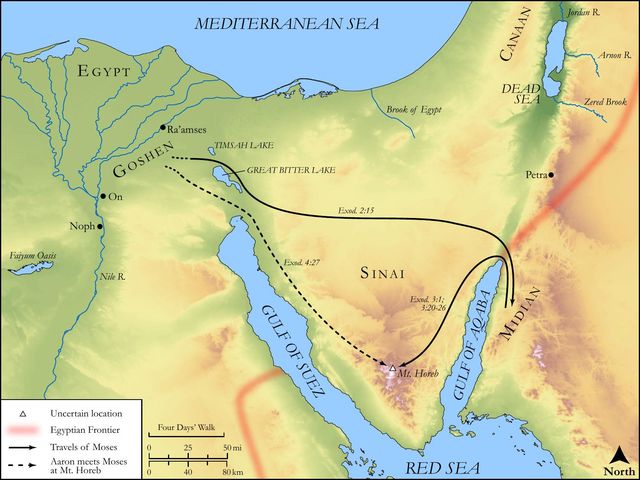
(4.)The flight of Moses to Midian, in consequence. The affront given him thus far proved a kindness to him; it gave him to understand that his killing the Egyptian was discovered, and so he had time to make his escape, otherwise the wrath of Pharaoh might have surprised him and taken him off. Note, God can overrule even the strife of tongues, so as, one way or other, to bring good to his people out of it. Information was brought to Pharaoh (and it is well if it was not brought by the Hebrew himself whom Moses reproved) of his killing the Egyptian; warrants are presently out for the apprehending of Moses, which obliged him to shift for his own safety, by flying into the land of Midian, Exo 2:15.
[1.]Moses did this out of a prudent care of his own life. If this be his forsaking of Egypt which the apostle refers to as done by faith (Heb 11:27), it teaches us that when we are at any time in trouble and danger for doing our duty the grace of faith will be of good use to us in taking proper methods for our own preservation. Yet there it is said, He feared not the wrath of the king; here it is said he feared, Exo 2:14. He did not fear with a fear of diffidence and amazement, which weakens and has torment, but with a fear of diligence, which quickened him to take that way which Providence opened to him for his own preservation.
[2.]God ordered it for wise and holy ends. Things were not yet ripe for Israel's deliverance: the measure of Egypt's iniquity was not yet full; the Hebrews were not sufficiently humbled, nor were they yet increased to such a multitude as God designed; Moses is to be further fitted for the service, and therefore is directed to withdraw for the present, till the time to favour Israel, even the set time, should come. God guided Moses to Midian because the Midianites were of the seed of Abraham, and retained the worship of the true God among them, so that he might have not only a safe but a comfortable settlement among them. And through this country he was afterwards to lead Israel, with which (that he might do it the better) he now had opportunity of making himself acquainted. Hither he came, and sat down by a well, tired and thoughtful, at a loss, and waiting to see which way Providence would direct him. It was a great change with him, since he was but the other day at ease in Pharaoh's court: thus God tried his faith, and it was found to praise and honour.
Historical interpretation
Fourteen Centuries of Reception
3 surviving comments on this verse. Each one is dated, so this reads as a timeline rather than a list.
Select a marker to jump to its quote. Markers stagger vertically where authors wrote within a few decades of each other.
Moses went out from Egypt and was made a prophet and sent back to the people that he might free their souls from the land of affliction.
Thus did Moses flee from the face of Pharaoh, so that the royal palace would not defile him or royal power ensnare him. Indeed, he valued reproach for Christ as more precious than the riches of Egypt.
Madian: A city and country of Arabia, which took its name from Madian the son of Abraham, by Cetura, and was peopled by his posterity.
Continue studying Exodus 2:15 across the web’s major study libraries — every link below opens this exact verse, chapter, or book on the destination site.
Read & Compare
 BibleGatewayThis verse in more than 200 translations and 70 languages.
 Bible.comThe YouVersion reader — hundreds of translations, reading plans, and highlights.
 ESV.orgCrossway's official English Standard Version reader.
 NET BibleThe NET translation with 60,000+ translators' notes on every rendering decision.
 STEP BibleTyndale House's free study tool — original text, vocabulary, and scholarly resources.
 BibliaLogos Bible Software's free web reader.
 USCCBThe New American Bible (Revised Edition) with the U.S. bishops' study notes.
Commentaries
 BibleHub CommentariesDozens of classic commentaries on this verse, gathered on one page.
 StudyLightMore than 100 commentary sets — the largest collection on the web.
 BibleRefPlain-English commentary on what this verse means, verse by verse.
 Enduring WordDavid Guzik's free commentary on this chapter, widely used by Bible teachers.
 Bible Study ToolsVerse commentary alongside Greek and Hebrew study aids.
Original Language & Research
- BibleHub InterlinearThe verse word by word — original language, transliteration, and English.
- BibleHub LexiconEvery word's original-language definition and Strong's entry.
 Blue Letter BibleDeep-study tools — Strong's numbers, concordance, and word studies.
 SefariaThe Hebrew text with Rashi and centuries of Jewish commentary.
Sermons, Hymns & Audio


TrulyRandomVerse is not affiliated with these sites and doesn’t control their content. They’re linked because they’re genuinely useful.
Summary
Exodus 2:15 marks a critical juncture in the life of Moses, narrating Pharaoh's discovery of Moses' act of killing an Egyptian taskmaster, which triggers a royal decree for Moses' execution. This immediate and grave threat compels Moses to flee Egypt, seeking refuge in the distant land of Midian, where he settles by a well, signifying his dramatic transition from an esteemed prince in the world's most powerful empire to a solitary fugitive in the wilderness, wholly dependent on divine providence.
Context
ShowHideLiterary Context
This verse immediately follows Moses' two significant encounters in Exodus 2:11-14. First, he intervenes on behalf of a Hebrew slave, killing an Egyptian taskmaster. Second, he attempts to mediate a dispute between two Hebrews, only to have his previous act exposed by one of them. The exposure of his crime, particularly by a fellow Israelite whom he sought to help, underscores the isolation and danger Moses now faces. His flight is not a strategic retreat but a desperate escape from a very real and imminent threat to his life, setting the stage for his forty-year sojourn in the wilderness, a period of divine preparation before his ultimate calling.
Historical & Cultural Context
In the monarchies of that day, the killing of a royal official, especially by someone raised within the royal court, would be considered an act of treason, punishable by death. Pharaoh, as the absolute ruler and perceived divine embodiment, would view such an act as a direct challenge to his authority and the stability of his kingdom. The "face of Pharaoh" (H6440, pânîym) signifies not just his physical presence but the full weight of his royal power, his wrath, and his legal authority. Fleeing to Midian, a nomadic region east of the Gulf of Aqaba, was a common strategy for those seeking asylum from Egyptian rule, as it lay beyond Pharaoh's direct jurisdiction, offering a safe haven in its vast, arid expanse.
Key Themes
ShowHideExodus 2:15 contributes significantly to several overarching themes within the book of Exodus and the broader Pentateuch. It highlights the theme of Divine Providence, demonstrating how God sovereignly orchestrates events, even human failures and flights, to fulfill His ultimate purposes, preparing Moses for his future role as Israel's deliverer. It also underscores the theme of Preparation in Obscurity, as Moses' exile from the palace to the wilderness of Midian serves as a crucial period of spiritual and practical formation, stripping him of his Egyptian identity and preparing him for the arduous task of leading a nomadic people. Furthermore, the verse subtly introduces the theme of God's Deliverance through Unlikely Means, as the future deliverer of Israel begins his journey not from a position of strength, but from one of vulnerability and flight, foreshadowing God's pattern of using the weak and unassuming to accomplish His mighty works, a pattern seen throughout the biblical narrative, from Abraham to David to the apostles in the New Testament.
Exposition and Analysis
ShowHideKey Word Analysis
ShowHideThis verb denotes an active, determined, and often intense pursuit or search. Pharaoh's "seeking to slay Moses" implies not a casual desire but a deliberate and official effort to apprehend and execute him. It conveys the full weight of royal authority and the severity of the threat Moses faced, making his flight an absolute necessity.
This word describes a sudden, urgent, and often desperate escape. Moses' flight was not a leisurely departure but a rapid, life-saving act, emphasizing the immediate danger and the swiftness with which he had to abandon his former life and privileges. It highlights his vulnerability and the complete reversal of his circumstances.
This versatile verb can mean "to sit," "to dwell," "to remain," or "to settle." In the context of Moses' arrival in Midian, it first signifies his act of sitting down by the well, likely out of exhaustion and need for refreshment after his flight. Subsequently, it implies his prolonged "dwelling" or "settling" in Midian for the next forty years, indicating a period of stability and integration into a new life, albeit one far removed from his princely past.
A "well" in the arid lands of Midian and of the patriarchs was a vital source of life, a gathering place, and often a site of significant encounters. For Moses, sitting by a well after his arduous flight symbolizes not only his physical need for water and rest but also a point of transition and potential new beginnings. It is at this well that he soon encounters the daughters of Reuel (Jethro), leading to his marriage and new life in Midian.
Verse Breakdown
ShowHide"Now when Pharaoh heard this thing,"
This clause establishes the immediate cause of Moses' flight—the revelation of his act of killing the Egyptian taskmaster. Pharaoh's "hearing" implies not just passive reception of information but official intelligence reaching the highest authority, demanding a response. The "thing" (H1697, dâbâr) refers to the specific incident of the murder, which was considered a capital offense and an act of rebellion against the crown.
"he sought to slay Moses."
This phrase reveals Pharaoh's immediate and severe reaction. His "seeking to slay" (H1245, bâqash to seek; H2026, hârag to slay) indicates a deliberate and determined pursuit, underscoring the mortal danger Moses was in. It highlights the absolute power of the monarch and the gravity of Moses' perceived crime.
"But Moses fled from the face of Pharaoh,"
This marks Moses' desperate and urgent response to the threat. "Fled" (H1272, bârach) emphasizes the haste and necessity of his escape. Fleeing "from the face of Pharaoh" (H6440, pânîym) signifies escaping the direct presence, authority, and wrath of the king, symbolizing a complete severance from his former life and position within the Egyptian court.
"and dwelt in the land of Midian:"
This specifies Moses' destination and initial period of refuge. Midian (H4080, Midyân) was a region beyond Egyptian control, offering safety to fugitives. His "dwelling" (H3427, yâshab) there indicates a prolonged stay, marking the beginning of his forty-year exile and period of preparation away from the influences of Egypt.
"and he sat down by a well."
This final clause depicts Moses' state upon arrival in Midian. Sitting "by a well" (H875, bᵉʼêr) suggests exhaustion and vulnerability after his flight, but also a place of vital sustenance and potential encounter in the arid wilderness. It sets the scene for his pivotal meeting with Jethro's daughters and his subsequent integration into Midianite life.
Literary Devices
ShowHideExodus 2:15 effectively employs several literary devices. Irony is prominent, as Moses, raised in Pharaoh's palace and destined to be a prince, finds himself a fugitive from that very power. The one who was "drawn out" (Moses' name, H4872, Môsheh) of the water is now forced to flee into the wilderness, dependent on a well for survival. There is also significant Foreshadowing in Moses' flight from a tyrannical ruler who seeks to kill the deliverer; this motif will recur in the New Testament with Christ's flight from Herod. The verse uses Contrast to highlight Moses' dramatic shift in status and environment: from the opulence of Pharaoh's court to the desolation of the Midianite wilderness, from a position of power to one of vulnerability. The Symbolism of the "well" is also noteworthy, representing not only physical sustenance in a barren land but also a place of encounter, new beginnings, and the provision of life in unexpected circumstances.
Theological and Thematic Connections
ShowHideThis pivotal moment in Moses' life profoundly illustrates God's sovereign control over seemingly chaotic human events. Even Moses' impulsive act and subsequent flight, which appear to be setbacks, are divinely orchestrated to remove him from the corrupting influences of Egypt and initiate a crucial period of spiritual formation. God uses this time of obscurity and hardship in the wilderness to strip Moses of his self-reliance and prepare him, through humility and dependence, for the monumental task of leading Israel. It demonstrates that God's plans are not thwarted by human weakness or opposition, but rather, He masterfully weaves all circumstances—even flight and exile—into the fabric of His redemptive purposes, proving that His timing and methods often differ from human expectations, yet always lead to His intended glorious outcome.
Reflection and Application
ShowHideExodus 2:15 offers profound lessons for our own spiritual journeys. We often face unexpected detours, forced changes, or the consequences of our own impulsive actions. Like Moses, we may find ourselves in seasons of obscurity, exile, or what feels like a wilderness, far removed from our perceived purpose or former glory. This verse encourages us to recognize that even in these moments of flight or perceived failure, God is not absent. Rather, He is actively at work, using these very circumstances to shape our character, cultivate humility, and teach us absolute dependence on Him. It reminds us that our "wilderness" experiences are often God's training grounds, essential for preparing us for future callings and for deepening our faith. We are called to trust His sovereign hand, even when the path is unclear, knowing that He can redeem and repurpose every experience for His ultimate glory and our good, transforming our setbacks into stepping stones for His divine plan.
Questions for Reflection
ShowHideFAQ
ShowHideWhy did Moses flee rather than confront Pharaoh immediately?
ShowHideMoses' flight was a direct and necessary response to Pharaoh's intent to kill him, indicating a very real and immediate threat to his life. At this point in his life, Moses was acting on his own strength and timing, not under divine commission. His impulsive act of killing the Egyptian revealed that he was not yet spiritually or practically prepared or empowered by God for the monumental task of confronting Pharaoh and leading Israel. His forty years in Midian were essential for his spiritual formation, learning humility, patience, and the ways of the desert, before he could fulfill his divine calling to lead God's people out of bondage, as detailed later in Exodus 3.
Christ-Centered Fulfillment
ShowHideMoses' flight from Pharaoh, a king who sought to destroy the deliverer, profoundly foreshadows Christ's own flight to Egypt as an infant to escape Herod's murderous decree, as recorded in Matthew 2:13-15. Both narratives highlight the vulnerability of God's chosen deliverers in the face of tyrannical earthly power, yet also underscore God's providential protection over His anointed ones. Furthermore, Moses' forty-year period of obscurity and preparation in Midian, where he learned humility and dependence on God away from the world's spotlight, parallels Christ's own thirty years of quiet preparation in Nazareth before His public ministry began. Ultimately, Moses, as the one who fled to save his life and eventually delivered his people from physical bondage, prefigures Christ, who, though innocent and divine, "fled" from the glory of heaven to earth. Jesus willingly laid down His life, not to save His own, but to deliver His people from the ultimate bondage of sin and death, fulfilling the greater exodus from spiritual slavery, as depicted in passages like John 1:29 and Hebrews 2:14-15. He is the true and greater Moses, the Lamb of God who takes away the sin of the world, leading His people to true freedom.