


Exodus 2:16
Bible text: King James Version (1769 Blayney text) · Public domain
Bible text: Berean Standard Bible · Public domain
Bible text: American Standard Version (1901) · Public domain
Bible text: World English Bible, Messianic edition · Public domain
Bible text: Geneva Bible (1599) · Public domain
Bible text: Young's Literal Translation · Public domain
- וּלְכֹהֵןu·le·kho·Henand [belonged] to [the] priest ofH3548Conj-w ¦ Prep-l ¦ N-mscNoun Singular Masculine Constructוּandלְ[belonged] toכֹהֵן[the] priest of
- מִדְיָןmid·YanMidianH4080N-properNoun Proper Location
- שֶׁבַעShe·va'sevenH7651Adj-csAdjective Numerical Singular common gender Absolute
- בָּנוֹתba·NotdaughtersH1323N-fpNoun Plural Feminine Absolute
- וַתָּבֹאנָהva·ta·Vo·nahand they cameH935Conj-w ¦ V-Qal-ConsecImperf-3fpVerb Qal Consecutive Imperfect 3rd Plural Feminineוַandתָּבֹאנָהthey came
- וַתִּדְלֶנָהva·tid·Le·nahand they drewH1802Conj-w ¦ V-Qal-ConsecImperf-3fpVerb Qal Consecutive Imperfect 3rd Plural Feminineוַandתִּדְלֶנָהthey drew
- וַתְּמַלֶּאנָהva·te·ma·Le·nahand they filledH4390Conj-w ¦ V-Piel-ConsecImperf-3fpVerb Piel Consecutive Imperfect 3rd Plural Feminineוַandתְּמַלֶּאנָהthey filled
- אֶת'et<obj.>H853DirObjMParticle Object Indicator
- הָרְהָטִיםha·re·ha·Timthe drinking troughsH7298Art ¦ N-mpNoun Plural Masculine Absoluteהָtheרְהָטִיםdrinking troughs
- לְהַשְׁקוֹתle·hash·Kotto waterH8248Prep-l ¦ V-Hiphil-InfVerb Hiphil Infinitive Constructלְtoהַשְׁקוֹתwater
- צֹאןtzon[the] flock ofH6629N-cscNoun Singular common gender Construct
- אֲבִיהֶן'a·vi·Hentheir fatherH1N-msc ¦ 3fpNoun Singular Masculine Constructאֲבִיfatherהֶןtheir
English is a literal word-by-word gloss of the Hebrew, not the KJV's wording. Why?
This is the original text the KJV's translators worked from — each Hebrew word with its own literal English meaning in this verse, prepared by scholars at Tyndale House, Cambridge. The KJV translates whole sentences, not word by word, so its wording differs: one Hebrew word can become several English words, and the KJV may choose “the LORD” where the gloss reads “Yahweh”. Both are faithful — they answer different questions. For the KJV's own rendering, switch to the KJV text.
Details
See on the biblical-era maps

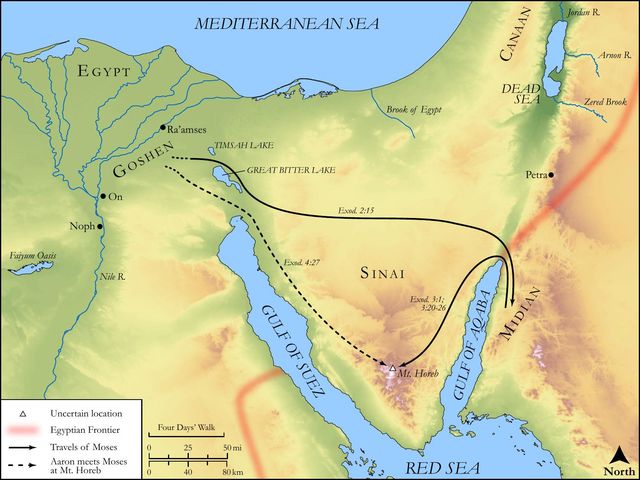
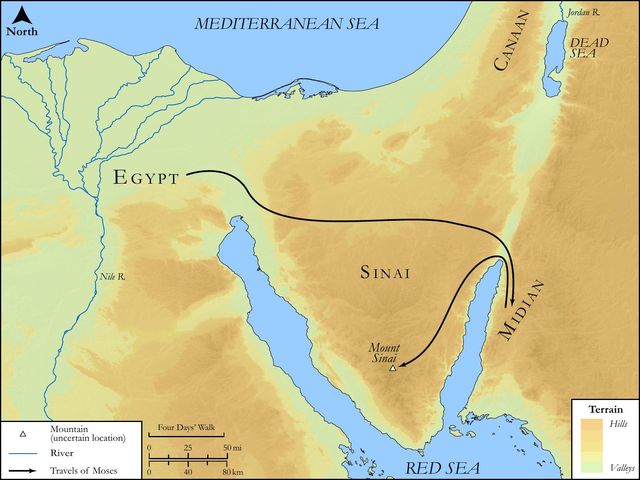
Study this verse
Public-domain commentary
Matthew Henry
From his Commentary on the Whole Bible. Henry comments on passages, not single verses — this entry covers Exodus 2:16–22. His four-level outline is real structure in the source text, so it is rendered as structure.
Moses here gains a settlement in Midian, just as his father Jacob had gained one in Syria, Gen 29:2, etc. And both these instances should encourage us to trust Providence, and to follow it. Events that seem inconsiderable, and purely accidental, afterwards appear to have been designed by the wisdom of God for very good purposes, and of great consequence to his people. A casual transient occurrence has sometimes occasioned the greatest and happiest turns of a man's life. Observe,
I.Concerning the seven daughters of Reuel the priest or prince of Midian.
1.They were humble, and very industrious, according as the employment of the country was: they drew water for their father's flock, Exo 2:16. If their father was a prince, it teaches us that even those who are honourably born, and are of quality and distinction in their country, should yet apply themselves to some useful business, and what their hand finds to do do it with all their might. Idleness can be no one's honour. If their father was a priest, it teaches us that ministers' children should, in a special manner, be examples of humility and industry.
2.They were modest, and would not ask this strange Egyptian to come home with them (though handsome and a great courtier), till their father sent for him. Modesty is the ornament of woman.
II.Concerning Moses.
He was taken for an Egyptian (Exo 2:19); and strangers must be content to be the subjects of mistake; but it is observable,
1.How ready he was to help Reuel's daughters to water their flocks. Though bred in learning and at court, yet he knew how to turn his hand to such an office as this when there was occasion; nor had he learned of the Egyptians to despise shepherds. Note, Those that have had a liberal education yet should not be strangers to servile work, because they know not what necessity Providence may put them in of working for themselves, or what opportunity Providence may give them of being serviceable to others. These young women, it seems, met with some opposition in their employment, more than they and their servants could conquer; the shepherds of some neighbouring prince, as some think, or some idle fellows that called themselves shepherds, drove away their flocks; but Moses, though melancholy and in distress, stood up and helped them, not only to get clear of the shepherds, but, when that was done, to water the flocks. This he did, not only in complaisance to the daughters of Reuel (though that also did very well become him), but because, wherever he was, as occasion offered itself,
(1.)He loved to be doing justice, and appearing in the defence of such as he saw injured, which every man ought to do as far as it is in the power of his hand to do it.
(2.)He loved to be doing good. Wherever the Providence of God casts us we should desire and endeavour to be useful; and, when we cannot do the good we would, we must be ready to do the good we can. And he that is faithful in a little shall be entrusted with more.
2.How well he was paid for his serviceableness. When the young women acquainted their father with the kindnesses they had received from this stranger, he sent to invite him to his house, and made much of him, Exo 2:20. Thus God will recompense the kindnesses which are at any time shown to his children; they shall in no wise lose their reward. Moses soon recommended himself to the esteem and good affection of this prince of Midian, who took him into his house, and, in process of time, married one of his daughters to him (Exo 2:21), by whom he had a son, whom he called Gershom, a stranger there (Exo 2:22), that if ever God should give him a home of his own he might keep in remembrance the land in which he had been a stranger. Now this settlement of Moses in Midian was designed by Providence,
(1.)To shelter him for the present. God will find hiding-places for his people in the day of their distress; nay, he will himself be to them a little sanctuary, and will secure them, either under heaven or in heaven. But,
(2.)It was also designed to prepare him for the great services he was further designed for. His manner of life in Midian, where he kept the flock of his father-in-law (having none of his own to keep), would be of use to him,
[1.]To inure him to hardship and poverty, that he might learn how to want as well as how to abound. Those whom God intends to exalt he first humbles.
[2.]To inure him to contemplation and devotion. Egypt accomplished him as a scholar, a gentleman, a statesman, a soldier, all which accomplishments would be afterwards of use to him; but yet he lacked one thing, in which the court of Egypt could not befriend him. He that was to do all by divine revelation must know, by a long experience, what it was to live a life of communion with God; and in this he would be greatly furthered by the solitude and retirement of a shepherd's life in Midian. By the former he was prepared to rule in Jeshurun, but by the latter he was prepared to converse with God in Mount Horeb, near which mount he had spent much of his time. Those that know what it is to be alone with God in holy exercises are acquainted with better delights than ever Moses tasted in the court of Pharaoh.
Continue studying Exodus 2:16 across the web’s major study libraries — every link below opens this exact verse, chapter, or book on the destination site.
Read & Compare
 BibleGatewayThis verse in more than 200 translations and 70 languages.
 Bible.comThe YouVersion reader — hundreds of translations, reading plans, and highlights.
 ESV.orgCrossway's official English Standard Version reader.
 NET BibleThe NET translation with 60,000+ translators' notes on every rendering decision.
 STEP BibleTyndale House's free study tool — original text, vocabulary, and scholarly resources.
 BibliaLogos Bible Software's free web reader.
 USCCBThe New American Bible (Revised Edition) with the U.S. bishops' study notes.
Commentaries
 BibleHub CommentariesDozens of classic commentaries on this verse, gathered on one page.
 StudyLightMore than 100 commentary sets — the largest collection on the web.
 BibleRefPlain-English commentary on what this verse means, verse by verse.
 Enduring WordDavid Guzik's free commentary on this chapter, widely used by Bible teachers.
 Bible Study ToolsVerse commentary alongside Greek and Hebrew study aids.
Original Language & Research
- BibleHub InterlinearThe verse word by word — original language, transliteration, and English.
- BibleHub LexiconEvery word's original-language definition and Strong's entry.
 Blue Letter BibleDeep-study tools — Strong's numbers, concordance, and word studies.
 SefariaThe Hebrew text with Rashi and centuries of Jewish commentary.
Sermons, Hymns & Audio


TrulyRandomVerse is not affiliated with these sites and doesn’t control their content. They’re linked because they’re genuinely useful.
Summary
Marks a pivotal moment in Moses's life, detailing his arrival in Midian and his providential encounter with the seven daughters of the local priest at a well. This seemingly ordinary event, following his flight from Egypt, is divinely orchestrated to provide Moses with refuge, a new family, and essential preparation for his future calling as the deliverer of Israel, demonstrating God's sovereign hand even in unexpected circumstances.
Context
ShowHideLiterary Context
This verse immediately follows Moses's flight from Egypt after he killed an Egyptian who was beating a Hebrew (Exodus 2:11-15). Having been discovered and fearing Pharaoh's wrath, Moses flees into the wilderness, finding himself in the land of Midian. Exodus 2:16 thus introduces the next major phase of Moses's life, transitioning him from a prince in Pharaoh's court to a fugitive seeking refuge, setting the stage for his forty years of pastoral life before his divine commission. The narrative shifts from the dangers of Egypt to the quiet, domestic scene at a well, a common biblical motif for significant encounters.
Historical & Cultural Context
The land of Midian, generally located to the east of the Gulf of Aqaba in the Arabian Peninsula, was inhabited by nomadic or semi-nomadic peoples, descendants of Abraham through Keturah (Genesis 25:1-2). In the lands of the patriarchs, wells were vital centers of community life, serving as primary sources of water for both people and livestock. Drawing water was a daily, often laborious, task, typically performed by women. Such places were natural meeting points, and many significant biblical encounters, especially those leading to marriage or covenant, occurred at wells, highlighting their importance as divinely appointed locations for human interaction and divine intervention.
Key Themes
ShowHideExodus 2:16 introduces several key themes that resonate throughout the book of Exodus and the broader biblical narrative. Divine Providence is paramount, as God orchestrates Moses's escape and leads him to safety, providing for his needs in a foreign land. The theme of Refuge and Hospitality is also established, as Moses, a fugitive, finds shelter and acceptance. Furthermore, this encounter initiates Moses's Preparation for Leadership, as his time in Midian, tending flocks, will shape him into the shepherd leader necessary for guiding Israel. The Dignity of Mundane Tasks is subtly highlighted, as a simple act of drawing water becomes the catalyst for a life-altering encounter, underscoring God's ability to work through ordinary circumstances to achieve His extraordinary purposes, a theme seen consistently throughout the Pentateuch, from the call of Abraham to the wilderness wanderings.
Exposition and Analysis
ShowHideKey Word Analysis
ShowHideMeaning "one officiating, a priest; also (by courtesy) an acting priest (although a layman)." This term identifies the father of the seven daughters as a prominent religious or civic leader in the Midianite community. While his specific religious practices are not detailed, his title suggests a position of authority and influence, making his family a significant household for Moses to encounter.
Meaning "to dangle, i.e. to let down a bucket (for drawing out water); figuratively, to deliver." This verb describes the physical act of lowering a bucket into the well to retrieve water. The literal meaning of drawing water is central to the scene, but the figurative sense of "to deliver" subtly foreshadows Moses's future role as Israel's deliverer, an ironic echo given his present need for deliverance.
A collective name for "a flock (of sheep or goats); also figuratively (of men)." This word specifies the animals the daughters were tending, highlighting the pastoral nature of the Midianite society. Moses's subsequent integration into this family involves him becoming a shepherd of these flocks, a role that will profoundly shape his character and prepare him for shepherding God's people, Israel.
Verse Breakdown
ShowHide"Now the priest of Midian had seven daughters"
This clause introduces the central figures of the encounter, the family of the "priest of Midian" (later identified as Reuel/Jethro). The mention of "seven daughters" is a specific detail indicating the size of the family and the collective effort required for their daily tasks, setting the stage for Moses's interaction with them as a group.
"and they came and drew [water]"
This describes the routine daily activity of the daughters. They arrive at the well, a common gathering place, to perform the essential task of drawing water. The act of drawing water is a recurring motif in biblical narratives, often preceding significant life events and divine encounters.
"and filled the troughs"
This specifies the purpose of their drawing water – to fill the troughs, which were basins or channels used to hold water for livestock. This detail emphasizes the practical, laborious nature of their work and their responsibility for their father's animals.
"to water their father's flock"
This final phrase clarifies the ultimate goal of their labor, linking their actions directly to the care of their family's livelihood. It establishes the pastoral context and highlights the daughters' diligence in tending to their father's valuable assets, the flock.
Literary Devices
ShowHideExodus 2:16 employs several literary devices to enrich its narrative. The most prominent is Motif, specifically the "well encounter" motif. This recurring pattern in biblical narratives (e.g., Abraham's servant meeting Rebekah at the well in Genesis 24:11, Jacob meeting Rachel at the well in Genesis 29:2-10) signals to the discerning reader that a significant, divinely orchestrated event, often involving marriage or a crucial relationship, is about to unfold. The verse also utilizes Foreshadowing, as Moses's act of helping the daughters and his subsequent integration into their family subtly prefigure his future role as a protector and leader, and his eventual marriage to Zipporah. There is also a subtle Irony in Moses, who fled from the power of Pharaoh, finding refuge and a new identity among the humble, pastoral people of Midian, a stark contrast to his princely past. This scene, though seemingly mundane, is imbued with Divine Providence, as God's unseen hand guides Moses to this specific well at this precise moment, transforming a simple daily chore into a pivotal turning point in salvation history.
Theological and Thematic Connections
ShowHideExodus 2:16 profoundly illustrates God's sovereign providence, demonstrating His meticulous care and guidance over Moses's life even in moments of fear, uncertainty, and exile. Moses, a fugitive from the most powerful empire of his day, is not abandoned but divinely led to a place of safety and provision. This encounter at the well is not accidental but a deliberate act of God, initiating a crucial period of preparation for Moses's ultimate calling. It underscores that God's plans are often unfolded through seemingly ordinary interactions and circumstances, revealing His presence and purpose in the mundane details of life. This narrative encourages believers to trust in God's guiding hand, knowing that He orchestrates events for His glory and for the good of His people, even when the path is unclear.
Reflection and Application
ShowHideExodus 2:16 offers profound lessons for our own lives, particularly in seasons of transition, uncertainty, or perceived failure. Moses, a prince who became a fugitive, found himself at a literal and metaphorical crossroads. Yet, it was at this seemingly ordinary well, engaged in a simple act of daily life, that God's providential hand opened a new chapter for him. This passage reminds us that God is actively at work even when we feel lost or our plans have been derailed. He uses mundane circumstances and unexpected encounters to position us for His greater purposes. We are called to trust in His sovereignty, to be open to the new relationships and opportunities He brings our way, and to recognize the dignity and divine potential within everyday tasks. Just as Moses's simple act of helping the daughters led to his integration into a new family and a period of crucial preparation, our faithfulness in small things can lead to significant divine appointments, shaping our character and preparing us for the unique callings God has for us.
Questions for Reflection
ShowHideFAQ
ShowHideWhy is the "priest of Midian" significant?
ShowHideThe "priest of Midian," later identified as Reuel or Jethro (Exodus 3:1), is highly significant because he becomes Moses's father-in-law and a crucial mentor. His family provides Moses with refuge, a wife (Zipporah), and a new life during his forty years in exile, preparing him for his eventual return to Egypt and leadership of Israel. Jethro also offers wise counsel to Moses regarding judicial administration in the wilderness, demonstrating a spiritual wisdom that benefits Moses's leadership (Exodus 18:13-26).
Does the mention of "seven daughters" have symbolic meaning?
ShowHideWhile the number seven often carries symbolic weight in the Bible, signifying completeness or perfection (e.g., the seven days of creation in Genesis 1), in Exodus 2:16, it primarily serves as a descriptive detail indicating the size of the family and the collective effort required for their daily tasks. The specific number emphasizes the communal nature of their work and sets the stage for Moses's interaction with the entire group, ultimately leading to his marriage to one of them, Zipporah. Its primary function is narrative rather than strictly symbolic.
What is the significance of encounters at wells in the Bible?
ShowHideEncounters at wells in the Bible are highly significant, often serving as divinely appointed meeting places that precede major life events, particularly marriages, covenant formations, or crucial turning points. They symbolize provision, life, and the convergence of divine providence with human activity. These encounters are often marked by hospitality, the formation of new relationships, and the unfolding of God's plan. Notable examples include Abraham's servant meeting Rebekah (Genesis 24:11-20), Jacob meeting Rachel (Genesis 29:2-10), and Jesus's transformative encounter with the Samaritan woman (John 4:7-30), all of which involve profound spiritual or relational developments initiated at a well.
Christ-Centered Fulfillment
ShowHideWhile Exodus 2:16 directly details Moses's personal journey, it richly points to Christ in several profound ways. Moses, as a shepherd and deliverer, serves as a powerful type of Christ, the ultimate Good Shepherd who provides for His flock and delivers His people from the bondage of sin. Just as Moses found refuge and provision in the wilderness through a divinely orchestrated encounter at a well, so too does Christ meet us in our spiritual wilderness, offering living water and a new beginning. He is the ultimate "well" of salvation, where all who are thirsty can come and find eternal life and rest, fulfilling the deepest needs of humanity that physical wells could only temporarily satisfy (John 4:13-14). Furthermore, Moses's transition from a prince to a humble shepherd, caring for a flock, foreshadows Christ's own condescension, leaving His heavenly glory to become a servant, tending to His sheep with sacrificial love (Philippians 2:5-8). The hospitality Moses received in Midian also prefigures the welcoming embrace of Christ, who invites all who are weary and burdened to find rest in Him (Matthew 11:28-30). Ultimately, the divine providence that guided Moses to this well is the same providence that orchestrates all of history, culminating in the saving work of Jesus Christ, who is the source of all life and the fulfillment of all God's promises (Colossians 1:16-17).