


Genesis 24:14
- וְהָיָהve·ha·Yahand it will beH1961Conj-w ¦ V-Qal-ConsecPerf-3msVerb Qal Consecutive Perfect 3rd Singular Masculineוְandהָיָהit will be
- הַנַּעֲרָha·na·'a·Rathe young womanH5291Art ¦ N-fsNoun Singular Feminine Absoluteהַtheנַּעֲרָyoung woman
- אֲשֶׁר'a·SherwhomH834RelParticle Relative
- אֹמַר'o·MarI will sayH559V-Qal-Imperf-1csVerb Qal Imperfect 1st Singular common gender
- אֵלֶיהָ'e·Lei·hato herH413Prep ¦ 3fsPreposition Definiteאֵלֶיtoהָher
- הַטִּיha·tibend downH5186V-Hiphil-Imp-2fsVerb Hiphil Imperative 2nd Singular Feminine
- נָאna'pleaseH4994PrtParticle Interjection
- כַדֵּךְkha·deKhyour jarH3537N-fsc ¦ 2fsNoun Singular Feminine Constructכַדֵּjarךְyour
- וְאֶשְׁתֶּהve·'esh·Tehso I may drinkH8354Conj-w ¦ V-Qal-ConjImperf-1csVerb Qal Conjunction+Imperfect 1st Singular common genderוְsoאֶשְׁתֶּהI may drink
- וְאָמְרָהve·'a·me·Rahand she will sayH559Conj-w ¦ V-Qal-ConsecPerf-3fsVerb Qal Consecutive Perfect 3rd Singular Feminineוְandאָמְרָהshe will say
- שְׁתֵהshe·TehdrinkH8354V-Qal-Imp-2msVerb Qal Imperative 2nd Singular Masculine
- וְגַםve·gamand alsoH1571Conj-w ¦ AdvAdverbוְandגַםalso
- גְּמַלֶּיךָge·ma·Lei·khayour camelsH1581N-mpc ¦ 2msNoun Plural Masculine Constructגְּמַלֶּיcamelsךָyour
- אַשְׁקֶה'ash·KehI will give a drink toH8248V-Hiphil-Imperf-1csVerb Hiphil Imperfect 1st Singular common gender
- אֹתָהּ'o·Tah<obj.> herH853DirObjM ¦ 3fsParticle Object Indicatorאֹתָ<obj.>הּher
- הֹכַחְתָּho·Khach·tayou have appointedH3198V-Hiphil-Perf-2msVerb Hiphil Perfect 2nd Singular Masculine
- לְעַבְדְּךָle·'av·de·Khafor your servantH5650Prep-l ¦ N-msc ¦ 2msNoun Singular Masculine Constructלְforעַבְדְּservantךָyour
- לְיִצְחָקle·yitz·Chakfor IsaacH3327Prep-l ¦ N-proper-mNoun Proper MasculineלְforיִצְחָקIsaac
- וּבָהּu·Vahand by <the> itConj-w ¦ Prep-b ¦ 3fsSuffix Personal 3rd Singular Feminineוּandבָby <the>הּit
- אֵדַע'e·Da'I will knowH3045V-Qal-Imperf-1csVerb Qal Imperfect 1st Singular common gender
- כִּיkithatH3588PrtParticle Conditional
- עָשִׂיתָ'a·Si·tayou have doneH6213V-Qal-Perf-2msVerb Qal Perfect 2nd Singular Masculine
- חֶסֶדChe·sedcovenant loyaltyH2617N-msNoun Singular Masculine Absolute
- עִם'imwithH5973PrepPreposition
- אֲדֹנִי'a·do·Nimy masterH113N-msc ¦ 1csNoun Singular Masculine Constructאֲדֹנִmasterיmy
English is a literal word-by-word gloss of the Hebrew, not the KJV's wording. Why?
This is the original text the KJV's translators worked from — each Hebrew word with its own literal English meaning in this verse, prepared by scholars at Tyndale House, Cambridge. The KJV translates whole sentences, not word by word, so its wording differs: one Hebrew word can become several English words, and the KJV may choose “the LORD” where the gloss reads “Yahweh”. Both are faithful — they answer different questions. For the KJV's own rendering, switch to the KJV text.
Details
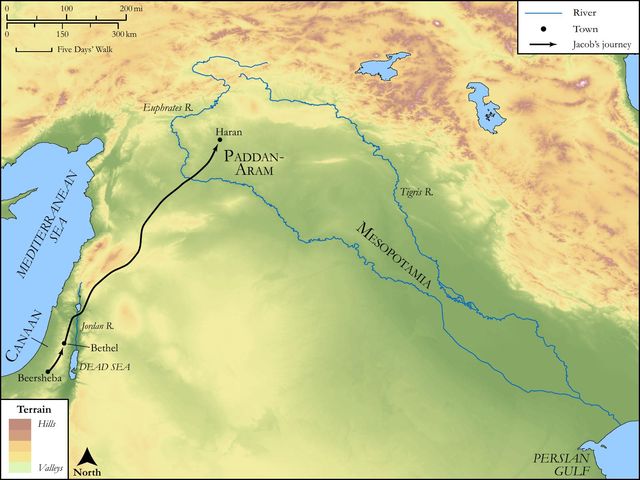
See on the biblical-era map


Study this verse
Public-domain commentary
Matthew Henry
From his Commentary on the Whole Bible. Henry comments on passages, not single verses — this entry covers Genesis 24:10–28. His four-level outline is real structure in the source text, so it is rendered as structure.
Abraham's servant now begins to make a figure in this story; and, though he is not named, yet much is here recorded to his honour, and for an example to all servants, who shall be honoured if, by faithfully serving God and their masters, they adorn the doctrine of Christ (compare Pro 27:18 with Tit 2:10); for there is no respect of persons with God, Col 3:24, Col 3:25. A good servant that makes conscience of the duty of his place, and does it in the fear of God, though he make not a figure in the world nor have praise of men, yet shall be owned and accepted of God and have praise of him. Observe here,
I.How faithful Abraham's servant approved himself to his master.
Having received his charge, he with all expedition set out on his journey, with an equipage suitable to the object of his negotiation (Gen 24:10), and he had all the goods of his master, that is, a schedule or particular account of them, in his hand, to show to those with whom he was to treat; for, from first to last, he consulted his master's honour. Isaac being a type of Christ, some make this fetching of a wife for him to signify the espousing of the church by the agency of his servants the ministers. The church is the bride, the Lamb's wife, Rev 21:9. Christ is the bridegroom, and ministers are the friends of the bridegroom (Joh 3:29), whose work it is to persuade souls to consent to him, Co2 11:2. The spouse of Christ must not be of the Canaanites, but of his own kindred, born again from above. Ministers, like Abraham's servant, must lay out themselves with the utmost wisdom and care to serve their master's interest herein.
II.How devoutly he acknowledged God in this affair, like one of that happy household which Abraham had commanded to keep the way of the Lord, etc., Gen 18:19. He arrived early in the evening (after many days' journeying) at the place of his destination, and reposed himself by a well of water, to consider how he might manage his business for the best. And,
1.He acknowledges God by a particular prayer (Gen 24:12-14), wherein,
(1.)He petitions for prosperity and good success in this affair: Send me good speed, this day. Note, We have leave to be particular in recommending our affairs to the conduct and care of the divine Providence. Those that would have good speed must pray for it. This day, in this affair; thus we must, in all our ways, acknowledge God, Pro 3:6. And, if we thus look up to God in every undertaking which we are in care about, we shall have the comfort of having done our duty, whatever the issue be.
(2.)He pleads God's covenant with his master Abraham: O God of my master Abraham, show kindness to him. Note, As the children of good parents, so the servants of good masters, have peculiar encouragement in the prayers they offer to God for prosperity and success.
(3.)He proposes a sign (Gen 24:14), not by it to limit God, nor with a design to proceed no further if he were not gratified in it; but it is a prayer,
[1.]That God would provide a good wife for his young master, and this was a good prayer. He knew that a prudent wife is from the Lord (Pro 19:14), and therefore that for this he will be enquired of. He desires that his master's wife might be humble and industrious woman, bred up to care and labour, and willing to put her hand to any work that was to be done; and that she might be of a courteous disposition, and charitable to strangers. When he came to seek a wife for his master, he did not go to the playhouse or the park, and pray that he might meet one there, but to the well of water, expecting to find one there well employed.
[2.]That he would please to make his way, in this matter, plain and clear before him, by the concurrence of minute circumstances in his favour. Note, First, It is the comfort, as well as the belief, of a good man, that God's providence extends itself to the smallest occurrences and admirably serves its own purposes by them. Our times are in God's hand; not only events themselves, but the times of them. Secondly, It is our wisdom, in all our affairs, to follow Providence, and folly to force it. Thirdly, It is very desirable, and that which we may lawfully pray for, while in the general we set God's will before us as our rule, that he will, by hints of providence, direct us in the way of our duty, and give us indications what his mind it. Thus he guides his people with his eye (Psa 32:8), and leads them in a plain path, Psa 27:11.
2.God owns him by a particular providence. He decreed the thing, and it was established to him, Job 22:28. According to his faith, so was it unto him. The answer to this prayer was,
(1.)Speedy - before he had made an end of speaking (Gen 24:15), as it is written (Isa 65:24), While they are yet speaking, I will hear. Though we are backward to pray, God is forward to hear prayer.
(2.)Satisfactory: the first that came to draw water was, and did, in every thing, according to his own heart.
[1.]She was so well qualified that in all respects she answered the characters he wished for in the woman that was to be his master's wife, handsome and healthful, humble and industrious, very courteous and obliging to a stranger, and having all the marks of a good disposition. When she came to the well (Gen 24:16), she went down and filled her pitcher, and came up to go home with it. She did not stand to gaze upon the strange man and his camels, but minded her business, and would not have been diverted from it but by an opportunity of doing good. She did not curiously nor confidently enter into discourse with him, but modestly answered him, with all the decorum that became her sex. What a degenerate age do we live in, in which appear all the instances of pride, luxury, and laziness, the reverse of Rebekah's character, whose daughters few are! Those instances of goodness which were then in honour are now in contempt.
[2.]Providence so ordered it that she did that which exactly answered to his sign, and was wonderfully the counterpart of his proposal: she not only gave him drink, but, which was more than could have been expected, she offered her services to give his camels drink, which was the very sign he proposed. Note, First, God, in his providence, does sometimes wonderfully own the prayer of faith, and gratify the innocent desires of his praying people, even in little things, that he may show the extent of his care, and may encourage them at all times to seek to him and trust in him; yet we must take heed of being over-bold in prescribing to God, lest the event should weaken our faith rather than strengthen it. Secondly, It is good to take all opportunities of showing a humble, courteous, charitable, disposition, because, some time or other, it may turn more to our honour and benefit than we think of; some hereby have entertained angels, and Rebekah hereby, quite beyond her expectation at this time, was brought into the line of Christ and the covenant. Thirdly, There may be a great deal of obliging kindness in that which costs but little: our Saviour has promised a reward for a cup of cold water, Mat 10:42. Fourthly, The concurrence of providences and their minute circumstances, for the furtherance of our success in any business, ought to be particularly observed, with wonder and thankfulness, to the glory of God: The man wondered, Gen 24:21. We have been wanting to ourselves, both in duty and in comfort, by neglecting to observe Providence.
[3.]Upon enquiry he found, to his great satisfaction, that she was a near relation to his master, and that the family she was of was considerable, and able to give him entertainment, Gen 24:23-25. Note, Providence sometimes wonderfully directs those that by faith and prayer seek direction from heaven in the choice of suitable yoke-fellows: happy marriages those are likely to be that are made in the fear of God; and these, we are sure, are made in heaven.
3.He acknowledges God in a particular thanksgiving. He first paid his respects to Rebekah, in gratitude for her civility (Gen 24:22), obliging her with such ornaments and attire as a maid, especially a bride, cannot forget (Jer 2:32), which yet, we should think, ill suited the pitcher of water; but the ear-rings and bracelets she sometimes wore did not make her think herself above the labours of a virtuous woman (Pro 31:13), who works willingly with her hands; nor the services of a child, who, while under age, differs nothing from a servant, Gal 4:1. Having done this, he turns his wonder (Gen 24:21) into worshipping: Blessed be the Lord God of my master Abraham, Gen 24:26, Gen 24:27. Observe here,
(1.)He had prayed for good speed (Gen 24:12), and now that he had sped well he gives thanks. Note, What we win by prayer we must wear with praise; for mercies in answer to prayer lay us under particular obligations.
(2.)He had as yet but a comfortable prospect of mercy, and was not certain what the issue might prove; yet he gives thanks. Note, When God's favours are coming towards us we must meet them with our praises.
(3.)He blesses God for success when he was negotiating for his master. Note, We should be thankful for our friend's mercies as for our own.
(4.)He gives thanks that, being in the way, at a loss what course to steer, the Lord had led him. Note, In doubtful cases, it is very comfortable to see God leading us, as he led Israel in the wilderness by the pillar of cloud and fire.
(5.)He thinks himself very happy, and owns God in it, that he was led to the house of his master's brethren, those of them that had come out of Ur of the Chaldees, though they had not come to Canaan, but remained in Haran. They were not idolaters, but worshippers of the true God, and inclinable to the religion of Abraham's family. Note, God is to be acknowledged in providing suitable yoke-fellows, especially such as are agreeable in religion.
(6.)He acknowledges that God, herein, had not left his master destitute of his mercy and truth. God had promised to build up Abraham's family, yet it seemed destitute of the benefit of that promise; but now Providence is working towards the accomplishing of it. Note,
[1.]God's faithful ones, how destitute soever they may be of worldly comforts, shall never be left destitute of God's mercy and truth; for God's mercy is an inexhaustible fountain, and his truth an inviolable foundation.
[2.]It adds much to the comfort of any blessing to see in it the continuance of God's mercy and truth.
Historical interpretation
Three Centuries of Reception
2 surviving comments on this verse. Each one is dated, so this reads as a timeline rather than a list.
Select a marker to jump to its quote. Markers stagger vertically where authors wrote within a few decades of each other.
Here, then, a woman proclaims Christ to the Samaritans, and at the end of the Gospels also the woman who saw him before all the others tells the apostles of the resurrection of the Savior.
Now, dearly beloved, let us briefly see, as far as we can, what these facts mean. When blessed Abraham directed his servant to take a wife for his son, he portrayed an image of God the Father. Just as when he offered the boy as a holocaust, he then presented an image of God the Father, so also his servant signified the words of prophecy. For this reason Abraham sent his servant into a distant land to take a wife for his son, because God the Father intended to send his prophetic word throughout the world to search for the Catholic church as a spouse for his only-begotten Son.
Continue studying Genesis 24:14 across the web’s major study libraries — every link below opens this exact verse, chapter, or book on the destination site.
Read & Compare
 BibleGatewayThis verse in more than 200 translations and 70 languages.
 Bible.comThe YouVersion reader — hundreds of translations, reading plans, and highlights.
 ESV.orgCrossway's official English Standard Version reader.
 NET BibleThe NET translation with 60,000+ translators' notes on every rendering decision.
 STEP BibleTyndale House's free study tool — original text, vocabulary, and scholarly resources.
 BibliaLogos Bible Software's free web reader.
 USCCBThe New American Bible (Revised Edition) with the U.S. bishops' study notes.
Commentaries
 BibleHub CommentariesDozens of classic commentaries on this verse, gathered on one page.
 StudyLightMore than 100 commentary sets — the largest collection on the web.
 BibleRefPlain-English commentary on what this verse means, verse by verse.
 Enduring WordDavid Guzik's free commentary on this chapter, widely used by Bible teachers.
 Bible Study ToolsVerse commentary alongside Greek and Hebrew study aids.
Original Language & Research
- BibleHub InterlinearThe verse word by word — original language, transliteration, and English.
- BibleHub LexiconEvery word's original-language definition and Strong's entry.
 Blue Letter BibleDeep-study tools — Strong's numbers, concordance, and word studies.
 SefariaThe Hebrew text with Rashi and centuries of Jewish commentary.
Sermons, Hymns & Audio


TrulyRandomVerse is not affiliated with these sites and doesn’t control their content. They’re linked because they’re genuinely useful.
Summary
Genesis 24:14 records the precise and audacious prayer of Abraham's chief servant, dispatched to Mesopotamia to secure a wife for Isaac. Facing the daunting task of identifying God's chosen bride, he petitions for a specific, unmistakable divine sign: the woman divinely appointed for Isaac will not only offer him water but will also proactively and generously offer to water his ten thirsty camels, thereby unequivocally confirming God's steadfast kindness and faithful guidance to Abraham and his household.
Context
ShowHideLiterary Context
Genesis 24 unfolds as a pivotal narrative within the Abrahamic covenant, focusing on the continuation of the promised lineage through Isaac. Abraham, now old and well-advanced in years, takes proactive steps to ensure Isaac's marriage aligns with God's will, specifically forbidding a Canaanite wife and instead sending his trusted servant to his homeland in Mesopotamia. The servant's journey and his prayer at the well are strategically placed after Abraham's solemn oath (Genesis 24:2-4) and before the miraculous fulfillment of his petition, highlighting divine providence in the most personal of life decisions. This verse immediately follows the servant's arrival at the well outside the city of Nahor and his turning to God in prayer, recognizing the immense challenge of his mission and his need for supernatural guidance.
Historical & Cultural Context
In the ancient Near East, wells were vital communal gathering places, especially for women who would draw water for their households. This made them natural settings for social interaction and, as seen here, for significant encounters. Hospitality was a paramount cultural virtue, with offering water to a weary traveler being a customary act of politeness. However, the servant's request went far beyond this norm. Watering ten camels, which can collectively drink hundreds of gallons after a long journey (a single camel can drink up to 25 gallons in minutes), represented an extraordinary, laborious, and proactive act of selfless service. Such an undertaking would reveal a woman of exceptional generosity, diligence, and compassionate character, far exceeding mere social courtesy.
Key Themes
ShowHideThis verse powerfully contributes to several overarching themes in Genesis and the broader biblical narrative. Foremost is Divine Providence, showcasing God's meticulous involvement in the details of human lives to fulfill His overarching plan, particularly in securing the covenant line through Isaac (Genesis 12:1-3). It also underscores the Power and Specificity of Prayer, demonstrating that God responds to earnest, faith-filled petitions, even those seeking specific signs, when they align with His purposes. The servant's request for an act of extraordinary generosity highlights the biblical emphasis on Character and Hospitality as vital virtues, reflecting an inner disposition of selfless love (Romans 12:13). Finally, the servant's desire to know that God "shewed kindness" (H2617, chesed) emphasizes God's Covenant Faithfulness—His unwavering, steadfast love and loyalty to His promises and His people.
Exposition and Analysis
ShowHideKey Word Analysis
ShowHideThis term refers to a young woman, typically from infancy to adolescence, or a maiden. Its use here indicates the servant was looking for a woman of marriageable age, highlighting the youth and potential for a long life within Abraham's lineage. It emphasizes the specific demographic of the woman he sought, not just any individual, but a young, unmarried woman suitable for Isaac.
This root means "to be right," "to argue," or "to decide," and causatively, "to justify or convict." In this context, it carries the sense of being "designated," "determined," or "decided upon" by God. The servant's prayer is not a test of chance, but a request for confirmation of God's pre-ordained choice. It underscores his conviction that Isaac's future wife was already divinely chosen and that God would provide a clear sign to identify her, thereby justifying or confirming His selection.
This rich theological term signifies more than general kindness. It denotes covenant loyalty, steadfast love, mercy, and active benevolence. The servant's concluding statement, "thereby shall I know that thou hast shewed kindness unto my master," reveals his understanding that the success of his mission, confirmed by this specific sign, would be a tangible demonstration of God's unwavering faithfulness to Abraham and the covenant promises concerning his descendants. It is an appeal to God's enduring, loyal love.
Verse Breakdown
ShowHide"And let it come to pass, that the damsel to whom I shall say, Let down thy pitcher, I pray thee, that I may drink;"
This initial clause sets the stage for the servant's specific test. He envisions a scenario where he initiates the interaction, requesting a customary act of hospitality—a drink from the woman's water pitcher. This establishes the baseline of polite interaction, against which the subsequent extraordinary act will be measured.
"and she shall say, Drink, and I will give thy camels drink also:"
This is the crucial, defining element of the servant's requested sign. It moves beyond simple politeness to an act of exceptional, proactive, and laborious generosity. The woman's spontaneous offer to water the camels, without being asked, would demonstrate a heart of selfless service, diligence, and overflowing hospitality—qualities the servant believed would characterize God's chosen bride for Isaac.
"let the same be she that thou hast appointed for thy servant Isaac;"
This clause reveals the theological conviction underlying the servant's prayer. He is not merely seeking a suitable woman, but the woman whom God has already divinely designated or decided upon for Isaac. This highlights the servant's faith in God's sovereign hand in orchestrating the details of Isaac's life and the continuation of the covenant line.
"and thereby shall I know that thou hast shewed kindness unto my master."
The servant's ultimate goal is not just to find a wife for Isaac, but to receive clear confirmation of God's faithful love and covenant loyalty (chesed) to Abraham. The successful fulfillment of this specific sign would serve as undeniable proof of God's active involvement and unwavering commitment to His promises, reassuring Abraham and his household of divine favor.
Literary Devices
ShowHideThe passage masterfully employs Divine Intervention and Symbolism. The entire narrative of Genesis 24, and this verse in particular, showcases God's direct and meticulous involvement in the seemingly mundane details of human life to fulfill His grand purposes. The servant's prayer is an appeal for this divine intervention, and its immediate, perfect fulfillment underscores God's active hand. The act of offering water, particularly to the thirsty camels, is rich in Symbolism. Water itself symbolizes life, sustenance, and blessing. The laborious act of drawing water for ten camels symbolizes a selfless, generous, and diligent character—qualities essential for a matriarch in a covenant lineage. Furthermore, the servant's specific request functions as a Test or Divine Sign, a common literary motif in biblical narratives where a specific, verifiable event confirms divine will or presence. The remarkable specificity of the prayer, followed by its exact fulfillment, also demonstrates Narrative Precision, emphasizing the miraculous nature of the event and God's attentiveness to even the most detailed petitions.
Theological and Thematic Connections
ShowHideThis passage profoundly illustrates God's active and sovereign involvement in the specific details of human life, particularly in crucial decisions like marriage, demonstrating His meticulous guidance in fulfilling His divine purposes for His people and their lineage. It underscores that God's providence is not merely general oversight but extends to the intimate and personal aspects of our existence. The servant's prayer exemplifies a profound trust in God's ability and willingness to provide clear direction when sought in faith and aligned with His will. Moreover, the emphasis on God's "kindness" (chesed) highlights His unwavering covenant loyalty and steadfast love, actively demonstrated through His faithful provision and guidance.
Reflection and Application
ShowHideGenesis 24:14 offers timeless lessons for believers today, particularly regarding seeking God's guidance in significant life decisions. The servant's example encourages us to approach God with specific, faith-filled prayers, trusting that He is intimately involved in our lives and willing to provide clear direction when our desires align with His purposes. This passage challenges us to prioritize character over superficial qualities, recognizing that true virtue, exemplified by selfless generosity and diligent service, is a hallmark of a heart aligned with God's principles. It reminds us that God's faithfulness (chesed) is not merely a theological concept but a lived reality, actively demonstrated as He guides and provides for His people through life's complexities, ensuring His promises are fulfilled. We are called to cultivate a spirit of dependence on God, acknowledging His sovereignty in all our endeavors, much like the servant who understood that the success of his mission depended entirely on divine appointment.
Questions for Reflection
ShowHideFAQ
ShowHideWhy did the servant ask for such a specific sign?
ShowHideThe servant faced an enormous and critical task: finding a suitable wife for Isaac from a distant land, without any prior knowledge of the women there. He sought a specific, undeniable sign because he desired clear divine guidance, rather than relying on his own limited judgment or chance. The sign he requested—offering water to him and his ten thirsty camels—was a test of extraordinary generosity, diligence, and character, demonstrating a heart of selfless service that he believed would be a clear indicator of God's divinely appointed woman. This specificity reflected his profound faith in God's active involvement in human affairs, especially regarding the fulfillment of the covenant promises to Abraham.
Does this passage encourage believers to ask God for signs today?
ShowHideWhile God is certainly able to provide clear guidance and this passage demonstrates His willingness to answer specific, faith-filled prayers, it does not necessarily establish a universal principle for believers to always ask for specific, verifiable signs. The servant's situation was unique, involving the direct fulfillment of a crucial covenant promise that would shape the destiny of God's chosen people. Today, believers are primarily guided by the Holy Spirit through prayer, the diligent study of Scripture, wise counsel from godly individuals (Proverbs 11:14), and discerning circumstances. While God can and sometimes does confirm His will through extraordinary means, the primary mode of guidance for the New Testament believer is through His Word and the inner witness of the Spirit, fostering a walk of faith rather than a constant search for external validation.
What is the significance of the camels in the servant's request?
ShowHideThe camels were absolutely crucial to the specificity and difficulty of the sign. Ten camels, having just completed a long journey, would be extremely thirsty, capable of drinking hundreds of gallons of water. Volunteering to draw and provide such a large quantity of water for a stranger's animals was an act of immense labor, requiring significant physical effort and a proactive, selfless spirit, far exceeding customary hospitality. This served as a robust test of character, revealing a woman's willingness to go above and beyond what was expected, demonstrating a truly generous and diligent heart, rather than just polite compliance. It made the sign undeniable and indicative of profound inner virtue.
What does chesed mean in the context of this verse?
ShowHideChesed (חֶסֶד), translated as "kindness" in the KJV, is a profound and multifaceted Hebrew term that encompasses far more than simple kindness. In this context, it signifies God's covenant loyalty, steadfast love, unwavering faithfulness, and active benevolence. The servant was asking for God to demonstrate His faithful commitment to Abraham and His covenant promises—especially the promise of a lineage through Isaac—by clearly revealing the divinely appointed bride. It's an expression of God's enduring, unwavering faithfulness to His promises and His people, a love that is both loyal and actively expressed in their lives.
Christ-Centered Fulfillment
ShowHideThe meticulous divine providence seen in the search for a bride for Isaac, ensuring the continuation of the covenant line through whom the Messiah would come, profoundly prefigures Christ's perfect provision for His Church, His Bride. Just as the servant sought a woman demonstrating extraordinary chesed (steadfast love and generosity), Christ perfectly embodies God's ultimate chesed through His sacrificial love on the cross (Romans 5:8), offering the ultimate "living water" to all who believe (John 4:10-14). He is the divinely appointed Bridegroom (John 3:29), fulfilling all covenant promises and gathering His people, not by a specific sign at a well, but through His completed work of redemption. Through His death and resurrection, Christ establishes His eternal kingdom, preparing His Church as a pure and spotless Bride (Ephesians 5:25-27) for His glorious return, demonstrating God's ultimate and unwavering faithfulness to His redemptive plan.