


Exodus 2:19
Bible text: King James Version (1769 Blayney text) · Public domain
Bible text: Berean Standard Bible · Public domain
Bible text: American Standard Version (1901) · Public domain
Bible text: World English Bible, Messianic edition · Public domain
Bible text: Geneva Bible (1599) · Public domain
Bible text: Young's Literal Translation · Public domain
- וַתֹּאמַרְןָva·to·Mar·naand they saidH559Conj-w ¦ V-Qal-ConsecImperf-3fpVerb Qal Consecutive Imperfect 3rd Plural Feminineוַandתֹּאמַרְןָthey said
- אִישׁ'isha manH376N-msNoun Singular Masculine Absolute
- מִצְרִיmitz·RiEgyptianH4713N-msNoun Gentilic Singular Masculine Absolute
- הִצִּילָנוּhi·tzi·La·nuhe rescued usH5337V-Hiphil-Perf-3ms ¦ 1cpVerb Hiphil Perfect 3rd Singular Masculineהִצִּילָhe rescuedנוּus
- מִיַּדmi·Yadfrom [the] hand ofH3027Prep-m ¦ N-cscNoun Singular common gender Constructמִfromיַּד[the] hand of
- הָרֹעִיםha·ro·'Imthe shepherdsH7462Art ¦ V-Qal-Prtcpl-mpVerb Qal Participle Plural Masculine Absoluteהָtheרֹעִיםshepherds
- וְגַםve·gamand alsoH1571Conj-w ¦ AdvAdverbוְandגַםalso
- דָּלֹהda·Lohcarefully <to draw>H1802V-Qal-InfAbsVerb Qal Infinitive Absolute
- דָלָהda·Lahhe drewH1802V-Qal-Perf-3msVerb Qal Perfect 3rd Singular Masculine
- לָנוּLa·nufor <the> usPrep-l ¦ 1cpSuffix Personal 1st Plural common genderלָfor <the>נוּus
- וַיַּשְׁקְvai·Yashkand he wateredH8248Conj-w ¦ V-Hiphil-ConsecImperf-3msVerb Hiphil Consecutive Imperfect 3rd Singular Masculineוַandיַּשְׁקְhe watered
- אֶת'et<obj.>H853DirObjMParticle Object Indicator
- הַצֹּאןha·Tzonthe flockH6629Art ¦ N-csNoun Singular common gender Absoluteהַtheצֹּאןflock
English is a literal word-by-word gloss of the Hebrew, not the KJV's wording. Why?
This is the original text the KJV's translators worked from — each Hebrew word with its own literal English meaning in this verse, prepared by scholars at Tyndale House, Cambridge. The KJV translates whole sentences, not word by word, so its wording differs: one Hebrew word can become several English words, and the KJV may choose “the LORD” where the gloss reads “Yahweh”. Both are faithful — they answer different questions. For the KJV's own rendering, switch to the KJV text.
Details
See on the biblical-era maps

Study this verse
Public-domain commentary
Matthew Henry
From his Commentary on the Whole Bible. Henry comments on passages, not single verses — this entry covers Exodus 2:16–22. His four-level outline is real structure in the source text, so it is rendered as structure.
Moses here gains a settlement in Midian, just as his father Jacob had gained one in Syria, Gen 29:2, etc. And both these instances should encourage us to trust Providence, and to follow it. Events that seem inconsiderable, and purely accidental, afterwards appear to have been designed by the wisdom of God for very good purposes, and of great consequence to his people. A casual transient occurrence has sometimes occasioned the greatest and happiest turns of a man's life. Observe,
I.Concerning the seven daughters of Reuel the priest or prince of Midian.
1.They were humble, and very industrious, according as the employment of the country was: they drew water for their father's flock, Exo 2:16. If their father was a prince, it teaches us that even those who are honourably born, and are of quality and distinction in their country, should yet apply themselves to some useful business, and what their hand finds to do do it with all their might. Idleness can be no one's honour. If their father was a priest, it teaches us that ministers' children should, in a special manner, be examples of humility and industry.
2.They were modest, and would not ask this strange Egyptian to come home with them (though handsome and a great courtier), till their father sent for him. Modesty is the ornament of woman.
II.Concerning Moses.
He was taken for an Egyptian (Exo 2:19); and strangers must be content to be the subjects of mistake; but it is observable,
1.How ready he was to help Reuel's daughters to water their flocks. Though bred in learning and at court, yet he knew how to turn his hand to such an office as this when there was occasion; nor had he learned of the Egyptians to despise shepherds. Note, Those that have had a liberal education yet should not be strangers to servile work, because they know not what necessity Providence may put them in of working for themselves, or what opportunity Providence may give them of being serviceable to others. These young women, it seems, met with some opposition in their employment, more than they and their servants could conquer; the shepherds of some neighbouring prince, as some think, or some idle fellows that called themselves shepherds, drove away their flocks; but Moses, though melancholy and in distress, stood up and helped them, not only to get clear of the shepherds, but, when that was done, to water the flocks. This he did, not only in complaisance to the daughters of Reuel (though that also did very well become him), but because, wherever he was, as occasion offered itself,
(1.)He loved to be doing justice, and appearing in the defence of such as he saw injured, which every man ought to do as far as it is in the power of his hand to do it.
(2.)He loved to be doing good. Wherever the Providence of God casts us we should desire and endeavour to be useful; and, when we cannot do the good we would, we must be ready to do the good we can. And he that is faithful in a little shall be entrusted with more.
2.How well he was paid for his serviceableness. When the young women acquainted their father with the kindnesses they had received from this stranger, he sent to invite him to his house, and made much of him, Exo 2:20. Thus God will recompense the kindnesses which are at any time shown to his children; they shall in no wise lose their reward. Moses soon recommended himself to the esteem and good affection of this prince of Midian, who took him into his house, and, in process of time, married one of his daughters to him (Exo 2:21), by whom he had a son, whom he called Gershom, a stranger there (Exo 2:22), that if ever God should give him a home of his own he might keep in remembrance the land in which he had been a stranger. Now this settlement of Moses in Midian was designed by Providence,
(1.)To shelter him for the present. God will find hiding-places for his people in the day of their distress; nay, he will himself be to them a little sanctuary, and will secure them, either under heaven or in heaven. But,
(2.)It was also designed to prepare him for the great services he was further designed for. His manner of life in Midian, where he kept the flock of his father-in-law (having none of his own to keep), would be of use to him,
[1.]To inure him to hardship and poverty, that he might learn how to want as well as how to abound. Those whom God intends to exalt he first humbles.
[2.]To inure him to contemplation and devotion. Egypt accomplished him as a scholar, a gentleman, a statesman, a soldier, all which accomplishments would be afterwards of use to him; but yet he lacked one thing, in which the court of Egypt could not befriend him. He that was to do all by divine revelation must know, by a long experience, what it was to live a life of communion with God; and in this he would be greatly furthered by the solitude and retirement of a shepherd's life in Midian. By the former he was prepared to rule in Jeshurun, but by the latter he was prepared to converse with God in Mount Horeb, near which mount he had spent much of his time. Those that know what it is to be alone with God in holy exercises are acquainted with better delights than ever Moses tasted in the court of Pharaoh.
Continue studying Exodus 2:19 across the web’s major study libraries — every link below opens this exact verse, chapter, or book on the destination site.
Read & Compare
 BibleGatewayThis verse in more than 200 translations and 70 languages.
 Bible.comThe YouVersion reader — hundreds of translations, reading plans, and highlights.
 ESV.orgCrossway's official English Standard Version reader.
 NET BibleThe NET translation with 60,000+ translators' notes on every rendering decision.
 STEP BibleTyndale House's free study tool — original text, vocabulary, and scholarly resources.
 BibliaLogos Bible Software's free web reader.
 USCCBThe New American Bible (Revised Edition) with the U.S. bishops' study notes.
Commentaries
 BibleHub CommentariesDozens of classic commentaries on this verse, gathered on one page.
 StudyLightMore than 100 commentary sets — the largest collection on the web.
 BibleRefPlain-English commentary on what this verse means, verse by verse.
 Enduring WordDavid Guzik's free commentary on this chapter, widely used by Bible teachers.
 Bible Study ToolsVerse commentary alongside Greek and Hebrew study aids.
Original Language & Research
- BibleHub InterlinearThe verse word by word — original language, transliteration, and English.
- BibleHub LexiconEvery word's original-language definition and Strong's entry.
 Blue Letter BibleDeep-study tools — Strong's numbers, concordance, and word studies.
 SefariaThe Hebrew text with Rashi and centuries of Jewish commentary.
Sermons, Hymns & Audio


TrulyRandomVerse is not affiliated with these sites and doesn’t control their content. They’re linked because they’re genuinely useful.
Summary
Exodus 2:19 recounts the report of Reuel's daughters to their father, detailing how an "Egyptian" (Moses) intervened on their behalf at a well, rescuing them from aggressive shepherds and ensuring their flock was fully watered. This pivotal encounter leads to Moses' integration into their household in Midian, marking a crucial step in his preparation for future divine service.
Context
ShowHideLiterary Context
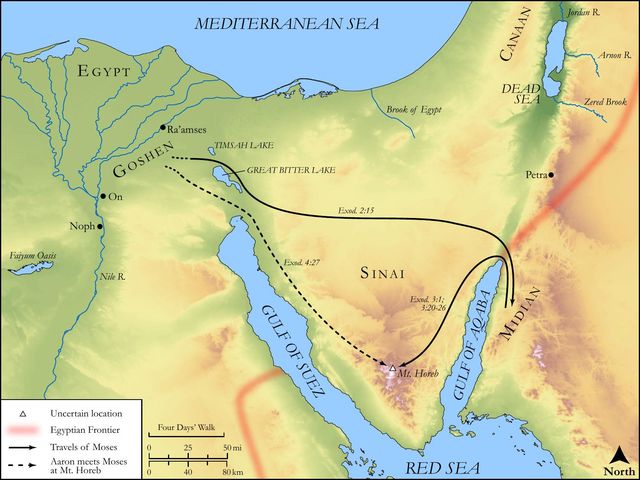
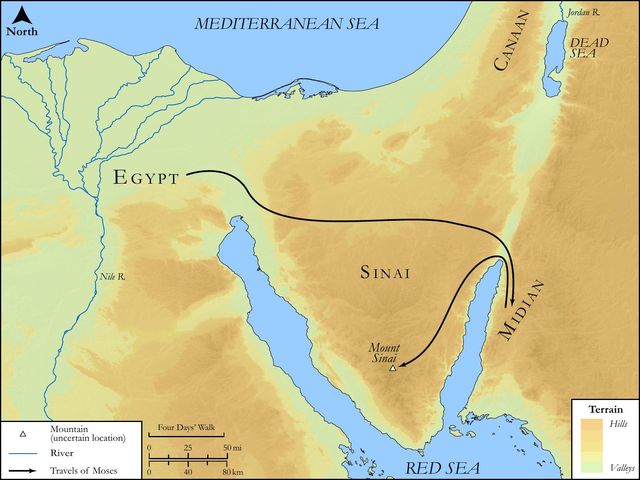
This verse is situated immediately after Moses' flight from Egypt, having killed an Egyptian taskmaster to defend an enslaved Hebrew (Exodus 2:11-15). He has arrived in the land of Midian, a desert region east of the Gulf of Aqaba. The narrative flow positions Moses, a fugitive, at a communal well, a vital gathering place in the land of Midian. Here, he encounters the seven daughters of Reuel (also known as Jethro), a priest of Midian, who are facing harassment from male shepherds. The daughters' report in Exodus 2:19 serves as the immediate catalyst for Reuel's invitation to Moses, leading to his integration into their family and household, a period of forty years that profoundly shapes his character and prepares him for his divine calling in Exodus 3.
Historical & Cultural Context
Wells in the lands of the patriarchs and of Midian were not merely sources of water; they were crucial social hubs, economic centers, and often sites of conflict over resources. Access to water for livestock was paramount for nomadic and semi-nomadic peoples like the Midianites. The aggressive behavior of the shepherds towards women at the well reflects a common patriarchal societal dynamic where the vulnerable could be exploited. Moses' intervention, therefore, was not just an act of kindness but a defense of the weak against the strong, demonstrating a strong sense of justice. His appearance, likely in Egyptian attire and mannerisms due to his upbringing in Pharaoh's court, would have immediately marked him as a foreigner, hence the daughters' identification of him as an "Egyptian."
Key Themes
ShowHideExodus 2:19 contributes to several overarching themes in the book of Exodus and the broader Pentateuch. It highlights Divine Providence, showing how God orchestrates seemingly random events—Moses' flight, his arrival at a specific well, his encounter with Reuel's daughters—to fulfill His larger redemptive plan. The verse also underscores the theme of Justice and Compassion, as Moses, even in exile, demonstrates an innate desire to defend the oppressed, foreshadowing his future role as a deliverer. Furthermore, it touches upon Preparation for Leadership, illustrating how God uses the circumstances of an individual's life, including periods of obscurity and cultural immersion, to shape them for a specific divine calling, much like Joseph's preparation in Genesis 39-41.
Exposition and Analysis
ShowHideThe daughters' concise report to their father, "An Egyptian delivered us out of the hand of the shepherds, and also drew [water] enough for us, and watered the flock," encapsulates Moses' decisive and compassionate intervention, revealing significant insights into his character and God's unfolding plan.
Key Word Analysis
ShowHideThis term, derived from "Mitsrayim" (Egypt), refers to an inhabitant of Egypt. The daughters' identification of Moses as an "Egyptian" is crucial. Despite his Hebrew ethnicity, Moses' upbringing in Pharaoh's palace meant he would have dressed, spoken, and carried himself in a manner consistent with Egyptian nobility, making him appear as such to the Midianite women. This highlights his unique dual identity, which would later be instrumental in his role as a mediator between Pharaoh and the Israelites.
A primitive root meaning "to snatch away," whether in a good or bad sense, encompassing actions like rescuing, preserving, or saving. Here, it emphasizes Moses' active and forceful intervention to free the daughters from the oppressive control ("out of the hand") of the aggressive shepherds. This verb choice underscores the protective, liberating nature of Moses' act, foreshadowing his greater role as the deliverer of Israel from Egyptian bondage.
This primitive root means "to dangle" or "to let down a bucket for drawing out water." The phrase "enough" (also derived from H1802 in this context) implies not just the act of drawing water, but drawing it sufficiently and completely for the entire flock. This detail emphasizes Moses' thoroughness and generosity, going beyond a mere token gesture to ensure the needs of the flock were fully met, reflecting a comprehensive and caring provision.
Verse Breakdown
ShowHide"And they said,"
This simple introductory phrase sets the scene for the daughters' explanation to their father, Reuel, immediately upon their unusually early return home. It signals the beginning of their account of the remarkable event at the well.
"An Egyptian delivered us out of the hand of the shepherds,"
This is the core of their report, identifying Moses by his apparent nationality and describing his heroic action. The phrase "out of the hand of the shepherds" signifies rescue from their oppressive power or control, implying that the shepherds were actively preventing the daughters from accessing the well or harassing them. Moses' intervention was a direct challenge to this injustice.
"and also drew [water] enough for us,"
This clause highlights Moses' practical assistance. After defending them, he actively participated in the arduous task of drawing water, ensuring they had ample supply. The inclusion of "enough" underscores that he completed the task thoroughly, providing fully for their needs.
"and watered the flock."
This final clause confirms the successful outcome of Moses' efforts. Not only were the daughters protected and water drawn, but their livestock, the very purpose of their visit to the well, were properly cared for, demonstrating Moses' comprehensive and compassionate provision.
Literary Devices
ShowHideThe narrative of Exodus 2:19 employs several literary devices. Foreshadowing is prominent, as Moses' spontaneous act of justice and deliverance for the vulnerable at the well directly anticipates his future, divinely appointed role as the deliverer of the entire Israelite nation from Egyptian oppression. His willingness to intercede for the lowly is a consistent character trait. There is also a subtle Irony in the daughters identifying Moses as an "Egyptian," given his true Hebrew identity and his ultimate mission to lead the Hebrews out of Egypt; the one who appears to be an oppressor's kin becomes the liberator. Furthermore, the Symbolism of the well as a place of both conflict and crucial encounter is significant. Wells often serve as settings for pivotal meetings and the establishment of new relationships in biblical narratives, and here it becomes the site where Moses' new life in Midian begins, leading to his marriage and forty years of preparation.
Theological and Thematic Connections
ShowHideExodus 2:19 powerfully illustrates God's sovereign hand in orchestrating seemingly mundane events to fulfill His grand redemptive purposes. Moses' spontaneous act of justice at the well is not a mere coincidence but a divinely guided step in his preparation for the monumental task of leading Israel out of bondage. This passage underscores that God often uses the inherent character and compassionate actions of His chosen servants, even in their obscurity or exile, to advance His kingdom. It also highlights the divine value placed on defending the vulnerable and ensuring justice, a theme that resonates throughout biblical history.
Reflection and Application
ShowHideExodus 2:19 serves as a profound reminder that God's plans often unfold through our seemingly ordinary acts of compassion and intervention. Moses, a fugitive, could have easily ignored the plight of Reuel's daughters, yet his innate sense of justice compelled him to act. This spontaneous defense of the vulnerable, without expectation of reward or recognition, exemplifies a timeless call to righteous living and service. We are encouraged to cultivate a character of attentiveness to the needs of others, recognizing that God often uses our willingness to act righteously, even in unexpected circumstances, to prepare us for broader purposes and to advance His kingdom work in the world. Just as Moses was being prepared for the monumental task of leading the Exodus from Egypt, so too can our daily choices and acts of kindness contribute to God's unfolding work, shaping us for His unique calling on our lives.
Questions for Reflection
ShowHideFAQ
ShowHideWhy did Jethro's daughters call Moses an "Egyptian"?
ShowHideAlthough Moses was ethnically Hebrew, his upbringing in Pharaoh's palace meant he would have dressed, spoken, and carried himself like an Egyptian, including his mannerisms and possibly his dialect. The Midianite women, unfamiliar with his true heritage, would have identified him by his outward appearance and cultural markers, leading them to perceive him as an Egyptian. This highlights his unique dual identity, which would later be crucial for his role as a mediator between Pharaoh and the Israelites in the Exodus narrative.
What is the significance of the well in this narrative?
ShowHideWells were vital centers of life in the lands of the patriarchs, serving as primary sources of water for people and livestock in arid regions. They were also crucial social gathering points, often sites of interaction, negotiation, and sometimes conflict over resources. In biblical narratives, wells frequently serve as settings for significant encounters, betrothals, and the establishment of new relationships (e.g., Jacob meeting Rachel at a well in Genesis 29). Moses' meeting with Jethro's daughters at the well is therefore a classic biblical motif, marking a pivotal turning point in his life and leading to his new family and home in Midian.
Who were the shepherds mentioned in the verse?
ShowHideThese were likely local male shepherds who, due to their greater strength or social standing, were attempting to monopolize the well's access, preventing Jethro's daughters from watering their flock. This was a common practice in patriarchal societies where women were often vulnerable to exploitation. Moses' immediate intervention demonstrates his commitment to justice and protection for the oppressed, even before his divine calling to deliver Israel from a far greater oppression in Exodus 3.
Christ-Centered Fulfillment
ShowHideWhile Exodus 2:19 details Moses' compassionate act, it subtly points to the ultimate Deliverer, Jesus Christ. Moses' spontaneous intervention to protect the vulnerable and provide water foreshadows Christ's divine compassion and His role as the Good Shepherd who not only protects His flock from spiritual adversaries but also provides the living water of salvation (John 4:10 and John 7:37-38). Just as Moses was prepared for his mission to lead Israel out of bondage, Christ, the greater Moses (as seen in Deuteronomy 18:15), came to deliver humanity from the ultimate bondage of sin and death (Romans 6:23). He demonstrates perfect justice, unwavering care for the lowly and oppressed (Matthew 11:28-30), and provides eternal spiritual nourishment, fulfilling the temporary physical provision Moses offered at the well.