


Exodus 2:20
Bible text: King James Version (1769 Blayney text) · Public domain
Bible text: Berean Standard Bible · Public domain
Bible text: American Standard Version (1901) · Public domain
Bible text: World English Bible, Messianic edition · Public domain
Bible text: Geneva Bible (1599) · Public domain
Bible text: Young's Literal Translation · Public domain
- וַיֹּאמֶרvai·Yo·merand he saidH559Conj-w ¦ V-Qal-ConsecImperf-3msVerb Qal Consecutive Imperfect 3rd Singular Masculineוַandיֹּאמֶרhe said
- אֶל'eltoH413PrepPreposition
- בְּנֹתָיוbe·no·Tavhis daughtersH1323N-fpc ¦ 3msNoun Plural Feminine Constructבְּנֹתָיdaughtersוhis
- וְאַיּוֹve·'ai·Yoand where [is]? heH335Conj-w ¦ Interrog ¦ 3msParticle Interrogativeוְandאַיּwhere [is]?וֹhe
- לָמָּהLa·mah<to> why?H4100Prep-l ¦ InterrogPronoun Interrogativeלָ<to>מָּהwhy?
- זֶּהzehthisH2088PrtParticle Demonstrative
- עֲזַבְתֶּן'a·zav·Tenhave you leftH5800V-Qal-Perf-2fpVerb Qal Perfect 2nd Plural Feminine
- אֶת'et<obj.>H853DirObjMParticle Object Indicator
- הָאִישׁha·'Ishthe manH376Art ¦ N-msNoun Singular Masculine Absoluteהָtheאִישׁman
- קִרְאֶןkir·'EninviteH7121V-Qal-Imp-2fpVerb Qal Imperative 2nd Plural Feminine
- לוֹlo<to> <the> himPrep-l ¦ 3msSuffix Personal 3rd Singular Masculineל<to> <the>וֹhim
- וְיֹאכַלve·Yo·khalso he may eatH398Conj-w ¦ V-Qal-ConjImperf-3msVerb Qal Conjunction+Imperfect 3rd Singular Masculineוְsoיֹאכַלhe may eat
- לָחֶםLa·chemfoodH3899N-msNoun Singular Masculine Absolute
English is a literal word-by-word gloss of the Hebrew, not the KJV's wording. Why?
This is the original text the KJV's translators worked from — each Hebrew word with its own literal English meaning in this verse, prepared by scholars at Tyndale House, Cambridge. The KJV translates whole sentences, not word by word, so its wording differs: one Hebrew word can become several English words, and the KJV may choose “the LORD” where the gloss reads “Yahweh”. Both are faithful — they answer different questions. For the KJV's own rendering, switch to the KJV text.
Details
See on the biblical-era maps

Study this verse
Public-domain commentary
Matthew Henry
From his Commentary on the Whole Bible. Henry comments on passages, not single verses — this entry covers Exodus 2:16–22. His four-level outline is real structure in the source text, so it is rendered as structure.
Moses here gains a settlement in Midian, just as his father Jacob had gained one in Syria, Gen 29:2, etc. And both these instances should encourage us to trust Providence, and to follow it. Events that seem inconsiderable, and purely accidental, afterwards appear to have been designed by the wisdom of God for very good purposes, and of great consequence to his people. A casual transient occurrence has sometimes occasioned the greatest and happiest turns of a man's life. Observe,
I.Concerning the seven daughters of Reuel the priest or prince of Midian.
1.They were humble, and very industrious, according as the employment of the country was: they drew water for their father's flock, Exo 2:16. If their father was a prince, it teaches us that even those who are honourably born, and are of quality and distinction in their country, should yet apply themselves to some useful business, and what their hand finds to do do it with all their might. Idleness can be no one's honour. If their father was a priest, it teaches us that ministers' children should, in a special manner, be examples of humility and industry.
2.They were modest, and would not ask this strange Egyptian to come home with them (though handsome and a great courtier), till their father sent for him. Modesty is the ornament of woman.
II.Concerning Moses.
He was taken for an Egyptian (Exo 2:19); and strangers must be content to be the subjects of mistake; but it is observable,
1.How ready he was to help Reuel's daughters to water their flocks. Though bred in learning and at court, yet he knew how to turn his hand to such an office as this when there was occasion; nor had he learned of the Egyptians to despise shepherds. Note, Those that have had a liberal education yet should not be strangers to servile work, because they know not what necessity Providence may put them in of working for themselves, or what opportunity Providence may give them of being serviceable to others. These young women, it seems, met with some opposition in their employment, more than they and their servants could conquer; the shepherds of some neighbouring prince, as some think, or some idle fellows that called themselves shepherds, drove away their flocks; but Moses, though melancholy and in distress, stood up and helped them, not only to get clear of the shepherds, but, when that was done, to water the flocks. This he did, not only in complaisance to the daughters of Reuel (though that also did very well become him), but because, wherever he was, as occasion offered itself,
(1.)He loved to be doing justice, and appearing in the defence of such as he saw injured, which every man ought to do as far as it is in the power of his hand to do it.
(2.)He loved to be doing good. Wherever the Providence of God casts us we should desire and endeavour to be useful; and, when we cannot do the good we would, we must be ready to do the good we can. And he that is faithful in a little shall be entrusted with more.
2.How well he was paid for his serviceableness. When the young women acquainted their father with the kindnesses they had received from this stranger, he sent to invite him to his house, and made much of him, Exo 2:20. Thus God will recompense the kindnesses which are at any time shown to his children; they shall in no wise lose their reward. Moses soon recommended himself to the esteem and good affection of this prince of Midian, who took him into his house, and, in process of time, married one of his daughters to him (Exo 2:21), by whom he had a son, whom he called Gershom, a stranger there (Exo 2:22), that if ever God should give him a home of his own he might keep in remembrance the land in which he had been a stranger. Now this settlement of Moses in Midian was designed by Providence,
(1.)To shelter him for the present. God will find hiding-places for his people in the day of their distress; nay, he will himself be to them a little sanctuary, and will secure them, either under heaven or in heaven. But,
(2.)It was also designed to prepare him for the great services he was further designed for. His manner of life in Midian, where he kept the flock of his father-in-law (having none of his own to keep), would be of use to him,
[1.]To inure him to hardship and poverty, that he might learn how to want as well as how to abound. Those whom God intends to exalt he first humbles.
[2.]To inure him to contemplation and devotion. Egypt accomplished him as a scholar, a gentleman, a statesman, a soldier, all which accomplishments would be afterwards of use to him; but yet he lacked one thing, in which the court of Egypt could not befriend him. He that was to do all by divine revelation must know, by a long experience, what it was to live a life of communion with God; and in this he would be greatly furthered by the solitude and retirement of a shepherd's life in Midian. By the former he was prepared to rule in Jeshurun, but by the latter he was prepared to converse with God in Mount Horeb, near which mount he had spent much of his time. Those that know what it is to be alone with God in holy exercises are acquainted with better delights than ever Moses tasted in the court of Pharaoh.
Continue studying Exodus 2:20 across the web’s major study libraries — every link below opens this exact verse, chapter, or book on the destination site.
Read & Compare
 BibleGatewayThis verse in more than 200 translations and 70 languages.
 Bible.comThe YouVersion reader — hundreds of translations, reading plans, and highlights.
 ESV.orgCrossway's official English Standard Version reader.
 NET BibleThe NET translation with 60,000+ translators' notes on every rendering decision.
 STEP BibleTyndale House's free study tool — original text, vocabulary, and scholarly resources.
 BibliaLogos Bible Software's free web reader.
 USCCBThe New American Bible (Revised Edition) with the U.S. bishops' study notes.
Commentaries
 BibleHub CommentariesDozens of classic commentaries on this verse, gathered on one page.
 StudyLightMore than 100 commentary sets — the largest collection on the web.
 BibleRefPlain-English commentary on what this verse means, verse by verse.
 Enduring WordDavid Guzik's free commentary on this chapter, widely used by Bible teachers.
 Bible Study ToolsVerse commentary alongside Greek and Hebrew study aids.
Original Language & Research
- BibleHub InterlinearThe verse word by word — original language, transliteration, and English.
- BibleHub LexiconEvery word's original-language definition and Strong's entry.
 Blue Letter BibleDeep-study tools — Strong's numbers, concordance, and word studies.
 SefariaThe Hebrew text with Rashi and centuries of Jewish commentary.
Sermons, Hymns & Audio


TrulyRandomVerse is not affiliated with these sites and doesn’t control their content. They’re linked because they’re genuinely useful.
Summary
Exodus 2:20 captures the pivotal moment when Reuel (also known as Jethro), the priest of Midian, questions his daughters about their swift return from the well and the absence of the man who aided them. His subsequent command to invite Moses for a meal underscores the profound cultural value of hospitality in the lands of the patriarchs and marks the divine provision of a safe haven for Moses, initiating a crucial forty-year period of preparation for his future leadership.
Context
ShowHideLiterary Context
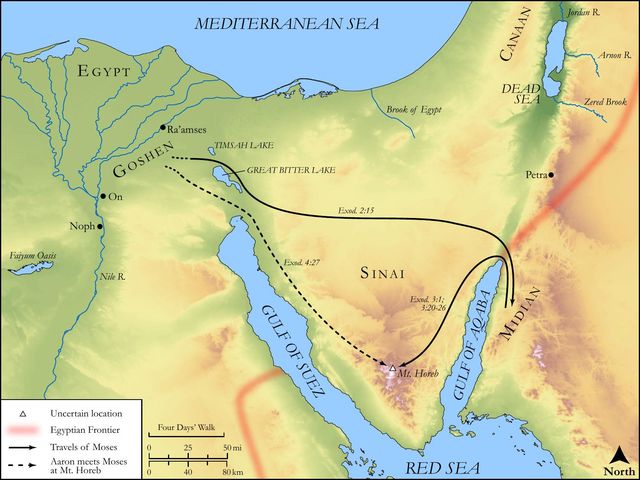
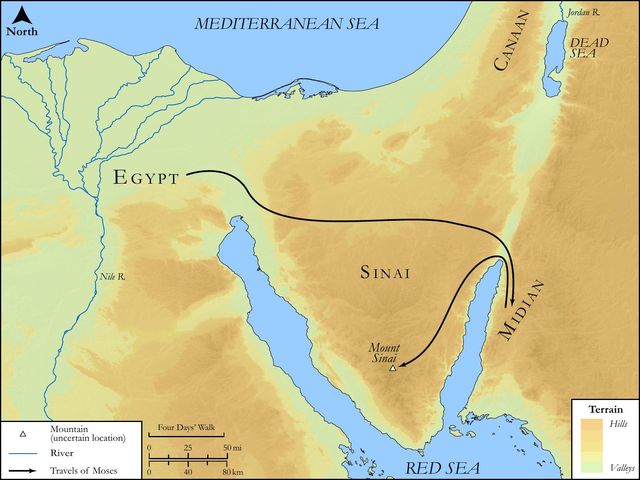
This verse immediately follows Moses' dramatic flight from Egypt after killing an Egyptian taskmaster who was oppressing a Hebrew slave, a deed that became known to Pharaoh (Exodus 2:15). Having fled to the land of Midian, Moses encounters Reuel's seven daughters at a well, where he heroically defends them against hostile shepherds and helps them water their flock (Exodus 2:17). Their unusually quick return home prompts Reuel's inquiry in verse 20, setting the stage for Moses to be welcomed into their household and begin a new chapter of his life in exile. This brief encounter is crucial, as it transitions Moses from a fugitive to a member of a new family, providing him with stability and a period of quiet preparation before his divine calling in Exodus 3.
Historical & Cultural Context
The households of the patriarchs placed immense value on hospitality, as Abraham's welcome at Mamre shows, particularly towards strangers and travelers. In arid regions like Midian, water was a precious commodity, and wells were vital communal gathering points. Offering food and shelter to a stranger was not merely an act of kindness but a sacred obligation, often establishing a temporary bond of protection and kinship. Reuel's immediate concern for the man who had helped his daughters, and his insistence on inviting him for "bread," reflects this deeply ingrained cultural norm. Such acts of hospitality were seen as reflective of one's character and piety, ensuring the well-being of the community and demonstrating respect for divine order.
Key Themes
ShowHideExodus 2:20 contributes significantly to several overarching themes in the book of Exodus. Firstly, it highlights Divine Providence, demonstrating how God orchestrates seemingly ordinary human interactions to protect and guide Moses, preparing him for his monumental task of leading Israel out of bondage. Moses' flight from Egypt and subsequent refuge in Midian, facilitated by Reuel's hospitality, is not accidental but part of God's sovereign plan. Secondly, the passage emphasizes the Importance of Hospitality and Kindness, portraying Reuel as a righteous figure who embodies a core biblical value. This act of welcoming a stranger foreshadows the broader theme of God's welcoming nature towards His people and the call for His people to extend similar grace. Lastly, it underscores the theme of Preparation for Leadership, as Moses' forty years in Midian, beginning with this invitation, are a crucial period of spiritual formation and practical experience that molds him into the shepherd-leader God intends him to be, as seen later when he encounters God at Horeb.
Exposition and Analysis
ShowHideKey Word Analysis
ShowHideA primitive root meaning "to say" or "to speak," used with great latitude. In this context, Reuel's "saying" is not merely an utterance but an authoritative inquiry and command, reflecting his patriarchal role and the expectation of accountability from his daughters. It conveys his immediate concern and decisive action.
A primitive root meaning "to loosen," "relinquish," or "forsake." Reuel's question, "why is it that ye have left the man?" implies a mild rebuke. It suggests that the daughters' departure without inviting Moses was a breach of customary hospitality, a "leaving behind" of someone who deserved recognition and welcome.
A primitive root meaning "to call out to," "address by name," or "invite." Reuel's command, "call him," is an imperative that demands immediate action. It signifies a formal invitation, an act of summoning someone into one's presence, particularly for the purpose of extending hospitality and fellowship.
Verse Breakdown
ShowHide"And he said unto his daughters,"
This phrase establishes Reuel's patriarchal authority and his role as the head of the household. His daughters' quick return prompts his immediate attention and inquiry, indicating his active engagement in their lives and his awareness of proper social conduct.
"And where [is] he? why [is] it [that] ye have left the man?"
Reuel's questions are rhetorical, expressing surprise and a gentle reproof. He is not merely asking for information but implicitly conveying that their actions were incomplete or improper. The phrase "left the man" highlights the omission of a crucial act of gratitude and hospitality towards the one who had helped them.
"call him, that he may eat bread."
This is Reuel's decisive command, correcting his daughters' oversight. "Call him" is an immediate summons. The phrase "that he may eat bread" is an idiom for sharing a meal, signifying a profound act of hospitality, an invitation to fellowship, and an offer of sustenance and protection. It transforms Moses from an anonymous helper into a welcomed guest, laying the groundwork for his integration into Reuel's family.
Literary Devices
ShowHideThe verse employs Dialogue to advance the narrative, revealing Reuel's character and cultural values through his direct interaction with his daughters. His questions function as a form of Rhetorical Questioning, implicitly conveying a gentle rebuke and guiding his daughters toward the proper course of action. The phrase "eat bread" is a powerful Metonymy or Synecdoche, where "bread" stands for an entire meal, and by extension, for the act of hospitality, fellowship, and the provision of sustenance and refuge. This simple phrase carries profound cultural and theological weight, signifying a bond of welcome and protection.
Theological and Thematic Connections
ShowHideExodus 2:20 is a profound illustration of God's meticulous providence, working through ordinary human kindness to fulfill His extraordinary purposes. Reuel's spontaneous act of hospitality towards Moses is not merely a cultural custom but a divinely orchestrated event that provides Moses with a safe haven, a family, and a crucial period of preparation for his future role as Israel's deliverer. This seemingly small act of welcome sets the stage for Moses' forty years in Midian, a time of quiet development and spiritual maturation essential for his encounter with God at the burning bush and his subsequent call to lead. It underscores that God often uses the generosity and moral responses of individuals to advance His redemptive plan, reminding us that our acts of compassion can have far-reaching, divinely appointed consequences.
Reflection and Application
ShowHideExodus 2:20 serves as a powerful reminder of the enduring biblical call to hospitality and the profound impact of simple acts of kindness. In a world often marked by suspicion and isolation, Reuel's immediate and unreserved welcome of a stranger stands as a compelling model for Christian living. It challenges us to look beyond initial appearances and extend grace, recognizing that every person we encounter is made in God's image and may be in need of compassion, provision, or simply a welcoming presence. Furthermore, this passage beautifully illustrates how God often works through human agency and ordinary circumstances to accomplish His divine will. Moses' journey to becoming a deliverer was not a straightforward path but involved periods of refuge and preparation, often facilitated by the benevolence of others. This encourages us to trust in God's timing and to be open to how He might use our own acts of generosity to further His purposes in the lives of others, even when the ultimate outcome is not immediately apparent.
Questions for Reflection
ShowHideFAQ
ShowHideWho was Reuel, and why is he also called Jethro?
ShowHideReuel was the priest of Midian and Moses' father-in-law. The Bible uses both names for him. "Reuel" (meaning "friend of God") is used here in Exodus 2:18 and in this verse. "Jethro" (meaning "his excellence" or "abundance") is more commonly used later in Exodus, particularly from Exodus 3:1 onwards. It is common in the Bible for individuals to have multiple names or titles, or for one to be a proper name and the other a title, with both referring to the same person.
Why was offering "bread" such a significant act of hospitality in ancient times?
ShowHideIn the lands of the patriarchs, particularly in desert environments like Midian, food and water were precious commodities, and travel was often perilous. Offering "bread" (which often signified a full meal, not just bread alone) to a stranger was a profound act of generosity, trust, and welcome. It meant sharing one's limited resources, providing nourishment, rest, and often implied an invitation to fellowship and protection under one's roof. This act established a temporary bond of kinship and security, demonstrating a deep cultural value placed on caring for the vulnerable and honoring those who perform good deeds.
Does this passage suggest that God's providence relies on human actions?
ShowHideYes, this passage beautifully illustrates the interplay between divine providence and human actions. While God's plan for Moses was sovereignly ordained, He chose to work through the hospitality of Reuel and the kindness of his daughters. God often uses the ordinary decisions and moral responses of individuals to accomplish His extraordinary purposes, demonstrating that our acts of obedience and compassion can be integral to His unfolding will. This does not diminish God's sovereignty but highlights His method of working through willing human agents.
Christ-Centered Fulfillment
ShowHideExodus 2:20, while a narrative of human hospitality, powerfully foreshadows Christ's ultimate provision and welcome. Just as Moses, a deliverer in exile, found refuge and sustenance through the kindness of Reuel, so too does humanity, exiled by sin, find ultimate refuge and spiritual nourishment in Christ. Jesus Himself declares, "I am the bread of life; whoever comes to me shall not hunger" (John 6:35), offering true and eternal sustenance to all who come to Him in faith. Furthermore, Christ embodies the ultimate act of divine hospitality, not merely inviting us to a meal but welcoming sinners into God's family through His atoning sacrifice. He prepares a place for us, inviting us into eternal fellowship with God (John 14:2-3). The church, as the body of Christ, is called to extend this same radical, Christ-like hospitality, reflecting the welcoming heart of God to a world in desperate need of spiritual refuge and provision.