


1 Timothy 5:10
- ἐνeninG1722PREPPreposition
- ἔργοιςergoisworksG2041N-DPNNoun Dative Plural Neuter
- καλοῖςkaloisgoodG2570A-DPNAdjective Dative Plural Neuter
- μαρτυρουμένηmarturoumenēbeing borne witness toG3140V-PPP-NSFVerb Present Passive Participle Nominative Singular Feminine
- εἰeiifG1487CONDConjunction
- ἐτεκνοτρόφησενeteknotrophēsenshe has brought up childrenG5044V-AAI-3SVerb Aorist Active Indicative 3rd Singular
- εἰeiifG1487CONDConjunction
- ἐξενοδόχησενexenodochēsenshe entertained strangersG3580V-AAI-3SVerb Aorist Active Indicative 3rd Singular
- εἰeiifG1487CONDConjunction
- ἁγίωνhagiōnsaints’G40A-GPMAdjective Genitive Plural Masculine
- πόδαςpodasfeetG4228N-APMNoun Accusative Plural Masculine
- ἔνιψενenipsenshe has washedG3538V-AAI-3SVerb Aorist Active Indicative 3rd Singular
- εἰeiifG1487CONDConjunction
- θλιβομένοιςthlibomenoisto those being oppressedG2346V-PPP-DPMVerb Present Passive Participle Dative Plural Masculine
- ἐπήρκεσενepērkesenshe has imparted reliefG1884V-AAI-3SVerb Aorist Active Indicative 3rd Singular
- εἰeiifG1487CONDConjunction
- παντὶpantito everyG3956A-DSNAdjective Dative Singular Neuter
- ἔργῳergōworkG2041N-DSNNoun Dative Singular Neuter
- ἀγαθῷagathōgoodG18A-DSNAdjective Dative Singular Neuter
- ἐπηκολούθησενepēkolouthēsenshe has followed afterG1872V-AAI-3SVerb Aorist Active Indicative 3rd Singular
English is a literal word-by-word gloss of the Greek, not the KJV's wording. Why?
This is the original text the KJV's translators worked from — each Greek word with its own literal English meaning in this verse, prepared by scholars at Tyndale House, Cambridge. The KJV translates whole sentences, not word by word, so its wording differs: one Greek word can become several English words, and the KJV may choose “charity” where the gloss reads “love”. Both are faithful — they answer different questions. For the KJV's own rendering, switch to the KJV text.
Details
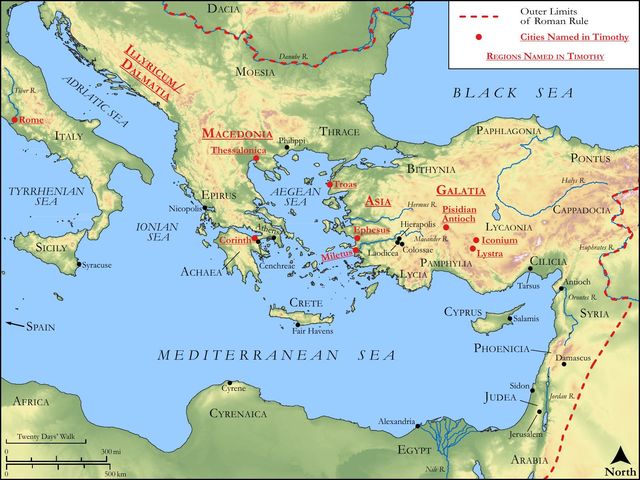
See on the biblical-era map

Study this verse
Public-domain commentary
Matthew Henry
From his Commentary on the Whole Bible. Henry comments on passages, not single verses — this entry covers 1 Timothy 5:3–16. His two-level outline is real structure in the source text, so it is rendered as structure.
Directions are here given concerning the taking of widows into the number of those who were employed by the church and had maintenance from the church: Honour widows that are widows indeed. Honour them, that is, maintain them, admit them into office. There was in those times an office in the church in which widows were employed, and that was to tend the sick and the aged, to look to them by the direction of the deacons. We read of the care taken of widows immediately upon the first forming of the Christian church (Act 6:1), where the Grecians thought their widows were neglected in the daily ministration and provision made for poor widows. The general rule is to honour widows that are widows indeed, to maintain them, to relieve them with respect and tenderness.
I.It is appointed that those widows only should be relieved by the charity of the church who were pious and devout, and not wanton widows that lived in pleasure, Ti1 5:5, Ti1 5:6. She is to be reckoned a widow indeed, and it to be maintained at the church's charge, who, being desolate, trusteth in God. Observe, It is the duty and comfort of those who are desolate to trust in God. Therefore God sometimes brings his people into such straits that they have nothing else to trust to, that they may with more confidence trust in him. Widowhood is a desolate estate; but let the widows trust in me (Jer 49:11), and rejoice that they have a God to trust to. Again, Those who trust in God must continue in prayer. If by faith we confide in God, by prayer we must give glory to God and commit ourselves to his guidance. Anna was a widow indeed, who departed not from the temple (Luk 2:37), but served God with fasting and prayer night and day. But she is not a widow indeed that lives in pleasure (Ti1 5:6), or who lives licentiously. A jovial widow is not a widow indeed, not fit to be taken under the care of the church. She that lives in pleasure is dead while she lives, is no living member of the church, but as a carcase in it, or a mortified member. We may apply it more generally; those who live in pleasure are dead while they live, spiritually dead, dead in trespasses and sins; they are in the world to no purpose, buried alive as to the great ends of living.
II.Another rule he gives is that the church should not be charged with the maintenance of those widows who had relations of their own that were able to maintain them. This is mentioned several times (Ti1 5:4): If any widow have children or nephews, that is grandchildren or near relations, let them maintain them, and let not the church be burdened. So Ti1 5:16. This is called showing piety at home (Ti1 5:4), or showing piety towards their own families. Observe, The respect of children to their parents, with their care of them, is fitly called piety. This is requiting their parents. Children can never sufficiently requite their parents for the care they have taken of them, and the pains they have taken with them; but they must endeavour to do it. It is the indispensable duty of children, if their parents be in necessity, and they in ability to relieve them, to do it to the utmost of their power, for this is good and acceptable before God. The Pharisees taught that a gift to the altar was more acceptable to God than relieving a poor parent, Mat 15:5. But here we are told that this is better than all burnt-offerings and sacrifices; this is good and acceptable, etc. He speaks of this again (Ti1 5:8), If any provide not for his own, etc. If any men or women do not maintain their own poor relations who belong to them, they do in effect deny the faith; for the design of Christ was to confirm the law of Moses, and particularly the law of the fifth commandment, which is, Honour thy father and mother; so that those deny the faith who disobey that law, much more if they provide not for their wives and children, who are parts of themselves; if they spend that upon their lusts which should maintain their families, they have denied the faith and are worse than infidels. One reason why this care must be taken that those who are rich should maintain their poor relations, and not burden the church with them is (Ti1 5:16) that it may relieve those who are widows indeed. Observe, Charity misplaced is a great hindrance to true charity; there should be prudence in the choice of the objects of charity, that it may not be thrown away upon those who are not properly so, that there may be the more for those who are real objects of charity.
III.He gives directions concerning the characters of the widows that were to be taken into the number to receive the church's charity:
not under sixty years old, nor any who have divorced their husbands or been divorced from them and have married again; she must have been the wife of one man, such as had been a housekeeper, had a good name for hospitality and charity, well reported of for good works. Observe, Particular care ought to be taken to relieve those, when they fall into decay, who, when they had wherewithal, were ready to every good work. Here are instances of such good works as are proper to be done by good wives: If she have brought up children: he does not say, If she have borne children (children are a heritage of the Lord), that depends on the will of God; but, if she had not children of her own, yet if she had brought up children. If she have lodged strangers, and washed the saints' feet; if she have been ready to give entertainment to good Christians and good ministers, when they were in their travels for the spreading of the gospel. Washing of the feet o their friends was a part of their entertainments. If she have relieved the afflicted when she had ability, let her be relieved now. Observe, Those who would find mercy when they are in distress must show mercy when they are in prosperity.
IV.He cautions them to take heed of admitting into the number those who are likely to be no credit to them (Ti1 5:11):
The younger widows refuse: they will be weary of their employments in the church, and of living by rule, as they must do; so they will marry, and cast off their first faith. You read of a first love (Rev 2:4), and here of a first faith, that is, the engagements they gave to the church to behave well, and as became the trust reposed in them: it does not appear that by their first faith is meant their vow not to marry, for the scripture is very silent on that head; besides the apostle here advises the younger widows to marry (Ti1 5:14), which he would not if hereby they must have broken their vows. Dr. Whitby well observes, "If this faith referred to a promise made to the church not to marry, it could not be called their first faith." Withal they learn to be idle, and not only idle, but tattlers, etc., Ti1 5:13. Observe, It is seldom that those who are idle are idle only, they learn to be tattlers and busy-bodies, and to make mischief among neighbours, and sow discord among brethren. Those who had not attained to such a gravity of mind as was fit for the deaconesses (or the widows who were taken among the church's poor), let them marry, bear children, etc., Ti1 5:14. Observe, If housekeepers do not mind their business, but are tattlers, they give occasion to the adversaries of Christianity to reproach the Christian name, which, it seems, there were some instances of, Ti1 5:15. We learn hence,
1.In the primitive church there was care taken of poor widows, and provision made for them; and the churches of Christ in these days should follow so good an example, as far as they are able.
2.In the distribution of the church's charity, or alms, great care is to be taken that those share in the public bounty who most want it and best deserve it. A widow was not to be taken into the primitive church that had relations who were able to maintain her, or who was not well reported of for good works, but lived in pleasure: But the younger widows refuse, for, when they have begun to wax wanton against Christ, they will marry.
3.The credit of religion, and the reputation of Christian churches, are very much concerned in the character and behaviour of those that are taken into any employment in the church, though of a lower nature (such as the business of deaconesses), or that receive alms of the church; if they do not behave well, but are tatlers and busy-bodies, they will give occasion to the adversary to speak reproachfully.
4.Christianity obliges its professors to relieve their indigent friends, particularly poor widows, that the church may not be charged with them, that it may relieve those that are widows indeed: rich people should be ashamed to burden the church with their poor relations, when it is with difficulty that those are supplied who have no children or nephews, that is, grand-children, who are in a capacity to relieve them.
Historical interpretation
Eight Centuries of Reception
7 surviving comments on this verse. Each one is dated, so this reads as a timeline rather than a list.
Select a marker to jump to its quote. Markers stagger vertically where authors wrote within a few decades of each other.
For who would suffer his wife, for the sake of visiting the brethren, to go round from street to street to other men's, and indeed to all the poorer, cottages? Who will willingly bear her being taken from his side by nocturnal convocations, if need so be? Who, finally, will without anxiety endure her absence all the night long at the paschal solemnities? Who will, without some suspicion of his own, dismiss her to attend that Lord's Supper which they defame? Who will suffer her to creep into prison to kiss a martyr's bonds? nay, truly, to meet any one of the brethren to exchange the kiss? to offer water for the saints' feet? to snatch (somewhat for them) from her food, from her cup? to yearn (after them)? to have (them) in her mind? If a pilgrim brother arrive, what hospitality for him in an alien home? If bounty is to be distributed to any, the granaries, the storehouses, are foreclosed.
It is possible, however, that even one who is a saint needs the washing of feet, since even the widow who is enrolled into ecclesiastical honor is examined, along with her other good works, also about this, “If she has washed the feet of saints.”... Consequently, the faithful are obliged to do this in whatever station of life they happen to be, whether bishops and presbyters, who seem to be in ecclesiastical prominence, or even those in other positions of honor in the world. This means that the master comes to wash the feet of the believing servant, and parents the feet of their son.
The title of true widow is not a title of calamity but of honor, even of the greatest honor.… "Heavens," cried a sophist teacher [of Chrysostom as a young man], "what women there are among the Christians." So great is the admiration and praise enjoyed by widowhood not only among ourselves but also among those who are outside the church. And being aware of all this, the blessed Paul said, "Let not a widow be enrolled under threescore years of age." And even after this great qualification of age he does not permit her to be ranked in this sacred society but mentions some additional requisites. She must be "well reported of for good works, if she has brought up children, if she has lodged strangers, if she has washed the saints' feet, if she has relieved the afflicted, if she has diligently followed every good work." Heavens! What testing and scrutiny! How much virtue does he demand from the widow, and how precisely does he define it! He would not have done this had he not intended to entrust to her a position of honor and dignity.
"Well reported of for good works, if she have brought up children." Truly, it is no unimportant work to bring up children; but bringing them up is not merely taking care of them; they must be brought up well; as he said before, "If they continue in faith, and charity, and holiness." Observe how constantly he sets kindnesses to our own relatives before those to strangers. First he says, "If she have brought up children," then, "If she have lodged strangers, if she have washed the Saints' feet, if she have relieved the afflicted, if she have diligently followed every good work." But what if she be poor? Not even in that case is she debarred from bringing up children, lodging strangers, relieving the afflicted. She is not more destitute than the widow who gave the two mites. Poor though she be, she has an house, she does not lodge in the open air. "If," he says, "she have washed the Saints' feet." This is not a costly work. "If she have diligently followed every good work." What precept does he give here? He exhorts them to contribute bodily service, for women are peculiarly fitted for such attendance, for making the bed of the sick, and composing them to rest.
Strange! what strictness does he require of widows; almost as much as of the Bishop himself. For he says, "If she have diligently followed every good work." This is as though he meant that, if she could not of herself perform it, she shared and cooperated in it. When he cuts off luxury, he would have her provident, a good economist, and at the same time continually persevering in prayer. Such was Anna. Such strictness does he require of widows. Greater even than of virgins, from whom he yet requires much strictness, and eminent virtue. For when he speaks of "that which is comely," and "that she may attend upon the Lord without distraction," he gives, in a manner, a summary of all virtue.
Observe, the hospitality here spoken of is not merely a friendly reception, but one given with zeal and alacrity, with readiness, and going about it as if one were receiving Christ Himself. The widows should perform these services themselves, not commit them to their handmaids. For Christ said, "If I your Master and Lord have washed your feet, ye ought also to wash one another's feet." And though a woman may be very rich, and of the highest rank, vain of her birth and noble family, there is not the same distance between her and others, as between God and the disciples. If thou receivest the stranger as Christ, be not ashamed, but rather glory: but if you receive him not as Christ, receive him not at all. "He that receiveth you," He said, "receiveth Me." If you do not so receive him, you have no reward.
Abraham was receiving men that passed as travelers, as he thought, and he did not leave to his servants to make the preparations for their entertainment, but took the greater part of the service upon himself, and commanded his wife to mix the flour, though he had three hundred and eighteen servants born in his house, of whom there must have been many maidservants; but he wished that himself and his wife should have the reward, not of the cost only, but of the service. Thus ought we ever to exercise hospitality by our own personal exertions, that we may be sanctified, and our hands be blessed. And if thou givest to the poor, disdain not thyself to give it, for it is not to the poor that it is given, but to Christ; and who is so wretched, as to disdain to stretch out his own hand to Christ?
This is hospitality, this is truly to do it for God's sake. But if you give orders with pride, though you bid him take the first place, it is not hospitality, it is not done for God's sake. The stranger requires much attendance, much encouragement, and with all this it is difficult for him not to feel abashed; for so delicate is his position, that whilst he receives the favor, he is ashamed. That shame we ought to remove by the most attentive service, and to show by words and actions, that we do not think we are conferring a favor, but receiving one, that we are obliging less than we are obliged. So much does good will multiply the kindness. For as he who considers himself a loser, and thinks that he is doing a favor, destroys all the merit of it; so he who looks upon himself as receiving a kindness, increases the reward. "For God loveth a cheerful giver." So that you are rather indebted to the poor man for receiving your kindness. For if there were no poor, the greater part of your sins would not be removed. They are the healers of your wounds, their hands are medicinal to you. The physician, extending his hand to apply a remedy, does not exercise the healing art more than the poor man, who stretches out his hand to receive your alms, and thus becomes a cure for your ills. You give your money, and with it your sins pass away. Such were the Priests of old, of whom it was said, "They eat up the sin of My people." Thus thou receivest more than thou givest, thou art benefited more than thou benefitest. Thou lendest to God, not to men. Thou increasest thy wealth, rather than diminishest it. But if thou dost not lessen it by giving, then it is indeed diminished!
"If she have received strangers, if she have washed the Saints' feet." But who are these? The distressed saints, not any saints whatever. For there may be saints, who are much waited on by every one. Do not visit these, who are in the enjoyment of plenty, but those who are in tribulation, who are unknown, or known to few. He who hath "done it unto the least of these," He saith, "hath done it unto Me."
In emphasizing hospitality and the care of the saints as important qualifications for the widow, Paul’s goal is not to focus on a certain quantity of virtuous activity but rather on a quality of mind.
Let a widow be counted as not less than sixty years old, the wife of one man, well attested for good works, if she has brought up children, if she has hosted strangers, if she has washed the feet of the saints, if she has comforted the afflicted, if she has devoted herself to every good work.
Here, Paul also considers age along with other factors, and previously he states the reason, saying that even if the age were sixty years old, without the other conditions being met, it should not be counted.
— [OECUMENIUS] They also say that Paul is referring to those designated for widowhood. [end of the excerpt by Oecumenius A f. 172v, B f. 207v; G J. 295v] —
— [OECUMENIUS] well attested for good works. Having said generally, "well attested for good works," Paul then proceeds to each particular thing. And he said that the care of children is above. What then, if he has no children? Let him do the rest. [end of the excerpt by Oecumenius] —
— [OECUMENIUS] He does not say "if she had children," but "if she has brought them up according to the will of God, if she has led them properly," for this is exceptional. One must understand that this is said concerning widows. [end of the excerpt by Oecumenius G f. 295v] —
if she has hosted strangers. Do you see that even here Paul places the benefits to one's own people before those to foreigners? For having said this first.
if she has brought up children. Thus it suggests, "She has hosted strangers."
if she has washed the feet of the saints. But he will say: I am very poor, and I do not have the means to be host or to assist the afflicted. Does he not say, "Can you not wash the feet of the saints?" Is the ability lacking to pursue good works? For Paul spoke of each of these according to what was available.
if she washed the feet of the saints; that is, if she performed the lowest services to the saints without shame. Thus, Clement in the seventh book of Hypotyposes.
if she has devoted herself to every good work, that is, she has shared, supplied. For although the ability to act may be lacking, the ability to provide is nevertheless present.
Continue studying 1 Timothy 5:10 across the web’s major study libraries — every link below opens this exact verse, chapter, or book on the destination site.
Read & Compare
 BibleGatewayThis verse in more than 200 translations and 70 languages.
 Bible.comThe YouVersion reader — hundreds of translations, reading plans, and highlights.
 ESV.orgCrossway's official English Standard Version reader.
 NET BibleThe NET translation with 60,000+ translators' notes on every rendering decision.
 STEP BibleTyndale House's free study tool — original text, vocabulary, and scholarly resources.
 BibliaLogos Bible Software's free web reader.
 USCCBThe New American Bible (Revised Edition) with the U.S. bishops' study notes.
Commentaries
 BibleHub CommentariesDozens of classic commentaries on this verse, gathered on one page.
 StudyLightMore than 100 commentary sets — the largest collection on the web.
 BibleRefPlain-English commentary on what this verse means, verse by verse.
 Enduring WordDavid Guzik's free commentary on this chapter, widely used by Bible teachers.
 Bible Study ToolsVerse commentary alongside Greek and Hebrew study aids.
Original Language & Research
- BibleHub InterlinearThe verse word by word — original language, transliteration, and English.
- BibleHub LexiconEvery word's original-language definition and Strong's entry.
 Blue Letter BibleDeep-study tools — Strong's numbers, concordance, and word studies.
 CNTR CollationThe earliest Greek manuscripts of this verse, collated letter by letter.
Sermons, Hymns & Audio


TrulyRandomVerse is not affiliated with these sites and doesn’t control their content. They’re linked because they’re genuinely useful.
Summary
First Timothy 5:10 outlines the specific qualifications for widows to be officially enrolled and supported by the early church, emphasizing that such support was reserved for those whose lives consistently demonstrated genuine faith through tangible acts of service and devotion. These criteria, following the age requirement of the preceding verse, highlight a reputation built on good works, faithful family nurturing, generous hospitality, humble service to fellow believers, compassionate care for the afflicted, and diligent pursuit of every good deed.
Context
ShowHideLiterary Context
This verse is part of a larger section in 1 Timothy 5 where Paul provides detailed instructions to Timothy regarding the proper conduct and organization of the church in Ephesus. Specifically, verses 3-16 address the care of widows. Paul distinguishes between truly destitute widows who warrant church support and younger widows who should remarry. Verse 9 sets the age requirement (sixty years old), and verse 10 then elaborates on the character and conduct expected of those who would be officially enrolled and receive aid. The subsequent verses continue to discuss the responsibilities of family members to care for their own and the dangers of idleness among younger widows. The criteria in 1 Timothy 5:10 are therefore not general exhortations but specific prerequisites for a particular role within the church's care for the needy system.
Historical & Cultural Context
In the Greco-Roman world, and particularly within Jewish tradition, widows were often a vulnerable demographic, lacking the social and economic protections typically afforded by a husband or male relatives. The early church, embodying the compassionate spirit of Christ, took on the responsibility of caring for its needy members, especially those without family support. This care was not merely charity but an organized system, reflecting the church's commitment to justice and practical love. The specific activities listed in 1 Timothy 5:10—raising children, hospitality, humble service, and aiding the afflicted—were highly esteemed virtues in both Jewish and early Christian communities, seen as concrete expressions of faith and devotion. Foot washing, for instance, was a common act of hospitality in a dusty climate, often performed by servants, and its mention here signifies a willingness to perform humble, self-sacrificial service.
Key Themes
ShowHideThe overarching theme in 1 Timothy is the proper conduct and order within the church, emphasizing sound doctrine and godly living. Within this, 1 Timothy 5:10 contributes to several key themes. Firstly, it highlights the importance of good works as an outward manifestation of genuine faith, reinforcing that Christian belief is not merely intellectual but active. Secondly, it underscores the value of practical compassion and service within the community, demonstrating the church's responsibility to care for its most vulnerable members. Thirdly, it emphasizes integrity and reputation, as the widow's life must be "well reported of," indicating that her past conduct serves as a testament to her character and worthiness of support. This aligns with Paul's broader emphasis on the importance of blameless conduct for church leaders and members alike, as seen in passages like 1 Timothy 3:2.
Exposition and Analysis
ShowHideKey Word Analysis
ShowHideThis word signifies "to be a witness" or "to testify," and in this context, it means "having testimony borne to her" or "having a good reputation." It implies that her commendable character and actions were widely known and affirmed by others, not merely self-proclaimed. It is a public acknowledgment of her consistent, godly conduct.
While there are multiple Greek words for "good," kalós specifically refers to that which is inherently beautiful, honorable, excellent, or morally upright. It suggests deeds that are intrinsically good in quality and appearance, reflecting a virtuous character, distinguishing it from agathós (G18), which denotes intrinsic goodness.
This compound word, meaning "to accompany" or "to follow after," implies a persistent, active, and consistent pursuit. It's not about occasional good deeds but a life marked by a continuous and earnest engagement in every good work, demonstrating a pattern of dedication and zeal.
Verse Breakdown
ShowHide"Well reported of for good works"
This opening phrase establishes the foundational requirement: the widow must have a public reputation for a life characterized by honorable and virtuous deeds. This isn't about isolated acts but a consistent pattern of behavior that has earned her widespread respect and affirmation within the community. Her life itself serves as a testimony to her faith.
"if she have brought up children"
This clause emphasizes her faithfulness within the family sphere. It speaks to her role as a nurturing parent, suggesting a history of responsible care, spiritual guidance, and diligent upbringing of her own household. This demonstrates her capacity for selfless devotion and responsibility.
"if she have lodged strangers"
This highlights the vital practice of hospitality, a cornerstone of early Christian community. It refers to providing shelter, food, and welcome to travelers, missionaries, or those in need, showcasing a generous and open heart that extends beyond one's immediate family.
"if she have washed the saints' feet"
This points to an act of humble, practical service. Foot washing was a common, yet menial, task performed for guests, often by servants. By performing such a task for "saints" (fellow believers), she demonstrates a willingness to stoop to the lowest forms of service out of love and humility, echoing the example of Christ.
"if she have relieved the afflicted"
This emphasizes compassion and active aid to those suffering from distress, sickness, poverty, or oppression. It signifies a heart sensitive to human suffering and a proactive willingness to provide practical assistance and support to those in need. The Greek implies "to come to the aid of" or "to succor."
"if she have diligently followed every good work"
This concluding clause serves as a summary and intensifier. It means that her life has been marked by a consistent, persistent, and zealous pursuit of all kinds of good deeds. It's not just about fulfilling specific duties but about a general disposition of actively seeking and performing every opportunity to do good, demonstrating a comprehensive commitment to a life of service.
Literary Devices
ShowHideThe verse employs Anaphora through the repeated use of "if she have" (Greek: ei G1487) at the beginning of each qualifying clause. This repetition creates a strong rhetorical emphasis on the cumulative nature of the requirements, underscoring that it is not one isolated act but a pattern of life that qualifies a widow for church support. The structure is also a form of Enumeration, systematically listing specific examples of "good works" to provide a concrete and comprehensive picture of the expected character. The acts themselves serve as Metonymy or Synecdoche, where specific actions (like washing feet or lodging strangers) stand for broader virtues like humility, hospitality, and selfless service. The entire verse functions as a Criterion List, setting clear, measurable standards for a specific ecclesiastical role.
Theological and Thematic Connections
ShowHideThe criteria for widows in 1 Timothy 5:10 underscore a profound theological truth: genuine faith is invariably demonstrated through a life of active love and service. While salvation is by grace through faith, not by works (Ephesians 2:8-9), good works are the natural and necessary outflow of a transformed heart, prepared by God for this very purpose (Ephesians 2:10). This verse illustrates that a life "well reported of for good works" is not about earning merit but about evidencing the Spirit's work within. It reflects God's character of compassion and service, calling His people to imitate Him in practical ways, especially towards the vulnerable. The church, as God's household, is called to embody this active love, recognizing and supporting those whose lives have consistently reflected these divine virtues.
Reflection and Application
ShowHideWhile the specific context of 1 Timothy 5:10 pertains to the church's official care for elderly widows, the principles it embodies are timeless and universally applicable to all believers. This verse challenges us to consider the tangible evidence of our faith. Is our life "well reported of for good works"? Do our actions demonstrate genuine love, humility, and compassion? It encourages us to actively seek opportunities to serve, whether by nurturing our families, extending hospitality to strangers, humbly serving those in our community, or relieving the burdens of the afflicted. Our good works are not a means to earn God's favor, but rather the natural, Spirit-empowered overflow of a heart transformed by His grace. They are the visible fruit of our faith, testifying to the reality of Christ within us and bringing glory to God. This passage calls us to a diligent, consistent pursuit of every good work, making our lives a living testament to the gospel.
Questions for Reflection
ShowHideFAQ
ShowHideWhat is the significance of "washing the saints' feet" in this context?
ShowHide"Washing the saints' feet" refers to a literal act of humble service and hospitality. In ancient times, people wore sandals, and their feet would become dusty and dirty from travel. Washing a guest's feet was a common act of hospitality, usually performed by a servant. For a widow to have performed this act for "saints" (fellow believers) indicates a spirit of profound humility, selflessness, and a willingness to perform even the lowliest tasks out of love and devotion. It echoes the example of Jesus, who washed His disciples' feet as a demonstration of servant leadership (John 13:1-17). Thus, it signifies a life characterized by practical, unassuming service to the body of Christ.
Christ-Centered Fulfillment
ShowHideWhile 1 Timothy 5:10 outlines qualifications for human service, its spirit finds ultimate fulfillment in the person and work of Jesus Christ. He is the one supremely "well reported of for good works," His entire life a testament to perfect obedience and selfless service, as attested by God the Father Himself (Matthew 3:17). Jesus perfectly "brought up children" in a spiritual sense, nurturing His disciples and teaching them the ways of God (John 17:6-19). He "lodged strangers" by welcoming all who came to Him, even outcasts and sinners, offering them spiritual refuge and belonging in the Kingdom of God (Luke 15:1-2). Most profoundly, Jesus "washed the saints' feet" not merely as a symbolic gesture but by humbling Himself to the point of death on a cross, becoming a servant to all to cleanse us from sin (Philippians 2:5-8). He "relieved the afflicted" by healing the sick, casting out demons, feeding the hungry, and ultimately bearing the afflictions of humanity on the cross to offer eternal relief and salvation (Isaiah 53:4-5). Indeed, Jesus "diligently followed every good work," fulfilling all righteousness and perfectly accomplishing the Father's will (John 4:34). Thus, the qualities Paul commends in widows are but faint reflections of the perfect life of service embodied by our Lord, Jesus Christ, through whom alone we are empowered to live lives of good works for God's glory (Colossians 1:10).